×

Ecuador🇪🇨 | best beachesBest 7 beaches in Ecuador

Ecuador’s beaches run along a Pacific coast of about 2,000 kilometers (1,250 miles), and each stretch plays by different rules. The north around Esmeraldas is Afro-Ecuadorian, humid and cheap, with palm-lined sand and few foreign visitors. Manabí brings surf towns, fishing villages and national park coves. The Santa Elena coast near Guayaquil is the busiest, with hostels, nightlife and weekend crowds from the city. Everything costs US dollars, buses are frequent, and independent backpacking here is easy and cheap. Pick your coast first, then chase the sunset, the swell or the whales.

By Johan Kruseman 🇳🇱 | Updated October 20, 2026
Explore the best attractions in Ecuador

Why go?What Makes Them Special

Ecuador pairs a tropical coast with a cold ocean current, and that combination shapes every beach decision. The Humboldt Current sweeps up from the south and cools the water and air along the southern shoreline, while warm equatorial water washes the north. One country delivers two distinct climates, and dry, scrubby cliffs in the south give way to wet, green palm coastline in the north.

The coast was shaped by fishing communities, not resort developers. Dugout-style boats still land catches on many beaches, ceviche stalls outnumber beach clubs, and most towns grew around markets and fishing piers. Ecuador’s use of the US dollar keeps pricing simple, and a dense web of buses and shared taxis links nearly every coastal town cheaply.

Know before you choose Ecuador for beaches: this is a country … read more 👉
Ecuador pairs a tropical coast with a cold ocean current, and that combination shapes every beach decision. The Humboldt Current sweeps up from the south and cools the water and air along the southern shoreline, while warm equatorial water washes the north. One country delivers two distinct climates, and dry, scrubby cliffs in the south give way to wet, green palm coastline in the north.

The coast was shaped by fishing communities, not resort developers. Dugout-style boats still land catches on many beaches, ceviche stalls outnumber beach clubs, and most towns grew around markets and fishing piers. Ecuador’s use of the US dollar keeps pricing simple, and a dense web of buses and shared taxis links nearly every coastal town cheaply.

Know before you choose Ecuador for beaches: this is a country of surf, wildlife and local culture more than of swimming-pool-clear lagoons. Water is often cloudy, strong rip currents are common, and lifeguard coverage is thin outside busy weekends. Many of the best beaches lie beside mangroves, fishing ports or working cliffs. Serious snorkeling and white sand are mostly found on the Galápagos, a separate and far pricier trip that needs flights and a park fee. For everything else, the mainland coast rewards travelers who like salty, lived-in places and a lot of seafood.
Why These Made the Cut
The list of best beaches in Ecuador is created based on beauty, vibe, water quality, activities, and surrounding scenery. If you feel a beach is missing in this list, please let us know.

When to go?Optimal Periods for Travel

Best months for sun and warm water: January to April is the best window on the coast, with air temperatures of 28 to 31°C (82 to 88°F), sea temperatures around 25 to 27°C (77 to 81°F) and long, hot days. The trade-off is rain. February and March bring the heaviest downpours, usually in short, intense afternoon bursts, and in the north around Esmeraldas it can feel sticky and wet almost year-round.
The dry season and the shoulder months: June to November is the cooler, drier half of the year, particularly in the south along Santa Elena and Manabí. Skies often turn gray with garúa, a fine coastal mist, air temperatures sit near 22 to 26°C (72 to 79°F) and the water drops to around 20 to 23°C (68 to 73°F). Rainfall is minimal, crowds thin out and rooms are cheaper. May and December are decent … read more 👉
Best months for sun and warm water: January to April is the best window on the coast, with air temperatures of 28 to 31°C (82 to 88°F), sea temperatures around 25 to 27°C (77 to 81°F) and long, hot days. The trade-off is rain. February and March bring the heaviest downpours, usually in short, intense afternoon bursts, and in the north around Esmeraldas it can feel sticky and wet almost year-round.
The dry season and the shoulder months: June to November is the cooler, drier half of the year, particularly in the south along Santa Elena and Manabí. Skies often turn gray with garúa, a fine coastal mist, air temperatures sit near 22 to 26°C (72 to 79°F) and the water drops to around 20 to 23°C (68 to 73°F). Rainfall is minimal, crowds thin out and rooms are cheaper. May and December are decent shoulder months with warming water and fewer visitors.
Peak periods and prices: Carnaval (February or March), Christmas to New Year and national long weekends send Ecuadorian families to the coast, particularly the Guayaquil-side beaches. Room rates can climb 30 to 100 percent, buses fill up, and booking ahead matters. Midweek in the low season, dorm beds can cost US$8 to 12 and private rooms US$20 to 35. Humpback whales pass the Manabí coast from roughly June to September, so the cooler months have their own draw.

beach hoppingOptimizing Your Multi-Stop Itinerary

How many days to allow: A trip linking several Ecuadorian beaches needs 7 to 14 days, because distances look short on the map but buses stop often. The mainland coast splits into a northern cluster (Esmeraldas province and northern Manabí) and a southern cluster (southern Manabí and Santa Elena), with Guayaquil and Quito acting as the two transport hubs.
Direction and transfers: Travel from north to south when you can: fly into Quito, take a 6 to 8 hour bus to the Esmeraldas or northern Manabí coast, then work down the coast toward Guayaquil for your flight home. Moving between the clusters takes roughly 6 to 8 hours by bus, and Guayaquil to the Santa Elena beaches takes 2 to 3 hours. Domestic flights between Quito and Guayaquil take about 45 minutes and save a full day on the way back.
Pacing … read more 👉
How many days to allow: A trip linking several Ecuadorian beaches needs 7 to 14 days, because distances look short on the map but buses stop often. The mainland coast splits into a northern cluster (Esmeraldas province and northern Manabí) and a southern cluster (southern Manabí and Santa Elena), with Guayaquil and Quito acting as the two transport hubs.
Direction and transfers: Travel from north to south when you can: fly into Quito, take a 6 to 8 hour bus to the Esmeraldas or northern Manabí coast, then work down the coast toward Guayaquil for your flight home. Moving between the clusters takes roughly 6 to 8 hours by bus, and Guayaquil to the Santa Elena beaches takes 2 to 3 hours. Domestic flights between Quito and Guayaquil take about 45 minutes and save a full day on the way back.
Pacing and common mistakes: Allow 2 to 4 days per stop, with a rest day built in after each long bus day. The usual error is packing in five or six places in a week, which leaves you living in terminals. Pick two or three bases and use day trips instead. Another mistake is joining both clusters on a short trip, so choose one cluster for under 8 days. A third is traveling on Friday evenings or Sunday afternoons around holidays, when buses are full and roads are slow. Leave early in the morning, because afternoon rain can slow the coastal roads.
Adding the Galápagos: The islands need their own 5 to 7 days and a separate budget, so treat them as a different trip.

The ListHighly Recommended beaches of Ecuador

1 Playa de los Frailes

Turquoise crescent, clifftop loop, La Tortuguita cove, park entrance stalls

Hike the cliff loop past dry forest and seabirds, then cool off in a calm bay and eat fried fish at the entrance.

ecuador-beach-playa-de-los-frailes
© Google | Karen Parraga

2 Montañita

Point break, Calle de los Cocteles, green headland, Olón walk

Catch a long peeling wave at dawn, climb the headland at sunset, then follow the pedestrian cocktail street into a late night.

3 Salinas

Chipipe bay, La Chocolatera, whale boats, evening malecón

Swim the calm shallows of Chipipe, ride out to the westernmost cliffs of mainland Ecuador, and finish with grilled corn along the seafront.

ecuador-beach-salinas
© Google |

4 Canoa

Beginner beach break, cliff paragliding, low-tide sand walks, weekend bonfires

Paddle out for a first lesson on mellow sandy-bottomed waves, then watch tandem paragliders lift off the cliffs before grilled fish and a beach bonfire.

5 Punta Carnero

Surf lessons, wide windswept strand, southern point, humpback season

Book a morning surf lesson on long steady waves, walk firm sand at dawn, and scan the offshore water for whale spouts from June to September.

6 Playa de las Palmas

Encebollado stalls, city promenade, marimba weekends, shore-break bodysurfing

Sit at a beachfront stall for tuna soup and shrimp ceviche, stroll the promenade, and join Sunday football games on the flat sand.

7 Isla Portete

Alonso de Illescas monument, 6 km white sand, coconut palms, Portete estuary, boats until 18:00

Cross by boat from the Portete dock, then walk six kilometers of pale sand under palms before exploring the quiet mangrove estuary behind.

Loading the map 🌍

Expert viewTips and Advice from Travelers

How many beaches to visit: Three to four beaches suit most backpackers, because each stop needs a couple of days to feel worth the journey and the buses between coastal towns eat time. That number lets you sample at least two different coasts, with enough hours left to surf, hike or just sit with a plate of ceviche. Going past five usually means paying more for transport than you get back in sand time.
Which kind to prioritize: Social travelers get the most from a surf-and-hostel town in the south. It costs the least per night, offers lessons, bars and easy company, and demands little planning, though nights can be loud and weekend crowds are heavy. Travelers wanting space and wildlife should pick a national park coast in Manabí, where a boat tour or whale watch costs more but delivers the … read more 👉
How many beaches to visit: Three to four beaches suit most backpackers, because each stop needs a couple of days to feel worth the journey and the buses between coastal towns eat time. That number lets you sample at least two different coasts, with enough hours left to surf, hike or just sit with a plate of ceviche. Going past five usually means paying more for transport than you get back in sand time.
Which kind to prioritize: Social travelers get the most from a surf-and-hostel town in the south. It costs the least per night, offers lessons, bars and easy company, and demands little planning, though nights can be loud and weekend crowds are heavy. Travelers wanting space and wildlife should pick a national park coast in Manabí, where a boat tour or whale watch costs more but delivers the most memorable day for the money. Those who want culture and almost no tourists should try the northern Afro-Ecuadorian beaches, which are slower and humid but cost the least in comfort-adjusted terms. Skip the glossy resort strips near Guayaquil unless you want weekend city crowds.
Budget: Plan on US$25 to 45 a day: a dorm bed at US$8 to 15, a set lunch (almuerzo) at US$3 to 5, dinner or seafood at US$6 to 12, and buses at roughly US$1 to 2 per hour of travel. Surf lessons run about US$20 to 35, board rental US$5 to 10 a day, whale-watching or island boat tours US$30 to 50, and park entry fees are usually a few dollars. Splurge on one boat day and skimp on beachfront rooms, since a room two streets back is often half the price and just as comfortable.
Safety and local etiquette: Rip currents kill more swimmers here than anything else, and lifeguards are scarce, so swim near others and read the flags. Leave valuables at your hostel, never leave bags unattended on the sand, and take a taxi after dark between towns rather than walking dark beaches. The equatorial sun burns fast even under garúa, so use reef-safe sunscreen. Look for tsunami evacuation signs and know the route inland. Cover up when walking through town, ask before photographing fishermen or their catch, and carry small bills, because many beach vendors cannot change US$20 notes. In the far north near the Colombian border, check current local advice before going.

✈️ The backpacker research shortcutEcuador Travel Guide

An offline-friendly backpacking guide with optimized travel routes, ranked highlights, transport advice, and the best areas to stay.
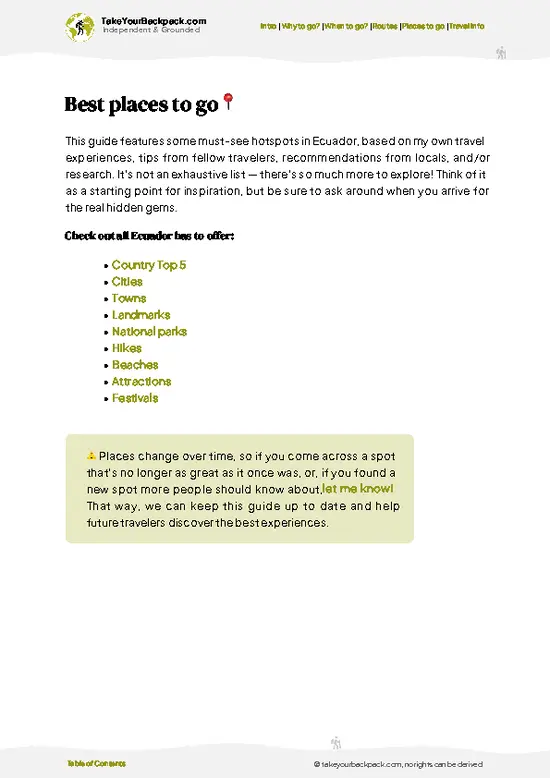
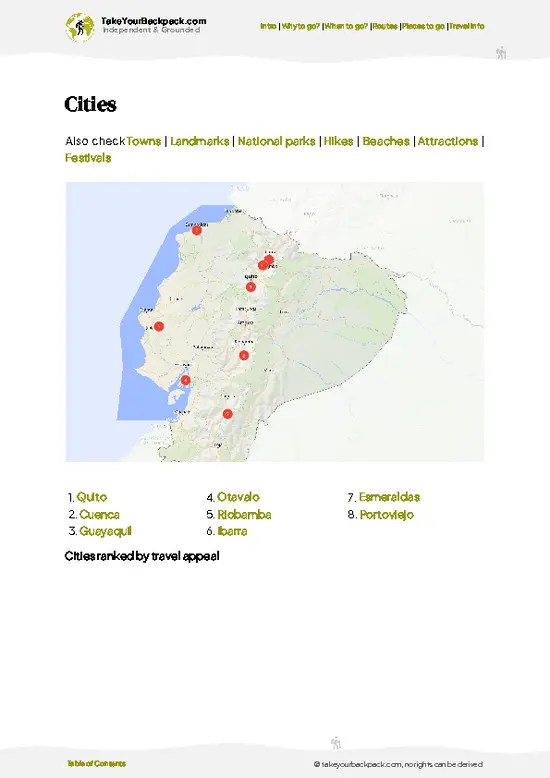
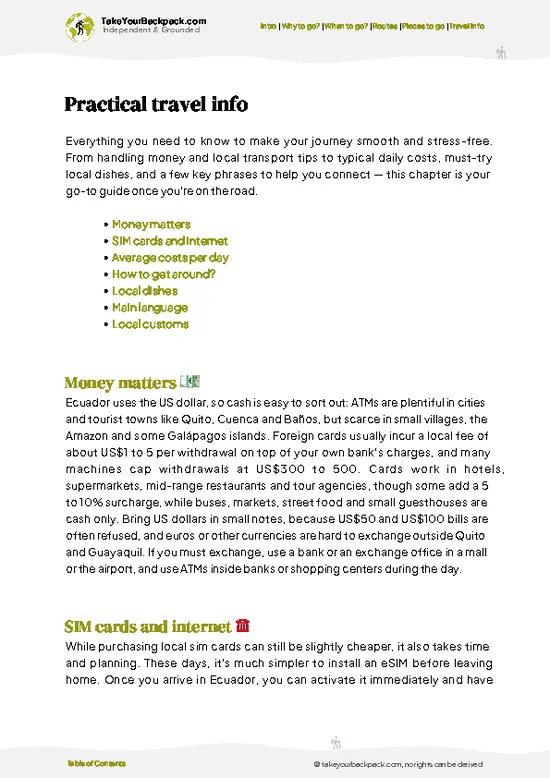
example page 0 from our offline Travel Guide for Ecuador
example page 1 from our offline Travel Guide for Ecuador
example page 2 from our offline Travel Guide for Ecuador
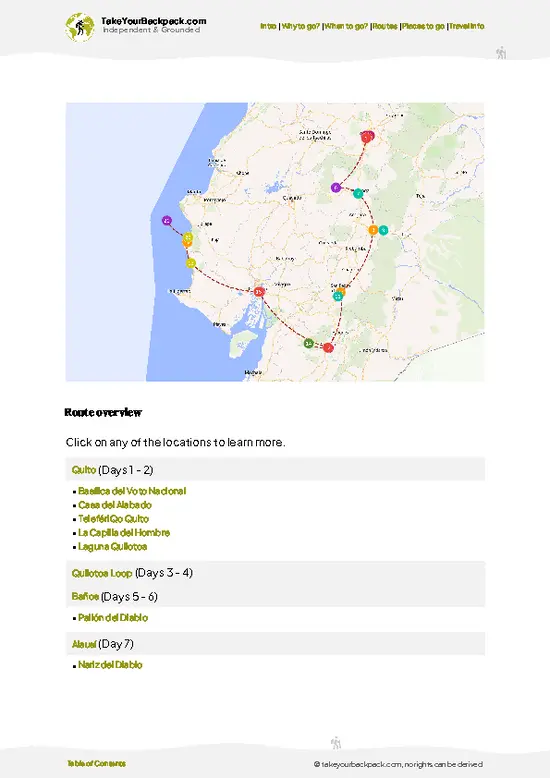
example page 3 from our offline Travel Guide for Ecuador
example page 4 from our offline Travel Guide for Ecuador
example page 5 from our offline Travel Guide for Ecuador
example page 6 from our offline Travel Guide for Ecuador
example page 7 from our offline Travel Guide for Ecuador
The digital guide (274 pages) contains:
✅ 87 highlights, ranked by travel appeal
✅ Optimized 5, 10 & 15-day travel routes
✅ Cities, national parks, landmarks, beaches
✅ How to get around
✅ Offline-friendly for travel without Wi-Fi
👉 Click to see all 30+ guide features

📅 Plan smarter in minutes, not weeks
✅ Month by month travel advice
✅ Festivals & national holidays
✅ Budget expectations

🗺️ Go to the right places, skip the overrated ones
✅ Honest pros & cons of destinations
✅ Top hikes, parks & viewpoints
✅ Lesser-known places most travelers miss
✅ Clear “worth it vs skip it” guidance

🛏️ Travel smoothly without rookie mistakes
✅ Best areas to stay
✅ Transport systems explained simply
✅ Common scams & safety advice
✅ SIM cards, money & practical tips

🌍 Understand the country, not just visit it
✅ Culture & traditions
✅ 52 Essential phrases & customs
✅ Festivals worth planning around
✅ Traveler-friendly historical context
✅ Insights that make places more meaningful

📱 Built for real travel conditions
✅ Fully downloadable PDF
✅ Works completely offline
✅ Optimized for phone use
✅ Useful in remote areas & buses
✅ Everything in one place
Stop searching, start planning
Get instant access to your full guide. 30‑day money-back guarantee.
+ Add another guide for just

By proceeding you agree to our terms.
Sent to your inbox immediately after payment • 100% Secure Checkout
Best Backpacking Travel Advisor 2025 tourism awardBest Backpacking
Travel Advisor
2025
What others say about Take Your Backpack Guides:
⭐⭐⭐⭐⭐
Fantastic, amazing amount of information!
⭐⭐⭐⭐⭐
My goodness this is amazing, it's what I've been looking for hats off too you!
⭐⭐⭐⭐⭐
I think this is absolutely BRILLIANT
⭐⭐⭐⭐
Very complete and informative. It's still missing places, but I gotta to commend you
⭐⭐⭐⭐⭐
This is truly amazing, thank you, can't wait to explore it with my kids!
⭐⭐⭐⭐⭐
Awesome resource, thank you!
⭐⭐⭐⭐⭐
This is amazing! Can't wait to explore the ones I haven't seen
⭐⭐⭐⭐
I love this! Well done, great idea.
⭐⭐⭐⭐⭐
Thanks for taking the time to make this gem!
⭐⭐⭐⭐⭐
This might be the best website I've ever seen.
⭐⭐⭐⭐⭐
Congratulations, and thank you so much for your work; it's incredibly valuable.
⭐⭐⭐⭐
In all seriousness I think you did a great job pointing out the important spots
⭐⭐⭐⭐⭐
10/10 very good
⭐⭐⭐⭐⭐
As someone who's only just starting to visit regularly this is awesome, thank you.
⭐⭐⭐⭐
Thank you very much! I'm going to visit my dad, it's going to be very useful!
⭐⭐⭐⭐⭐
This is really cool! We'll be travelling for the first time and this definitely come in handy.
⭐⭐⭐⭐⭐
You are now our minister of culture, congratulations 👨‍💼
⭐⭐⭐⭐⭐
Just wanted to tell you that this is a pearl! Going to follow your recommendations.
⭐⭐⭐⭐⭐
This is so cool. I'll definitely be using the resource for my travels soon.
⭐⭐⭐⭐⭐
This is very impressive! Good work.
⭐⭐⭐⭐⭐
This is an amazing and informative site. Very well done!

🛏️ Where to stay?Where to Stay: Ecuador Edition

Ecuador has plenty of hostels and guesthouses, with dorm beds typically running US$8 to 15 a night and private rooms from about US$20 to 35. In Quito, La Mariscal packs in the most hostels, bars and tour agencies but gets rowdy and sketchy after dark, the Centro Histórico puts you steps from the colonial churches and plazas yet empties out at night, and La Floresta trades nightlife for leafy, safer streets and good cafés. Beyond the capital, Baños clusters its cheap beds near the bus terminal and thermal baths, Cuenca has quiet, walkable options around its old center, and Montañita offers beachside dorms where the parties run until sunrise and sleep comes second.

If you enjoy meeting fellow travelers, … read more 👉
Ecuador has plenty of hostels and guesthouses, with dorm beds typically running US$8 to 15 a night and private rooms from about US$20 to 35. In Quito, La Mariscal packs in the most hostels, bars and tour agencies but gets rowdy and sketchy after dark, the Centro Histórico puts you steps from the colonial churches and plazas yet empties out at night, and La Floresta trades nightlife for leafy, safer streets and good cafés. Beyond the capital, Baños clusters its cheap beds near the bus terminal and thermal baths, Cuenca has quiet, walkable options around its old center, and Montañita offers beachside dorms where the parties run until sunrise and sleep comes second.

If you enjoy meeting fellow travelers, consider choosing hostels with high ratings for atmosphere. On the other hand, if you prefer having your own space, a hotel might be a better option.

EcuadorExplore Beyond This Category

👋 Meet the founderWho’s Behind Take Your Backpack?

Johan, backpacker and founder of TakeYourBackpackHi, I’m Johan (Netherlands 🇳🇱), the creator of TakeYourBackpack. Over the past 3 decades, I’ve backpacked through 90+ countries across six continents, gaining extensive experience with independent travel, long-term trips, and overland routes.

This site is built on a combination of firsthand travel experience and carefully curated insights from other backpackers. Many guides are based on places I’ve personally visited, while others bring together tips, observations, and practical advice shared by trusted travelers I’ve met along the way.

The goal is to provide realistic, experience-driven guidance — not generic itineraries — so you can explore destinations with better context, clearer expectations, and more confidence.