×

Ecuador🇪🇨 | best landmarksBest 8 landmarks in Ecuador

Ecuador packs four worlds into a country smaller than Colorado, and its landmarks change character with every climb or descent. In the Andean highlands, you tour colonial churches, volcano rims and Inca-era stonework, usually for US$2 to 15 a visit, with bus rides that run a few hours. The Amazon side rewards a stubborn streak: jungle lodges, river travel and guides push costs up. The coast brings sleepy fishing towns and cheap seafood. Then there are the Galápagos Islands, where park fees and boat trips turn any plan into a splurge. For backpackers traveling independently, the highlands deliver the best mix of ease, value and variety.

By Johan Kruseman 🇳🇱 | Updated October 20, 2026
Explore the best national parks in Ecuador

Why go?What Makes Them Special

Ecuador sits on the equator, and that single fact shapes everything. The Andes split the country into distinct landscapes within a day of each other, so a traveler can stand on a snow-capped volcano before lunch and be in cloud forest by dinner. Few countries compress such different settings into such short distances.

History stacks up as well. Pre-Inca peoples, then the Inca, then Spanish colonists each left marks, and the highland cities kept their colonial cores remarkably intact. Indigenous communities, especially in the northern and central Andes, still run markets, festivals and weaving traditions that give sites living context rather than museum silence.

Getting around is a strength. Ecuador uses the US dollar, buses reach almost every town, and fares are among the cheapest in South … read more 👉
Ecuador sits on the equator, and that single fact shapes everything. The Andes split the country into distinct landscapes within a day of each other, so a traveler can stand on a snow-capped volcano before lunch and be in cloud forest by dinner. Few countries compress such different settings into such short distances.

History stacks up as well. Pre-Inca peoples, then the Inca, then Spanish colonists each left marks, and the highland cities kept their colonial cores remarkably intact. Indigenous communities, especially in the northern and central Andes, still run markets, festivals and weaving traditions that give sites living context rather than museum silence.

Getting around is a strength. Ecuador uses the US dollar, buses reach almost every town, and fares are among the cheapest in South America, often US$1 to 2 an hour of travel. Entry fees stay modest outside the Galápagos.

Know the limits before choosing it. Altitude is real: Quito sits at about 2,850 meters, and many highland sites climb higher, so headaches and breathlessness hit early arrivals. Mountain weather turns fast, and clouds can hide a summit you traveled hours to see. The Galápagos and Amazon demand advance planning and bigger budgets. Come ready to adapt, and Ecuador pays you back generously.
How the List Was Created
The list of best unique sites in Ecuador is created based on history or culture, wow factor, atmosphere, quirks, and memorability. If you feel a unique site is missing in this list, please let us know.

When to go?Optimal Periods for Travel

Best months for landmarks: June to September is the best window in the highlands, because the dry season brings the clearest skies, firm trails and the best odds of seeing volcano summits. Days in Quito run around 18 to 22°C, while nights drop to 6 to 9°C, so pack layers. October to May is wetter, with afternoon downpours that often follow bright mornings. Start early, and most of the rain misses you.

Shoulder seasons and regional shifts: December to February makes a decent second choice in the Andes, with a short drier spell and fewer crowds than July and August. The Amazon stays wet and humid all year, around 24 to 30°C, with the heaviest rain from March to July, so river levels and trail mud matter more than the calendar. On the coast, the hot, rainy season runs December to May, and the … read more 👉
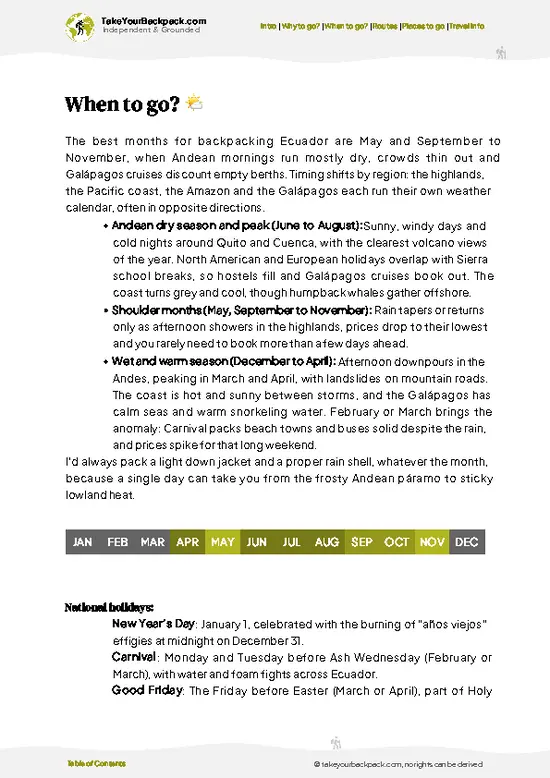
Best months for landmarks: June to September is the best window in the highlands, because the dry season brings the clearest skies, firm trails and the best odds of seeing volcano summits. Days in Quito run around 18 to 22°C, while nights drop to 6 to 9°C, so pack layers. October to May is wetter, with afternoon downpours that often follow bright mornings. Start early, and most of the rain misses you.

Shoulder seasons and regional shifts: December to February makes a decent second choice in the Andes, with a short drier spell and fewer crowds than July and August. The Amazon stays wet and humid all year, around 24 to 30°C, with the heaviest rain from March to July, so river levels and trail mud matter more than the calendar. On the coast, the hot, rainy season runs December to May, and the cooler, drier months from June to November bring gray, misty skies.

The Galápagos works year-round. The warm season from December to May brings calmer, clearer water, while June to November brings cooler seas and richer wildlife.

Peak periods and prices: July, August and the Christmas to New Year stretch fill up fastest. Expect Galápagos cruises and flights to climb 15 to 30 percent, and book highland hostels ahead. Carnival in February and Holy Week also crowd popular towns with domestic travelers.

unique site hoppingOptimizing Your Multi-Stop Itinerary

How many days to plan: A trip linking several landmarks needs 10 to 14 days, and 3 weeks gives breathing room for the Amazon or Galápagos. Ecuador looks small on the map, but mountain roads slow everything down.

Which regions cluster: The northern and central highlands group naturally along the Pan-American Highway, the Avenue of the Volcanoes, running south from Quito through Latacunga, Ambato and Riobamba to Cuenca. Travel north to south, because the long haul ends near Cuenca, with Guayaquil offering a cheap flight back to Quito or onward connections. Quito to Cuenca by bus takes roughly 9 to 10 hours, so break it up with a stop in Riobamba or Baños. Segments between neighboring highland towns generally take 1.5 to 3 hours.

Allow 1 to 2 days for a city center, and 1 full day for a volcano … read more 👉
How many days to plan: A trip linking several landmarks needs 10 to 14 days, and 3 weeks gives breathing room for the Amazon or Galápagos. Ecuador looks small on the map, but mountain roads slow everything down.

Which regions cluster: The northern and central highlands group naturally along the Pan-American Highway, the Avenue of the Volcanoes, running south from Quito through Latacunga, Ambato and Riobamba to Cuenca. Travel north to south, because the long haul ends near Cuenca, with Guayaquil offering a cheap flight back to Quito or onward connections. Quito to Cuenca by bus takes roughly 9 to 10 hours, so break it up with a stop in Riobamba or Baños. Segments between neighboring highland towns generally take 1.5 to 3 hours.

Allow 1 to 2 days for a city center, and 1 full day for a volcano or ruin site. The Amazon, usually entered from Baños, Tena or Lago Agrio, needs 3 to 4 days to justify the transit. The Galápagos, reached by flight from Quito or Guayaquil, needs at least 5 days.

Mistakes to avoid: The most common error is cramming too many sites into too few days. Altitude drags the first 48 hours, so spend them at gentler heights before any big climb. Another is booking a night bus before a hike, which leaves you exhausted at the trailhead. Pick fewer bases, take daytime buses for the views, and leave a spare day for weather.

The ListHighly Recommended landmarks of Ecuador

1 Laguna Quilotoa

Crater lake, 3,900-meter rim, sandy descent, Tigua art

Circle a collapsed volcano on a rim loop of three to four hours, drop to the shore for kayaking, then browse painted sheepskin drums in the village.

ecuador-unique-site-laguna-quilotoa
© Google | Rafael Machado

2 Papallacta Hot Springs

Volcanic pools, hot-cold circuits, páramo pass, village trout

Rotate between steaming pools and cold plunges, compare the resort with cheaper local baths, then walk the páramo and finish with grilled trout.

ecuador-unique-site-papallacta-hot-springs
© Google | David L

3 Isla de la Plata

Blue-footed boobies, Machalilla boat crossing, clifftop loop, reef snorkeling

Cross by boat from Puerto López to an island where boobies nest beside the trails, humpbacks pass in season, and a bay swim ends the tour.

4 Puyango Petrified Forest

Stone logs, growth rings, dry tropical forest, ranger-led trails

Follow guided paths past fossilized trunks with visible bark and rings, rest by the river, and listen for parrots in the dry southern forest.

5 Mirador Indichuris

Pastaza canopy deck, Puyo valley, leafcutter ants, Kichwa name

Climb a quiet hilltop above Puyo to look across flat forest canopy, trace the river valley, and watch tanagers, parrots and toucans fly past at eye level.

6 Pailón del Diablo

Pastaza plunge, tunnel window, gorge stairs, Baños waterfall road

Descend stone steps and bridges into the gorge, then crouch in a wet tunnel to a slit window a few feet from the roaring Pastaza.

ecuador-unique-site-pailon-del-diablo
© Google |

7 Nariz del Diablo

Railway switchbacks, Alausí station, Sibambe turnaround, Chanchán gorge

Ride a train that reverses down a near-vertical rock face, stopping at Sibambe for Cañari folk dance before climbing back to Alausí.

ecuador-unique-site-nariz-del-diablo
© Google | Herna Castilo

8 Ingapirca

Elliptical Inca temple, Cañari foundations, sun-aligned doorway, grassy ridge

Walk a compact ridge-top site where an oval Inca temple stands over earlier Cañari foundations, with a museum and a stretch of royal road nearby.

Loading the map 🌍

Expert viewTips and Advice from Travelers

How many landmarks to aim for: Plan on six to eight landmarks over two weeks. That number leaves one meaningful visit every second day, with space for altitude recovery, weather delays and bus rides that run longer than the schedule says. Pack in more and the trip blurs into tickets and terminals. Choose fewer and you miss the variety that makes Ecuador special.

Which kinds to prioritize: Culture-minded travelers get the most from colonial centers and Indigenous markets, which cost little (many are free) and are walkable from a hostel. Hikers should put volcanic and mountain sites first, accepting early starts and cold in exchange for open skies. Wildlife seekers face the biggest decision. The Galápagos is a true splurge, typically US$1,000 or more for a short trip once the park fee (US$200 … read more 👉
How many landmarks to aim for: Plan on six to eight landmarks over two weeks. That number leaves one meaningful visit every second day, with space for altitude recovery, weather delays and bus rides that run longer than the schedule says. Pack in more and the trip blurs into tickets and terminals. Choose fewer and you miss the variety that makes Ecuador special.

Which kinds to prioritize: Culture-minded travelers get the most from colonial centers and Indigenous markets, which cost little (many are free) and are walkable from a hostel. Hikers should put volcanic and mountain sites first, accepting early starts and cold in exchange for open skies. Wildlife seekers face the biggest decision. The Galápagos is a true splurge, typically US$1,000 or more for a short trip once the park fee (US$200 for most foreign adults) and transit tax are added. Amazon lodges cost less at US$50 to 120 a night, often with guides included, and give the best value for animals and canopy. For most backpackers, highlands first, Amazon second and Galápagos only if the budget stretches gives the most return per dollar and per day.

What it costs: Budget US$30 to 50 a day in the highlands with a dorm bed, local meals and buses. Entry fees mostly run US$2 to 15. Guides for volcanoes or high-altitude hikes cost US$40 to 120 a day, and the guide is worth paying where a trail crosses glaciers or unclear terrain. Shared transport to a trailhead runs US$1 to 10. Amazon days push toward US$60 to 100, and the Galápagos can top US$150 a day even on tight budgets.

Safety and cultural sense: Take altitude seriously. Sleep one or two nights in the 2,500 to 3,000 meter range before climbing past 4,000, drink water constantly and skip alcohol on arrival. Descend at the first sign of a worsening headache or confusion. In cities, petty theft clusters around bus terminals and crowded plazas, so keep phones and day packs close and use registered taxis or ride apps after dark. Avoid unlit trails and isolated viewpoints alone.

On the cultural side, ask before photographing people, especially Indigenous market vendors, and expect to tip a small amount or buy something. Dress modestly in active churches. Respect park rules, since sites in protected areas can be closed without notice for weather or volcanic activity, so check conditions locally the day before. Carry small bills, because change is scarce in smaller towns.

✈️ The backpacker research shortcutEcuador Travel Guide

An offline-friendly backpacking guide with optimized travel routes, ranked highlights, transport advice, and the best areas to stay.
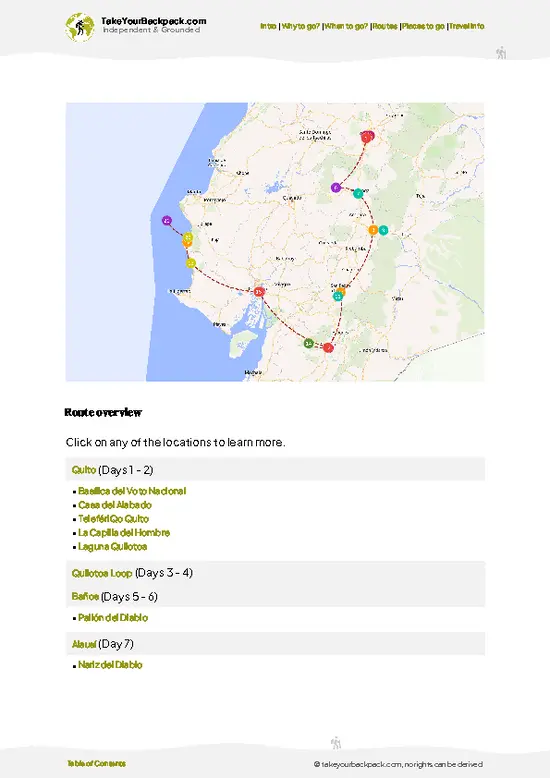
example page 0 from our offline Travel Guide for Ecuador
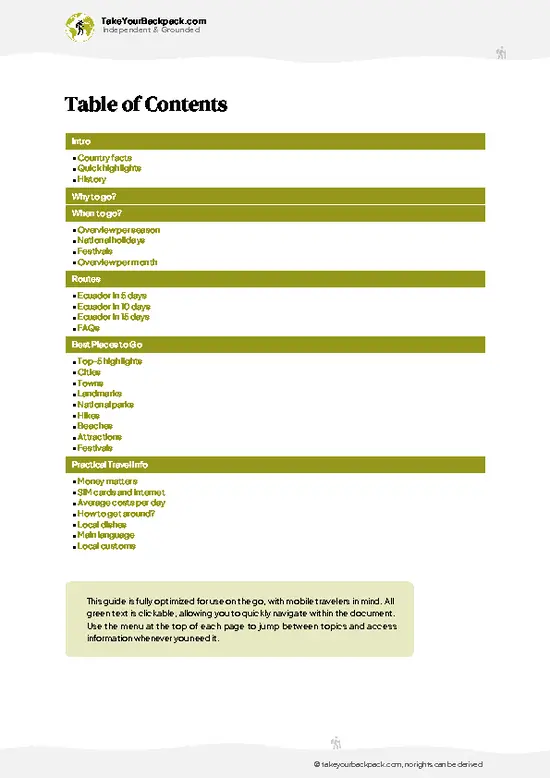
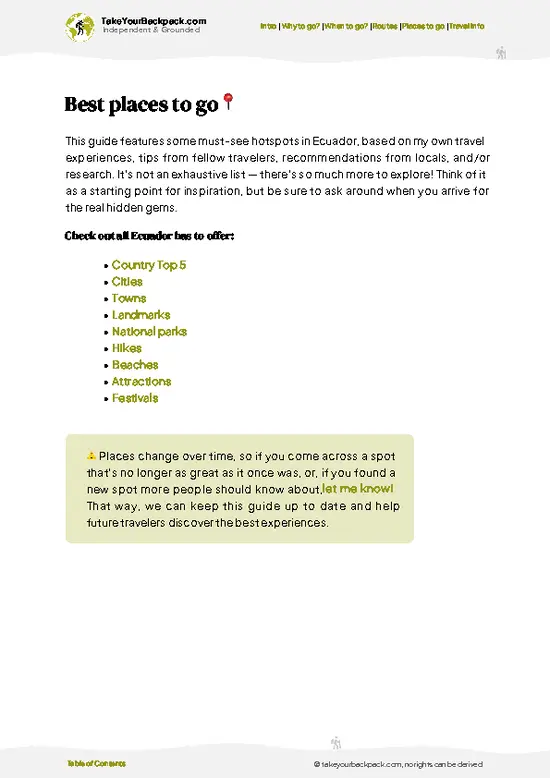
example page 1 from our offline Travel Guide for Ecuador
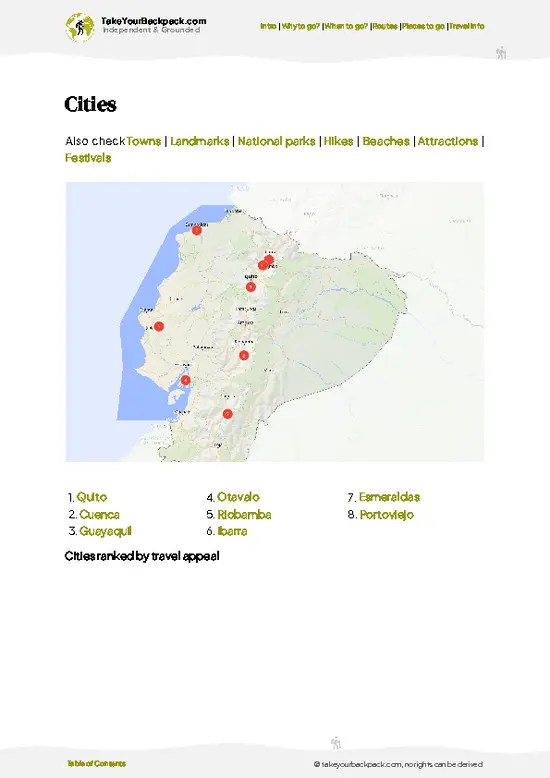
example page 2 from our offline Travel Guide for Ecuador
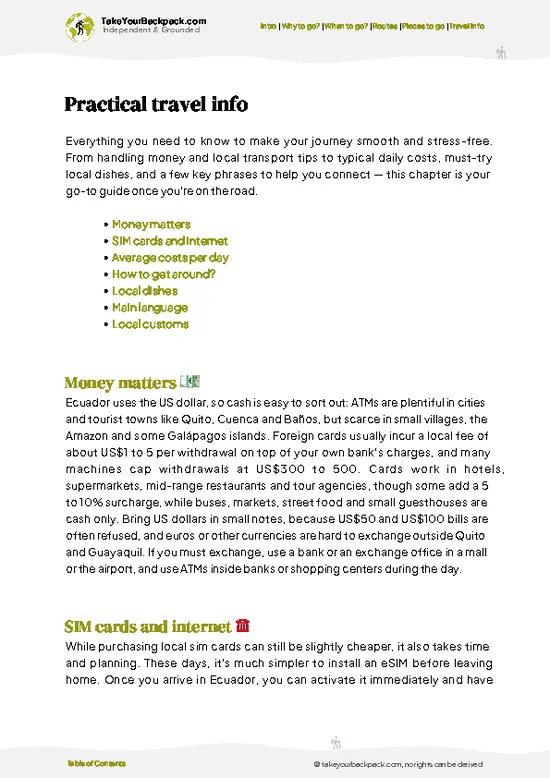
example page 3 from our offline Travel Guide for Ecuador
example page 4 from our offline Travel Guide for Ecuador
example page 5 from our offline Travel Guide for Ecuador
example page 6 from our offline Travel Guide for Ecuador
example page 7 from our offline Travel Guide for Ecuador
The digital guide (274 pages) contains:
✅ 87 highlights, ranked by travel appeal
✅ Optimized 5, 10 & 15-day travel routes
✅ Cities, national parks, landmarks, beaches
✅ How to get around
✅ Offline-friendly for travel without Wi-Fi
👉 Click to see all 30+ guide features

📅 Plan smarter in minutes, not weeks
✅ Month by month travel advice
✅ Festivals & national holidays
✅ Budget expectations

🗺️ Go to the right places, skip the overrated ones
✅ Honest pros & cons of destinations
✅ Top hikes, parks & viewpoints
✅ Lesser-known places most travelers miss
✅ Clear “worth it vs skip it” guidance

🛏️ Travel smoothly without rookie mistakes
✅ Best areas to stay
✅ Transport systems explained simply
✅ Common scams & safety advice
✅ SIM cards, money & practical tips

🌍 Understand the country, not just visit it
✅ Culture & traditions
✅ 52 Essential phrases & customs
✅ Festivals worth planning around
✅ Traveler-friendly historical context
✅ Insights that make places more meaningful

📱 Built for real travel conditions
✅ Fully downloadable PDF
✅ Works completely offline
✅ Optimized for phone use
✅ Useful in remote areas & buses
✅ Everything in one place
Stop searching, start planning
Get instant access to your full guide. 30‑day money-back guarantee.
+ Add another guide for just

By proceeding you agree to our terms.
Sent to your inbox immediately after payment • 100% Secure Checkout
Best Backpacking Travel Advisor 2025 tourism awardBest Backpacking
Travel Advisor
2025
What others say about Take Your Backpack Guides:
⭐⭐⭐⭐⭐
Fantastic, amazing amount of information!
⭐⭐⭐⭐⭐
My goodness this is amazing, it's what I've been looking for hats off too you!
⭐⭐⭐⭐⭐
I think this is absolutely BRILLIANT
⭐⭐⭐⭐
Very complete and informative. It's still missing places, but I gotta to commend you
⭐⭐⭐⭐⭐
This is truly amazing, thank you, can't wait to explore it with my kids!
⭐⭐⭐⭐⭐
Awesome resource, thank you!
⭐⭐⭐⭐⭐
This is amazing! Can't wait to explore the ones I haven't seen
⭐⭐⭐⭐
I love this! Well done, great idea.
⭐⭐⭐⭐⭐
Thanks for taking the time to make this gem!
⭐⭐⭐⭐⭐
This might be the best website I've ever seen.
⭐⭐⭐⭐⭐
Congratulations, and thank you so much for your work; it's incredibly valuable.
⭐⭐⭐⭐
In all seriousness I think you did a great job pointing out the important spots
⭐⭐⭐⭐⭐
10/10 very good
⭐⭐⭐⭐⭐
As someone who's only just starting to visit regularly this is awesome, thank you.
⭐⭐⭐⭐
Thank you very much! I'm going to visit my dad, it's going to be very useful!
⭐⭐⭐⭐⭐
This is really cool! We'll be travelling for the first time and this definitely come in handy.
⭐⭐⭐⭐⭐
You are now our minister of culture, congratulations 👨‍💼
⭐⭐⭐⭐⭐
Just wanted to tell you that this is a pearl! Going to follow your recommendations.
⭐⭐⭐⭐⭐
This is so cool. I'll definitely be using the resource for my travels soon.
⭐⭐⭐⭐⭐
This is very impressive! Good work.
⭐⭐⭐⭐⭐
This is an amazing and informative site. Very well done!

🛏️ Where to stay?Best Stay Options in Ecuador

Ecuador has plenty of hostels and guesthouses, with dorm beds typically running US$8 to 15 a night and private rooms from about US$20 to 35. In Quito, La Mariscal packs in the most hostels, bars and tour agencies but gets rowdy and sketchy after dark, the Centro Histórico puts you steps from the colonial churches and plazas yet empties out at night, and La Floresta trades nightlife for leafy, safer streets and good cafés. Beyond the capital, Baños clusters its cheap beds near the bus terminal and thermal baths, Cuenca has quiet, walkable options around its old center, and Montañita offers beachside dorms where the parties run until sunrise and sleep comes second.

If you enjoy meeting fellow travelers, … read more 👉
Ecuador has plenty of hostels and guesthouses, with dorm beds typically running US$8 to 15 a night and private rooms from about US$20 to 35. In Quito, La Mariscal packs in the most hostels, bars and tour agencies but gets rowdy and sketchy after dark, the Centro Histórico puts you steps from the colonial churches and plazas yet empties out at night, and La Floresta trades nightlife for leafy, safer streets and good cafés. Beyond the capital, Baños clusters its cheap beds near the bus terminal and thermal baths, Cuenca has quiet, walkable options around its old center, and Montañita offers beachside dorms where the parties run until sunrise and sleep comes second.

If you enjoy meeting fellow travelers, consider choosing hostels with high ratings for atmosphere. On the other hand, if you prefer having your own space, a hotel might be a better option.

EcuadorWhere to Go Next

👋 Meet the founderWho’s Behind Take Your Backpack?

Johan, backpacker and founder of TakeYourBackpackHi, I’m Johan (Netherlands 🇳🇱), the creator of TakeYourBackpack. Over the past 3 decades, I’ve backpacked through 90+ countries across six continents, gaining extensive experience with independent travel, long-term trips, and overland routes.

This site is built on a combination of firsthand travel experience and carefully curated insights from other backpackers. Many guides are based on places I’ve personally visited, while others bring together tips, observations, and practical advice shared by trusted travelers I’ve met along the way.

The goal is to provide realistic, experience-driven guidance — not generic itineraries — so you can explore destinations with better context, clearer expectations, and more confidence.