×

Ecuador🇪🇨 | best hikesBest 4 hikes in Ecuador

Ecuador packs volcano summits, cloud forest, páramo grassland and Amazon trails into a country smaller than Colorado, and you can chase all of them without a rental car. The Andean highlands deliver the headline climbs: high altitude, cold wind, crater lakes, and trailheads reached by US$1 to 3 local buses. The coast and lowland forest trade thin air for heat and humidity, with far fewer people on the path. The Amazon side costs more, since lodges and guides are part of the deal. For independent travelers, the mix means one week can swing from glacier-edge scrambles to muddy jungle walks.

By Johan Kruseman 🇳🇱 | Updated October 20, 2026
Explore the best beaches in Ecuador

Why go?What Makes Them Special

Ecuador sits on the equator, and that single fact rewrites the rules. Two parallel Andean ranges, the Avenue of the Volcanoes, run down the middle of the country and throw up a dozen peaks above 4,500 meters, several above 5,000. Because the land climbs from sea level to over 6,200 meters at Chimborazo in a few hours' drive, you can change ecosystems in a single day. Few countries compress that much variety into so little distance.

Infrastructure helps. Buses reach almost every town, trailheads often sit 30 to 90 minutes from a city, and tourism-focused hubs such as Quito, Baños and Riobamba have outfitters ready to rent gear and book guides. Prices stay low by regional standards. Indigenous Quichua communities manage many highland routes and lodges, so walking here often means crossing working … read more 👉
Ecuador sits on the equator, and that single fact rewrites the rules. Two parallel Andean ranges, the Avenue of the Volcanoes, run down the middle of the country and throw up a dozen peaks above 4,500 meters, several above 5,000. Because the land climbs from sea level to over 6,200 meters at Chimborazo in a few hours' drive, you can change ecosystems in a single day. Few countries compress that much variety into so little distance.

Infrastructure helps. Buses reach almost every town, trailheads often sit 30 to 90 minutes from a city, and tourism-focused hubs such as Quito, Baños and Riobamba have outfitters ready to rent gear and book guides. Prices stay low by regional standards. Indigenous Quichua communities manage many highland routes and lodges, so walking here often means crossing working farmland and community land, not empty wilderness.

Know before you commit: altitude is the main challenge. Quito already sits at 2,850 meters, and many classic routes top 4,000. Plan acclimatization before anything serious. Weather swings fast, with sun, hail and fog sometimes inside one hour. Several high-profile volcanoes close temporarily when activity rises, and some peaks require a certified guide and a permit. Trail markings are patchy, so offline maps are worth having. Go in with that knowledge and the country rewards you generously.
Evaluating the Top Choices
The list of best hikes in Ecuador is created based on scenery, challenge, trail quality, landmarks, and overall enjoyment. If you feel a hike is missing in this list, please let us know.

When to go?Optimal Periods for Travel

Best months for highland hiking: June to September is the best window for the Andes, because the dry season brings the clearest mornings and the most stable summit conditions. December to February offers a second, shorter dry spell, while the shoulder months of March to May and October to November bring heavier afternoon rain, especially above 3,000 meters.

What the weather does: Near the equator, temperature depends on altitude more than month. Quito days hover around 18 to 22°C with nights of 7 to 10°C. At 4,000 meters, expect 0 to 8°C by day and frost at night, with strong wind year-round. Wet months can push highland rainfall to 100 to 150 millimeters monthly, and cloud often rolls in by early afternoon, so start before 7 a.m. in any season.

Coast and Amazon: The Pacific coast is hot … read more 👉
Best months for highland hiking: June to September is the best window for the Andes, because the dry season brings the clearest mornings and the most stable summit conditions. December to February offers a second, shorter dry spell, while the shoulder months of March to May and October to November bring heavier afternoon rain, especially above 3,000 meters.

What the weather does: Near the equator, temperature depends on altitude more than month. Quito days hover around 18 to 22°C with nights of 7 to 10°C. At 4,000 meters, expect 0 to 8°C by day and frost at night, with strong wind year-round. Wet months can push highland rainfall to 100 to 150 millimeters monthly, and cloud often rolls in by early afternoon, so start before 7 a.m. in any season.

Coast and Amazon: The Pacific coast is hot and humid from about January to May (28 to 32°C) with rain, then drier and cooler from June to December. The Amazon basin stays wet all year, but August to October and December to February tend to be a little drier. Expect 24 to 30°C and sudden downpours in any month.

Crowds and prices: July, August and the Christmas to New Year stretch fill hostels and guided climbs in Baños and Riobamba. Book guides a week ahead then. Outside those weeks, rates are often negotiable and trails stay quiet.

hike hoppingOptimizing Your Multi-Stop Itinerary

How long a multi-hike trip takes: Plan 14 to 21 days to link several hikes in Ecuador without rushing, and treat 10 days as the realistic minimum. The most efficient shape is a north to south run through the highlands, then a drop to the Amazon or coast at the end. Start in Quito (2,850 meters), where acclimatizing for two to three days makes everything higher feel easier. Then roll south to the central Andes around Latacunga, Baños and Riobamba, and continue to Cuenca and the southern highlands if time allows.

Pacing and transfers: Give each base two to four nights, allowing one hiking day plus a rest or buffer day for weather. Buses are frequent and cheap: Quito to Baños takes about 3.5 to 4 hours, Baños to Riobamba about 1 to 1.5 hours, and Riobamba to Cuenca roughly 6 to 7 hours. Quito … read more 👉
How long a multi-hike trip takes: Plan 14 to 21 days to link several hikes in Ecuador without rushing, and treat 10 days as the realistic minimum. The most efficient shape is a north to south run through the highlands, then a drop to the Amazon or coast at the end. Start in Quito (2,850 meters), where acclimatizing for two to three days makes everything higher feel easier. Then roll south to the central Andes around Latacunga, Baños and Riobamba, and continue to Cuenca and the southern highlands if time allows.

Pacing and transfers: Give each base two to four nights, allowing one hiking day plus a rest or buffer day for weather. Buses are frequent and cheap: Quito to Baños takes about 3.5 to 4 hours, Baños to Riobamba about 1 to 1.5 hours, and Riobamba to Cuenca roughly 6 to 7 hours. Quito to the Amazon gateway towns such as Tena runs 4 to 5 hours, and to the coast at Guayaquil 8 to 9 hours. Overnight buses exist but hand you a cold, tired morning at altitude.

Mistakes to avoid: The classic error is stacking high summits on consecutive days before the body has adapted. Alternate big days with lower ones. Another is chasing both coast and highlands in a short trip, which burns days on buses. Pick one side first. Last, skip fixed bookings far ahead, since mountain weather forces changes.

The ListHighly Recommended hikes of Ecuador

1 Quilotoa Loop

Village-to-village, Sigüi canyon, Hostel dinners, 3,900 m crater

Link farming villages across deep canyons and steep fields, sleep in hostels with wood fires, and finish at a turquoise lake inside a collapsed volcano.

2 El Altar

Emerald Laguna Amarilla, Collanes wild horses, Collapsed caldera, Muddy two-day trek

Trek from Candelaria through Collanes valley grassland to a green crater lake, with the jagged rim of a collapsed volcano rising above the water.

ecuador-hike-el-altar
© Google | Jessenia Rueda

3 Inca Trail to Ingapirca

Achupallas to Ingapirca, Cobbled Inca road, Sacred Culebrillas lake, Wild camping

Follow roughly 40 kilometers of open páramo from Achupallas to the stone Temple of the Sun, camping beside a sacred lake along original paved Inca road.

ecuador-hike-inca-trail-to-ingapirca
© Google |

4 Laguna de Cuicocha

14 km rim loop, Twin lake islands, Cotacachi views, Steaming fumaroles

Circle a flooded caldera on a steady climbing path, with two dome-shaped islands below, Cotacachi on the skyline, and gas bubbling up near the shore.

ecuador-hike-laguna-de-cuicocha
© Google |
Loading the map 🌍

Expert viewTips and Advice from Travelers

How many hikes to plan: Three to five serious hikes make the best trip, spread across a two to three week stay. Fewer wastes the variety. More, and altitude fatigue and rain days start eating your plan. Treat anything above 4,000 meters as a major effort that needs a recovery day after, and fill the gaps with easy valley and cloud forest walks that cost almost nothing.

Choosing between kinds: If you are on a tight budget and want the best return, the highland day hikes win: you pay for a bus (US$1 to 4), maybe a park fee (free to US$10), and carry your own food. Volcano climbs with a guide cost more, typically US$150 to 300 per person for peaks like Cotopaxi when you add transport, gear and refuge, but they deliver the sharpest sense of achievement in a single day. Rent gear (boots, crampons, … read more 👉
How many hikes to plan: Three to five serious hikes make the best trip, spread across a two to three week stay. Fewer wastes the variety. More, and altitude fatigue and rain days start eating your plan. Treat anything above 4,000 meters as a major effort that needs a recovery day after, and fill the gaps with easy valley and cloud forest walks that cost almost nothing.

Choosing between kinds: If you are on a tight budget and want the best return, the highland day hikes win: you pay for a bus (US$1 to 4), maybe a park fee (free to US$10), and carry your own food. Volcano climbs with a guide cost more, typically US$150 to 300 per person for peaks like Cotopaxi when you add transport, gear and refuge, but they deliver the sharpest sense of achievement in a single day. Rent gear (boots, crampons, ice axe) in town for US$15 to 30 rather than hauling it from home. Amazon trips bring the most wildlife, though a guided jungle stay often runs US$50 to 100 a day, so keep it to two or three nights. Coastal and dry forest walks are the cheapest and quietest option, though also the hottest.

Budget: Self-guided highland hiking runs roughly US$25 to 40 a day with hostel dorms (US$8 to 15), local meals (US$3 to 6) and buses. Add US$40 to 80 for a guided day on any route where one is advisable, and US$150 to 300 for a glacier summit. A realistic total for three weeks with four paid guides sits around US$900 to 1,500.

Safety and culture: Altitude sickness is the biggest risk, so ascend gradually, drink water often and turn around if headaches or nausea worsen. Use licensed guides for glaciers and any ascent above 5,000 meters, and check current volcano status before booking, since closures happen. Carry rain gear and a warm layer even on sunny mornings. Petty theft occurs around city trailheads and on buses, so avoid leaving bags in parked taxis or unattended. Many routes cross community land, where small entry fees are normal. Carry coins, ask before photographing people, greet farmers you pass, and close livestock gates behind you.

✈️ The backpacker research shortcutEcuador Travel Guide

An offline-friendly backpacking guide with optimized travel routes, ranked highlights, transport advice, and the best areas to stay.
example page 0 from our offline Travel Guide for Ecuador
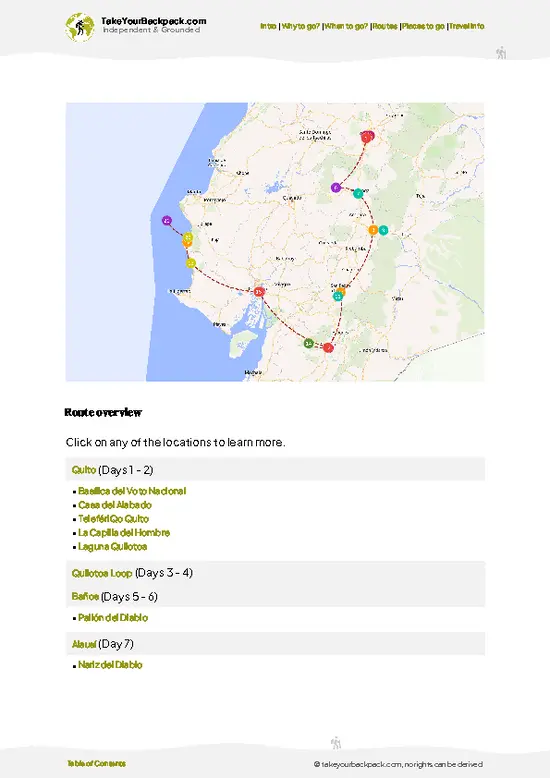
example page 1 from our offline Travel Guide for Ecuador
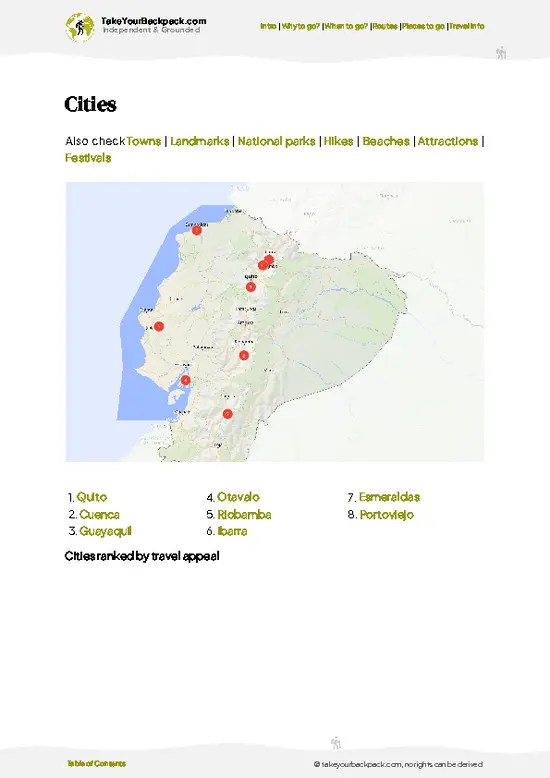
example page 2 from our offline Travel Guide for Ecuador
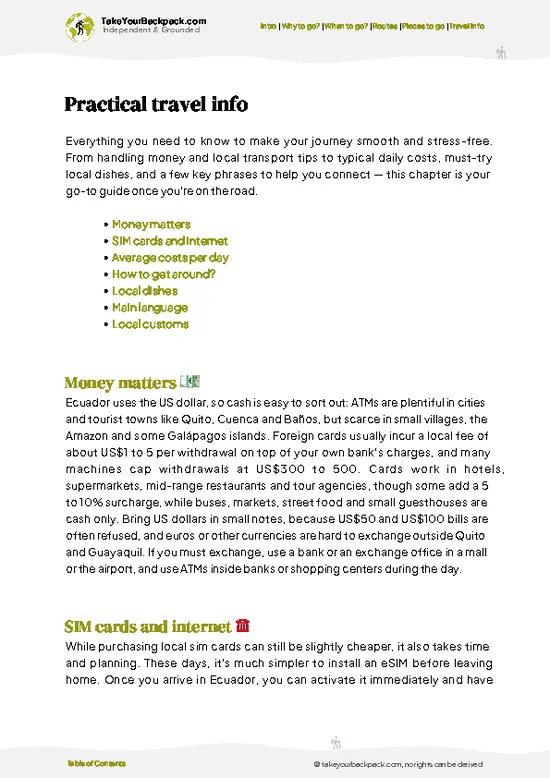
example page 3 from our offline Travel Guide for Ecuador
example page 4 from our offline Travel Guide for Ecuador
example page 5 from our offline Travel Guide for Ecuador
example page 6 from our offline Travel Guide for Ecuador
example page 7 from our offline Travel Guide for Ecuador
The digital guide (274 pages) contains:
✅ 87 highlights, ranked by travel appeal
✅ Optimized 5, 10 & 15-day travel routes
✅ Cities, national parks, landmarks, beaches
✅ How to get around
✅ Offline-friendly for travel without Wi-Fi
👉 Click to see all 30+ guide features

📅 Plan smarter in minutes, not weeks
✅ Month by month travel advice
✅ Festivals & national holidays
✅ Budget expectations

🗺️ Go to the right places, skip the overrated ones
✅ Honest pros & cons of destinations
✅ Top hikes, parks & viewpoints
✅ Lesser-known places most travelers miss
✅ Clear “worth it vs skip it” guidance

🛏️ Travel smoothly without rookie mistakes
✅ Best areas to stay
✅ Transport systems explained simply
✅ Common scams & safety advice
✅ SIM cards, money & practical tips

🌍 Understand the country, not just visit it
✅ Culture & traditions
✅ 52 Essential phrases & customs
✅ Festivals worth planning around
✅ Traveler-friendly historical context
✅ Insights that make places more meaningful

📱 Built for real travel conditions
✅ Fully downloadable PDF
✅ Works completely offline
✅ Optimized for phone use
✅ Useful in remote areas & buses
✅ Everything in one place
Stop searching, start planning
Get instant access to your full guide. 30‑day money-back guarantee.
+ Add another guide for just

By proceeding you agree to our terms.
Sent to your inbox immediately after payment • 100% Secure Checkout
Best Backpacking Travel Advisor 2025 tourism awardBest Backpacking
Travel Advisor
2025
What others say about Take Your Backpack Guides:
⭐⭐⭐⭐⭐
Fantastic, amazing amount of information!
⭐⭐⭐⭐⭐
My goodness this is amazing, it's what I've been looking for hats off too you!
⭐⭐⭐⭐⭐
I think this is absolutely BRILLIANT
⭐⭐⭐⭐
Very complete and informative. It's still missing places, but I gotta to commend you
⭐⭐⭐⭐⭐
This is truly amazing, thank you, can't wait to explore it with my kids!
⭐⭐⭐⭐⭐
Awesome resource, thank you!
⭐⭐⭐⭐⭐
This is amazing! Can't wait to explore the ones I haven't seen
⭐⭐⭐⭐
I love this! Well done, great idea.
⭐⭐⭐⭐⭐
Thanks for taking the time to make this gem!
⭐⭐⭐⭐⭐
This might be the best website I've ever seen.
⭐⭐⭐⭐⭐
Congratulations, and thank you so much for your work; it's incredibly valuable.
⭐⭐⭐⭐
In all seriousness I think you did a great job pointing out the important spots
⭐⭐⭐⭐⭐
10/10 very good
⭐⭐⭐⭐⭐
As someone who's only just starting to visit regularly this is awesome, thank you.
⭐⭐⭐⭐
Thank you very much! I'm going to visit my dad, it's going to be very useful!
⭐⭐⭐⭐⭐
This is really cool! We'll be travelling for the first time and this definitely come in handy.
⭐⭐⭐⭐⭐
You are now our minister of culture, congratulations 👨‍💼
⭐⭐⭐⭐⭐
Just wanted to tell you that this is a pearl! Going to follow your recommendations.
⭐⭐⭐⭐⭐
This is so cool. I'll definitely be using the resource for my travels soon.
⭐⭐⭐⭐⭐
This is very impressive! Good work.
⭐⭐⭐⭐⭐
This is an amazing and informative site. Very well done!

🛏️ Where to stay?Accommodation Highlights

Ecuador has plenty of hostels and guesthouses, with dorm beds typically running US$8 to 15 a night and private rooms from about US$20 to 35. In Quito, La Mariscal packs in the most hostels, bars and tour agencies but gets rowdy and sketchy after dark, the Centro Histórico puts you steps from the colonial churches and plazas yet empties out at night, and La Floresta trades nightlife for leafy, safer streets and good cafés. Beyond the capital, Baños clusters its cheap beds near the bus terminal and thermal baths, Cuenca has quiet, walkable options around its old center, and Montañita offers beachside dorms where the parties run until sunrise and sleep comes second.

If you enjoy meeting fellow travelers, … read more 👉
Ecuador has plenty of hostels and guesthouses, with dorm beds typically running US$8 to 15 a night and private rooms from about US$20 to 35. In Quito, La Mariscal packs in the most hostels, bars and tour agencies but gets rowdy and sketchy after dark, the Centro Histórico puts you steps from the colonial churches and plazas yet empties out at night, and La Floresta trades nightlife for leafy, safer streets and good cafés. Beyond the capital, Baños clusters its cheap beds near the bus terminal and thermal baths, Cuenca has quiet, walkable options around its old center, and Montañita offers beachside dorms where the parties run until sunrise and sleep comes second.

If you enjoy meeting fellow travelers, consider choosing hostels with high ratings for atmosphere. On the other hand, if you prefer having your own space, a hotel might be a better option.

EcuadorSee More of Ecuador

👋 Meet the founderWho’s Behind Take Your Backpack?

Johan, backpacker and founder of TakeYourBackpackHi, I’m Johan (Netherlands 🇳🇱), the creator of TakeYourBackpack. Over the past 3 decades, I’ve backpacked through 90+ countries across six continents, gaining extensive experience with independent travel, long-term trips, and overland routes.

This site is built on a combination of firsthand travel experience and carefully curated insights from other backpackers. Many guides are based on places I’ve personally visited, while others bring together tips, observations, and practical advice shared by trusted travelers I’ve met along the way.

The goal is to provide realistic, experience-driven guidance — not generic itineraries — so you can explore destinations with better context, clearer expectations, and more confidence.