×

Ethiopia🇪🇹 | citiesDebre BerhanAngel-faced ceiling, wool carpets, gari carts, highway pause | things to do and best time to go

Explore Arba MinchExplore Debre Markos

Backpacking in Debre Berhan
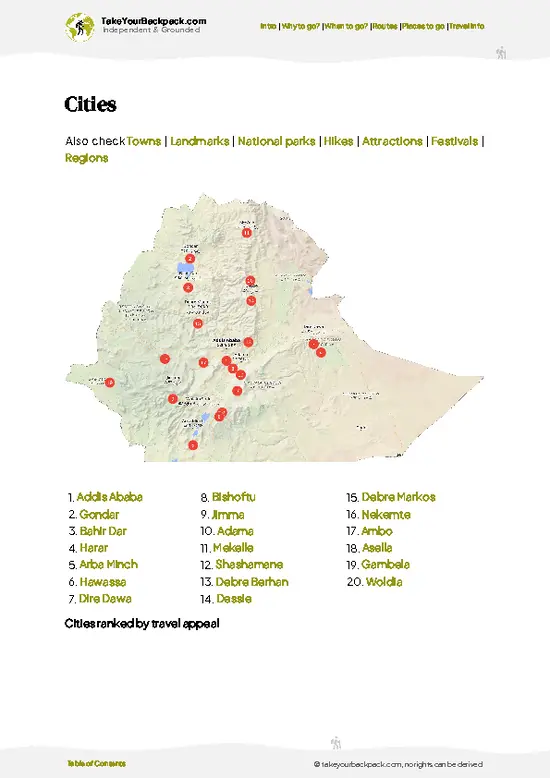
👌 Worth visitingcity ranked #14
By Johan Kruseman 🇳🇱 | Updated October 22, 2026

Debre Berhan sits right on the main highway between Addis Ababa and the northern circuit, so you can break the road here for a night instead of grinding through in one go. It lies in the north of Ethiopia, on the central highlands plateau. I still connect it with the clack of horse-drawn gari carts on wet asphalt and the smell of eucalyptus smoke at dusk. Skip it if you want nightlife or polish. Come for a cool, unhurried stop, simple guesthouses and a bed that costs far less than the capital. A grain market and sheep wool blankets fill the main street.

Discover everything you want to know in the 📖 Ethiopia Travel Guide.
Safety warning

The current risk level for Ethiopia is high. Check the advice before going.


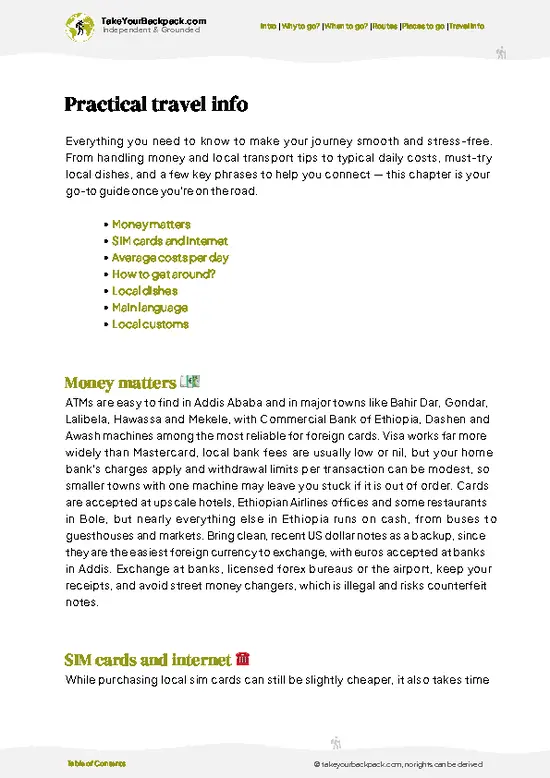
example page 0 from our offline Travel Guide for Ethiopia
example page 1 from our offline Travel Guide for Ethiopia
example page 2 from our offline Travel Guide for Ethiopia
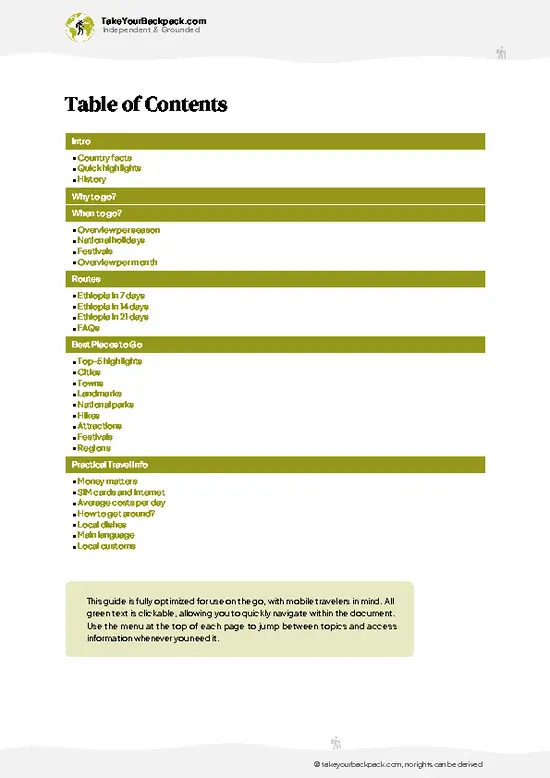
example page 3 from our offline Travel Guide for Ethiopia
example page 4 from our offline Travel Guide for Ethiopia
example page 5 from our offline Travel Guide for Ethiopia
example page 6 from our offline Travel Guide for Ethiopia
example page 7 from our offline Travel Guide for Ethiopia
Loading the map 🌍
CLICK TO FILTER
cities
towns
landmarks
national parks
hikes
attractions
festivals
regions
SHOW COUNTRY’S BESTSHOW ALL

✨ Why go?
Ranked #14 city in Ethiopia
What makes it a must-see city

Debre Berhan works best as a one or two night stop on the road north, and that is how most backpackers use it. It breaks up the long haul toward Lalibela and Dessie, and it spares you a night of Addis traffic and noise. The town is small enough to cover on foot, with plain hostels and cafes serving strong buna and fresh bread. It is also known for its famous Debre Berhan carpets and blankets, woven locally and sold at fair prices. At around 2,800 meters, the air is crisp, so bring a proper jacket. If you want big sights and bars, keep going. If you want a real Ethiopian highland town, stay.

💡 HighlightsEssential experiences to have while visiting Debre Berhan

  1. Debre Berhan Selassie Church: The town's best-known landmark, a round church with painted walls and a ceiling covered in angel faces. Go in the morning when the light is soft inside. Foreigner entry is about US$5 to 10, and you need 45 minutes to 1 hour.
  2. Debre Berhan Carpet Factory and weaving shops: Watch wool carpets and blankets being made on looms, then buy directly. Weekday mornings are best. Browsing is free, purchases vary, and you need about 1 hour.
  3. Central Market (Monday and Thursday): Grain, spices, livestock and woven goods fill the streets, and the busiest hours are early morning. Free, 1 to 2 hours.
  4. Menz Gera and local viewpoints on the escarpment edge: Short rides from town lead to open plateau views over farmland and eucalyptus groves. Visit late afternoon. Cost is small for transport
… read more 👉
  1. Debre Berhan Selassie Church: The town's best-known landmark, a round church with painted walls and a ceiling covered in angel faces. Go in the morning when the light is soft inside. Foreigner entry is about US$5 to 10, and you need 45 minutes to 1 hour.
  2. Debre Berhan Carpet Factory and weaving shops: Watch wool carpets and blankets being made on looms, then buy directly. Weekday mornings are best. Browsing is free, purchases vary, and you need about 1 hour.
  3. Central Market (Monday and Thursday): Grain, spices, livestock and woven goods fill the streets, and the busiest hours are early morning. Free, 1 to 2 hours.
  4. Menz Gera and local viewpoints on the escarpment edge: Short rides from town lead to open plateau views over farmland and eucalyptus groves. Visit late afternoon. Cost is small for transport only, about 2 hours.
  5. Gari cart rides: Hop on a horse cart for a short trip through the town's lanes. Costs are about US$0.50 to 1 per ride, and 15 to 30 minutes is plenty.
  6. Local buna houses: Sit for a traditional coffee ceremony in a simple cafe on the main street. Mornings are quietest. A cup costs about US$0.30 to 0.60, and the visit takes 30 to 45 minutes.
Debre Berhan also makes a good base for day trips to Ankober, Menz Guassa Community Conservation Area and the Menagesha area.
The church charges a foreigner entry fee at the gate and needs no booking ahead, and nothing else here requires a ticket.
Spotted a mistake or missing something? Contact us.

🏘️ NeighborhoodsWhere things are and how it's laid out

Debre Berhan is compact, and the three areas below cover nearly everything a backpacker needs, so you can skip taxis for most of it.
  • Central Piazza and Main Road: The spine of town along the Addis Ababa to Dessie highway, loud with minibus horns, roasting coffee and the smell of diesel. Cafés serving fresh bread and macchiato crowd here, and everything is walkable in 15 minutes. This gives you the most for the least effort.
  • Market District (Saturday market area): Sacks of grain, wool blankets and piled onions fill muddy lanes, and the crush is easy to enjoy before noon. Debre Berhan is famous for its handwoven blankets, so haggle politely. Go early, when the light is soft and the dust has not risen.
  • Selassie Church Area: A quieter, residential pocket with eucalyptus shade and a hush broken by
… read more 👉
Debre Berhan is compact, and the three areas below cover nearly everything a backpacker needs, so you can skip taxis for most of it.
  • Central Piazza and Main Road: The spine of town along the Addis Ababa to Dessie highway, loud with minibus horns, roasting coffee and the smell of diesel. Cafés serving fresh bread and macchiato crowd here, and everything is walkable in 15 minutes. This gives you the most for the least effort.
  • Market District (Saturday market area): Sacks of grain, wool blankets and piled onions fill muddy lanes, and the crush is easy to enjoy before noon. Debre Berhan is famous for its handwoven blankets, so haggle politely. Go early, when the light is soft and the dust has not risen.
  • Selassie Church Area: A quieter, residential pocket with eucalyptus shade and a hush broken by chanting. Debre Berhan Selassie Church is a short bajaj ride, and the roads are uphill, so skip walking with a pack.

⌛️ 1 dayHow to make the most of one day

7:30 AM: Buna house on the main street Start with a small cup of coffee and bread. Locals fill the tables early, and it is a gentle way to warm up before walking.
9:00 AM: Debre Berhan Selassie Church Walk or take a short gari cart ride to the church. Take your time with the painted ceiling and the quiet courtyard.
11:30 AM: Carpet weaving shops Head back into town to watch weavers at their looms. Buy a small blanket or scarf if you like. It is a practical souvenir.
1:00 PM: Lunch near the central market Eat a simple local lunch such as shiro or fasting dishes at a cafe by the market. Wander the stalls afterward.
3:00 PM: Edge-of-town farm lanes Off the standard route, walk the dirt lanes past barley fields and eucalyptus groves on the outskirts. Farmers are friendly and the views open wide.
5:30 … read more 👉
7:30 AM: Buna house on the main street Start with a small cup of coffee and bread. Locals fill the tables early, and it is a gentle way to warm up before walking.
9:00 AM: Debre Berhan Selassie Church Walk or take a short gari cart ride to the church. Take your time with the painted ceiling and the quiet courtyard.
11:30 AM: Carpet weaving shops Head back into town to watch weavers at their looms. Buy a small blanket or scarf if you like. It is a practical souvenir.
1:00 PM: Lunch near the central market Eat a simple local lunch such as shiro or fasting dishes at a cafe by the market. Wander the stalls afterward.
3:00 PM: Edge-of-town farm lanes Off the standard route, walk the dirt lanes past barley fields and eucalyptus groves on the outskirts. Farmers are friendly and the views open wide.
5:30 PM: Dusk on the main street Return for tea, watch the carts clatter home and settle in for an early night.

🌤️ When to go?When to go for the best experience

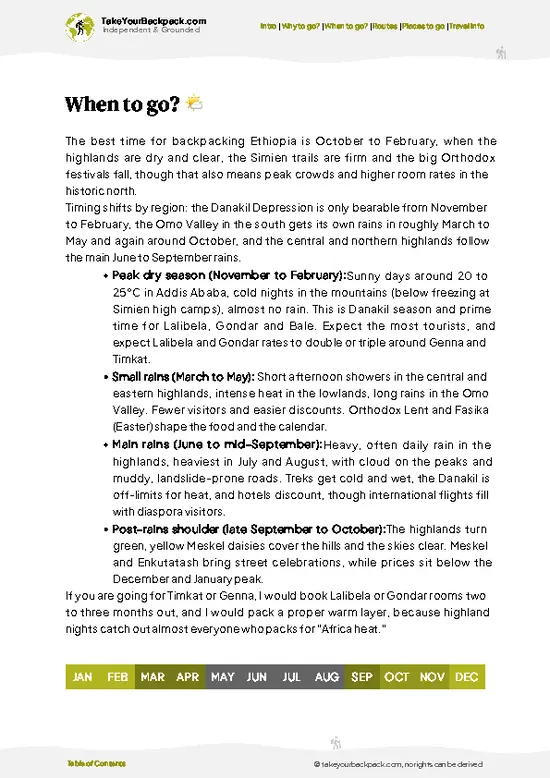
  • Dry Season (October to February): Sunny days of 18 to 22°C (64 to 72°F) and cold nights near 3 to 6°C (37 to 43°F), since Debre Berhan sits around 2,800 meters. Roads are easiest and fields glow green-gold after the rains.
  • Short Rains (March to May): Showers are light, prices stay low and crowds are thin.
  • Main Rains (June to September): Cool, wet and misty at 12 to 18°C (54 to 64°F). Dirt roads turn to mud.
  • Festivals: Timkat in January and Meskel in September draw crowds and push transport prices up.
Pack a warm jacket in every season, because the altitude chills evenings fast.

source: climatestotravel.comJANJanuary: highly recommended for travelingFEBFebruary: highly recommended for travelingMARMarch: fair for travelingAPRApril: below average for travelingMAYMay: below average for travelingJUNJune: good for travelingJULJuly: good for travelingAUGAugust: fair for travelingSEPSeptember: fair for travelingOCTOctober: excellent for travelingNOVNovember: good for travelingDECDecember: highly recommended for traveling
when-to-go

✈️ The backpacker research shortcutEthiopia Travel Guide

An offline-friendly backpacking guide with optimized travel routes, ranked highlights, transport advice, and the best areas to stay.
example page 0 from our offline Travel Guide for Ethiopia
example page 1 from our offline Travel Guide for Ethiopia
example page 2 from our offline Travel Guide for Ethiopia
example page 3 from our offline Travel Guide for Ethiopia
example page 4 from our offline Travel Guide for Ethiopia
example page 5 from our offline Travel Guide for Ethiopia
example page 6 from our offline Travel Guide for Ethiopia
example page 7 from our offline Travel Guide for Ethiopia
The digital guide (380 pages) contains:
✅ 98 highlights, ranked by travel appeal
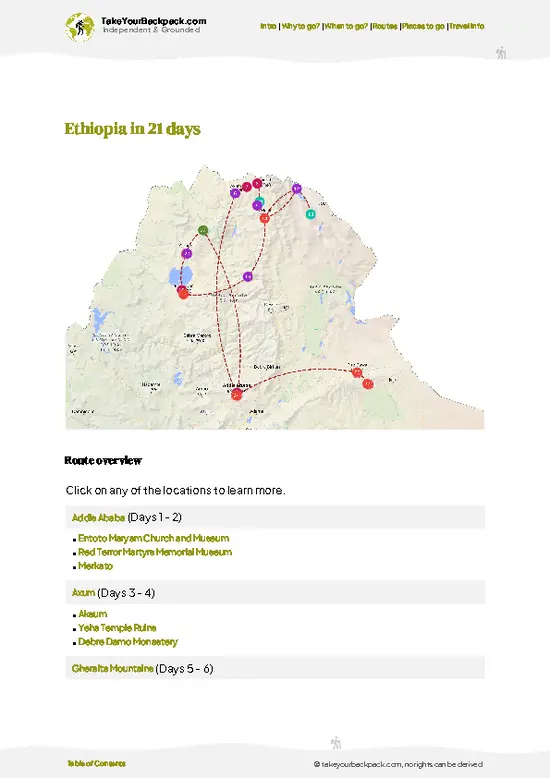
✅ Optimized 7, 14 & 21-day travel routes
✅ Cities, national parks, landmarks, beaches
✅ How to get around
✅ Offline-friendly for travel without Wi-Fi
👉 Click to see all 30+ guide features

📅 Plan smarter in minutes, not weeks
✅ Month by month travel advice
✅ Festivals & national holidays
✅ Budget expectations

🗺️ Go to the right places, skip the overrated ones
✅ Honest pros & cons of destinations
✅ Top hikes, parks & viewpoints
✅ Lesser-known places most travelers miss
✅ Clear “worth it vs skip it” guidance

🛏️ Travel smoothly without rookie mistakes
✅ Best areas to stay
✅ Transport systems explained simply
✅ Common scams & safety advice
✅ SIM cards, money & practical tips

🌍 Understand the country, not just visit it
✅ Culture & traditions
✅ 52 Essential phrases & customs
✅ Festivals worth planning around
✅ Traveler-friendly historical context
✅ Insights that make places more meaningful

📱 Built for real travel conditions
✅ Fully downloadable PDF
✅ Works completely offline
✅ Optimized for phone use
✅ Useful in remote areas & buses
✅ Everything in one place
Stop searching, start planning
Get instant access to your full guide. 30‑day money-back guarantee.
+ Add another guide for just

By proceeding you agree to our terms.
Sent to your inbox immediately after payment • 100% Secure Checkout
Best Backpacking Travel Advisor 2025 tourism awardBest Backpacking
Travel Advisor
2025
What others say about Take Your Backpack Guides:
⭐⭐⭐⭐⭐
Fantastic, amazing amount of information!
⭐⭐⭐⭐⭐
My goodness this is amazing, it's what I've been looking for hats off too you!
⭐⭐⭐⭐⭐
I think this is absolutely BRILLIANT
⭐⭐⭐⭐
Very complete and informative. It's still missing places, but I gotta to commend you
⭐⭐⭐⭐⭐
This is truly amazing, thank you, can't wait to explore it with my kids!
⭐⭐⭐⭐⭐
Awesome resource, thank you!
⭐⭐⭐⭐⭐
This is amazing! Can't wait to explore the ones I haven't seen
⭐⭐⭐⭐
I love this! Well done, great idea.
⭐⭐⭐⭐⭐
Thanks for taking the time to make this gem!
⭐⭐⭐⭐⭐
This might be the best website I've ever seen.
⭐⭐⭐⭐⭐
Congratulations, and thank you so much for your work; it's incredibly valuable.
⭐⭐⭐⭐
In all seriousness I think you did a great job pointing out the important spots
⭐⭐⭐⭐⭐
10/10 very good
⭐⭐⭐⭐⭐
As someone who's only just starting to visit regularly this is awesome, thank you.
⭐⭐⭐⭐
Thank you very much! I'm going to visit my dad, it's going to be very useful!
⭐⭐⭐⭐⭐
This is really cool! We'll be travelling for the first time and this definitely come in handy.
⭐⭐⭐⭐⭐
You are now our minister of culture, congratulations 👨‍💼
⭐⭐⭐⭐⭐
Just wanted to tell you that this is a pearl! Going to follow your recommendations.
⭐⭐⭐⭐⭐
This is so cool. I'll definitely be using the resource for my travels soon.
⭐⭐⭐⭐⭐
This is very impressive! Good work.
⭐⭐⭐⭐⭐
This is an amazing and informative site. Very well done!

🛏️ Where to stay?Choosing the right base

The area around the main road and central piazza is the best place for a budget bed in Debre Berhan. Cheap guesthouses and simple hotels cluster here, usually US$8 to 20 a night for a private room, and dorm hostels barely exist. Walking to cafés, the bus station and the market takes minutes, and the streets stay lit and busy into the evening. Noise is the downside, as minibus horns start before dawn and music from bars can carry late. Ask for a back room. A second option is the quieter streets toward the church, where rooms are calmer but you will need a bajaj after dark. Hot water is not guaranteed, … read more 👉
The area around the main road and central piazza is the best place for a budget bed in Debre Berhan. Cheap guesthouses and simple hotels cluster here, usually US$8 to 20 a night for a private room, and dorm hostels barely exist. Walking to cafés, the bus station and the market takes minutes, and the streets stay lit and busy into the evening. Noise is the downside, as minibus horns start before dawn and music from bars can carry late. Ask for a back room. A second option is the quieter streets toward the church, where rooms are calmer but you will need a bajaj after dark. Hot water is not guaranteed, and nights get cold, so check for blankets before booking.

🚌 Getting aroundMoving around without the hassle

Walking plus the occasional bajaj is the easiest way to get around Debre Berhan, because the center is flat enough and small enough to cross in 15 minutes. Traffic is mostly minibuses and three-wheelers honking along the highway, and dust hangs in the air in the dry months. Public transport is informal but dependable.
  • Walking: Free, and the best way to see the market and cafés. Mornings are crisp and cold, so layer up. Uphill streets near the church tire you at this altitude.
  • Bajaj (three-wheeler): Blue tuk-tuks cost roughly US$0.50 to 1.50 per ride within town. They rattle and smell of exhaust but save your legs, and they give the most for the money on short hops. Agree the fare before climbing in.
  • Minibus (taxi): Shared minibuses run fixed routes for under US$0.30 and fill up fast, so expect
… read more 👉
Walking plus the occasional bajaj is the easiest way to get around Debre Berhan, because the center is flat enough and small enough to cross in 15 minutes. Traffic is mostly minibuses and three-wheelers honking along the highway, and dust hangs in the air in the dry months. Public transport is informal but dependable.
  • Walking: Free, and the best way to see the market and cafés. Mornings are crisp and cold, so layer up. Uphill streets near the church tire you at this altitude.
  • Bajaj (three-wheeler): Blue tuk-tuks cost roughly US$0.50 to 1.50 per ride within town. They rattle and smell of exhaust but save your legs, and they give the most for the money on short hops. Agree the fare before climbing in.
  • Minibus (taxi): Shared minibuses run fixed routes for under US$0.30 and fill up fast, so expect tight seats. Gather at the main station early. Most leave from first light until about dusk.
  • Long-distance bus: Buses to Addis Ababa take about 2 to 3 hours for US$2 to 4 and run through the day. Minibuses to Addis leave when full, quicker but more cramped. Buses toward Dessie also pass through.

👛 Costs (as of 22 October 2026)Travel costs and budget guide for Debre Berhan

Debre Berhan costs about US$22 to 30 a day for a backpacker, which is cheap even by Ethiopian standards.
CategoryBudget RangeLocal Reality
Dorm (high season)US$8 to 12Dorms are rare, so expect a basic private room.
Dorm (off-season)US$6 to 9Rooms are cheaper from June to September.
MealsUS$5 to 8Local restaurants and street food.
Local transportUS$1 to 3Bajaj and minibus rides.
City transport passNot availableYou pay per ride in cash.
Activities/entry feesUS$3 to 8Church visits and market time.
MiscellaneousUS$2 to 4Water, snacks and data.
Total Daily BudgetUS$22 to 30Pay in birr, mostly in cash.
Eat where locals do and share minibus rides to save the most.
⚠️ Prices can change and everyone travels differently, so take this as a rough guide. Hope it helps you plan your adventure!

🚌 Day tripsBest day trips from Debre Berhan

Debre Berhan works well as a base for short outings, especially because Addis Ababa is two to three hours away and the highlands are on its doorstep.Ankober: Perched on an escarpment edge, Ankober was a medieval royal capital with dramatic views over the Rift Valley. It takes about 1.5 to 2 hours by minibus, costs around US$5 to 10 round trip, and is best from October to February. First-timers often leave too late and miss the last ride back.
Menz Guassa Community Conservation Area: High moorland where gelada monkeys graze and Ethiopian wolves sometimes appear. Plan 2 to 3 hours each way, with entry and a required scout around US$15 to 25, and a hired vehicle is usually easier than public transport. Come in the dry season, and bring a warm coat for 3,200 meters.
Debre Berhan Selassie Church … read more 👉
Debre Berhan works well as a base for short outings, especially because Addis Ababa is two to three hours away and the highlands are on its doorstep.Ankober: Perched on an escarpment edge, Ankober was a medieval royal capital with dramatic views over the Rift Valley. It takes about 1.5 to 2 hours by minibus, costs around US$5 to 10 round trip, and is best from October to February. First-timers often leave too late and miss the last ride back.
Menz Guassa Community Conservation Area: High moorland where gelada monkeys graze and Ethiopian wolves sometimes appear. Plan 2 to 3 hours each way, with entry and a required scout around US$15 to 25, and a hired vehicle is usually easier than public transport. Come in the dry season, and bring a warm coat for 3,200 meters.
Debre Berhan Selassie Church Area and Nearby Villages: A short ride out gives you weaving villages and a quiet countryside walk. Costs stay under US$5.

🍲 FoodLocal Flavors for Backpackers

Debre Berhan is known for its highland lamb and barley, and the cold climate shapes the menu. Try genfo, a thick barley or wheat porridge with spiced butter, a warming breakfast, and kitfo served here with fresh cottage cheese. Tej, the honey wine, is often homemade, and you can drink it in simple local bars. Look for macchiato in the cafés along the main road, fresh and sweet. Markets sell fresh bread and roasted barley kolo snacks for pennies. Meals at casual local restaurants run roughly US$1.50 to 4, and tibs sizzling on a clay brazier smells irresistible on a cold evening.

🛡️ SafetySafety Tips and Common Scams in Debre Berhan

Debre Berhan is calm, and most problems are small. Pickpocketing in the crowded Saturday market and around the bus station is the main risk, so keep your phone in a front pocket. Solo travelers, including women, generally feel comfortable, though streets are dark after about 8 pm and a bajaj beats walking. Expect persistent offers from children or touts selling things, and agree prices for rides ahead of time. Altitude can cause mild headaches on arrival, so drink water. Stray dogs roam at night, so avoid dark lanes.

FAQCommon questions from travelers

Two days is enough for Debre Berhan, with one day for the market and the church and another for Ankober, about 1.5 to 2 hours away. Add a third day if you want Menz Guassa at around 3,200 meters. Debre Berhan sits about two to three hours from Addis Ababa by bus.
Yes, Debre Berhan is comfortable for solo backpackers, including women. Petty theft in the Saturday market and bus station is the main concern, so keep valuables in front pockets. Streets are dark after about 8 pm, so take a bajaj, which costs US$0.50 to 1.50.
Debre Berhan is known for its altitude of about 2,800 meters, its cold climate and its handwoven wool blankets. It is also known as a historic city founded in the 15th century by Emperor Zara Yaqob, and for Debre Berhan Selassie Church. Menz Guassa and Ankober are the main nearby draws.
⚠️ Things can change over time, so always validate details locally before you go.

Other Ethiopian cities near Debre Berhan

Explore more nearby:

  • Addis Ababa—Mercato market, national museums, Entoto hills, diplomatic quarter| 113 km away
  • Bishoftu—Crater lakes, resort lodges, birdwatching spots| 120 km away
  • Adama—Hot springs, transport hub, modern hotels| 131 km away

💡 Not sure where to go next?
Create a personalized itinerary for Ethiopia including Debre Berhan and the places that fit your trip.

Generate my itinerary

👉 Discover all cities

Or checkout all Ethiopia has to offer (think cities, towns, villages, national parks, hikes, beaches, festivals)
Country photo of Ethiopia

We 💚 feedbackIs it worth it?

Debre Berhan is best in the early morning, when church bells carry across the cold air and the market is just waking up. I would stay one night, bring a warm jacket and leave the next morning after coffee. It is not a big destination, and that is the appeal.

✈️ When did I visit Ethiopia?
Ethiopia I visited back in October 2017. I combined the trip with a visit to Sudan. Ethiopia was a pure surprise with the magical scenery like the Danakil Depression and the Simien Mountains.

✍️ Help improve this page!
The information on this page is based on my own backpacking experience in Ethiopia, supplemented with up-to-date research and feedback from other travelers. Travel details can change, so if you notice anything outdated or incomplete, feel free to let me know.


🙋‍♂️ Give feedback

👋 Meet the founderWho’s Behind Take Your Backpack?

Johan, backpacker and founder of TakeYourBackpackHi, I’m Johan (Netherlands 🇳🇱), the creator of TakeYourBackpack. Over the past 3 decades, I’ve backpacked through 90+ countries across six continents, gaining extensive experience with independent travel, long-term trips, and overland routes.

This site is built on a combination of firsthand travel experience and carefully curated insights from other backpackers. Many guides are based on places I’ve personally visited, while others bring together tips, observations, and practical advice shared by trusted travelers I’ve met along the way.

The goal is to provide realistic, experience-driven guidance — not generic itineraries — so you can explore destinations with better context, clearer expectations, and more confidence.