×

Finland🇫🇮 | best beachesDiscover the 5 Best beaches Across Finland

Beaches in Finland are freshwater and brackish more often than salty: pale sand and pine needles on lake shores, granite slabs warm underfoot on the Baltic archipelago, and a wide, shallow Gulf of Finland where the water takes weeks to warm. Expect the smell of resin and wet stone, the whine of mosquitoes at dusk, and light that lingers past 10 p.m. in summer. The south coast is busiest and easiest to reach by train and bus. Lakeland beaches are quieter, often free, and suit independent travelers with a bike or rental car. Lapland shores are wild and nearly empty. Water is cold, even in July.

By Johan Kruseman 🇳🇱 | Updated October 19, 2026
Explore the best attractions in Finland

Why go?Understanding Their Importance

Finland has roughly 188,000 lakes and tens of thousands of islands, so water access is built into daily life rather than concentrated in resort strips. The Right of Public Access (jokamiehenoikeus) lets you swim, walk and camp briefly on most shores without paying, which is why many beaches have no ticket booth, no loungers and no vendors. What you get instead is a changing hut, a timber sauna and a jetty. Municipal beaches often have lifeguard-free swimming, a kiosk selling ice cream and coffee, and clean toilets.

The sauna culture shapes everything. Finns warm up in 80 to 100°C heat, then jump into the lake, so a 17°C swim feels normal rather than extreme. Granite, glacial sand and soft brown lake water (colored by peat) give beaches a texture unlike tropical ones: smooth rock, fine sand … read more 👉
Finland has roughly 188,000 lakes and tens of thousands of islands, so water access is built into daily life rather than concentrated in resort strips. The Right of Public Access (jokamiehenoikeus) lets you swim, walk and camp briefly on most shores without paying, which is why many beaches have no ticket booth, no loungers and no vendors. What you get instead is a changing hut, a timber sauna and a jetty. Municipal beaches often have lifeguard-free swimming, a kiosk selling ice cream and coffee, and clean toilets.

The sauna culture shapes everything. Finns warm up in 80 to 100°C heat, then jump into the lake, so a 17°C swim feels normal rather than extreme. Granite, glacial sand and soft brown lake water (colored by peat) give beaches a texture unlike tropical ones: smooth rock, fine sand that squeaks, reeds rustling at the edge.

Before choosing Finland for beaches, know that the swimming season is short, sea temperatures stay modest, and you should not expect surf, reef or all-night beach bars. Midsummer brings long, soft evenings. Mosquitoes, midges and occasional blue-green algae are part of the deal. If you want warm turquoise water, go elsewhere. If you want quiet, clean water and a sauna afterward, Finland is hard to beat.
Our Approach to Ranking
The list of best beaches in Finland is created based on beauty, vibe, water quality, activities, and surrounding scenery. If you feel a beach is missing in this list, please let us know.

When to go?Optimal Periods for Travel

Best months for beach days: The best months for beaches in Finland are late June to mid-August, when daytime air reaches 20 to 25°C, lakes warm to roughly 18 to 22°C and daylight stretches to 18 to 19 hours in the south. Midsummer weekend (around June 20 to 26) is the national exodus: city streets empty, cottages fill, and lakeside buses and campsites book out, so reserve ahead. July is the warmest and the busiest, with the most open kiosks and cafés.

Shoulder seasons and what closes: In late May and early June the water sits at 8 to 14°C, birch leaves are bright green and the crowds are thin, but many seasonal kiosks and lifeguarded sites are not yet open. In late August and early September the lakes are still around 14 to 17°C, evenings grow dark by 8 to 9 p.m., and the mosquitoes ease. … read more 👉
Best months for beach days: The best months for beaches in Finland are late June to mid-August, when daytime air reaches 20 to 25°C, lakes warm to roughly 18 to 22°C and daylight stretches to 18 to 19 hours in the south. Midsummer weekend (around June 20 to 26) is the national exodus: city streets empty, cottages fill, and lakeside buses and campsites book out, so reserve ahead. July is the warmest and the busiest, with the most open kiosks and cafés.

Shoulder seasons and what closes: In late May and early June the water sits at 8 to 14°C, birch leaves are bright green and the crowds are thin, but many seasonal kiosks and lifeguarded sites are not yet open. In late August and early September the lakes are still around 14 to 17°C, evenings grow dark by 8 to 9 p.m., and the mosquitoes ease. Prices for cabins and campsites drop outside July. Rain is spread through the summer, around 50 to 80 mm a month, usually in short showers.

Regional differences: The south and southwest coast warms earliest. Lakeland gets the warmest, calmest water in July. Lapland has a shorter window, mainly July, when the midnight sun lights the shore, but mosquitoes peak then. From October to April, shores are frozen or snow-covered.

beach hoppingSuggested Travel Strategies

How many days to allow: A trip combining several beaches in Finland needs 7 to 12 days, which allows two to three regions without constant transfers. Give each stop 1 to 3 nights: one night barely covers the walk, swim and sauna that make a beach day work, while more than three rarely adds much unless you are renting a cottage.

Which regions group well: The south coast and archipelago around Helsinki, Porvoo, Hanko and Turku cluster tightly. Trains and buses link them in 1 to 2.5 hours, and ferries connect Turku with the islands. Lakeland (Tampere, Jyväskylä, Savonlinna, Kuopio) sits 2 to 5 hours north and east by train or bus. Heading from the coast inland and then north works best, because the water in the Lakeland warms later in spring and stays warm into August. Lapland is a separate … read more 👉
How many days to allow: A trip combining several beaches in Finland needs 7 to 12 days, which allows two to three regions without constant transfers. Give each stop 1 to 3 nights: one night barely covers the walk, swim and sauna that make a beach day work, while more than three rarely adds much unless you are renting a cottage.

Which regions group well: The south coast and archipelago around Helsinki, Porvoo, Hanko and Turku cluster tightly. Trains and buses link them in 1 to 2.5 hours, and ferries connect Turku with the islands. Lakeland (Tampere, Jyväskylä, Savonlinna, Kuopio) sits 2 to 5 hours north and east by train or bus. Heading from the coast inland and then north works best, because the water in the Lakeland warms later in spring and stays warm into August. Lapland is a separate trip: Helsinki to Rovaniemi is about 8 to 12 hours by train or 1.5 hours by plane.

Planning mistakes: The most common error is relying on public transport to lakeshore sites. Rural buses run a few times a day, or not at all on Sundays, so check schedules and book a rental car or bike for lake stops. Another is packing too many regions into a week. Pick two, and allow slack for rain and for the long, slow evenings. Buses may not match train arrivals, so build in a buffer of an hour or two.

The ListMust-Visit beaches in Finland

1 Yyteri Beach

endless dunes, birdwatching towers, surf spots

Walk for hours along rolling dunes, watch migratory birds from observation towers, or try windsurfing on exposed, breezy waters.

finland-beach-yyteri-beach
© Google | Pasi Pulkkinen

2 Kalajoen Hiekkasärkät

dune landscape, long boardwalk, summer cottages

Walk along expansive dunes and wooden paths, with easy access to rental cabins and a coastline that stretches for kilometers.

finland-beach-kalajoen-hiekkasarkat
© Google |

3 Nallikari Beach

wide sands, Baltic Sea, camping grounds

Spend a day on broad, open sand with easy access to campsites and gentle waves, drawing both locals and travelers to Oulu’s coast.

4 Hietaniemi Beach

urban shoreline, volleyball courts, city skyline

Join locals on soft sand just steps from Helsinki’s center, where city life meets relaxed sunbathing and casual outdoor sports.

finland-beach-hietaniemi-beach
© Google | Risto Tuomarla

5 Huuhanranta

forest edge, secluded sands, shallow lake

Relax on a quiet stretch of sand bordered by pine woods and gentle lake waters, ideal for peaceful swimming and picnics away from crowds.

finland-beach-huuhanranta
© Google |
Loading the map 🌍

Expert viewExpert Commentary on beaches

How many beaches to visit: Three to five beach stops is the right number for most trips. Finnish beaches are about slow time: the swim, the sauna, the long evening light. Visiting more than one a day means you spend your hours on buses, and the water here is cold enough that you will want to dry off, warm up and eat before moving on. Five stops over a week or more keeps it relaxed.

Choosing by travel style: First-timers and those on a tight schedule should prioritize south coast and archipelago beaches, which have trains, ferries, cafés and lifeguarded swimming areas. If you want quiet and rental-bike freedom, choose Lakeland shores, where the water is soft and brown from peat and often warmer than the sea. For solitude, Lapland and national park shores suit hikers with a tent, but expect … read more 👉
How many beaches to visit: Three to five beach stops is the right number for most trips. Finnish beaches are about slow time: the swim, the sauna, the long evening light. Visiting more than one a day means you spend your hours on buses, and the water here is cold enough that you will want to dry off, warm up and eat before moving on. Five stops over a week or more keeps it relaxed.

Choosing by travel style: First-timers and those on a tight schedule should prioritize south coast and archipelago beaches, which have trains, ferries, cafés and lifeguarded swimming areas. If you want quiet and rental-bike freedom, choose Lakeland shores, where the water is soft and brown from peat and often warmer than the sea. For solitude, Lapland and national park shores suit hikers with a tent, but expect cold water and strong mosquito pressure.

What it costs: Most public beaches are free, because of the Right of Public Access. Budget US$55 to 90 a day (about €50 to 80) if you camp or use hostels, cook some meals and use buses. Ferry rides to islands cost roughly €5 to 25 return. Rental bikes run about €15 to 30 a day, and a rental car €50 to 90. Public saunas and spas charge around €10 to 20. A kiosk coffee and pastry is typically €5 to 8. Camping in a campground costs about €15 to 30 a night. Free wild camping is allowed for one night away from houses and not on private yards.

Safety and etiquette: Cold water is the main hazard. Water at 12 to 16°C can cause cold shock, so enter slowly, stay near shore and never swim alone far out. Most beaches have no lifeguard, and many have no phone signal on remote shores, so tell someone your plan. Check local reports for blue-green algae, which appears in warm July and August weeks and can irritate skin; do not swim if the water looks like green paint. Mosquitoes and ticks are routine: bring repellent and check your skin after walking through grass.

Culturally, quiet is the norm. Finns keep personal space on the sand, speak softly and do not play loud music. Nudity is common in saunas, usually separated by gender in public ones, and swimsuits are not worn in traditional ones, so follow the signs. Leave no trash and do not light fires except in marked places, especially in dry summers when a forest-fire warning may be in force. Pay by card nearly everywhere, because cash is rarely used.

✈️ The backpacker research shortcutFinland Travel Guide

An offline-friendly backpacking guide with optimized travel routes, ranked highlights, transport advice, and the best areas to stay.
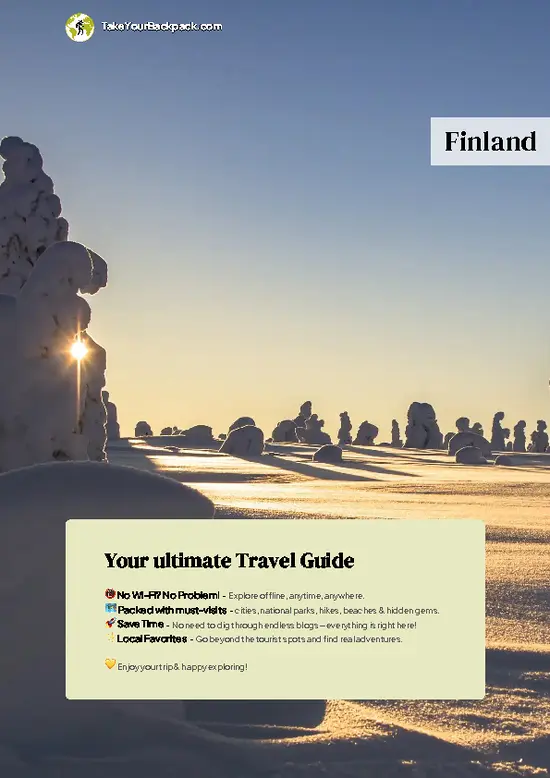
example page 0 from our offline Travel Guide for Finland
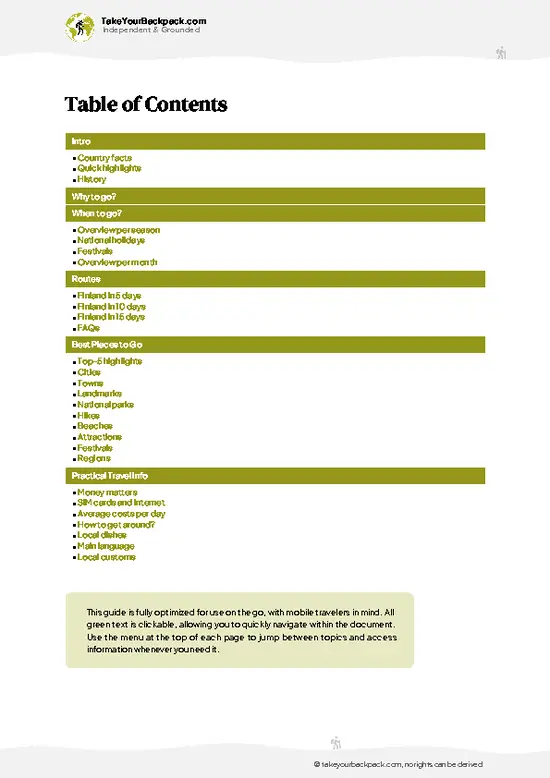
example page 1 from our offline Travel Guide for Finland
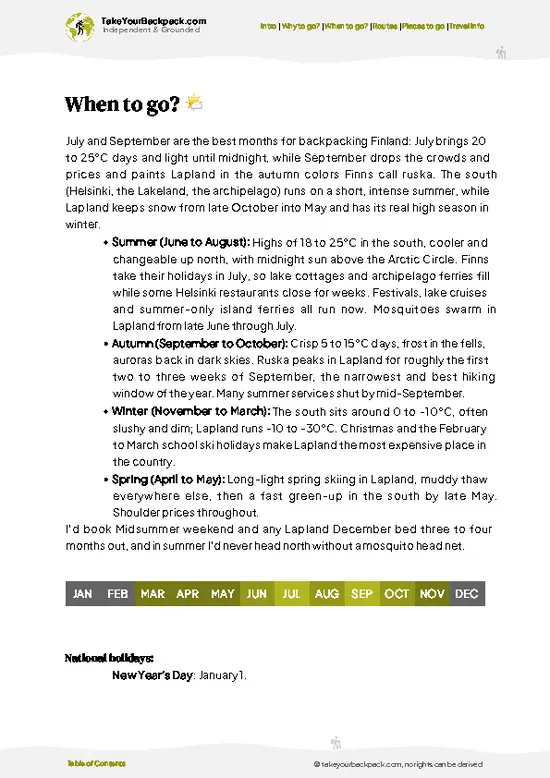
example page 2 from our offline Travel Guide for Finland
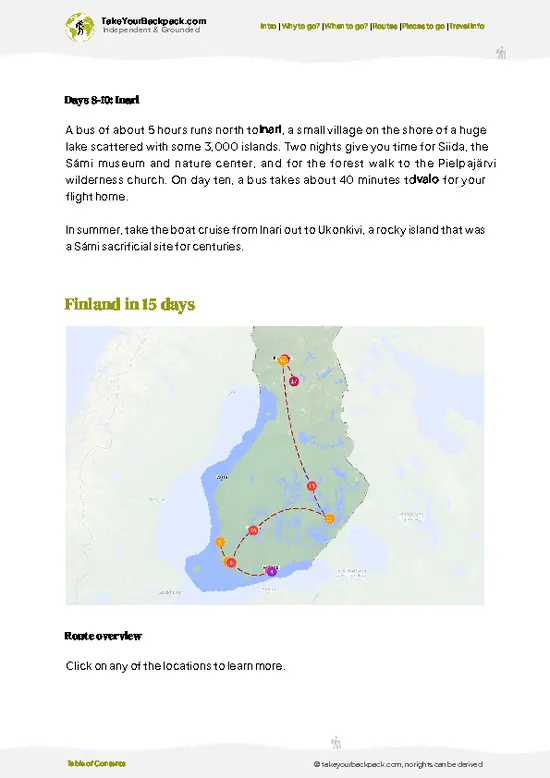
example page 3 from our offline Travel Guide for Finland
example page 4 from our offline Travel Guide for Finland
example page 5 from our offline Travel Guide for Finland
example page 6 from our offline Travel Guide for Finland
example page 7 from our offline Travel Guide for Finland
The digital guide (341 pages) contains:
✅ 87 highlights, ranked by travel appeal
✅ Optimized 5, 10 & 15-day travel routes
✅ Cities, national parks, landmarks, beaches
✅ How to get around
✅ Offline-friendly for travel without Wi-Fi
👉 Click to see all 30+ guide features

📅 Plan smarter in minutes, not weeks
✅ Month by month travel advice
✅ Festivals & national holidays
✅ Budget expectations

🗺️ Go to the right places, skip the overrated ones
✅ Honest pros & cons of destinations
✅ Top hikes, parks & viewpoints
✅ Lesser-known places most travelers miss
✅ Clear “worth it vs skip it” guidance

🛏️ Travel smoothly without rookie mistakes
✅ Best areas to stay
✅ Transport systems explained simply
✅ Common scams & safety advice
✅ SIM cards, money & practical tips

🌍 Understand the country, not just visit it
✅ Culture & traditions
✅ 52 Essential phrases & customs
✅ Festivals worth planning around
✅ Traveler-friendly historical context
✅ Insights that make places more meaningful

📱 Built for real travel conditions
✅ Fully downloadable PDF
✅ Works completely offline
✅ Optimized for phone use
✅ Useful in remote areas & buses
✅ Everything in one place
Stop searching, start planning
Get instant access to your full guide. 30‑day money-back guarantee.
+ Add another guide for just

By proceeding you agree to our terms.
Sent to your inbox immediately after payment • 100% Secure Checkout
Best Backpacking Travel Advisor 2025 tourism awardBest Backpacking
Travel Advisor
2025
What others say about Take Your Backpack Guides:
⭐⭐⭐⭐⭐
Fantastic, amazing amount of information!
⭐⭐⭐⭐⭐
My goodness this is amazing, it's what I've been looking for hats off too you!
⭐⭐⭐⭐⭐
I think this is absolutely BRILLIANT
⭐⭐⭐⭐
Very complete and informative. It's still missing places, but I gotta to commend you
⭐⭐⭐⭐⭐
This is truly amazing, thank you, can't wait to explore it with my kids!
⭐⭐⭐⭐⭐
Awesome resource, thank you!
⭐⭐⭐⭐⭐
This is amazing! Can't wait to explore the ones I haven't seen
⭐⭐⭐⭐
I love this! Well done, great idea.
⭐⭐⭐⭐⭐
Thanks for taking the time to make this gem!
⭐⭐⭐⭐⭐
This might be the best website I've ever seen.
⭐⭐⭐⭐⭐
Congratulations, and thank you so much for your work; it's incredibly valuable.
⭐⭐⭐⭐
In all seriousness I think you did a great job pointing out the important spots
⭐⭐⭐⭐⭐
10/10 very good
⭐⭐⭐⭐⭐
As someone who's only just starting to visit regularly this is awesome, thank you.
⭐⭐⭐⭐
Thank you very much! I'm going to visit my dad, it's going to be very useful!
⭐⭐⭐⭐⭐
This is really cool! We'll be travelling for the first time and this definitely come in handy.
⭐⭐⭐⭐⭐
You are now our minister of culture, congratulations 👨‍💼
⭐⭐⭐⭐⭐
Just wanted to tell you that this is a pearl! Going to follow your recommendations.
⭐⭐⭐⭐⭐
This is so cool. I'll definitely be using the resource for my travels soon.
⭐⭐⭐⭐⭐
This is very impressive! Good work.
⭐⭐⭐⭐⭐
This is an amazing and informative site. Very well done!

🛏️ Where to stay?Where to Base Yourself

Finland has a solid hostel network, with dorm beds typically €30 to €45 a night in Helsinki and less in smaller cities, plus summer-only hostels set up in student housing from June to August. In Helsinki, Kamppi and the streets around the Central Station put you within walking distance of the main sights and the airport train but cost the most, Kallio is cheaper and has the city’s liveliest bar scene with louder weekend nights, and Punavuori is quieter, with design shops and cafés about 15 minutes’ walk from the center. Outside the capital, the central districts of Turku, Tampere and Rovaniemi hold most budget beds, all of them safe, though Rovaniemi books out and gets pricey around Christmas. … read more 👉
Finland has a solid hostel network, with dorm beds typically €30 to €45 a night in Helsinki and less in smaller cities, plus summer-only hostels set up in student housing from June to August. In Helsinki, Kamppi and the streets around the Central Station put you within walking distance of the main sights and the airport train but cost the most, Kallio is cheaper and has the city’s liveliest bar scene with louder weekend nights, and Punavuori is quieter, with design shops and cafés about 15 minutes’ walk from the center. Outside the capital, the central districts of Turku, Tampere and Rovaniemi hold most budget beds, all of them safe, though Rovaniemi books out and gets pricey around Christmas.

If you enjoy meeting fellow travelers, consider choosing hostels with high ratings for atmosphere. On the other hand, if you prefer having your own space, a hotel might be a better option.

FinlandExpand Your Journey

👋 Meet the founderWho’s Behind Take Your Backpack?

Johan, backpacker and founder of TakeYourBackpackHi, I’m Johan (Netherlands 🇳🇱), the creator of TakeYourBackpack. Over the past 3 decades, I’ve backpacked through 90+ countries across six continents, gaining extensive experience with independent travel, long-term trips, and overland routes.

This site is built on a combination of firsthand travel experience and carefully curated insights from other backpackers. Many guides are based on places I’ve personally visited, while others bring together tips, observations, and practical advice shared by trusted travelers I’ve met along the way.

The goal is to provide realistic, experience-driven guidance — not generic itineraries — so you can explore destinations with better context, clearer expectations, and more confidence.