×

Finland🇫🇮 | best attractionsDiscover the 12 Best attractions Across Finland

Finland’s attractions are mostly nature first, built sights second. Expect birch and pine forest, lakes that smell of cold stone and resin, and wood-smoke saunas, rather than a checklist of monuments. The south has Helsinki’s sea-fortress and design scene, with tram bells, gull cries and the highest prices. The Lakeland middle is quieter, with ferries and cabin shores. Lapland in the north brings squeaking snow, reindeer and long distances between stops. Independent travelers get far on trains and buses in the south, but need a car or tours to go north. Crowds stay thin outside Helsinki and the winter hotspots, and entry is often free in nature.

By Johan Kruseman 🇳🇱 | Updated October 19, 2026
Explore the best festivals in Finland

Why go?Understanding Their Importance

Finland suits attractions built around space, silence and weather. About three quarters of the country is forest, there are roughly 180,000 lakes, and the population of around 5.6 million is concentrated in the south. That leaves vast stretches where the loudest sound is wind in the spruce and the air carries sap, peat and lake water. Everyman’s Right (jokamiehenoikeus) lets anyone walk, ski, swim and pick berries on most land, so many of the best experiences cost nothing and have no ticket gate.

The climate shapes everything. Summer brings near-constant light in the north and the midnight sun, while winter brings darkness, dry snow and the aurora, with temperatures that can drop below -20°C. Culture is just as distinctive: sauna is a daily habit, with roughly three million saunas in the … read more 👉
Finland suits attractions built around space, silence and weather. About three quarters of the country is forest, there are roughly 180,000 lakes, and the population of around 5.6 million is concentrated in the south. That leaves vast stretches where the loudest sound is wind in the spruce and the air carries sap, peat and lake water. Everyman’s Right (jokamiehenoikeus) lets anyone walk, ski, swim and pick berries on most land, so many of the best experiences cost nothing and have no ticket gate.

The climate shapes everything. Summer brings near-constant light in the north and the midnight sun, while winter brings darkness, dry snow and the aurora, with temperatures that can drop below -20°C. Culture is just as distinctive: sauna is a daily habit, with roughly three million saunas in the country, and swimming in a hole cut through lake ice is part of normal life.

Before choosing Finland, know that it is expensive, with restaurant meals and lodging well above southern European levels. Distances are long, and the museums and heritage sites are modest in number compared with Central Europe. Many smaller sites close or shorten hours outside summer. Travelers who want castles and cathedrals every day will be happier elsewhere. Those who want wilderness, lake and sea will be satisfied.
Behind the Scenes of Selection
The list of best attractions in Finland is created based on cultural significance or entertainment value. If you feel a attraction is missing in this list, please let us know.

When to go?Optimal Periods for Travel

Best months and seasons: Plan for June to August for most attractions, because nearly everything is open, days run 18 to 24 hours in the north, and daytime temperatures sit around 15 to 25°C. The air smells of cut grass and lake water, and mosquitoes are thick in Lapland from late June to early August. Rain is moderate, with roughly 50 to 80 mm a month, usually in short showers.

Shoulder seasons: May and September are quieter and cheaper, with accommodation often 15 to 30 percent below July rates. September brings ruska, the autumn color season in Lapland, with crisp air at 5 to 12°C and the first aurora displays. Some island ferries, seasonal cottages and small museums run reduced hours or close in these months.

Winter: December to March is the second peak, centered on Lapland, where snow … read more 👉
Best months and seasons: Plan for June to August for most attractions, because nearly everything is open, days run 18 to 24 hours in the north, and daytime temperatures sit around 15 to 25°C. The air smells of cut grass and lake water, and mosquitoes are thick in Lapland from late June to early August. Rain is moderate, with roughly 50 to 80 mm a month, usually in short showers.

Shoulder seasons: May and September are quieter and cheaper, with accommodation often 15 to 30 percent below July rates. September brings ruska, the autumn color season in Lapland, with crisp air at 5 to 12°C and the first aurora displays. Some island ferries, seasonal cottages and small museums run reduced hours or close in these months.

Winter: December to March is the second peak, centered on Lapland, where snow is reliable from late November and temperatures run -5 to -25°C. Prices for lodging and tours around Christmas and February can double. Daylight in the far north is only a few hours in midwinter, and in the south it stays dark, wet and gray, with slushy streets in November. April and late October are the weakest months, with thawing or freezing ground, patchy snow and many closures.

attraction hoppingSuggested Travel Strategies

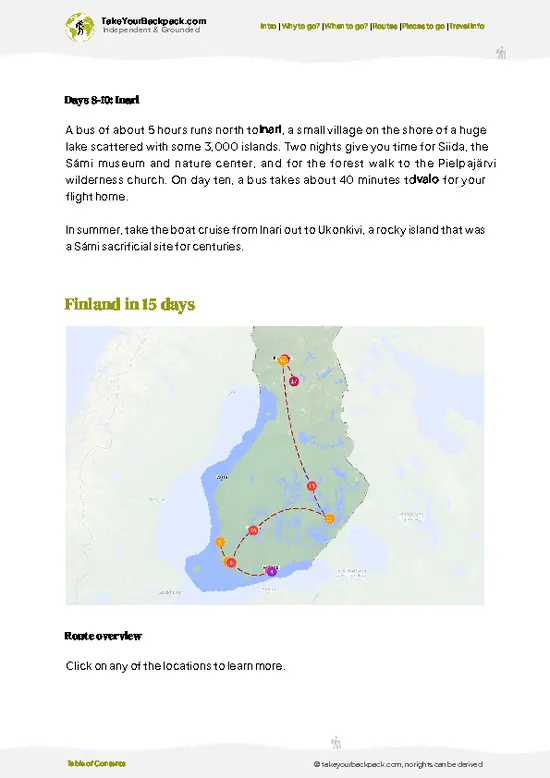
Pacing a multi-stop trip: A trip combining several attractions in Finland needs 10 to 14 days, because the distances are large and the roads and trains are slow. Start in Helsinki and move gradually north. Group the south coast, with Helsinki and Turku, in about 3 to 4 days. Then take the train or bus into the Lakeland around Tampere, Savonlinna or Kuopio, giving it 3 to 4 days. Finish in Lapland around Rovaniemi, giving it 3 to 5 days. This order puts the longest journey last, so you can fly or take the night train back south.

Travel times add up. Helsinki to Tampere takes about 1.5 to 2 hours by train. Helsinki to Kuopio takes around 4.5 to 5 hours. Helsinki to Rovaniemi takes about 8 to 12 hours by train, including the overnight service, or about 1.5 hours by plane. Within Lapland, buses … read more 👉
Pacing a multi-stop trip: A trip combining several attractions in Finland needs 10 to 14 days, because the distances are large and the roads and trains are slow. Start in Helsinki and move gradually north. Group the south coast, with Helsinki and Turku, in about 3 to 4 days. Then take the train or bus into the Lakeland around Tampere, Savonlinna or Kuopio, giving it 3 to 4 days. Finish in Lapland around Rovaniemi, giving it 3 to 5 days. This order puts the longest journey last, so you can fly or take the night train back south.

Travel times add up. Helsinki to Tampere takes about 1.5 to 2 hours by train. Helsinki to Kuopio takes around 4.5 to 5 hours. Helsinki to Rovaniemi takes about 8 to 12 hours by train, including the overnight service, or about 1.5 hours by plane. Within Lapland, buses are infrequent and a rental car or organized transfer is often needed.

Common planning mistakes: The biggest error is trying to cover the whole country in a week, which means whole days spent in vehicles. Pick two regions and go deeper instead. Another is underestimating winter darkness and summer closures, so check opening hours before fixing a date. Travelers also book tight connections on rural buses. Leave a buffer day before any flight home.

The ListMust-Visit attractions in Finland

1 Santa Claus Village

Arctic Circle, Christmas traditions, year-round festivities

Cross the Arctic Circle and meet Santa in a themed village offering postal services, souvenir shops, and seasonal activities.

finland-attraction-santa-claus-village
© Google |

2 Olavinlinna Castle

medieval fortress, lakeside setting, stone towers

Wander through centuries-old halls and ramparts surrounded by water, discovering the castle’s role in Nordic military history.

finland-attraction-olavinlinna-castle
© Google |

3 Temppeliaukio Rock Church

quarried stone, copper dome, natural acoustics

Step into a church carved from solid rock, where sunlight and sound create a distinctive atmosphere for concerts and quiet visits.

finland-attraction-temppeliaukio-rock-church
© Google |

4 Turku Castle

Renaissance halls, medieval dungeons, riverbank location

Tour restored chambers and vaulted cellars in a fortress that has witnessed royal courts, sieges, and centuries of Finnish history.

finland-attraction-turku-castle
© Google |

5 Arktikum

glass corridor, Arctic research, Northern cultures

Experience Arctic phenomena and Sámi heritage through interactive displays and panoramic views that highlight the region’s scientific and cultural narratives.

6 Ateneum Art Museum

Finnish classics, 19th-century paintings, national art collection

Survey the evolution of Finnish visual arts from iconic golden age works to modern pieces in a landmark institution at the city’s heart.

finland-attraction-ateneum-art-museum
© Google |

7 Kiasma Museum of Contemporary Art

avant-garde exhibitions, striking architecture, new media art

Engage with provocative works and experimental installations in a building designed to challenge conventional museum experiences.

8 Ranua Wildlife Park

Arctic animals, forest trails, natural habitats

Observe native species such as polar bears and lynx in spacious enclosures set within boreal forest landscapes.

finland-attraction-ranua-wildlife-park
© Google |

9 Seurasaari Open-Air Museum

historic wooden buildings, island setting, folk traditions

Stroll among relocated rural structures and learn about Finnish lifestyles through demonstrations and guided walks on a wooded island.

10 Amos Rex

underground galleries, modern architecture, immersive installations

Descend beneath the city to encounter contemporary art in a subterranean setting where innovative exhibitions reshape your sense of space.

11 Helsinki Design Museum

Scandinavian design, industrial objects, design history

Trace the impact of Finnish creativity through curated objects and thematic exhibitions that reveal the country’s influence on global design.

12 Finnish National Theatre

granite façade, Finnish drama, central square

Attend performances in a historic venue where national identity and dramatic arts converge beside the city’s main railway station.

Loading the map 🌍

Expert viewExpert Commentary on attractions

How many attractions to plan: Plan one or two main attractions per region, so five to eight on a two-week trip. Finland rewards time spent in one place: a sauna, a lake swim, a forest walk. Travel days are long, light changes by the hour, and rushing wastes the quiet that people come for. Long gaps between stops also mean that adding a third sight in a day usually costs a full afternoon in transit.

Choosing between kinds of attractions: If you are on a tight budget, prioritize nature, since Everyman’s Right makes hiking, swimming, foraging and wild camping free. Those who like culture and design should concentrate on Helsinki, where museums are concentrated and the Helsinki Card or museum passes can save money if you visit three or more paid sites. Winter-experience seekers should accept … read more 👉
How many attractions to plan: Plan one or two main attractions per region, so five to eight on a two-week trip. Finland rewards time spent in one place: a sauna, a lake swim, a forest walk. Travel days are long, light changes by the hour, and rushing wastes the quiet that people come for. Long gaps between stops also mean that adding a third sight in a day usually costs a full afternoon in transit.

Choosing between kinds of attractions: If you are on a tight budget, prioritize nature, since Everyman’s Right makes hiking, swimming, foraging and wild camping free. Those who like culture and design should concentrate on Helsinki, where museums are concentrated and the Helsinki Card or museum passes can save money if you visit three or more paid sites. Winter-experience seekers should accept that Lapland activities such as husky rides, snowmobiling and aurora tours are the costly part of the trip. Book those few and fill other days with free walks and saunas.

What it costs: A budget backpacker can manage on €60 to 90 a day with hostel dorms (€30 to 50), self-catering from supermarkets such as K-Market and Lidl, and mostly free outdoor activities. Mid-range travelers should expect €120 to 200. Museums and castles usually charge €10 to 25. National park entry is free, though some have paid huts or boat transfers of about €10 to 40. Guided activities in Lapland run €90 to 250 per person for a half-day. Intercity trains vary from €15 to 70 depending on advance booking.

Safety and etiquette: Finland is very safe, and crime at attractions is low. The real hazards are weather and cold. Wear layers, wool and a windproof shell, and carry a charged phone and a map in remote areas. Ice that looks solid may not be, so only walk on lakes where locals are clearly doing so or where marked. In forests, ticks are common from spring to autumn, so check your skin and clothing. Mosquitoes in northern summer are fierce, so carry repellent.

Culturally, Finns value quiet and personal space. Silence in a sauna or on a trail is normal, not rude, and loud groups stand out. In public saunas, follow the local rule of showering first and using the towel or seat cover provided. Mixed-gender saunas are usually swimsuit-optional only if signed, so check. Fires are only permitted in designated places, and wild camping excludes private yards and some protected areas.

✈️ The backpacker research shortcutFinland Travel Guide

An offline-friendly backpacking guide with optimized travel routes, ranked highlights, transport advice, and the best areas to stay.
example page 0 from our offline Travel Guide for Finland
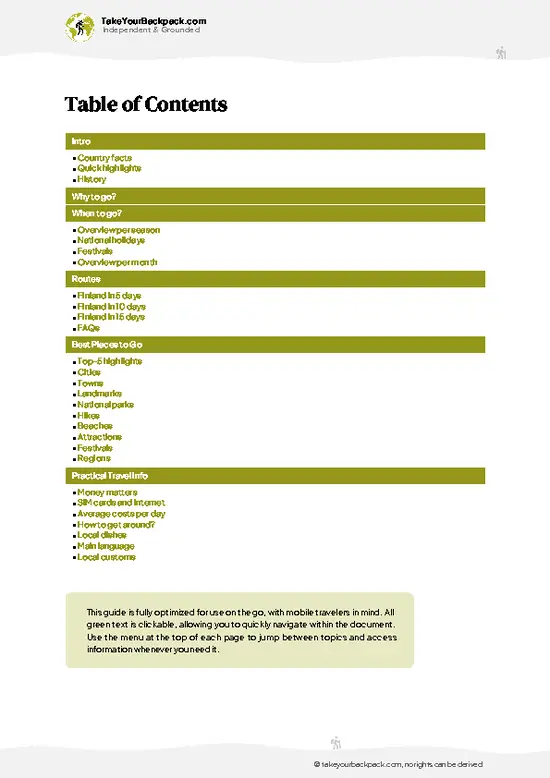
example page 1 from our offline Travel Guide for Finland
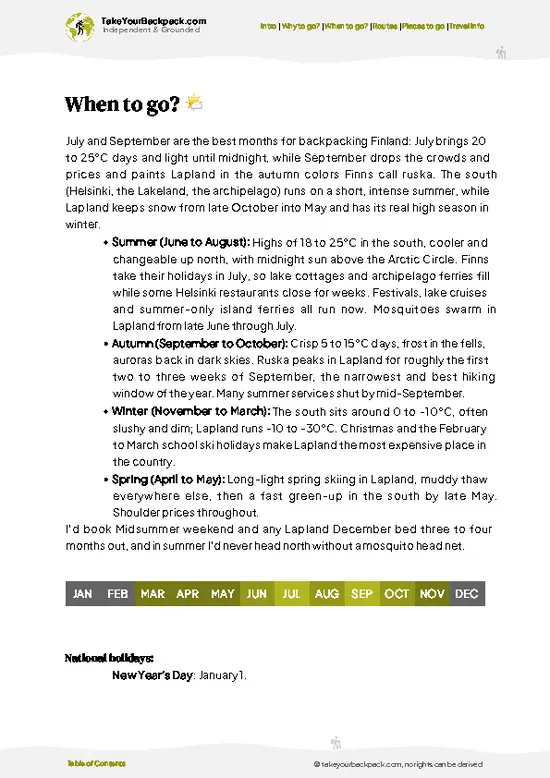
example page 2 from our offline Travel Guide for Finland
example page 3 from our offline Travel Guide for Finland
example page 4 from our offline Travel Guide for Finland
example page 5 from our offline Travel Guide for Finland
example page 6 from our offline Travel Guide for Finland
example page 7 from our offline Travel Guide for Finland
The digital guide (341 pages) contains:
✅ 87 highlights, ranked by travel appeal
✅ Optimized 5, 10 & 15-day travel routes
✅ Cities, national parks, landmarks, beaches
✅ How to get around
✅ Offline-friendly for travel without Wi-Fi
👉 Click to see all 30+ guide features

📅 Plan smarter in minutes, not weeks
✅ Month by month travel advice
✅ Festivals & national holidays
✅ Budget expectations

🗺️ Go to the right places, skip the overrated ones
✅ Honest pros & cons of destinations
✅ Top hikes, parks & viewpoints
✅ Lesser-known places most travelers miss
✅ Clear “worth it vs skip it” guidance

🛏️ Travel smoothly without rookie mistakes
✅ Best areas to stay
✅ Transport systems explained simply
✅ Common scams & safety advice
✅ SIM cards, money & practical tips

🌍 Understand the country, not just visit it
✅ Culture & traditions
✅ 52 Essential phrases & customs
✅ Festivals worth planning around
✅ Traveler-friendly historical context
✅ Insights that make places more meaningful

📱 Built for real travel conditions
✅ Fully downloadable PDF
✅ Works completely offline
✅ Optimized for phone use
✅ Useful in remote areas & buses
✅ Everything in one place
Stop searching, start planning
Get instant access to your full guide. 30‑day money-back guarantee.
+ Add another guide for just

By proceeding you agree to our terms.
Sent to your inbox immediately after payment • 100% Secure Checkout
Best Backpacking Travel Advisor 2025 tourism awardBest Backpacking
Travel Advisor
2025
What others say about Take Your Backpack Guides:
⭐⭐⭐⭐⭐
Fantastic, amazing amount of information!
⭐⭐⭐⭐⭐
My goodness this is amazing, it's what I've been looking for hats off too you!
⭐⭐⭐⭐⭐
I think this is absolutely BRILLIANT
⭐⭐⭐⭐
Very complete and informative. It's still missing places, but I gotta to commend you
⭐⭐⭐⭐⭐
This is truly amazing, thank you, can't wait to explore it with my kids!
⭐⭐⭐⭐⭐
Awesome resource, thank you!
⭐⭐⭐⭐⭐
This is amazing! Can't wait to explore the ones I haven't seen
⭐⭐⭐⭐
I love this! Well done, great idea.
⭐⭐⭐⭐⭐
Thanks for taking the time to make this gem!
⭐⭐⭐⭐⭐
This might be the best website I've ever seen.
⭐⭐⭐⭐⭐
Congratulations, and thank you so much for your work; it's incredibly valuable.
⭐⭐⭐⭐
In all seriousness I think you did a great job pointing out the important spots
⭐⭐⭐⭐⭐
10/10 very good
⭐⭐⭐⭐⭐
As someone who's only just starting to visit regularly this is awesome, thank you.
⭐⭐⭐⭐
Thank you very much! I'm going to visit my dad, it's going to be very useful!
⭐⭐⭐⭐⭐
This is really cool! We'll be travelling for the first time and this definitely come in handy.
⭐⭐⭐⭐⭐
You are now our minister of culture, congratulations 👨‍💼
⭐⭐⭐⭐⭐
Just wanted to tell you that this is a pearl! Going to follow your recommendations.
⭐⭐⭐⭐⭐
This is so cool. I'll definitely be using the resource for my travels soon.
⭐⭐⭐⭐⭐
This is very impressive! Good work.
⭐⭐⭐⭐⭐
This is an amazing and informative site. Very well done!

🛏️ Where to stay?Accommodation Highlights

Finland has a solid hostel network, with dorm beds typically €30 to €45 a night in Helsinki and less in smaller cities, plus summer-only hostels set up in student housing from June to August. In Helsinki, Kamppi and the streets around the Central Station put you within walking distance of the main sights and the airport train but cost the most, Kallio is cheaper and has the city’s liveliest bar scene with louder weekend nights, and Punavuori is quieter, with design shops and cafés about 15 minutes’ walk from the center. Outside the capital, the central districts of Turku, Tampere and Rovaniemi hold most budget beds, all of them safe, though Rovaniemi books out and gets pricey around Christmas. … read more 👉
Finland has a solid hostel network, with dorm beds typically €30 to €45 a night in Helsinki and less in smaller cities, plus summer-only hostels set up in student housing from June to August. In Helsinki, Kamppi and the streets around the Central Station put you within walking distance of the main sights and the airport train but cost the most, Kallio is cheaper and has the city’s liveliest bar scene with louder weekend nights, and Punavuori is quieter, with design shops and cafés about 15 minutes’ walk from the center. Outside the capital, the central districts of Turku, Tampere and Rovaniemi hold most budget beds, all of them safe, though Rovaniemi books out and gets pricey around Christmas.

If you enjoy meeting fellow travelers, consider choosing hostels with high ratings for atmosphere. On the other hand, if you prefer having your own space, a hotel might be a better option.

FinlandSee More of Finland

👋 Meet the founderWho’s Behind Take Your Backpack?

Johan, backpacker and founder of TakeYourBackpackHi, I’m Johan (Netherlands 🇳🇱), the creator of TakeYourBackpack. Over the past 3 decades, I’ve backpacked through 90+ countries across six continents, gaining extensive experience with independent travel, long-term trips, and overland routes.

This site is built on a combination of firsthand travel experience and carefully curated insights from other backpackers. Many guides are based on places I’ve personally visited, while others bring together tips, observations, and practical advice shared by trusted travelers I’ve met along the way.

The goal is to provide realistic, experience-driven guidance — not generic itineraries — so you can explore destinations with better context, clearer expectations, and more confidence.