×

Finland🇫🇮 | best citiesDiscover the 7 Best cities Across Finland

Finland’s cities are compact, clean and quiet, and the differences between them come down to latitude and water. In the south, the coastal cities smell of tar, salt and coffee, with ferries horning in the harbor and trams rattling past. Lake towns in the center run slower, with birch-lined shores and saunas on the water’s edge. Up north, Lapland brings winter darkness, squeaking snow and prices that climb with every degree of cold. Costs are high everywhere, but the rail network and walkable centers make independent travel and backpacking easy. Crowds stay thin outside July.

By Johan Kruseman 🇳🇱 | Updated October 19, 2026
Explore the best towns in Finland

Why go?Understanding Their Importance

Finland suits cities in an unusual way: they are small, spread across a huge, forested country, and built around nature rather than against it. Only about 5.6 million people live here, mostly in the south, so even the largest urban areas feel manageable, with forest edges, lakes or sea reachable by tram or bike. Long Swedish and Russian rule left a mix of neoclassical, wooden and Nordic modern architecture, while design and public sauna culture shape daily life more than monuments do.

The climate defines everything. Winter brings only a few hours of weak daylight in the south, ice underfoot and frozen harbors. Summer brings near-endless light, with the sun barely dropping below the horizon at night. Expect silence on streets and in public transport, personal space and little small talk. That … read more 👉
Finland suits cities in an unusual way: they are small, spread across a huge, forested country, and built around nature rather than against it. Only about 5.6 million people live here, mostly in the south, so even the largest urban areas feel manageable, with forest edges, lakes or sea reachable by tram or bike. Long Swedish and Russian rule left a mix of neoclassical, wooden and Nordic modern architecture, while design and public sauna culture shape daily life more than monuments do.

The climate defines everything. Winter brings only a few hours of weak daylight in the south, ice underfoot and frozen harbors. Summer brings near-endless light, with the sun barely dropping below the horizon at night. Expect silence on streets and in public transport, personal space and little small talk. That is respect, not coldness.

Before choosing Finland for its cities, know that prices are high, especially for meals out and alcohol, and that nightlife is modest outside weekends. Distances between cities are long, though trains and buses are punctual and reliable. Many sights close early or seasonally, and the best urban experiences are often outdoors: markets, island ferries, lakeside saunas and cafe stops with a cinnamon bun.
How the List Was Created
The list of best cities in Finland is created based on culture, vibe, attractions, transport ease, and local charm. If you feel a city is missing in this list, please let us know.

When to go?Optimal Periods for Travel

Best months: June to August is the best window for Finland’s cities, with daytime temperatures of roughly 15 to 25°C, daylight stretching past 18 hours in the south, and outdoor markets, terraces and ferries all running. Midsummer weekend in late June empties the cities as Finns head to cottages, so shops and restaurants often close for a few days. July is the busiest month for visitors and the most expensive for hotels.
Shoulder seasons: May and September are the smart choice for value. Temperatures sit around 8 to 17°C, rooms are often 20 to 30 percent cheaper than in July, and September brings crisp air and yellowing birch leaves. Rain is light but regular, so pack a shell. Some island and lake attractions shut after mid-August or open only on weekends.
Winter: December to February is cold … read more 👉
Best months: June to August is the best window for Finland’s cities, with daytime temperatures of roughly 15 to 25°C, daylight stretching past 18 hours in the south, and outdoor markets, terraces and ferries all running. Midsummer weekend in late June empties the cities as Finns head to cottages, so shops and restaurants often close for a few days. July is the busiest month for visitors and the most expensive for hotels.
Shoulder seasons: May and September are the smart choice for value. Temperatures sit around 8 to 17°C, rooms are often 20 to 30 percent cheaper than in July, and September brings crisp air and yellowing birch leaves. Rain is light but regular, so pack a shell. Some island and lake attractions shut after mid-August or open only on weekends.
Winter: December to February is cold and dark. Southern cities hover around -10 to 0°C, while Lapland regularly drops to -20°C or lower and sees only a few hours of twilight, or none at all in midwinter. Snow squeaks underfoot, trams are warm and smell of wet wool, and Christmas markets and ice-swimming add real draw. Northern prices peak in December and around February school holidays, so book early. April and November are the weakest months: gray slush, mud and closed attractions.

city hoppingSuggested Travel Strategies

Trip length and direction: A trip linking several cities in Finland works best in 7 to 14 days, because distances are large and the good stretches are the ones between stops. The south and southwest cluster tightly: coastal cities there are 1.5 to 3 hours apart by train or bus. Lake Finland sits 3 to 5 hours inland, and Lapland is an overnight sleeper train or a flight of around an hour and a half from the capital region. Travel south to north, finishing in Lapland, so the long leg comes last and you can fly out from the north or loop back by night train.
Pacing: Allow 2 to 3 nights in a larger city and 1 to 2 in a smaller one. Trains of 3 to 5 hours pass through flat forest and glinting lakes, with Finnish rail seats that are wide and quiet, so they feel like part of the trip. Book long-distance … read more 👉
Trip length and direction: A trip linking several cities in Finland works best in 7 to 14 days, because distances are large and the good stretches are the ones between stops. The south and southwest cluster tightly: coastal cities there are 1.5 to 3 hours apart by train or bus. Lake Finland sits 3 to 5 hours inland, and Lapland is an overnight sleeper train or a flight of around an hour and a half from the capital region. Travel south to north, finishing in Lapland, so the long leg comes last and you can fly out from the north or loop back by night train.
Pacing: Allow 2 to 3 nights in a larger city and 1 to 2 in a smaller one. Trains of 3 to 5 hours pass through flat forest and glinting lakes, with Finnish rail seats that are wide and quiet, so they feel like part of the trip. Book long-distance trains early, since the cheapest fares go quickly, and consider buses for budget savings.
Common mistakes: The biggest mistake is trying to cover Lapland and the south in one week, which leaves you in transit for much of it. Another is arriving on a Sunday or holiday, when shops and some transport shut. Choose one region per week instead, and plan the northern leg only in winter or midsummer.

The ListMust-Visit cities in Finland

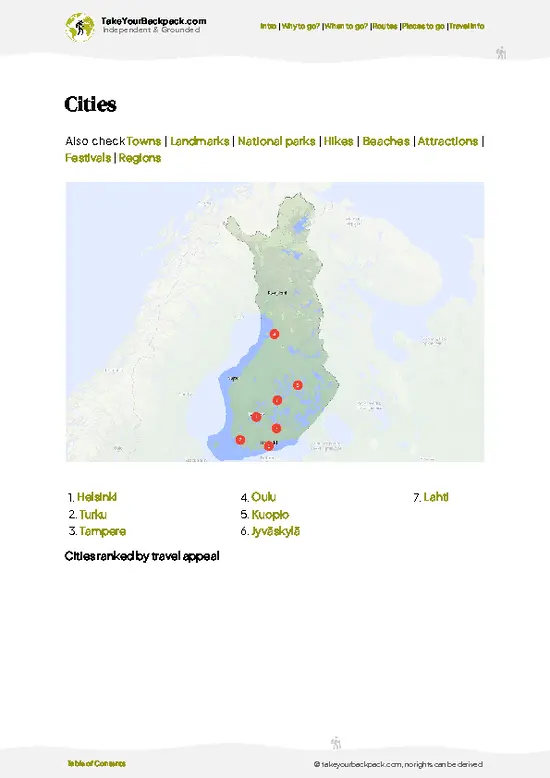
1 Helsinki

harbor islands, Nordic design, neoclassical squares

Navigate ferry routes between islands, browse design shops, and experience a capital shaped by Baltic influences and open public spaces.

finland-city-helsinki
© Google | Reza Karami

2 Turku

medieval castle, riverside bars, archipelago ferries

Wander from a centuries-old castle to lively riverside terraces, then board a ferry to explore the scattered islands beyond the city.

finland-city-turku
© Google | Reza Karami

3 Tampere

red-brick factories, lakeside saunas, market hall

Walk between lakes on old industrial streets, relax in traditional saunas, and taste local specialties in a covered food market.

finland-city-tampere
© Google | Carlos Reis

4 Oulu

river delta, cycling routes, tech startups

Cycle along riverside paths, encounter a youthful energy driven by innovation, and find northern lights just outside the city’s edge.

5 Kuopio

market square, lakeside sauna, Puijo Tower views

Climb observation towers, sample local fish at the market, and unwind in public saunas overlooking a patchwork of lakes and islands.

finland-city-kuopio
© Google |

6 Jyväskylä

lakeside campus, Alvar Aalto architecture, forested hills

Follow trails from university streets to wooded ridges, discovering a city where modern design and nature blend into daily life.

7 Lahti

ski jumps, harbor promenade, Sibelius Hall

Watch ski jumpers train, stroll along a redeveloped waterfront, and catch concerts in a city known for winter sports and music venues.

finland-city-lahti
© Google |
Loading the map 🌍

Expert viewExpert Commentary on cities

How many cities: Three to four cities is the sensible limit for a Finland trip. The country is long, the trains are comfortable but slow, and each place rewards at least two nights. Packing in more means spending your budget on tickets rather than on saunas, markets and ferry rides. Pick one southern coastal city, one lake or inland city, and add a northern stop only if you have 10 days or more.
Which kind for which traveler: First-timers and tight budgets do best in the south, where hostels, transit passes and free sights concentrate. Nature lovers should favor lake and northern cities, where a short bus ride puts you in forest or on frozen water. Design and food fans should stay in the larger coastal cities, with more museums, cafes and restaurants. Northern cities cost more in winter because … read more 👉
How many cities: Three to four cities is the sensible limit for a Finland trip. The country is long, the trains are comfortable but slow, and each place rewards at least two nights. Packing in more means spending your budget on tickets rather than on saunas, markets and ferry rides. Pick one southern coastal city, one lake or inland city, and add a northern stop only if you have 10 days or more.
Which kind for which traveler: First-timers and tight budgets do best in the south, where hostels, transit passes and free sights concentrate. Nature lovers should favor lake and northern cities, where a short bus ride puts you in forest or on frozen water. Design and food fans should stay in the larger coastal cities, with more museums, cafes and restaurants. Northern cities cost more in winter because of heated activities and limited lodging, so choose them for the experience, not the savings.
What it costs: Plan on US$85 to 130 a day (roughly €80 to 120) for a frugal backpacker: dorm beds run €30 to 60, supermarket meals and the lunch buffet (often €10 to 14, usually the best-value meal in the country) keep food at €20 to 35. Add €3 to 5 for a city tram or bus single. Museums typically charge €10 to 25, and a public sauna visit is €10 to 20. Regional trains cost around €15 to 45 per leg when booked ahead. Alcohol is heavily taxed, so a beer in a bar often costs €7 to 9. Buying drinks at a supermarket is far cheaper.
Safety and etiquette: Finland is among the safest countries for solo travelers, with low violent crime and reliable transit at night. Petty theft exists around main stations and crowded summer events, so keep your phone and wallet zipped away. The real hazards are cold and ice: wear winter boots with grip, layers and a hat from November to March, and treat frozen lakes as unsafe unless a local authority marks them.
Cultural rules: Finns value quiet, so keep phone calls low on trains and trams. Queue properly and keep a respectful distance. Saunas are usually taken naked, and mixed public ones often require swimsuits, so check the sign. Tipping is not expected. Cards and contactless work nearly everywhere, so carrying cash is rarely needed. Many shops close early on Sundays, so shop for groceries a day ahead.

✈️ The backpacker research shortcutFinland Travel Guide

An offline-friendly backpacking guide with optimized travel routes, ranked highlights, transport advice, and the best areas to stay.
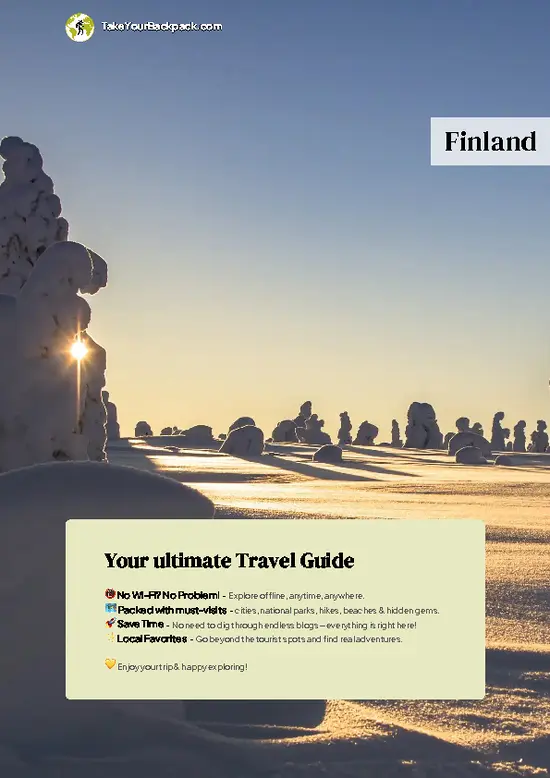
example page 0 from our offline Travel Guide for Finland
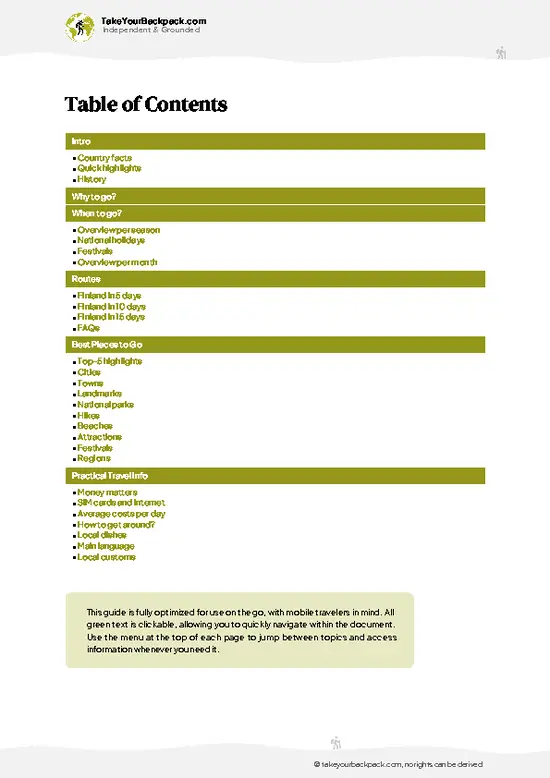
example page 1 from our offline Travel Guide for Finland
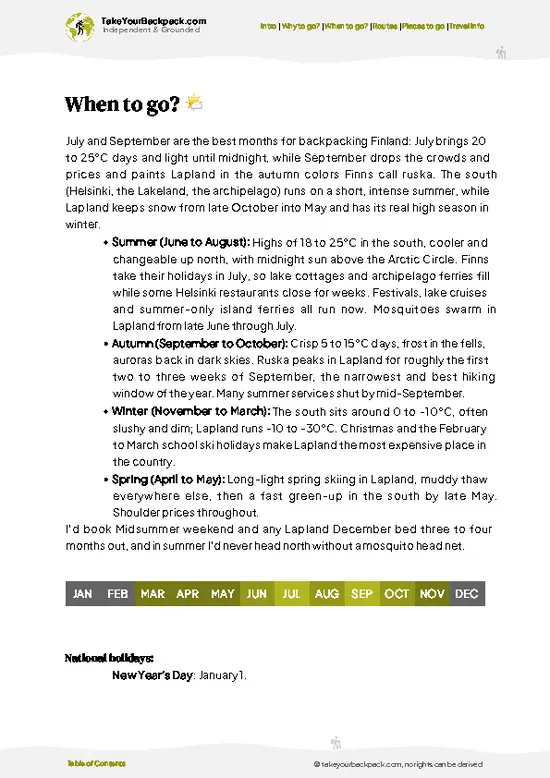
example page 2 from our offline Travel Guide for Finland
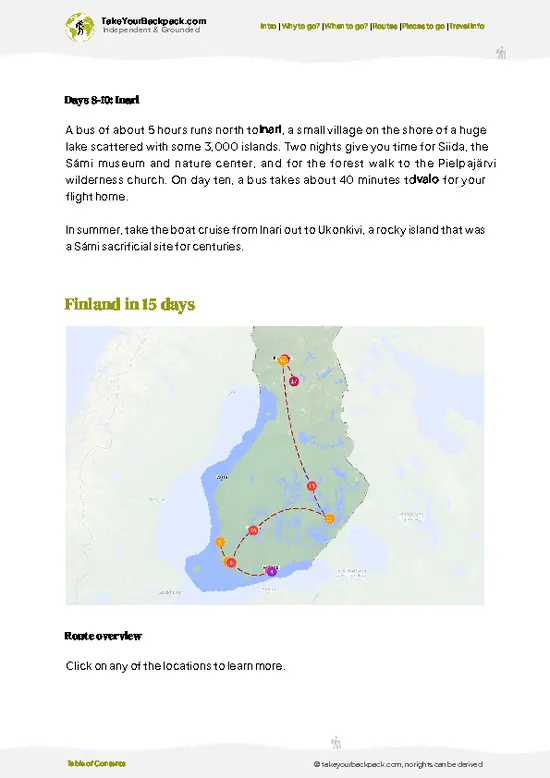
example page 3 from our offline Travel Guide for Finland
example page 4 from our offline Travel Guide for Finland
example page 5 from our offline Travel Guide for Finland
example page 6 from our offline Travel Guide for Finland
example page 7 from our offline Travel Guide for Finland
The digital guide (341 pages) contains:
✅ 87 highlights, ranked by travel appeal
✅ Optimized 5, 10 & 15-day travel routes
✅ Cities, national parks, landmarks, beaches
✅ How to get around
✅ Offline-friendly for travel without Wi-Fi
👉 Click to see all 30+ guide features

📅 Plan smarter in minutes, not weeks
✅ Month by month travel advice
✅ Festivals & national holidays
✅ Budget expectations

🗺️ Go to the right places, skip the overrated ones
✅ Honest pros & cons of destinations
✅ Top hikes, parks & viewpoints
✅ Lesser-known places most travelers miss
✅ Clear “worth it vs skip it” guidance

🛏️ Travel smoothly without rookie mistakes
✅ Best areas to stay
✅ Transport systems explained simply
✅ Common scams & safety advice
✅ SIM cards, money & practical tips

🌍 Understand the country, not just visit it
✅ Culture & traditions
✅ 52 Essential phrases & customs
✅ Festivals worth planning around
✅ Traveler-friendly historical context
✅ Insights that make places more meaningful

📱 Built for real travel conditions
✅ Fully downloadable PDF
✅ Works completely offline
✅ Optimized for phone use
✅ Useful in remote areas & buses
✅ Everything in one place
Stop searching, start planning
Get instant access to your full guide. 30‑day money-back guarantee.
+ Add another guide for just

By proceeding you agree to our terms.
Sent to your inbox immediately after payment • 100% Secure Checkout
Best Backpacking Travel Advisor 2025 tourism awardBest Backpacking
Travel Advisor
2025
What others say about Take Your Backpack Guides:
⭐⭐⭐⭐⭐
Fantastic, amazing amount of information!
⭐⭐⭐⭐⭐
My goodness this is amazing, it's what I've been looking for hats off too you!
⭐⭐⭐⭐⭐
I think this is absolutely BRILLIANT
⭐⭐⭐⭐
Very complete and informative. It's still missing places, but I gotta to commend you
⭐⭐⭐⭐⭐
This is truly amazing, thank you, can't wait to explore it with my kids!
⭐⭐⭐⭐⭐
Awesome resource, thank you!
⭐⭐⭐⭐⭐
This is amazing! Can't wait to explore the ones I haven't seen
⭐⭐⭐⭐
I love this! Well done, great idea.
⭐⭐⭐⭐⭐
Thanks for taking the time to make this gem!
⭐⭐⭐⭐⭐
This might be the best website I've ever seen.
⭐⭐⭐⭐⭐
Congratulations, and thank you so much for your work; it's incredibly valuable.
⭐⭐⭐⭐
In all seriousness I think you did a great job pointing out the important spots
⭐⭐⭐⭐⭐
10/10 very good
⭐⭐⭐⭐⭐
As someone who's only just starting to visit regularly this is awesome, thank you.
⭐⭐⭐⭐
Thank you very much! I'm going to visit my dad, it's going to be very useful!
⭐⭐⭐⭐⭐
This is really cool! We'll be travelling for the first time and this definitely come in handy.
⭐⭐⭐⭐⭐
You are now our minister of culture, congratulations 👨‍💼
⭐⭐⭐⭐⭐
Just wanted to tell you that this is a pearl! Going to follow your recommendations.
⭐⭐⭐⭐⭐
This is so cool. I'll definitely be using the resource for my travels soon.
⭐⭐⭐⭐⭐
This is very impressive! Good work.
⭐⭐⭐⭐⭐
This is an amazing and informative site. Very well done!

🛏️ Where to stay?Top Places to Consider Staying

Finland has a solid hostel network, with dorm beds typically €30 to €45 a night in Helsinki and less in smaller cities, plus summer-only hostels set up in student housing from June to August. In Helsinki, Kamppi and the streets around the Central Station put you within walking distance of the main sights and the airport train but cost the most, Kallio is cheaper and has the city’s liveliest bar scene with louder weekend nights, and Punavuori is quieter, with design shops and cafés about 15 minutes’ walk from the center. Outside the capital, the central districts of Turku, Tampere and Rovaniemi hold most budget beds, all of them safe, though Rovaniemi books out and gets pricey around Christmas. … read more 👉
Finland has a solid hostel network, with dorm beds typically €30 to €45 a night in Helsinki and less in smaller cities, plus summer-only hostels set up in student housing from June to August. In Helsinki, Kamppi and the streets around the Central Station put you within walking distance of the main sights and the airport train but cost the most, Kallio is cheaper and has the city’s liveliest bar scene with louder weekend nights, and Punavuori is quieter, with design shops and cafés about 15 minutes’ walk from the center. Outside the capital, the central districts of Turku, Tampere and Rovaniemi hold most budget beds, all of them safe, though Rovaniemi books out and gets pricey around Christmas.

If you enjoy meeting fellow travelers, consider choosing hostels with high ratings for atmosphere. On the other hand, if you prefer having your own space, a hotel might be a better option.

FinlandMore Places Across Finland

👋 Meet the founderWho’s Behind Take Your Backpack?

Johan, backpacker and founder of TakeYourBackpackHi, I’m Johan (Netherlands 🇳🇱), the creator of TakeYourBackpack. Over the past 3 decades, I’ve backpacked through 90+ countries across six continents, gaining extensive experience with independent travel, long-term trips, and overland routes.

This site is built on a combination of firsthand travel experience and carefully curated insights from other backpackers. Many guides are based on places I’ve personally visited, while others bring together tips, observations, and practical advice shared by trusted travelers I’ve met along the way.

The goal is to provide realistic, experience-driven guidance — not generic itineraries — so you can explore destinations with better context, clearer expectations, and more confidence.