×

Finland🇫🇮 | best regionsDiscover the 6 Best regions Across Finland

Finland’s regions split along a sharp line: the south is where the trains, ferries and hostels are, and the north is where the air turns clean and the nights run long. Along the Gulf of Finland coast you get tarred wooden piers, gull noise and a dense network of buses and trains. Head into the Lakeland and the soundtrack drops to loons, birch leaves and sauna stoves crackling. Lapland adds reindeer-trodden fells, squeaking snow and real distances between services. Costs climb with remoteness and season, crowds gather in a few winter hotspots, and independent travelers need to plan around infrequent buses.

By Johan Kruseman 🇳🇱 | Updated October 19, 2026
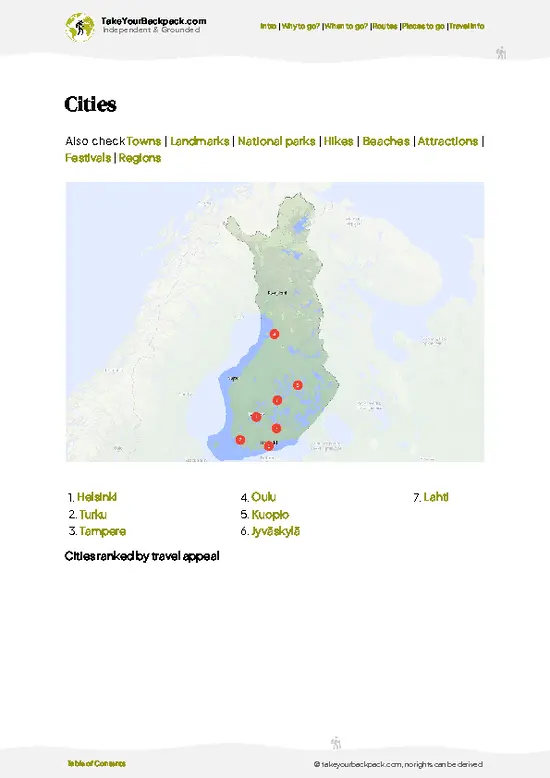
Explore the best cities in Finland

Why go?Understanding Their Importance

Finland suits regional travel because everyman’s rights (jokamiehenoikeus) let you walk, camp, pick berries and mushrooms on most land without paying or asking, so the countryside works as a shared commons rather than a series of ticketed sights. About 75 percent of the country is forest, there are roughly 180,000 lakes, and the air smells of resin and wet moss after rain. The country is long, running from the Baltic coast to well past the Arctic Circle, so latitude changes the experience more than any cultural border does. Summer brings near-constant daylight in the north, while midwinter gives only a blue twilight or none at all. Public infrastructure is excellent: trains, long-distance buses and domestic flights are punctual, and English is spoken almost everywhere. The hard part is scale … read more 👉
Finland suits regional travel because everyman’s rights (jokamiehenoikeus) let you walk, camp, pick berries and mushrooms on most land without paying or asking, so the countryside works as a shared commons rather than a series of ticketed sights. About 75 percent of the country is forest, there are roughly 180,000 lakes, and the air smells of resin and wet moss after rain. The country is long, running from the Baltic coast to well past the Arctic Circle, so latitude changes the experience more than any cultural border does. Summer brings near-constant daylight in the north, while midwinter gives only a blue twilight or none at all. Public infrastructure is excellent: trains, long-distance buses and domestic flights are punctual, and English is spoken almost everywhere. The hard part is scale and price. Finland is sparsely populated (about 5.6 million people), so rural bus timetables thin out, many services run only a few times a day, and groceries and alcohol cost more than in most of Europe. Mosquitoes and black flies are fierce in July in the wetlands, and winter cold demands proper layers. Know that you are choosing space and silence, not density of attractions.
Our Approach to Ranking
The list of best regions in Finland is created based on landscapes, local culture, attractions, vibes, and overall appeal. If you feel a region is missing in this list, please let us know.

When to go?Optimal Periods for Travel

Best months: June to August is the best window for most regions in Finland, with daytime highs of about 15 to 24°C, warm lake water for swimming and light that lasts past 10 p.m. in the south and never fully fades in the far north around midsummer. Mosquitoes peak in July, so pack repellent and a head net for boggy ground. Nearly everything is open, but prices rise, and cottages and campsites around Midsummer (late June) fill early.
Shoulder seasons: May and September are quieter and cheaper. May still has cold nights and some closed summer venues, while September brings crisp air, fewer insects and the red and gold of ruska, the autumn color season, in Lapland from roughly mid-September. Hiking huts stay open, and rates drop by about 20 to 30 percent.
Winter: December to March brings temperatures … read more 👉
Best months: June to August is the best window for most regions in Finland, with daytime highs of about 15 to 24°C, warm lake water for swimming and light that lasts past 10 p.m. in the south and never fully fades in the far north around midsummer. Mosquitoes peak in July, so pack repellent and a head net for boggy ground. Nearly everything is open, but prices rise, and cottages and campsites around Midsummer (late June) fill early.
Shoulder seasons: May and September are quieter and cheaper. May still has cold nights and some closed summer venues, while September brings crisp air, fewer insects and the red and gold of ruska, the autumn color season, in Lapland from roughly mid-September. Hiking huts stay open, and rates drop by about 20 to 30 percent.
Winter: December to March brings temperatures of about -5 to -30°C, with the coldest snaps in Lapland. Snow squeaks underfoot, daylight lasts only a few hours in the north, and the northern lights show on clear nights from September to March. Winter is peak season in Lapland, with flights and accommodation costing much more around Christmas and February. April and November are the dull in-between months, with slush, mud and many businesses closed.

region hoppingSuggested Travel Strategies

How long to allow: A trip combining several regions in Finland needs 10 to 16 days, since distances are long even when the transport is good. Plan 2 to 4 nights per stop, because the pleasures of the country (a sauna, a lake paddle, a forest walk) need slow hours rather than quick visits.
Direction and links: Start in the south, where the international flights, ferries from Tallinn and Stockholm, and the rail hub of Helsinki sit, then work north toward Lapland, finishing with the longest haul. Trains from Helsinki reach Tampere in about 1.5 to 2 hours, Kuopio in 4 to 5, Oulu in 6 to 7, and Rovaniemi in 8 to 12 hours, including the overnight sleeper. Long-distance buses cover places the rails miss, and domestic flights to Rovaniemi, Kittilä or Ivalo take roughly 1.5 hours. Book sleepers and … read more 👉
How long to allow: A trip combining several regions in Finland needs 10 to 16 days, since distances are long even when the transport is good. Plan 2 to 4 nights per stop, because the pleasures of the country (a sauna, a lake paddle, a forest walk) need slow hours rather than quick visits.
Direction and links: Start in the south, where the international flights, ferries from Tallinn and Stockholm, and the rail hub of Helsinki sit, then work north toward Lapland, finishing with the longest haul. Trains from Helsinki reach Tampere in about 1.5 to 2 hours, Kuopio in 4 to 5, Oulu in 6 to 7, and Rovaniemi in 8 to 12 hours, including the overnight sleeper. Long-distance buses cover places the rails miss, and domestic flights to Rovaniemi, Kittilä or Ivalo take roughly 1.5 hours. Book sleepers and flights early for winter.
Common mistakes: The classic error is trying to fit Lapland into a short trip from the capital, losing a full day each way to transit. Fly or take the night train instead, and sleep through the distance. Another is relying on rural buses without checking timetables, as many routes run once or twice a day and thin out on weekends. Build in a buffer day, and hire a car for the lake and forest areas where public transport is sparse. Do not cross the country several times in a zigzag. Keep the line moving in one direction.

The ListMust-Visit regions in Finland

1 Lapland

arctic tundra, reindeer herding, northern lights

Travel above the Arctic Circle for vast open spaces, Sámi culture, and the seasonal extremes of polar night and midnight sun.

finland-region-lapland
© Google | Mike Mccombie

2 Åland Islands

maritime heritage, red granite cliffs, apple orchards

Cycle quiet coastal roads between harbors, lighthouses, and farms, with Swedish-speaking locals and a distinct island identity.

finland-region-aland-islands
© Google | Nataliya Karpenko

3 Finnish Lakeland

interconnected lakes, forested ridges, wooden villages

Navigate a landscape defined by endless waterways, where ferries, saunas, and quiet trails connect small communities and dense pine woods.

finland-region-finnish-lakeland
© Google | Νεκτάριος

4 Kvarken Archipelago

shifting islands, glacial rock fields, UNESCO geology

Experience a dynamic seascape where land rises from the sea, marked by unusual stone formations and ever-changing shorelines.

5 Kainuu

peat bogs, wild forests, brown bear habitat

Hike through remote terrain where wildlife sightings are common, and traditional smoke saunas and local folklore shape daily life.

finland-region-kainuu
© Google | Arto Karjalainen

6 Kemiönsaari

archipelago villages, Swedish-speaking locals, cycling routes

Cycle quiet roads between small harbors, meet locals who speak Swedish, and explore a network of islands by ferry or bridge.

Loading the map 🌍

Expert viewExpert Commentary on regions

How many regions to visit: I advise two or three regions on a trip of up to two weeks. Finland’s distances are big, and the rhythm here is slow: a sauna, a long walk, a quiet evening by water. Each extra region costs you a travel day and a lot of the stillness that makes the country worth visiting. One southern base plus one northern or lake region is the sensible baseline, while a third only makes sense with 14 days or more.
Choosing by travel style: Culture and city-lovers get the most from the south, where museums, design shops and cafés sit within walking distance of the station. Hikers and campers do better in the Lakeland and national park areas, where free wilderness huts and marked trails are common, and everyman’s rights let you pitch a tent for a night away from homes and farmland. … read more 👉
How many regions to visit: I advise two or three regions on a trip of up to two weeks. Finland’s distances are big, and the rhythm here is slow: a sauna, a long walk, a quiet evening by water. Each extra region costs you a travel day and a lot of the stillness that makes the country worth visiting. One southern base plus one northern or lake region is the sensible baseline, while a third only makes sense with 14 days or more.
Choosing by travel style: Culture and city-lovers get the most from the south, where museums, design shops and cafés sit within walking distance of the station. Hikers and campers do better in the Lakeland and national park areas, where free wilderness huts and marked trails are common, and everyman’s rights let you pitch a tent for a night away from homes and farmland. Winter-activity seekers go to Lapland, but that is the priciest choice by far. Experienced travelers pick one theme per trip, because forcing city, lake and Arctic into one short trip leaves everything half done.
What it costs: Finland is expensive, but it is manageable. A frugal backpacker spends about €50 to 80 a day using hostels or dorms (€30 to 45), supermarket cooking and a daily transport pass or occasional train ticket. Mid-range travelers should expect €100 to 160. Lapland in winter runs higher: a husky ride or snowmobile safari costs about €100 to 200 per person, and a guided northern lights outing about €70 to 150. National park entry is free, wilderness huts are free or a few euros, and a campsite pitch is usually €15 to 30. Supermarket lunch deals and the lunch buffet (lounas, often €10 to 14) beat dinner prices. Alcohol is sold in state shops, and a beer in a bar costs €7 to 9, so buy there if you drink.
Safety and cultural points: Finland is very safe, and crime is low. The real risks are natural: cold, ticks (use long trousers and check your skin after walking in grass, since tick-borne encephalitis and Lyme disease occur), and getting lost in forests with poor phone coverage. Carry a paper map or offline map, a headlamp, and layers, as winter temperatures drop fast. Respect quiet: Finns value personal space, speak softly in public, and do not expect small talk with strangers. Take your shoes off indoors, and shower before entering a sauna, which is usually unclothed in same-sex groups. Leave no trace on camping spots, and do not light fires in dry summer spells, when bans apply. Reindeer wander roads in Lapland, so drive slowly at dusk.

✈️ The backpacker research shortcutFinland Travel Guide

An offline-friendly backpacking guide with optimized travel routes, ranked highlights, transport advice, and the best areas to stay.
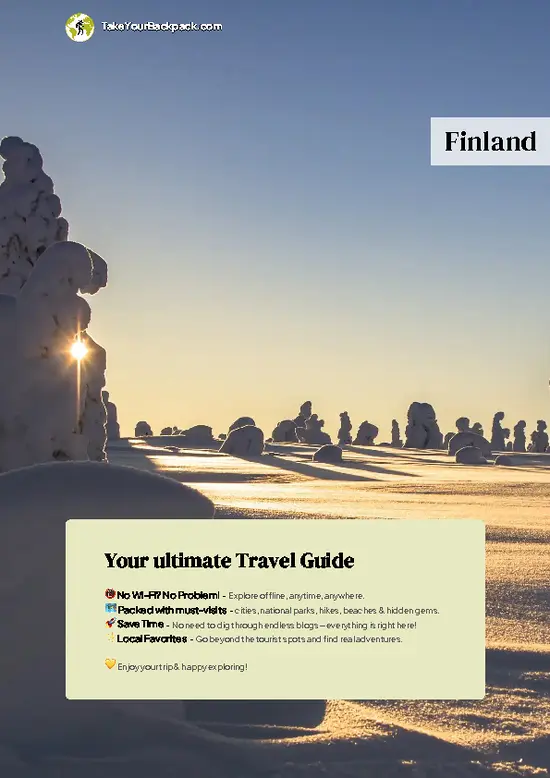
example page 0 from our offline Travel Guide for Finland
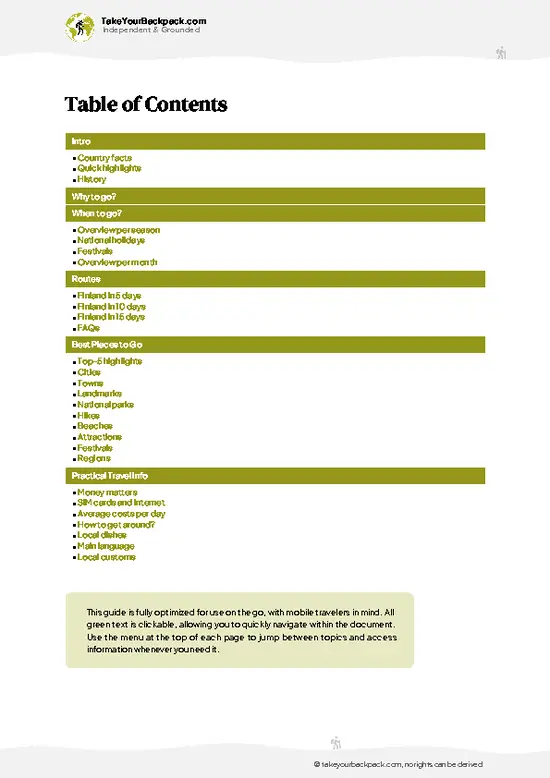
example page 1 from our offline Travel Guide for Finland
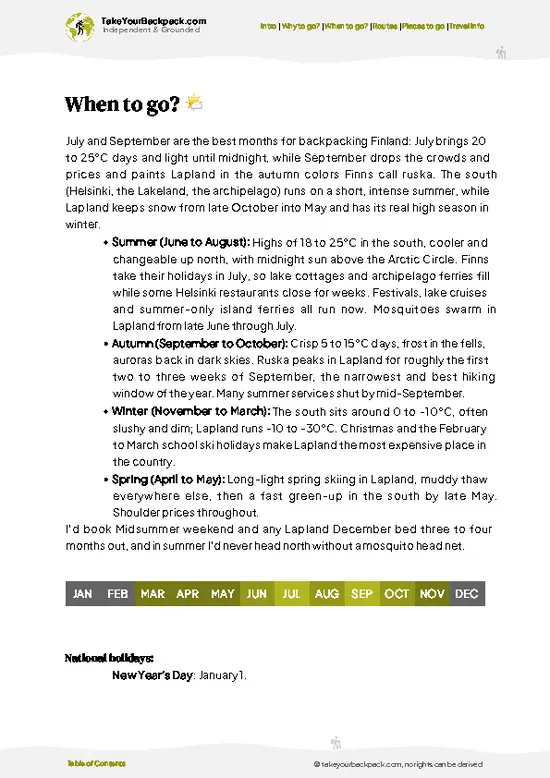
example page 2 from our offline Travel Guide for Finland
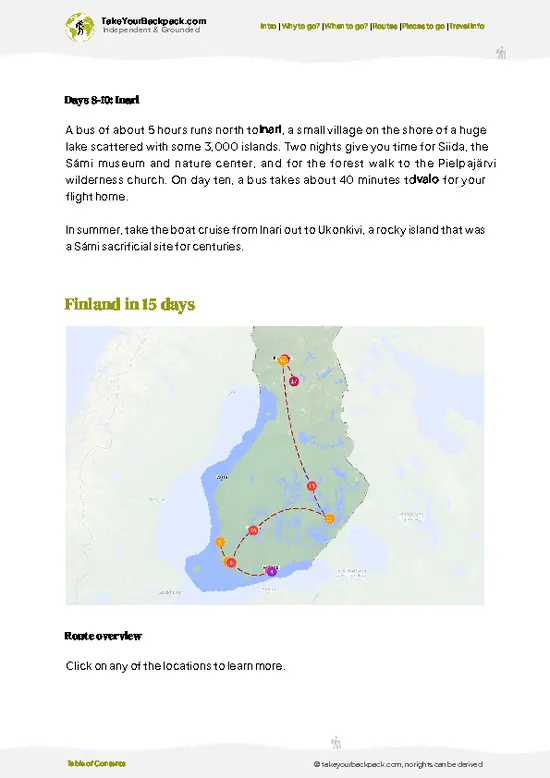
example page 3 from our offline Travel Guide for Finland
example page 4 from our offline Travel Guide for Finland
example page 5 from our offline Travel Guide for Finland
example page 6 from our offline Travel Guide for Finland
example page 7 from our offline Travel Guide for Finland
The digital guide (341 pages) contains:
✅ 87 highlights, ranked by travel appeal
✅ Optimized 5, 10 & 15-day travel routes
✅ Cities, national parks, landmarks, beaches
✅ How to get around
✅ Offline-friendly for travel without Wi-Fi
👉 Click to see all 30+ guide features

📅 Plan smarter in minutes, not weeks
✅ Month by month travel advice
✅ Festivals & national holidays
✅ Budget expectations

🗺️ Go to the right places, skip the overrated ones
✅ Honest pros & cons of destinations
✅ Top hikes, parks & viewpoints
✅ Lesser-known places most travelers miss
✅ Clear “worth it vs skip it” guidance

🛏️ Travel smoothly without rookie mistakes
✅ Best areas to stay
✅ Transport systems explained simply
✅ Common scams & safety advice
✅ SIM cards, money & practical tips

🌍 Understand the country, not just visit it
✅ Culture & traditions
✅ 52 Essential phrases & customs
✅ Festivals worth planning around
✅ Traveler-friendly historical context
✅ Insights that make places more meaningful

📱 Built for real travel conditions
✅ Fully downloadable PDF
✅ Works completely offline
✅ Optimized for phone use
✅ Useful in remote areas & buses
✅ Everything in one place
Stop searching, start planning
Get instant access to your full guide. 30‑day money-back guarantee.
+ Add another guide for just

By proceeding you agree to our terms.
Sent to your inbox immediately after payment • 100% Secure Checkout
Best Backpacking Travel Advisor 2025 tourism awardBest Backpacking
Travel Advisor
2025
What others say about Take Your Backpack Guides:
⭐⭐⭐⭐⭐
Fantastic, amazing amount of information!
⭐⭐⭐⭐⭐
My goodness this is amazing, it's what I've been looking for hats off too you!
⭐⭐⭐⭐⭐
I think this is absolutely BRILLIANT
⭐⭐⭐⭐
Very complete and informative. It's still missing places, but I gotta to commend you
⭐⭐⭐⭐⭐
This is truly amazing, thank you, can't wait to explore it with my kids!
⭐⭐⭐⭐⭐
Awesome resource, thank you!
⭐⭐⭐⭐⭐
This is amazing! Can't wait to explore the ones I haven't seen
⭐⭐⭐⭐
I love this! Well done, great idea.
⭐⭐⭐⭐⭐
Thanks for taking the time to make this gem!
⭐⭐⭐⭐⭐
This might be the best website I've ever seen.
⭐⭐⭐⭐⭐
Congratulations, and thank you so much for your work; it's incredibly valuable.
⭐⭐⭐⭐
In all seriousness I think you did a great job pointing out the important spots
⭐⭐⭐⭐⭐
10/10 very good
⭐⭐⭐⭐⭐
As someone who's only just starting to visit regularly this is awesome, thank you.
⭐⭐⭐⭐
Thank you very much! I'm going to visit my dad, it's going to be very useful!
⭐⭐⭐⭐⭐
This is really cool! We'll be travelling for the first time and this definitely come in handy.
⭐⭐⭐⭐⭐
You are now our minister of culture, congratulations 👨‍💼
⭐⭐⭐⭐⭐
Just wanted to tell you that this is a pearl! Going to follow your recommendations.
⭐⭐⭐⭐⭐
This is so cool. I'll definitely be using the resource for my travels soon.
⭐⭐⭐⭐⭐
This is very impressive! Good work.
⭐⭐⭐⭐⭐
This is an amazing and informative site. Very well done!

🛏️ Where to stay?Best Places to Stay in Finland

Finland has a solid hostel network, with dorm beds typically €30 to €45 a night in Helsinki and less in smaller cities, plus summer-only hostels set up in student housing from June to August. In Helsinki, Kamppi and the streets around the Central Station put you within walking distance of the main sights and the airport train but cost the most, Kallio is cheaper and has the city’s liveliest bar scene with louder weekend nights, and Punavuori is quieter, with design shops and cafés about 15 minutes’ walk from the center. Outside the capital, the central districts of Turku, Tampere and Rovaniemi hold most budget beds, all of them safe, though Rovaniemi books out and gets pricey around Christmas. … read more 👉
Finland has a solid hostel network, with dorm beds typically €30 to €45 a night in Helsinki and less in smaller cities, plus summer-only hostels set up in student housing from June to August. In Helsinki, Kamppi and the streets around the Central Station put you within walking distance of the main sights and the airport train but cost the most, Kallio is cheaper and has the city’s liveliest bar scene with louder weekend nights, and Punavuori is quieter, with design shops and cafés about 15 minutes’ walk from the center. Outside the capital, the central districts of Turku, Tampere and Rovaniemi hold most budget beds, all of them safe, though Rovaniemi books out and gets pricey around Christmas.

If you enjoy meeting fellow travelers, consider choosing hostels with high ratings for atmosphere. On the other hand, if you prefer having your own space, a hotel might be a better option.

FinlandExplore Finland

👋 Meet the founderWho’s Behind Take Your Backpack?

Johan, backpacker and founder of TakeYourBackpackHi, I’m Johan (Netherlands 🇳🇱), the creator of TakeYourBackpack. Over the past 3 decades, I’ve backpacked through 90+ countries across six continents, gaining extensive experience with independent travel, long-term trips, and overland routes.

This site is built on a combination of firsthand travel experience and carefully curated insights from other backpackers. Many guides are based on places I’ve personally visited, while others bring together tips, observations, and practical advice shared by trusted travelers I’ve met along the way.

The goal is to provide realistic, experience-driven guidance — not generic itineraries — so you can explore destinations with better context, clearer expectations, and more confidence.