×

Finland🇫🇮 | best festivalsDiscover the 12 Best festivals Across Finland

Finland stages its festivals in a short, loud burst. From late May to August the sun barely drops, and open-air festivals run on fields, islands and old factory yards, with the smell of woodsmoke, sausages and wet grass. Helsinki and the south bring the biggest crowds, higher prices and easy trains. Eastern Finland's lake towns feel smaller, with opera in a medieval castle or tango in a dance hall. Lapland adds midnight light or dark-season gatherings, but distances are long. Backpacking or independent travel works if you book beds early, since summer weekends fill up, and pick one region per trip.

By Johan Kruseman 🇳🇱 | Updated October 19, 2026
Explore the best regions in Finland

Why go?Understanding Their Importance

Finland suits festivals because of light and silence. In June and July the sun stays up almost all night, so outdoor programs run late and nobody checks the time. Finns spend the dark months indoors, and the summer release is intense: weekend towns of 10,000 can swell several times over, and a beer tent at 11 p.m. looks like afternoon. The summer cottage culture also means many locals leave cities, so small-town events draw families with thermoses and folding chairs rather than party tourists.

Infrastructure is a strength. Trains, buses and festival shuttles are punctual, tap water is clean, tents and campsites are plentiful, and the right to roam (everyman's right) allows free camping in many places, though not at festival grounds. Mosquitoes near lakes are part of the experience, so bring … read more 👉
Finland suits festivals because of light and silence. In June and July the sun stays up almost all night, so outdoor programs run late and nobody checks the time. Finns spend the dark months indoors, and the summer release is intense: weekend towns of 10,000 can swell several times over, and a beer tent at 11 p.m. looks like afternoon. The summer cottage culture also means many locals leave cities, so small-town events draw families with thermoses and folding chairs rather than party tourists.

Infrastructure is a strength. Trains, buses and festival shuttles are punctual, tap water is clean, tents and campsites are plentiful, and the right to roam (everyman's right) allows free camping in many places, though not at festival grounds. Mosquitoes near lakes are part of the experience, so bring repellent.

Know before you choose Finland: the season is short, roughly late May to early September, with winter events concentrated around snow and ice in the north. Alcohol is expensive, bought at Alko stores or in licensed tents, and festival beer often costs €7 to 9. Distances between regions are large, and rain can turn fields to mud even in July. Timing matters more here than in most countries.
Behind the Scenes of Selection
The list of best festivals in Finland is created based on energy, traditions, crowd experience, activities, and overall excitement. If you feel a festival is missing in this list, please let us know.

When to go?Optimal Periods for Travel

Best months: The best months for festivals in Finland are June to August, when daylight lasts 18 to 24 hours in the north and temperatures average 15 to 22°C in the south, with the warmest days reaching 25 to 30°C. Midsummer, the weekend closest to June 24, empties Helsinki as locals head to cottages, and many shops close from Thursday evening to Saturday. July is peak for lakeland events, with the highest bed prices and early sell-outs.
Shoulder seasons: May and September are cooler, 5 to 15°C, with fewer crowds and rooms often 20 to 40 percent cheaper than July. Late August brings darker evenings, cold nights near 8 to 10°C and the first smell of autumn leaves. Rain falls across summer, around 50 to 80 millimeters a month in the south, so pack a shell jacket.
Winter and the north: From December … read more 👉
Best months: The best months for festivals in Finland are June to August, when daylight lasts 18 to 24 hours in the north and temperatures average 15 to 22°C in the south, with the warmest days reaching 25 to 30°C. Midsummer, the weekend closest to June 24, empties Helsinki as locals head to cottages, and many shops close from Thursday evening to Saturday. July is peak for lakeland events, with the highest bed prices and early sell-outs.
Shoulder seasons: May and September are cooler, 5 to 15°C, with fewer crowds and rooms often 20 to 40 percent cheaper than July. Late August brings darker evenings, cold nights near 8 to 10°C and the first smell of autumn leaves. Rain falls across summer, around 50 to 80 millimeters a month in the south, so pack a shell jacket.
Winter and the north: From December to March, Lapland drops to minus 10 to minus 30°C, with only 3 to 5 hours of weak daylight in midwinter. Winter events there rely on snow, ice and northern lights, and accommodations jump sharply around Christmas and February. Outside Lapland, the south is gray, damp and quieter from October to April, with far fewer outdoor events.

festival hoppingSuggested Travel Strategies

How many days: A trip combining several festivals in Finland needs 7 to 14 days, depending on how far apart you place the stops. Cluster by region rather than chasing dates across the country. The south coast (Helsinki, Turku, Porvoo) is the easiest hub, with trains of 1.5 to 2.5 hours between towns. The Lakeland east (Tampere, Jyväskylä, Kuopio, Savonlinna) links by train and bus, usually 2 to 5 hours apart. Lapland sits far off, so Rovaniemi is 8 to 12 hours by train from Helsinki, or about 1.5 hours by flight.
Direction and pacing: Travel south to east, then north only if time allows. Start in Helsinki, move through Tampere, then head into the lakes, ending in Kuopio or Oulu with a flight south if needed. Give each stop 2 to 3 days, so you can arrive, sleep off the journey and catch the … read more 👉
How many days: A trip combining several festivals in Finland needs 7 to 14 days, depending on how far apart you place the stops. Cluster by region rather than chasing dates across the country. The south coast (Helsinki, Turku, Porvoo) is the easiest hub, with trains of 1.5 to 2.5 hours between towns. The Lakeland east (Tampere, Jyväskylä, Kuopio, Savonlinna) links by train and bus, usually 2 to 5 hours apart. Lapland sits far off, so Rovaniemi is 8 to 12 hours by train from Helsinki, or about 1.5 hours by flight.
Direction and pacing: Travel south to east, then north only if time allows. Start in Helsinki, move through Tampere, then head into the lakes, ending in Kuopio or Oulu with a flight south if needed. Give each stop 2 to 3 days, so you can arrive, sleep off the journey and catch the full program. Smaller towns need a full day to settle, since buses thin out on Sundays and after dark.
Common mistakes: Travelers often pack three towns into three days, ignoring that Finnish distances run long and bus connections are sparse. Another is booking beds late: July weekends sell out weeks ahead. Leave a buffer day between festivals, reserve long-distance trains early for cheaper fares, and build in a rest day near a lake with a sauna.

The ListMust-Visit festivals in Finland

1 Ruisrock

island location, mainstream pop, Baltic Sea views

Travel by ferry to Turku’s Ruissalo island for a festival that blends big-name acts with scenic coastal backdrops and sandy beaches.

2 Flow Festival

urban setting, art installations, electronic acts

Experience Helsinki’s industrial district transformed by cutting-edge music, visual art, and inventive food, drawing a diverse international crowd.

3 Pori Jazz

riverside venues, jazz legends, summer evenings

Catch world-class jazz and genre-blending performances in open-air parks and intimate clubs along the Kokemäenjoki river.

4 Savonlinna Opera Festival

medieval castle, classical opera, lakeside setting

Watch acclaimed opera productions staged inside Olavinlinna Castle, surrounded by water and the quiet forests of eastern Finland.

5 Midsummer

bonfires, lakeside cabins, white nights

Mark the longest day by joining Finns at rural retreats, lighting bonfires, and enjoying communal meals under nearly endless daylight.

6 Ilosaarirock

lakeside park, indie bands, relaxed atmosphere

Join locals and travelers on grassy shores for a weekend of alternative music, easygoing crowds, and open-air stages beside the water.

7 Provinssirock

forest stages, alternative music, camping culture

Immerse yourself in a multi-day festival where music fans camp out among trees and catch both Finnish and global acts.

8 Weekend Festival

mainstream DJs, electronic dance, festival production

Dance to international headliners and immersive light shows, with a focus on electronic music and large-scale stage design.

9 Tuska Festival

industrial district, extreme metal, dedicated fans

Join a passionate crowd for three days of heavy music, alternative fashion, and festival rituals in Helsinki’s Suvilahti area.

10 Tammerfest

city center, Finnish artists, urban nightlife

Sample a cross-section of Finnish music in Tampere’s downtown clubs and outdoor venues, with late-night events across the city.

11 Rockfest

stadium shows, heavy metal, large crowds

Stand shoulder-to-shoulder with thousands for high-energy sets from major rock and metal bands in a massive open-air arena.

12 Kotka Maritime Festival

coastal city, maritime events, family-friendly

Celebrate Kotka’s seafaring heritage with harbor parades, concerts, and community gatherings that fill the city’s waterfront each July.

Loading the map 🌍

Expert viewExpert Commentary on festivals

How many to attend: I advise two to three festivals on one trip. Finland's festivals are spread across a huge country, and each one needs a day of travel on either side, so a fourth rarely gets enough attention. Two gives you time for saunas, lake swims and quiet evenings too. Three works if they sit in the same region.
Which kind to prioritize: Choose by travel style. Music lovers on a tighter budget should pick large multi-day open-air festivals in the south, where train links make a tent-based trip easy. Culture-focused travelers do better at classical, folk or opera events in the eastern lake towns, where venues are old and seats cost less than a big-name concert. Adventure seekers prefer northern or winter events, which are small, snow-heavy and expensive to reach. Because of the compressed … read more 👉
How many to attend: I advise two to three festivals on one trip. Finland's festivals are spread across a huge country, and each one needs a day of travel on either side, so a fourth rarely gets enough attention. Two gives you time for saunas, lake swims and quiet evenings too. Three works if they sit in the same region.
Which kind to prioritize: Choose by travel style. Music lovers on a tighter budget should pick large multi-day open-air festivals in the south, where train links make a tent-based trip easy. Culture-focused travelers do better at classical, folk or opera events in the eastern lake towns, where venues are old and seats cost less than a big-name concert. Adventure seekers prefer northern or winter events, which are small, snow-heavy and expensive to reach. Because of the compressed season, popular events sell tickets months ahead, so decide on the kind first and book second.
What it costs: Budget US$80 to 130 a day (about €75 to 120) in summer, including a dorm bed or campsite (€25 to 45), self-catered food, and local transport. Festival tickets run roughly €40 to 120 for a day and €150 to 300 for multi-day passes at major events; folk and regional events often cost €15 to 50. Festival beer is €7 to 9, so many travelers drink at the campsite or buy from Alko earlier. Intercity trains cost €20 to 60 if booked ahead. Per festival, plan €150 to 400 all in for a weekend, including entry, transport and food.
Safety and etiquette: Finland is very safe and crowds are calm, but alcohol rules are strict: public drinking outside licensed zones can bring a fine, and festival areas often enforce wristbands and ID checks. Finns queue politely and keep personal space, so shoving at the front is rude. Quiet respect during performances matters, especially at classical events. At night, temperatures fall sharply even in July, so a warm layer helps. Ticks live in tall grass and forest, and mosquitoes peak in July near water, so cover up and carry repellent. Tap water is safe, and sauna etiquette (naked, no swimwear in traditional ones, sit on a towel) matters at campsites with shared facilities.

✈️ The backpacker research shortcutFinland Travel Guide

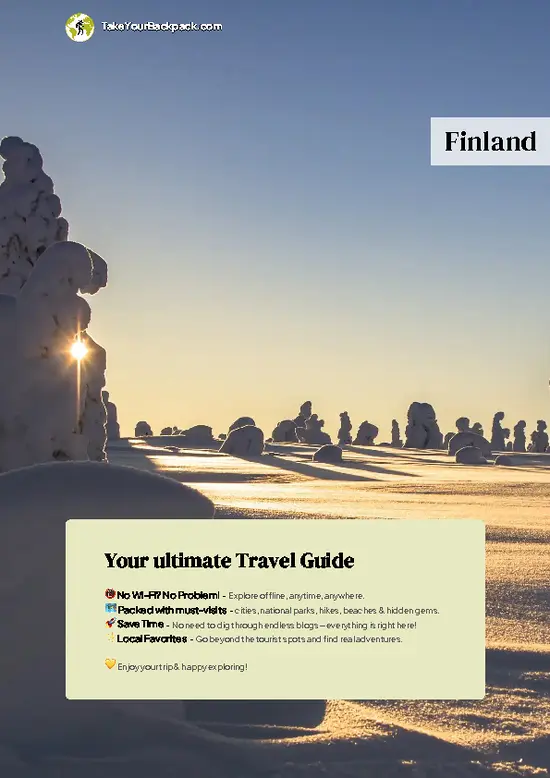
An offline-friendly backpacking guide with optimized travel routes, ranked highlights, transport advice, and the best areas to stay.
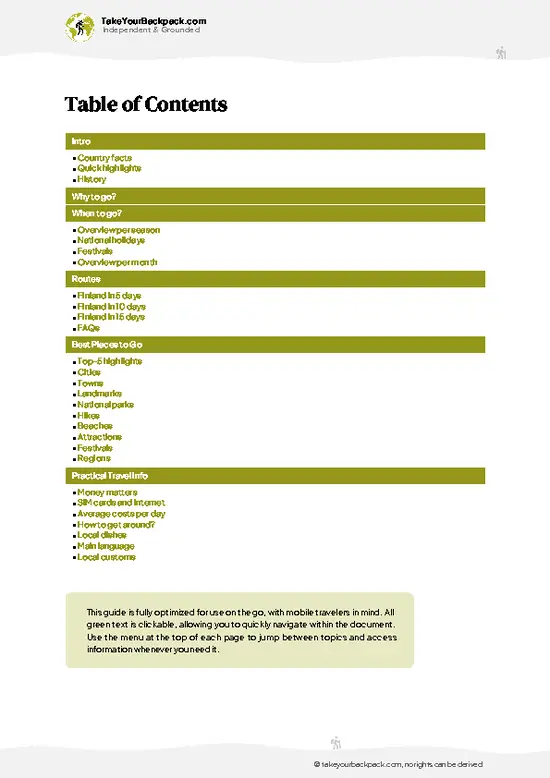
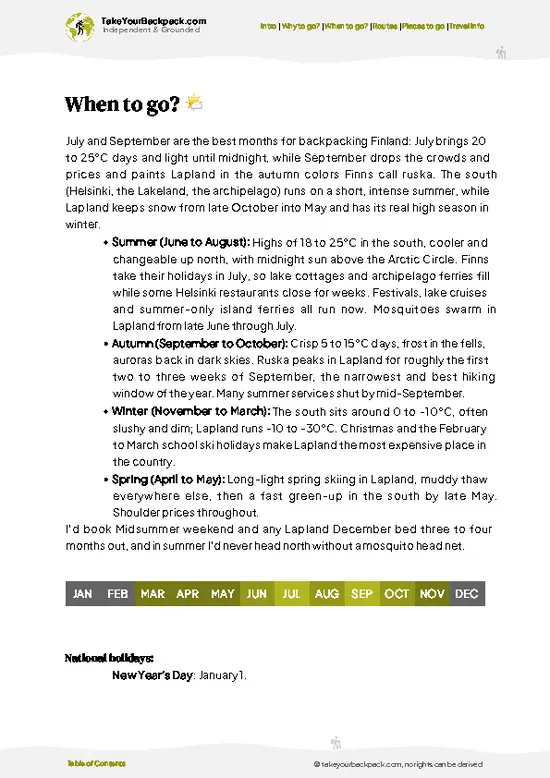
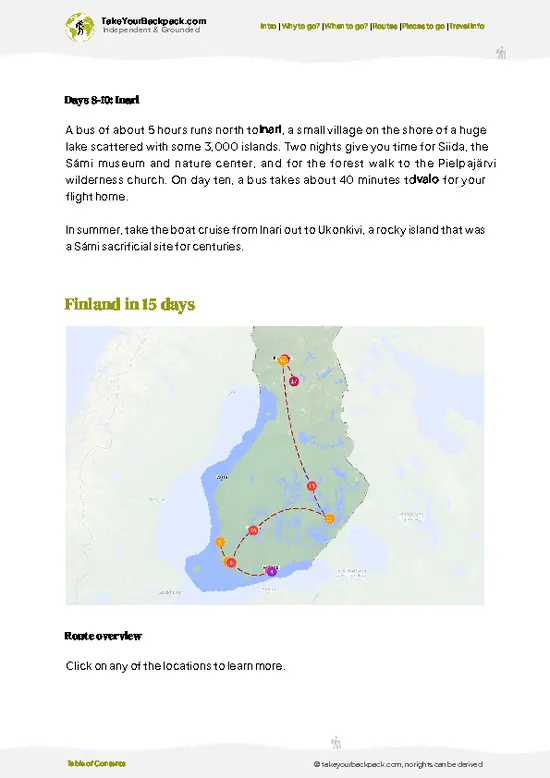
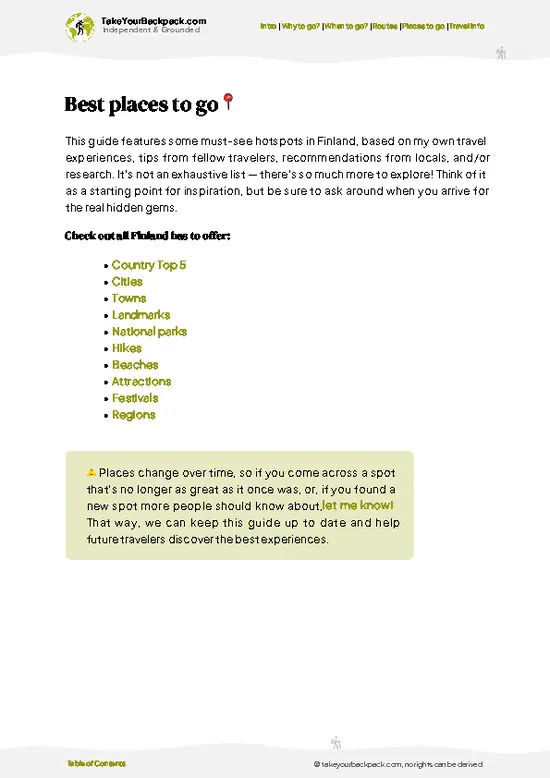
example page 0 from our offline Travel Guide for Finland
example page 1 from our offline Travel Guide for Finland
example page 2 from our offline Travel Guide for Finland
example page 3 from our offline Travel Guide for Finland
example page 4 from our offline Travel Guide for Finland
example page 5 from our offline Travel Guide for Finland
example page 6 from our offline Travel Guide for Finland
example page 7 from our offline Travel Guide for Finland
The digital guide (341 pages) contains:
✅ 87 highlights, ranked by travel appeal
✅ Optimized 5, 10 & 15-day travel routes
✅ Cities, national parks, landmarks, beaches
✅ How to get around
✅ Offline-friendly for travel without Wi-Fi
👉 Click to see all 30+ guide features

📅 Plan smarter in minutes, not weeks
✅ Month by month travel advice
✅ Festivals & national holidays
✅ Budget expectations

🗺️ Go to the right places, skip the overrated ones
✅ Honest pros & cons of destinations
✅ Top hikes, parks & viewpoints
✅ Lesser-known places most travelers miss
✅ Clear “worth it vs skip it” guidance

🛏️ Travel smoothly without rookie mistakes
✅ Best areas to stay
✅ Transport systems explained simply
✅ Common scams & safety advice
✅ SIM cards, money & practical tips

🌍 Understand the country, not just visit it
✅ Culture & traditions
✅ 52 Essential phrases & customs
✅ Festivals worth planning around
✅ Traveler-friendly historical context
✅ Insights that make places more meaningful

📱 Built for real travel conditions
✅ Fully downloadable PDF
✅ Works completely offline
✅ Optimized for phone use
✅ Useful in remote areas & buses
✅ Everything in one place
Stop searching, start planning
Get instant access to your full guide. 30‑day money-back guarantee.
+ Add another guide for just

By proceeding you agree to our terms.
Sent to your inbox immediately after payment • 100% Secure Checkout
Best Backpacking Travel Advisor 2025 tourism awardBest Backpacking
Travel Advisor
2025
What others say about Take Your Backpack Guides:
⭐⭐⭐⭐⭐
Fantastic, amazing amount of information!
⭐⭐⭐⭐⭐
My goodness this is amazing, it's what I've been looking for hats off too you!
⭐⭐⭐⭐⭐
I think this is absolutely BRILLIANT
⭐⭐⭐⭐
Very complete and informative. It's still missing places, but I gotta to commend you
⭐⭐⭐⭐⭐
This is truly amazing, thank you, can't wait to explore it with my kids!
⭐⭐⭐⭐⭐
Awesome resource, thank you!
⭐⭐⭐⭐⭐
This is amazing! Can't wait to explore the ones I haven't seen
⭐⭐⭐⭐
I love this! Well done, great idea.
⭐⭐⭐⭐⭐
Thanks for taking the time to make this gem!
⭐⭐⭐⭐⭐
This might be the best website I've ever seen.
⭐⭐⭐⭐⭐
Congratulations, and thank you so much for your work; it's incredibly valuable.
⭐⭐⭐⭐
In all seriousness I think you did a great job pointing out the important spots
⭐⭐⭐⭐⭐
10/10 very good
⭐⭐⭐⭐⭐
As someone who's only just starting to visit regularly this is awesome, thank you.
⭐⭐⭐⭐
Thank you very much! I'm going to visit my dad, it's going to be very useful!
⭐⭐⭐⭐⭐
This is really cool! We'll be travelling for the first time and this definitely come in handy.
⭐⭐⭐⭐⭐
You are now our minister of culture, congratulations 👨‍💼
⭐⭐⭐⭐⭐
Just wanted to tell you that this is a pearl! Going to follow your recommendations.
⭐⭐⭐⭐⭐
This is so cool. I'll definitely be using the resource for my travels soon.
⭐⭐⭐⭐⭐
This is very impressive! Good work.
⭐⭐⭐⭐⭐
This is an amazing and informative site. Very well done!

🛏️ Where to stay?Where to Base Yourself

Finland has a solid hostel network, with dorm beds typically €30 to €45 a night in Helsinki and less in smaller cities, plus summer-only hostels set up in student housing from June to August. In Helsinki, Kamppi and the streets around the Central Station put you within walking distance of the main sights and the airport train but cost the most, Kallio is cheaper and has the city’s liveliest bar scene with louder weekend nights, and Punavuori is quieter, with design shops and cafés about 15 minutes’ walk from the center. Outside the capital, the central districts of Turku, Tampere and Rovaniemi hold most budget beds, all of them safe, though Rovaniemi books out and gets pricey around Christmas. … read more 👉
Finland has a solid hostel network, with dorm beds typically €30 to €45 a night in Helsinki and less in smaller cities, plus summer-only hostels set up in student housing from June to August. In Helsinki, Kamppi and the streets around the Central Station put you within walking distance of the main sights and the airport train but cost the most, Kallio is cheaper and has the city’s liveliest bar scene with louder weekend nights, and Punavuori is quieter, with design shops and cafés about 15 minutes’ walk from the center. Outside the capital, the central districts of Turku, Tampere and Rovaniemi hold most budget beds, all of them safe, though Rovaniemi books out and gets pricey around Christmas.

If you enjoy meeting fellow travelers, consider choosing hostels with high ratings for atmosphere. On the other hand, if you prefer having your own space, a hotel might be a better option.

FinlandExpand Your Journey

👋 Meet the founderWho’s Behind Take Your Backpack?

Johan, backpacker and founder of TakeYourBackpackHi, I’m Johan (Netherlands 🇳🇱), the creator of TakeYourBackpack. Over the past 3 decades, I’ve backpacked through 90+ countries across six continents, gaining extensive experience with independent travel, long-term trips, and overland routes.

This site is built on a combination of firsthand travel experience and carefully curated insights from other backpackers. Many guides are based on places I’ve personally visited, while others bring together tips, observations, and practical advice shared by trusted travelers I’ve met along the way.

The goal is to provide realistic, experience-driven guidance — not generic itineraries — so you can explore destinations with better context, clearer expectations, and more confidence.