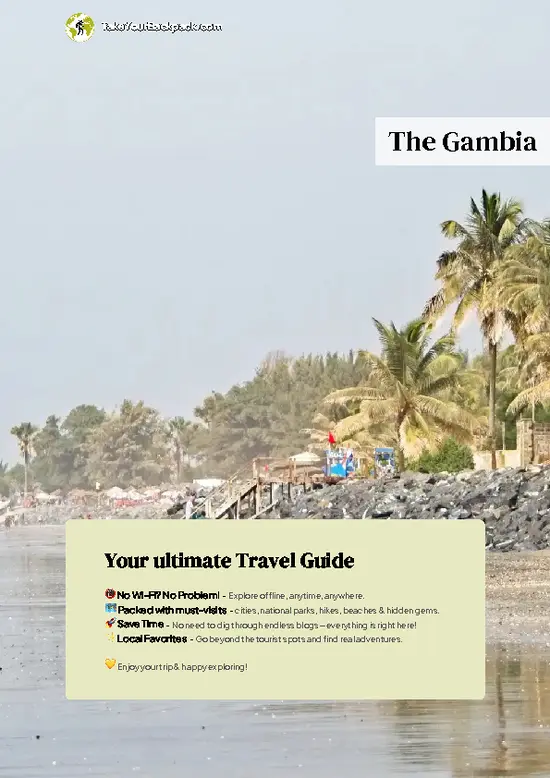
Short version: yes, Gambia is very doable to backpack independently, especially if you’ve handled any other West African country. It’s small, English is widely spoken, and the main tourist strip around Senegambia is used to foreigners doing their own thing. The easy parts: the coastal area (Bakau–Fajara–Kololi–Bijilo–Brufut) has plenty of cheap guesthouses, hostels, and local restaurants, and you can walk or grab shared taxis for short hops. People are generally friendly and curious, and you’ll rarely feel completely “out there” or isolated. The challenges: you’ll deal with a lot of “bumsters” (beach hustlers and self-appointed guides) who want to show you around for a fee or commission. They’re not usually dangerous, just persistent. A firm, polite “no, thanks, I’m fine” repeated a few times works; agreeing to “just look” at something often leads to awkward tipping moments. Bureaucracy is light once you’re in, but border crossings to/from Senegal can be slow and chaotic, especially the Barra–Banjul ferry. Have patience, keep your valuables tight, and don’t expect clear signage. For a first-time backpacker, Gambia is a good intro to West Africa because distances are short, the river is a natural orientation line, and you can base yourself on the coast while doing day or overnight trips inland. For a veteran, it’s an easy, low-stress country where you can move on instinct rather than strict planning.
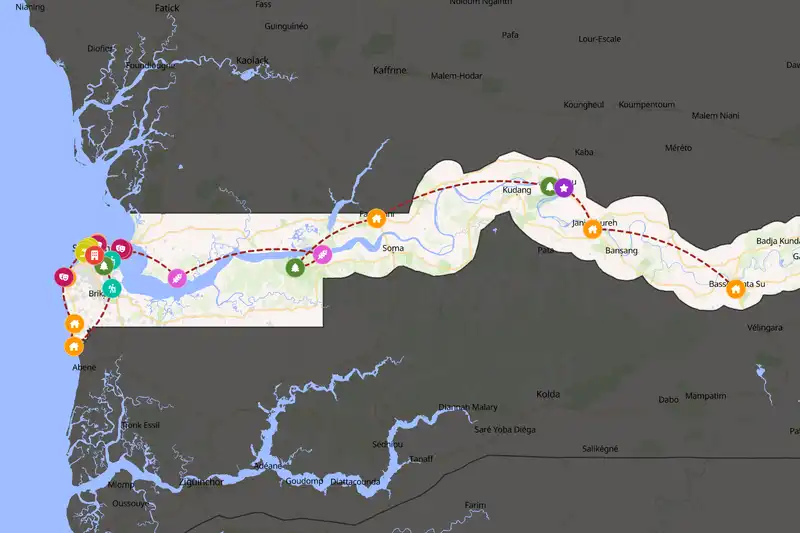
If you only want a taste of Gambia and you’re already in the region, 4–5 days is enough for the basics: a couple of beach days around Kololi/Bijilo, a river trip or nature reserve, and a quick look at Banjul and Bakau. That’s the “I’m passing through” version. For a solid backpacking trip that feels like more than a stopover, aim for 7–10 days. That gives you time to: base on the coast, do a day trip to Kachikally Crocodile Pool and local markets, spend a night or two upriver (Janjanbureh/Georgetown or Tendaba), and maybe cross briefly into Senegal’s Casamance if your visa situation allows. If you’re slow-traveling West Africa and want to really lean into the river and birdlife, 2 weeks is a sweet spot. You can move gradually along the river, stay in simple eco-lodges, and actually relax instead of just ticking sights. More than 2 weeks only makes sense if you’re combining Gambia with Senegal or using it as a base to rest, write, or work remotely. The country is small; you’ll run out of “new” places faster than in, say, Ghana or Morocco, but you’ll gain depth by getting to know a few communities well.
You can absolutely get around Gambia without a car, but you need to be comfortable with slow, slightly chaotic transport. On the coast, movement is easy. Shared yellow taxis and green tourist taxis run constantly between Bakau, Fajara, Kololi, Bijilo, and Brufut. Shared taxis are cheaper but more cramped; agree on the price before you get in, and ask for the shared rate, not the private hire rate. For very short distances, walking is often faster than waiting for a taxi to fill. For longer distances and inland travel, you’ll use bush taxis (sept-place style cars or minibuses) and occasionally river transport. They leave when full, not on a timetable, so mornings are your friend; show up early at the main taxi garage for your direction (e.g., Brikama, Soma, Farafenni, Basse). Expect tight seating, heat, and dust, but also a lot of human interaction and random roadside snack stops. The Barra–Banjul ferry is a key crossing if you’re heading north or connecting to Senegal. It’s cheap but can be slow and crowded. Keep your daypack on you, not on the floor, and treat the schedule as a suggestion. If you’re short on time or patience, you can mix in occasional private taxis for specific legs (like late-night arrivals or early-morning departures). For a budget backpacker, though, public transport is the default and works fine as long as you don’t stack too many connections in one day.
For a budget traveler, the must-visits are less about big-ticket attractions and more about a few key zones that show different sides of the country. 1) The coastal strip (Kololi–Bijilo–Brufut): This is your base camp. Cheap guesthouses, beach shacks, and easy food options. Bijilo Forest Park (Monkey Park) is worth a walk if you go early to avoid the heat and crowds; skip feeding monkeys from your hand to avoid bites and bad habits. Brufut and Tanji beaches feel more local than the main Senegambia strip. 2) Bakau & Kachikally Crocodile Pool: Bakau has a more lived-in feel than the resort area. Kachikally is touristy but unique: a sacred pool where crocodiles are considered tame and tied to local beliefs. Go with a clear idea of your boundaries (photos, touching crocs, tipping guides) and treat it as a cultural site, not a zoo. Combine it with a wander through nearby markets and the coastal cliffs. 3) Banjul (half-day): The capital is small but worth a quick look for context. Climb Arch 22 if it’s open, walk Albert Market, and see how compact the city actually is. It’s not a place to linger for days, but it rounds out the story beyond the beach. 4) River Gambia / upriver stay (Tendaba or Janjanbureh/Georgetown): This is the real highlight if you like nature and slower travel. A night or two in a simple lodge or camp along the river gives you birdlife, boat trips at dawn or dusk, and a sense of rural Gambia that the coast can’t match. Janjanbureh has history and a small-town feel; Tendaba is more about wetlands and wildlife. 5) Local markets anywhere you land: Serrekunda Market on the coast, plus smaller town markets inland, are essential for understanding daily life. Go with small bills, a secure money belt, and a relaxed attitude toward haggling. Even if you don’t buy much, the sensory overload is the point.
If you’re short on time, skip anything that eats hours without adding much beyond what you’ve already seen. 1) Multiple similar beach towns: Pick one base on the coast (Kololi/Bijilo or Brufut) and stick with it. You don’t need to hop between every beach; the differences are subtle, and you’ll waste time repacking and renegotiating taxis. 2) Overlong Banjul stay: Banjul is worth a half-day to a day, not a long stay. After the market, Arch 22, and a few streets, you’ve basically seen it. Sleeping there is usually less convenient and not cheaper than staying in the coastal area. 3) Package-style resort activities: Jet skis, overpriced sunset cruises from big hotels, and generic “cultural shows” aimed at package tourists are easy to skip on a backpacker budget. You can get more authentic culture by visiting a local compound, chatting with people at a tea stand, or joining a football game on the beach. 4) Trying to see the entire river in one go: The river is long, transport is slow, and trying to push all the way to Basse and back on a tight schedule turns into a bus marathon. If time is limited, choose one upriver base (Tendaba or Janjanbureh) and do it properly instead of racing to the far end. 5) Shopping-heavy itineraries: Gambia has crafts and textiles, but if your time is tight, don’t burn hours hunting for souvenirs. Focus on experiences—river trips, markets, conversations—and if you see something you like along the way, buy it then instead of planning dedicated shopping days.