×
Gambia🇬🇲 | 5 days itinerary

The Perfect 5-Day Route for The Gambia

By Johan Kruseman 🇳🇱 | Updated May 11, 2026
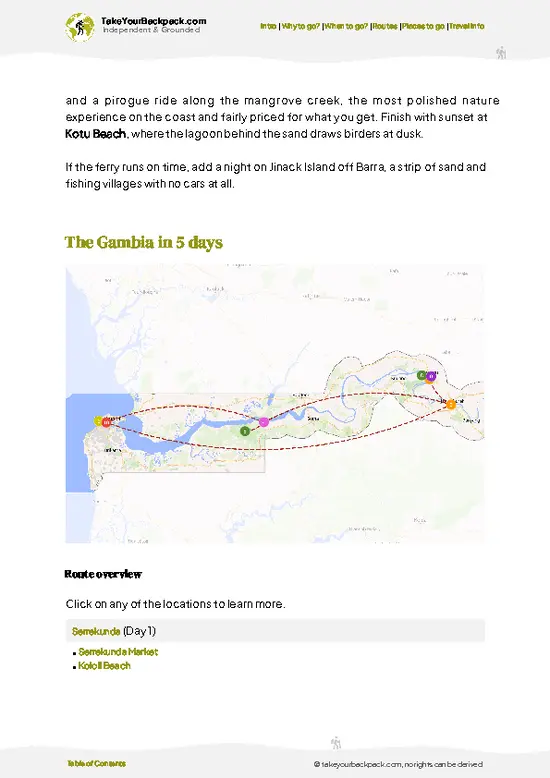
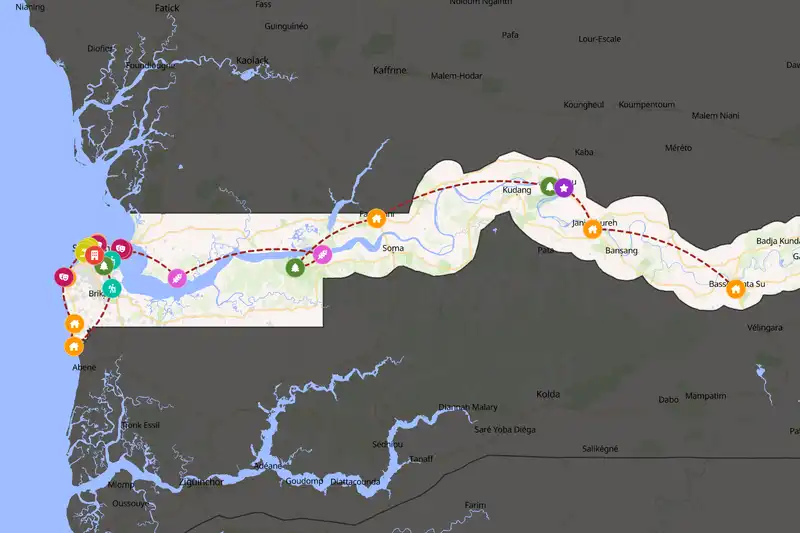
This 5-day route is for travelers who want to feel the full stretch of The Gambia: coast, forest, river, and ancient stones, with enough time to breathe in each place instead of just ticking boxes. The pace is steady but not frantic, using a mix of taxis, bush taxis, and a hired driver for the longer hauls upriver, plus simple boat trips to get you onto the water where this country really comes alive.

Days 1-2: Coastal Base - Serrekunda, Bijilo Forest Park, and Kololi/Kotu Beaches

Start with two nights on the coast around Serrekunda, using the city as your practical anchor for cash, food, and transport while spending your days on the sand and in the trees. Split your beach time between Kololi Beach and Kotu Beach, walking the shoreline, watching local football games, and easing into Gambian time with grilled fish and cold drinks at simple beach shacks. When you’re ready to move, duck into Bijilo Forest Park for a half-day walk among monkeys, birds, and sandy forest trails that sit surprisingly … read more 👉
This 5-day route is for travelers who want to feel the full stretch of The Gambia: coast, forest, river, and ancient stones, with enough time to breathe in each place instead of just ticking boxes. The pace is steady but not frantic, using a mix of taxis, bush taxis, and a hired driver for the longer hauls upriver, plus simple boat trips to get you onto the water where this country really comes alive.

Days 1-2: Coastal Base - Serrekunda, Bijilo Forest Park, and Kololi/Kotu Beaches

Start with two nights on the coast around Serrekunda, using the city as your practical anchor for cash, food, and transport while spending your days on the sand and in the trees. Split your beach time between Kololi Beach and Kotu Beach, walking the shoreline, watching local football games, and easing into Gambian time with grilled fish and cold drinks at simple beach shacks. When you’re ready to move, duck into Bijilo Forest Park for a half-day walk among monkeys, birds, and sandy forest trails that sit surprisingly close to the resort strip, giving you an easy first taste of the country’s wildlife without a long transfer.

Day 3: Abuko Nature Reserve & Makasutu Culture Forest - Forest Trails and River Culture

On day three, leave the pure beach scene behind and head inland to Abuko Nature Reserve, one of the country’s classic wildlife spots, where short trails wind through gallery forest alive with monkeys, antelope, and a serious bird list. After a few hours on the paths and at the hides, continue on to Makasutu Culture Forest, a mix of woodland, mangroves, and cultural experiences along a quiet stretch of river. Here you can walk shaded trails, paddle or motor through mangrove channels, and learn how local communities use the forest and water, making this day the heart of your nature-and-culture blend before you push further upriver.

Day 4: Upriver to Janjanbureh & Wassu - Stones and River Island Life

Use day four as your big upriver push, traveling by road to Janjanbureh, the historic river island town that once sat at the center of colonial trade routes. After settling in, arrange a side trip to Wassu, home to the ancient stone circles that are among West Africa’s most intriguing archaeological sites, standing quietly in the savanna and raising more questions than they answer. Back in Janjanbureh, walk the streets, talk to locals about the town’s layered history, and, if time allows, take a short boat ride on the river to watch hippos and birds as the light softens toward evening.

Day 5: Juffureh & River Gambia National Park - Memory and Wildlife

On your final day, begin the journey back downriver with a stop at Juffureh, the village made globally known through the story of “Roots,” where you can visit local memorials and talk with guides about the region’s role in the transatlantic slave trade. From there, continue toward River Gambia National Park, where boat trips along the river bring you close to forested islands that shelter chimpanzees and a rich mix of birdlife and other animals, giving you a last, powerful immersion in the country’s wild side. As you return toward the coast in the evening, you’ll have traced a full arc from ocean to upriver stones and back, with the river itself tying the whole journey together in your memory.

For a bonus detour that rewards the truly curious, slip off the main road to the tiny settlement of Dankunku, where evenings are spent under mango trees trading stories with villagers as the river glows in the last light.
Loading the map 🌍
film
0
0
0a
Kololi Beach
film
1
1
1a
Kotu Beach
film
2
2
2a
Bijilo Forest Park
film
3
3
3a
Abuko Nature Reserve
film
4
4
4a
Makasutu Culture Forest
film
5
5
5a
Wassu

🛏️ Where to stay?Your Route at a Glance

✈️ The backpacker research shortcutThe Gambia Travel Guide

An offline-friendly backpacking guide with optimized travel routes, ranked highlights, transport advice, and the best areas to stay.
example page 0 from our offline Travel Guide for Gambiaexample page 1 from our offline Travel Guide for Gambiaexample page 2 from our offline Travel Guide for Gambiaexample page 3 from our offline Travel Guide for Gambiaexample page 4 from our offline Travel Guide for Gambiaexample page 5 from our offline Travel Guide for Gambia
The digital guide (204 pages) contains:
57 highlights, ranked by travel appeal
Optimized 2, 3 & 5-day travel routes
Best neighborhoods to stay
How to get around
Offline-friendly for travel without Wi-Fi
👉 See all 30+ guide features

📅 Plan smarter in minutes, not weeks
Month by month travel advice
Festivals & national holidays
Budget expectations

🗺️ Go to the right places, skip the overrated ones
Honest pros & cons of destinations
Top hikes, parks & viewpoints
Lesser-known places most travelers miss
Clear “worth it vs skip it” guidance

🛏️ Travel smoothly without rookie mistakes
Best areas to stay
Transport systems explained simply
Common scams & safety advice
SIM cards, money & practical tips

🌍 Understand the country, not just visit it
Culture & traditions
52 Essential phrases & customs
Festivals worth planning around
Traveler-friendly historical context
Insights that make places more meaningful

📱 Built for real travel conditions
Fully downloadable PDF
Works completely offline
Optimized for phone use
Useful in remote areas & buses
Everything in one place
Save weeks of stressful planning
Get instant access to the full guide directly. 30-day money-back guarantee.


Sent to your inbox immediately after payment • 100% Secure Checkout
Best Backpacking Travel Advisor 2025 tourism awardBest Backpacking
Travel Advisor
2025
What others say about Take Your Backpack Guides:
⭐⭐⭐⭐⭐
Fantastic, amazing amount of information!
⭐⭐⭐⭐⭐
My goodness this is amazing, it's what I've been looking for hats off too you!
⭐⭐⭐⭐⭐
I think this is absolutely BRILLIANT
⭐⭐⭐⭐
Very complete and informative. It's still missing places, but I gotta to commend you
⭐⭐⭐⭐⭐
This is truly amazing, thank you, can't wait to explore it with my kids!
⭐⭐⭐⭐⭐
Awesome resource, thank you!
⭐⭐⭐⭐⭐
This is amazing! Can't wait to explore the ones I haven't seen
⭐⭐⭐⭐
I love this! Well done, great idea.
⭐⭐⭐⭐⭐
Thanks for taking the time to make this gem!
⭐⭐⭐⭐⭐
This might be the best website I've ever seen.
⭐⭐⭐⭐⭐
Congratulations, and thank you so much for your work; it's incredibly valuable.
⭐⭐⭐⭐
In all seriousness I think you did a great job pointing out the important spots
⭐⭐⭐⭐⭐
10/10 very good
⭐⭐⭐⭐⭐
As someone who's only just starting to visit regularly this is awesome, thank you.
⭐⭐⭐⭐
Thank you very much! I'm going to visit my dad, it's going to be very useful!
⭐⭐⭐⭐⭐
This is really cool! We'll be travelling for the first time and this definitely come in handy.
⭐⭐⭐⭐⭐
You are now our minister of culture, congratulations 👨‍💼
⭐⭐⭐⭐⭐
Just wanted to tell you that this is a pearl! Going to follow your recommendations.
⭐⭐⭐⭐⭐
This is so cool. I'll definitely be using the resource for my travels soon.
⭐⭐⭐⭐⭐
This is very impressive! Good work.
⭐⭐⭐⭐⭐
This is an amazing and informative site. Very well done!

🧭 RouteAlternative Routes

Travel The Gambia your way — from a quick highlights trip to a slow-paced adventure.

🙋 FAQBackpacking FAQ

Short version: yes, Gambia is very doable to backpack independently, especially if you’ve handled any other West African country. It’s small, English is widely spoken, and the main tourist strip around Senegambia is used to foreigners doing their own thing. The easy parts: the coastal area (Bakau–Fajara–Kololi–Bijilo–Brufut) has plenty of cheap guesthouses, hostels, and local restaurants, and you can walk or grab shared taxis for short hops. People are generally friendly and curious, and you’ll rarely feel completely “out there” or isolated. The challenges: you’ll deal with a lot of “bumsters” (beach hustlers and self-appointed guides) who want to show you around for a fee or commission. They’re not usually dangerous, just persistent. A firm, polite “no, thanks, I’m fine” repeated a few times works; agreeing to “just look” at something often leads to awkward tipping moments. Bureaucracy is light once you’re in, but border crossings to/from Senegal can be slow and chaotic, especially the Barra–Banjul ferry. Have patience, keep your valuables tight, and don’t expect clear signage. For a first-time backpacker, Gambia is a good intro to West Africa because distances are short, the river is a natural orientation line, and you can base yourself on the coast while doing day or overnight trips inland. For a veteran, it’s an easy, low-stress country where you can move on instinct rather than strict planning.
If you only want a taste of Gambia and you’re already in the region, 4–5 days is enough for the basics: a couple of beach days around Kololi/Bijilo, a river trip or nature reserve, and a quick look at Banjul and Bakau. That’s the “I’m passing through” version. For a solid backpacking trip that feels like more than a stopover, aim for 7–10 days. That gives you time to: base on the coast, do a day trip to Kachikally Crocodile Pool and local markets, spend a night or two upriver (Janjanbureh/Georgetown or Tendaba), and maybe cross briefly into Senegal’s Casamance if your visa situation allows. If you’re slow-traveling West Africa and want to really lean into the river and birdlife, 2 weeks is a sweet spot. You can move gradually along the river, stay in simple eco-lodges, and actually relax instead of just ticking sights. More than 2 weeks only makes sense if you’re combining Gambia with Senegal or using it as a base to rest, write, or work remotely. The country is small; you’ll run out of “new” places faster than in, say, Ghana or Morocco, but you’ll gain depth by getting to know a few communities well.
You can absolutely get around Gambia without a car, but you need to be comfortable with slow, slightly chaotic transport. On the coast, movement is easy. Shared yellow taxis and green tourist taxis run constantly between Bakau, Fajara, Kololi, Bijilo, and Brufut. Shared taxis are cheaper but more cramped; agree on the price before you get in, and ask for the shared rate, not the private hire rate. For very short distances, walking is often faster than waiting for a taxi to fill. For longer distances and inland travel, you’ll use bush taxis (sept-place style cars or minibuses) and occasionally river transport. They leave when full, not on a timetable, so mornings are your friend; show up early at the main taxi garage for your direction (e.g., Brikama, Soma, Farafenni, Basse). Expect tight seating, heat, and dust, but also a lot of human interaction and random roadside snack stops. The Barra–Banjul ferry is a key crossing if you’re heading north or connecting to Senegal. It’s cheap but can be slow and crowded. Keep your daypack on you, not on the floor, and treat the schedule as a suggestion. If you’re short on time or patience, you can mix in occasional private taxis for specific legs (like late-night arrivals or early-morning departures). For a budget backpacker, though, public transport is the default and works fine as long as you don’t stack too many connections in one day.
For a budget traveler, the must-visits are less about big-ticket attractions and more about a few key zones that show different sides of the country. 1) The coastal strip (Kololi–Bijilo–Brufut): This is your base camp. Cheap guesthouses, beach shacks, and easy food options. Bijilo Forest Park (Monkey Park) is worth a walk if you go early to avoid the heat and crowds; skip feeding monkeys from your hand to avoid bites and bad habits. Brufut and Tanji beaches feel more local than the main Senegambia strip. 2) Bakau & Kachikally Crocodile Pool: Bakau has a more lived-in feel than the resort area. Kachikally is touristy but unique: a sacred pool where crocodiles are considered tame and tied to local beliefs. Go with a clear idea of your boundaries (photos, touching crocs, tipping guides) and treat it as a cultural site, not a zoo. Combine it with a wander through nearby markets and the coastal cliffs. 3) Banjul (half-day): The capital is small but worth a quick look for context. Climb Arch 22 if it’s open, walk Albert Market, and see how compact the city actually is. It’s not a place to linger for days, but it rounds out the story beyond the beach. 4) River Gambia / upriver stay (Tendaba or Janjanbureh/Georgetown): This is the real highlight if you like nature and slower travel. A night or two in a simple lodge or camp along the river gives you birdlife, boat trips at dawn or dusk, and a sense of rural Gambia that the coast can’t match. Janjanbureh has history and a small-town feel; Tendaba is more about wetlands and wildlife. 5) Local markets anywhere you land: Serrekunda Market on the coast, plus smaller town markets inland, are essential for understanding daily life. Go with small bills, a secure money belt, and a relaxed attitude toward haggling. Even if you don’t buy much, the sensory overload is the point.
If you’re short on time, skip anything that eats hours without adding much beyond what you’ve already seen. 1) Multiple similar beach towns: Pick one base on the coast (Kololi/Bijilo or Brufut) and stick with it. You don’t need to hop between every beach; the differences are subtle, and you’ll waste time repacking and renegotiating taxis. 2) Overlong Banjul stay: Banjul is worth a half-day to a day, not a long stay. After the market, Arch 22, and a few streets, you’ve basically seen it. Sleeping there is usually less convenient and not cheaper than staying in the coastal area. 3) Package-style resort activities: Jet skis, overpriced sunset cruises from big hotels, and generic “cultural shows” aimed at package tourists are easy to skip on a backpacker budget. You can get more authentic culture by visiting a local compound, chatting with people at a tea stand, or joining a football game on the beach. 4) Trying to see the entire river in one go: The river is long, transport is slow, and trying to push all the way to Basse and back on a tight schedule turns into a bus marathon. If time is limited, choose one upriver base (Tendaba or Janjanbureh) and do it properly instead of racing to the far end. 5) Shopping-heavy itineraries: Gambia has crafts and textiles, but if your time is tight, don’t burn hours hunting for souvenirs. Focus on experiences—river trips, markets, conversations—and if you see something you like along the way, buy it then instead of planning dedicated shopping days.

🇬🇲 The GambiaMore of The Gambia

Ready to build a truly unique trip? Predefined routes are perfect for first-time visitors, but there is so much more to discover. Whether you are chasing a city trip, pristine national parks, local food scenes, or quiet beaches, pick a category to design your own path.