×

Georgia🇬🇪 | best hikesYour Guide to the 7 Best hikes in Georgia

Hiking in Georgia means ridgelines of the Greater Caucasus in the north, where stone towers rise above wet meadows and cowbells clank at dusk, and dry, wind-scoured volcanic plateaus and forested hills in the south and west. Svaneti and Kazbegi draw the crowds and the marked trails. Tusheti and Khevsureti stay quieter, with rutted 4x4 roads and fewer beds. Lowland forests around Borjomi and Mtirala are cheap and easy to reach. Independent travelers can reach most trailheads by minibus (marshrutka) for US$2 to 10, and guesthouse dinners come with smoky cheese and homemade wine.

By Johan Kruseman 🇳🇱 | Updated October 18, 2026
Explore the best beaches in Georgia

Why go?Why Travelers Love These Spots

Georgia packs three climate zones into a country smaller than Ireland. Subtropical Black Sea forest, semi-desert near Davit Gareja and glaciated 5,000-meter peaks sit within a day's drive of each other. That variety means the air can change from damp, mossy and fern-scented to thin, cold and crackling with wind in a single afternoon. Trails also follow old human routes. Medieval watchtowers, stone shrines and shepherd paths link villages that were cut off by snow for months each winter, so even a remote walk usually ends at a hearth and a plate of khachapuri or kubdari.

Before choosing Georgia, know that infrastructure is uneven. Waymarking is patchy outside Kazbegi, Mestia and Ushguli, mountain roads can be washed out, and the Tusheti road is closed by snow for much of the year. Mountain … read more 👉
Georgia packs three climate zones into a country smaller than Ireland. Subtropical Black Sea forest, semi-desert near Davit Gareja and glaciated 5,000-meter peaks sit within a day's drive of each other. That variety means the air can change from damp, mossy and fern-scented to thin, cold and crackling with wind in a single afternoon. Trails also follow old human routes. Medieval watchtowers, stone shrines and shepherd paths link villages that were cut off by snow for months each winter, so even a remote walk usually ends at a hearth and a plate of khachapuri or kubdari.

Before choosing Georgia, know that infrastructure is uneven. Waymarking is patchy outside Kazbegi, Mestia and Ushguli, mountain roads can be washed out, and the Tusheti road is closed by snow for much of the year. Mountain weather turns fast, with afternoon storms common on high passes. Mobile signal fades in valleys. Rescue services exist but are slow in remote districts, so self-reliance and offline maps matter. In return, hospitality is genuine, wild camping is widely tolerated, and the cost of a full trip stays low by European standards.
Why These Made the Cut
The list of best hikes in Georgia is created based on scenery, challenge, trail quality, landmarks, and overall enjoyment. If you feel a hike is missing in this list, please let us know.

When to go?When to Plan Your Trip

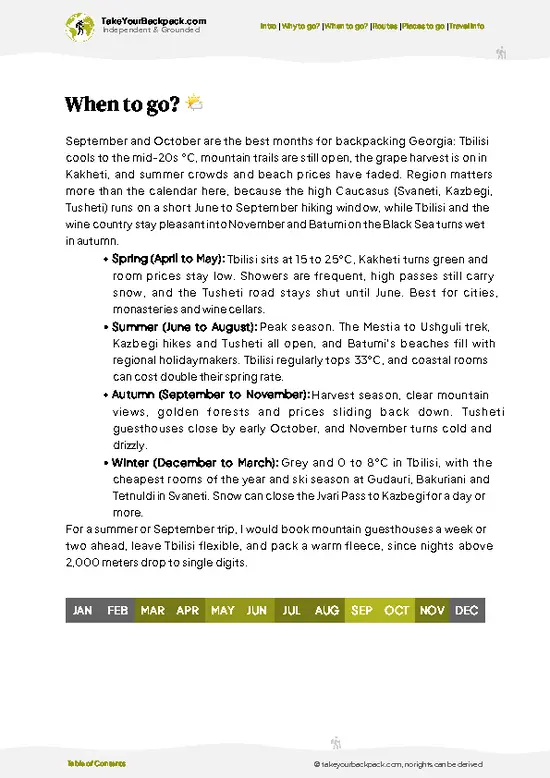
Best months: The best months for hiking in Georgia are June to September in the high Caucasus, when snow has left most passes and meadows are loud with insects and thick with wildflowers. July and August bring daytime highs of 18 to 28°C in the valleys, but nights at 2,500 meters can drop close to freezing, and afternoon thunderstorms are frequent. Late June is greenest, with snow patches still on passes above 2,800 meters.
Shoulder seasons: May and September to early October suit lower trails, with cooler air, golden birch and beech forest and fewer people. Many high passes are still blocked in May, and Tusheti road access usually opens only from around June. By late October guesthouses in Svaneti and Kazbegi start to close, and snow can arrive at altitude.
Lowlands and winter: Western Georgia … read more 👉
Best months: The best months for hiking in Georgia are June to September in the high Caucasus, when snow has left most passes and meadows are loud with insects and thick with wildflowers. July and August bring daytime highs of 18 to 28°C in the valleys, but nights at 2,500 meters can drop close to freezing, and afternoon thunderstorms are frequent. Late June is greenest, with snow patches still on passes above 2,800 meters.
Shoulder seasons: May and September to early October suit lower trails, with cooler air, golden birch and beech forest and fewer people. Many high passes are still blocked in May, and Tusheti road access usually opens only from around June. By late October guesthouses in Svaneti and Kazbegi start to close, and snow can arrive at altitude.
Lowlands and winter: Western Georgia around Mtirala, the Black Sea and Adjara is humid and rainy, with more than 2,000 mm of annual rainfall in places. Spring and autumn are best there, while summer feels sticky. Winter is for the southeast and low hills only, and prices dip then. July and August are peak, with guesthouse beds in Mestia and Kazbegi costing about US$20 to 40 with dinner, and booking ahead is wise.

hike hoppingSuggested Travel Strategies

How long to allow: A trip combining several hikes in Georgia needs 10 to 14 days, with a week the minimum for two regions. Tbilisi is the hub, with marshrutkas and shared taxis leaving from Didube and Ortachala stations.
Grouping regions: Kazbegi and Tusheti pair poorly despite looking close on a map, since Tusheti is reached via a separate road over the Abano Pass, a 4x4 ride of 6 to 8 hours from Telavi. Kazbegi sits on the Military Highway, about 3 to 4 hours north of Tbilisi, and combines easily with Khevsureti. Svaneti lies in the northwest, reached from Tbilisi by a 8 to 10 hour road journey, or by a short flight to Mestia in good weather. Borjomi and the western forests fit between. A sensible direction runs east to west, starting in the dry heights and finishing in the greener, wetter … read more 👉
How long to allow: A trip combining several hikes in Georgia needs 10 to 14 days, with a week the minimum for two regions. Tbilisi is the hub, with marshrutkas and shared taxis leaving from Didube and Ortachala stations.
Grouping regions: Kazbegi and Tusheti pair poorly despite looking close on a map, since Tusheti is reached via a separate road over the Abano Pass, a 4x4 ride of 6 to 8 hours from Telavi. Kazbegi sits on the Military Highway, about 3 to 4 hours north of Tbilisi, and combines easily with Khevsureti. Svaneti lies in the northwest, reached from Tbilisi by a 8 to 10 hour road journey, or by a short flight to Mestia in good weather. Borjomi and the western forests fit between. A sensible direction runs east to west, starting in the dry heights and finishing in the greener, wetter forests, ending near Kutaisi airport.
Time per stop: Give each mountain base 3 to 4 days, which covers a day for arrival and rest, plus a one-day walk and a multi-day trek if wanted. Transfers between regions take most of a day, often 6 to 10 hours on winding roads.
Common planning mistakes: Travelers often cram four regions into one week and spend it staring at van windows. Pick two or three. Weather also closes roads and grounds Mestia flights, so leave a spare day before departure.

The ListThe Best hikes of Georgia

1 Mestia to Ushguli

medieval towers, highland villages, Svaneti ridges

Traverse remote valleys and ancient settlements, passing between stone watchtowers and alpine meadows on a multi-day route through Svaneti’s cultural heart.

georgia-hike-mestia-to-ushguli
© Google |

2 Omalo to Shatili

Tusheti passes, stone villages, wild borderlands

Cross rugged mountain passes linking two remote regions, encountering fortified hamlets and steep, exposed trails along the way.

georgia-hike-omalo-to-shatili
© Google |

3 Juta to Roshka

Chaukhi massif, Abudelauri lakes, rocky passes

Navigate a challenging route over a high pass, rewarded by glacial lakes and dramatic rock formations unique to the Greater Caucasus.

georgia-hike-juta-to-roshka
© Google |

4 Kazbegi to Gergeti Glacier

Mount Kazbek views, glacier approach, alpine tundra

Ascend from the iconic church above Stepantsminda to the edge of permanent ice, with shifting weather and panoramic mountain vistas throughout the climb.

georgia-hike-kazbegi-to-gergeti-glacier
© Google |

5 Chalaadi Glacier

glacial river, moraine fields, short ascent

Reach the glacier’s edge on a half-day trek, crossing boulder-strewn terrain and icy streams beneath towering peaks near Mestia.

6 Khada Valley Trail

tower ruins, wildflower meadows, narrow gorge

Walk through a secluded valley dotted with medieval remnants, where narrow paths wind between steep slopes and seasonal blooms.

7 Borjomi to Likani

forest trails, mineral springs, gentle slopes

Follow wooded paths through Borjomi-Kharagauli National Park, where mild gradients and forest clearings make for a relaxed day hike.

georgia-hike-borjomi-to-likani
© Google |
Loading the map 🌍

Expert viewTips and Advice from Travelers

How many hikes to plan: I advise four to six hikes across a two-week trip. That allows two or three multi-day treks and a few day walks, with rest days built in. Georgian mountain roads are slow, the weather turns, and legs need recovery on steep climbs that gain 800 to 1,200 meters. More than six turns the trip into a checklist, and you miss the part where a host presses another glass of wine on you in a stone kitchen thick with wood smoke.
Choosing the kind of hike: First-timers should start with marked day walks from Kazbegi or Mestia, where trails are clear, guesthouses are close and the views of glaciers and snow ridges come quickly. Experienced trekkers will find more solitude on multi-day routes in Tusheti, Khevsureti or the Svaneti villages, where you carry food and a tent and cross … read more 👉
How many hikes to plan: I advise four to six hikes across a two-week trip. That allows two or three multi-day treks and a few day walks, with rest days built in. Georgian mountain roads are slow, the weather turns, and legs need recovery on steep climbs that gain 800 to 1,200 meters. More than six turns the trip into a checklist, and you miss the part where a host presses another glass of wine on you in a stone kitchen thick with wood smoke.
Choosing the kind of hike: First-timers should start with marked day walks from Kazbegi or Mestia, where trails are clear, guesthouses are close and the views of glaciers and snow ridges come quickly. Experienced trekkers will find more solitude on multi-day routes in Tusheti, Khevsureti or the Svaneti villages, where you carry food and a tent and cross high passes. Travelers on a tight schedule or in wet shoulder months can try lowland forest trails near Borjomi or Mtirala, which are gentler and cheaper to reach. Pick one hard route, then fill the rest with easy days.
What it costs: Budget US$30 to 55 a day on your own, with guesthouse bed, dinner and breakfast at US$20 to 40, trail snacks and marshrutka rides of US$2 to 10 per leg. Entry fees to national parks are small or nil for most trails, though Kazbegi and Borjomi charge modest amounts. A local guide runs about US$60 to 120 a day, and a 4x4 transfer to Tusheti or Ushguli costs US$100 to 250 per vehicle, shared between passengers. For a two-week trip, plan US$600 to 1,100 including transport between bases. Tents save money, and wild camping is widely tolerated away from villages.
Safety and local etiquette: The main hazards are weather and navigation. Fog can erase a ridge in minutes, lightning strikes exposed passes in the afternoon, and rivers swell with snowmelt in June and early July. Carry offline maps, a rain shell, warm layers and a headlamp, and start early. Shepherd dogs guard flocks and can be aggressive, so stop, pick up no stones, and walk around the flock slowly. Border zones with Russia and Abkhazia and South Ossetia are restricted, so keep to marked areas and carry your passport near the Azerbaijan and Dagestan frontiers. Mountain rescue is slow, so register your plan with your host. Dress modestly in village churches, ask before photographing people, and accept a toast with at least a sip. That small gesture often brings an invitation to the table.

✈️ The backpacker research shortcutGeorgia Travel Guide

An offline-friendly backpacking guide with optimized travel routes, ranked highlights, transport advice, and the best areas to stay.
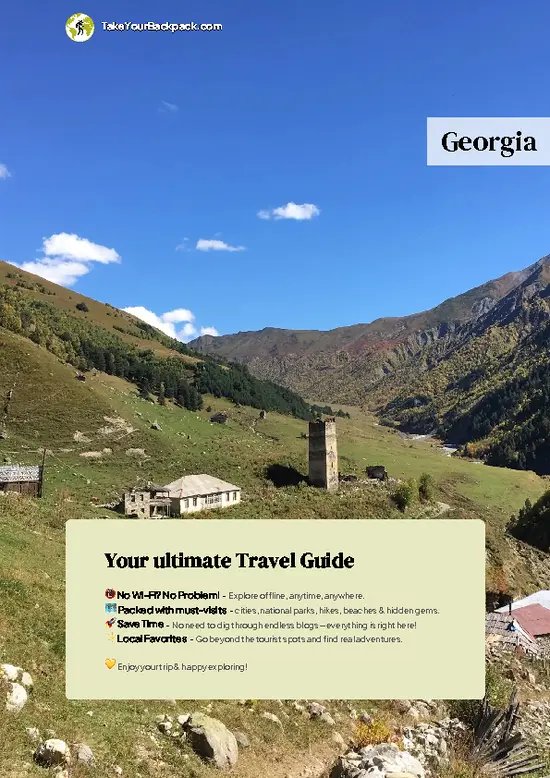
example page 0 from our offline Travel Guide for Georgia
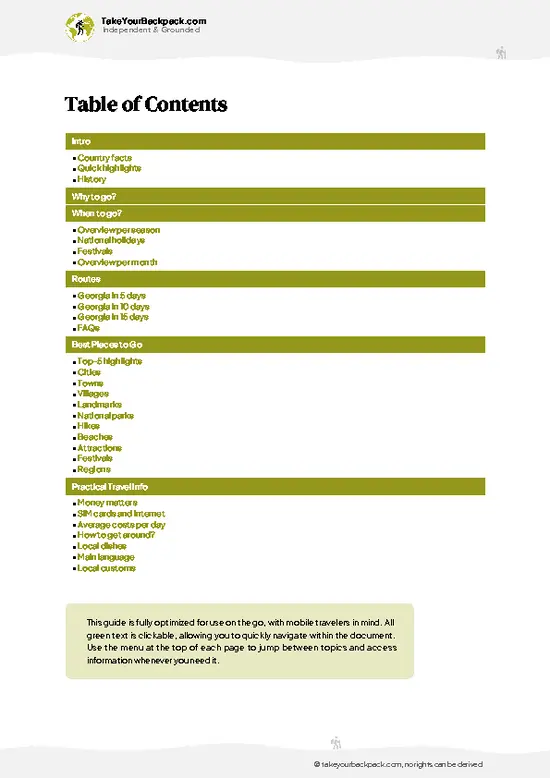
example page 1 from our offline Travel Guide for Georgia
example page 2 from our offline Travel Guide for Georgia
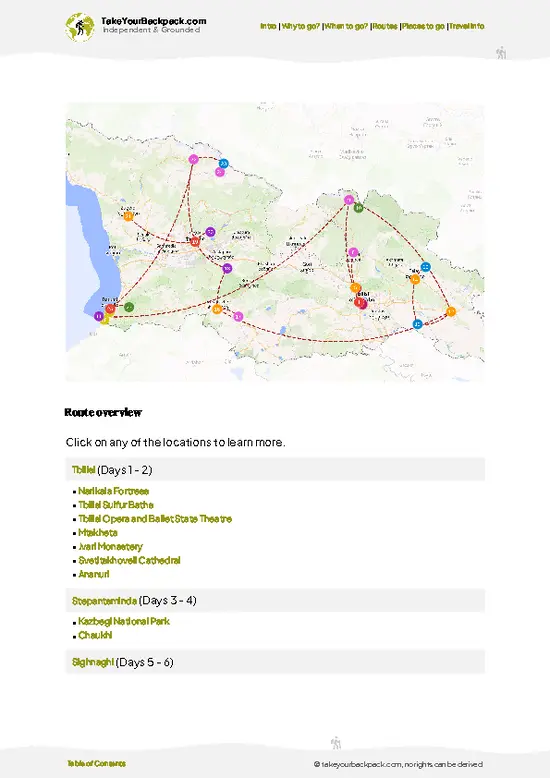
example page 3 from our offline Travel Guide for Georgia
example page 4 from our offline Travel Guide for Georgia
example page 5 from our offline Travel Guide for Georgia
example page 6 from our offline Travel Guide for Georgia
example page 7 from our offline Travel Guide for Georgia
The digital guide (350 pages) contains:
✅ 89 highlights, ranked by travel appeal
✅ Optimized 5, 10 & 15-day travel routes
✅ Cities, national parks, landmarks, beaches
✅ How to get around
✅ Offline-friendly for travel without Wi-Fi
👉 Click to see all 30+ guide features

📅 Plan smarter in minutes, not weeks
✅ Month by month travel advice
✅ Festivals & national holidays
✅ Budget expectations

🗺️ Go to the right places, skip the overrated ones
✅ Honest pros & cons of destinations
✅ Top hikes, parks & viewpoints
✅ Lesser-known places most travelers miss
✅ Clear “worth it vs skip it” guidance

🛏️ Travel smoothly without rookie mistakes
✅ Best areas to stay
✅ Transport systems explained simply
✅ Common scams & safety advice
✅ SIM cards, money & practical tips

🌍 Understand the country, not just visit it
✅ Culture & traditions
✅ 52 Essential phrases & customs
✅ Festivals worth planning around
✅ Traveler-friendly historical context
✅ Insights that make places more meaningful

📱 Built for real travel conditions
✅ Fully downloadable PDF
✅ Works completely offline
✅ Optimized for phone use
✅ Useful in remote areas & buses
✅ Everything in one place
Stop searching, start planning
Get instant access to your full guide. 30‑day money-back guarantee.
+ Add another guide for just

By proceeding you agree to our terms.
Sent to your inbox immediately after payment • 100% Secure Checkout
Best Backpacking Travel Advisor 2025 tourism awardBest Backpacking
Travel Advisor
2025
What others say about Take Your Backpack Guides:
⭐⭐⭐⭐⭐
Fantastic, amazing amount of information!
⭐⭐⭐⭐⭐
My goodness this is amazing, it's what I've been looking for hats off too you!
⭐⭐⭐⭐⭐
I think this is absolutely BRILLIANT
⭐⭐⭐⭐
Very complete and informative. It's still missing places, but I gotta to commend you
⭐⭐⭐⭐⭐
This is truly amazing, thank you, can't wait to explore it with my kids!
⭐⭐⭐⭐⭐
Awesome resource, thank you!
⭐⭐⭐⭐⭐
This is amazing! Can't wait to explore the ones I haven't seen
⭐⭐⭐⭐
I love this! Well done, great idea.
⭐⭐⭐⭐⭐
Thanks for taking the time to make this gem!
⭐⭐⭐⭐⭐
This might be the best website I've ever seen.
⭐⭐⭐⭐⭐
Congratulations, and thank you so much for your work; it's incredibly valuable.
⭐⭐⭐⭐
In all seriousness I think you did a great job pointing out the important spots
⭐⭐⭐⭐⭐
10/10 very good
⭐⭐⭐⭐⭐
As someone who's only just starting to visit regularly this is awesome, thank you.
⭐⭐⭐⭐
Thank you very much! I'm going to visit my dad, it's going to be very useful!
⭐⭐⭐⭐⭐
This is really cool! We'll be travelling for the first time and this definitely come in handy.
⭐⭐⭐⭐⭐
You are now our minister of culture, congratulations 👨‍💼
⭐⭐⭐⭐⭐
Just wanted to tell you that this is a pearl! Going to follow your recommendations.
⭐⭐⭐⭐⭐
This is so cool. I'll definitely be using the resource for my travels soon.
⭐⭐⭐⭐⭐
This is very impressive! Good work.
⭐⭐⭐⭐⭐
This is an amazing and informative site. Very well done!

🛏️ Where to stay?Best Places to Stay in Georgia

Georgia has plenty of hostels and guesthouses, with dorm beds typically 25 to 40 GEL (about US$9 to 15) and private guesthouse rooms from around 70 GEL (US$26). In Tbilisi, Sololaki and the Old Town put you within walking distance of the sulfur baths and the best wine bars but come with steep cobbled streets and late-night noise, while Marjanishvili and Chughureti on the left bank are cheaper, well connected by metro and home to the city’s liveliest hostel and bar scene. On the coast, Batumi’s Old Town keeps you close to the boulevard and beach, and in Kutaisi the streets around the center are quiet, safe and handy for early marshrutka departures to the mountains.

If you enjoy meeting fellow … read more 👉
Georgia has plenty of hostels and guesthouses, with dorm beds typically 25 to 40 GEL (about US$9 to 15) and private guesthouse rooms from around 70 GEL (US$26). In Tbilisi, Sololaki and the Old Town put you within walking distance of the sulfur baths and the best wine bars but come with steep cobbled streets and late-night noise, while Marjanishvili and Chughureti on the left bank are cheaper, well connected by metro and home to the city’s liveliest hostel and bar scene. On the coast, Batumi’s Old Town keeps you close to the boulevard and beach, and in Kutaisi the streets around the center are quiet, safe and handy for early marshrutka departures to the mountains.

If you enjoy meeting fellow travelers, consider choosing hostels with high ratings for atmosphere. On the other hand, if you prefer having your own space, a hotel might be a better option.

GeorgiaExplore Georgia

👋 Meet the founderWho’s Behind Take Your Backpack?

Johan, backpacker and founder of TakeYourBackpackHi, I’m Johan (Netherlands 🇳🇱), the creator of TakeYourBackpack. Over the past 3 decades, I’ve backpacked through 90+ countries across six continents, gaining extensive experience with independent travel, long-term trips, and overland routes.

This site is built on a combination of firsthand travel experience and carefully curated insights from other backpackers. Many guides are based on places I’ve personally visited, while others bring together tips, observations, and practical advice shared by trusted travelers I’ve met along the way.

The goal is to provide realistic, experience-driven guidance — not generic itineraries — so you can explore destinations with better context, clearer expectations, and more confidence.