×

Georgia🇬🇪 | best citiesYour Guide to the 3 Best cities in Georgia

Cities in the country Georgia are small, walkable and layered, and they change character fast as you cross the country. In the west, Black Sea air carries salt, damp stone and wood smoke, and the streets are green and humid. In the east, dry heat bakes brick balconies, and the smell of fresh bread from tandoor-style ovens drifts out of basements. Mountain towns sit cool and quiet, with long road transfers. Costs stay low, usually US$30 to 60 a day, and marshrutkas link most places cheaply. For independent travel it is easy, though crowds thicken in the capital and on the coast in summer.

By Johan Kruseman 🇳🇱 | Updated October 18, 2026
Explore the best towns in Georgia

Why go?Why Travelers Love These Spots

Georgia works for cities because the country is compact, roughly the size of South Carolina, yet it packs in Black Sea coast, Caucasus peaks and dry eastern plains. A couple of hours by road changes the climate, the architecture and even the wine in your glass. Its position on the old Silk Road left Persian, Ottoman, Russian and Soviet layers stacked side by side: carved wooden balconies, sulfur-scented bathhouses, stone churches with steep conical domes, and concrete apartment blocks with laundry lines. Hospitality is a real social code, so a supra feast with toasts, qvevri wine and khachapuri can start with a stranger at the next table.

Before you commit, know the hard parts. Cities are small, so you will see most highlights in a day or two each, and the pace outside the capital is slow. … read more 👉
Georgia works for cities because the country is compact, roughly the size of South Carolina, yet it packs in Black Sea coast, Caucasus peaks and dry eastern plains. A couple of hours by road changes the climate, the architecture and even the wine in your glass. Its position on the old Silk Road left Persian, Ottoman, Russian and Soviet layers stacked side by side: carved wooden balconies, sulfur-scented bathhouses, stone churches with steep conical domes, and concrete apartment blocks with laundry lines. Hospitality is a real social code, so a supra feast with toasts, qvevri wine and khachapuri can start with a stranger at the next table.

Before you commit, know the hard parts. Cities are small, so you will see most highlights in a day or two each, and the pace outside the capital is slow. Pavements are cracked, traffic is aggressive, and Georgian script is hard to read, though bigger signs often carry English. Rail is limited, so you will depend on minibuses, shared taxis and apps. Winter brings gray skies, wet cobblestones and heating that varies by building. The reward is a country where history, food and mountain access sit unusually close together, at prices well below Western Europe.
Evaluating the Top Choices
The list of best cities in Georgia is created based on culture, vibe, attractions, transport ease, and local charm. If you feel a city is missing in this list, please let us know.

When to go?When to Plan Your Trip

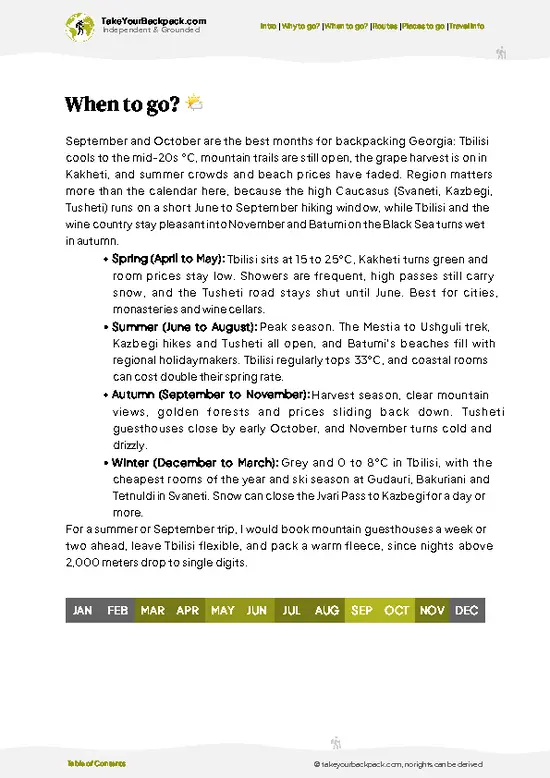
Best months and seasons: The best months for Georgian cities are May to June and September to October, when daytime temperatures sit around 18 to 27°C, the light is clear and terraces are open. Spring brings green hills, blossom and some rain, especially in the west, where May can see frequent showers. Autumn is the harvest season, with grape-picking in the east, the smell of fermenting must in villages and warm evenings that suit long dinners.

Summer and winter: July and August are hot: the east, including Tbilisi, regularly reaches 30 to 38°C, with stuffy buses and baking pavements. The Black Sea coast is humid and crowded, and accommodation prices can rise 30 to 60 percent in beach towns. Mountain towns are the cooler refuge in summer.

November to March is cold, damp and quiet. Eastern … read more 👉
Best months and seasons: The best months for Georgian cities are May to June and September to October, when daytime temperatures sit around 18 to 27°C, the light is clear and terraces are open. Spring brings green hills, blossom and some rain, especially in the west, where May can see frequent showers. Autumn is the harvest season, with grape-picking in the east, the smell of fermenting must in villages and warm evenings that suit long dinners.

Summer and winter: July and August are hot: the east, including Tbilisi, regularly reaches 30 to 38°C, with stuffy buses and baking pavements. The Black Sea coast is humid and crowded, and accommodation prices can rise 30 to 60 percent in beach towns. Mountain towns are the cooler refuge in summer.

November to March is cold, damp and quiet. Eastern cities hover around 0 to 8°C, the west gets heavy rain (the coast can see over 2,000 mm a year), and mountain towns have snow with some roads closed. Prices drop, though ski resorts are busy from December to March. Some coastal and seasonal attractions close, but cafés, bathhouses and wine cellars stay warm and welcoming.

city hoppingSuggested Travel Strategies

How many days to plan: A trip combining several Georgian cities needs 7 to 14 days, and 10 days is comfortable. Distances look short on the map but roads are winding, so a trip feels longer than the kilometers suggest.

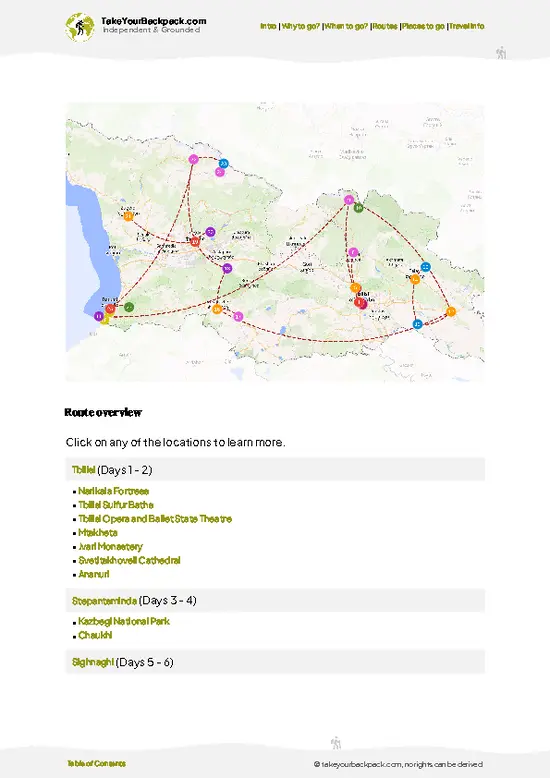
Grouping regions and direction: Group stops by region: the east (the capital and its surrounding wine country), the center (the Kutaisi area) and the west and coast (Batumi and the Black Sea). A west-to-east or east-to-west line works well, flying or taking a train into one end and out of the other. Mountain towns in the north form a separate branch that needs extra days, particularly outside summer when roads can be closed.

Allow 2 to 3 nights per stop for larger places and 1 to 2 for smaller towns. Typical transfers run 2 to 3 hours between the capital and central Georgia, … read more 👉
How many days to plan: A trip combining several Georgian cities needs 7 to 14 days, and 10 days is comfortable. Distances look short on the map but roads are winding, so a trip feels longer than the kilometers suggest.

Grouping regions and direction: Group stops by region: the east (the capital and its surrounding wine country), the center (the Kutaisi area) and the west and coast (Batumi and the Black Sea). A west-to-east or east-to-west line works well, flying or taking a train into one end and out of the other. Mountain towns in the north form a separate branch that needs extra days, particularly outside summer when roads can be closed.

Allow 2 to 3 nights per stop for larger places and 1 to 2 for smaller towns. Typical transfers run 2 to 3 hours between the capital and central Georgia, and 3 to 5 hours from there to the coast. The fast Stadler train between Tbilisi and Batumi takes about 5 hours. Marshrutkas are cheaper but cramped, hot in summer and sometimes leave only when full.

Common planning mistakes: Travelers often cram one new city per day and spend half of it in a minibus. Instead, base yourself in a hub and make day trips. Another mistake is skipping the early start: morning departures are more frequent, while afternoon services thin out. Book mountain legs with a buffer day for weather.

The ListThe Best cities of Georgia

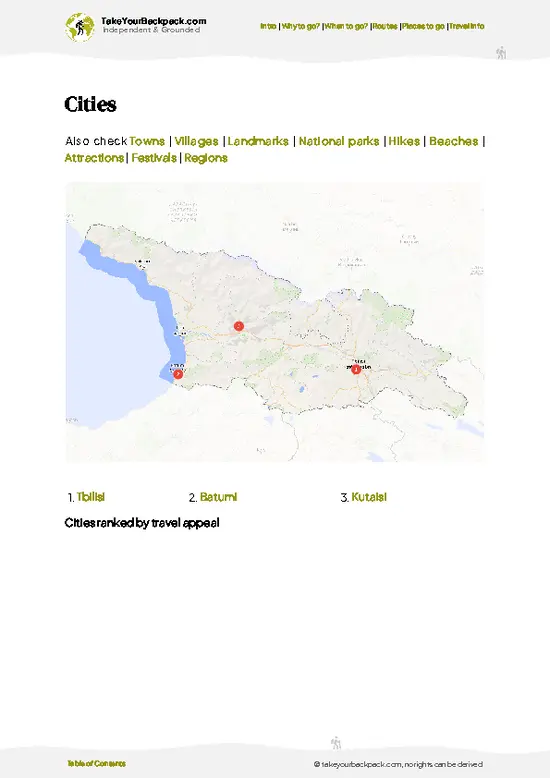
1 Tbilisi

cobbled alleys, sulfur baths, hillside neighborhoods

Descend winding streets from fortress heights to riverside courtyards, pausing in bathhouses and hidden courtyards that reveal the city’s layered identity.

2 Batumi

Black Sea coast, modern skyline, subtropical parks

Stroll along the seafront and watch the city shift from beach life to illuminated towers, with palm-lined boulevards and eclectic architecture framing every view.

3 Kutaisi

market squares, Soviet mosaics, hilltop cathedrals

Wander through lively markets and faded grandeur, then climb to panoramic churches overlooking a city where daily life and ancient ritual still intersect.

Loading the map 🌍

Expert viewTips and Advice from Travelers

How many cities to visit: Three to five cities is the right number for most trips of 7 to 14 days. Georgian cities are compact and the roads between them are slow, so every extra stop costs half a day in a vehicle. Fewer, longer stays let you wander old quarters, sit through a long lunch and still have time for a wine cellar or mountain day without feeling rushed.

Choosing between kinds of cities: Pick by travel style. If food and nightlife matter, favor the large eastern capital, where sulfur bathhouses, cellar bars and crowded bazaars give you the most variety. If you want sea air and easy beach time, choose a coastal city, but expect summer crowds and high-rise development. If you like quiet cobbled lanes, old churches and cheaper rooms, choose smaller inland towns. Mountain towns suit … read more 👉
How many cities to visit: Three to five cities is the right number for most trips of 7 to 14 days. Georgian cities are compact and the roads between them are slow, so every extra stop costs half a day in a vehicle. Fewer, longer stays let you wander old quarters, sit through a long lunch and still have time for a wine cellar or mountain day without feeling rushed.

Choosing between kinds of cities: Pick by travel style. If food and nightlife matter, favor the large eastern capital, where sulfur bathhouses, cellar bars and crowded bazaars give you the most variety. If you want sea air and easy beach time, choose a coastal city, but expect summer crowds and high-rise development. If you like quiet cobbled lanes, old churches and cheaper rooms, choose smaller inland towns. Mountain towns suit hikers: you get fresh air, stone towers and long views, but fewer services and longer transfers. First-timers will find the capital the easiest base, while veterans often get more from smaller places.

What it costs: Budget US$30 to 60 a day on a backpacker budget, covering a hostel dorm (US$8 to 15), a hearty meal of khachapuri, khinkali and a drink (US$5 to 10) and local transport. Mid-range travelers can plan US$70 to 120. Minibuses between cities usually cost about US$3 to 10, and taxi apps such as Bolt keep city rides at US$1 to 4. Museum and church entries range from free to roughly US$3 to 10, and a local guide for a half day typically costs US$30 to 70. Wine tastings run US$5 to 20. In summer, add a cushion for coastal rooms.

Safety and etiquette: Georgian cities are generally safe, with low violent crime. The usual risks are traffic: drivers rarely stop at crossings, so cross decisively and watch for cars on pavements. Stray dogs are common, and ear-tagged ones are usually vaccinated, but keep your distance. Use taxi apps to avoid inflated fares, and carry some cash because small shops may not take cards. Cover your shoulders and knees, and women should cover their heads, when entering Orthodox churches and monasteries. At a supra, the toasts are part of the meal, so sip with the table and decline politely if you must, since refusing a host’s wine can be seen as rude. Avoid the occupied regions of Abkhazia and South Ossetia, and check current advice before traveling near their administrative boundary lines.

✈️ The backpacker research shortcutGeorgia Travel Guide

An offline-friendly backpacking guide with optimized travel routes, ranked highlights, transport advice, and the best areas to stay.
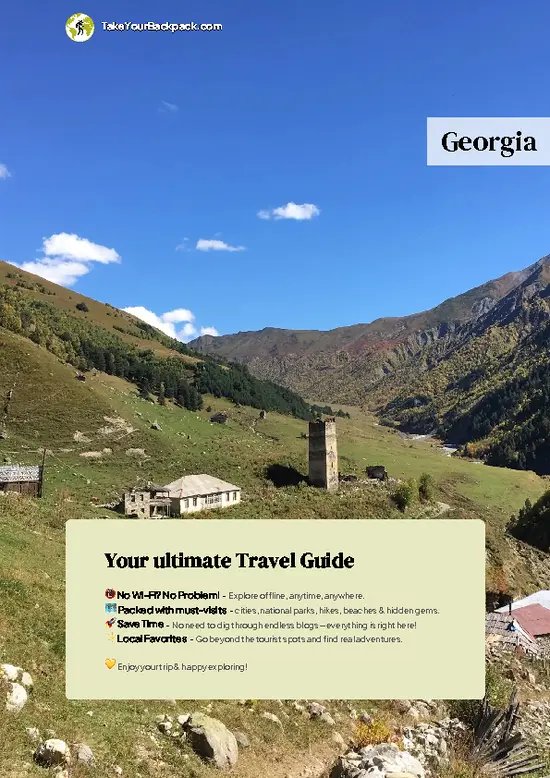
example page 0 from our offline Travel Guide for Georgia
example page 1 from our offline Travel Guide for Georgia
example page 2 from our offline Travel Guide for Georgia
example page 3 from our offline Travel Guide for Georgia
example page 4 from our offline Travel Guide for Georgia
example page 5 from our offline Travel Guide for Georgia
example page 6 from our offline Travel Guide for Georgia
example page 7 from our offline Travel Guide for Georgia
The digital guide (350 pages) contains:
✅ 89 highlights, ranked by travel appeal
✅ Optimized 5, 10 & 15-day travel routes
✅ Cities, national parks, landmarks, beaches
✅ How to get around
✅ Offline-friendly for travel without Wi-Fi
👉 Click to see all 30+ guide features

📅 Plan smarter in minutes, not weeks
✅ Month by month travel advice
✅ Festivals & national holidays
✅ Budget expectations

🗺️ Go to the right places, skip the overrated ones
✅ Honest pros & cons of destinations
✅ Top hikes, parks & viewpoints
✅ Lesser-known places most travelers miss
✅ Clear “worth it vs skip it” guidance

🛏️ Travel smoothly without rookie mistakes
✅ Best areas to stay
✅ Transport systems explained simply
✅ Common scams & safety advice
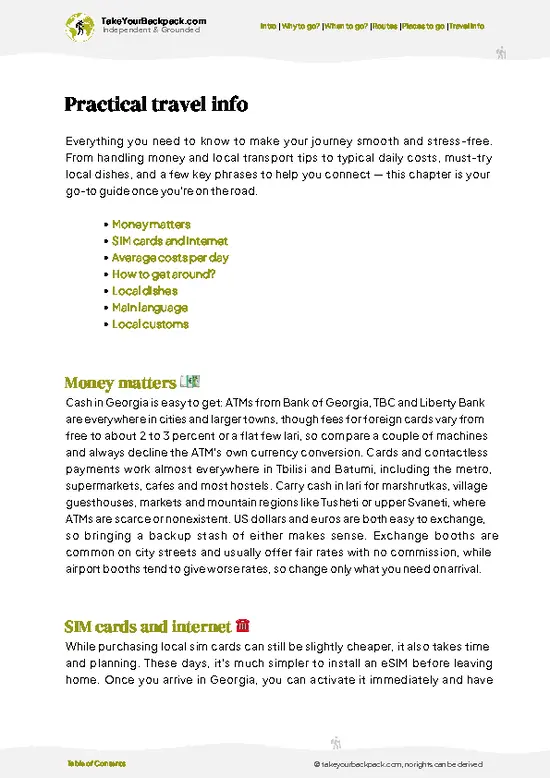
✅ SIM cards, money & practical tips

🌍 Understand the country, not just visit it
✅ Culture & traditions
✅ 52 Essential phrases & customs
✅ Festivals worth planning around
✅ Traveler-friendly historical context
✅ Insights that make places more meaningful

📱 Built for real travel conditions
✅ Fully downloadable PDF
✅ Works completely offline
✅ Optimized for phone use
✅ Useful in remote areas & buses
✅ Everything in one place
Stop searching, start planning
Get instant access to your full guide. 30‑day money-back guarantee.
+ Add another guide for just

By proceeding you agree to our terms.
Sent to your inbox immediately after payment • 100% Secure Checkout
Best Backpacking Travel Advisor 2025 tourism awardBest Backpacking
Travel Advisor
2025
What others say about Take Your Backpack Guides:
⭐⭐⭐⭐⭐
Fantastic, amazing amount of information!
⭐⭐⭐⭐⭐
My goodness this is amazing, it's what I've been looking for hats off too you!
⭐⭐⭐⭐⭐
I think this is absolutely BRILLIANT
⭐⭐⭐⭐
Very complete and informative. It's still missing places, but I gotta to commend you
⭐⭐⭐⭐⭐
This is truly amazing, thank you, can't wait to explore it with my kids!
⭐⭐⭐⭐⭐
Awesome resource, thank you!
⭐⭐⭐⭐⭐
This is amazing! Can't wait to explore the ones I haven't seen
⭐⭐⭐⭐
I love this! Well done, great idea.
⭐⭐⭐⭐⭐
Thanks for taking the time to make this gem!
⭐⭐⭐⭐⭐
This might be the best website I've ever seen.
⭐⭐⭐⭐⭐
Congratulations, and thank you so much for your work; it's incredibly valuable.
⭐⭐⭐⭐
In all seriousness I think you did a great job pointing out the important spots
⭐⭐⭐⭐⭐
10/10 very good
⭐⭐⭐⭐⭐
As someone who's only just starting to visit regularly this is awesome, thank you.
⭐⭐⭐⭐
Thank you very much! I'm going to visit my dad, it's going to be very useful!
⭐⭐⭐⭐⭐
This is really cool! We'll be travelling for the first time and this definitely come in handy.
⭐⭐⭐⭐⭐
You are now our minister of culture, congratulations 👨‍💼
⭐⭐⭐⭐⭐
Just wanted to tell you that this is a pearl! Going to follow your recommendations.
⭐⭐⭐⭐⭐
This is so cool. I'll definitely be using the resource for my travels soon.
⭐⭐⭐⭐⭐
This is very impressive! Good work.
⭐⭐⭐⭐⭐
This is an amazing and informative site. Very well done!

🛏️ Where to stay?Best Places to Stay in Georgia

Georgia has plenty of hostels and guesthouses, with dorm beds typically 25 to 40 GEL (about US$9 to 15) and private guesthouse rooms from around 70 GEL (US$26). In Tbilisi, Sololaki and the Old Town put you within walking distance of the sulfur baths and the best wine bars but come with steep cobbled streets and late-night noise, while Marjanishvili and Chughureti on the left bank are cheaper, well connected by metro and home to the city’s liveliest hostel and bar scene. On the coast, Batumi’s Old Town keeps you close to the boulevard and beach, and in Kutaisi the streets around the center are quiet, safe and handy for early marshrutka departures to the mountains.

If you enjoy meeting fellow … read more 👉
Georgia has plenty of hostels and guesthouses, with dorm beds typically 25 to 40 GEL (about US$9 to 15) and private guesthouse rooms from around 70 GEL (US$26). In Tbilisi, Sololaki and the Old Town put you within walking distance of the sulfur baths and the best wine bars but come with steep cobbled streets and late-night noise, while Marjanishvili and Chughureti on the left bank are cheaper, well connected by metro and home to the city’s liveliest hostel and bar scene. On the coast, Batumi’s Old Town keeps you close to the boulevard and beach, and in Kutaisi the streets around the center are quiet, safe and handy for early marshrutka departures to the mountains.

If you enjoy meeting fellow travelers, consider choosing hostels with high ratings for atmosphere. On the other hand, if you prefer having your own space, a hotel might be a better option.

GeorgiaExplore Georgia

👋 Meet the founderWho’s Behind Take Your Backpack?

Johan, backpacker and founder of TakeYourBackpackHi, I’m Johan (Netherlands 🇳🇱), the creator of TakeYourBackpack. Over the past 3 decades, I’ve backpacked through 90+ countries across six continents, gaining extensive experience with independent travel, long-term trips, and overland routes.

This site is built on a combination of firsthand travel experience and carefully curated insights from other backpackers. Many guides are based on places I’ve personally visited, while others bring together tips, observations, and practical advice shared by trusted travelers I’ve met along the way.

The goal is to provide realistic, experience-driven guidance — not generic itineraries — so you can explore destinations with better context, clearer expectations, and more confidence.