×

Georgia🇬🇪 | best landmarksYour Guide to the 3 Best landmarks in Georgia

Landmarks in Georgia are mostly stone, and they sit in places that make you work a little. Hilltop monasteries smell of beeswax and cold limestone, cave cities hold the dry chill of rock, and Soviet-era concrete stands beside medieval towers in the capital. The Caucasus highlands of Svaneti and Kazbegi bring thin air, mud roads and village towers, with few crowds. Kakheti and Imereti offer easy day trips by marshrutka (shared minibus) and low entry costs, often free. Tbilisi is the busiest and most polished. For independent travel, the question is whether you want accessible heritage or remote, rougher sites.

By Johan Kruseman 🇳🇱 | Updated October 18, 2026
Explore the best national parks in Georgia

Why go?Why Travelers Love These Spots

Georgia sits where Persian, Byzantine, Ottoman and Russian influence overlapped, and the landmark density shows it. A country roughly the size of West Virginia holds fortresses, cave settlements, towers and churches that stand a few valleys apart. Christianity became the state religion in the 4th century, so many churches and monasteries are still working places, with candle smoke, chanting and women in headscarves rather than ticket queues. That living quality is the main difference from museum-style heritage elsewhere.

Geography shapes everything. The Greater Caucasus in the north brings steep roads, snow-closed passes and weather that changes within an hour, while the lowlands east and west are dry or humid and easy to cover. Infrastructure is uneven: the main highway and rail lines work … read more 👉
Georgia sits where Persian, Byzantine, Ottoman and Russian influence overlapped, and the landmark density shows it. A country roughly the size of West Virginia holds fortresses, cave settlements, towers and churches that stand a few valleys apart. Christianity became the state religion in the 4th century, so many churches and monasteries are still working places, with candle smoke, chanting and women in headscarves rather than ticket queues. That living quality is the main difference from museum-style heritage elsewhere.

Geography shapes everything. The Greater Caucasus in the north brings steep roads, snow-closed passes and weather that changes within an hour, while the lowlands east and west are dry or humid and easy to cover. Infrastructure is uneven: the main highway and rail lines work well, but many sites at the end of rural roads depend on shared minibuses, taxis or a hired driver.

Before choosing Georgia, know the practical rules. Cover your shoulders and knees in active churches, and expect some places to close for services. Signage in English is patchy, opening hours can be loose, and entry fees are low or absent at most sites. Distances look short on a map but mountain roads run slowly, and that slowness is part of the experience.
How the List Was Created
The list of best unique sites in Georgia is created based on history or culture, wow factor, atmosphere, quirks, and memorability. If you feel a unique site is missing in this list, please let us know.

When to go?When to Plan Your Trip

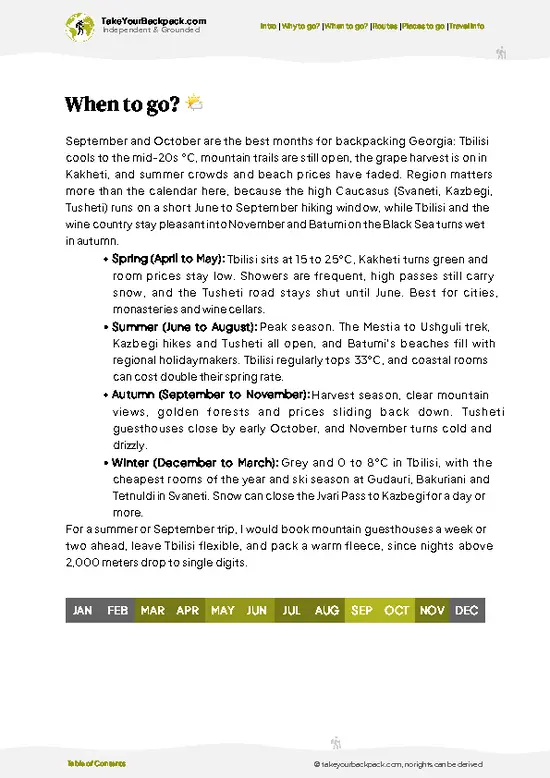
Best months and weather: The best months for landmarks in Georgia are May to June and September to early October, when daytime temperatures sit around 18 to 27°C, hillsides are green or gold, and mountain roads are open. Light is soft in the morning and long in the evening, and stone sites are comfortable to walk without baking in the sun.
Summer and shoulder seasons: July and August bring heat of 30 to 38°C in Tbilisi and the eastern lowlands, where exposed fortress sites have almost no shade and the pavement radiates. The Black Sea coast and Imereti are humid, with afternoon storms. Highlands such as Svaneti and Kazbegi are at their best then, with cool nights of 5 to 12°C and open trails, but guesthouse prices rise by roughly 20 to 40 percent and the busiest churches fill with tour groups … read more 👉
Best months and weather: The best months for landmarks in Georgia are May to June and September to early October, when daytime temperatures sit around 18 to 27°C, hillsides are green or gold, and mountain roads are open. Light is soft in the morning and long in the evening, and stone sites are comfortable to walk without baking in the sun.
Summer and shoulder seasons: July and August bring heat of 30 to 38°C in Tbilisi and the eastern lowlands, where exposed fortress sites have almost no shade and the pavement radiates. The Black Sea coast and Imereti are humid, with afternoon storms. Highlands such as Svaneti and Kazbegi are at their best then, with cool nights of 5 to 12°C and open trails, but guesthouse prices rise by roughly 20 to 40 percent and the busiest churches fill with tour groups on weekends. April and late October are cooler shoulder months with more rain, around 60 to 100 mm monthly in the west, and lower prices.
Winter: From November to March, Tbilisi and Kakheti are cold and gray, around 0 to 8°C, but quiet and cheap. High mountain roads can close with snow, notably around Kazbegi and Svaneti, and some rural sites cut their hours or become unreachable without a 4x4 or a local driver.

unique site hoppingSuggested Travel Strategies

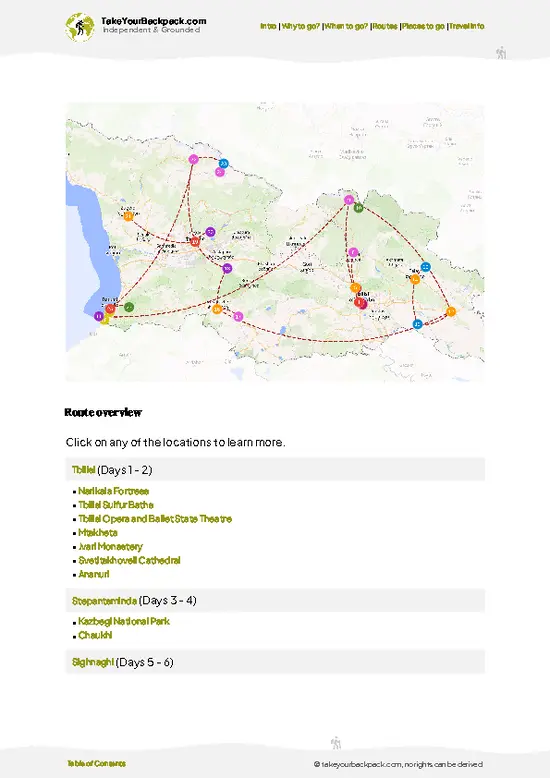
How many days to allow: A trip combining several landmarks in Georgia needs 7 to 12 days. Anything shorter turns into a blur of windows and minibus seats. The country clusters into a few natural groups: Tbilisi with the eastern Kakheti wine region and nearby Mtskheta, central and western Imereti around Kutaisi, and the northern mountains of Kazbegi and Svaneti.
Direction and timing: Starting in Tbilisi and moving west suits most travelers, since the capital has the main transport hub and the best onward connections. Kutaisi, reached by train or marshrutka in about 4 to 5 hours, works as a western base for day trips. Svaneti is roughly 4 to 6 hours from Kutaisi by minibus to Mestia on a winding road, and it is best placed at the end of a loop or as a separate branch. Kazbegi is about 3 hours … read more 👉
How many days to allow: A trip combining several landmarks in Georgia needs 7 to 12 days. Anything shorter turns into a blur of windows and minibus seats. The country clusters into a few natural groups: Tbilisi with the eastern Kakheti wine region and nearby Mtskheta, central and western Imereti around Kutaisi, and the northern mountains of Kazbegi and Svaneti.
Direction and timing: Starting in Tbilisi and moving west suits most travelers, since the capital has the main transport hub and the best onward connections. Kutaisi, reached by train or marshrutka in about 4 to 5 hours, works as a western base for day trips. Svaneti is roughly 4 to 6 hours from Kutaisi by minibus to Mestia on a winding road, and it is best placed at the end of a loop or as a separate branch. Kazbegi is about 3 hours north of Tbilisi along the Military Highway.
Pacing and common mistakes: Allow half a day for most sites near a base and a full day for remote valleys. The usual mistake is packing two distant regions into one day on the strength of a map. Mountain roads add hours, and marshrutkas often leave only when full, so morning departures matter. Another is skipping a buffer day before a flight, since landslides and snow can close roads. Fewer bases and longer stays give better light and calmer mornings.

The ListThe Best landmarks of Georgia

1 Vardzia

cliffside dwellings, hidden monastery, river gorge

Descend into a honeycomb of interconnected rooms and tunnels, where monastic life unfolded above a dramatic canyon landscape.

georgia-unique-site-vardzia
© Google |

2 Gelati Monastery

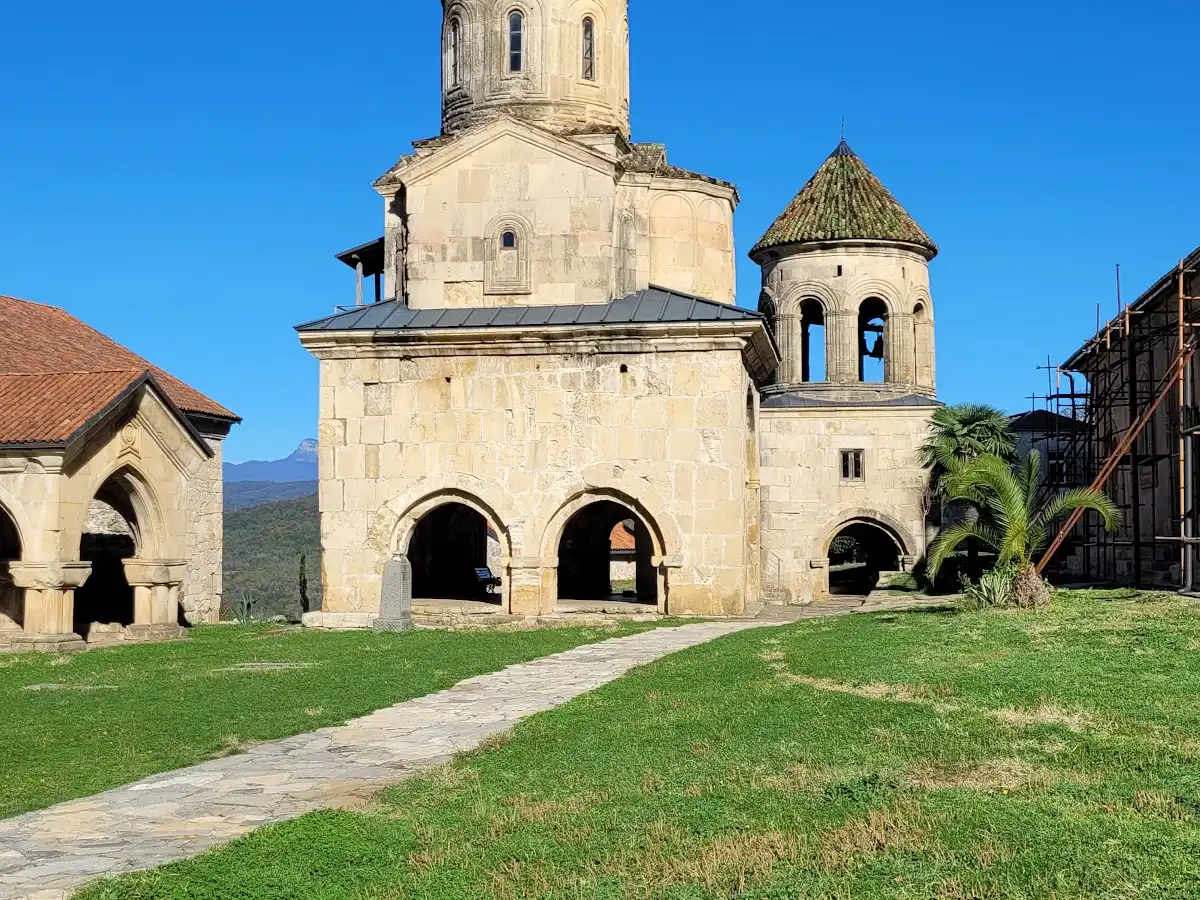
Byzantine mosaics, hillside monastery, royal tombs

Stand beneath centuries-old frescoes and walk the grounds where scholars and kings once gathered in a center of medieval learning.

georgia-unique-site-gelati-monastery
© Google |

3 Chaukhi

alpine lakes, wildflower meadows, remote borderland

Hike through high-altitude valleys where glacial lakes reflect jagged peaks and the landscape shifts quickly from open grassland to rocky outcrops.

Loading the map 🌍

Expert viewTips and Advice from Travelers

How many landmarks to visit: I advise 8 to 12 landmarks over a typical 7 to 10 day trip. That is roughly one major site plus one small one per day, which leaves time for the long marshrutka rides, a slow lunch of khachapuri and a walk at dusk when the stone turns amber. Push past that and the monasteries begin to merge, while the road time eats your energy.
Choosing between kinds of sites: Pick by travel style. History and architecture fans should favor the medieval churches and monasteries, where you get candlelight, chanting and frescoes in the cool dark. Hikers should lean toward mountain towers and highland fortresses, which come with thin air, wildflowers and a long, muddy approach. People short on time or gear do well with the Tbilisi old town and nearby cave and fortress sites, reachable … read more 👉
How many landmarks to visit: I advise 8 to 12 landmarks over a typical 7 to 10 day trip. That is roughly one major site plus one small one per day, which leaves time for the long marshrutka rides, a slow lunch of khachapuri and a walk at dusk when the stone turns amber. Push past that and the monasteries begin to merge, while the road time eats your energy.
Choosing between kinds of sites: Pick by travel style. History and architecture fans should favor the medieval churches and monasteries, where you get candlelight, chanting and frescoes in the cool dark. Hikers should lean toward mountain towers and highland fortresses, which come with thin air, wildflowers and a long, muddy approach. People short on time or gear do well with the Tbilisi old town and nearby cave and fortress sites, reachable by city bus or short taxi rides. Budget travelers can fill most days with sites that are free or nearly so, and still get the stone, the view and the quiet.
What it costs: Plan on US$30 to 55 a day (about 80 to 150 GEL) including a hostel or guesthouse bed, food, and local transport. Entry fees at most churches are free, while major museums, cave complexes and fortresses often charge around 5 to 20 GEL (US$2 to 7). Marshrutkas between towns cost roughly 5 to 25 GEL depending on distance. A private driver for a full day runs about 150 to 300 GEL (US$55 to 110) and is worth splitting among three or four people for remote valleys. Local guides charge around 50 to 150 GEL for a few hours, useful where there is little signage.
Safety and respect: Landmarks in Georgia are generally safe, and the main risks are physical. Mountain tracks turn to mud after rain, stone steps are worn and slick, and weather can drop 10°C in an hour, so pack a shell and proper shoes. Rural roads have stray dogs and unpredictable drivers, and I would avoid night driving in the highlands. Cultural rules matter at active churches: women cover their heads and wear skirts or wraps over trousers, men remove hats and wear long pants, and everyone keeps quiet during services. Ask before photographing worshippers or priests, and avoid walking in front of a service. You are rewarded with a warm welcome and often an invitation to share bread or wine at a village stop.

✈️ The backpacker research shortcutGeorgia Travel Guide

An offline-friendly backpacking guide with optimized travel routes, ranked highlights, transport advice, and the best areas to stay.
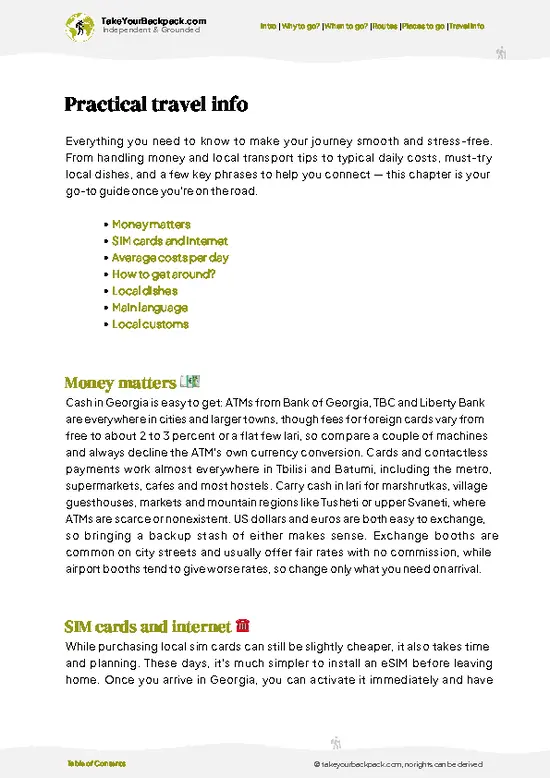
example page 0 from our offline Travel Guide for Georgia
example page 1 from our offline Travel Guide for Georgia
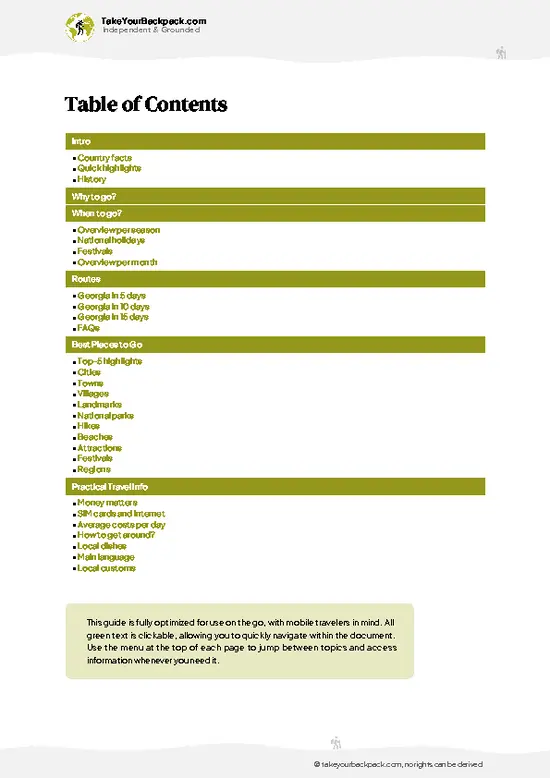
example page 2 from our offline Travel Guide for Georgia
example page 3 from our offline Travel Guide for Georgia
example page 4 from our offline Travel Guide for Georgia
example page 5 from our offline Travel Guide for Georgia
example page 6 from our offline Travel Guide for Georgia
example page 7 from our offline Travel Guide for Georgia
The digital guide (350 pages) contains:
✅ 89 highlights, ranked by travel appeal
✅ Optimized 5, 10 & 15-day travel routes
✅ Cities, national parks, landmarks, beaches
✅ How to get around
✅ Offline-friendly for travel without Wi-Fi
👉 Click to see all 30+ guide features

📅 Plan smarter in minutes, not weeks
✅ Month by month travel advice
✅ Festivals & national holidays
✅ Budget expectations

🗺️ Go to the right places, skip the overrated ones
✅ Honest pros & cons of destinations
✅ Top hikes, parks & viewpoints
✅ Lesser-known places most travelers miss
✅ Clear “worth it vs skip it” guidance

🛏️ Travel smoothly without rookie mistakes
✅ Best areas to stay
✅ Transport systems explained simply
✅ Common scams & safety advice
✅ SIM cards, money & practical tips

🌍 Understand the country, not just visit it
✅ Culture & traditions
✅ 52 Essential phrases & customs
✅ Festivals worth planning around
✅ Traveler-friendly historical context
✅ Insights that make places more meaningful

📱 Built for real travel conditions
✅ Fully downloadable PDF
✅ Works completely offline
✅ Optimized for phone use
✅ Useful in remote areas & buses
✅ Everything in one place
Stop searching, start planning
Get instant access to your full guide. 30‑day money-back guarantee.
+ Add another guide for just

By proceeding you agree to our terms.
Sent to your inbox immediately after payment • 100% Secure Checkout
Best Backpacking Travel Advisor 2025 tourism awardBest Backpacking
Travel Advisor
2025
What others say about Take Your Backpack Guides:
⭐⭐⭐⭐⭐
Fantastic, amazing amount of information!
⭐⭐⭐⭐⭐
My goodness this is amazing, it's what I've been looking for hats off too you!
⭐⭐⭐⭐⭐
I think this is absolutely BRILLIANT
⭐⭐⭐⭐
Very complete and informative. It's still missing places, but I gotta to commend you
⭐⭐⭐⭐⭐
This is truly amazing, thank you, can't wait to explore it with my kids!
⭐⭐⭐⭐⭐
Awesome resource, thank you!
⭐⭐⭐⭐⭐
This is amazing! Can't wait to explore the ones I haven't seen
⭐⭐⭐⭐
I love this! Well done, great idea.
⭐⭐⭐⭐⭐
Thanks for taking the time to make this gem!
⭐⭐⭐⭐⭐
This might be the best website I've ever seen.
⭐⭐⭐⭐⭐
Congratulations, and thank you so much for your work; it's incredibly valuable.
⭐⭐⭐⭐
In all seriousness I think you did a great job pointing out the important spots
⭐⭐⭐⭐⭐
10/10 very good
⭐⭐⭐⭐⭐
As someone who's only just starting to visit regularly this is awesome, thank you.
⭐⭐⭐⭐
Thank you very much! I'm going to visit my dad, it's going to be very useful!
⭐⭐⭐⭐⭐
This is really cool! We'll be travelling for the first time and this definitely come in handy.
⭐⭐⭐⭐⭐
You are now our minister of culture, congratulations 👨‍💼
⭐⭐⭐⭐⭐
Just wanted to tell you that this is a pearl! Going to follow your recommendations.
⭐⭐⭐⭐⭐
This is so cool. I'll definitely be using the resource for my travels soon.
⭐⭐⭐⭐⭐
This is very impressive! Good work.
⭐⭐⭐⭐⭐
This is an amazing and informative site. Very well done!

🛏️ Where to stay?Where to Stay in Georgia

Georgia has plenty of hostels and guesthouses, with dorm beds typically 25 to 40 GEL (about US$9 to 15) and private guesthouse rooms from around 70 GEL (US$26). In Tbilisi, Sololaki and the Old Town put you within walking distance of the sulfur baths and the best wine bars but come with steep cobbled streets and late-night noise, while Marjanishvili and Chughureti on the left bank are cheaper, well connected by metro and home to the city’s liveliest hostel and bar scene. On the coast, Batumi’s Old Town keeps you close to the boulevard and beach, and in Kutaisi the streets around the center are quiet, safe and handy for early marshrutka departures to the mountains.

If you enjoy meeting fellow … read more 👉
Georgia has plenty of hostels and guesthouses, with dorm beds typically 25 to 40 GEL (about US$9 to 15) and private guesthouse rooms from around 70 GEL (US$26). In Tbilisi, Sololaki and the Old Town put you within walking distance of the sulfur baths and the best wine bars but come with steep cobbled streets and late-night noise, while Marjanishvili and Chughureti on the left bank are cheaper, well connected by metro and home to the city’s liveliest hostel and bar scene. On the coast, Batumi’s Old Town keeps you close to the boulevard and beach, and in Kutaisi the streets around the center are quiet, safe and handy for early marshrutka departures to the mountains.

If you enjoy meeting fellow travelers, consider choosing hostels with high ratings for atmosphere. On the other hand, if you prefer having your own space, a hotel might be a better option.

GeorgiaMore of Georgia

👋 Meet the founderWho’s Behind Take Your Backpack?

Johan, backpacker and founder of TakeYourBackpackHi, I’m Johan (Netherlands 🇳🇱), the creator of TakeYourBackpack. Over the past 3 decades, I’ve backpacked through 90+ countries across six continents, gaining extensive experience with independent travel, long-term trips, and overland routes.

This site is built on a combination of firsthand travel experience and carefully curated insights from other backpackers. Many guides are based on places I’ve personally visited, while others bring together tips, observations, and practical advice shared by trusted travelers I’ve met along the way.

The goal is to provide realistic, experience-driven guidance — not generic itineraries — so you can explore destinations with better context, clearer expectations, and more confidence.