×

Georgia🇬🇪 | best national parksYour Guide to the 10 Best national parks in Georgia

Georgia’s national parks sit in the Caucasus, and they are a different animal from the American kind. Expect no entry gates and no shuttle buses. You get pine and beech forest that smells of wet resin, rivers the color of weak tea, and dirt roads that turn to soup after rain. Western parks near Batumi and Kutaisi are humid, green and easy to reach by marshrutka (minibus). Highland parks in Svaneti and Tusheti are colder, rougher and far less crowded, with one road in and mud or snow shutting it. Fees are low, but independent travel and backpacking here demand patience with logistics.

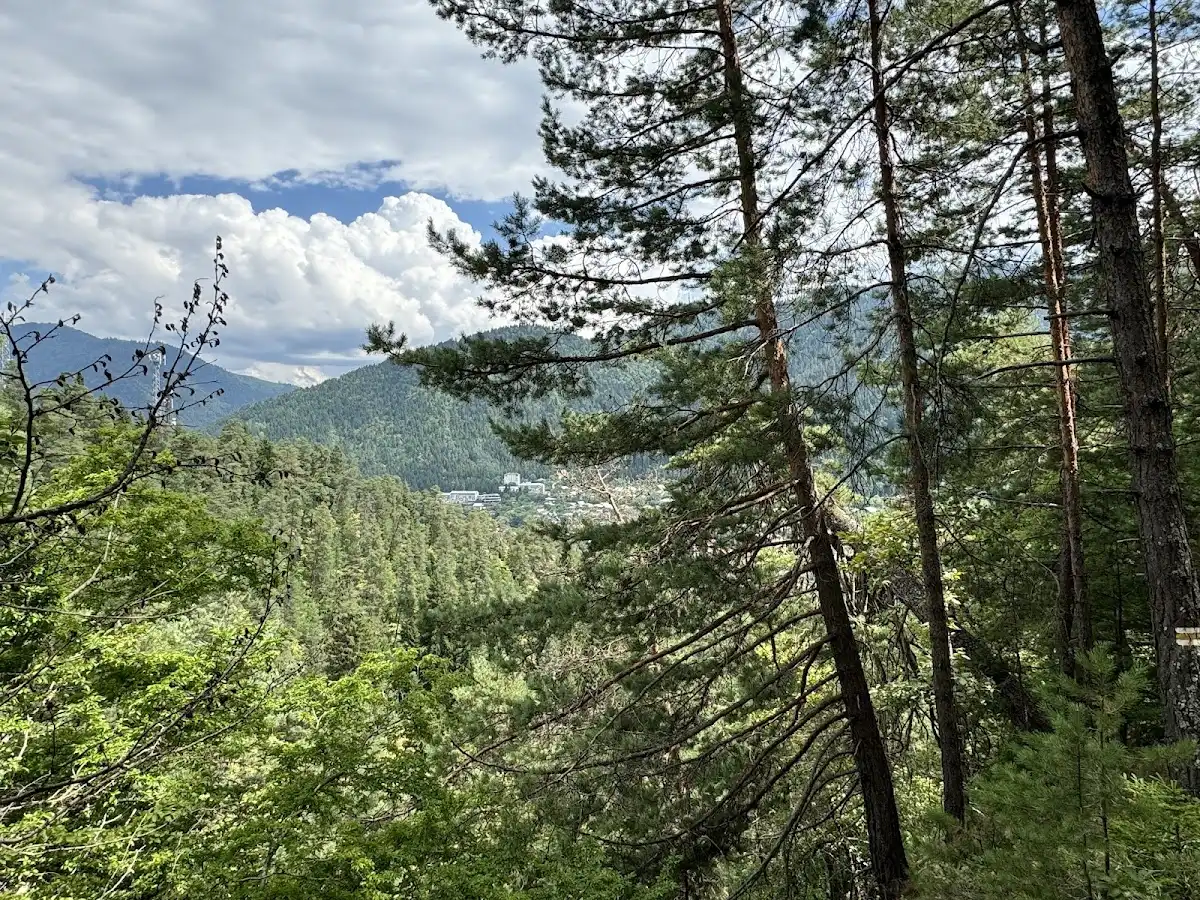
By Johan Kruseman 🇳🇱 | Updated October 18, 2026
Explore the best hikes in Georgia

Why go?Why Travelers Love These Spots

Georgia packs subtropical coast, glaciated peaks above 5,000 meters and semi-desert steppe into a country roughly the size of West Virginia. That compression is what makes its protected areas so varied: you can smell wet fern in the morning and dry sagebrush by evening. Much of the system was reorganized after independence, with international funding, so park management is young. Expect marked trails in some places and faded paint blazes in others, and visitor centers that may be shut outside summer.

Before choosing Georgia for parks, know that access is the real challenge, not the terrain. Highland roads are unpaved, often one lane with sheer drops, and a 4x4 with a local driver is normal. Mobile signal disappears in valleys. Mountain villages run on guesthouse hospitality, so you eat homemade … read more 👉
Georgia packs subtropical coast, glaciated peaks above 5,000 meters and semi-desert steppe into a country roughly the size of West Virginia. That compression is what makes its protected areas so varied: you can smell wet fern in the morning and dry sagebrush by evening. Much of the system was reorganized after independence, with international funding, so park management is young. Expect marked trails in some places and faded paint blazes in others, and visitor centers that may be shut outside summer.

Before choosing Georgia for parks, know that access is the real challenge, not the terrain. Highland roads are unpaved, often one lane with sheer drops, and a 4x4 with a local driver is normal. Mobile signal disappears in valleys. Mountain villages run on guesthouse hospitality, so you eat homemade bread, cheese and walnut sauces at a family table rather than from a park café. That is a highlight, but it means cash, patience and flexible timing.

Also know that livestock, shepherd dogs and Soviet-era ruins share the landscape. Cows block trails, sheepdogs bark hard at strangers, and few areas feel like untouched wilderness. Prices stay low compared with the Alps, which is a big part of the appeal for independent travelers.
Our Approach to Ranking
The list of best national parks in Georgia is created based on landscapes, wildlife, adventure opportunities, facilities, and overall experience. If you feel a national park is missing in this list, please let us know.

When to go?When to Plan Your Trip

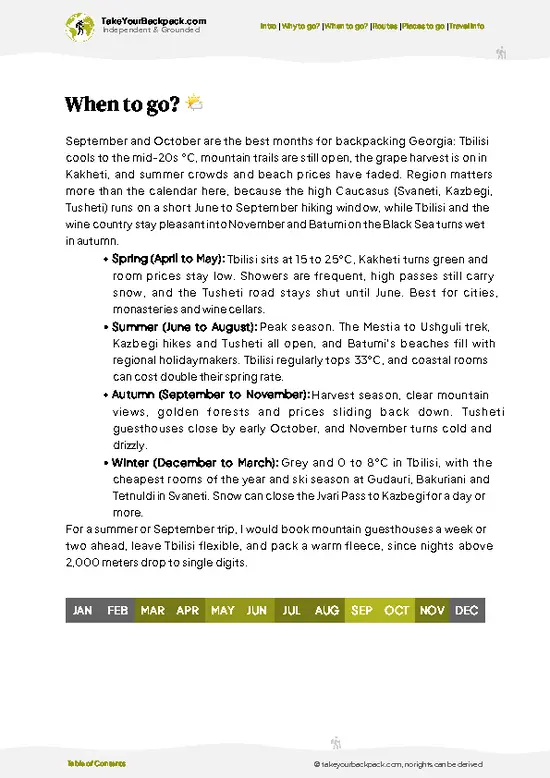
Best months and why: The best months are June to September, when highland passes are open, snow has left the trails and daytime temperatures in the mountains sit around 15 to 25°C. Higher camps still drop to near freezing at night, even in July, and afternoon thunderstorms roll in with sudden hail.

Shoulder seasons: In May and October, the lowland forests of western Georgia are at their best. Spring brings rhododendron bloom and loud, swollen streams, and autumn turns beech woods copper under low, golden light. Expect 8 to 18°C in the day, and mud. Western Georgia is the wettest part of the country, with often 1,500 to 2,500 mm of rain a year on the Black Sea side, so waterproofs matter in any month. High passes such as those into Tusheti typically open only from about mid-June to late September … read more 👉
Best months and why: The best months are June to September, when highland passes are open, snow has left the trails and daytime temperatures in the mountains sit around 15 to 25°C. Higher camps still drop to near freezing at night, even in July, and afternoon thunderstorms roll in with sudden hail.

Shoulder seasons: In May and October, the lowland forests of western Georgia are at their best. Spring brings rhododendron bloom and loud, swollen streams, and autumn turns beech woods copper under low, golden light. Expect 8 to 18°C in the day, and mud. Western Georgia is the wettest part of the country, with often 1,500 to 2,500 mm of rain a year on the Black Sea side, so waterproofs matter in any month. High passes such as those into Tusheti typically open only from about mid-June to late September and can close early with the first snow.

Winter and crowds: From December to March, highland roads are often impassable, guesthouses close, and temperatures fall well below freezing. Lowland parks stay accessible but gray and damp. Crowds peak in July and August, when local holidaymakers and trekkers fill guesthouses in Svaneti and Kazbegi, and rooms cost 20 to 40% more than in shoulder months. Book ahead for those weeks, and go mid-week where you can.

national park hoppingSuggested Travel Strategies

How many days to plan: A trip combining several national parks in Georgia needs 10 to 14 days, mostly because getting between regions eats time. Roads wind, and a 200 km leg often takes 4 to 6 hours.

Grouping regions: The west clusters naturally: Batumi, Kutaisi and Mestia link by marshrutka, with Kutaisi as the transport hub. The east pairs Tbilisi with Kakheti and the Greater Caucasus. A sensible direction is to start in the humid west, climb into the highlands while the weather is stable, then finish in the drier east and Tbilisi, where flights and onward trains are easiest. Kutaisi to Mestia takes roughly 4 to 5 hours, Tbilisi to Kazbegi about 3 hours, and Tbilisi to Telavi about 2 hours.

Time per stop: Give lowland parks 1 to 2 days and highland areas 3 to 4 days, so trail time is not … read more 👉
How many days to plan: A trip combining several national parks in Georgia needs 10 to 14 days, mostly because getting between regions eats time. Roads wind, and a 200 km leg often takes 4 to 6 hours.

Grouping regions: The west clusters naturally: Batumi, Kutaisi and Mestia link by marshrutka, with Kutaisi as the transport hub. The east pairs Tbilisi with Kakheti and the Greater Caucasus. A sensible direction is to start in the humid west, climb into the highlands while the weather is stable, then finish in the drier east and Tbilisi, where flights and onward trains are easiest. Kutaisi to Mestia takes roughly 4 to 5 hours, Tbilisi to Kazbegi about 3 hours, and Tbilisi to Telavi about 2 hours.

Time per stop: Give lowland parks 1 to 2 days and highland areas 3 to 4 days, so trail time is not swallowed by road time. Keep one buffer day in each mountain region, because rain can wash out a track and marshrutkas run on demand, often leaving only when full.

Common planning mistakes: The usual error is cramming three regions into one week and spending it in a van. Another is trusting map distances; the roads are slow, with potholes and livestock. Choose two regions, travel in daylight, and book a driver for the unpaved highland legs.

The ListThe Best national parks of Georgia

1 Tusheti National Park

remote valleys, medieval towers, shepherd trails

Travel on foot or horseback through isolated villages and high passes, following ancient routes used by local herders for centuries.

2 Kazbegi National Park

glacial peaks, alpine meadows, remote villages

Climb towards snow-capped summits and cross high pastures, with stone towers and isolated hamlets dotting the dramatic mountain landscape.

3 Borjomi-Kharagauli National Park

mixed forests, long-distance trails, mountain huts

Trek across varied terrain on multi-day routes, staying in basic shelters and passing through forests, meadows, and high ridges.

georgia-national-park-borjomi-kharagauli-national-park
© Google |

4 Lagodekhi Protected Areas

dense forest, alpine lakes, border trails

Follow marked routes through thick woodlands and up to high-altitude lakes, where wildlife sightings and borderland views reward patient hikers.

georgia-national-park-lagodekhi-protected-areas
© Google |

5 Mtirala National Park

humid forest, waterfalls, subtropical flora

Experience a lush, rain-soaked landscape where mossy trails, tumbling streams, and rare plant life create a distinctively wet hiking environment.

6 Vashlovani National Park

badlands, pistachio groves, arid plateaus

Drive or hike across dry, open country marked by eroded cliffs and scattered trees, where wildlife adapts to a harsh, sunbaked environment.

7 Javakheti National Park

volcanic plateaus, steppe lakes, bird habitats

Watch migratory birds gather on open lakes and cross wide, treeless plains shaped by ancient volcanic activity and seasonal winds.

8 Kolkheti National Park

peat bogs, Black Sea coast, boat tours

Travel by water through wetlands and lagoons, observing rare birds and unique plant communities along the low-lying coastal plain.

9 Tbilisi National Park

oak forest, city views, cycling routes

Cycle or hike through rolling woodlands just outside the capital, where panoramic overlooks and quiet trails offer a quick urban escape.

10 Sataplia Nature Reserve

caves, dinosaur footprints, karst hills

Descend into limestone caves and view preserved dinosaur tracks, then climb gentle hills for views over the surrounding lowlands.

11 Martvili Canyon

turquoise river, limestone cliffs, boat rides

Glide by boat through narrow gorges, where clear water and sheer rock walls create a cool retreat from the surrounding lowlands.

12 Okatse Canyon

suspended walkway, waterfalls, panoramic cliffs

Walk above a deep gorge on a metal path, pausing for wide views and the sound of falling water echoing from below.

georgia-national-park-okatse-canyon
© Google |

13 Kintrishi Protected Areas

mountain rivers, ancient bridges, laurel groves

Trace narrow paths beside fast-flowing streams and pass centuries-old stone bridges hidden among evergreen laurel and chestnut trees.

14 Kobuleti Protected Areas

peat marshes, migratory birds, reed beds

Observe flocks of waterfowl in quiet wetlands, where raised boardwalks and observation towers provide access to fragile peat ecosystems.

15 Batsara-Babaneuri Protected Areas

yew forest, river valleys, rare flora

Walk beneath ancient yew trees and along cool riverbanks, where rare plants and quiet paths define the experience for nature-focused visitors.

16 Algeti National Park

pine woods, river gorge, picnic spots

Walk through pine forests and along a winding river, with easy access to scenic rest areas and gentle slopes ideal for day trips.

georgia-national-park-algeti-national-park
© Google |

17 Mariamjvari Strict Nature Reserve

relict pine, steep ravines, scientific interest

Explore steep, forested ravines dominated by ancient pine species, with access limited to researchers and guided visits only.

18 Saguramo National Park

beech woods, ridge trails, wildflowers

Hike along ridgelines through mixed forests, especially in spring when the ground is covered with blooming wildflowers and fresh greenery.

19 Liakhvi Strict Nature Reserve

mountain slopes, pristine streams, limited access

Navigate rugged hills and untouched waterways in a strictly protected zone, where entry is restricted and nature remains largely undisturbed.

Think you know Georgia?

Prove you’re a true local — uncover 9 lesser-known national parks in Georgia that locals tend to keep to themselves.
Loading the map 🌍

Expert viewTips and Advice from Travelers

How many parks to visit: I advise two to three parks in one trip, and no more. Georgia’s distances are short on a map but slow on the ground, and each highland area needs several days to repay the journey. Two or three lets you actually hike, eat at a family table and sit out a rainstorm rather than just collect names.

Choosing between kinds: Choose by travel style. Lowland forest parks in the west suit first-timers, short budgets and shoulder seasons: wet green trails, easy minibus access, cheap guesthouses. Highland parks in the Greater Caucasus suit confident hikers who want glacier views, stone towers and cold, clear air, but need time, a sturdy pack and flexible dates. Steppe and semi-desert areas in the southeast suit people who want dry, open walking, warm light and few other visitors, … read more 👉
How many parks to visit: I advise two to three parks in one trip, and no more. Georgia’s distances are short on a map but slow on the ground, and each highland area needs several days to repay the journey. Two or three lets you actually hike, eat at a family table and sit out a rainstorm rather than just collect names.

Choosing between kinds: Choose by travel style. Lowland forest parks in the west suit first-timers, short budgets and shoulder seasons: wet green trails, easy minibus access, cheap guesthouses. Highland parks in the Greater Caucasus suit confident hikers who want glacier views, stone towers and cold, clear air, but need time, a sturdy pack and flexible dates. Steppe and semi-desert areas in the southeast suit people who want dry, open walking, warm light and few other visitors, and they work in spring and autumn when the highlands are not ideal.

What it costs: Plan US$30 to 50 a day for independent hiking with guesthouse half-board. Beds in mountain guesthouses run roughly 40 to 80 GEL (about US$15 to 30), often with dinner and breakfast included at 20 to 40 GEL extra. Park entry is often free or a few lari, though some areas charge small fees for camping or permits. Shared marshrutka rides cost about 10 to 30 GEL per leg, while a 4x4 with driver for rough highland roads is typically 150 to 300 GEL a day, split among passengers. A local guide runs about 100 to 250 GEL a day. Budget roughly US$150 to 300 per park visit for several days including transport, food and a guide where needed.

Safety on the trail: Mountain weather turns fast, so carry a rain shell and warm layer even in July. Trails can be poorly marked, and mobile signal drops in valleys, so download offline maps and tell your host your plan. Shepherd dogs are large and protective. Stop, avoid eye contact, keep walking sticks low and give flocks a wide berth. Border zones near Russia and the breakaway regions can be restricted, so check permit rules for any area near them. Carry travel insurance covering hiking and rescue, because helicopter evacuation is rare and costly.

Cultural manners: Hospitality is serious here. Accept tea or a toast at a guesthouse table, and expect to eat more than you planned. Dress modestly when entering village churches, with covered shoulders and knees, and ask before photographing people or their livestock. Pack out your trash, because collection in villages is limited. A bag of sweets or fruit for your hosts goes a long way, and so does learning “gaumarjos” (cheers).

✈️ The backpacker research shortcutGeorgia Travel Guide

An offline-friendly backpacking guide with optimized travel routes, ranked highlights, transport advice, and the best areas to stay.
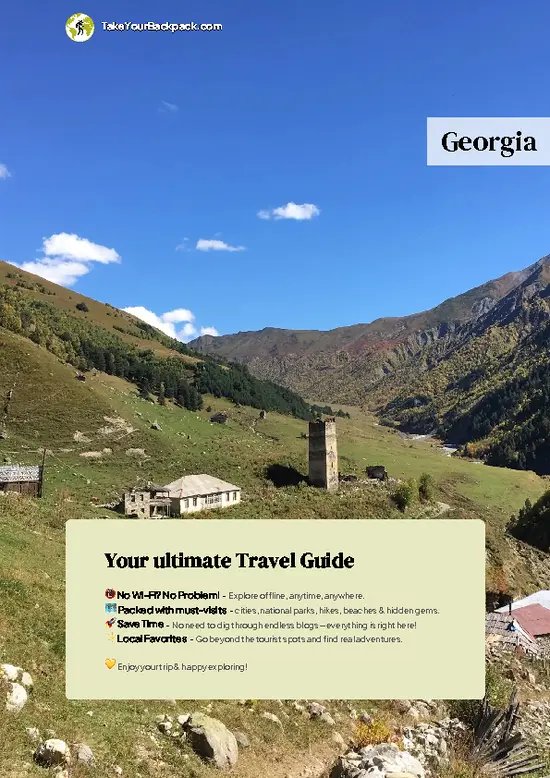
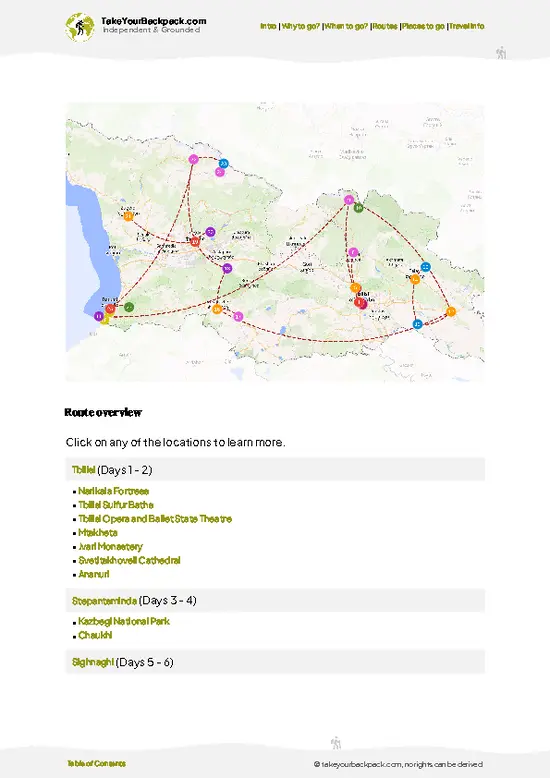
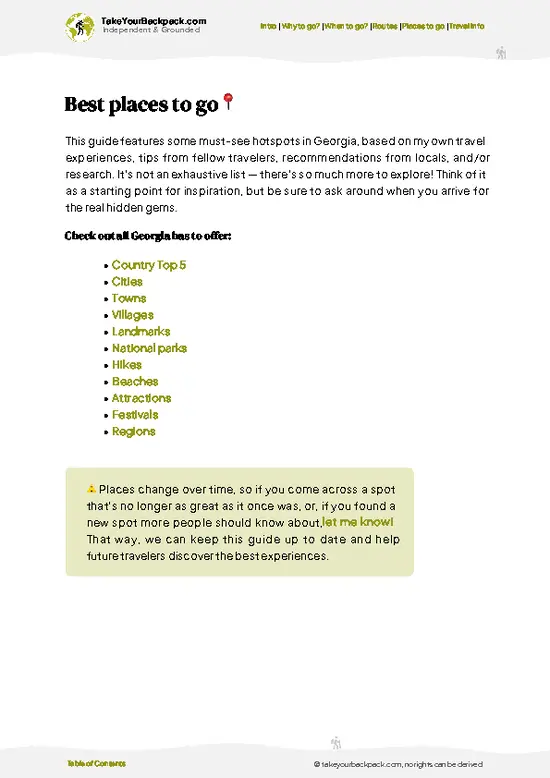
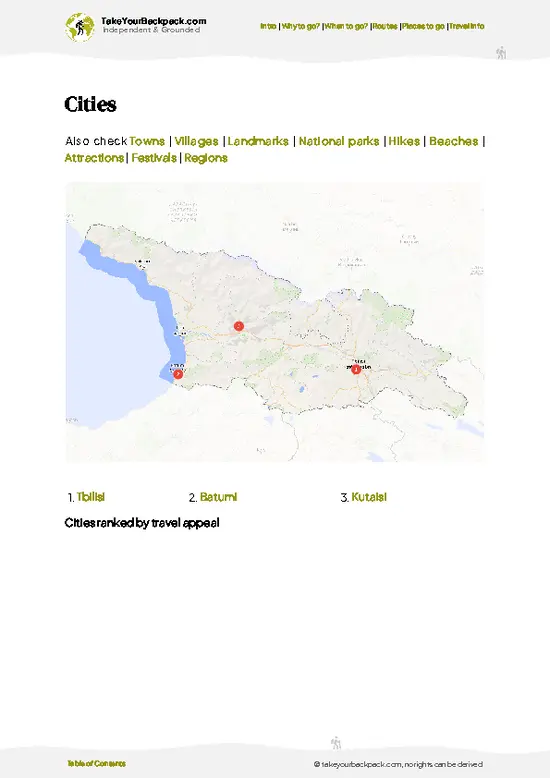
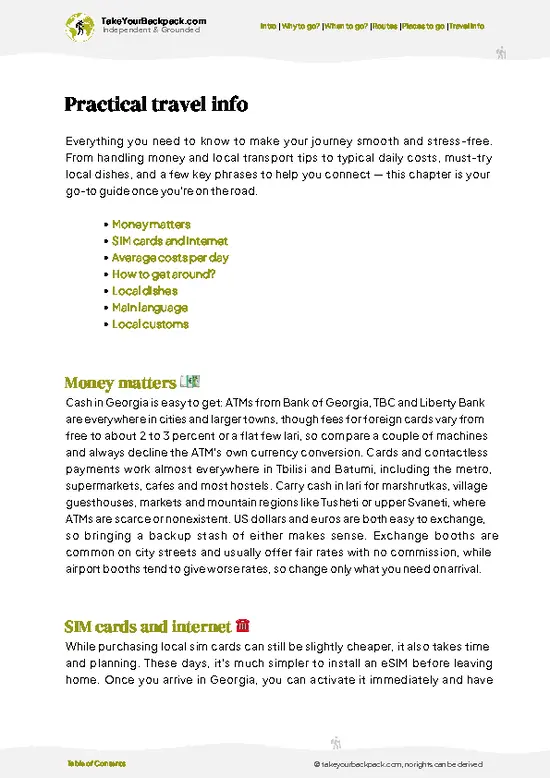
example page 0 from our offline Travel Guide for Georgia
example page 1 from our offline Travel Guide for Georgia
example page 2 from our offline Travel Guide for Georgia
example page 3 from our offline Travel Guide for Georgia
example page 4 from our offline Travel Guide for Georgia
example page 5 from our offline Travel Guide for Georgia
example page 6 from our offline Travel Guide for Georgia
example page 7 from our offline Travel Guide for Georgia
The digital guide (350 pages) contains:
✅ 89 highlights, ranked by travel appeal
✅ Optimized 5, 10 & 15-day travel routes
✅ Cities, national parks, landmarks, beaches
✅ How to get around
✅ Offline-friendly for travel without Wi-Fi
👉 Click to see all 30+ guide features

📅 Plan smarter in minutes, not weeks
✅ Month by month travel advice
✅ Festivals & national holidays
✅ Budget expectations

🗺️ Go to the right places, skip the overrated ones
✅ Honest pros & cons of destinations
✅ Top hikes, parks & viewpoints
✅ Lesser-known places most travelers miss
✅ Clear “worth it vs skip it” guidance

🛏️ Travel smoothly without rookie mistakes
✅ Best areas to stay
✅ Transport systems explained simply
✅ Common scams & safety advice
✅ SIM cards, money & practical tips

🌍 Understand the country, not just visit it
✅ Culture & traditions
✅ 52 Essential phrases & customs
✅ Festivals worth planning around
✅ Traveler-friendly historical context
✅ Insights that make places more meaningful

📱 Built for real travel conditions
✅ Fully downloadable PDF
✅ Works completely offline
✅ Optimized for phone use
✅ Useful in remote areas & buses
✅ Everything in one place
Stop searching, start planning
Get instant access to your full guide. 30‑day money-back guarantee.
+ Add another guide for just

By proceeding you agree to our terms.
Sent to your inbox immediately after payment • 100% Secure Checkout
Best Backpacking Travel Advisor 2025 tourism awardBest Backpacking
Travel Advisor
2025
What others say about Take Your Backpack Guides:
⭐⭐⭐⭐⭐
Fantastic, amazing amount of information!
⭐⭐⭐⭐⭐
My goodness this is amazing, it's what I've been looking for hats off too you!
⭐⭐⭐⭐⭐
I think this is absolutely BRILLIANT
⭐⭐⭐⭐
Very complete and informative. It's still missing places, but I gotta to commend you
⭐⭐⭐⭐⭐
This is truly amazing, thank you, can't wait to explore it with my kids!
⭐⭐⭐⭐⭐
Awesome resource, thank you!
⭐⭐⭐⭐⭐
This is amazing! Can't wait to explore the ones I haven't seen
⭐⭐⭐⭐
I love this! Well done, great idea.
⭐⭐⭐⭐⭐
Thanks for taking the time to make this gem!
⭐⭐⭐⭐⭐
This might be the best website I've ever seen.
⭐⭐⭐⭐⭐
Congratulations, and thank you so much for your work; it's incredibly valuable.
⭐⭐⭐⭐
In all seriousness I think you did a great job pointing out the important spots
⭐⭐⭐⭐⭐
10/10 very good
⭐⭐⭐⭐⭐
As someone who's only just starting to visit regularly this is awesome, thank you.
⭐⭐⭐⭐
Thank you very much! I'm going to visit my dad, it's going to be very useful!
⭐⭐⭐⭐⭐
This is really cool! We'll be travelling for the first time and this definitely come in handy.
⭐⭐⭐⭐⭐
You are now our minister of culture, congratulations 👨‍💼
⭐⭐⭐⭐⭐
Just wanted to tell you that this is a pearl! Going to follow your recommendations.
⭐⭐⭐⭐⭐
This is so cool. I'll definitely be using the resource for my travels soon.
⭐⭐⭐⭐⭐
This is very impressive! Good work.
⭐⭐⭐⭐⭐
This is an amazing and informative site. Very well done!

🛏️ Where to stay?Top Places to Consider Staying

Georgia has plenty of hostels and guesthouses, with dorm beds typically 25 to 40 GEL (about US$9 to 15) and private guesthouse rooms from around 70 GEL (US$26). In Tbilisi, Sololaki and the Old Town put you within walking distance of the sulfur baths and the best wine bars but come with steep cobbled streets and late-night noise, while Marjanishvili and Chughureti on the left bank are cheaper, well connected by metro and home to the city’s liveliest hostel and bar scene. On the coast, Batumi’s Old Town keeps you close to the boulevard and beach, and in Kutaisi the streets around the center are quiet, safe and handy for early marshrutka departures to the mountains.

If you enjoy meeting fellow … read more 👉
Georgia has plenty of hostels and guesthouses, with dorm beds typically 25 to 40 GEL (about US$9 to 15) and private guesthouse rooms from around 70 GEL (US$26). In Tbilisi, Sololaki and the Old Town put you within walking distance of the sulfur baths and the best wine bars but come with steep cobbled streets and late-night noise, while Marjanishvili and Chughureti on the left bank are cheaper, well connected by metro and home to the city’s liveliest hostel and bar scene. On the coast, Batumi’s Old Town keeps you close to the boulevard and beach, and in Kutaisi the streets around the center are quiet, safe and handy for early marshrutka departures to the mountains.

If you enjoy meeting fellow travelers, consider choosing hostels with high ratings for atmosphere. On the other hand, if you prefer having your own space, a hotel might be a better option.

GeorgiaMore Places Across Georgia

👋 Meet the founderWho’s Behind Take Your Backpack?

Johan, backpacker and founder of TakeYourBackpackHi, I’m Johan (Netherlands 🇳🇱), the creator of TakeYourBackpack. Over the past 3 decades, I’ve backpacked through 90+ countries across six continents, gaining extensive experience with independent travel, long-term trips, and overland routes.

This site is built on a combination of firsthand travel experience and carefully curated insights from other backpackers. Many guides are based on places I’ve personally visited, while others bring together tips, observations, and practical advice shared by trusted travelers I’ve met along the way.

The goal is to provide realistic, experience-driven guidance — not generic itineraries — so you can explore destinations with better context, clearer expectations, and more confidence.