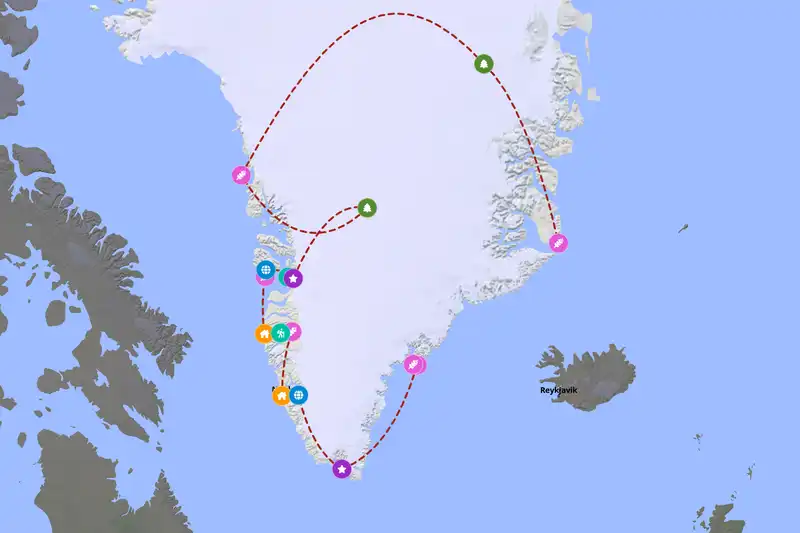
Short version: Greenland is not an easy classic backpacking destination, but it is absolutely doable if you’re organized, flexible, and okay with fewer choices and higher prices.
The challenge is that there are no roads between towns, very limited public transport, and weather that can shut things down fast. You can’t just hitch from village to village like in mainland Europe. Instead, you build your trip around a few hubs and then day-hike or do hut-to-hut treks from there.
For a first-timer on a budget, the most realistic independent style is: pick 1–2 regions, base yourself in a town with a hostel or cheap guesthouse, and do a mix of marked trails, boat day trips, and maybe one guided activity that’s worth the money (like a glacier hike or iceberg boat tour). Trying to “see all of Greenland” in one go will destroy your budget and your sanity.
Camping and self-catering are your biggest money-savers. Wild camping is generally accepted outside towns if you’re respectful, leave no trace, and stay clear of private property and water sources used by locals. Stock up on food at supermarkets in the bigger towns (Nuuk, Ilulissat, Sisimiut) and carry a stove; eating out regularly will nuke your budget.
Independence here means planning your logistics like a mini-expedition: pre-book flights between towns, know your hiking routes, carry proper cold-weather and wet-weather gear even in summer, and build in buffer days for delays. If you like improvising day by day, Greenland will feel restrictive. If you enjoy maps, planning, and being self-reliant, it’s incredibly rewarding.
For most backpackers, 7–14 days is the sweet spot. Less than a week and you’ll spend most of your time in transit; more than two weeks and costs start to stack up unless you’re camping and cooking almost everything yourself.
If you have 5–7 days: Focus on one region only. The easiest, high-impact choice is Ilulissat and the Disko Bay area. Fly in, spend your time hiking along the icefjord, doing one or two boat trips, and maybe a short overnight trek or camping near marked trails. You’ll actually feel Greenland instead of just collecting airports.
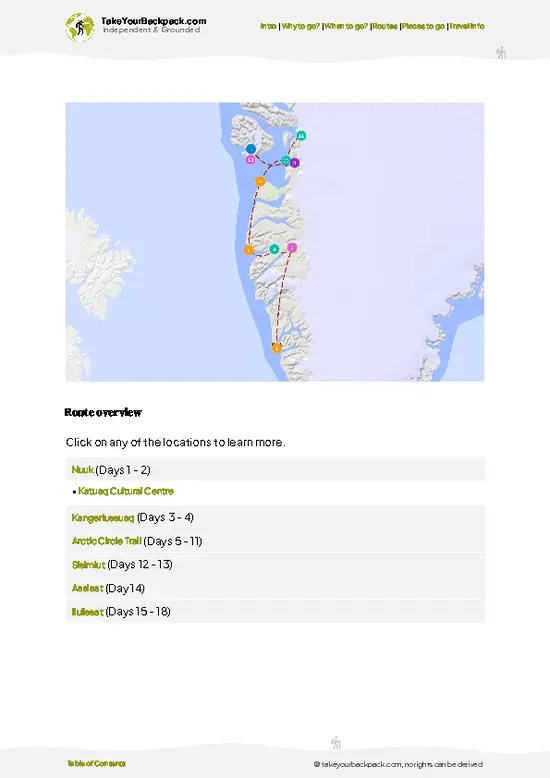
If you have 10–12 days: Combine two hubs. A strong combo is Nuuk (for culture, everyday Greenlandic life, and fjord trips) plus Ilulissat (for ice and classic Arctic scenery). Another good option is Sisimiut + Kangerlussuaq if you want more hiking and the Arctic Circle Trail vibe. Keep it to two bases so you’re not burning days and money on extra flights.
If you have 2–3 weeks: You can add a multi-day trek like the Arctic Circle Trail (9–11 days for most hikers) or a hut-to-hut route near Sisimiut or South Greenland. With this much time, you can also include a more remote area like East Greenland (Tasiilaq region), but every extra region usually means at least one extra expensive flight.
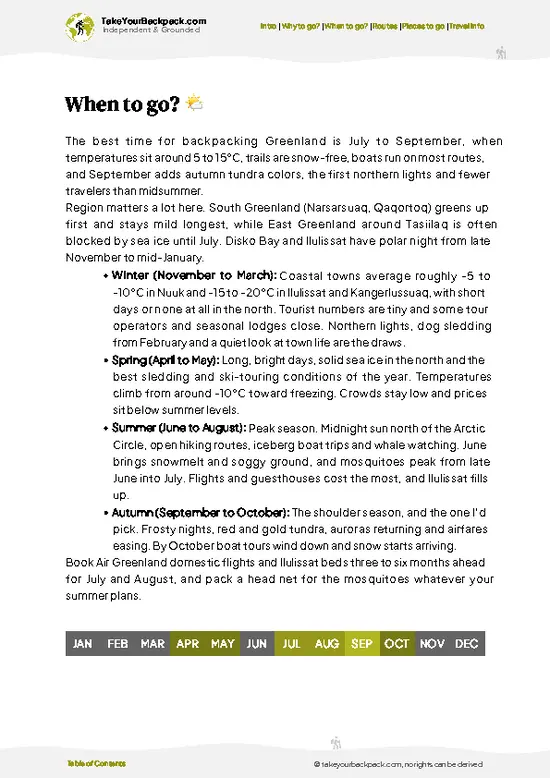
Season matters. The main backpacking season is roughly late June to early September. Outside that window, you’ll lose hiking options, gain winter activities, and need more buffer days for weather delays. For a first trip, aim for mid-summer unless you’re specifically chasing northern lights and snow and are ready for more logistical friction.
Yes, you can get around without a car, and in most cases you have to, because there are no roads connecting towns. Think of Greenland as a chain of isolated islands, even when it’s all on the same landmass.
Between towns, your options are:
- Domestic flights: Fast but expensive. Air travel is the backbone of Greenland transport. For backpackers, this usually means picking fewer destinations and staying longer in each.
- Boats: In some regions (especially Disko Bay and parts of West Greenland), passenger boats and local ferries connect towns and settlements. They’re often cheaper than flying and way more scenic, but slower and more weather-dependent.
- Occasional coastal ferries: On some routes, a larger coastal ferry runs between multiple towns. It’s not always daily, but when it lines up with your route, it can be a good value move.
Within towns and for hiking access:
- Walking: Most towns are compact. You can walk almost everywhere, though you’ll be dealing with hills, wind, and sometimes rough paths.
- Local buses: A few larger towns (like Nuuk) have simple bus systems that are cheap and easy to use.
- Taxis: Useful when you’re hauling gear to a trailhead or the airport, but not something you want to rely on constantly if you’re counting coins.
- Boats to trailheads: In some areas, boats drop hikers at the start of routes or pick them up at the end. This can be pricey but sometimes unavoidable if you want specific hikes.
For a budget traveler, the key is to choose a region where you can do a lot on foot from a single base, and then use one or two strategic boat or flight transfers instead of bouncing all over the map.
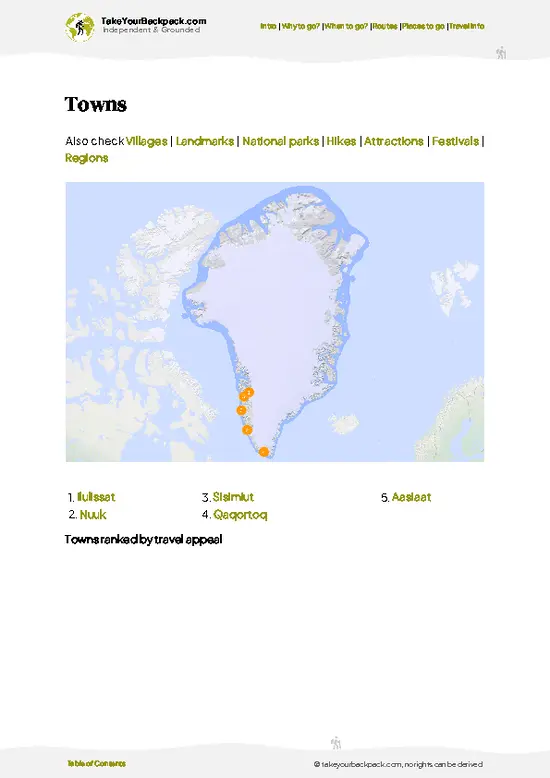
For backpackers and budget travelers, the must-visits are less about specific tourist sights and more about regions that give you maximum payoff for each flight and each grocery run.
1. Ilulissat & Disko Bay (West Greenland)
If you only go one place, make it here. Ilulissat Icefjord is one of those rare places that actually lives up to the hype: huge icebergs drifting past town, trails that follow the coastline, and boat trips that feel like you’re sailing through a frozen sculpture garden. From a budget perspective, you can:
- Stay in hostels or basic guesthouses.
- Hike multiple marked trails for free once you’re there.
- Wild camp outside town if you’re prepared and respectful.
2. Nuuk (Capital region)
Nuuk is where you see real, everyday Greenlandic life: supermarkets, schools, street art, and people just living their lives in a wild setting. For backpackers, it’s a good base because:
- You can self-cater easily with decent supermarket options.
- There are affordable-ish hostels and guesthouses.
- You can do day hikes into the hills and fjords, plus boat trips that are cheaper than in more remote areas.
3. Sisimiut & the Arctic Circle region
Sisimiut is a great hiking town with a strong local vibe. It’s the western end of the Arctic Circle Trail, so you’ll meet other hikers and have access to gear shops and information. If you’re into multi-day trekking and camping, this region is gold:
- The Arctic Circle Trail (Kangerlussuaq–Sisimiut) is one of the best long-distance hikes in the Arctic that you can do independently.
- Shorter hut-to-hut or camping trips are possible if you don’t want the full trail.
4. South Greenland (Narsarsuaq / Qaqortoq area)
If you like the idea of mixing Arctic landscapes with green valleys, small farms, and Norse ruins, South Greenland is worth the extra hop. For backpackers:
- There are good options for camping and simple accommodation.
- You can hike between small settlements, see glaciers, and explore historical sites without needing a tour every day.
If your budget and time are tight, prioritize one of these: Ilulissat for ice and classic views, or Sisimiut/Arctic Circle region if your main goal is hiking and camping.
If you’re short on time or money, skip anything that adds an extra flight or long boat ride just for one or two sights. Greenland punishes over-ambitious itineraries.
You can usually skip:
1. Trying to hit both East and West Greenland in one trip
East Greenland (like Tasiilaq) is incredible, but combining it with West Greenland on a short trip means you’ll spend a fortune on flights and lose days in transit. For a first visit under two weeks, pick one side and do it properly.
2. Too many towns that feel similar
Small West Greenland towns can start to blur together if you rush through them: colorful houses, a harbor, a supermarket, a church, some nearby hills. They’re all interesting, but if you only have a week or ten days, it’s better to go deep in one or two places than to collect five quick stops that all feel half-finished.
3. Expensive, short helicopter or flightseeing tours if they eat your core budget
Aerial views are amazing, but if the choice is between a 30-minute scenic flight and three extra days of hiking, camping, and boat trips, the longer ground time usually wins for backpackers. Put your money into experiences that also help you move from A to B, like a boat transfer that doubles as a fjord tour.
4. Over-structured, fully guided multi-day packages
If you’re comfortable hiking and camping independently, you don’t need a high-priced package that bundles accommodation, meals, and every activity. Those are great for people who want zero logistics, but as a budget traveler you’ll get more value by planning your own days and only paying for guides when safety or access truly requires it (like glacier travel or serious backcountry routes).
5. Rushing inland just to say you “touched the ice cap” if it doesn’t fit your route
Places like Kangerlussuaq offer easy access to the ice cap, but if visiting requires a big detour and extra flights, it might not be worth it on a short trip. You’ll see plenty of ice and glaciers from coastal hubs like Ilulissat or South Greenland without burning days on a side mission.
The rule: fewer regions, more days in each, and skip anything that forces you into a chain of extra flights or tours that don’t add much beyond what you’re already seeing.