×

Guinea-Bissau🇬🇼 | townsMadina do Boé1973 proclamation site, garrison ruins, Fula compounds, Corubal lowlands | things to do and best time to go

Explore CoculiExplore Niumana

Backpacking in Madina do Boé
👀 For curious travelerstown ranked #16
By Johan Kruseman 🇳🇱 | Updated October 22, 2026

Reaching Madina do Boé takes real commitment, and that is what tips the decision: go only if the 1973 independence story matters to you. It sits in the far southeast of Guinea-Bissau, near the Guinean border, where red laterite tracks cut through dry savanna. The reward is silence, ruined walls and Fula villages with woodsmoke and goat bells. Skip it if you want hostels, cafés or other backpackers; there are none. Evenings are dark and quiet. Arrange a 4x4 and a local guide in Gabú before you set out.

Discover everything you want to know in the 📖 Guinea-Bissau Travel Guide.


example page 0 from our offline Travel Guide for Guinea-Bissau
example page 1 from our offline Travel Guide for Guinea-Bissau
example page 2 from our offline Travel Guide for Guinea-Bissau
example page 3 from our offline Travel Guide for Guinea-Bissau
example page 4 from our offline Travel Guide for Guinea-Bissau
example page 5 from our offline Travel Guide for Guinea-Bissau
example page 6 from our offline Travel Guide for Guinea-Bissau
example page 7 from our offline Travel Guide for Guinea-Bissau
Loading the map 🌍
CLICK TO FILTER
cities
towns
national parks
beaches
attractions
festivals
regions
SHOW COUNTRY’S BESTSHOW ALL

✨ Why go?
Ranked #16 town in Guinea-Bissau
Reasons people choose to visit here

Madina do Boé is where Guinea-Bissau declared independence in 1973, and almost nobody on the usual coastal circuit ever sees the place. That makes it a pilgrimage for history-minded, self-sufficient travelers who like remote country and don’t mind improvising. You come for the 1973 proclamation site, the crumbling Portuguese garrison ruins and the unhurried life of the surrounding villages. Most people stay a single night, long enough to walk the sites and talk with elders. Solo travelers with decent French or Portuguese get the most from it. Anyone wanting comfort or nightlife should stay in Gabú.

💡 HighlightsKey sights and experiences for travelers

  1. Independence proclamation site: The spot where the PAIGC announced the new state in September 1973, and the reason anyone comes. Go in the cooler morning. Free, with a guide to explain it, about 45 minutes.
  2. Portuguese garrison ruins: Broken walls and foundations of the colonial military post, which the Portuguese abandoned in the war years. Bring a hat and water, since there is little shade. Free, about 1 hour.
  3. Village walk through Fula compounds: Mud-brick houses, millet pounding and children trailing you with curiosity. Late afternoon is best, when people return from the fields. Free, 1 to 2 hours; greet the village head first.
  4. Rio Corubal banks: The river in the surrounding Boé lowlands, good for quiet birdwatching and cooler air. Early morning works best. A guide or motorbike driver costs
… read more 👉
  1. Independence proclamation site: The spot where the PAIGC announced the new state in September 1973, and the reason anyone comes. Go in the cooler morning. Free, with a guide to explain it, about 45 minutes.
  2. Portuguese garrison ruins: Broken walls and foundations of the colonial military post, which the Portuguese abandoned in the war years. Bring a hat and water, since there is little shade. Free, about 1 hour.
  3. Village walk through Fula compounds: Mud-brick houses, millet pounding and children trailing you with curiosity. Late afternoon is best, when people return from the fields. Free, 1 to 2 hours; greet the village head first.
  4. Rio Corubal banks: The river in the surrounding Boé lowlands, good for quiet birdwatching and cooler air. Early morning works best. A guide or motorbike driver costs about €5 to 15, and the outing takes 2 to 3 hours.
From Madina do Boé, the main day-trip bases lie toward Gabú, with its market and Fula culture, and along the Corubal River, where rapids and riverside villages repay a slow drive. Nothing here needs a ticket, but booking a driver and guide in Gabú ahead is wise.
Spotted a mistake or missing something? Contact us.

🏘️ NeighborhoodsNeighborhood guide to Madina do Boé

Madina do Boé is a tiny, scattered settlement in the far southeast, near the Guinea border, so think of it as a handful of spots rather than districts.
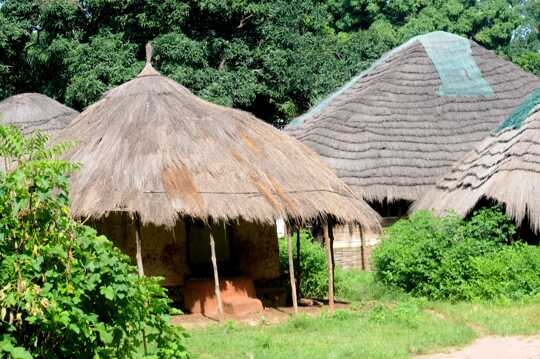
  • Village center: A few mud-brick and tin-roofed compounds around a dusty road. Mornings smell of woodsmoke, roosters and goats are the soundtrack, and you can cross it on foot in ten minutes. Spend an hour here, chat, and move on.
  • Old Boé ruins and independence sites: This is the part worth your time. Here, in 1973, the independence of Guinea-Bissau was proclaimed, and the ruined colonial-era buildings and bush around them are quiet, hot and photogenic. Go early, when the light is soft.
  • Surrounding savanna and river: Red laterite tracks, tall grass and small farms. Walkable only in short stretches because of heat and distance, and there is almost no nightlife, only stars and insects.

⌛️ 1 day1-day itinerary for Madina do Boé

8:00 AM, Independence proclamation site: Start here before the heat, with a local guide who knows where delegates gathered in 1973. Spend about 45 minutes reading the ground and asking questions, then walk on.

9:30 AM, Portuguese garrison ruins: Wander the collapsed walls and foundations. The silence and the red dust tell the war story better than any plaque. Drink water here, then head back toward the village.

11:30 AM, Village and midday rest: Greet the elders, buy tea or fruit where available, and shelter from the heat. Eating with a host family, if invited, is the best lunch.

3:30 PM, Rio Corubal banks: A rarely visited detour away from the historic sites. Walk or ride out to the water, watch birds and fishermen, and take photos in the softer light.

6:00 PM, Evening in the compounds: Return … read more 👉
8:00 AM, Independence proclamation site: Start here before the heat, with a local guide who knows where delegates gathered in 1973. Spend about 45 minutes reading the ground and asking questions, then walk on.

9:30 AM, Portuguese garrison ruins: Wander the collapsed walls and foundations. The silence and the red dust tell the war story better than any plaque. Drink water here, then head back toward the village.

11:30 AM, Village and midday rest: Greet the elders, buy tea or fruit where available, and shelter from the heat. Eating with a host family, if invited, is the best lunch.

3:30 PM, Rio Corubal banks: A rarely visited detour away from the historic sites. Walk or ride out to the water, watch birds and fishermen, and take photos in the softer light.

6:00 PM, Evening in the compounds: Return as cooking fires start, and settle in for a quiet, dark evening.

🌤️ When to go?Weather, crowds, and seasonal trade-offs

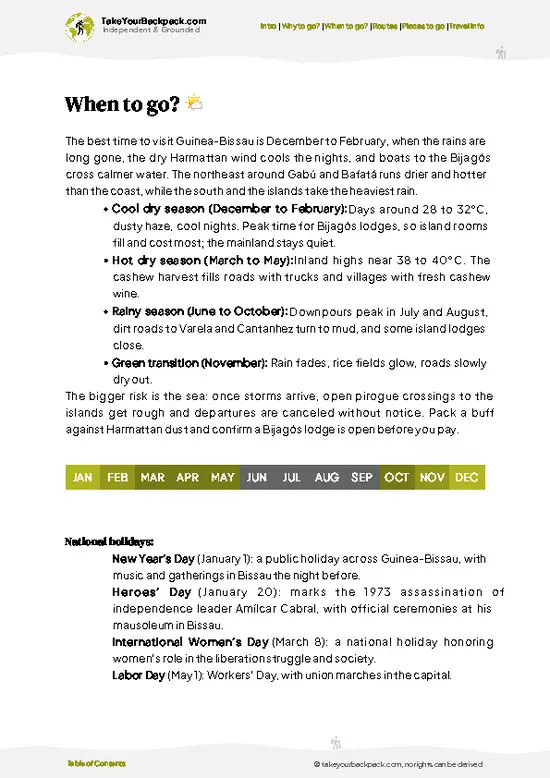
Come between December and February, when days reach about 30 to 35°C (86 to 95°F), nights drop to roughly 18 to 22°C (64 to 72°F), and the red tracks are firm.
  • Dry Season (November to April): Clear skies, dusty harmattan haze in January, and easy road access. Prices stay flat because tourists are almost nonexistent.
  • Hot Months (March to May): Highs can pass 38°C (100°F).
  • Rainy Season (June to October): Heavy downpours cut off roads, so avoid it.
Leave early in the day, since heat builds fast after 10 a.m.

source: climatestotravel.comJANJanuary: excellent for travelingFEBFebruary: excellent for travelingMARMarch: excellent for travelingAPRApril: excellent for travelingMAYMay: highly recommended for travelingJUNJune: fair for travelingJULJuly: below average for travelingAUGAugust: below average for travelingSEPSeptember: fair for travelingOCTOctober: fair for travelingNOVNovember: highly recommended for travelingDECDecember: excellent for traveling
when-to-go

✈️ The backpacker research shortcutGuinea-Bissau Travel Guide

An offline-friendly backpacking guide with optimized travel routes, ranked highlights, transport advice, and the best areas to stay.
example page 0 from our offline Travel Guide for Guinea-Bissau
example page 1 from our offline Travel Guide for Guinea-Bissau
example page 2 from our offline Travel Guide for Guinea-Bissau
example page 3 from our offline Travel Guide for Guinea-Bissau
example page 4 from our offline Travel Guide for Guinea-Bissau
example page 5 from our offline Travel Guide for Guinea-Bissau
example page 6 from our offline Travel Guide for Guinea-Bissau
example page 7 from our offline Travel Guide for Guinea-Bissau
The digital guide (214 pages) contains:
✅ 48 highlights, ranked by travel appeal
✅ Optimized 2, 3 & 5-day travel routes
✅ Cities, national parks, landmarks, beaches
✅ How to get around
✅ Offline-friendly for travel without Wi-Fi
👉 Click to see all 30+ guide features

📅 Plan smarter in minutes, not weeks
✅ Month by month travel advice
✅ Festivals & national holidays
✅ Budget expectations

🗺️ Go to the right places, skip the overrated ones
✅ Honest pros & cons of destinations
✅ Top hikes, parks & viewpoints
✅ Lesser-known places most travelers miss
✅ Clear “worth it vs skip it” guidance

🛏️ Travel smoothly without rookie mistakes
✅ Best areas to stay
✅ Transport systems explained simply
✅ Common scams & safety advice
✅ SIM cards, money & practical tips

🌍 Understand the country, not just visit it
✅ Culture & traditions
✅ 52 Essential phrases & customs
✅ Festivals worth planning around
✅ Traveler-friendly historical context
✅ Insights that make places more meaningful

📱 Built for real travel conditions
✅ Fully downloadable PDF
✅ Works completely offline
✅ Optimized for phone use
✅ Useful in remote areas & buses
✅ Everything in one place
Stop searching, start planning
Get instant access to your full guide. 30‑day money-back guarantee.
+ Add another guide for just

By proceeding you agree to our terms.
Sent to your inbox immediately after payment • 100% Secure Checkout
Best Backpacking Travel Advisor 2025 tourism awardBest Backpacking
Travel Advisor
2025
What others say about Take Your Backpack Guides:
⭐⭐⭐⭐⭐
Fantastic, amazing amount of information!
⭐⭐⭐⭐⭐
My goodness this is amazing, it's what I've been looking for hats off too you!
⭐⭐⭐⭐⭐
I think this is absolutely BRILLIANT
⭐⭐⭐⭐
Very complete and informative. It's still missing places, but I gotta to commend you
⭐⭐⭐⭐⭐
This is truly amazing, thank you, can't wait to explore it with my kids!
⭐⭐⭐⭐⭐
Awesome resource, thank you!
⭐⭐⭐⭐⭐
This is amazing! Can't wait to explore the ones I haven't seen
⭐⭐⭐⭐
I love this! Well done, great idea.
⭐⭐⭐⭐⭐
Thanks for taking the time to make this gem!
⭐⭐⭐⭐⭐
This might be the best website I've ever seen.
⭐⭐⭐⭐⭐
Congratulations, and thank you so much for your work; it's incredibly valuable.
⭐⭐⭐⭐
In all seriousness I think you did a great job pointing out the important spots
⭐⭐⭐⭐⭐
10/10 very good
⭐⭐⭐⭐⭐
As someone who's only just starting to visit regularly this is awesome, thank you.
⭐⭐⭐⭐
Thank you very much! I'm going to visit my dad, it's going to be very useful!
⭐⭐⭐⭐⭐
This is really cool! We'll be travelling for the first time and this definitely come in handy.
⭐⭐⭐⭐⭐
You are now our minister of culture, congratulations 👨‍💼
⭐⭐⭐⭐⭐
Just wanted to tell you that this is a pearl! Going to follow your recommendations.
⭐⭐⭐⭐⭐
This is so cool. I'll definitely be using the resource for my travels soon.
⭐⭐⭐⭐⭐
This is very impressive! Good work.
⭐⭐⭐⭐⭐
This is an amazing and informative site. Very well done!

🛏️ Where to stay?How to pick the right area

Gabú, the nearest real town, is the best place to sleep, as Madina do Boé itself has almost no formal lodging. Gabú has a handful of basic guesthouses with private rooms at about €10 to 20 a night and no proper hostels, so do not expect dorms. Its center is busier, with a market, lights, restaurants and better chances of a working fan or generator, and it is where shared taxis start. Nights are generally calm, though dogs and music can be loud. Within Madina do Boé, the only realistic option is arranging a bed in a family compound through a local contact, which is simple, quiet and very rustic. Bring a mosquito net, cash and a flashlight.

🚌 Getting aroundTransportation options and practical tips

Madina do Boé has no bus station, so you arrive at the shared-taxi or bush-taxi stop on the main dirt road, and the center is a flat five-minute walk from there, past mud-brick walls and cooking fires. Traffic is a few motorbikes and the occasional 4x4 raising red dust. Public transport is informal and runs when vehicles fill, so patience matters more than a timetable.
  • Walking: The best option for the village and the nearby independence sites. Carry water and a hat, because shade is rare and the midday sun is brutal.
  • Motorbike taxi: Quick for the longer tracks to outlying sites, about €1 to 4 per ride, negotiated before you climb on. Expect a dusty, bumpy seat and no helmet.
  • Shared bush taxi: Battered vans and cars link the area with Gabú, roughly 2 to 3 hours in the dry season for about €5 to
… read more 👉
Madina do Boé has no bus station, so you arrive at the shared-taxi or bush-taxi stop on the main dirt road, and the center is a flat five-minute walk from there, past mud-brick walls and cooking fires. Traffic is a few motorbikes and the occasional 4x4 raising red dust. Public transport is informal and runs when vehicles fill, so patience matters more than a timetable.
  • Walking: The best option for the village and the nearby independence sites. Carry water and a hat, because shade is rare and the midday sun is brutal.
  • Motorbike taxi: Quick for the longer tracks to outlying sites, about €1 to 4 per ride, negotiated before you climb on. Expect a dusty, bumpy seat and no helmet.
  • Shared bush taxi: Battered vans and cars link the area with Gabú, roughly 2 to 3 hours in the dry season for about €5 to 9. They leave in the morning when full, and the last ones go by early afternoon, so do not count on an evening ride.
  • Hired 4x4 with driver: The sensible choice if you want a private trip from Gabú, around €60 to 100 per day including fuel. It handles ruts and river crossings that sink ordinary cars.

👛 Costs (as of 22 October 2026)Typical daily expenses

Madina do Boé costs roughly €34 to 53 a day for a backpacker, mostly because transport and a guide are the main expenses.
CategoryBudget RangeLocal Reality
Dorm accommodation€10 to 20No dorms; basic private rooms in nearby Gabú, or a family compound
Meals€4 to 8Rice, fish or chicken sauce, bread and eggs at simple stalls
Local transport€5 to 12Bush taxi and motorbike rides, paid in cash
Basic activities/entry fees€3 to 8Local guide tip or small fee at sites
Miscellaneous expenses€2 to 5Water, phone credit, small gifts
Total Daily Budget€34 to 53Total for one day at high-season rates
Buy water and snacks in Gabú before heading out, since prices rise and choice shrinks in the village.
⚠️ Prices can change and everyone travels differently, so take this as a rough guide. Hope it helps you plan your adventure!

🚌 Day tripsEasy escapes and nearby places

Madina do Boé works better as a day destination from Gabú than as a base, since services are thin and roads are slow.Independence Proclamation Site: Reach the historic spot where independence was declared in 1973 by hired 4x4 or bush taxi plus walking, about 2 to 3 hours each way from Gabú. Budget €15 to 30 if sharing transport. Go in the dry season and leave early; first-timers often start too late and get caught by heat.
Gabú Market and Old Town: A short return trip toward Gabú gives you the region’s biggest market, with fabrics, spices and Fula and Mandinka traders. Shared taxis cost about €5 to 9, and Gabú is best on market days in the dry months. Bring small bills, as vendors rarely have change.
👉 Explore GabúBoé Region Villages: Savanna tracks connect small farming hamlets, where you can … read more 👉
Madina do Boé works better as a day destination from Gabú than as a base, since services are thin and roads are slow.Independence Proclamation Site: Reach the historic spot where independence was declared in 1973 by hired 4x4 or bush taxi plus walking, about 2 to 3 hours each way from Gabú. Budget €15 to 30 if sharing transport. Go in the dry season and leave early; first-timers often start too late and get caught by heat.
Gabú Market and Old Town: A short return trip toward Gabú gives you the region’s biggest market, with fabrics, spices and Fula and Mandinka traders. Shared taxis cost about €5 to 9, and Gabú is best on market days in the dry months. Bring small bills, as vendors rarely have change.
👉 Explore GabúBoé Region Villages: Savanna tracks connect small farming hamlets, where you can see baobabs, mango groves and traditional compounds. A driver costs around €10 to 25 for a half day, and November to February is most comfortable. Ask before photographing people.

🛡️ SafetySafety Tips and Common Scams in Madina do Boé

Madina do Boé is quiet and calm, with little street crime, and the main risks are practical ones. The area sits close to the Guinea border, so carry your passport and expect friendly but thorough checkpoints. Heat, dehydration and malaria are bigger worries than theft, so drink treated water and use a net. Roads are poor and unlit, so avoid traveling after dark. Solo travelers will draw curiosity, so a local guide helps and is worth the few euros. Agree on prices before any ride, and keep cash discreet.

FAQFrequently asked questions about Madina do Boé

Madina do Boé is worth visiting if you care about history, since it is where Guinea-Bissau declared independence in 1973, but it is not a place for amenities or nightlife. Allow a half day for the ruins and village. Access is rough, and the trip suits adventurous travelers more than beach seekers.
Madina do Boé needs one day for the main sites, or two if you want to sleep in a village compound and see the surrounding savanna. The trip from Gabú takes roughly 2 to 3 hours each way in the dry season. Plan a half day on site and an early start.
Madina do Boé can be done as a long day trip from Gabú, about 2 to 3 hours each way by 4x4 or bush taxi, costing roughly €15 to 30 shared. From Bissau, it is too far, so plan an overnight in Gabú. Go in the dry season, November to April, when the tracks are passable.
⚠️ Things can change over time, so always validate details locally before you go.

Other Bissau-Guinean towns near Madina do Boé

Explore more nearby:

  • Bafatá—old Portuguese quarter, Geba River, faded architecture| 68 km away
  • Buba—coastal inlet, timber port, quiet neighborhoods| 87 km away
  • Quebo—savanna edge, weekly market, crossroads village| 91 km away

💡 Not sure where to go next?
Create a personalized itinerary for Guinea-Bissau including Madina do Boé and the places that fit your trip.

Generate my itinerary

👉 Discover all towns

Or checkout all Guinea-Bissau has to offer (think cities, towns, villages, national parks, hikes, beaches, festivals)
Country photo of Guinea-Bissau

We 💚 feedbackKey takeaways before you go

Madina do Boé trips fail when travelers turn up without a driver and guide, then stall on bad tracks with no one to explain the ruins. Hire both in Gabú, carry cash and extra water, and take your time with elders.

✍️ Help improve this page!
The information on this page is based on in-depth research, insights shared by experienced travelers, and feedback from the local travel community in Guinea-Bissau. While every effort is made to keep the information accurate and current, conditions can change — so if you spot anything incorrect or outdated, please get in touch.


🙋‍♂️ Give feedback

👋 Meet the founderWho’s Behind Take Your Backpack?

Johan, backpacker and founder of TakeYourBackpackHi, I’m Johan (Netherlands 🇳🇱), the creator of TakeYourBackpack. Over the past 3 decades, I’ve backpacked through 90+ countries across six continents, gaining extensive experience with independent travel, long-term trips, and overland routes.

This site is built on a combination of firsthand travel experience and carefully curated insights from other backpackers. Many guides are based on places I’ve personally visited, while others bring together tips, observations, and practical advice shared by trusted travelers I’ve met along the way.

The goal is to provide realistic, experience-driven guidance — not generic itineraries — so you can explore destinations with better context, clearer expectations, and more confidence.