×

Haiti🇭🇹 | best national parksExplore the 4 Best national parks in Haiti

National parks in Haiti are mountain and heritage areas with almost no visitor infrastructure, and that is the whole appeal. The north around Cap-Haïtien has the easiest access, with paved roads, guides at the gate and a few hours of walking. The southern massifs (La Selle and La Hotte) mean rough tracks, cold nights and campsites run by local associations. Crowds are close to zero everywhere, but so are signs, maps and cafés. Independent travel works only with a local contact and a guide, and costs run higher than the facilities suggest. Skip the parks near Port-au-Prince unless your security plan is solid.

By Johan Kruseman 🇳🇱 | Updated October 20, 2026
Explore the best hikes in Haiti

Why go?Why These national park Stand Out

Haiti is a poor fit for travelers who expect marked trails, ranger stations and a park pass system. Parks here exist on paper more than on the ground, and funding is thin. What Haiti offers instead is rare: steep terrain that kept some cloud forest alive in a country that lost most of its tree cover to charcoal burning, and a revolutionary-era heritage unmatched in the Caribbean, built by people who defeated Napoleon’s army. Few islands combine native highland ecosystems and 19th-century fortifications in one country.

The geography does the work. Mountains cover most of the country, so protected areas sit high, cold and remote, which means long approaches and slow transport rather than quick day trips. Hispaniola’s endemic birds and amphibians live in those last forest patches, so birders and … read more 👉
Haiti is a poor fit for travelers who expect marked trails, ranger stations and a park pass system. Parks here exist on paper more than on the ground, and funding is thin. What Haiti offers instead is rare: steep terrain that kept some cloud forest alive in a country that lost most of its tree cover to charcoal burning, and a revolutionary-era heritage unmatched in the Caribbean, built by people who defeated Napoleon’s army. Few islands combine native highland ecosystems and 19th-century fortifications in one country.

The geography does the work. Mountains cover most of the country, so protected areas sit high, cold and remote, which means long approaches and slow transport rather than quick day trips. Hispaniola’s endemic birds and amphibians live in those last forest patches, so birders and botanists get far more from a visit than casual sightseers.

Before choosing Haiti, accept three facts. Security is the deciding factor: gang violence around Port-au-Prince has disrupted roads and flights, and government travel advisories are severe. Logistics need local fixers, because online booking barely exists. And services are basic, with limited electricity, cash only and little English. If you want easy hiking with a guaranteed bed at the end, choose the Dominican Republic next door.
Why These Made the Cut
The list of best national parks in Haiti is created based on landscapes, wildlife, adventure opportunities, facilities, and overall experience. If you feel a national park is missing in this list, please let us know.

When to go?When to Plan Your Trip

Best Months for Haiti’s Parks: The best months are January to March, when the dry season gives clearer mountain views, firmer tracks and the lowest hurricane risk. Daytime temperatures on the lowlands and coast sit around 28 to 32°C, while highland areas above 1,800 meters run 10 to 20°C by day and can fall close to freezing on clear winter nights. Pack a real sleeping bag and a warm layer, because most visitors underestimate the cold.Shoulder Seasons and Regional Differences: April to June and November to December are workable but uneven. The north coast around Cap-Haïtien gets its wettest spell from November to January, so a northern trip fits February to April better. The south and southwest are wetter overall, with heavy rain from April to June and again from August to October, and mud … read more 👉
Best Months for Haiti’s Parks: The best months are January to March, when the dry season gives clearer mountain views, firmer tracks and the lowest hurricane risk. Daytime temperatures on the lowlands and coast sit around 28 to 32°C, while highland areas above 1,800 meters run 10 to 20°C by day and can fall close to freezing on clear winter nights. Pack a real sleeping bag and a warm layer, because most visitors underestimate the cold.Shoulder Seasons and Regional Differences: April to June and November to December are workable but uneven. The north coast around Cap-Haïtien gets its wettest spell from November to January, so a northern trip fits February to April better. The south and southwest are wetter overall, with heavy rain from April to June and again from August to October, and mud turns unpaved approaches into slow, risky going.What to Avoid: Skip August to October. This is peak Atlantic hurricane season, and landslides can close mountain roads for days. Flights and ground transport are cut with little notice, and a missed connection can cost two extra nights.

Prices barely move by season, since Haiti has no real tourist high season. Guides and drivers charge the same rate year-round, but demand around Christmas and Carnival (February) pushes up transport and Cap-Haïtien rooms, so book early for those weeks.

national park hoppingPlanning Your Route Efficiently

How Many Days to Allow: A trip combining several national parks in Haiti needs 6 to 9 days, and that is only workable if you accept one region per leg and no overland sprints. Haiti’s road network is slow and security dictates what is possible, so the map lies about distances.Regions That Group Well: The north (Cap-Haïtien, Milot) is a base for the heritage sites, and the southwest (Les Cayes, Camp-Perrin) is a base for the high forest. These two do not cluster, so treat them as separate trips connected by a domestic flight. Start in the north, where logistics are easiest, then fly south if the security picture allows. Allow 2 to 3 days for the north, 3 to 4 days for the southwest including a night in the highlands, and half a day on each end for transfers. Cap-Haïtien to Milot takes roughly … read more 👉
How Many Days to Allow: A trip combining several national parks in Haiti needs 6 to 9 days, and that is only workable if you accept one region per leg and no overland sprints. Haiti’s road network is slow and security dictates what is possible, so the map lies about distances.Regions That Group Well: The north (Cap-Haïtien, Milot) is a base for the heritage sites, and the southwest (Les Cayes, Camp-Perrin) is a base for the high forest. These two do not cluster, so treat them as separate trips connected by a domestic flight. Start in the north, where logistics are easiest, then fly south if the security picture allows. Allow 2 to 3 days for the north, 3 to 4 days for the southwest including a night in the highlands, and half a day on each end for transfers. Cap-Haïtien to Milot takes roughly 45 minutes to 1 hour by taxi or tap-tap. Les Cayes to the foothills takes 1 to 2 hours, then 3 to 8 hours on foot or by moto depending on the route.Planning Mistakes: The first mistake is driving between Port-au-Prince and the north or south. Roads are controlled by armed groups in places, so use flights or sea routes instead. The second is stacking a mountain climb the day after arrival, which wastes the legs you need for altitude. The third is booking a tight onward flight, since delays are routine. Build a spare day into each leg.

The ListTop national parks of Haiti

1 La Hotte Biosphere Reserve

Pic Macaya summit, orchid slopes, Macaya frogs, Tiburon Peninsula

Hike with a guide up Pic Macaya through moss-draped cloud forest, passing coffee hamlets, epiphytes and endemic frogs before ridge views open toward the Caribbean.

2 La Visite National Park

Seguin ridges, highest summit, La Selle thrush, Marigot traverse

Trek the Massif de la Selle from Seguin, reaching open ridges and Haiti’s highest peak, or commit to the multi-day descent toward Marigot.

haiti-national-park-la-visite-national-park
© Google | Karl Arthur

3 Forêt des Pins National Park

Frosty pine ridges, Pic la Selle approaches, Furcy viewpoints, cold-night camping

Climb through misty Hispaniolan pines above Seguin and Furcy, watch for endemic birds at dawn, then pitch a tent under frosty, very dark skies.

4 Grand Bois National Park

Hotte cloud forest, night-walk frogs, farmers’ footpaths, endemic birds

Follow farmers’ footpaths with a local guide into damp, mossy forest, listening for rare birdcalls and searching leaf litter for tiny frogs after dark.

Loading the map 🌍

Expert viewExpert Commentary on national parks

How Many Parks to Visit: Visit two parks, three at most. Haiti’s access is slow and security constraints change by the week, so each additional park adds a transfer, a guide negotiation and a delay risk. Two well-chosen stops, one heritage and one mountain, give a fuller picture than a rushed tour of five.Which Kind Suits You: Travelers on a short trip or a first visit should pick heritage parks in the north: you get road access, rooms nearby and a guide at the gate. Hikers, birders and campers who handle rough logistics should take a mountain forest park, where the wildlife is the point but the cost in time and effort is much higher. Skip the temptation to fit both into a weekend. The forest parks need a full day of approach and a full day of descent just to give you one good morning on the … read more 👉
How Many Parks to Visit: Visit two parks, three at most. Haiti’s access is slow and security constraints change by the week, so each additional park adds a transfer, a guide negotiation and a delay risk. Two well-chosen stops, one heritage and one mountain, give a fuller picture than a rushed tour of five.Which Kind Suits You: Travelers on a short trip or a first visit should pick heritage parks in the north: you get road access, rooms nearby and a guide at the gate. Hikers, birders and campers who handle rough logistics should take a mountain forest park, where the wildlife is the point but the cost in time and effort is much higher. Skip the temptation to fit both into a weekend. The forest parks need a full day of approach and a full day of descent just to give you one good morning on the trail.Budget: Plan US$50 to 100 a day in total: a basic guesthouse at US$20 to 50, meals at US$10 to 20, and ground transport at US$15 to 40 for shared rides or a few moto-taxis. Entry fees are modest at roughly US$5 to 15 per visit and paid in gourdes or dollars. A local guide costs US$20 to 50 a day, and a porter or mule adds US$10 to 20. Hiring a private driver for the day runs US$60 to 120, which is the figure that breaks budgets. Bring small US$1 and US$5 bills, because change is scarce and ATMs are unreliable. Carry enough cash for the whole trip.Costs and Delays That Catch People Out: Unmarked informal fees appear at checkpoints and gates. Ask your guide to confirm the price before you start, and keep receipts. Flight changes are common, so avoid same-day connections and pad each leg with a spare day. Arranging a guide at the last minute raises the price, so contact a local association or your guesthouse a week ahead. Buy medical evacuation insurance before you go, since standard policies often exclude high-risk destinations.Safety and Culture: Check your government’s advisory immediately before booking, because Haiti’s security can change within days. Never travel at night, and never go without a local contact who knows current conditions. Parks sit in working farmland, so greet people first with “bonjou” and ask before photographing anyone. Dress modestly, and pay the community associations that maintain trails and campsites rather than bargaining hard. Carry water treatment, a headlamp and a first-aid kit, since the nearest clinic can be hours away.

✈️ The backpacker research shortcutHaiti Travel Guide

An offline-friendly backpacking guide with optimized travel routes, ranked highlights, transport advice, and the best areas to stay.
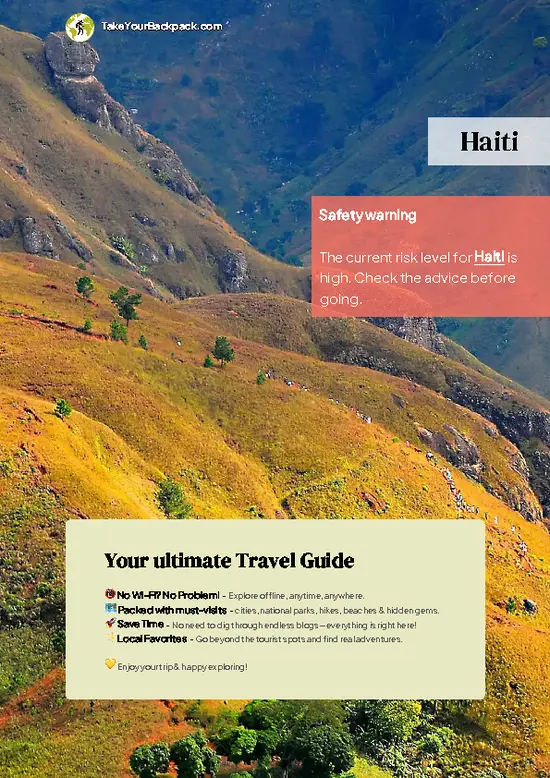
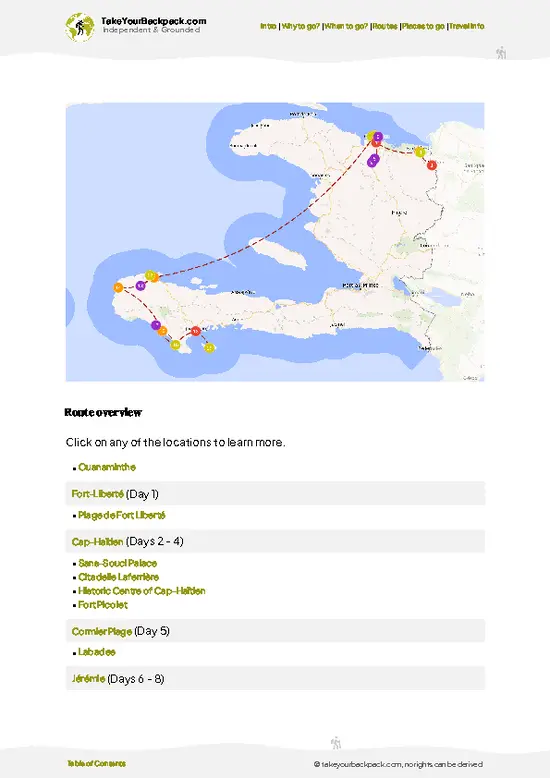
example page 0 from our offline Travel Guide for Haiti
example page 1 from our offline Travel Guide for Haiti
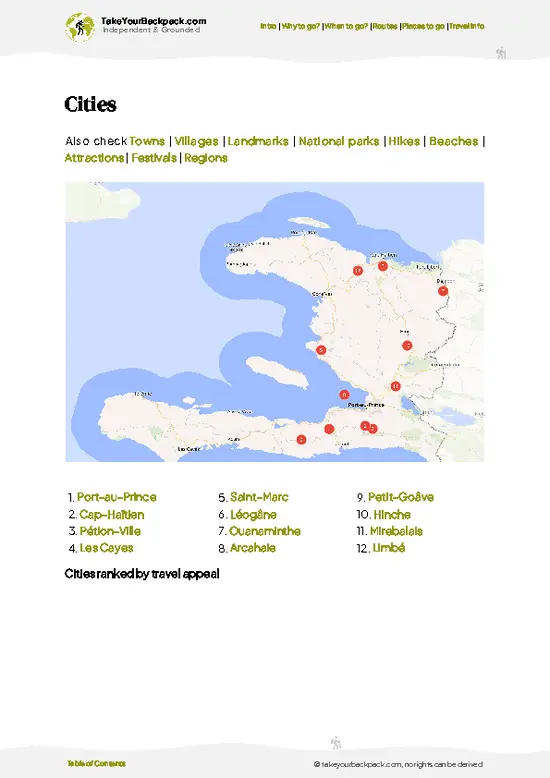
example page 2 from our offline Travel Guide for Haiti
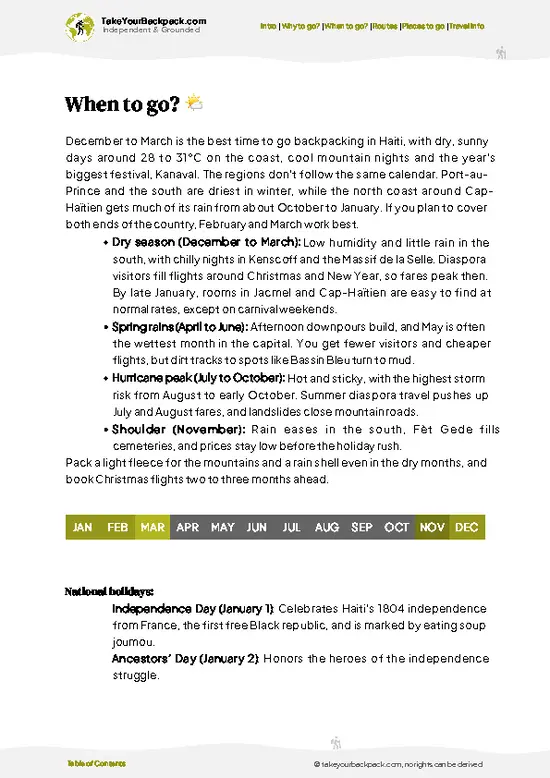
example page 3 from our offline Travel Guide for Haiti
example page 4 from our offline Travel Guide for Haiti
example page 5 from our offline Travel Guide for Haiti
example page 6 from our offline Travel Guide for Haiti
example page 7 from our offline Travel Guide for Haiti
The digital guide (332 pages) contains:
✅ 89 highlights, ranked by travel appeal
✅ Optimized 5, 10 & 15-day travel routes
✅ Cities, national parks, landmarks, beaches
✅ How to get around
✅ Offline-friendly for travel without Wi-Fi
👉 Click to see all 30+ guide features

📅 Plan smarter in minutes, not weeks
✅ Month by month travel advice
✅ Festivals & national holidays
✅ Budget expectations

🗺️ Go to the right places, skip the overrated ones
✅ Honest pros & cons of destinations
✅ Top hikes, parks & viewpoints
✅ Lesser-known places most travelers miss
✅ Clear “worth it vs skip it” guidance

🛏️ Travel smoothly without rookie mistakes
✅ Best areas to stay
✅ Transport systems explained simply
✅ Common scams & safety advice
✅ SIM cards, money & practical tips

🌍 Understand the country, not just visit it
✅ Culture & traditions
✅ 52 Essential phrases & customs
✅ Festivals worth planning around
✅ Traveler-friendly historical context
✅ Insights that make places more meaningful

📱 Built for real travel conditions
✅ Fully downloadable PDF
✅ Works completely offline
✅ Optimized for phone use
✅ Useful in remote areas & buses
✅ Everything in one place
Stop searching, start planning
Get instant access to your full guide. 30‑day money-back guarantee.
+ Add another guide for just

By proceeding you agree to our terms.
Sent to your inbox immediately after payment • 100% Secure Checkout
Best Backpacking Travel Advisor 2025 tourism awardBest Backpacking
Travel Advisor
2025
What others say about Take Your Backpack Guides:
⭐⭐⭐⭐⭐
Fantastic, amazing amount of information!
⭐⭐⭐⭐⭐
My goodness this is amazing, it's what I've been looking for hats off too you!
⭐⭐⭐⭐⭐
I think this is absolutely BRILLIANT
⭐⭐⭐⭐
Very complete and informative. It's still missing places, but I gotta to commend you
⭐⭐⭐⭐⭐
This is truly amazing, thank you, can't wait to explore it with my kids!
⭐⭐⭐⭐⭐
Awesome resource, thank you!
⭐⭐⭐⭐⭐
This is amazing! Can't wait to explore the ones I haven't seen
⭐⭐⭐⭐
I love this! Well done, great idea.
⭐⭐⭐⭐⭐
Thanks for taking the time to make this gem!
⭐⭐⭐⭐⭐
This might be the best website I've ever seen.
⭐⭐⭐⭐⭐
Congratulations, and thank you so much for your work; it's incredibly valuable.
⭐⭐⭐⭐
In all seriousness I think you did a great job pointing out the important spots
⭐⭐⭐⭐⭐
10/10 very good
⭐⭐⭐⭐⭐
As someone who's only just starting to visit regularly this is awesome, thank you.
⭐⭐⭐⭐
Thank you very much! I'm going to visit my dad, it's going to be very useful!
⭐⭐⭐⭐⭐
This is really cool! We'll be travelling for the first time and this definitely come in handy.
⭐⭐⭐⭐⭐
You are now our minister of culture, congratulations 👨‍💼
⭐⭐⭐⭐⭐
Just wanted to tell you that this is a pearl! Going to follow your recommendations.
⭐⭐⭐⭐⭐
This is so cool. I'll definitely be using the resource for my travels soon.
⭐⭐⭐⭐⭐
This is very impressive! Good work.
⭐⭐⭐⭐⭐
This is an amazing and informative site. Very well done!

🛏️ Where to stay?Top Places to Consider Staying

Haiti has almost no hostels in the dorm-bed sense, so budget travel here means family-run guesthouses and small hotels, typically around 4,000 to 8,000 HTG (US$30 to 60) a night. In Cap-Haïtien, the grid-street Centre-Ville keeps you close to the waterfront boulevard and to transport for the Citadelle, with the calmest evenings in the country, while the beach strip at Cormier west of town is quieter but needs a car or moto to get anywhere; in Jacmel, the walkable historic center among the old iron-balconied mansions has the easiest low-key bar scene. Pétion-Ville in Port-au-Prince has the capital’s widest choice of rooms and restaurants, but gang violence affects much of the city and the roads … read more 👉
Haiti has almost no hostels in the dorm-bed sense, so budget travel here means family-run guesthouses and small hotels, typically around 4,000 to 8,000 HTG (US$30 to 60) a night. In Cap-Haïtien, the grid-street Centre-Ville keeps you close to the waterfront boulevard and to transport for the Citadelle, with the calmest evenings in the country, while the beach strip at Cormier west of town is quieter but needs a car or moto to get anywhere; in Jacmel, the walkable historic center among the old iron-balconied mansions has the easiest low-key bar scene. Pétion-Ville in Port-au-Prince has the capital’s widest choice of rooms and restaurants, but gang violence affects much of the city and the roads in and out, so stay there only with a current security briefing and pre-arranged transport.

If you enjoy meeting fellow travelers, consider choosing hostels with high ratings for atmosphere. On the other hand, if you prefer having your own space, a hotel might be a better option.

HaitiMore Places Across Haiti

👋 Meet the founderWho’s Behind Take Your Backpack?

Johan, backpacker and founder of TakeYourBackpackHi, I’m Johan (Netherlands 🇳🇱), the creator of TakeYourBackpack. Over the past 3 decades, I’ve backpacked through 90+ countries across six continents, gaining extensive experience with independent travel, long-term trips, and overland routes.

This site is built on a combination of firsthand travel experience and carefully curated insights from other backpackers. Many guides are based on places I’ve personally visited, while others bring together tips, observations, and practical advice shared by trusted travelers I’ve met along the way.

The goal is to provide realistic, experience-driven guidance — not generic itineraries — so you can explore destinations with better context, clearer expectations, and more confidence.