×

Haiti🇭🇹 | best landmarksExplore the 10 Best landmarks in Haiti

Landmarks in Haiti are mostly early-19th-century fortresses and palaces, spring-fed waterfalls, and Vodou pilgrimage sites, and the experience changes sharply by region. The north around Cap-Haïtien is the easiest to reach and the best set up for independent travelers, with guides at the gates and modest fees. The south coast and Jacmel mean slower roads, quieter sites and a strong arts scene. Port-au-Prince holds major museums, but security makes it a poor bet for most backpackers right now. Expect few crowds and thin infrastructure everywhere. Come for history and rough-edged nature. Skip it if you need polish, signage or set opening hours.

By Johan Kruseman 🇳🇱 | Updated October 20, 2026
Explore the best national parks in Haiti

Why go?Why These unique site Stand Out

Haiti is the only country born from a successful slave revolt, and that origin is what makes its landmarks different. Sites here were built as proof of independence: huge hilltop forts meant to repel a French return, ruined palaces from the 1800s, and Vodou ceremonial grounds tied to waterfalls and sacred trees. Few countries in the Caribbean offer military architecture on this scale without a tour-bus industry around it.

The mountainous terrain shapes everything. Most of the country is steep, roads are poor, and a 50-kilometer trip can eat half a day. Sites are rarely signposted, so a local guide is the norm, not a luxury. Interpretation is minimal, and a guide supplies the history that plaques do not.

Before choosing Haiti for landmarks, understand that security is the deciding factor. Gang … read more 👉
Haiti is the only country born from a successful slave revolt, and that origin is what makes its landmarks different. Sites here were built as proof of independence: huge hilltop forts meant to repel a French return, ruined palaces from the 1800s, and Vodou ceremonial grounds tied to waterfalls and sacred trees. Few countries in the Caribbean offer military architecture on this scale without a tour-bus industry around it.

The mountainous terrain shapes everything. Most of the country is steep, roads are poor, and a 50-kilometer trip can eat half a day. Sites are rarely signposted, so a local guide is the norm, not a luxury. Interpretation is minimal, and a guide supplies the history that plaques do not.

Before choosing Haiti for landmarks, understand that security is the deciding factor. Gang violence has made much of the Port-au-Prince area unsafe, and government travel advisories at the highest level warn against travel. The north has been calmer, but conditions shift and flights, roads and fuel supply can change quickly. Earthquakes (2010, 2021) and hurricanes have also damaged and closed sites. If you want predictable logistics, pick another country. If you accept real uncertainty and plan with local contacts, the rewards are uncrowded, historically heavy places that most travelers never see.
Evaluating the Top Choices
The list of best unique sites in Haiti is created based on history or culture, wow factor, atmosphere, quirks, and memorability. If you feel a unique site is missing in this list, please let us know.

When to go?When to Plan Your Trip

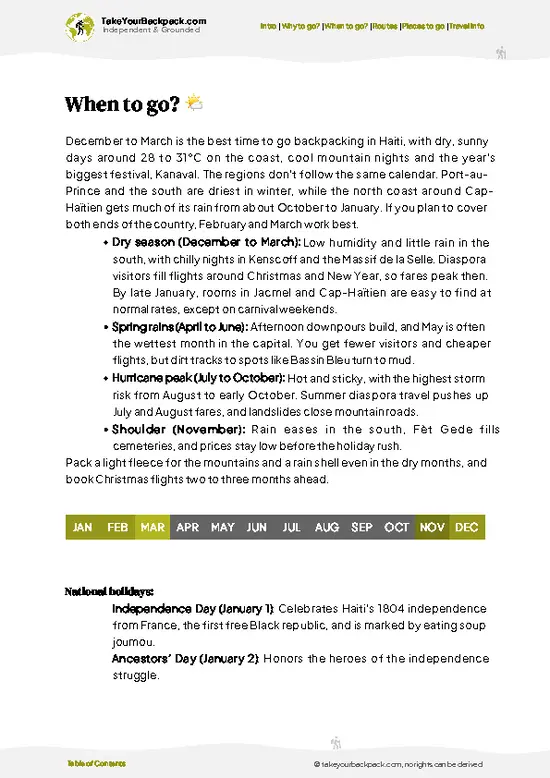
Best months: November to March: The best months for landmarks in Haiti are November to March, when rainfall drops and the dirt and mountain roads to the sites are driest. Coastal temperatures sit around 24 to 31°C with lower humidity, which makes hilltop climbs and long walks to waterfalls manageable. January and February are the safest bet for dry trails.

Shoulder and wet seasons: April to June is the shoulder period. Showers build, mainly as afternoon downpours, and heat climbs toward 32 to 35°C on the coast. Sites remain open and prices stay flat, but muddy tracks can slow transport. July and August are hot and drier in places, though hurricane risk begins in June. The worst stretch is August to October, the peak of hurricane season. Heavy rain washes out roads, rivers swell around waterfall … read more 👉
Best months: November to March: The best months for landmarks in Haiti are November to March, when rainfall drops and the dirt and mountain roads to the sites are driest. Coastal temperatures sit around 24 to 31°C with lower humidity, which makes hilltop climbs and long walks to waterfalls manageable. January and February are the safest bet for dry trails.

Shoulder and wet seasons: April to June is the shoulder period. Showers build, mainly as afternoon downpours, and heat climbs toward 32 to 35°C on the coast. Sites remain open and prices stay flat, but muddy tracks can slow transport. July and August are hot and drier in places, though hurricane risk begins in June. The worst stretch is August to October, the peak of hurricane season. Heavy rain washes out roads, rivers swell around waterfall sites, and flights are canceled. Skip these months unless you have a flexible schedule.

Regional differences and peak periods: The north around Cap-Haïtien gets its heaviest rain from October to January, so it can be wetter than the south in what is otherwise the dry season. Pack a rain layer there. The southern coast is driest from December to March. Highland areas such as Kenscoff and La Visite are cooler, roughly 10 to 22°C, and can dip to single digits at night.

Crowds are rarely an issue, with two exceptions. Carnival in February fills hotels and can double room prices in host towns. The mid-July pilgrimage to the Saut-d'Eau area draws thousands, so book ahead or avoid it.

unique site hoppingPlanning Your Route Efficiently

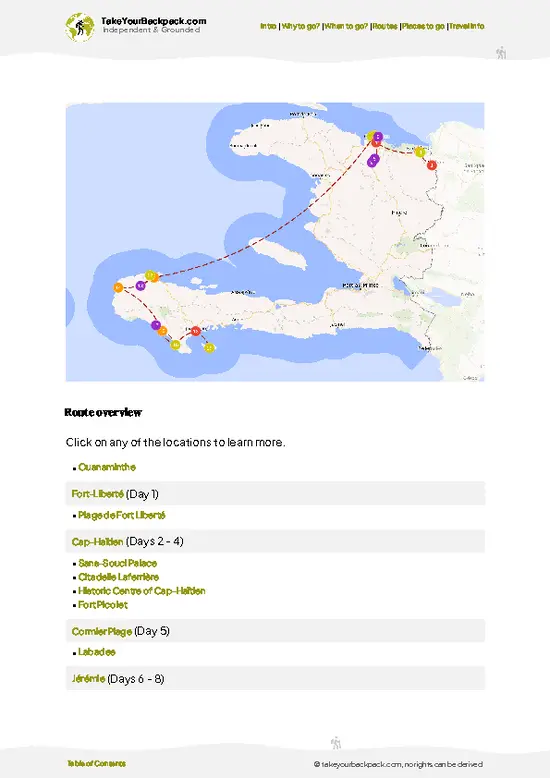
Plan 7 to 10 days: A trip combining several landmarks in Haiti needs 7 to 10 days, because transport is slow and flights are infrequent. Plan on two regions at most. The north (Cap-Haïtien and the surrounding hills) and the southeast (Jacmel and its hinterland) are the two realistic clusters, and each one takes 3 to 4 days on its own.

Direction and timing: Start in the north. Cap-Haïtien is the best-organized base, and sites around it are 30 to 90 minutes away by road, so you can see one or two per day. Allow a half day for an easy stop and a full day for anything with a climb or a long ride. Then move south by domestic flight rather than by road. The overland trip from Cap-Haïtien to the capital region takes 7 to 10 hours or more, and it crosses the areas with the worst security. Flights run … read more 👉
Plan 7 to 10 days: A trip combining several landmarks in Haiti needs 7 to 10 days, because transport is slow and flights are infrequent. Plan on two regions at most. The north (Cap-Haïtien and the surrounding hills) and the southeast (Jacmel and its hinterland) are the two realistic clusters, and each one takes 3 to 4 days on its own.

Direction and timing: Start in the north. Cap-Haïtien is the best-organized base, and sites around it are 30 to 90 minutes away by road, so you can see one or two per day. Allow a half day for an easy stop and a full day for anything with a climb or a long ride. Then move south by domestic flight rather than by road. The overland trip from Cap-Haïtien to the capital region takes 7 to 10 hours or more, and it crosses the areas with the worst security. Flights run about an hour but depend on schedules and operator reliability, so confirm them days ahead. Jacmel is roughly 2.5 to 4 hours from Port-au-Prince by road, but that road also carries risk. Arrange a vetted driver or a flight where available.

Planning mistakes: The first mistake is squeezing in three sites a day. Roads, checkpoints and breakdowns routinely add hours, so limit it to one major stop plus one small one. The second is booking tight connections. Leave a spare day before any international flight. The third is travelling after dark. Aim to arrive by mid-afternoon, since darkness comes early and unlit roads are the biggest hazard.

The ListTop landmarks of Haiti

1 Citadelle Laferrière

Mountaintop fortress, cannonball pyramids, horse ride, cloud-level ramparts

Climb by horse or on foot to thick walls and stacked iron shot, then scan the northern mountains toward the Atlantic from the roof.

haiti-unique-site-citadelle-laferriere
© Google | Wens

2 Bassin Bleu

Cobalt limestone pools, cliff ledge, waterfall slides, Vodou folklore

Swim through three linked basins after a short gorge descent, slide down smooth rock chutes, and weigh the cliff jump from the ledge.

haiti-unique-site-bassin-bleu
© Google | Frantzdy Gabriel

3 Sans-Souci Palace

Double staircase, red-brick ruin, 1842 quake cracks, shared Citadelle ticket

Climb the broken terraces of Christophe’s palace, spot the leaning walls left by the earthquake, and look down over Milot’s rooftops.

4 Grotte Marie Jeanne

Wet limestone chambers, headlamp crawl, Marie Jeanne story, bats

Follow a local guide through slick passages of stalactites and dripping water, then rinse off at the Port-à-Piment shore with fried fish.

5 Saut-Mathurine

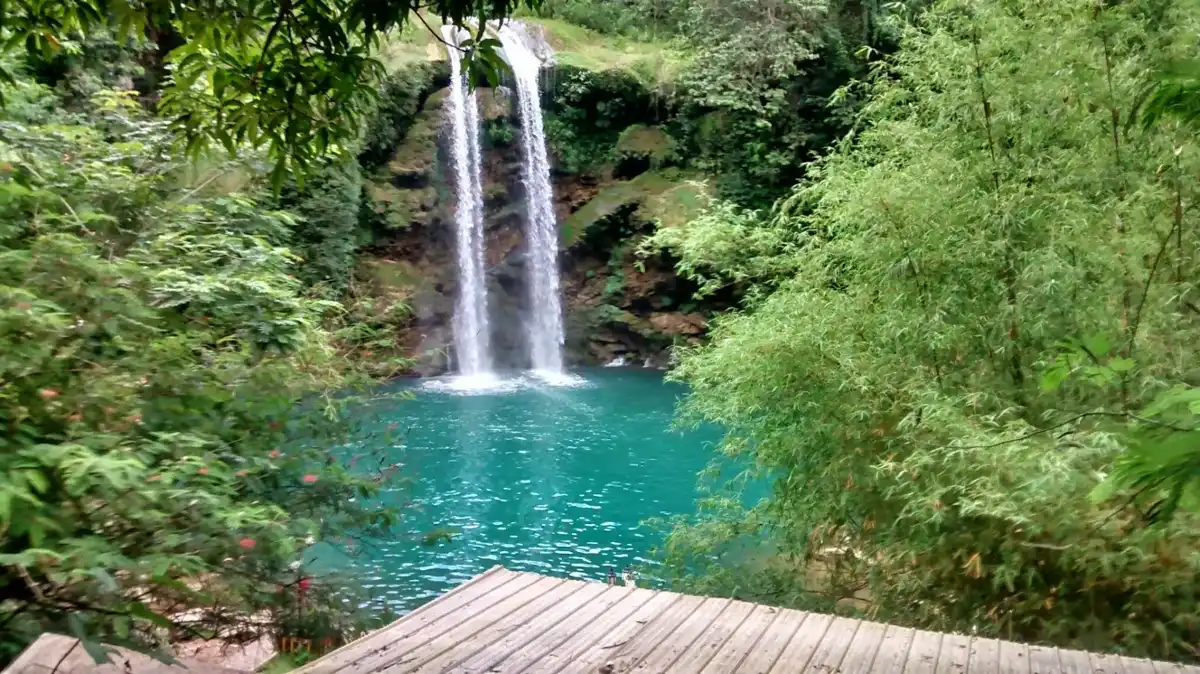
20-meter curtain fall, green plunge pool, fern banks, Camp-Perrin

Walk through farm plots to a wide limestone drop, swim in the cool green pool, and photograph the fall from the side ledge.

haiti-unique-site-saut-mathurine
© Google | Alberto Suarez

6 Chapelle Royale de Milot

Roofed royal chapel, pale brick arches, Milot gate guides

Step inside the only palace building that kept its roof, then walk the terraces and arches where King Christophe held court.

7 Fort Picolet

Harbor-mouth ramparts, rusted cannons, fishing shoreline

Ride the coast road past fishing neighborhoods to a weathered French battery, and read the bay entrance along the line of its guns.

8 Ruine Fort Valliere

Seaward embrasures, hilltop fort, city rooftops, shaded courtyard

Scramble up a short steep hill past houses to blackened ramparts, then look over Cap-Haïtien’s harbor and tin roofs from the walls.

9 La Passerelle de Marfranc

Swaying footbridge, river gorge, daily crossings, Marfranc farms

Cross a flexing plank span above a loud brown river, and step aside for villagers carrying produce along their daily road.

10 Habitation Dion

Plantation foundations, cactus hedges, dusty tracks, goats

Trace the masonry outlines of a colonial estate across dry farmland, with footpaths, neighbors and ridgelines as the only company.

Loading the map 🌍

Expert viewExpert Commentary on landmarks

How many landmarks to visit: Three to five landmarks is the right number for a Haiti trip. Transport eats most of each day, and a guide, driver and fixer need to be arranged per stop. Packing in more means you rush through places that need an hour of walking and a guide to make sense. Pick fewer, and give each a proper half or full day.

Which kind to prioritize: History-minded travelers should put the fortresses and palace ruins first. They are the country's defining sites and the most reliably accessible. Hikers and photographers should choose a waterfall or highland site, which means early starts and more walking, with the best light in the morning. Those curious about culture should add one Vodou-related or arts site, ideally in Jacmel, and go with a local who can explain what is respectful. … read more 👉
How many landmarks to visit: Three to five landmarks is the right number for a Haiti trip. Transport eats most of each day, and a guide, driver and fixer need to be arranged per stop. Packing in more means you rush through places that need an hour of walking and a guide to make sense. Pick fewer, and give each a proper half or full day.

Which kind to prioritize: History-minded travelers should put the fortresses and palace ruins first. They are the country's defining sites and the most reliably accessible. Hikers and photographers should choose a waterfall or highland site, which means early starts and more walking, with the best light in the morning. Those curious about culture should add one Vodou-related or arts site, ideally in Jacmel, and go with a local who can explain what is respectful. Skip museums in Port-au-Prince for now. The security risk is not worth it, and the north and southeast offer better value for your time.

What it costs: Haiti is not cheap for a backpacker, since fuel, imports and limited tourism infrastructure push prices up. Budget US$50 to 90 a day including a basic room (US$25 to 50), meals (US$10 to 20) and local transport. Entry fees are usually small, around US$2 to 10. Guides charge US$10 to 30 per site, and at larger sites that fee is rarely optional. Moto-taxis cost US$1 to 4 a ride and shared tap-taps less, but a private driver for a day runs US$60 to 120 depending on distance and fuel. Prices are often quoted in US dollars or gourdes (about 130 to the dollar), so confirm the currency before agreeing. Carry small bills, because change is scarce.

Costs and delays that catch travelers out: The commonest budget leak is unagreed prices. Settle guide, driver and fee totals before leaving, and write them down. Horse rental or porter charges at hilltop sites are sometimes added at the gate, so ask what is optional. Another leak is flight changes: book flexible tickets and keep a reserve of US$100 to 150 for a rebooked flight or an extra night. Cash is vital, as cards and ATMs are unreliable, so bring enough US dollars in clean, recent notes.

Safety and cultural points: Check current advisories immediately before departure and again en route. Use a trusted local contact or an established guesthouse to arrange drivers, never a stranger from the street. Avoid road travel after dark and any trip through Port-au-Prince. Stay out of protests and roadblocks, and carry a photocopy of your passport. Always ask before photographing people, and especially at Vodou or pilgrimage sites, where cameras may be refused. Dress modestly, and tip guides, who often support whole families.

✈️ The backpacker research shortcutHaiti Travel Guide

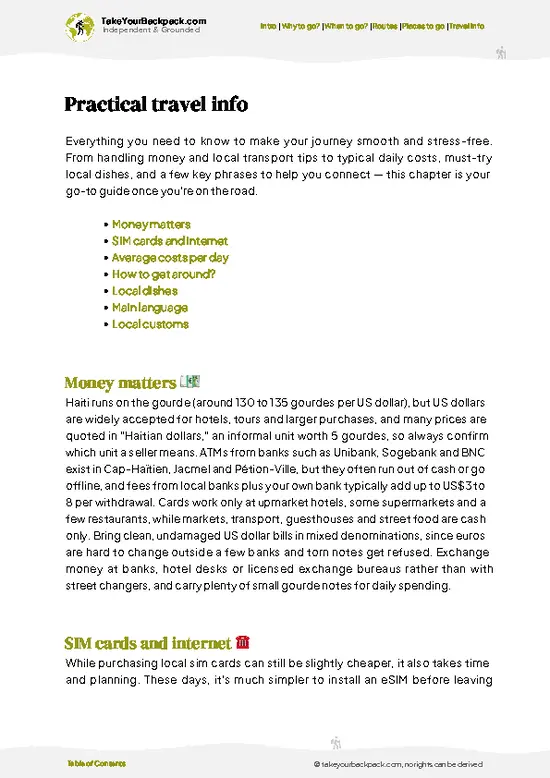
An offline-friendly backpacking guide with optimized travel routes, ranked highlights, transport advice, and the best areas to stay.
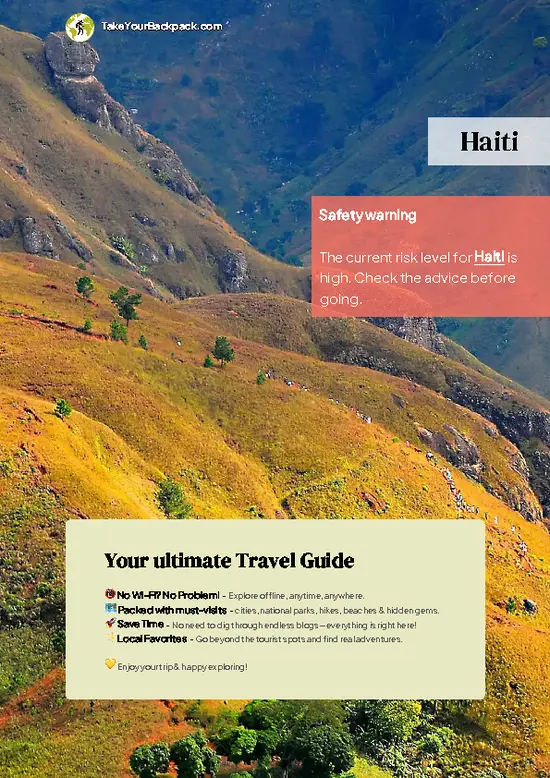
example page 0 from our offline Travel Guide for Haiti
example page 1 from our offline Travel Guide for Haiti
example page 2 from our offline Travel Guide for Haiti
example page 3 from our offline Travel Guide for Haiti
example page 4 from our offline Travel Guide for Haiti
example page 5 from our offline Travel Guide for Haiti
example page 6 from our offline Travel Guide for Haiti
example page 7 from our offline Travel Guide for Haiti
The digital guide (332 pages) contains:
✅ 89 highlights, ranked by travel appeal
✅ Optimized 5, 10 & 15-day travel routes
✅ Cities, national parks, landmarks, beaches
✅ How to get around
✅ Offline-friendly for travel without Wi-Fi
👉 Click to see all 30+ guide features

📅 Plan smarter in minutes, not weeks
✅ Month by month travel advice
✅ Festivals & national holidays
✅ Budget expectations

🗺️ Go to the right places, skip the overrated ones
✅ Honest pros & cons of destinations
✅ Top hikes, parks & viewpoints
✅ Lesser-known places most travelers miss
✅ Clear “worth it vs skip it” guidance

🛏️ Travel smoothly without rookie mistakes
✅ Best areas to stay
✅ Transport systems explained simply
✅ Common scams & safety advice
✅ SIM cards, money & practical tips

🌍 Understand the country, not just visit it
✅ Culture & traditions
✅ 52 Essential phrases & customs
✅ Festivals worth planning around
✅ Traveler-friendly historical context
✅ Insights that make places more meaningful

📱 Built for real travel conditions
✅ Fully downloadable PDF
✅ Works completely offline
✅ Optimized for phone use
✅ Useful in remote areas & buses
✅ Everything in one place
Stop searching, start planning
Get instant access to your full guide. 30‑day money-back guarantee.
+ Add another guide for just

By proceeding you agree to our terms.
Sent to your inbox immediately after payment • 100% Secure Checkout
Best Backpacking Travel Advisor 2025 tourism awardBest Backpacking
Travel Advisor
2025
What others say about Take Your Backpack Guides:
⭐⭐⭐⭐⭐
Fantastic, amazing amount of information!
⭐⭐⭐⭐⭐
My goodness this is amazing, it's what I've been looking for hats off too you!
⭐⭐⭐⭐⭐
I think this is absolutely BRILLIANT
⭐⭐⭐⭐
Very complete and informative. It's still missing places, but I gotta to commend you
⭐⭐⭐⭐⭐
This is truly amazing, thank you, can't wait to explore it with my kids!
⭐⭐⭐⭐⭐
Awesome resource, thank you!
⭐⭐⭐⭐⭐
This is amazing! Can't wait to explore the ones I haven't seen
⭐⭐⭐⭐
I love this! Well done, great idea.
⭐⭐⭐⭐⭐
Thanks for taking the time to make this gem!
⭐⭐⭐⭐⭐
This might be the best website I've ever seen.
⭐⭐⭐⭐⭐
Congratulations, and thank you so much for your work; it's incredibly valuable.
⭐⭐⭐⭐
In all seriousness I think you did a great job pointing out the important spots
⭐⭐⭐⭐⭐
10/10 very good
⭐⭐⭐⭐⭐
As someone who's only just starting to visit regularly this is awesome, thank you.
⭐⭐⭐⭐
Thank you very much! I'm going to visit my dad, it's going to be very useful!
⭐⭐⭐⭐⭐
This is really cool! We'll be travelling for the first time and this definitely come in handy.
⭐⭐⭐⭐⭐
You are now our minister of culture, congratulations 👨‍💼
⭐⭐⭐⭐⭐
Just wanted to tell you that this is a pearl! Going to follow your recommendations.
⭐⭐⭐⭐⭐
This is so cool. I'll definitely be using the resource for my travels soon.
⭐⭐⭐⭐⭐
This is very impressive! Good work.
⭐⭐⭐⭐⭐
This is an amazing and informative site. Very well done!

🛏️ Where to stay?Accommodation Highlights

Haiti has almost no hostels in the dorm-bed sense, so budget travel here means family-run guesthouses and small hotels, typically around 4,000 to 8,000 HTG (US$30 to 60) a night. In Cap-Haïtien, the grid-street Centre-Ville keeps you close to the waterfront boulevard and to transport for the Citadelle, with the calmest evenings in the country, while the beach strip at Cormier west of town is quieter but needs a car or moto to get anywhere; in Jacmel, the walkable historic center among the old iron-balconied mansions has the easiest low-key bar scene. Pétion-Ville in Port-au-Prince has the capital’s widest choice of rooms and restaurants, but gang violence affects much of the city and the roads … read more 👉
Haiti has almost no hostels in the dorm-bed sense, so budget travel here means family-run guesthouses and small hotels, typically around 4,000 to 8,000 HTG (US$30 to 60) a night. In Cap-Haïtien, the grid-street Centre-Ville keeps you close to the waterfront boulevard and to transport for the Citadelle, with the calmest evenings in the country, while the beach strip at Cormier west of town is quieter but needs a car or moto to get anywhere; in Jacmel, the walkable historic center among the old iron-balconied mansions has the easiest low-key bar scene. Pétion-Ville in Port-au-Prince has the capital’s widest choice of rooms and restaurants, but gang violence affects much of the city and the roads in and out, so stay there only with a current security briefing and pre-arranged transport.

If you enjoy meeting fellow travelers, consider choosing hostels with high ratings for atmosphere. On the other hand, if you prefer having your own space, a hotel might be a better option.

HaitiSee More of Haiti

👋 Meet the founderWho’s Behind Take Your Backpack?

Johan, backpacker and founder of TakeYourBackpackHi, I’m Johan (Netherlands 🇳🇱), the creator of TakeYourBackpack. Over the past 3 decades, I’ve backpacked through 90+ countries across six continents, gaining extensive experience with independent travel, long-term trips, and overland routes.

This site is built on a combination of firsthand travel experience and carefully curated insights from other backpackers. Many guides are based on places I’ve personally visited, while others bring together tips, observations, and practical advice shared by trusted travelers I’ve met along the way.

The goal is to provide realistic, experience-driven guidance — not generic itineraries — so you can explore destinations with better context, clearer expectations, and more confidence.