×

Iceland🇮🇸 | best attractionsDiscover the 6 Best attractions Across Iceland

Attractions in Iceland are mostly the landscape itself: black-sand beaches that crunch underfoot, waterfalls you hear before you see, and geothermal fields that smell of sulfur and hot stone. The South Coast is the easiest and busiest, with paved roads, car parks and tour buses by midmorning. The Westfjords and the Highlands are slower, rougher and far emptier, reached by gravel or F-roads that need a 4x4. The North sits between the two, with steaming lava fields and fewer crowds. Costs run high everywhere, but most sights are free. For backpackers and independent travelers, that makes wind, rain and distance the real price.

By Johan Kruseman 🇳🇱 | Updated October 18, 2026
Explore the best festivals in Iceland

Why go?Understanding Their Importance

Iceland sits on the Mid-Atlantic Ridge, where two tectonic plates pull apart, and that single fact produces the volcanoes, hot springs, lava fields and glaciers visitors come for. Nearly 11 percent of the island is covered by ice, and the air near it smells clean and mineral, with a faint rotten-egg note wherever geothermal vents break the surface. Most of the country is open land with almost no fences, so you can stand close to wonders that elsewhere sit behind ticket booths. That freedom is the appeal, and also the risk.

The weather changes within an hour. Wind can tear a car door off its hinges, rain moves sideways, and sunshine arrives without warning. Roads in the interior are closed for much of the year, and the ring road can shut in winter storms. Daylight swings from about 4 hours … read more 👉
Iceland sits on the Mid-Atlantic Ridge, where two tectonic plates pull apart, and that single fact produces the volcanoes, hot springs, lava fields and glaciers visitors come for. Nearly 11 percent of the island is covered by ice, and the air near it smells clean and mineral, with a faint rotten-egg note wherever geothermal vents break the surface. Most of the country is open land with almost no fences, so you can stand close to wonders that elsewhere sit behind ticket booths. That freedom is the appeal, and also the risk.

The weather changes within an hour. Wind can tear a car door off its hinges, rain moves sideways, and sunshine arrives without warning. Roads in the interior are closed for much of the year, and the ring road can shut in winter storms. Daylight swings from about 4 hours in December to near-continuous light in June, which reshapes what is possible on any given day.

The country has about 400,000 people and a small tourism workforce, so services thin out fast beyond Reykjavik and the main villages. Fuel, food and lodging are expensive, and many sights have newly introduced parking or entry fees. Choose Iceland for raw, exposed nature, and pack for it accordingly.
Behind the Scenes of Selection
The list of best attractions in Iceland is created based on cultural significance or entertainment value. If you feel a attraction is missing in this list, please let us know.

When to go?Optimal Periods for Travel

Best months: June to August are the best months for attractions in Iceland, because the highland roads open, daylight lasts 18 to 24 hours and daytime temperatures reach 10 to 15°C (50 to 59°F). The air is soft and smells of damp moss and warm earth, and gravel roads are mostly dry enough to drive without drama.

Shoulder seasons: May and September are the smart compromise. Crowds thin, accommodation prices drop by roughly 20 to 40 percent from July peaks, and temperatures hover around 5 to 10°C (41 to 50°F). September brings dark evenings, and the northern lights start to appear. Rain is frequent, and the South Coast is the wettest region, getting well over 1,500 mm a year in places, while the north is noticeably drier.

Winter: November to March is cold, dark and loud with wind. Highs sit … read more 👉
Best months: June to August are the best months for attractions in Iceland, because the highland roads open, daylight lasts 18 to 24 hours and daytime temperatures reach 10 to 15°C (50 to 59°F). The air is soft and smells of damp moss and warm earth, and gravel roads are mostly dry enough to drive without drama.

Shoulder seasons: May and September are the smart compromise. Crowds thin, accommodation prices drop by roughly 20 to 40 percent from July peaks, and temperatures hover around 5 to 10°C (41 to 50°F). September brings dark evenings, and the northern lights start to appear. Rain is frequent, and the South Coast is the wettest region, getting well over 1,500 mm a year in places, while the north is noticeably drier.

Winter: November to March is cold, dark and loud with wind. Highs sit near 0 to 4°C (32 to 39°F) on the coast, colder inland. Daylight shrinks to 4 to 5 hours in December, ice coats roads and paths, and the Highlands are closed. Ice caves open only in this season, and the aurora is visible on clear nights. Prices for cars and tours stay lower than summer, but some Westfjords and eastern roads close, and some guesthouses shut outright.

Peak pressure: July is the most crowded and expensive month, especially on the South Coast and around Reykjavik, so book cars and beds months ahead.

attraction hoppingHow to Combine attractions Into One Trip

How many days: A trip combining several of Iceland’s main attractions needs 7 to 10 days, and the full ring road takes at least 8 to cover without rushing. Fewer than 5 days limits you to the southwest and the South Coast.

Regions and direction: Reykjavik and Keflavik airport are the hubs, and the southwest clusters well: the Golden Circle, Reykjanes and the South Coast run along one corridor. From there, continue east through the southeast glacier area, then the East Fjords, and loop north to Akureyri and Lake Mývatn, returning via the Snaefellsnes Peninsula. Clockwise is common and works fine, but counterclockwise puts the crowded south at the end, when you are tired of crowds. Most travelers rent a car, since buses between regions are sparse and slow outside summer.

Time and distances: … read more 👉
How many days: A trip combining several of Iceland’s main attractions needs 7 to 10 days, and the full ring road takes at least 8 to cover without rushing. Fewer than 5 days limits you to the southwest and the South Coast.

Regions and direction: Reykjavik and Keflavik airport are the hubs, and the southwest clusters well: the Golden Circle, Reykjanes and the South Coast run along one corridor. From there, continue east through the southeast glacier area, then the East Fjords, and loop north to Akureyri and Lake Mývatn, returning via the Snaefellsnes Peninsula. Clockwise is common and works fine, but counterclockwise puts the crowded south at the end, when you are tired of crowds. Most travelers rent a car, since buses between regions are sparse and slow outside summer.

Time and distances: Allow 1 to 3 hours at a typical roadside stop and a half day for anything involving glacier walks or hot springs. Driving legs run about 2 to 4 hours between regions: Reykjavik to Vik takes roughly 2.5 hours, Höfn to Egilsstadir about 3.5, Akureyri to Mývatn about 1 hour.

Common planning mistakes: Travelers often judge distance by kilometers rather than speed limits, which top out at 90 km/h on paved roads and lower on gravel. Packing every stop into the first half leaves the north rushed. Instead, plan no more than 3 to 4 hours of driving a day, leave buffers for wind and weather, and keep one flexible day.

The ListThe Best attractions of Iceland

1 Blue Lagoon

geothermal spa, silica mud, mineral-rich waters, volcanic landscape

Soak in naturally heated pools surrounded by lava fields, experiencing the unique mineral composition and soothing warmth of Iceland’s geothermal activity.

iceland-attraction-blue-lagoon
© Google |

2 Aurora Reykjavík

interactive exhibits, aurora photography, science displays, immersive experience

Learn how Iceland’s skies come alive with color through hands-on displays, real-time forecasts, and detailed explanations of auroral phenomena.

iceland-attraction-aurora-reykjavik
© Google |

3 Perlan

glass dome, glacier exhibition, observation deck, artificial ice cave

Experience simulated glaciers, panoramic city views, and interactive displays that reveal Iceland’s volcanic and glacial forces.

4 Harpa

glass façade, modern architecture, performance venue, harbor views

Admire geometric glasswork and panoramic harbor vistas while attending concerts or exploring the building’s striking contemporary design.

iceland-attraction-harpa
© Google |

5 The Settlement Exhibition

Viking ruins, archaeological site, multimedia displays, early Reykjavik

Trace the origins of Reykjavík by viewing excavated longhouse remains and digital reconstructions that illustrate daily life in the first settlement.

6 Laugardalslaug

outdoor pools, hot tubs, local recreation, family-friendly facilities

Swim alongside locals in a complex of heated pools, water slides, and steam rooms, reflecting Iceland’s communal bathing culture.

iceland-attraction-laugardalslaug
© Google |
Loading the map 🌍

Expert viewInsights from Locals and Experts

How many attractions: I recommend 2 to 3 attractions a day at most, and around 15 to 20 across a 10-day trip. Iceland’s distances are long, the light and weather rule the schedule, and a hot spring or waterfall deserves enough time to feel the spray, the cold or the steam. Rushing turns the island into a series of car park photographs.

Choosing by travel style: If you like easy days, favor the roadside waterfalls, black beaches and geothermal areas near Reykjavik. If you want physical effort, put your energy into guided glacier hikes, day treks and the Highlands in summer. Photographers should spend more time in the East Fjords and the Westfjords, where light is low and rough, and crowds are small. If cost matters most, build the trip around free natural sites and skip the paid tours.

What … read more 👉
How many attractions: I recommend 2 to 3 attractions a day at most, and around 15 to 20 across a 10-day trip. Iceland’s distances are long, the light and weather rule the schedule, and a hot spring or waterfall deserves enough time to feel the spray, the cold or the steam. Rushing turns the island into a series of car park photographs.

Choosing by travel style: If you like easy days, favor the roadside waterfalls, black beaches and geothermal areas near Reykjavik. If you want physical effort, put your energy into guided glacier hikes, day treks and the Highlands in summer. Photographers should spend more time in the East Fjords and the Westfjords, where light is low and rough, and crowds are small. If cost matters most, build the trip around free natural sites and skip the paid tours.

What it costs: Budget about US$110 to 180 a day for a careful backpacker: dorm bed US$40 to 70, supermarket food US$25 to 40, and fuel or bus costs on top. A rental car runs US$60 to 150 a day depending on season and 4x4 needs. Many natural sights are free, but parking fees of roughly 1,000 to 1,500 ISK (US$7 to 11) are now common. Geothermal baths cost about US$40 to 90, glacier hikes US$90 to 150, ice caves US$150 to 250, and whale watching around US$90 to 120.

Safety: Iceland’s hazards are real and quiet. Sneaker waves kill visitors on black beaches, so stay well back from the surf. Check road.is for conditions and safetravel.is for alerts before driving anywhere, and register travel plans for remote trips. Never walk on glaciers without a guide and crampons. Gusts can snap car doors, so park facing into the wind and hold the handle with both hands. Wear waterproof layers, since wet cotton at 5°C becomes a problem quickly.

Cultural etiquette: Stay on marked paths: moss takes decades to recover from one footprint. Off-road driving is illegal and heavily fined. Shower naked with soap before entering any pool, a rule Icelanders enforce firmly. Wild camping is restricted, so use designated campsites, which cost about US$15 to 25 per person.

The effort pays off in small moments: sulfur steam in cold air, the hush after a bus pulls away, and light that stays amber past midnight.

✈️ The backpacker research shortcutIceland Travel Guide

An offline-friendly backpacking guide with optimized travel routes, ranked highlights, transport advice, and the best areas to stay.
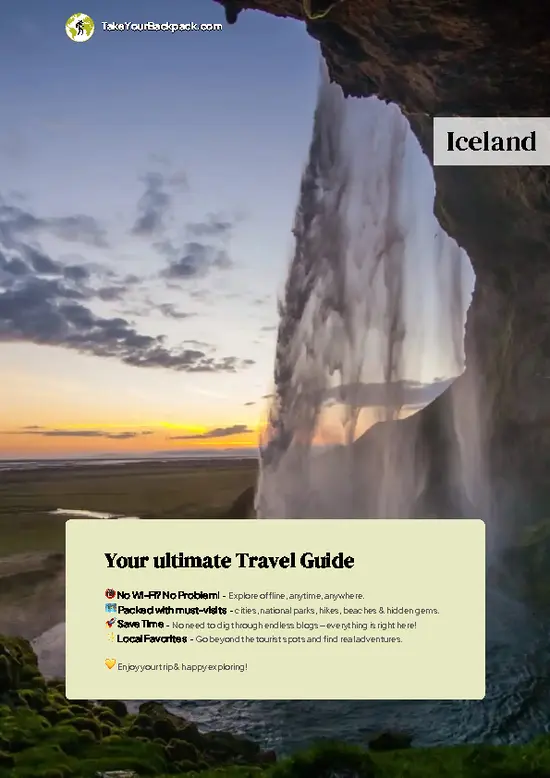
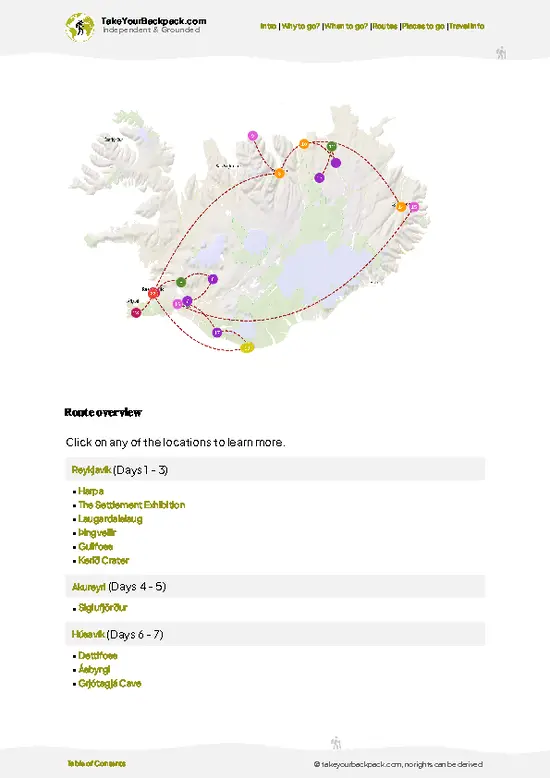
example page 0 from our offline Travel Guide for Iceland
example page 1 from our offline Travel Guide for Iceland
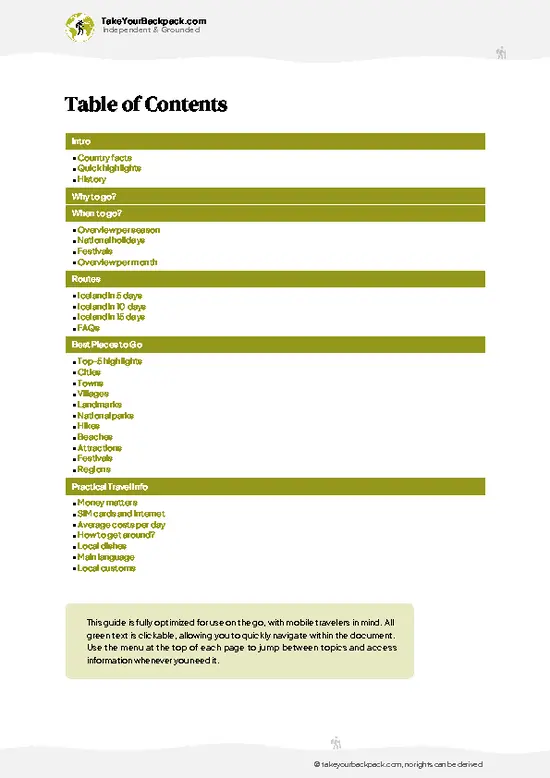
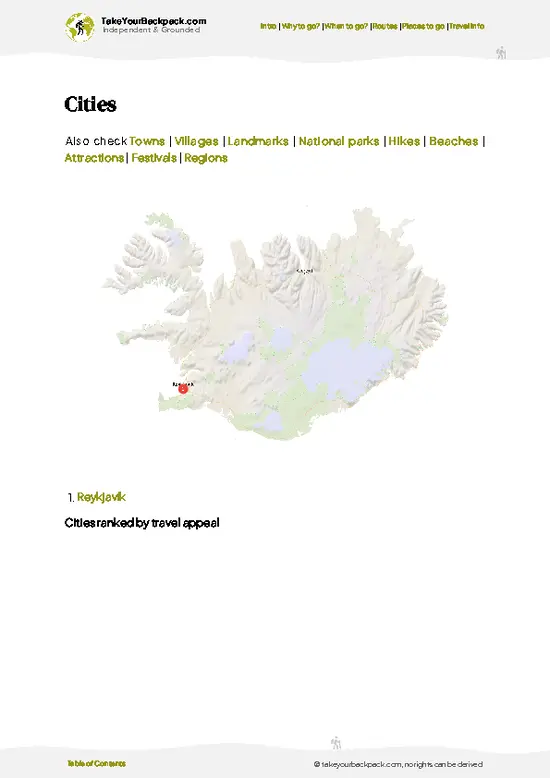
example page 2 from our offline Travel Guide for Iceland
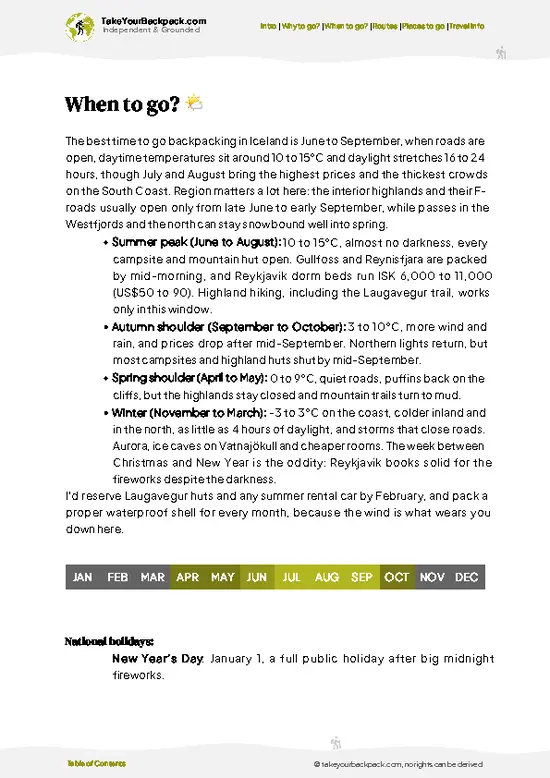
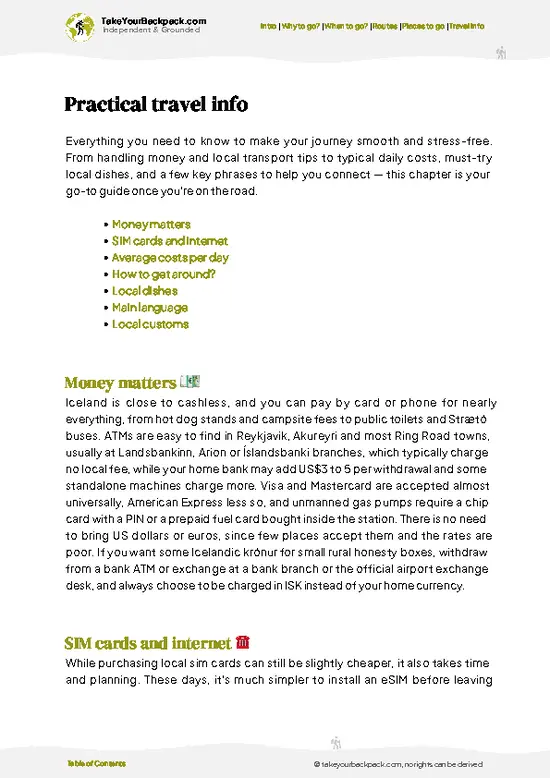
example page 3 from our offline Travel Guide for Iceland
example page 4 from our offline Travel Guide for Iceland
example page 5 from our offline Travel Guide for Iceland
example page 6 from our offline Travel Guide for Iceland
example page 7 from our offline Travel Guide for Iceland
The digital guide (230 pages) contains:
✅ 61 highlights, ranked by travel appeal
✅ Optimized 5, 10 & 15-day travel routes
✅ Cities, national parks, landmarks, beaches
✅ How to get around
✅ Offline-friendly for travel without Wi-Fi
👉 Click to see all 30+ guide features

📅 Plan smarter in minutes, not weeks
✅ Month by month travel advice
✅ Festivals & national holidays
✅ Budget expectations

🗺️ Go to the right places, skip the overrated ones
✅ Honest pros & cons of destinations
✅ Top hikes, parks & viewpoints
✅ Lesser-known places most travelers miss
✅ Clear “worth it vs skip it” guidance

🛏️ Travel smoothly without rookie mistakes
✅ Best areas to stay
✅ Transport systems explained simply
✅ Common scams & safety advice
✅ SIM cards, money & practical tips

🌍 Understand the country, not just visit it
✅ Culture & traditions
✅ 52 Essential phrases & customs
✅ Festivals worth planning around
✅ Traveler-friendly historical context
✅ Insights that make places more meaningful

📱 Built for real travel conditions
✅ Fully downloadable PDF
✅ Works completely offline
✅ Optimized for phone use
✅ Useful in remote areas & buses
✅ Everything in one place
Stop searching, start planning
Get instant access to your full guide. 30‑day money-back guarantee.
+ Add another guide for just

By proceeding you agree to our terms.
Sent to your inbox immediately after payment • 100% Secure Checkout
Best Backpacking Travel Advisor 2025 tourism awardBest Backpacking
Travel Advisor
2025
What others say about Take Your Backpack Guides:
⭐⭐⭐⭐⭐
Fantastic, amazing amount of information!
⭐⭐⭐⭐⭐
My goodness this is amazing, it's what I've been looking for hats off too you!
⭐⭐⭐⭐⭐
I think this is absolutely BRILLIANT
⭐⭐⭐⭐
Very complete and informative. It's still missing places, but I gotta to commend you
⭐⭐⭐⭐⭐
This is truly amazing, thank you, can't wait to explore it with my kids!
⭐⭐⭐⭐⭐
Awesome resource, thank you!
⭐⭐⭐⭐⭐
This is amazing! Can't wait to explore the ones I haven't seen
⭐⭐⭐⭐
I love this! Well done, great idea.
⭐⭐⭐⭐⭐
Thanks for taking the time to make this gem!
⭐⭐⭐⭐⭐
This might be the best website I've ever seen.
⭐⭐⭐⭐⭐
Congratulations, and thank you so much for your work; it's incredibly valuable.
⭐⭐⭐⭐
In all seriousness I think you did a great job pointing out the important spots
⭐⭐⭐⭐⭐
10/10 very good
⭐⭐⭐⭐⭐
As someone who's only just starting to visit regularly this is awesome, thank you.
⭐⭐⭐⭐
Thank you very much! I'm going to visit my dad, it's going to be very useful!
⭐⭐⭐⭐⭐
This is really cool! We'll be travelling for the first time and this definitely come in handy.
⭐⭐⭐⭐⭐
You are now our minister of culture, congratulations 👨‍💼
⭐⭐⭐⭐⭐
Just wanted to tell you that this is a pearl! Going to follow your recommendations.
⭐⭐⭐⭐⭐
This is so cool. I'll definitely be using the resource for my travels soon.
⭐⭐⭐⭐⭐
This is very impressive! Good work.
⭐⭐⭐⭐⭐
This is an amazing and informative site. Very well done!

🛏️ Where to stay?Best Stay Options in Iceland

Iceland has plenty of hostels and guesthouses, with dorm beds typically running ISK 6,000 to 11,000 (about US$45 to 80) a night in summer, and most of them are in Reykjavík. Miðborg (the 101 downtown area around Laugavegur) puts you within walking distance of Hallgrímskirkja, the harbor and the bus terminals, but weekend bar noise lasts until 4 or 5 a.m. Quieter Vesturbær and Laugardalur, home to the city campsite and the biggest public pool, are 15 to 30 minutes on foot from the center and very safe, while up north Akureyri has a small cluster of budget beds near its compact downtown.

If you enjoy meeting fellow travelers, consider choosing hostels with high ratings for atmosphere. On the other … read more 👉
Iceland has plenty of hostels and guesthouses, with dorm beds typically running ISK 6,000 to 11,000 (about US$45 to 80) a night in summer, and most of them are in Reykjavík. Miðborg (the 101 downtown area around Laugavegur) puts you within walking distance of Hallgrímskirkja, the harbor and the bus terminals, but weekend bar noise lasts until 4 or 5 a.m. Quieter Vesturbær and Laugardalur, home to the city campsite and the biggest public pool, are 15 to 30 minutes on foot from the center and very safe, while up north Akureyri has a small cluster of budget beds near its compact downtown.

If you enjoy meeting fellow travelers, consider choosing hostels with high ratings for atmosphere. On the other hand, if you prefer having your own space, a hotel might be a better option.

IcelandWhere to Go Next

👋 Meet the founderWho’s Behind Take Your Backpack?

Johan, backpacker and founder of TakeYourBackpackHi, I’m Johan (Netherlands 🇳🇱), the creator of TakeYourBackpack. Over the past 3 decades, I’ve backpacked through 90+ countries across six continents, gaining extensive experience with independent travel, long-term trips, and overland routes.

This site is built on a combination of firsthand travel experience and carefully curated insights from other backpackers. Many guides are based on places I’ve personally visited, while others bring together tips, observations, and practical advice shared by trusted travelers I’ve met along the way.

The goal is to provide realistic, experience-driven guidance — not generic itineraries — so you can explore destinations with better context, clearer expectations, and more confidence.