×

Iceland🇮🇸 | best regionsDiscover the 2 Best regions Across Iceland

Iceland’s regions are separated by distance, weather and tarmac more than by culture. Around Reykjavik and the Golden Circle you get paved roads, hot-dog stands and tour buses idling in gravel lots. Drive the Ring Road east and the air smells of sulfur, wet moss and sheep, the villages shrink, and prices for fuel and groceries climb. The Westfjords and the Highlands trade comfort for gravel, river fords and silence broken by wind. For backpackers and independent travelers, the choice is between easy, busy, well-served areas and slow, rugged ones where a single gas station sets your schedule.

By Johan Kruseman 🇳🇱 | Updated October 18, 2026
Explore the best cities in Iceland

Why go?Understanding Their Importance

Iceland sits on the Mid-Atlantic Ridge, where two tectonic plates pull apart, so volcanoes, steaming vents, black sand and glaciers sit within a few hours’ drive of each other. That compact geology is why the country works so well for choosing between regions: the landscape changes sharply over short distances, and the changes are visible from the car window. Settlement hugs the coast because the interior is lava, ice and desert, so one Ring Road (Route 1, about 1,330 km) links nearly everything, while the interior is reached only by rough F-roads open in summer.

Before choosing Iceland, know that it is expensive and weather-driven. Wind can rip a car door from your hand, rain arrives sideways, and the light swings from midnight sun to a few hours of winter daylight. Public transport between … read more 👉
Iceland sits on the Mid-Atlantic Ridge, where two tectonic plates pull apart, so volcanoes, steaming vents, black sand and glaciers sit within a few hours’ drive of each other. That compact geology is why the country works so well for choosing between regions: the landscape changes sharply over short distances, and the changes are visible from the car window. Settlement hugs the coast because the interior is lava, ice and desert, so one Ring Road (Route 1, about 1,330 km) links nearly everything, while the interior is reached only by rough F-roads open in summer.

Before choosing Iceland, know that it is expensive and weather-driven. Wind can rip a car door from your hand, rain arrives sideways, and the light swings from midnight sun to a few hours of winter daylight. Public transport between regions is thin outside summer, so most independent travelers rent a vehicle, and many F-roads require a 4x4 plus confidence crossing rivers. Tap water is excellent and free, hot springs are warm and mineral-scented, and the sparse population (about 400,000 people) means distances feel long and services few. Plan for fuel, food and stops with margin.
How the List Was Created
The list of best regions in Iceland is created based on landscapes, local culture, attractions, vibes, and overall appeal. If you feel a region is missing in this list, please let us know.

When to go?Optimal Periods for Travel

Best months and light: June to August is the best window for exploring Iceland’s regions because roads are fully open, the Highlands F-roads usually clear by late June or July, and daylight stretches past 20 hours. Daytime temperatures sit around 10 to 15°C, with rain showers common and wind always possible.
Shoulder seasons: May and September cut accommodation costs, often by 20 to 40 percent compared with July, and crowds thin at the busiest stops. Expect 5 to 10°C, damp air, early snow on high passes in September and lingering patches of it in May. Puffin colonies arrive in May, and September brings darker evenings suited to aurora.
Winter: November to March brings 0 to 4°C around the south coast, often icy roads and only 4 to 7 hours of daylight at midwinter. Northern lights are possible … read more 👉
Best months and light: June to August is the best window for exploring Iceland’s regions because roads are fully open, the Highlands F-roads usually clear by late June or July, and daylight stretches past 20 hours. Daytime temperatures sit around 10 to 15°C, with rain showers common and wind always possible.
Shoulder seasons: May and September cut accommodation costs, often by 20 to 40 percent compared with July, and crowds thin at the busiest stops. Expect 5 to 10°C, damp air, early snow on high passes in September and lingering patches of it in May. Puffin colonies arrive in May, and September brings darker evenings suited to aurora.
Winter: November to March brings 0 to 4°C around the south coast, often icy roads and only 4 to 7 hours of daylight at midwinter. Northern lights are possible on clear nights, and ice caves in Vatnajökull can be visited. The Highlands close entirely, and Westfjords and East Fjords mountain roads may shut for days after storms. Check road.is and vedur.is daily, and keep schedules loose.

region hoppingHow to Combine regions Into One Trip

Days needed: A trip linking several regions needs 8 to 14 days, and the full Ring Road is realistic in 8 to 10 days only if you accept long driving days. Add 3 to 5 days for the Westfjords or a Highlands detour.
Direction and pacing: Start and finish at Keflavik airport or Reykjavik, then pick a direction that fits the weather. Counterclockwise puts the busy south first while you are fresh. Allow two nights per region minimum, and three where hiking or hot springs matter. Typical drives between regions run 3 to 6 hours of actual road time, longer with photo stops, wind or roadworks. Gravel and F-roads average 30 to 50 km/h, so halve your expected speed. Public buses between regions run mainly in summer, and Straeto and Strætó services cover only some routes, so a rental car gives far more freedom. … read more 👉
Days needed: A trip linking several regions needs 8 to 14 days, and the full Ring Road is realistic in 8 to 10 days only if you accept long driving days. Add 3 to 5 days for the Westfjords or a Highlands detour.
Direction and pacing: Start and finish at Keflavik airport or Reykjavik, then pick a direction that fits the weather. Counterclockwise puts the busy south first while you are fresh. Allow two nights per region minimum, and three where hiking or hot springs matter. Typical drives between regions run 3 to 6 hours of actual road time, longer with photo stops, wind or roadworks. Gravel and F-roads average 30 to 50 km/h, so halve your expected speed. Public buses between regions run mainly in summer, and Straeto and Strætó services cover only some routes, so a rental car gives far more freedom.
Mistakes to avoid: The common errors are cramming too many regions into too few days, driving 500 km after a late start, and ignoring wind and fuel. Fill the tank whenever you pass half, since stations can be 100 km apart. Book summer lodging and rental cars months ahead, and leave a spare day for storms, which can close roads without notice.

The ListThe Best regions of Iceland

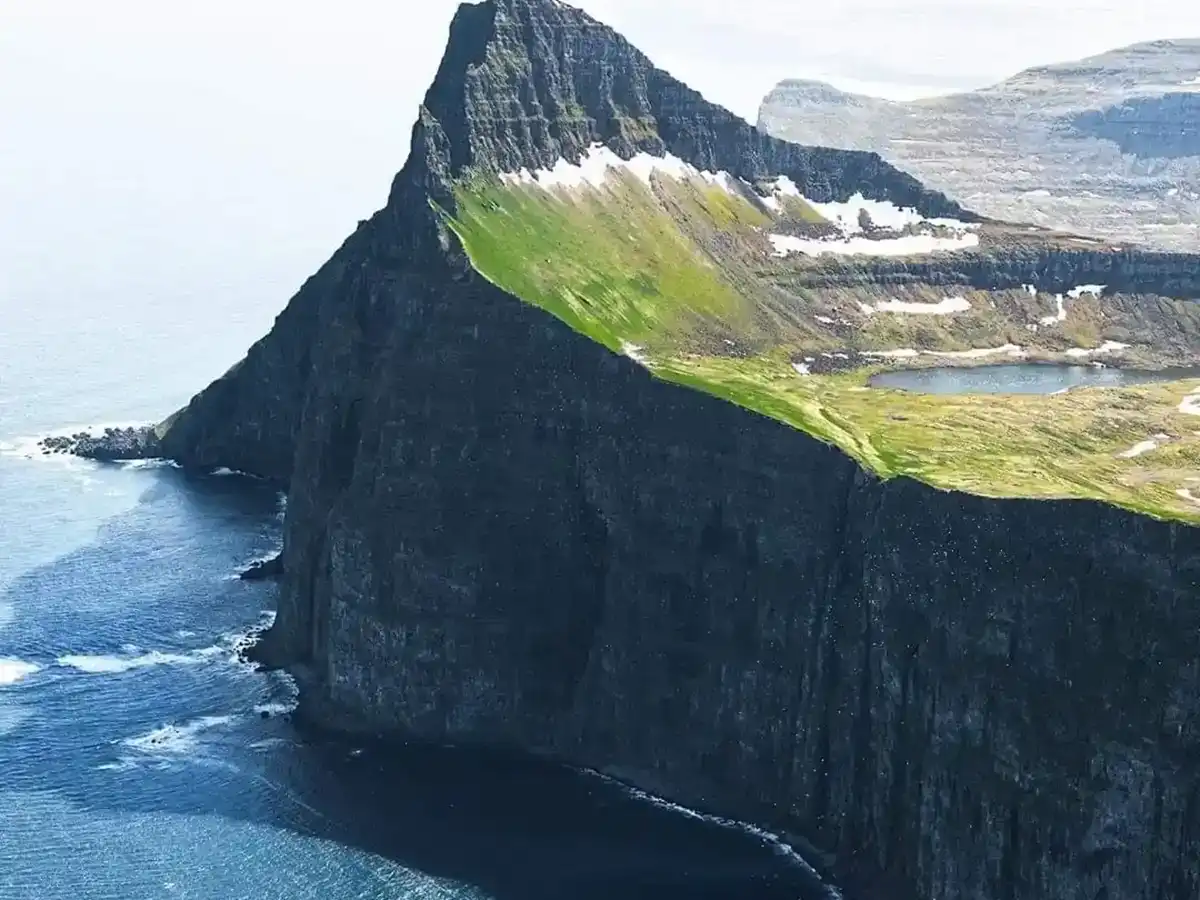
1 Hornstrandir

cliffside tundra, Arctic foxes, remote fjords

Hike through untouched wilderness where steep headlands, unpredictable weather, and wildlife encounters define every step far from roads or settlements.

iceland-region-hornstrandir
© Google | Mashallah

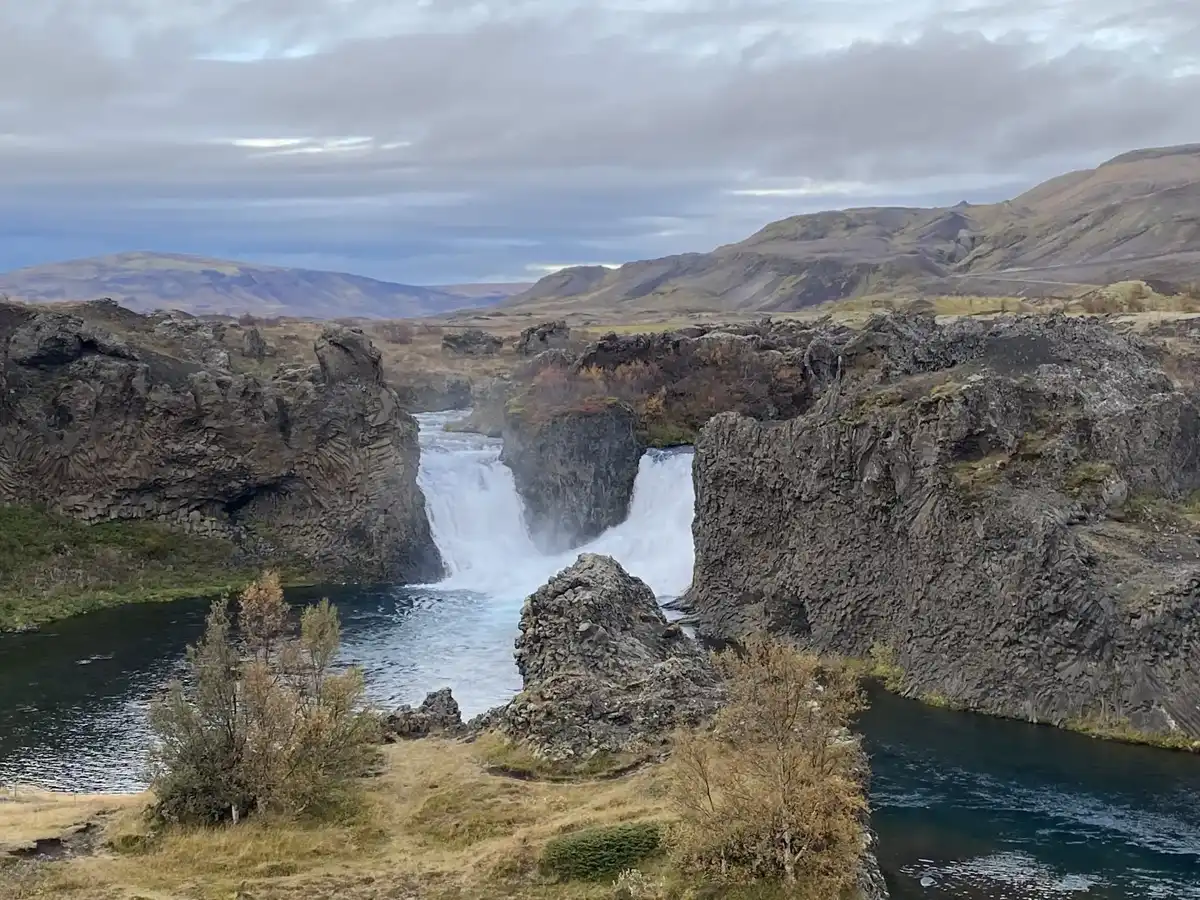
2 Þjórsárdalur

ash fields, reconstructed farmstead, basalt waterfalls

Trace the valley’s volcanic past among scattered ruins, lush oases, and striking rock formations shaped by centuries of eruptions and floods.

iceland-region-thjorsardalur
© Google | Vn
Loading the map 🌍

Expert viewInsights from Locals and Experts

How many regions: Choose three or four regions for a trip of 8 to 12 days. Iceland’s distances and weather eat time, and a rushed schedule means hours at the wheel with muddy boots and sore eyes rather than steam rising off a hot spring at dusk. Fewer regions also leave room for storm days, which happen in every season.
Prioritizing by travel style: First-timers and travelers on a short break do best with the accessible, well-served areas near Reykjavik and the south, where paved roads, hostels and campgrounds are frequent. Hikers and campers should lean toward the remote, rugged regions, where trails are quiet and the soundscape is wind, water and birds. Travelers who dislike driving can base in one area and use day tours. Mixing one popular region with one empty one balances comfort with … read more 👉
How many regions: Choose three or four regions for a trip of 8 to 12 days. Iceland’s distances and weather eat time, and a rushed schedule means hours at the wheel with muddy boots and sore eyes rather than steam rising off a hot spring at dusk. Fewer regions also leave room for storm days, which happen in every season.
Prioritizing by travel style: First-timers and travelers on a short break do best with the accessible, well-served areas near Reykjavik and the south, where paved roads, hostels and campgrounds are frequent. Hikers and campers should lean toward the remote, rugged regions, where trails are quiet and the soundscape is wind, water and birds. Travelers who dislike driving can base in one area and use day tours. Mixing one popular region with one empty one balances comfort with solitude.
What it costs: Iceland is among Europe’s priciest countries. Budget travelers can manage roughly US$100 to 160 a day using campsites (US$15 to 25 a person), supermarket food (Bónus and Krónan) and a shared rental car. Dorm beds run US$50 to 90 in summer. Mid-range travelers should plan US$220 to 350 a day. Fuel is a major cost: a week of Ring Road driving can cost US$150 to 300. Entry fees are modest or free at many natural sites, but parking charges of about US$5 to 10 are now common, and glacier hikes, ice caves and whale watching cost US$80 to 250 each. A typical visit of 10 days runs US$1,500 to 3,000 excluding flights, depending on how often you hire guides.
Safety and etiquette: The biggest dangers are weather and water. Sneaker waves on black sand beaches have killed visitors, so stay well back from the surf. Hot spring pools and geothermal areas can scald, and ground near steam vents is fragile and thin. Wind can bend car doors on cliffs and mountain passes. Check conditions at safetravel.is, file a travel plan for remote hikes, and carry waterproof layers, a headlamp and a charged phone. Never drive on closed roads or cross rivers without guidance.
Respecting the land: Off-road driving is illegal and heavily fined, and moss takes decades to recover from a single footprint. Wild camping in a tent is restricted in many places, so use designated campgrounds, and take every scrap of trash out with you. Shower naked with soap before entering public pools, a rule Icelanders take seriously. Stay behind fences on private farmland, and the long drives, sulfurous steam and cold clean air become the real reasons to make the journey.

✈️ The backpacker research shortcutIceland Travel Guide

An offline-friendly backpacking guide with optimized travel routes, ranked highlights, transport advice, and the best areas to stay.
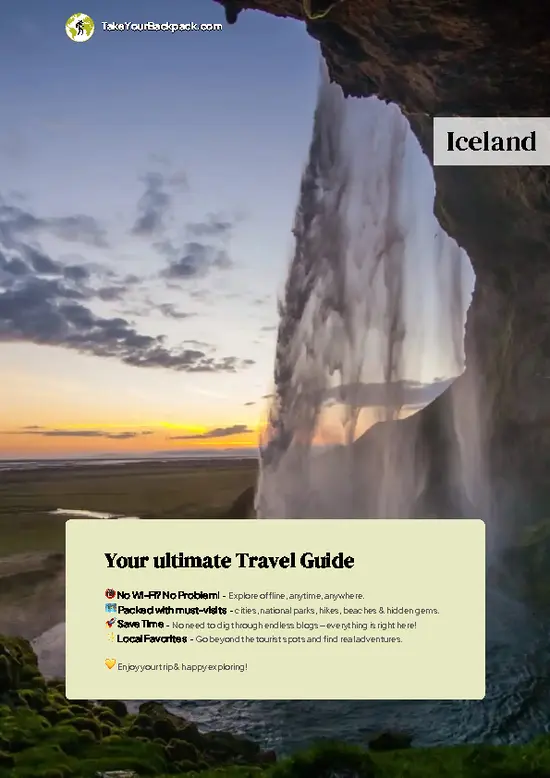
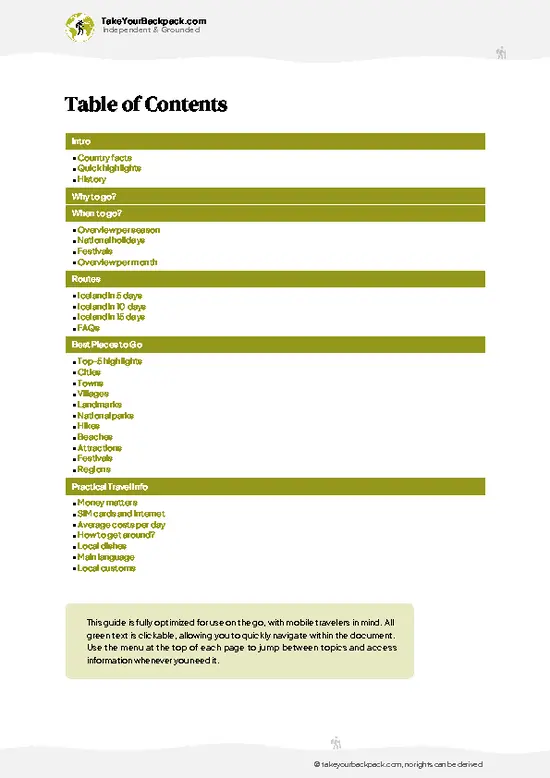
example page 0 from our offline Travel Guide for Iceland
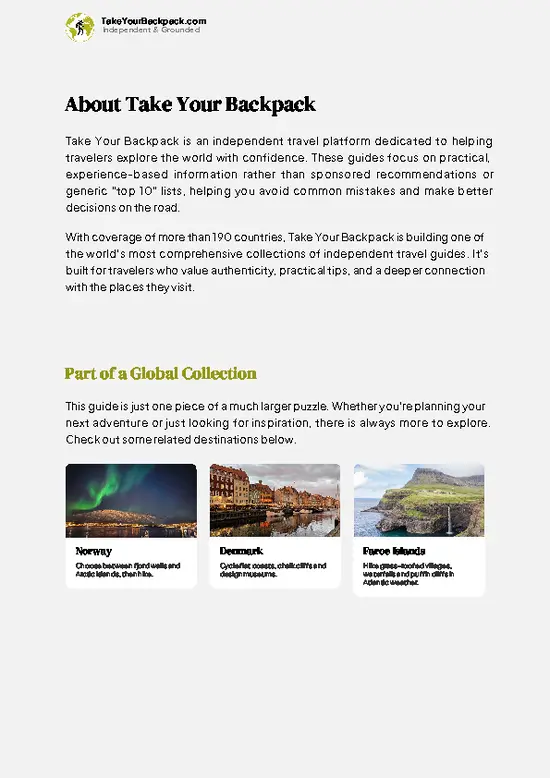
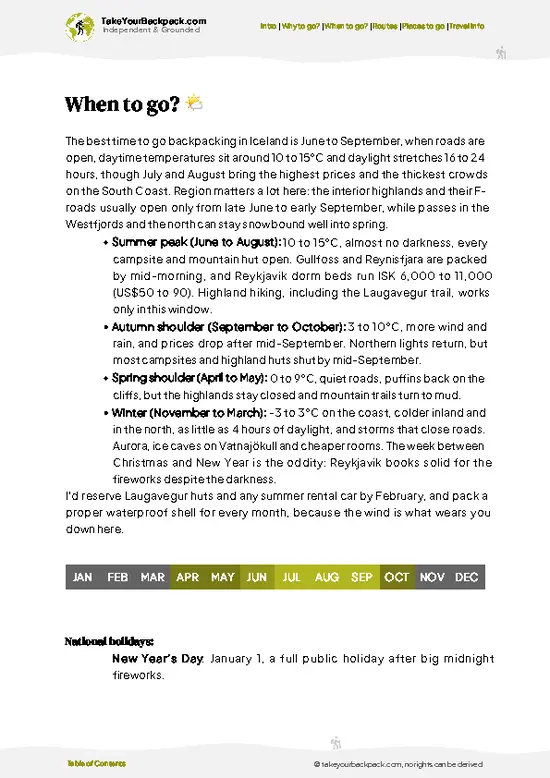
example page 1 from our offline Travel Guide for Iceland
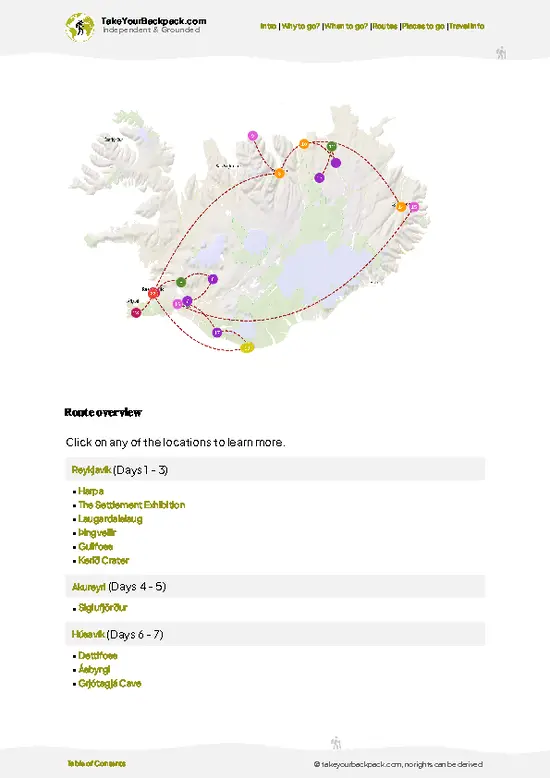
example page 2 from our offline Travel Guide for Iceland
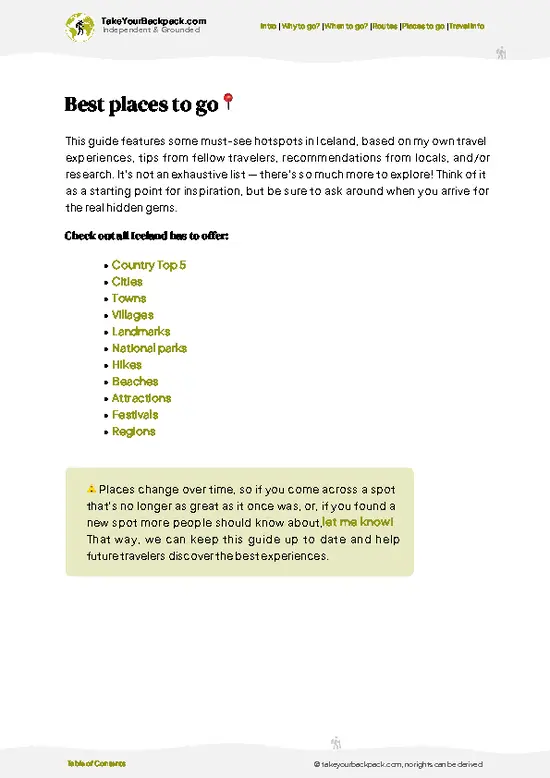
example page 3 from our offline Travel Guide for Iceland
example page 4 from our offline Travel Guide for Iceland
example page 5 from our offline Travel Guide for Iceland
example page 6 from our offline Travel Guide for Iceland
example page 7 from our offline Travel Guide for Iceland
The digital guide (230 pages) contains:
✅ 61 highlights, ranked by travel appeal
✅ Optimized 5, 10 & 15-day travel routes
✅ Cities, national parks, landmarks, beaches
✅ How to get around
✅ Offline-friendly for travel without Wi-Fi
👉 Click to see all 30+ guide features

📅 Plan smarter in minutes, not weeks
✅ Month by month travel advice
✅ Festivals & national holidays
✅ Budget expectations

🗺️ Go to the right places, skip the overrated ones
✅ Honest pros & cons of destinations
✅ Top hikes, parks & viewpoints
✅ Lesser-known places most travelers miss
✅ Clear “worth it vs skip it” guidance

🛏️ Travel smoothly without rookie mistakes
✅ Best areas to stay
✅ Transport systems explained simply
✅ Common scams & safety advice
✅ SIM cards, money & practical tips

🌍 Understand the country, not just visit it
✅ Culture & traditions
✅ 52 Essential phrases & customs
✅ Festivals worth planning around
✅ Traveler-friendly historical context
✅ Insights that make places more meaningful

📱 Built for real travel conditions
✅ Fully downloadable PDF
✅ Works completely offline
✅ Optimized for phone use
✅ Useful in remote areas & buses
✅ Everything in one place
Stop searching, start planning
Get instant access to your full guide. 30‑day money-back guarantee.
+ Add another guide for just

By proceeding you agree to our terms.
Sent to your inbox immediately after payment • 100% Secure Checkout
Best Backpacking Travel Advisor 2025 tourism awardBest Backpacking
Travel Advisor
2025
What others say about Take Your Backpack Guides:
⭐⭐⭐⭐⭐
Fantastic, amazing amount of information!
⭐⭐⭐⭐⭐
My goodness this is amazing, it's what I've been looking for hats off too you!
⭐⭐⭐⭐⭐
I think this is absolutely BRILLIANT
⭐⭐⭐⭐
Very complete and informative. It's still missing places, but I gotta to commend you
⭐⭐⭐⭐⭐
This is truly amazing, thank you, can't wait to explore it with my kids!
⭐⭐⭐⭐⭐
Awesome resource, thank you!
⭐⭐⭐⭐⭐
This is amazing! Can't wait to explore the ones I haven't seen
⭐⭐⭐⭐
I love this! Well done, great idea.
⭐⭐⭐⭐⭐
Thanks for taking the time to make this gem!
⭐⭐⭐⭐⭐
This might be the best website I've ever seen.
⭐⭐⭐⭐⭐
Congratulations, and thank you so much for your work; it's incredibly valuable.
⭐⭐⭐⭐
In all seriousness I think you did a great job pointing out the important spots
⭐⭐⭐⭐⭐
10/10 very good
⭐⭐⭐⭐⭐
As someone who's only just starting to visit regularly this is awesome, thank you.
⭐⭐⭐⭐
Thank you very much! I'm going to visit my dad, it's going to be very useful!
⭐⭐⭐⭐⭐
This is really cool! We'll be travelling for the first time and this definitely come in handy.
⭐⭐⭐⭐⭐
You are now our minister of culture, congratulations 👨‍💼
⭐⭐⭐⭐⭐
Just wanted to tell you that this is a pearl! Going to follow your recommendations.
⭐⭐⭐⭐⭐
This is so cool. I'll definitely be using the resource for my travels soon.
⭐⭐⭐⭐⭐
This is very impressive! Good work.
⭐⭐⭐⭐⭐
This is an amazing and informative site. Very well done!

🛏️ Where to stay?Best Places to Stay in Iceland

Iceland has plenty of hostels and guesthouses, with dorm beds typically running ISK 6,000 to 11,000 (about US$45 to 80) a night in summer, and most of them are in Reykjavík. Miðborg (the 101 downtown area around Laugavegur) puts you within walking distance of Hallgrímskirkja, the harbor and the bus terminals, but weekend bar noise lasts until 4 or 5 a.m. Quieter Vesturbær and Laugardalur, home to the city campsite and the biggest public pool, are 15 to 30 minutes on foot from the center and very safe, while up north Akureyri has a small cluster of budget beds near its compact downtown.

If you enjoy meeting fellow travelers, consider choosing hostels with high ratings for atmosphere. On the other … read more 👉
Iceland has plenty of hostels and guesthouses, with dorm beds typically running ISK 6,000 to 11,000 (about US$45 to 80) a night in summer, and most of them are in Reykjavík. Miðborg (the 101 downtown area around Laugavegur) puts you within walking distance of Hallgrímskirkja, the harbor and the bus terminals, but weekend bar noise lasts until 4 or 5 a.m. Quieter Vesturbær and Laugardalur, home to the city campsite and the biggest public pool, are 15 to 30 minutes on foot from the center and very safe, while up north Akureyri has a small cluster of budget beds near its compact downtown.

If you enjoy meeting fellow travelers, consider choosing hostels with high ratings for atmosphere. On the other hand, if you prefer having your own space, a hotel might be a better option.

IcelandExplore Iceland

👋 Meet the founderWho’s Behind Take Your Backpack?

Johan, backpacker and founder of TakeYourBackpackHi, I’m Johan (Netherlands 🇳🇱), the creator of TakeYourBackpack. Over the past 3 decades, I’ve backpacked through 90+ countries across six continents, gaining extensive experience with independent travel, long-term trips, and overland routes.

This site is built on a combination of firsthand travel experience and carefully curated insights from other backpackers. Many guides are based on places I’ve personally visited, while others bring together tips, observations, and practical advice shared by trusted travelers I’ve met along the way.

The goal is to provide realistic, experience-driven guidance — not generic itineraries — so you can explore destinations with better context, clearer expectations, and more confidence.