×

Iran🇮🇷 | best beachesExplore the 4 Best beaches in Iran

Beaches in Iran are built around domestic holidays, not sunbeds and beach bars. Two coasts split the experience. The Caspian shore in the north is green, humid and packed with Iranian families in summer. It has cheap guesthouses, roadside villas and easy roads from Tehran, but it is crowded, and the water is murky and brownish rather than clear. The Persian Gulf and Gulf of Oman in the south are hot, dry and far emptier, with islands, ferries, clearer water and a longer trip to reach them. Everywhere, dress codes shape the day: women swim clothed or use walled women-only sections, so Iran is a poor choice for a bikini-and-cocktails holiday. Backpackers get the most from short beach stops built into a wider journey. Pick the Caspian for convenience and the south for space.

By Johan Kruseman 🇳🇱 | Updated October 18, 2026
Explore the best attractions in Iran

Why go?Why These beach Stand Out

Iran is a strange country for beaches, and the reasons are structural. The Caspian is an enclosed, almost tideless sea, and the Alborz mountains trap its moisture, which is why the northern shore is forested and rainy instead of arid. It is the country’s main summer escape, so the infrastructure is built for Iranians: villa rentals, roadside restaurants, huge weekend traffic. The south is the opposite. Iran has well over 1,500 km of Persian Gulf and Gulf of Oman coastline, yet most of it is desert, fishing villages and port cities with little tourism development, and summer heat above 40°C makes it unusable for half the year.

The biggest factor is Islamic dress law. Public beaches enforce modesty rules for both sexes, and women cannot wear swimsuits in public view. Walled women-only beaches … read more 👉
Iran is a strange country for beaches, and the reasons are structural. The Caspian is an enclosed, almost tideless sea, and the Alborz mountains trap its moisture, which is why the northern shore is forested and rainy instead of arid. It is the country’s main summer escape, so the infrastructure is built for Iranians: villa rentals, roadside restaurants, huge weekend traffic. The south is the opposite. Iran has well over 1,500 km of Persian Gulf and Gulf of Oman coastline, yet most of it is desert, fishing villages and port cities with little tourism development, and summer heat above 40°C makes it unusable for half the year.

The biggest factor is Islamic dress law. Public beaches enforce modesty rules for both sexes, and women cannot wear swimsuits in public view. Walled women-only beaches exist in the main resort areas, and outside them women swim in loose clothing. Alcohol is banned, there are no beach clubs, and there is no party scene. If your idea of a beach trip is lounging in a swimsuit with a drink, Iran is not worth choosing for it.

Before committing, know the practical limits. International bank cards do not work because of sanctions, so you carry all your cash in euros or US dollars and exchange it locally. Water sports, diving and snorkeling operators are few and mostly confined to Kish. English is limited outside resort islands. What Iran does offer is cheap travel, empty southern coastlines, and a close view of how Iranians actually holiday. Treat the beaches as one strand of a wider trip, not the reason for it.
Evaluating the Top Choices
The list of best beaches in Iran is created based on beauty, vibe, water quality, activities, and surrounding scenery. If you feel a beach is missing in this list, please let us know.

When to go?When to Plan Your Trip

Best months for beaches in Iran: The best months are April to May and late September to October, when both coasts are usable at once, with Caspian days around 20 to 28°C and Persian Gulf days around 30 to 36°C. Outside those windows you must choose a coast by season.

Caspian coast: June to September: The north is a summer destination. July and August bring highs of 28 to 33°C, humidity often above 70 percent, and sea temperatures of 24 to 27°C. They also bring the crowds, since Iranian families fill every guesthouse, and Thursday and Friday traffic on the mountain roads from Tehran can add several hours. Autumn is the wet season, with heavy rain in Gilan and Mazandaran (annual totals reach 1,200 to 1,800 mm in the west), and winter is cold, gray and closed for swimming. Skip the Caspian between … read more 👉
Best months for beaches in Iran: The best months are April to May and late September to October, when both coasts are usable at once, with Caspian days around 20 to 28°C and Persian Gulf days around 30 to 36°C. Outside those windows you must choose a coast by season.

Caspian coast: June to September: The north is a summer destination. July and August bring highs of 28 to 33°C, humidity often above 70 percent, and sea temperatures of 24 to 27°C. They also bring the crowds, since Iranian families fill every guesthouse, and Thursday and Friday traffic on the mountain roads from Tehran can add several hours. Autumn is the wet season, with heavy rain in Gilan and Mazandaran (annual totals reach 1,200 to 1,800 mm in the west), and winter is cold, gray and closed for swimming. Skip the Caspian between November and March.

Persian Gulf and Gulf of Oman: November to April: The south is the reverse. From June to September, highs sit at 40 to 48°C with brutal humidity on the Gulf, which makes beach days miserable and midday outdoor time risky. From November to March, days are around 22 to 28°C, the sea is 20 to 25°C and rain is rare. Water is coolest in January and February, so April and October are better for swimming comfort.

Peak periods and prices: Nowruz, the Persian New Year around March 20 to April 2, is the busiest period of the year, and the Gulf islands fill with domestic tourists. Accommodation can cost 30 to 100 percent more than usual, and transport must be booked days ahead. July and August do the same on the Caspian, with weekend rates well above weekday rates. Visit midweek and outside those periods, and rooms are easy to find and negotiable.

beach hoppingHow to Combine beaches Into One Trip

How many days to plan: A trip combining several beaches in Iran needs 10 to 14 days, and only if you accept that beaches will fill a minority of the trip. The country is too large and the coasts too far apart to squeeze in more.

Which regions group well: The Caspian and the Persian Gulf do not sit near each other: they are roughly 1,200 to 1,500 km apart. Treat them as two separate clusters linked by a flight. In the north, base yourself in Tehran, Rasht or Sari and move along the coast. Tehran to the central Caspian by road takes 3 to 5 hours, and Rasht is around 4 to 5 hours. In the south, fly Tehran to Bandar Abbas (about 1 hour 45 minutes), where ferries serve Qeshm (30 to 45 minutes) and Hormuz (15 to 25 minutes), while Kish has its own airport. Chabahar on the Gulf of Oman is a separate … read more 👉
How many days to plan: A trip combining several beaches in Iran needs 10 to 14 days, and only if you accept that beaches will fill a minority of the trip. The country is too large and the coasts too far apart to squeeze in more.

Which regions group well: The Caspian and the Persian Gulf do not sit near each other: they are roughly 1,200 to 1,500 km apart. Treat them as two separate clusters linked by a flight. In the north, base yourself in Tehran, Rasht or Sari and move along the coast. Tehran to the central Caspian by road takes 3 to 5 hours, and Rasht is around 4 to 5 hours. In the south, fly Tehran to Bandar Abbas (about 1 hour 45 minutes), where ferries serve Qeshm (30 to 45 minutes) and Hormuz (15 to 25 minutes), while Kish has its own airport. Chabahar on the Gulf of Oman is a separate flight from Tehran of around 2 hours.

Direction and time per stop: Go north first and south last in April, May, October or early November, then fly out of Bandar Abbas or Kish. Allow 2 to 4 days on the Caspian and 2 to 3 days per Gulf island. Chabahar needs 2 to 3 days on its own.

Planning mistakes: The classic error is building a Caspian and Gulf trip in July, when the north is packed and the south is unbearable. Pick one coast for those months. Another is driving from Bandar Abbas to Chabahar: it is about 600 km and 8 to 10 hours, so fly or take an overnight bus, and do not add it as a casual stop. Many travelers also try to see three islands in four days and spend the time in ferry queues. Choose one or two. Finally, never plan a Caspian return to Tehran on a Friday evening, because traffic can run 6 hours or more. Leave Friday morning or stay through Saturday.

The ListMust-Visit beaches in Iran

1 Kish Island Beach

coral sands, clear water, cycling paths

Swim in calm, translucent water or cycle along the shoreline, where coral fragments crunch underfoot and sunsets linger.

2 Hormuz Island Beach

red sands, salt caves, mineral-streaked hills

Walk across vividly colored shores and explore surreal rock formations shaped by minerals and centuries of wind erosion.

iran-beach-hormuz-island-beach
© Google |

3 Chabahar Beach

rocky cliffs, tidal pools, Makran coast

Trace the coastline past layered cliffs and shallow pools, where the landscape shifts with the tides and monsoon winds.

iran-beach-chabahar-beach
© Google |

4 Bandar Abbas Beach

industrial port, palm-lined promenade, local markets

Experience the intersection of commerce and daily life where cargo ships dock, street vendors gather, and city rhythms meet the sea.

Loading the map 🌍

Expert viewExpert Commentary on beaches

How many beaches to visit: Visit two or three beach stops in total, and cap it at two regions. Iranian beach days are slow and similar, with the same dress rules and the same family-holiday feel. A fourth stop adds ferry queues and a long drive, not variety. The country’s mosques, bazaars, gardens and deserts are far stronger than its coastline, so spend your days there.

Which kind suits you: Choose the Caspian if you want an easy, cheap break from the interior, good for a night or two with a Tehran base and plenty of guesthouses. Choose the Gulf islands if you want space, clearer water, boat trips and landscapes, and accept the cost of a flight. Choose the Makran coast near Chabahar only if you are comfortable with remote travel, longer transfers and a stronger need to check government travel … read more 👉
How many beaches to visit: Visit two or three beach stops in total, and cap it at two regions. Iranian beach days are slow and similar, with the same dress rules and the same family-holiday feel. A fourth stop adds ferry queues and a long drive, not variety. The country’s mosques, bazaars, gardens and deserts are far stronger than its coastline, so spend your days there.

Which kind suits you: Choose the Caspian if you want an easy, cheap break from the interior, good for a night or two with a Tehran base and plenty of guesthouses. Choose the Gulf islands if you want space, clearer water, boat trips and landscapes, and accept the cost of a flight. Choose the Makran coast near Chabahar only if you are comfortable with remote travel, longer transfers and a stronger need to check government travel advisories first. Women traveling alone or in pairs usually have the easiest time on a walled women-only beach, or in a resort setting on Kish.

What it costs: A backpacker budget runs around US$25 to 45 a day with guesthouse beds, local food and shared taxis, rising to US$60 to 90 in resort areas or at Nowruz. Beds in simple guesthouses cost US$10 to 25. Meals cost US$3 to 8. Public beach entry is cheap or free, but private or women-only beaches usually charge around US$1 to 5. Island ferries cost about US$1 to 3 each way, and chartered boats or a hired driver and guide for a day cost US$30 to 70. Domestic flights cost roughly US$30 to 90 and sell out at Nowruz.

Iranian prices are quoted in rials or tomans (ten rials to one toman), and that confuses many visitors. Ask for the price in writing or on a phone calculator. Bring all your money in cash, euros or US dollars, because foreign cards are blocked, and change small amounts at licensed exchanges to avoid carrying large piles of rials.

Costs that catch travelers out: Booking late over Nowruz or in August leaves you with scarce rooms at inflated rates, so reserve two to three weeks ahead. Taking a taxi without agreeing the fare first nearly always raises the price, so settle it before you get in. Checking out of an island without a ferry timetable can strand you overnight, because the last boats often leave by late afternoon. Cash runs out faster than you expect when no ATM works.

Safety and culture on the sand: Women must wear a headscarf and loose clothing in public areas, and swimming happens in clothes that cover arms, legs and torso, or behind walls in segregated sections. Men should wear long shorts, and going shirtless away from the water is frowned on. Do not take photos of women who do not know you are doing it, and do not fly a drone without a permit. Alcohol is illegal, so do not bring any. Most public beaches have few or no lifeguards, and the Caspian has strong currents and sudden drop-offs, so swim only in marked zones, never alone and never after dark. On the Gulf, heat and sun cause the most trouble, so drink water, wear a hat and swim early or late.

Check your government’s travel advice before you book, especially for Sistan and Baluchestan, and note that some nationalities must travel with a registered guide. Buy insurance that covers Iran, since many standard policies and cards exclude it.

✈️ The backpacker research shortcutIran Travel Guide

An offline-friendly backpacking guide with optimized travel routes, ranked highlights, transport advice, and the best areas to stay.
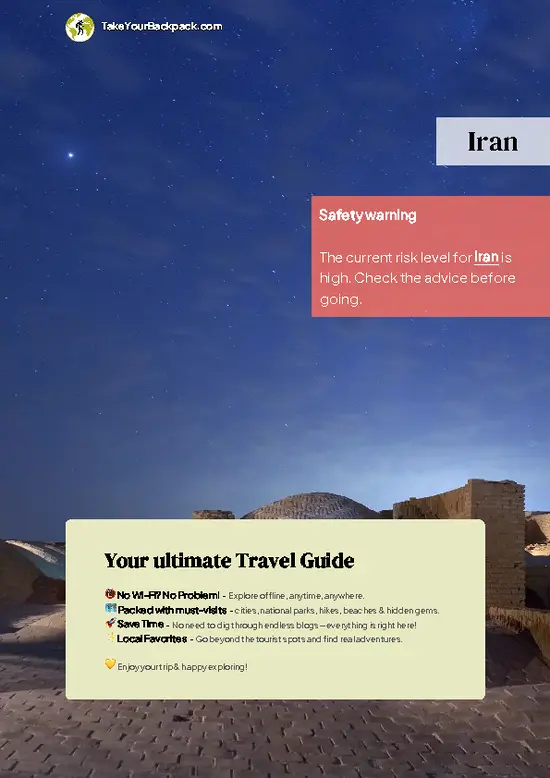
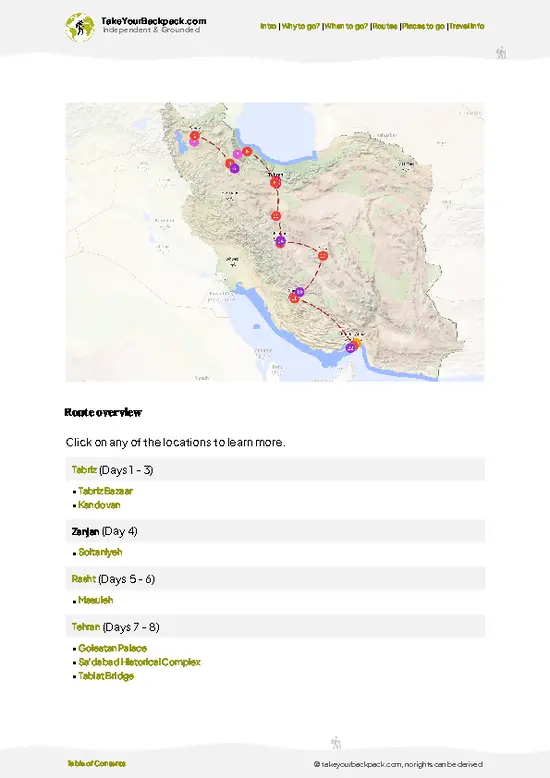
example page 0 from our offline Travel Guide for Iran
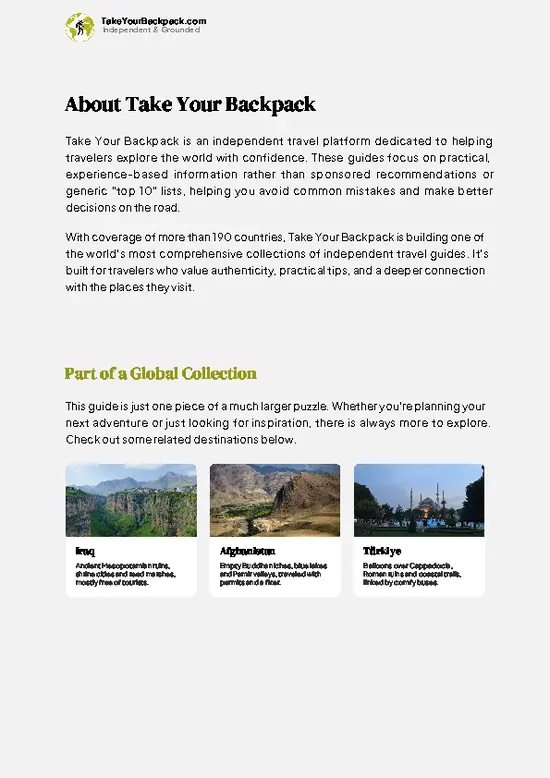
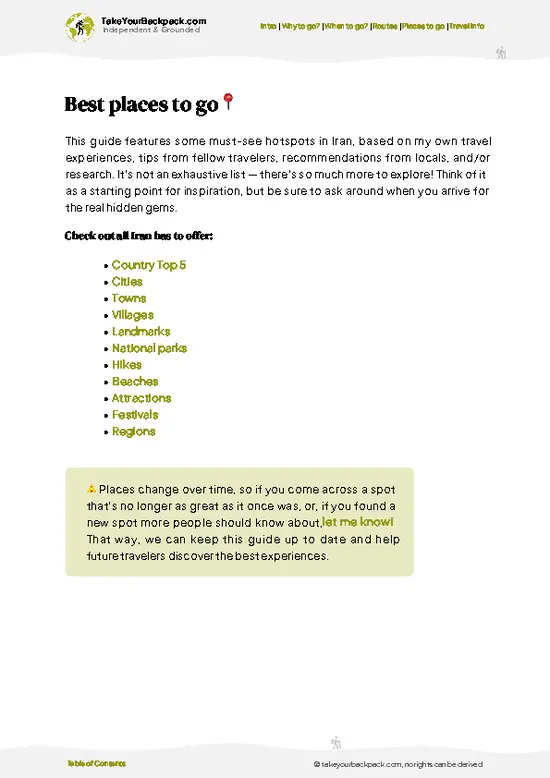
example page 1 from our offline Travel Guide for Iran
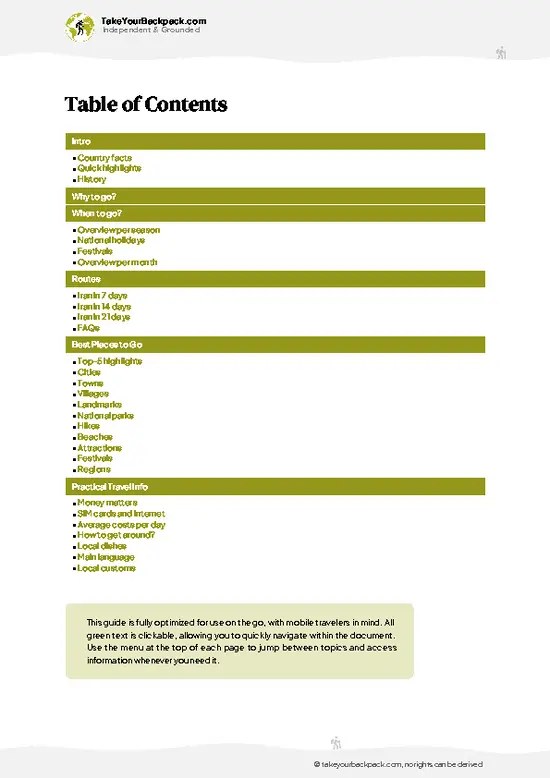
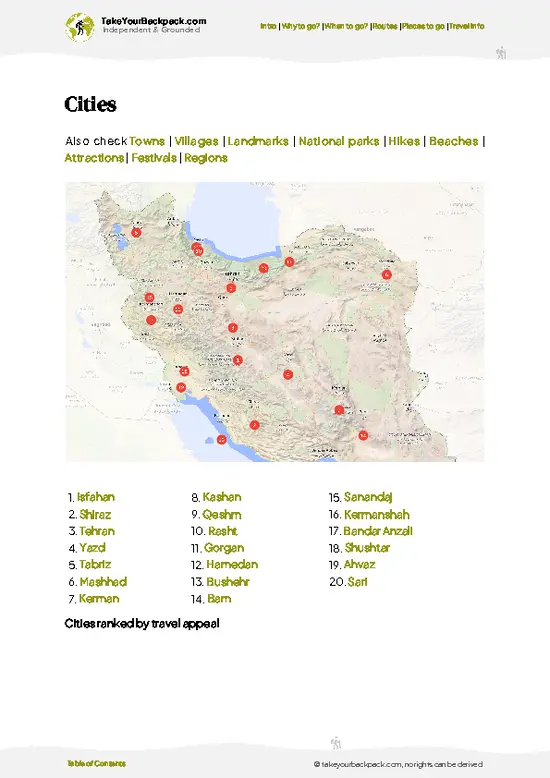
example page 2 from our offline Travel Guide for Iran
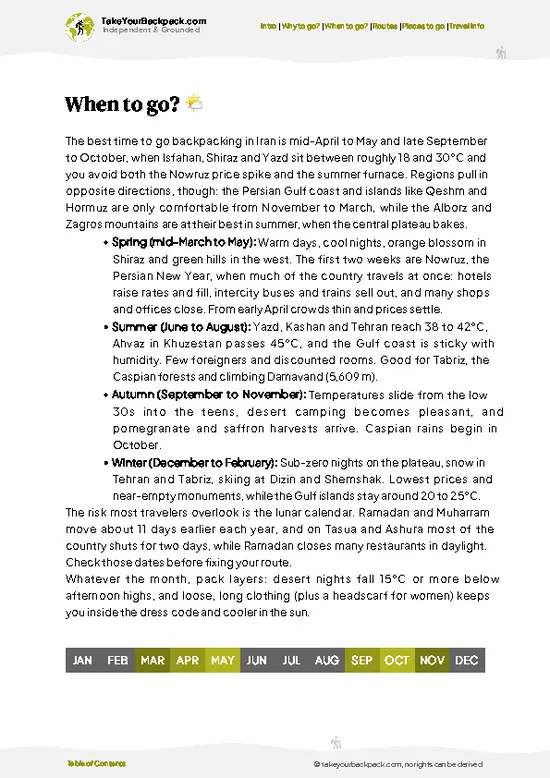
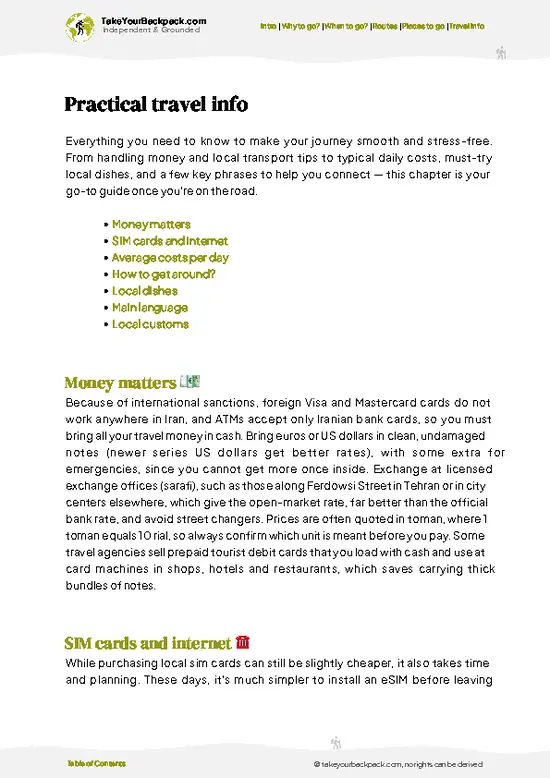
example page 3 from our offline Travel Guide for Iran
example page 4 from our offline Travel Guide for Iran
example page 5 from our offline Travel Guide for Iran
example page 6 from our offline Travel Guide for Iran
example page 7 from our offline Travel Guide for Iran
The digital guide (407 pages) contains:
✅ 115 highlights, ranked by travel appeal
✅ Optimized 7, 14 & 21-day travel routes
✅ Cities, national parks, landmarks, beaches
✅ How to get around
✅ Offline-friendly for travel without Wi-Fi
👉 Click to see all 30+ guide features

📅 Plan smarter in minutes, not weeks
✅ Month by month travel advice
✅ Festivals & national holidays
✅ Budget expectations

🗺️ Go to the right places, skip the overrated ones
✅ Honest pros & cons of destinations
✅ Top hikes, parks & viewpoints
✅ Lesser-known places most travelers miss
✅ Clear “worth it vs skip it” guidance

🛏️ Travel smoothly without rookie mistakes
✅ Best areas to stay
✅ Transport systems explained simply
✅ Common scams & safety advice
✅ SIM cards, money & practical tips

🌍 Understand the country, not just visit it
✅ Culture & traditions
✅ 52 Essential phrases & customs
✅ Festivals worth planning around
✅ Traveler-friendly historical context
✅ Insights that make places more meaningful

📱 Built for real travel conditions
✅ Fully downloadable PDF
✅ Works completely offline
✅ Optimized for phone use
✅ Useful in remote areas & buses
✅ Everything in one place
Stop searching, start planning
Get instant access to your full guide. 30‑day money-back guarantee.
+ Add another guide for just

By proceeding you agree to our terms.
Sent to your inbox immediately after payment • 100% Secure Checkout
Best Backpacking Travel Advisor 2025 tourism awardBest Backpacking
Travel Advisor
2025
What others say about Take Your Backpack Guides:
⭐⭐⭐⭐⭐
Fantastic, amazing amount of information!
⭐⭐⭐⭐⭐
My goodness this is amazing, it's what I've been looking for hats off too you!
⭐⭐⭐⭐⭐
I think this is absolutely BRILLIANT
⭐⭐⭐⭐
Very complete and informative. It's still missing places, but I gotta to commend you
⭐⭐⭐⭐⭐
This is truly amazing, thank you, can't wait to explore it with my kids!
⭐⭐⭐⭐⭐
Awesome resource, thank you!
⭐⭐⭐⭐⭐
This is amazing! Can't wait to explore the ones I haven't seen
⭐⭐⭐⭐
I love this! Well done, great idea.
⭐⭐⭐⭐⭐
Thanks for taking the time to make this gem!
⭐⭐⭐⭐⭐
This might be the best website I've ever seen.
⭐⭐⭐⭐⭐
Congratulations, and thank you so much for your work; it's incredibly valuable.
⭐⭐⭐⭐
In all seriousness I think you did a great job pointing out the important spots
⭐⭐⭐⭐⭐
10/10 very good
⭐⭐⭐⭐⭐
As someone who's only just starting to visit regularly this is awesome, thank you.
⭐⭐⭐⭐
Thank you very much! I'm going to visit my dad, it's going to be very useful!
⭐⭐⭐⭐⭐
This is really cool! We'll be travelling for the first time and this definitely come in handy.
⭐⭐⭐⭐⭐
You are now our minister of culture, congratulations 👨‍💼
⭐⭐⭐⭐⭐
Just wanted to tell you that this is a pearl! Going to follow your recommendations.
⭐⭐⭐⭐⭐
This is so cool. I'll definitely be using the resource for my travels soon.
⭐⭐⭐⭐⭐
This is very impressive! Good work.
⭐⭐⭐⭐⭐
This is an amazing and informative site. Very well done!

🛏️ Where to stay?Where to Stay in Iran

Iran has a small but well-run hostel scene, plus traditional courtyard guesthouses where a dorm bed usually costs US$6 to 12, although Western governments now advise against all travel, so routine backpacking is effectively on hold. In Tehran, downtown around Ferdowsi and Imam Khomeini Square puts you within walking distance of the bazaar and Golestan Palace and on the metro, but it’s loud and empty after dark, while leafier north Tehran is quieter and full of cafés (the closest thing to nightlife here) but far from the old sights. In Isfahan, beds near Naqsh-e Jahan Square keep everything walkable; in Yazd, the mud-brick old town (Fahadan) offers the most atmospheric courtyard stays, and Shiraz … read more 👉
Iran has a small but well-run hostel scene, plus traditional courtyard guesthouses where a dorm bed usually costs US$6 to 12, although Western governments now advise against all travel, so routine backpacking is effectively on hold. In Tehran, downtown around Ferdowsi and Imam Khomeini Square puts you within walking distance of the bazaar and Golestan Palace and on the metro, but it’s loud and empty after dark, while leafier north Tehran is quieter and full of cafés (the closest thing to nightlife here) but far from the old sights. In Isfahan, beds near Naqsh-e Jahan Square keep everything walkable; in Yazd, the mud-brick old town (Fahadan) offers the most atmospheric courtyard stays, and Shiraz clusters its budget options near Zand Boulevard, all of them very safe, with evenings that wind down early.

If you enjoy meeting fellow travelers, consider choosing hostels with high ratings for atmosphere. On the other hand, if you prefer having your own space, a hotel might be a better option.

IranMore of Iran

👋 Meet the founderWho’s Behind Take Your Backpack?

Johan, backpacker and founder of TakeYourBackpackHi, I’m Johan (Netherlands 🇳🇱), the creator of TakeYourBackpack. Over the past 3 decades, I’ve backpacked through 90+ countries across six continents, gaining extensive experience with independent travel, long-term trips, and overland routes.

This site is built on a combination of firsthand travel experience and carefully curated insights from other backpackers. Many guides are based on places I’ve personally visited, while others bring together tips, observations, and practical advice shared by trusted travelers I’ve met along the way.

The goal is to provide realistic, experience-driven guidance — not generic itineraries — so you can explore destinations with better context, clearer expectations, and more confidence.