×

Iraq🇮🇶 | best beachesEssential beaches to Explore in Iraq

Iraq has no resort coast. Its Persian Gulf shoreline is only about 58 km long, sits around port and oil infrastructure near Basra and Faw, and is not a place to lay out a towel. Swimming happens elsewhere: lakes and reservoirs in Kurdistan are the best bet for independent travelers, with cool water, cafes and day-use resorts for roughly US$4 to 15. Habbaniyah and the Tigris and Shatt al-Arab banks are local weekend spots, easy to reach but crowded on Fridays. Skip any plan built around Gulf sand and surf.

By Johan Kruseman 🇳🇱 | Updated October 19, 2026
Explore the best attractions in Iraq

Why go?Understanding Their Importance

Iraq suits water-edge days far better than classic beach holidays. The country is a river basin, not a seaside nation. The Tigris, the Euphrates and the reservoirs built on them shape how Iraqis relax, so a picnic at a lake or riverbank is the local equivalent of a beach day. The actual Gulf coast is short, shallow, muddy at the edges and dominated by shipping channels, ports and military zones, which means little public access and almost no tourist facilities.

Climate pushes hard in one direction. Southern summers reach 45 to 50°C with heavy humidity, so beaches there are miserable when swimming is most tempting. The north is cooler and greener, which is why Kurdistan carries most of the appeal.

Culture matters before you pack. Public swimming is modest: most Iraqi women swim in long clothing, … read more 👉
Iraq suits water-edge days far better than classic beach holidays. The country is a river basin, not a seaside nation. The Tigris, the Euphrates and the reservoirs built on them shape how Iraqis relax, so a picnic at a lake or riverbank is the local equivalent of a beach day. The actual Gulf coast is short, shallow, muddy at the edges and dominated by shipping channels, ports and military zones, which means little public access and almost no tourist facilities.

Climate pushes hard in one direction. Southern summers reach 45 to 50°C with heavy humidity, so beaches there are miserable when swimming is most tempting. The north is cooler and greener, which is why Kurdistan carries most of the appeal.

Culture matters before you pack. Public swimming is modest: most Iraqi women swim in long clothing, men keep shirts and shorts on, and bikinis and bare chests draw stares or complaints. Lifeguards are rare, and drowning in reservoirs is a real local risk. Facilities are basic outside Kurdistan, and foreign beach tourism barely exists, so expect to be the only visitor. Choose Iraq for local atmosphere, not for sand, snorkeling or nightlife.
Why These Made the Cut
The list of best beaches in Iraq is created based on beauty, vibe, water quality, activities, and surrounding scenery. If you feel a beach is missing in this list, please let us know.

When to go?Best Time to Visit Iraq for beaches

Best months: The best months for swimming are June to September in Kurdistan, when lake water is warm enough to enjoy and daytime air runs about 33 to 40°C, hot but tolerable beside water. Rain is almost absent in these months, while Kurdistan gets roughly 400 to 700 mm a year, mostly November to April.
Shoulder seasons: May and October work for lakes if you only want to paddle and sit by the shore. Water is cool and cafes may run reduced hours. In the south around Basra and Faw, the useful window is November to March, when highs are about 18 to 25°C. The Gulf water is too cold then for proper swimming, so treat that season as a time for shoreline walks, not beach days. Basra gets only around 100 to 150 mm of rain a year, mostly in winter.
Seasons to skip: Skip the south from June to August. … read more 👉
Best months: The best months for swimming are June to September in Kurdistan, when lake water is warm enough to enjoy and daytime air runs about 33 to 40°C, hot but tolerable beside water. Rain is almost absent in these months, while Kurdistan gets roughly 400 to 700 mm a year, mostly November to April.
Shoulder seasons: May and October work for lakes if you only want to paddle and sit by the shore. Water is cool and cafes may run reduced hours. In the south around Basra and Faw, the useful window is November to March, when highs are about 18 to 25°C. The Gulf water is too cold then for proper swimming, so treat that season as a time for shoreline walks, not beach days. Basra gets only around 100 to 150 mm of rain a year, mostly in winter.
Seasons to skip: Skip the south from June to August. Highs of 45 to 50°C, humidity and frequent power cuts make time outdoors not worth the effort. Central Iraq, including the Habbaniyah area, is similarly harsh at midsummer.
Crowds and prices: Fridays and public holidays fill Kurdistan lake areas, and Eid periods are the busiest. Resort prices and room rates rise at these times, often by 20 to 50 percent. Visit midweek in July and August for quieter shores and easier bargaining.

beach hoppingSuggested Travel Strategies

How long to allow: A trip combining several water-edge stops in Iraq needs 6 to 9 days. Anything shorter turns into transit, and the country’s checkpoints and distances eat time.
Which regions group well: Kurdistan clusters tightly. Erbil and Sulaymaniyah are the hubs, and the reservoir areas lie roughly 1 to 2 hours from Sulaymaniyah by shared taxi or hired car, with Erbil to Sulaymaniyah taking 2.5 to 3 hours. Allow 1 to 2 nights per stop. The south does not cluster with the north. Basra is a separate trip, reached by a 1.5 to 2 hour flight from Erbil or Baghdad, or a 6 to 8 hour road journey from Baghdad. Give the south 2 to 3 days, since access to the actual coast depends on local permissions and escorts.
Direction of travel: Start in Kurdistan, where independent travel is easiest, then … read more 👉
How long to allow: A trip combining several water-edge stops in Iraq needs 6 to 9 days. Anything shorter turns into transit, and the country’s checkpoints and distances eat time.
Which regions group well: Kurdistan clusters tightly. Erbil and Sulaymaniyah are the hubs, and the reservoir areas lie roughly 1 to 2 hours from Sulaymaniyah by shared taxi or hired car, with Erbil to Sulaymaniyah taking 2.5 to 3 hours. Allow 1 to 2 nights per stop. The south does not cluster with the north. Basra is a separate trip, reached by a 1.5 to 2 hour flight from Erbil or Baghdad, or a 6 to 8 hour road journey from Baghdad. Give the south 2 to 3 days, since access to the actual coast depends on local permissions and escorts.
Direction of travel: Start in Kurdistan, where independent travel is easiest, then fly south and finish in Basra. Doing it in reverse means arriving in the north after heat fatigue, with little saved for the cooler water.
Mistakes to avoid: The most common error is treating Iraq like a road trip. Driving Erbil to Basra in one go is not worth the day lost. Fly instead. Another is packing in three lake stops in a single day. Roads are slow, checkpoints add 15 to 45 minutes, and public transport thins out by late afternoon. Pick one stop per day, book return transport before you go, and leave by 3 pm.

The ListTop beaches of Iraq

1 Al-Faw Beach

Shatt al-Arab delta, tidal flats, fishing boats

Watch fishermen haul nets at dawn and wander muddy banks where the river meets the Gulf, with distant tankers on the horizon.

iraq-beach-al-faw-beach
© Google |
Loading the map 🌍

Expert viewPro Tips for Exploring the Best

How many to visit: Visit two or three water-edge spots in one trip, not five. Iraq does not offer the kind of variety that justifies a beach marathon, and every extra stop costs a half day to checkpoints, shared-taxi waits and hot roads. Two lake days in Kurdistan plus one southern waterfront stop give you the range of the country without burnout.
Which kind to prioritize: Backpackers on a tight schedule should pick Kurdistan lakes: easiest access, cooler air, real swimming and cafes that serve food. Culture-focused travelers should add a river or Shatt al-Arab corniche evening, where the point is watching local families, tea and grilled fish, not swimming. Skip the Gulf shoreline if your goal is to swim. Access is limited, the area is industrial, and the effort is better spent elsewhere. Travelers … read more 👉
How many to visit: Visit two or three water-edge spots in one trip, not five. Iraq does not offer the kind of variety that justifies a beach marathon, and every extra stop costs a half day to checkpoints, shared-taxi waits and hot roads. Two lake days in Kurdistan plus one southern waterfront stop give you the range of the country without burnout.
Which kind to prioritize: Backpackers on a tight schedule should pick Kurdistan lakes: easiest access, cooler air, real swimming and cafes that serve food. Culture-focused travelers should add a river or Shatt al-Arab corniche evening, where the point is watching local families, tea and grilled fish, not swimming. Skip the Gulf shoreline if your goal is to swim. Access is limited, the area is industrial, and the effort is better spent elsewhere. Travelers wanting nightlife or water sports will be disappointed anywhere in Iraq.
What it costs: Budget US$40 to 70 a day in Kurdistan, covering a guesthouse or simple hotel (US$20 to 40), meals (US$8 to 15) and local transport. In Basra, plan US$40 to 65, with hotel prices often higher for what you get. Per visit, entry to lake areas runs from free to about 5,000 IQD (roughly US$4), while private resorts charge about 10,000 to 20,000 IQD (US$8 to 15), sometimes with a separate fee for chairs and umbrellas. A taxi from a city to a lake costs about 25,000 to 60,000 IQD (US$20 to 45) return including waiting, and shared options cost less. Pay in Iraqi dinars, since small vendors rarely take dollars, and ask for the price before sitting down.
Safety and culture: Dress conservatively. Men should swim in shorts and a T-shirt, and women in long, quick-dry clothing. Bikinis and bare chests attract stares and sometimes confrontation. Lifeguards are rare, and lake drop-offs are steep and cold in places, so never swim alone or after eating heavily. Avoid photographing ports, military installations and checkpoints, and ask before photographing families. Carry your passport and visa copies, since checkpoints are frequent. Check current government advisories before heading south, as conditions shift faster there than in Kurdistan.
Costs and mistakes that catch people out: Unmetered taxis are the biggest budget leak. Agree the fare and the waiting time before you get in, or you will pay double. Weekend lake areas sell out of accommodation, so book ahead for Thursday to Saturday. Midday sun in summer burns fast and drains energy, so carry 2 to 3 liters of water and sun protection, because shade at shore cafes can run out. Tell your hotel where you are going and when you plan to return.

✈️ The backpacker research shortcutIraq Travel Guide

An offline-friendly backpacking guide with optimized travel routes, ranked highlights, transport advice, and the best areas to stay.
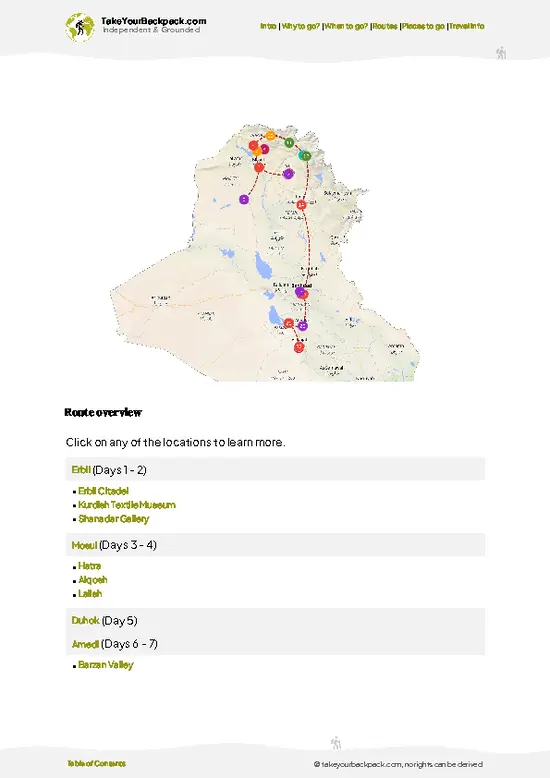
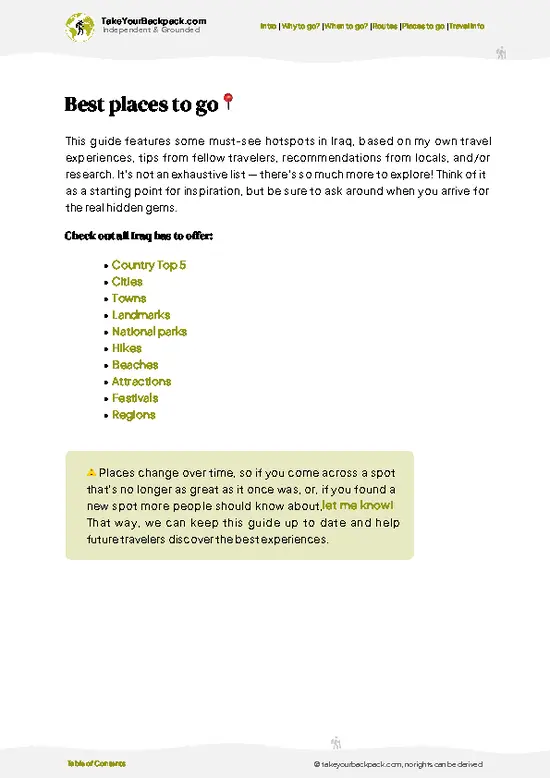
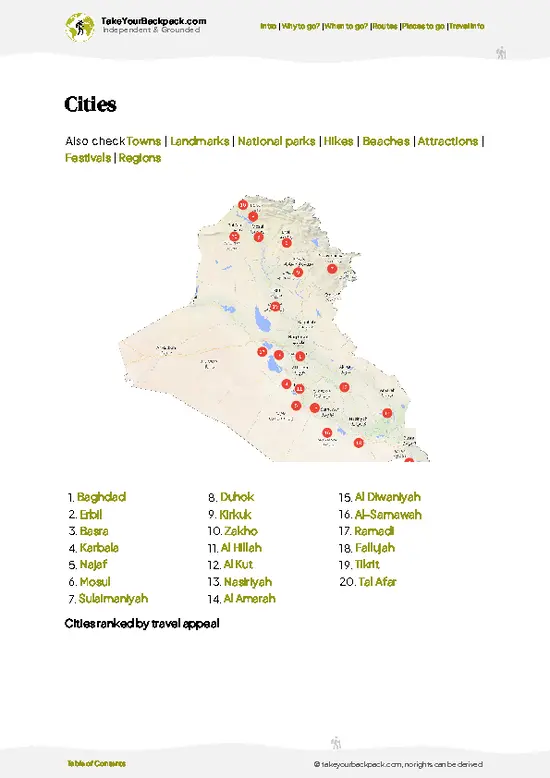
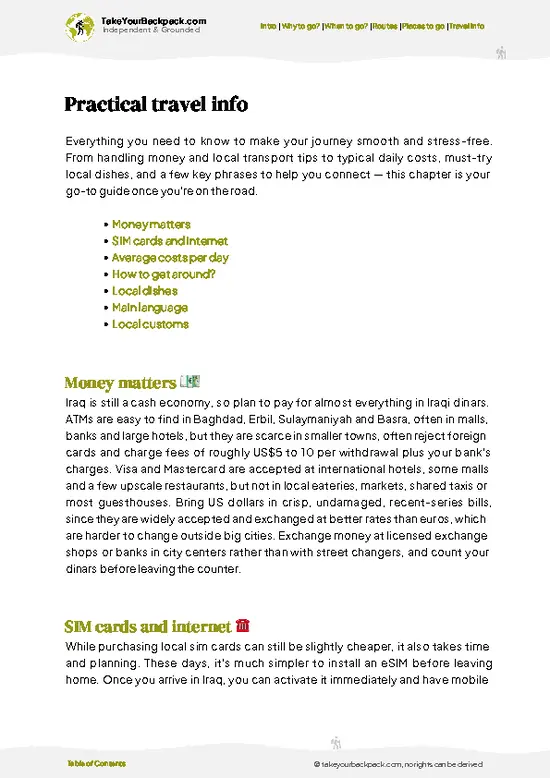
example page 0 from our offline Travel Guide for Iraq
example page 1 from our offline Travel Guide for Iraq
example page 2 from our offline Travel Guide for Iraq
example page 3 from our offline Travel Guide for Iraq
example page 4 from our offline Travel Guide for Iraq
example page 5 from our offline Travel Guide for Iraq
example page 6 from our offline Travel Guide for Iraq
example page 7 from our offline Travel Guide for Iraq
The digital guide (327 pages) contains:
✅ 95 highlights, ranked by travel appeal
✅ Optimized 5, 10 & 15-day travel routes
✅ Cities, national parks, landmarks, beaches
✅ How to get around
✅ Offline-friendly for travel without Wi-Fi
👉 Click to see all 30+ guide features

📅 Plan smarter in minutes, not weeks
✅ Month by month travel advice
✅ Festivals & national holidays
✅ Budget expectations

🗺️ Go to the right places, skip the overrated ones
✅ Honest pros & cons of destinations
✅ Top hikes, parks & viewpoints
✅ Lesser-known places most travelers miss
✅ Clear “worth it vs skip it” guidance

🛏️ Travel smoothly without rookie mistakes
✅ Best areas to stay
✅ Transport systems explained simply
✅ Common scams & safety advice
✅ SIM cards, money & practical tips

🌍 Understand the country, not just visit it
✅ Culture & traditions
✅ 52 Essential phrases & customs
✅ Festivals worth planning around
✅ Traveler-friendly historical context
✅ Insights that make places more meaningful

📱 Built for real travel conditions
✅ Fully downloadable PDF
✅ Works completely offline
✅ Optimized for phone use
✅ Useful in remote areas & buses
✅ Everything in one place
Stop searching, start planning
Get instant access to your full guide. 30‑day money-back guarantee.
+ Add another guide for just

By proceeding you agree to our terms.
Sent to your inbox immediately after payment • 100% Secure Checkout
Best Backpacking Travel Advisor 2025 tourism awardBest Backpacking
Travel Advisor
2025
What others say about Take Your Backpack Guides:
⭐⭐⭐⭐⭐
Fantastic, amazing amount of information!
⭐⭐⭐⭐⭐
My goodness this is amazing, it's what I've been looking for hats off too you!
⭐⭐⭐⭐⭐
I think this is absolutely BRILLIANT
⭐⭐⭐⭐
Very complete and informative. It's still missing places, but I gotta to commend you
⭐⭐⭐⭐⭐
This is truly amazing, thank you, can't wait to explore it with my kids!
⭐⭐⭐⭐⭐
Awesome resource, thank you!
⭐⭐⭐⭐⭐
This is amazing! Can't wait to explore the ones I haven't seen
⭐⭐⭐⭐
I love this! Well done, great idea.
⭐⭐⭐⭐⭐
Thanks for taking the time to make this gem!
⭐⭐⭐⭐⭐
This might be the best website I've ever seen.
⭐⭐⭐⭐⭐
Congratulations, and thank you so much for your work; it's incredibly valuable.
⭐⭐⭐⭐
In all seriousness I think you did a great job pointing out the important spots
⭐⭐⭐⭐⭐
10/10 very good
⭐⭐⭐⭐⭐
As someone who's only just starting to visit regularly this is awesome, thank you.
⭐⭐⭐⭐
Thank you very much! I'm going to visit my dad, it's going to be very useful!
⭐⭐⭐⭐⭐
This is really cool! We'll be travelling for the first time and this definitely come in handy.
⭐⭐⭐⭐⭐
You are now our minister of culture, congratulations 👨‍💼
⭐⭐⭐⭐⭐
Just wanted to tell you that this is a pearl! Going to follow your recommendations.
⭐⭐⭐⭐⭐
This is so cool. I'll definitely be using the resource for my travels soon.
⭐⭐⭐⭐⭐
This is very impressive! Good work.
⭐⭐⭐⭐⭐
This is an amazing and informative site. Very well done!

🛏️ Where to stay?Where to Stay: Iraq Edition

Backpacker hostels in Iraq are still rare, but cheap guesthouses and simple hotels at roughly US$15 to 35 a night exist in every major city, and a few small hostels have opened in Baghdad and the Kurdish cities. In Baghdad, Karrada has the widest choice, with riverside cafés and late-opening restaurants, while the older streets around Bab al-Sharqi and Saadoun Street are cheaper and closer to Tahrir Square and Mutanabbi Street, though louder and grittier after dark. In Erbil, budget rooms cluster around the Citadel and the bazaar for easy sightseeing on foot, the Christian district of Ankawa costs more but has bars and a calmer night, and in Sulaymaniyah the streets near the bazaar mix low prices … read more 👉
Backpacker hostels in Iraq are still rare, but cheap guesthouses and simple hotels at roughly US$15 to 35 a night exist in every major city, and a few small hostels have opened in Baghdad and the Kurdish cities. In Baghdad, Karrada has the widest choice, with riverside cafés and late-opening restaurants, while the older streets around Bab al-Sharqi and Saadoun Street are cheaper and closer to Tahrir Square and Mutanabbi Street, though louder and grittier after dark. In Erbil, budget rooms cluster around the Citadel and the bazaar for easy sightseeing on foot, the Christian district of Ankawa costs more but has bars and a calmer night, and in Sulaymaniyah the streets near the bazaar mix low prices with a lively evening crowd.

If you enjoy meeting fellow travelers, consider choosing hostels with high ratings for atmosphere. On the other hand, if you prefer having your own space, a hotel might be a better option.

IraqExplore Beyond This Category

👋 Meet the founderWho’s Behind Take Your Backpack?

Johan, backpacker and founder of TakeYourBackpackHi, I’m Johan (Netherlands 🇳🇱), the creator of TakeYourBackpack. Over the past 3 decades, I’ve backpacked through 90+ countries across six continents, gaining extensive experience with independent travel, long-term trips, and overland routes.

This site is built on a combination of firsthand travel experience and carefully curated insights from other backpackers. Many guides are based on places I’ve personally visited, while others bring together tips, observations, and practical advice shared by trusted travelers I’ve met along the way.

The goal is to provide realistic, experience-driven guidance — not generic itineraries — so you can explore destinations with better context, clearer expectations, and more confidence.