×

Iraq🇮🇶 | best hikesEssential 3 hikes to Explore in Iraq

Hiking in Iraq means the Kurdistan Region in the north. Its mountains, gorges and Zagros villages have marked trails in places, cheap guesthouses and a steady trickle of visitors. Federal Iraq to the south is flat desert and marsh, so skip it for serious walking. Expect short day hikes and a few multi-day routes, not an alpine hut network. Costs are modest, and access from Erbil or Sulaymaniyah is easy by shared taxi. Crowds are thin outside Newroz and summer weekends, when Iraqi families fill the popular gorges and picnic spots. Independent travel works well here, but trails are often unsigned, so a local guide or a downloaded offline map earns its fee.

By Johan Kruseman 🇳🇱 | Updated October 19, 2026
Explore the best beaches in Iraq

Why go?Understanding Their Importance

Iraq is unusual because almost all of its hiking sits in one mountain belt: the Zagros ranges along the Iranian and Turkish borders. Peaks here reach roughly 3,000 to 3,600 meters, and the valleys hold Kurdish villages, springs, orchards and old shepherd paths. Nothing comparable exists in the rest of the country, so the choice is really about the north versus nothing.

Be clear about what this is not. There is no national trail system, no hut network and little reliable signage. Trail information is thin, and landmines left from past conflicts still contaminate some border and former front-line areas. Staying on well-used paths and hiring a local guide for anything remote is not optional caution but basic sense.

The upside is hospitality. Villagers routinely offer tea, and a guesthouse stay … read more 👉
Iraq is unusual because almost all of its hiking sits in one mountain belt: the Zagros ranges along the Iranian and Turkish borders. Peaks here reach roughly 3,000 to 3,600 meters, and the valleys hold Kurdish villages, springs, orchards and old shepherd paths. Nothing comparable exists in the rest of the country, so the choice is really about the north versus nothing.

Be clear about what this is not. There is no national trail system, no hut network and little reliable signage. Trail information is thin, and landmines left from past conflicts still contaminate some border and former front-line areas. Staying on well-used paths and hiring a local guide for anything remote is not optional caution but basic sense.

The upside is hospitality. Villagers routinely offer tea, and a guesthouse stay costs a fraction of European mountain prices. Visitors also meet very few foreign hikers, which suits people who want space rather than a famous name.

Before choosing Iraq, check current government travel advice, carry your passport at checkpoints, and treat the Kurdistan Region as a separate entry zone with its own visa-on-arrival rules. The south and center are not hiking destinations. Anyone wanting polished infrastructure should go to Turkey or Georgia instead.
Why These Made the Cut
The list of best hikes in Iraq is created based on scenery, challenge, trail quality, landmarks, and overall enjoyment. If you feel a hike is missing in this list, please let us know.

When to go?Best Time to Visit Iraq for hikes

Best months for hiking in Iraq: April to early June and mid-September to October are best, because Kurdistan’s highlands sit at roughly 15 to 28°C by day while the lowlands have not yet reached their summer furnace. Spring is greenest, with streams running from snowmelt and wildflowers on the slopes. Rain is the trade-off: most of the 400 to 800 mm a year falls from November to April, so April trails can be muddy and high passes may still hold snow.
Shoulder seasons and seasons to skip: Autumn is drier and clearer, with cooler nights, but streams are low and the hills are brown. Summer from July to August is not worth it for most walkers. Erbil and Duhok regularly top 40°C, and even mid-elevation trails get hot by 10 a.m. Higher ground in the Zagros stays more tolerable, but start at dawn and … read more 👉
Best months for hiking in Iraq: April to early June and mid-September to October are best, because Kurdistan’s highlands sit at roughly 15 to 28°C by day while the lowlands have not yet reached their summer furnace. Spring is greenest, with streams running from snowmelt and wildflowers on the slopes. Rain is the trade-off: most of the 400 to 800 mm a year falls from November to April, so April trails can be muddy and high passes may still hold snow.
Shoulder seasons and seasons to skip: Autumn is drier and clearer, with cooler nights, but streams are low and the hills are brown. Summer from July to August is not worth it for most walkers. Erbil and Duhok regularly top 40°C, and even mid-elevation trails get hot by 10 a.m. Higher ground in the Zagros stays more tolerable, but start at dawn and finish by noon.
Winter and crowds: From December to March, snow closes high routes and some mountain roads, and many guesthouses cut back. Day walks near towns remain possible on mild days. Crowds peak around Newroz in March and on Friday holidays, when popular gorges and picnic spots fill with Iraqi families and taxi prices to them rise. Midweek visits in spring and autumn are quieter, with no formal high-season price jump for guesthouses.

hike hoppingSuggested Travel Strategies

How many days to combine several hikes: A trip linking several hikes in Iraq needs 7 to 14 days, and the northern Kurdistan Region is the only area worth including. Anything beyond 14 days adds rest days rather than new terrain.
Grouping regions and direction: Cluster by hub. Erbil and its northeast mountains pair well with Rawanduz, while Sulaymaniyah anchors the southeast near the Iranian border. Duhok and Amedi form a third northwest group. A sensible loop starts at Erbil, goes east, then south to Sulaymaniyah, and returns to the airport at Erbil or Sulaymaniyah. Duhok fits as an add-on if you have more than 10 days.
Time per stop and transfers: Allow 2 to 3 days per base: one for the hike, one for rest or a second walk, and a buffer for weather. Erbil to Sulaymaniyah is about 3 to 4 hours … read more 👉
How many days to combine several hikes: A trip linking several hikes in Iraq needs 7 to 14 days, and the northern Kurdistan Region is the only area worth including. Anything beyond 14 days adds rest days rather than new terrain.
Grouping regions and direction: Cluster by hub. Erbil and its northeast mountains pair well with Rawanduz, while Sulaymaniyah anchors the southeast near the Iranian border. Duhok and Amedi form a third northwest group. A sensible loop starts at Erbil, goes east, then south to Sulaymaniyah, and returns to the airport at Erbil or Sulaymaniyah. Duhok fits as an add-on if you have more than 10 days.
Time per stop and transfers: Allow 2 to 3 days per base: one for the hike, one for rest or a second walk, and a buffer for weather. Erbil to Sulaymaniyah is about 3 to 4 hours by road, Erbil to Duhok about 2.5 to 3.5 hours, and Erbil to Rawanduz about 2 hours. Shared taxis from city garages are cheapest, but trailheads usually need a private driver or a guide’s car.
Planning mistakes: Cramming four regions into five days wastes the trip on roads and checkpoints, so pick two or three bases. Trying to hike every day also backfires in heat or after rain. Booking a tight flight home is another error, since checkpoint queues and mountain roads run slow. Leave a full day spare before departure.

The ListTop hikes of Iraq

1 Gali Ali Beg

deep canyon, river crossing, dramatic cliffs

Traverse a narrow gorge carved by water, with steep rock faces overhead and a river that shapes the route’s pace and character.

iraq-hike-gali-ali-beg
© Google |

2 Ahmad Awa

spring-fed pools, lush valley, picnic spots

Follow a gentle trail along a green gorge, where clear water flows past shaded rest areas and local families gather on weekends.

iraq-hike-ahmad-awa
© Google |

3 Bekhal Waterfall

cascading water, forested gorge, footbridges

Navigate a short, lively route through wooded slopes to reach a waterfall surrounded by cool mist and the sound of rushing water.

iraq-hike-bekhal-waterfall
© Google |
Loading the map 🌍

Expert viewPro Tips for Exploring the Best

How many hikes to plan: Three to five hikes is the right number for most backpackers. That gives you a mix of terrain, a rest day for weather or checkpoint delays, and time to say yes when a village host invites you for tea. Chasing eight or more means hours in taxis for little extra reward.
Prioritizing by travel style: First-timers and solo travelers should choose gorge and village walks near Erbil, Rawanduz or Sulaymaniyah, where paths are used daily and help is close. Experienced hikers can add one remote multi-day route, but only with a local guide who knows which ground is clear of mines. Anyone on a tight budget should favor short walks reachable by shared taxi over remote trailheads that need a private car.
What it costs: Plan on US$30 to 55 a day. Guesthouses and basic hotels run about … read more 👉
How many hikes to plan: Three to five hikes is the right number for most backpackers. That gives you a mix of terrain, a rest day for weather or checkpoint delays, and time to say yes when a village host invites you for tea. Chasing eight or more means hours in taxis for little extra reward.
Prioritizing by travel style: First-timers and solo travelers should choose gorge and village walks near Erbil, Rawanduz or Sulaymaniyah, where paths are used daily and help is close. Experienced hikers can add one remote multi-day route, but only with a local guide who knows which ground is clear of mines. Anyone on a tight budget should favor short walks reachable by shared taxi over remote trailheads that need a private car.
What it costs: Plan on US$30 to 55 a day. Guesthouses and basic hotels run about US$15 to 30 a night, meals US$4 to 10, and shared taxis between cities US$5 to 15. Most trails are free to walk, though some picnic gorges and viewpoints charge small fees of US$1 to 3 per person. A local guide costs roughly US$40 to 80 a day, and a driver to a remote trailhead US$40 to 100 a day depending on distance. Costs add up fast when you travel alone, so split transport with other travelers where possible. Budget US$100 to 250 for a typical single-hike visit including guide and transport.
Costs and delays that catch people out: Taxi drivers quote tourist prices near popular gorges on Friday holidays. Agree the fare before you get in and arrange the return pickup. Checkpoints on mountain roads can add an hour or more, so carry your passport and entry stamp at all times and never plan tight connections. Cash matters, since many villages have no card machines. Carry Iraqi dinars, and bring more water than seems sensible because summer shops can be hours away.
Safety and cultural considerations: Landmines remain a real risk near border zones and old front lines, so stay on well-worn paths, never step off for photos, and ask locals before entering unfamiliar valleys. Do not hike near the Turkish and Iranian borders without local advice. Military zones are often unmarked, so photographing soldiers or installations can cause trouble. Dress modestly in villages, with covered shoulders and knees for both women and men, and ask before photographing people. Women traveling solo are generally welcomed in Kurdistan but should expect questions and attention. Check current government advice before booking, carry travel insurance that explicitly covers Iraq, and tell your guesthouse where you are going each morning.

✈️ The backpacker research shortcutIraq Travel Guide

An offline-friendly backpacking guide with optimized travel routes, ranked highlights, transport advice, and the best areas to stay.
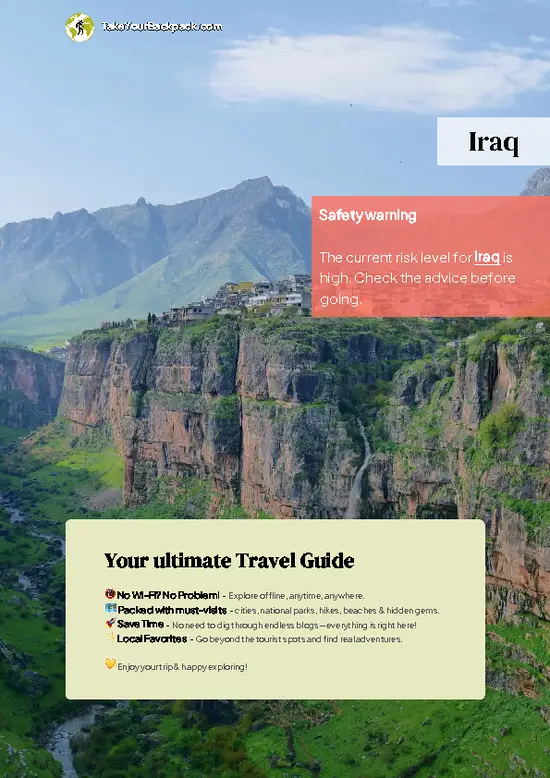
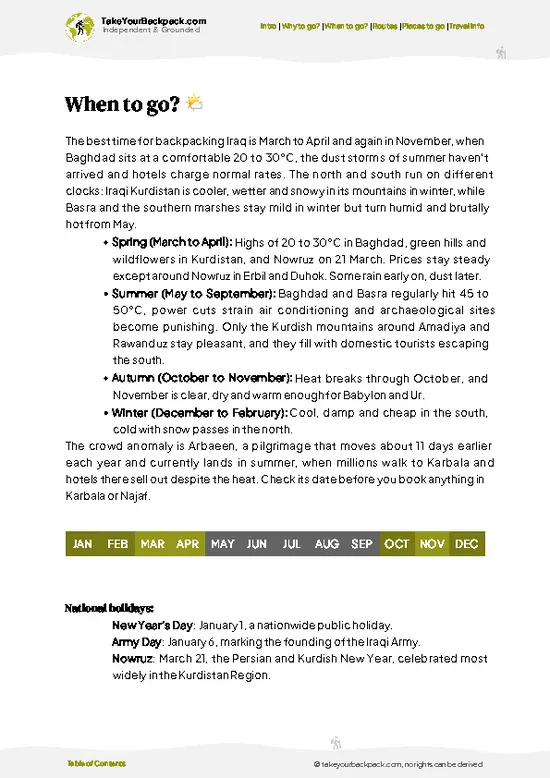
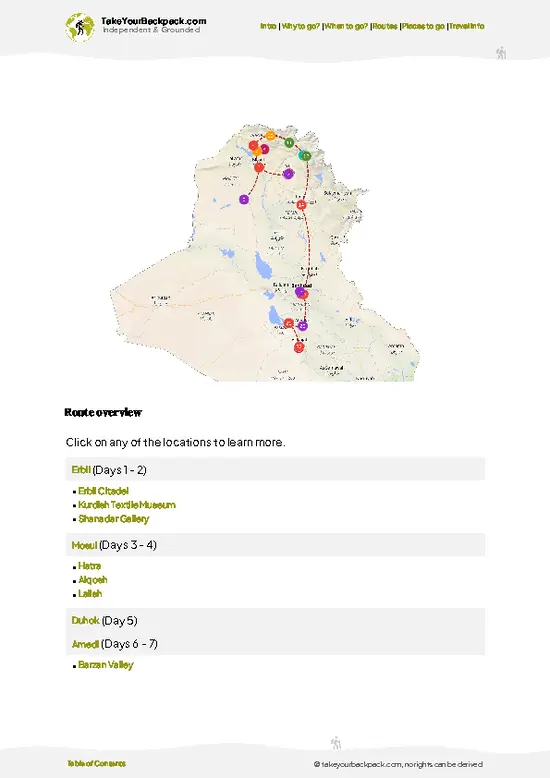
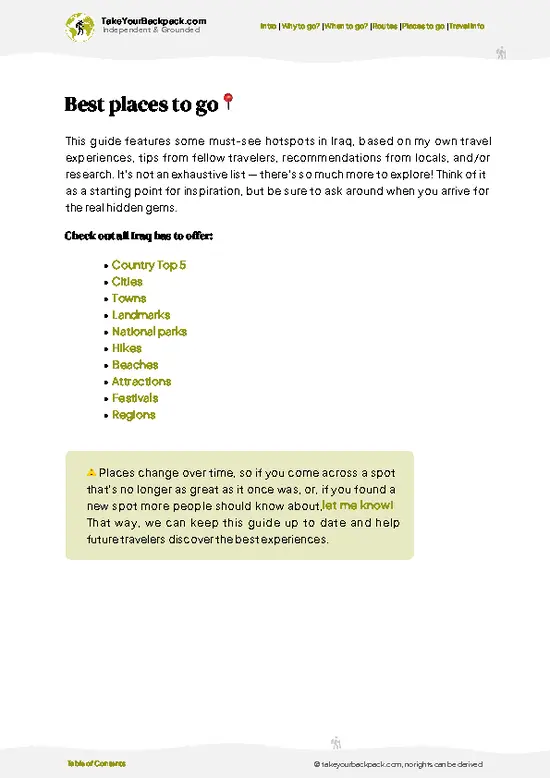
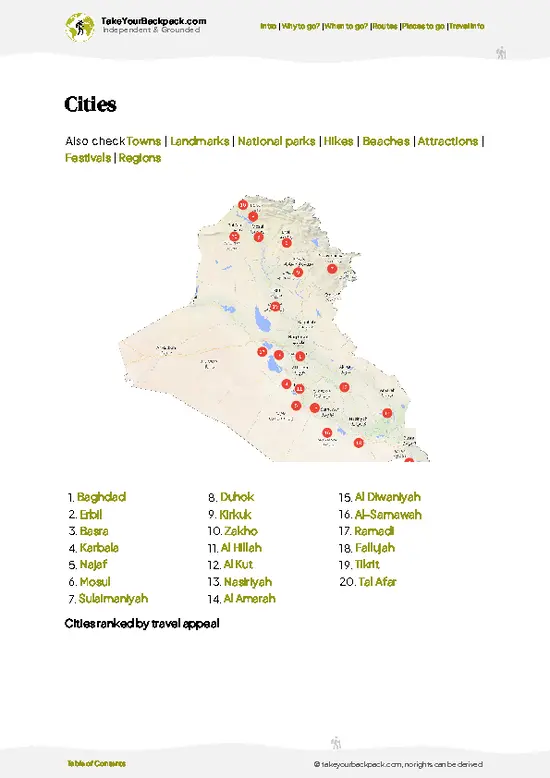
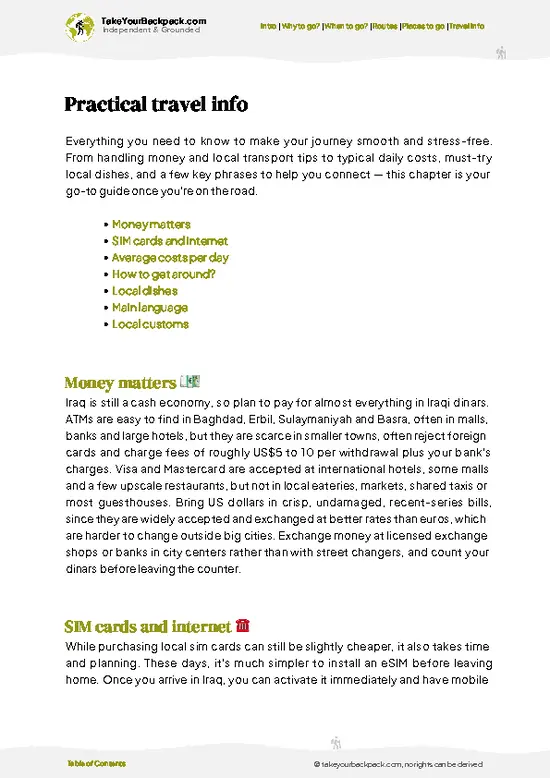
example page 0 from our offline Travel Guide for Iraq
example page 1 from our offline Travel Guide for Iraq
example page 2 from our offline Travel Guide for Iraq
example page 3 from our offline Travel Guide for Iraq
example page 4 from our offline Travel Guide for Iraq
example page 5 from our offline Travel Guide for Iraq
example page 6 from our offline Travel Guide for Iraq
example page 7 from our offline Travel Guide for Iraq
The digital guide (327 pages) contains:
✅ 95 highlights, ranked by travel appeal
✅ Optimized 5, 10 & 15-day travel routes
✅ Cities, national parks, landmarks, beaches
✅ How to get around
✅ Offline-friendly for travel without Wi-Fi
👉 Click to see all 30+ guide features

📅 Plan smarter in minutes, not weeks
✅ Month by month travel advice
✅ Festivals & national holidays
✅ Budget expectations

🗺️ Go to the right places, skip the overrated ones
✅ Honest pros & cons of destinations
✅ Top hikes, parks & viewpoints
✅ Lesser-known places most travelers miss
✅ Clear “worth it vs skip it” guidance

🛏️ Travel smoothly without rookie mistakes
✅ Best areas to stay
✅ Transport systems explained simply
✅ Common scams & safety advice
✅ SIM cards, money & practical tips

🌍 Understand the country, not just visit it
✅ Culture & traditions
✅ 52 Essential phrases & customs
✅ Festivals worth planning around
✅ Traveler-friendly historical context
✅ Insights that make places more meaningful

📱 Built for real travel conditions
✅ Fully downloadable PDF
✅ Works completely offline
✅ Optimized for phone use
✅ Useful in remote areas & buses
✅ Everything in one place
Stop searching, start planning
Get instant access to your full guide. 30‑day money-back guarantee.
+ Add another guide for just

By proceeding you agree to our terms.
Sent to your inbox immediately after payment • 100% Secure Checkout
Best Backpacking Travel Advisor 2025 tourism awardBest Backpacking
Travel Advisor
2025
What others say about Take Your Backpack Guides:
⭐⭐⭐⭐⭐
Fantastic, amazing amount of information!
⭐⭐⭐⭐⭐
My goodness this is amazing, it's what I've been looking for hats off too you!
⭐⭐⭐⭐⭐
I think this is absolutely BRILLIANT
⭐⭐⭐⭐
Very complete and informative. It's still missing places, but I gotta to commend you
⭐⭐⭐⭐⭐
This is truly amazing, thank you, can't wait to explore it with my kids!
⭐⭐⭐⭐⭐
Awesome resource, thank you!
⭐⭐⭐⭐⭐
This is amazing! Can't wait to explore the ones I haven't seen
⭐⭐⭐⭐
I love this! Well done, great idea.
⭐⭐⭐⭐⭐
Thanks for taking the time to make this gem!
⭐⭐⭐⭐⭐
This might be the best website I've ever seen.
⭐⭐⭐⭐⭐
Congratulations, and thank you so much for your work; it's incredibly valuable.
⭐⭐⭐⭐
In all seriousness I think you did a great job pointing out the important spots
⭐⭐⭐⭐⭐
10/10 very good
⭐⭐⭐⭐⭐
As someone who's only just starting to visit regularly this is awesome, thank you.
⭐⭐⭐⭐
Thank you very much! I'm going to visit my dad, it's going to be very useful!
⭐⭐⭐⭐⭐
This is really cool! We'll be travelling for the first time and this definitely come in handy.
⭐⭐⭐⭐⭐
You are now our minister of culture, congratulations 👨‍💼
⭐⭐⭐⭐⭐
Just wanted to tell you that this is a pearl! Going to follow your recommendations.
⭐⭐⭐⭐⭐
This is so cool. I'll definitely be using the resource for my travels soon.
⭐⭐⭐⭐⭐
This is very impressive! Good work.
⭐⭐⭐⭐⭐
This is an amazing and informative site. Very well done!

🛏️ Where to stay?Where to Base Yourself

Backpacker hostels in Iraq are still rare, but cheap guesthouses and simple hotels at roughly US$15 to 35 a night exist in every major city, and a few small hostels have opened in Baghdad and the Kurdish cities. In Baghdad, Karrada has the widest choice, with riverside cafés and late-opening restaurants, while the older streets around Bab al-Sharqi and Saadoun Street are cheaper and closer to Tahrir Square and Mutanabbi Street, though louder and grittier after dark. In Erbil, budget rooms cluster around the Citadel and the bazaar for easy sightseeing on foot, the Christian district of Ankawa costs more but has bars and a calmer night, and in Sulaymaniyah the streets near the bazaar mix low prices … read more 👉
Backpacker hostels in Iraq are still rare, but cheap guesthouses and simple hotels at roughly US$15 to 35 a night exist in every major city, and a few small hostels have opened in Baghdad and the Kurdish cities. In Baghdad, Karrada has the widest choice, with riverside cafés and late-opening restaurants, while the older streets around Bab al-Sharqi and Saadoun Street are cheaper and closer to Tahrir Square and Mutanabbi Street, though louder and grittier after dark. In Erbil, budget rooms cluster around the Citadel and the bazaar for easy sightseeing on foot, the Christian district of Ankawa costs more but has bars and a calmer night, and in Sulaymaniyah the streets near the bazaar mix low prices with a lively evening crowd.

If you enjoy meeting fellow travelers, consider choosing hostels with high ratings for atmosphere. On the other hand, if you prefer having your own space, a hotel might be a better option.

IraqExpand Your Journey

👋 Meet the founderWho’s Behind Take Your Backpack?

Johan, backpacker and founder of TakeYourBackpackHi, I’m Johan (Netherlands 🇳🇱), the creator of TakeYourBackpack. Over the past 3 decades, I’ve backpacked through 90+ countries across six continents, gaining extensive experience with independent travel, long-term trips, and overland routes.

This site is built on a combination of firsthand travel experience and carefully curated insights from other backpackers. Many guides are based on places I’ve personally visited, while others bring together tips, observations, and practical advice shared by trusted travelers I’ve met along the way.

The goal is to provide realistic, experience-driven guidance — not generic itineraries — so you can explore destinations with better context, clearer expectations, and more confidence.