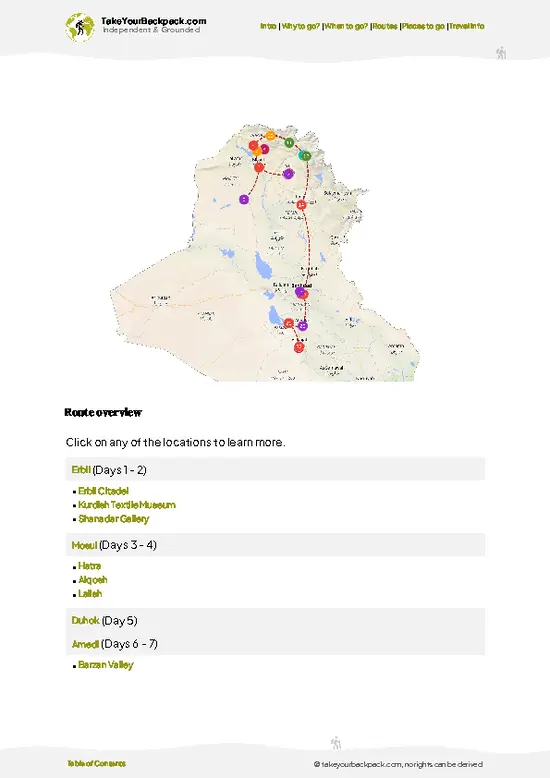
How many regions to visit: Two or three is the right number. Iraq’s distances, checkpoints and permits mean every extra region costs
two to three days of transit and paperwork, so a fourth rarely adds enough to justify it. One region done well beats four rushed.
Choosing by travel style: First-timers and budget travelers should start with the
Kurdistan Region. It has hostels, independent transport and no need for a guide. History seekers should add federal Iraq, where Mesopotamian sites and Islamic centers are the real draw. Those interested in religion should plan one shrine city outside the major pilgrimage dates. Hikers and food-focused travelers can stay in the north. The south suits people who want wetland landscapes and are prepared to arrange a guide.
What it costs: Expect
US$40 to 70 …
read more 👉 How many regions to visit: Two or three is the right number. Iraq’s distances, checkpoints and permits mean every extra region costs
two to three days of transit and paperwork, so a fourth rarely adds enough to justify it. One region done well beats four rushed.
Choosing by travel style: First-timers and budget travelers should start with the
Kurdistan Region. It has hostels, independent transport and no need for a guide. History seekers should add federal Iraq, where Mesopotamian sites and Islamic centers are the real draw. Those interested in religion should plan one shrine city outside the major pilgrimage dates. Hikers and food-focused travelers can stay in the north. The south suits people who want wetland landscapes and are prepared to arrange a guide.
What it costs: Expect
US$40 to 70 a day in Kurdistan including a private room, meals and shared taxis, and US$70 to 120 a day in federal Iraq once a driver or guide (typically US$50 to 100 a day) is included. A mid-range hotel runs about US$30 to 60 a night in most cities, and hostel beds in Erbil are around US$15 to 25. Museum and site entry is usually low, around 5,000 to 25,000 Iraqi dinars (roughly US$4 to 19). Domestic flights between Erbil, Baghdad and Basra cost roughly US$60 to 150 one way and sell out around holidays, so book early. Budget about US$900 to 1,800 for a two-week trip excluding international flights.
Costs and delays that catch travelers out: Unlicensed taxis often quote tourists double, so agree the fare before getting in. ATMs are patchy outside big cities, and card payments are rare, so carry
clean US dollar notes and change them in town. Torn or marked notes are often refused. Federal e-visa processing can take several days, so apply well ahead. Checkpoint queues add 30 minutes to two hours, so never plan tight connections with a flight.
Safety and cultural considerations: Check your government’s advisory and buy insurance that explicitly covers Iraq. Many standard policies exclude it, and a claim denial would be costly. Register with your embassy and share your plans with someone at home. Carry the passport and the visa at all times, since checkpoints are routine and polite compliance moves things fastest. Photography near military posts, bridges and government buildings can lead to detention, so ask first.
Dress modestly: long trousers for everyone, and covered shoulders and knees for women. Women entering shrines usually need an abaya, often provided at the door. Do not eat or drink in public during Ramadan daylight hours outside tourist hotels. Alcohol is easy to find in Kurdistan and much harder elsewhere, so never assume it is available. Accept tea when offered, as refusing can offend, and expect to be invited to eat.

 Best Backpacking
 Hi, I’m Johan (Netherlands 🇳🇱), the creator of TakeYourBackpack. Over the past 3 decades, I’ve backpacked through 90+ countries across six continents, gaining extensive experience with independent travel, long-term trips, and overland routes.