×

Iraq🇮🇶 | best attractionsEssential 10 attractions to Explore in Iraq

Attractions in Iraq are mostly about ancient history and living pilgrimage, not resorts or polished sightseeing. Skip the idea of a quick checklist: many sites are remote, signage is thin and facilities are basic. The Kurdistan Region is the easiest part, with a visa on arrival, tourist-friendly cities and moderate prices. Southern and central Iraq hold the deepest history (Mesopotamian ruins, Shia shrine cities), but you need permits, checkpoints and often a guide. Crowds are almost nonexistent outside pilgrimage events. For backpackers and independent travelers, Kurdistan suits a first visit, while federal Iraq suits experienced travelers who accept slower, more organized movement.

By Johan Kruseman 🇳🇱 | Updated October 19, 2026
Explore the best festivals in Iraq

Why go?Understanding Their Importance

Iraq holds more layered history than almost any country a backpacker can reach, and that is the real reason to come. Mesopotamia produced writing, the first cities and the earliest codified laws, and the physical remains sit across the Tigris and Euphrates plains, in the marshes of the south and in the northern mountains. Nowhere else lets you stand at sites of this age with so few other visitors. Add a living pilgrimage tradition, with millions of Shia worshippers arriving in Najaf and Karbala each year, and the country offers something no neighbor matches.

Be clear about what Iraq is not. It has no developed tourist circuit, so signage, English-language information and site facilities are thin outside the Kurdistan Region. Many ancient sites are bare mounds and eroded brick, and they reward … read more 👉
Iraq holds more layered history than almost any country a backpacker can reach, and that is the real reason to come. Mesopotamia produced writing, the first cities and the earliest codified laws, and the physical remains sit across the Tigris and Euphrates plains, in the marshes of the south and in the northern mountains. Nowhere else lets you stand at sites of this age with so few other visitors. Add a living pilgrimage tradition, with millions of Shia worshippers arriving in Najaf and Karbala each year, and the country offers something no neighbor matches.

Be clear about what Iraq is not. It has no developed tourist circuit, so signage, English-language information and site facilities are thin outside the Kurdistan Region. Many ancient sites are bare mounds and eroded brick, and they reward people who read up first. Skip them if you want finished museum-style displays. The Iraq Museum in Baghdad and the museums of the north are the exceptions.

Before choosing Iraq, know that conditions vary sharply by region. The Kurdistan Region has easy visa-on-arrival entry, ordinary transport and predictable checkpoints. Federal Iraq needs an e-visa, more patience and a current read of security advice. Summer heat above 45°C in the south and center makes daytime sightseeing there punishing. Plan around it, and expect plans to shift.
How the List Was Created
The list of best attractions in Iraq is created based on cultural significance or entertainment value. If you feel a attraction is missing in this list, please let us know.

When to go?Best Time to Visit Iraq for attractions

Best Months: The best months are March to April and October to November, when daytime temperatures sit around 20 to 30°C instead of the 45 to 50°C common in summer. That matters because most ancient sites are open, treeless ground with almost no shade.
Summer and Winter: From June to September, southern and central Iraq (Baghdad, Babylon, Basra, Ur) are not worth visiting for sightseeing. Midday temperatures regularly pass 45°C, and you will burn half your day hiding indoors. Kurdistan is milder, around 35 to 40°C in July, so it is the only workable summer option, and it is cooler in the mountains.

From December to February, the north gets cold, with snow in the mountains and nights near or below 0°C, and rain falls mostly between November and March, often 300 to 600 mm in the north but only … read more 👉
Best Months: The best months are March to April and October to November, when daytime temperatures sit around 20 to 30°C instead of the 45 to 50°C common in summer. That matters because most ancient sites are open, treeless ground with almost no shade.
Summer and Winter: From June to September, southern and central Iraq (Baghdad, Babylon, Basra, Ur) are not worth visiting for sightseeing. Midday temperatures regularly pass 45°C, and you will burn half your day hiding indoors. Kurdistan is milder, around 35 to 40°C in July, so it is the only workable summer option, and it is cooler in the mountains.

From December to February, the north gets cold, with snow in the mountains and nights near or below 0°C, and rain falls mostly between November and March, often 300 to 600 mm in the north but only about 100 to 150 mm in the south. Rain can turn dirt access roads to mud at remote ruins. The south is pleasantly mild in winter, 10 to 20°C, making it the best time for Ur and Basra.
Crowds and Prices: Tourist crowds are minimal everywhere. The real peak is Arbaeen, a Shia pilgrimage in Karbala that draws millions of people. Its date shifts about 11 days earlier each year. Hotels and roads around Najaf and Karbala fill and prices spike, so avoid those cities then unless you are joining the pilgrimage. Ramadan shortens opening hours and daytime dining.

attraction hoppingSuggested Travel Strategies

How Many Days: A trip combining several attractions in Iraq needs 10 to 16 days, and less than 8 only works if you stay in Kurdistan. Distances look short on a map but checkpoints and slow roads eat hours.
Grouping and Direction: Two clusters work. The north (Erbil, Sulaymaniyah, Duhok, Mosul area) links by shared taxis and buses in 2 to 4 hours per leg. The center and south (Baghdad, Najaf, Karbala, Babylon, Nasiriyah, Basra) is spread along the Euphrates, with legs of 1.5 to 5 hours. Baghdad to Basra takes roughly 8 to 10 hours by road, and domestic flights save the day. Enter through Erbil, work south via Baghdad, and exit from Baghdad or Basra, or fly back north. Doing this in reverse is fine, but one direction avoids backtracking.
Time Per Stop: Allow half a day for most single ruins, a … read more 👉
How Many Days: A trip combining several attractions in Iraq needs 10 to 16 days, and less than 8 only works if you stay in Kurdistan. Distances look short on a map but checkpoints and slow roads eat hours.
Grouping and Direction: Two clusters work. The north (Erbil, Sulaymaniyah, Duhok, Mosul area) links by shared taxis and buses in 2 to 4 hours per leg. The center and south (Baghdad, Najaf, Karbala, Babylon, Nasiriyah, Basra) is spread along the Euphrates, with legs of 1.5 to 5 hours. Baghdad to Basra takes roughly 8 to 10 hours by road, and domestic flights save the day. Enter through Erbil, work south via Baghdad, and exit from Baghdad or Basra, or fly back north. Doing this in reverse is fine, but one direction avoids backtracking.
Time Per Stop: Allow half a day for most single ruins, a full day for large archaeological sites or shrine cities, and 2 to 3 days for Baghdad or Erbil. Leave buffer for checkpoints.
Planning Mistakes: The biggest mistake is packing two distant sites into one day. Roads close, checkpoints slow everything, and daylight limits you; do one major site per day. Another is crossing between the north and south without checking permits first, since the Kurdistan and federal rules differ. Do not drive after dark between cities. Book guides and transport a few days ahead, and keep one spare day for delays.

The ListTop attractions of Iraq

1 National Museum of Iraq

Sumerian tablets, Assyrian reliefs, ancient jewelry

Survey millennia of civilization through original artifacts that document the rise and fall of Mesopotamian societies.

2 Imam Ali Shrine

religious relics, gold domes, pilgrimage artifacts

Survey collections that illuminate the spiritual and historical significance of Najaf’s revered shrine and its role in Shia Islam.

3 Imam Husayn Shrine

ceremonial halls, martyrdom displays, processional objects

Trace the story of Karbala’s central figure through museum spaces focused on ritual, memory, and religious devotion.

4 Erbil Civilization Museum

excavated relics, citadel courtyard, Kurdish heritage

Examine finds from ongoing digs and learn about the continuous habitation that defines this UNESCO-listed urban mound.

5 Lalish

Yazidi shrines, sacred valley, pilgrimage rituals

Experience a living religious site where visitors witness unique ceremonies and the continuity of Yazidi spiritual traditions.

6 Al-Shaheed Monument

blue dome, memorial plaza, reflective pools

Contemplate Iraq’s modern conflicts at a site designed for remembrance, with symbolic architecture and quiet spaces for reflection.

7 Al-Faw Palace

ornate halls, artificial lakes, presidential architecture

Tour lavish interiors and landscaped grounds that reflect the ambitions and contradictions of Iraq’s recent political history.

8 Baghdad Modern Art Museum

contemporary paintings, sculpture halls, Iraqi artists

View a cross-section of 20th-century and contemporary works that trace Iraq’s evolving artistic movements and cultural shifts.

9 Basra Museum

Mesopotamian artifacts, Ottoman galleries, riverside setting

Discover regional history through curated displays that span ancient civilizations, maritime trade, and Basra’s changing identity.

10 Slemani Museum

Neolithic tools, cuneiform tablets, regional archaeology

Explore curated rooms that chart the development of northern Iraq from prehistoric settlements to later urban cultures.

11 Kurdish Textile Museum

woven carpets, tribal costumes, loom demonstrations

Observe traditional techniques and regional patterns that tell the story of Kurdish identity through textiles and everyday objects.

12 Amna Suraka

prison cells, bullet-riddled walls, museum exhibits

Walk through preserved detention blocks and displays that document the realities of repression and resilience in Kurdistan.

13 Al-Zawraa Park

animal enclosures, amusement rides, picnic lawns

Spend a day among families enjoying open green spaces, local wildlife, and recreational facilities in the heart of Baghdad.

14 Al-Mutanabbi Street Book Market

book stalls, literary cafés, street murals

Browse eclectic collections and observe the city’s intellectual life unfold in a space shaped by writers, poets, and readers.

15 Citadel of Kirkuk

hilltop fortress, ancient ramparts, panoramic views

Climb to a vantage point overlooking the city, exploring layered ruins that reveal centuries of settlement and shifting control.

16 Iraqi National Theatre

performance stage, cultural events, modernist façade

Attend plays or concerts in a venue that has hosted generations of artists and reflects Baghdad’s ongoing creative life.

Think you know Iraq?

Prove you’re a true local — uncover 7 lesser-known attractions in Iraq that locals tend to keep to themselves.
Loading the map 🌍

Expert viewPro Tips for Exploring the Best

How Many Attractions: Aim for 8 to 12 attractions over two weeks. Anything beyond that turns into checkpoint time and transport, and Iraq punishes overpacked plans. A guide-led day usually covers one major site plus one minor stop. Cut the rest.
What to Prioritize: History travelers should put Mesopotamian ruins first and treat museums as a bonus, since the key collections are in Baghdad and Erbil. Culture-focused travelers should add one Shia shrine city, entered with respect, and one old souk or tea house district. Adventure or lower-stress travelers should focus on Kurdistan, where mountain villages and citadels are easy to reach without much paperwork. Skip anything that needs a long detour for a small, heavily reconstructed site.
Budget: Kurdistan runs about US$40 to 70 a day for a budget … read more 👉
How Many Attractions: Aim for 8 to 12 attractions over two weeks. Anything beyond that turns into checkpoint time and transport, and Iraq punishes overpacked plans. A guide-led day usually covers one major site plus one minor stop. Cut the rest.
What to Prioritize: History travelers should put Mesopotamian ruins first and treat museums as a bonus, since the key collections are in Baghdad and Erbil. Culture-focused travelers should add one Shia shrine city, entered with respect, and one old souk or tea house district. Adventure or lower-stress travelers should focus on Kurdistan, where mountain villages and citadels are easy to reach without much paperwork. Skip anything that needs a long detour for a small, heavily reconstructed site.
Budget: Kurdistan runs about US$40 to 70 a day for a budget traveler with simple hotels, local food and shared taxis. Federal Iraq costs more, about US$70 to 120 a day, because guides and drivers are usually required. Entry fees are low, often under US$1 to 10 per site, and some are free. A licensed guide or driver for a day typically costs US$50 to 150, which is the real expense. Intercity shared taxis run roughly US$5 to 20. Carry cash in US dollars and Iraqi dinars, since cards are unreliable outside big hotels.
Costs and Delays That Catch People Out: Visa and permit steps cause the most delays. Kurdistan offers visa on arrival, but federal Iraq needs an e-visa, and some provinces require extra approvals. Apply early. Another trap is arriving at a site that is closed or has unposted hours; confirm with your guide the day before. Unofficial “guides” at ruins may ask for inflated fees, so agree the price before you start. Expect to hand over your passport at checkpoints and carry photocopies.
Safety and Culture: Check current government advice before booking, because conditions change by province. Use licensed guides in the south and center, and do not wander off alone. Dress modestly, covering shoulders and knees, and women should carry a scarf for shrines. Ask before photographing people, military posts or checkpoints; photographing them can lead to detention. Remove shoes at holy sites and avoid visiting during religious ceremonies unless invited. Drink only bottled water and plan around heat, since remote ruins can be a long walk from help.

✈️ The backpacker research shortcutIraq Travel Guide

An offline-friendly backpacking guide with optimized travel routes, ranked highlights, transport advice, and the best areas to stay.
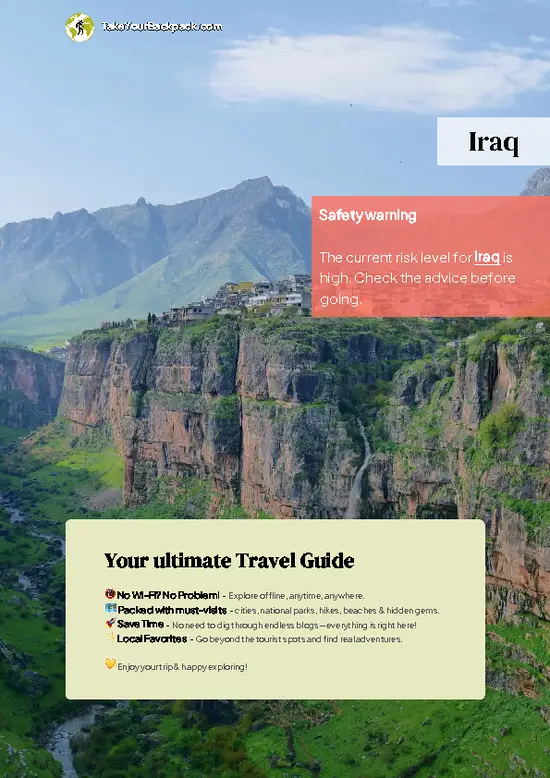
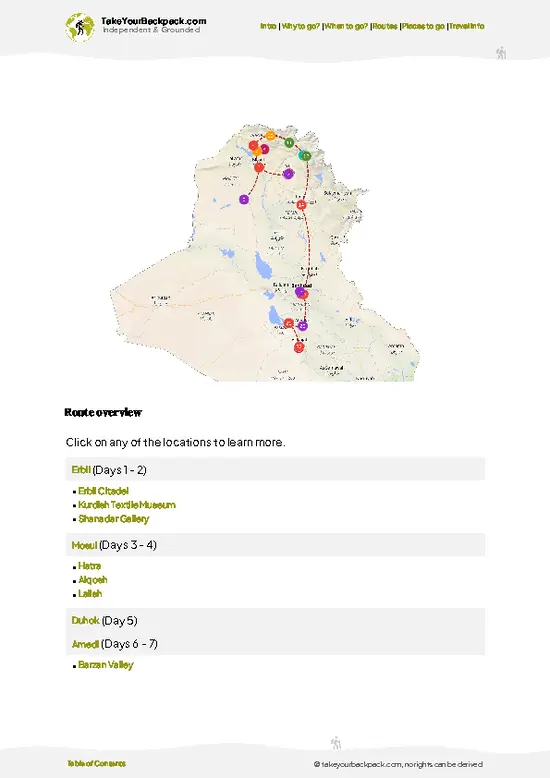
example page 0 from our offline Travel Guide for Iraq
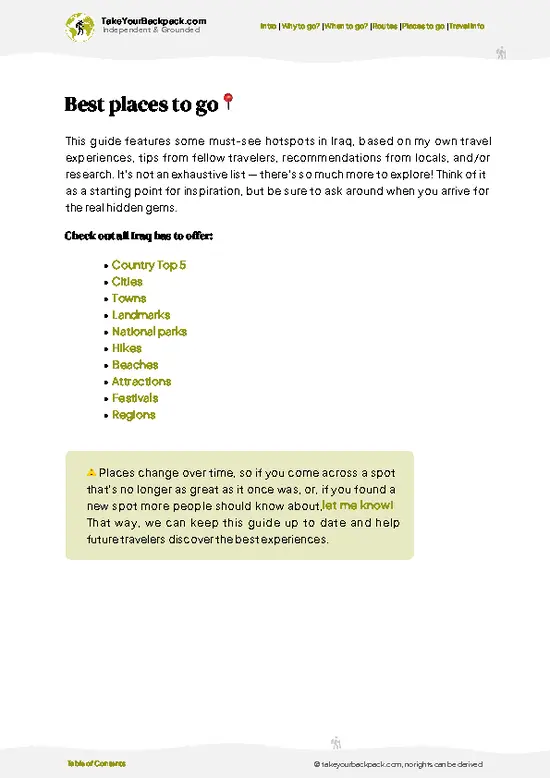
example page 1 from our offline Travel Guide for Iraq
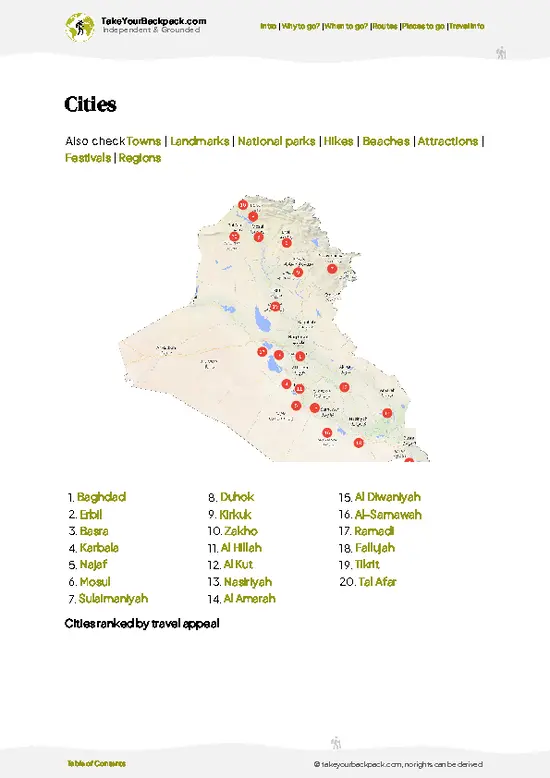
example page 2 from our offline Travel Guide for Iraq
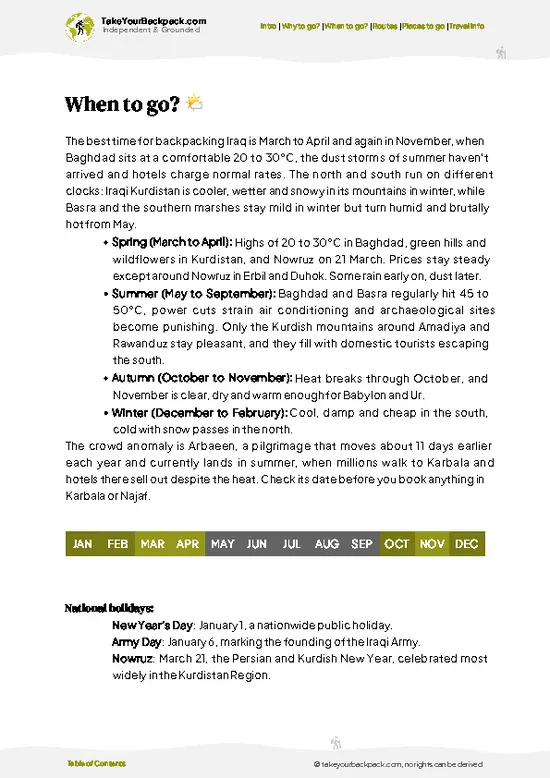
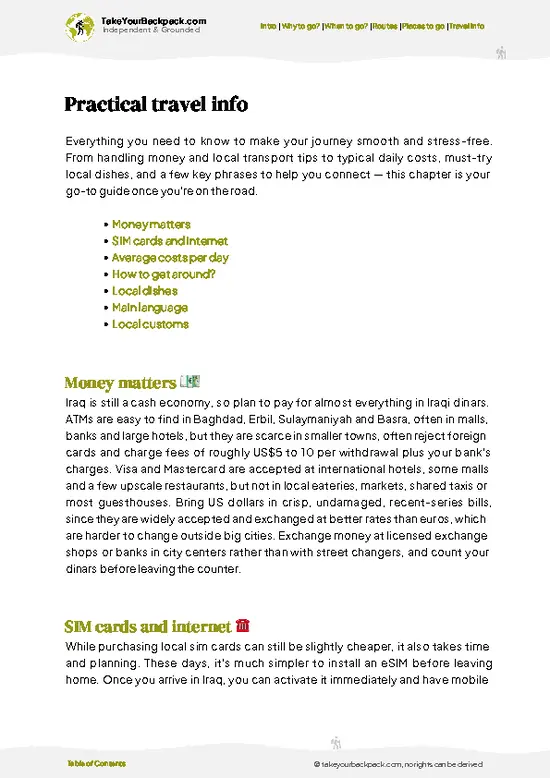
example page 3 from our offline Travel Guide for Iraq
example page 4 from our offline Travel Guide for Iraq
example page 5 from our offline Travel Guide for Iraq
example page 6 from our offline Travel Guide for Iraq
example page 7 from our offline Travel Guide for Iraq
The digital guide (327 pages) contains:
✅ 95 highlights, ranked by travel appeal
✅ Optimized 5, 10 & 15-day travel routes
✅ Cities, national parks, landmarks, beaches
✅ How to get around
✅ Offline-friendly for travel without Wi-Fi
👉 Click to see all 30+ guide features

📅 Plan smarter in minutes, not weeks
✅ Month by month travel advice
✅ Festivals & national holidays
✅ Budget expectations

🗺️ Go to the right places, skip the overrated ones
✅ Honest pros & cons of destinations
✅ Top hikes, parks & viewpoints
✅ Lesser-known places most travelers miss
✅ Clear “worth it vs skip it” guidance

🛏️ Travel smoothly without rookie mistakes
✅ Best areas to stay
✅ Transport systems explained simply
✅ Common scams & safety advice
✅ SIM cards, money & practical tips

🌍 Understand the country, not just visit it
✅ Culture & traditions
✅ 52 Essential phrases & customs
✅ Festivals worth planning around
✅ Traveler-friendly historical context
✅ Insights that make places more meaningful

📱 Built for real travel conditions
✅ Fully downloadable PDF
✅ Works completely offline
✅ Optimized for phone use
✅ Useful in remote areas & buses
✅ Everything in one place
Stop searching, start planning
Get instant access to your full guide. 30‑day money-back guarantee.
+ Add another guide for just

By proceeding you agree to our terms.
Sent to your inbox immediately after payment • 100% Secure Checkout
Best Backpacking Travel Advisor 2025 tourism awardBest Backpacking
Travel Advisor
2025
What others say about Take Your Backpack Guides:
⭐⭐⭐⭐⭐
Fantastic, amazing amount of information!
⭐⭐⭐⭐⭐
My goodness this is amazing, it's what I've been looking for hats off too you!
⭐⭐⭐⭐⭐
I think this is absolutely BRILLIANT
⭐⭐⭐⭐
Very complete and informative. It's still missing places, but I gotta to commend you
⭐⭐⭐⭐⭐
This is truly amazing, thank you, can't wait to explore it with my kids!
⭐⭐⭐⭐⭐
Awesome resource, thank you!
⭐⭐⭐⭐⭐
This is amazing! Can't wait to explore the ones I haven't seen
⭐⭐⭐⭐
I love this! Well done, great idea.
⭐⭐⭐⭐⭐
Thanks for taking the time to make this gem!
⭐⭐⭐⭐⭐
This might be the best website I've ever seen.
⭐⭐⭐⭐⭐
Congratulations, and thank you so much for your work; it's incredibly valuable.
⭐⭐⭐⭐
In all seriousness I think you did a great job pointing out the important spots
⭐⭐⭐⭐⭐
10/10 very good
⭐⭐⭐⭐⭐
As someone who's only just starting to visit regularly this is awesome, thank you.
⭐⭐⭐⭐
Thank you very much! I'm going to visit my dad, it's going to be very useful!
⭐⭐⭐⭐⭐
This is really cool! We'll be travelling for the first time and this definitely come in handy.
⭐⭐⭐⭐⭐
You are now our minister of culture, congratulations 👨‍💼
⭐⭐⭐⭐⭐
Just wanted to tell you that this is a pearl! Going to follow your recommendations.
⭐⭐⭐⭐⭐
This is so cool. I'll definitely be using the resource for my travels soon.
⭐⭐⭐⭐⭐
This is very impressive! Good work.
⭐⭐⭐⭐⭐
This is an amazing and informative site. Very well done!

🛏️ Where to stay?Accommodation Highlights

Backpacker hostels in Iraq are still rare, but cheap guesthouses and simple hotels at roughly US$15 to 35 a night exist in every major city, and a few small hostels have opened in Baghdad and the Kurdish cities. In Baghdad, Karrada has the widest choice, with riverside cafés and late-opening restaurants, while the older streets around Bab al-Sharqi and Saadoun Street are cheaper and closer to Tahrir Square and Mutanabbi Street, though louder and grittier after dark. In Erbil, budget rooms cluster around the Citadel and the bazaar for easy sightseeing on foot, the Christian district of Ankawa costs more but has bars and a calmer night, and in Sulaymaniyah the streets near the bazaar mix low prices … read more 👉
Backpacker hostels in Iraq are still rare, but cheap guesthouses and simple hotels at roughly US$15 to 35 a night exist in every major city, and a few small hostels have opened in Baghdad and the Kurdish cities. In Baghdad, Karrada has the widest choice, with riverside cafés and late-opening restaurants, while the older streets around Bab al-Sharqi and Saadoun Street are cheaper and closer to Tahrir Square and Mutanabbi Street, though louder and grittier after dark. In Erbil, budget rooms cluster around the Citadel and the bazaar for easy sightseeing on foot, the Christian district of Ankawa costs more but has bars and a calmer night, and in Sulaymaniyah the streets near the bazaar mix low prices with a lively evening crowd.

If you enjoy meeting fellow travelers, consider choosing hostels with high ratings for atmosphere. On the other hand, if you prefer having your own space, a hotel might be a better option.

IraqSee More of Iraq

👋 Meet the founderWho’s Behind Take Your Backpack?

Johan, backpacker and founder of TakeYourBackpackHi, I’m Johan (Netherlands 🇳🇱), the creator of TakeYourBackpack. Over the past 3 decades, I’ve backpacked through 90+ countries across six continents, gaining extensive experience with independent travel, long-term trips, and overland routes.

This site is built on a combination of firsthand travel experience and carefully curated insights from other backpackers. Many guides are based on places I’ve personally visited, while others bring together tips, observations, and practical advice shared by trusted travelers I’ve met along the way.

The goal is to provide realistic, experience-driven guidance — not generic itineraries — so you can explore destinations with better context, clearer expectations, and more confidence.