×

Israel🇮🇱 | best townsBest 7 towns in Israel

Towns in Israel come in sharply different types, and picking the wrong one wastes days. The Mediterranean coast is expensive, fast and beach-driven, with a Tel Aviv beer costing US$7 to 9. Galilee and the north are greener, slower and cheaper, but you need buses that thin out sharply on weekends. Jerusalem’s surroundings and the West Bank carry the heaviest history and the most checkpoints. The Negev and Eilat mean desert distances and long, empty drives. Independent travel works well here because the country is small, but skip any town that needs a rental car for a single sight. Choose by region first, then by pace.

By Johan Kruseman 🇳🇱 | Updated October 18, 2026
Explore the best villages in Israel

Why go?Understanding Their Importance

Israel packs an unusual range of towns into a country roughly the size of New Jersey. In a few hours you pass from Mediterranean port settlements to Galilee hill villages, Dead Sea shores and Negev desert outposts. That density comes from layered history: Canaanite, Roman, Crusader, Ottoman and British Mandate remains sit beside kibbutzim and development towns founded after 1948. Many places mix Jewish, Arab, Druze and Christian communities, so food, language and weekly rhythm change from one town to the next.

The geography also pushes people into towns. Rainfall is concentrated in the north, the south is desert, and settlement clusters around water, coast and ridge lines. Distances are short and public transport is solid between major hubs, though smaller places are served less often.

Before … read more 👉
Israel packs an unusual range of towns into a country roughly the size of New Jersey. In a few hours you pass from Mediterranean port settlements to Galilee hill villages, Dead Sea shores and Negev desert outposts. That density comes from layered history: Canaanite, Roman, Crusader, Ottoman and British Mandate remains sit beside kibbutzim and development towns founded after 1948. Many places mix Jewish, Arab, Druze and Christian communities, so food, language and weekly rhythm change from one town to the next.

The geography also pushes people into towns. Rainfall is concentrated in the north, the south is desert, and settlement clusters around water, coast and ridge lines. Distances are short and public transport is solid between major hubs, though smaller places are served less often.

Before choosing Israel for its towns, know the limits. It is expensive, among the priciest countries for food and lodging in the Mediterranean region. Public transport largely stops from Friday afternoon to Saturday evening for Shabbat, which shuts many Jewish towns and restricts movement. Regional security conditions can change quickly, and some areas are off limits or discouraged. Do not expect cheap, loose wandering. Expect compact, intense places that reward planning around the calendar and current advisories.
Evaluating the Top Choices
The list of best towns in Israel is created based on charm, local culture, atmosphere, hidden gems, and visitor appeal. If you feel a town is missing in this list, please let us know.

When to go?Best Time to Visit Israel for towns

Best months for towns: The best months are April to May and October to early November, when daytime highs sit around 22 to 29°C (72 to 84°F) and walking between sites is comfortable. Rain is rare in these windows.
Seasons by region: Summer from June to September brings 30 to 35°C (86 to 95°F) along the coast with heavy humidity. The Dead Sea and Negev often exceed 38°C (100°F), and Eilat can reach 40°C (104°F), so midday sightseeing in desert towns is a poor use of your time. Jerusalem and the Galilee hills run a few degrees cooler. Winter, December to February, brings most of the rain, mostly 100 to 200 mm in the north and coast over those months and far less in the south. Daytime temperatures hover at 12 to 18°C (54 to 64°F) in Jerusalem and the hills, with occasional cold snaps. The desert … read more 👉
Best months for towns: The best months are April to May and October to early November, when daytime highs sit around 22 to 29°C (72 to 84°F) and walking between sites is comfortable. Rain is rare in these windows.
Seasons by region: Summer from June to September brings 30 to 35°C (86 to 95°F) along the coast with heavy humidity. The Dead Sea and Negev often exceed 38°C (100°F), and Eilat can reach 40°C (104°F), so midday sightseeing in desert towns is a poor use of your time. Jerusalem and the Galilee hills run a few degrees cooler. Winter, December to February, brings most of the rain, mostly 100 to 200 mm in the north and coast over those months and far less in the south. Daytime temperatures hover at 12 to 18°C (54 to 64°F) in Jerusalem and the hills, with occasional cold snaps. The desert south is at its best then, with Eilat about 20 to 22°C (68 to 72°F).
Peaks and prices: Prices spike around Passover (spring), Sukkot and the Jewish High Holidays (autumn), when rooms book out and rates can rise 30 to 50 percent. Yom Kippur shuts nearly everything, including most transport, for about 25 hours. July and August push beach-town prices up too. Late winter is cheapest but wetter.

town hoppingHow to Combine towns Into One Trip

How many days to combine towns: A trip linking several towns in Israel needs 7 to 12 days, since the country is small but transfers and Shabbat eat time. Group towns by region. The north (Galilee and Golan), the coast and Jerusalem area, and the south (Dead Sea, Negev, Eilat) each work as a cluster.
Direction and pacing: Run north to south or the reverse, never zigzag. Tel Aviv and Jerusalem serve as the main transport hubs, linked by train or bus in roughly 30 to 60 minutes. Tel Aviv to Haifa takes about 1 hour by train. Jerusalem to the Dead Sea takes 1 to 1.5 hours, and Tel Aviv to Eilat about 4.5 to 5 hours by bus or a 1-hour flight. Plan 1 to 2 nights per town. A third night makes sense only where there is hiking or a desert base.
Planning mistakes: The most common error is ignoring Shabbat. … read more 👉
How many days to combine towns: A trip linking several towns in Israel needs 7 to 12 days, since the country is small but transfers and Shabbat eat time. Group towns by region. The north (Galilee and Golan), the coast and Jerusalem area, and the south (Dead Sea, Negev, Eilat) each work as a cluster.
Direction and pacing: Run north to south or the reverse, never zigzag. Tel Aviv and Jerusalem serve as the main transport hubs, linked by train or bus in roughly 30 to 60 minutes. Tel Aviv to Haifa takes about 1 hour by train. Jerusalem to the Dead Sea takes 1 to 1.5 hours, and Tel Aviv to Eilat about 4.5 to 5 hours by bus or a 1-hour flight. Plan 1 to 2 nights per town. A third night makes sense only where there is hiking or a desert base.
Planning mistakes: The most common error is ignoring Shabbat. Plan to be in a hub or a mixed town on Friday night and Saturday, as intercity buses and trains pause from Friday afternoon until Saturday evening. The second is over-packing the south: Eilat is not worth the long transfer unless you want diving or desert time. Third is relying on a car for the north and then dropping it in Jerusalem; return it before the city and use buses instead. Fourth is trying to cover all regions in under a week, which leaves you in transit.

The ListTop towns of Israel

1 Jaffa

Ancient port, flea market, Ottoman architecture, mixed communities

Browse antique stalls, climb narrow stairways, and sense the blend of cultures in one of the oldest harbors on the Mediterranean.

israel-city-jaffa
© Google |

2 Akko

Crusader halls, Ottoman walls, Mediterranean port, spice bazaars

Descend into underground passages, sample fresh seafood, and sense centuries of layered history at this ancient coastal stronghold.

3 Eilat

Red Sea beaches, coral reefs, border crossings, desert mountains

Swim with tropical fish, cross into neighboring countries, and watch the desert meet the sea in Israel’s southernmost city.

israel-city-eilat
© Google |

4 Nazareth

Basilica of the Annunciation, bustling markets, Arab cuisine, religious mosaics

Taste traditional foods, navigate winding alleys, and visit sacred Christian sites in the largest Arab city in Israel.

israel-city-nazareth
© Google |

5 Safed

Kabbalah heritage, stone alleyways, artists’ quarter, mountain breezes

Absorb mystical traditions, browse vibrant art studios, and enjoy cool evenings high above the Galilee plains.

israel-city-safed
© Google |

6 Tiberias

Sea of Galilee, hot springs, lakeside promenade, pilgrimage sites

Relax by the water, soak in mineral baths, and trace religious history along the shores of Israel’s largest freshwater lake.

7 Zichron Yaakov

Winery tours, Carmel views, 19th-century streets, artists’ studios

Sip local wines, wander tree-lined avenues, and discover the town’s early Zionist roots amid galleries and mountain air.

Loading the map 🌍

Expert viewInsights from Locals and Experts

How many towns to visit: I advise four to six towns on one trip. Israel looks small on a map, but each move costs half a day once you add bus waits, security checks and Shabbat closures. Under four and you miss the contrast between regions. Past six and you spend more time with luggage than in places.
Choosing between kinds of towns: If you want history and religious sites, put your nights in Jerusalem’s orbit and the old coastal towns. If you want food, beaches and nightlife, favor the coast, but accept the price. For hiking, wine and quiet, choose Galilee and Golan hill towns. For desert and stars, pick the Negev, and skip Eilat unless diving or a cheap flight matters to you. Resort strips and Dead Sea hotel zones are poor value for backpackers, as a public beach plus a day trip covers it. … read more 👉
How many towns to visit: I advise four to six towns on one trip. Israel looks small on a map, but each move costs half a day once you add bus waits, security checks and Shabbat closures. Under four and you miss the contrast between regions. Past six and you spend more time with luggage than in places.
Choosing between kinds of towns: If you want history and religious sites, put your nights in Jerusalem’s orbit and the old coastal towns. If you want food, beaches and nightlife, favor the coast, but accept the price. For hiking, wine and quiet, choose Galilee and Golan hill towns. For desert and stars, pick the Negev, and skip Eilat unless diving or a cheap flight matters to you. Resort strips and Dead Sea hotel zones are poor value for backpackers, as a public beach plus a day trip covers it.
What it costs: Budget US$70 to 110 a day if you use hostels (dorms US$35 to 60), supermarket meals, falafel or shawarma at US$6 to 10, and buses. Midrange travel runs US$150 to 220. Intercity buses cost about US$5 to 15, trains similar, and a Rav-Kav card cuts local fares. Entry fees for national parks and archaeological sites run US$7 to 15, and a National Parks Pass at around US$40 to 50 pays off after four or five sites. Guides cost US$100 to 250 for a half day, worth it only for complex sites. Tel Aviv drains budgets fastest, so reduce nights there.
Costs and delays that catch travelers out: Shabbat is the biggest. Transport stops from Friday afternoon, taxis surge in price, and many shops close. Book the bed and buy food on Thursday. Holiday weeks double hostel prices, so check the Jewish calendar before booking. Border and checkpoint queues can add 1 to 3 hours near the West Bank, and airport security questioning on departure can take time, so arrive 3 hours early.
Safety and culture: Check your government’s travel advisory immediately before leaving and again before each region, since conditions near Gaza, the Lebanese border and parts of the West Bank can change quickly. Follow local guidance, and know where the nearest shelter is, which hotels and hostels will point out. Dress modestly at religious sites and in Orthodox and Arab neighborhoods: covered shoulders and knees. Ask before photographing people. Carry your passport, and expect bag checks at malls and stations. Drink water constantly in summer, since heat injuries are a bigger everyday risk than crime.

✈️ The backpacker research shortcutIsrael Travel Guide

An offline-friendly backpacking guide with optimized travel routes, ranked highlights, transport advice, and the best areas to stay.
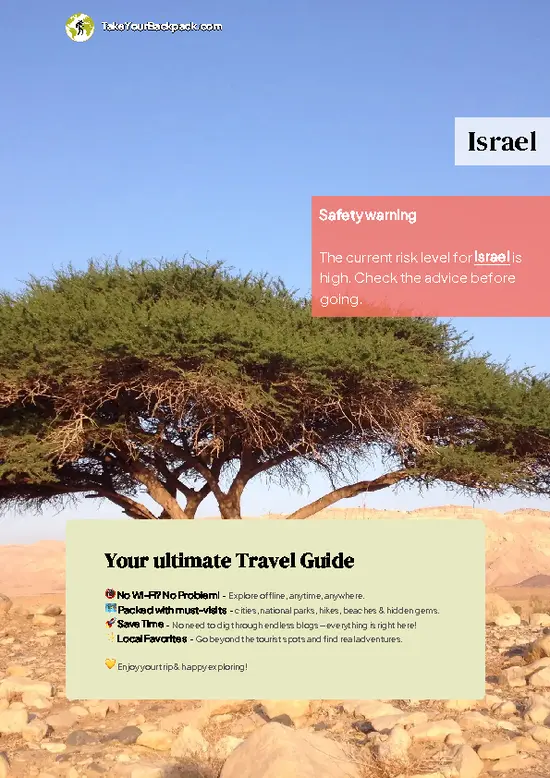
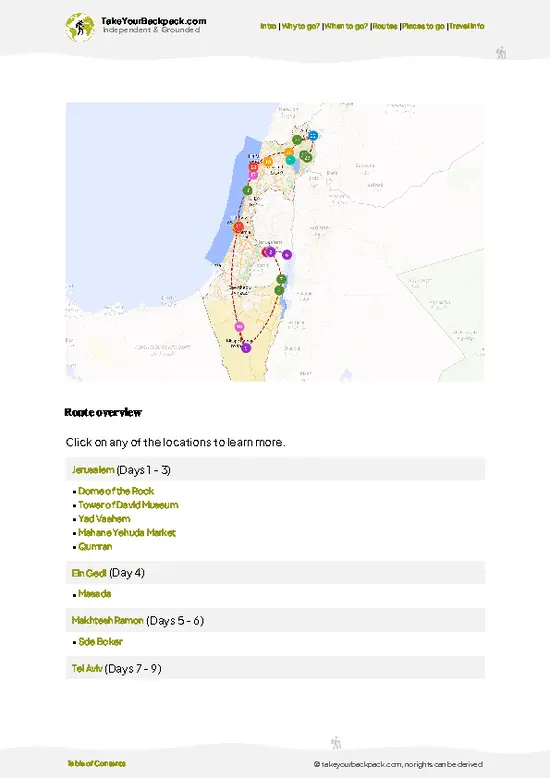
example page 0 from our offline Travel Guide for Israel
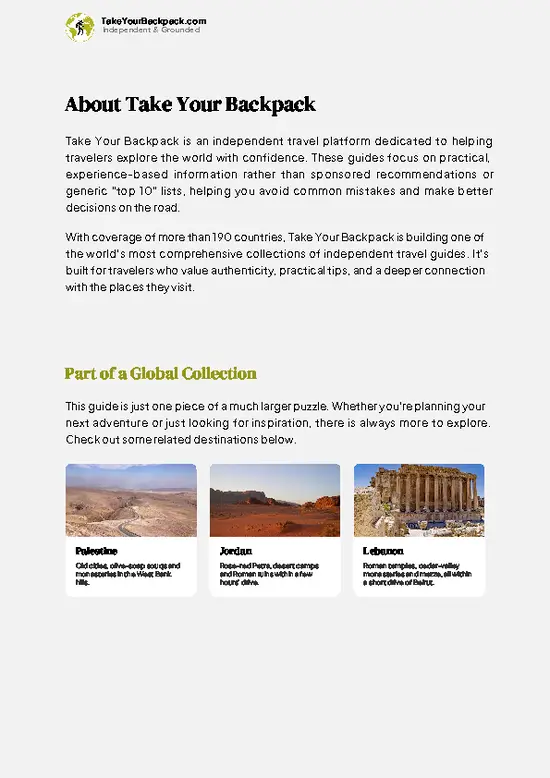
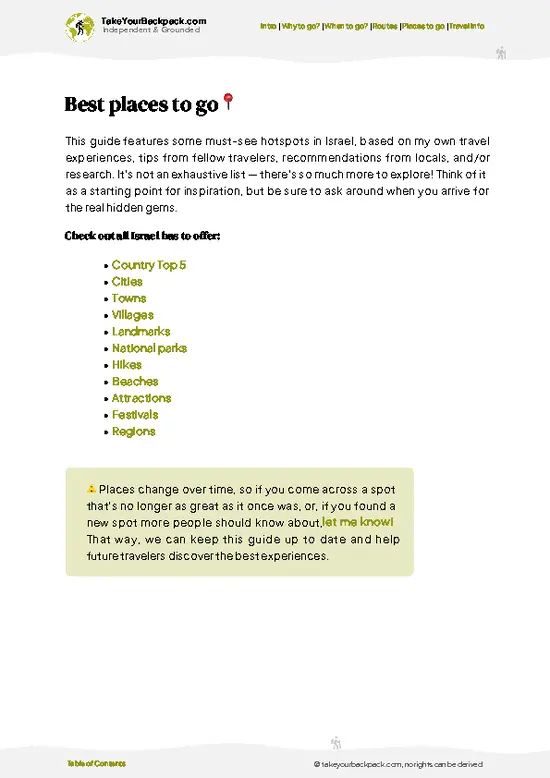
example page 1 from our offline Travel Guide for Israel
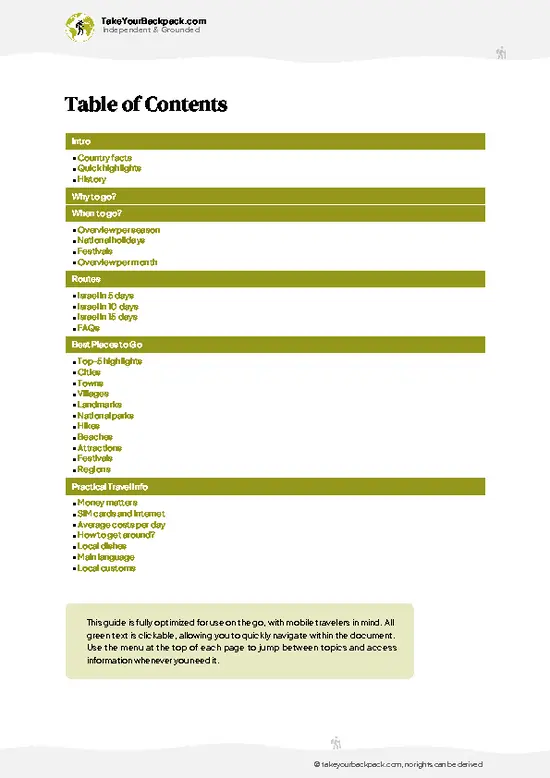
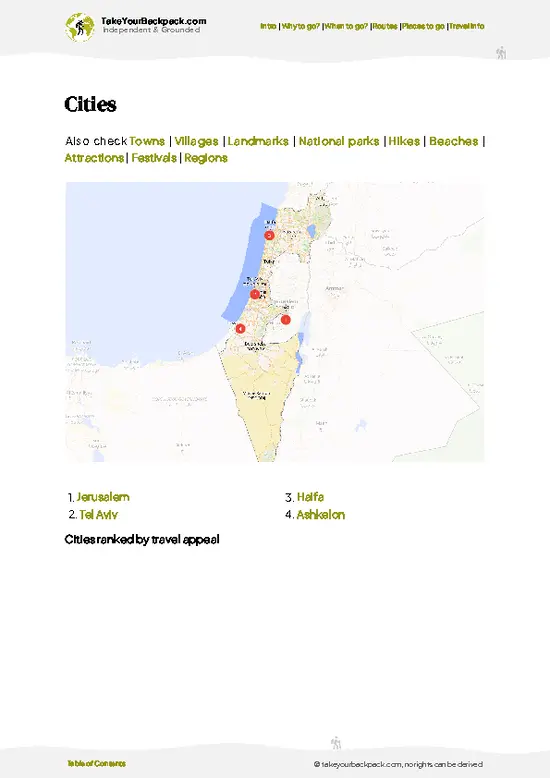
example page 2 from our offline Travel Guide for Israel
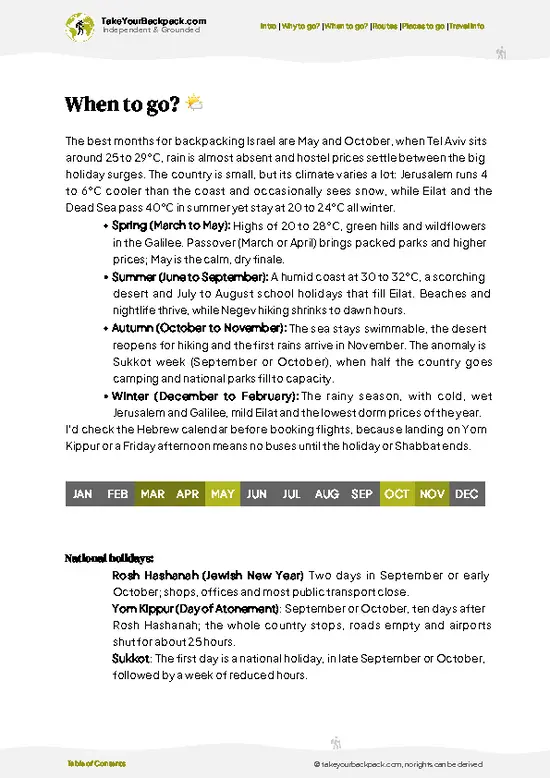
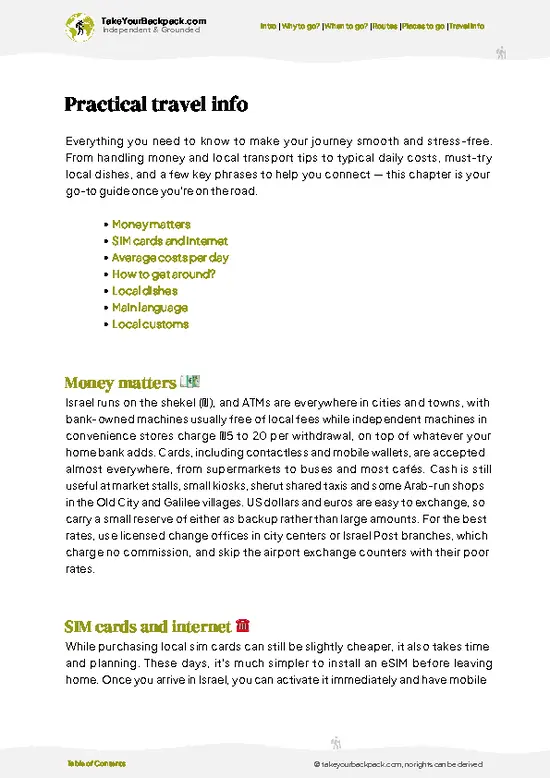
example page 3 from our offline Travel Guide for Israel
example page 4 from our offline Travel Guide for Israel
example page 5 from our offline Travel Guide for Israel
example page 6 from our offline Travel Guide for Israel
example page 7 from our offline Travel Guide for Israel
The digital guide (287 pages) contains:
✅ 77 highlights, ranked by travel appeal
✅ Optimized 5, 10 & 15-day travel routes
✅ Cities, national parks, landmarks, beaches
✅ How to get around
✅ Offline-friendly for travel without Wi-Fi
👉 Click to see all 30+ guide features

📅 Plan smarter in minutes, not weeks
✅ Month by month travel advice
✅ Festivals & national holidays
✅ Budget expectations

🗺️ Go to the right places, skip the overrated ones
✅ Honest pros & cons of destinations
✅ Top hikes, parks & viewpoints
✅ Lesser-known places most travelers miss
✅ Clear “worth it vs skip it” guidance

🛏️ Travel smoothly without rookie mistakes
✅ Best areas to stay
✅ Transport systems explained simply
✅ Common scams & safety advice
✅ SIM cards, money & practical tips

🌍 Understand the country, not just visit it
✅ Culture & traditions
✅ 52 Essential phrases & customs
✅ Festivals worth planning around
✅ Traveler-friendly historical context
✅ Insights that make places more meaningful

📱 Built for real travel conditions
✅ Fully downloadable PDF
✅ Works completely offline
✅ Optimized for phone use
✅ Useful in remote areas & buses
✅ Everything in one place
Stop searching, start planning
Get instant access to your full guide. 30‑day money-back guarantee.
+ Add another guide for just

By proceeding you agree to our terms.
Sent to your inbox immediately after payment • 100% Secure Checkout
Best Backpacking Travel Advisor 2025 tourism awardBest Backpacking
Travel Advisor
2025
What others say about Take Your Backpack Guides:
⭐⭐⭐⭐⭐
Fantastic, amazing amount of information!
⭐⭐⭐⭐⭐
My goodness this is amazing, it's what I've been looking for hats off too you!
⭐⭐⭐⭐⭐
I think this is absolutely BRILLIANT
⭐⭐⭐⭐
Very complete and informative. It's still missing places, but I gotta to commend you
⭐⭐⭐⭐⭐
This is truly amazing, thank you, can't wait to explore it with my kids!
⭐⭐⭐⭐⭐
Awesome resource, thank you!
⭐⭐⭐⭐⭐
This is amazing! Can't wait to explore the ones I haven't seen
⭐⭐⭐⭐
I love this! Well done, great idea.
⭐⭐⭐⭐⭐
Thanks for taking the time to make this gem!
⭐⭐⭐⭐⭐
This might be the best website I've ever seen.
⭐⭐⭐⭐⭐
Congratulations, and thank you so much for your work; it's incredibly valuable.
⭐⭐⭐⭐
In all seriousness I think you did a great job pointing out the important spots
⭐⭐⭐⭐⭐
10/10 very good
⭐⭐⭐⭐⭐
As someone who's only just starting to visit regularly this is awesome, thank you.
⭐⭐⭐⭐
Thank you very much! I'm going to visit my dad, it's going to be very useful!
⭐⭐⭐⭐⭐
This is really cool! We'll be travelling for the first time and this definitely come in handy.
⭐⭐⭐⭐⭐
You are now our minister of culture, congratulations 👨‍💼
⭐⭐⭐⭐⭐
Just wanted to tell you that this is a pearl! Going to follow your recommendations.
⭐⭐⭐⭐⭐
This is so cool. I'll definitely be using the resource for my travels soon.
⭐⭐⭐⭐⭐
This is very impressive! Good work.
⭐⭐⭐⭐⭐
This is an amazing and informative site. Very well done!

🛏️ Where to stay?Where to Base Yourself

Israel has a solid hostel scene, with dorm beds typically running ₪100 to 180 (about US$33 to 58) and private rooms in guesthouses from around ₪300 (US$100). In Tel Aviv, the Florentin district and the streets around Allenby and the beachfront put you near bars, street art and the sea, but expect late-night noise, while Jerusalem hostels cluster in the City Center around Jaffa Road (lively, close to the light rail and Mahane Yehuda market) and inside the Old City, which is atmospheric and steps from the holy sites but goes very quiet after dark. Haifa is calmer and cheaper, with most budget beds near the German Colony and downtown, a good pick if you want sleep over nightlife.

If you enjoy meeting … read more 👉
Israel has a solid hostel scene, with dorm beds typically running ₪100 to 180 (about US$33 to 58) and private rooms in guesthouses from around ₪300 (US$100). In Tel Aviv, the Florentin district and the streets around Allenby and the beachfront put you near bars, street art and the sea, but expect late-night noise, while Jerusalem hostels cluster in the City Center around Jaffa Road (lively, close to the light rail and Mahane Yehuda market) and inside the Old City, which is atmospheric and steps from the holy sites but goes very quiet after dark. Haifa is calmer and cheaper, with most budget beds near the German Colony and downtown, a good pick if you want sleep over nightlife.

If you enjoy meeting fellow travelers, consider choosing hostels with high ratings for atmosphere. On the other hand, if you prefer having your own space, a hotel might be a better option.

IsraelExpand Your Journey

👋 Meet the founderWho’s Behind Take Your Backpack?

Johan, backpacker and founder of TakeYourBackpackHi, I’m Johan (Netherlands 🇳🇱), the creator of TakeYourBackpack. Over the past 3 decades, I’ve backpacked through 90+ countries across six continents, gaining extensive experience with independent travel, long-term trips, and overland routes.

This site is built on a combination of firsthand travel experience and carefully curated insights from other backpackers. Many guides are based on places I’ve personally visited, while others bring together tips, observations, and practical advice shared by trusted travelers I’ve met along the way.

The goal is to provide realistic, experience-driven guidance — not generic itineraries — so you can explore destinations with better context, clearer expectations, and more confidence.