×

Jordan🇯🇴 | best townsEssential 5 towns to Explore in Jordan

Towns in Jordan come in three distinct flavors, and the one you pick changes your whole trip. The desert south means sandstone dust, the smell of cardamom coffee and tour-bus crowds by mid-morning. The King’s Highway plateau has hillside markets, cool nights and cheaper, quieter lodging. Around Amman and the north, call to prayer echoes over limestone hills and falafel stalls run until late. Distances are short, and buses and shared vans link most places, so independent travel is easy. Heat and long midday gaps in transport are the hard parts.

By Johan Kruseman 🇳🇱 | Updated October 19, 2026
Explore the best villages in Jordan

Why go?What Makes Them Special

Jordan is a small country built on a very old road. The King’s Highway has carried caravans, pilgrims and armies for thousands of years, and towns grew where water and trade met: springs in the hills, oases at the desert edge, ports on the Red Sea. That is why settlements here feel layered, with Roman columns, Crusader stone and Ottoman-era houses often within a short walk of a modern bakery. Geography does the rest. Roughly 75 percent of the land is desert, so towns cluster along the western plateau and the Jordan Valley, and the contrast between green olive terraces and bare red rock is visible from a bus window within an hour.
Before choosing Jordan for its towns, know that public transport is thin. Minibuses often leave only when full, schedules are loose and many routes die by mid-afternoon, … read more 👉
Jordan is a small country built on a very old road. The King’s Highway has carried caravans, pilgrims and armies for thousands of years, and towns grew where water and trade met: springs in the hills, oases at the desert edge, ports on the Red Sea. That is why settlements here feel layered, with Roman columns, Crusader stone and Ottoman-era houses often within a short walk of a modern bakery. Geography does the rest. Roughly 75 percent of the land is desert, so towns cluster along the western plateau and the Jordan Valley, and the contrast between green olive terraces and bare red rock is visible from a bus window within an hour.
Before choosing Jordan for its towns, know that public transport is thin. Minibuses often leave only when full, schedules are loose and many routes die by mid-afternoon, so taxis and short private transfers fill the gaps. Hospitality is real and constant: expect tea pressed into your hand, and expect to accept it. The sun is hard, with bright white light at noon and little shade, and water, a hat and modest clothing matter more than a guidebook. Entry fees at major sites are high compared with the region, while food and local lodging stay cheap.
Behind the Scenes of Selection
The list of best towns in Jordan is created based on charm, local culture, atmosphere, hidden gems, and visitor appeal. If you feel a town is missing in this list, please let us know.

When to go?Timing Your Visit for the Best Experience

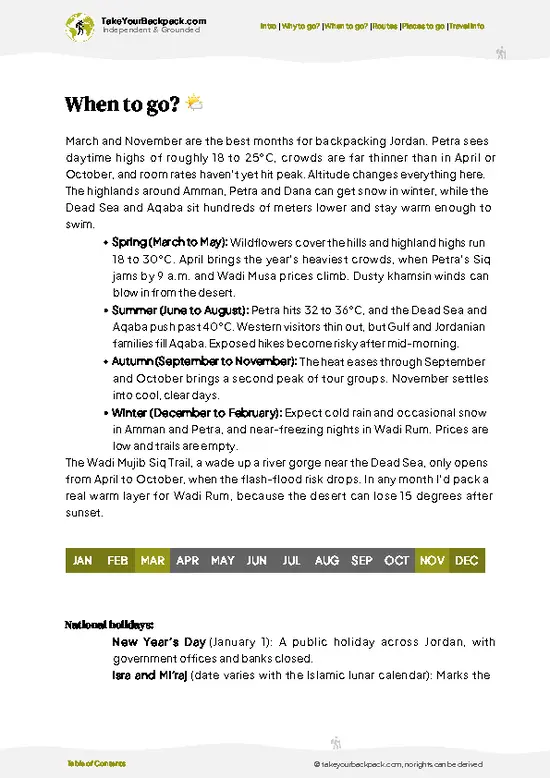
Best months: The best months for towns in Jordan are March to May and September to November, when daytime highs sit around 20 to 30°C and you can walk streets and ruins without the sun flattening you by 11 a.m. Spring brings wildflowers on the northern hills and green slopes after winter rain, while autumn is dry, clear and warm into the evening.
Summer and winter: From June to August, Amman and the plateau reach 30 to 35°C, and the southern desert and the Red Sea coast often pass 38 to 42°C. Start walking at dawn, rest through the afternoon and eat late. Hotels drop prices then, often 20 to 40 percent below spring rates. December to February is cold and wet on the plateau: Amman averages 5 to 12°C, with most of the country’s 200 to 600 mm of rain falling in those months, and snow can close … read more 👉
Best months: The best months for towns in Jordan are March to May and September to November, when daytime highs sit around 20 to 30°C and you can walk streets and ruins without the sun flattening you by 11 a.m. Spring brings wildflowers on the northern hills and green slopes after winter rain, while autumn is dry, clear and warm into the evening.
Summer and winter: From June to August, Amman and the plateau reach 30 to 35°C, and the southern desert and the Red Sea coast often pass 38 to 42°C. Start walking at dawn, rest through the afternoon and eat late. Hotels drop prices then, often 20 to 40 percent below spring rates. December to February is cold and wet on the plateau: Amman averages 5 to 12°C, with most of the country’s 200 to 600 mm of rain falling in those months, and snow can close roads around Amman and the highlands a few days each year. The Red Sea coast stays mild at 18 to 24°C.
Crowds and closures: Spring and October are the peak periods, when rooms in the south fill and prices climb. During Ramadan, daytime eating options shrink, many local places shut until sunset, and the evening meal turns lively and loud. Dates shift each year.

town hoppingPlanning Your Route Efficiently

How long to allow: A trip linking several towns in Jordan needs 7 to 12 days, enough to move at a human pace without living on buses. The country runs north to south in a line, so travel in one direction: fly into Amman, work through the northern hills, drop to the central plateau along the King’s Highway, then finish in the desert south and the Red Sea coast, flying out of Aqaba or returning by road.
Time per stop and between regions: Allow one to two nights per town, three if a stop is a base for desert or canyon days. Amman to the northern hills takes 1 to 1.5 hours, Amman to the central plateau 1.5 to 2.5 hours, and Amman to the south roughly 3 to 4 hours by road on the Desert Highway, with the King’s Highway taking longer for its curves and views. Aqaba is about 4 to 5 hours from Amman. … read more 👉
How long to allow: A trip linking several towns in Jordan needs 7 to 12 days, enough to move at a human pace without living on buses. The country runs north to south in a line, so travel in one direction: fly into Amman, work through the northern hills, drop to the central plateau along the King’s Highway, then finish in the desert south and the Red Sea coast, flying out of Aqaba or returning by road.
Time per stop and between regions: Allow one to two nights per town, three if a stop is a base for desert or canyon days. Amman to the northern hills takes 1 to 1.5 hours, Amman to the central plateau 1.5 to 2.5 hours, and Amman to the south roughly 3 to 4 hours by road on the Desert Highway, with the King’s Highway taking longer for its curves and views. Aqaba is about 4 to 5 hours from Amman. Buses and minibuses run from Amman’s terminals, but timetables are loose, so ask the evening before.
Planning mistakes: The classic error is cramming the south into a day trip from Amman, which means 7 to 8 hours on the road for a few hours in the heat. Sleep near the sites instead and start at dawn. Another is relying on afternoon public transport, which thins out after about 3 p.m. Move in the morning and keep a taxi fare in reserve.

The ListMust-Visit towns in Jordan

1 Wadi Musa

Petra gateway, hotel strip, Bedouin presence

Arrive early to navigate the busy main street, arrange Petra logistics, and experience local hospitality shaped by centuries of desert trade.

2 Umm Qais

Roman ruins, Golan views, Ottoman village

Wander among basalt ruins and stone houses while distant hills and borderlands shape a quiet, contemplative atmosphere above the Jordan Valley.

jordan-city-umm-qais
© Google |

3 Shobak

Crusader castle, orchard hills, rural quiet

Walk through castle ruins above orchards and fields, where the landscape feels remote and the pace of life slows noticeably.

4 Azraq

Desert oasis, basalt fort, wetland reserve

Visit a fortress built from black stone, spot migratory birds in fragile wetlands, and see how water scarcity shapes daily life.

5 Al-Tafilah

Mountain town, hot springs, mining legacy

Follow winding roads through rugged hills, soak in natural springs, and notice traces of Jordan’s industrial past in the landscape.

Loading the map 🌍

Expert viewWhat You Should Know

How many towns to visit: I advise four to six towns on a typical trip of 8 to 12 days. Fewer than four leaves you in a single climate and one style of Jordan. More than six turns the trip into a series of bus stations, because transport is loose and a missed minibus can cost half a day. Two nights in most places lets you wake early, catch the soft light before the heat, and eat a real dinner.
Choosing between kinds of towns: Jordan’s towns fall into three types. Desert and ancient-site towns cost the most and give the most famous views. Hotels and tours here run higher, and the big sites charge steep entry, so budget travelers get the best return by pairing one such stop with cheaper neighbors. Plateau and northern hill towns are cooler, cheaper and quieter, with bakeries, olive presses and … read more 👉
How many towns to visit: I advise four to six towns on a typical trip of 8 to 12 days. Fewer than four leaves you in a single climate and one style of Jordan. More than six turns the trip into a series of bus stations, because transport is loose and a missed minibus can cost half a day. Two nights in most places lets you wake early, catch the soft light before the heat, and eat a real dinner.
Choosing between kinds of towns: Jordan’s towns fall into three types. Desert and ancient-site towns cost the most and give the most famous views. Hotels and tours here run higher, and the big sites charge steep entry, so budget travelers get the best return by pairing one such stop with cheaper neighbors. Plateau and northern hill towns are cooler, cheaper and quieter, with bakeries, olive presses and few tour groups, ideal if you want everyday life and low costs. Amman is the practical hub with the widest food and bus choice, but it is noisy and hilly, so one or two nights is enough. The Red Sea coast suits anyone wanting a swim after dust, though it is hot and priced for resort visitors. Slow travelers should favor the hills; short-trip travelers should favor the south.
Budget: Expect US$35 to 60 a day on a lean independent budget. Dorm beds run about US$10 to 20, local meals of hummus, falafel and flatbread US$3 to 6, and intercity minibuses US$2 to 10 a leg. Shared taxis and short private rides add US$5 to 25 each. Entry to major heritage sites can cost around US$50 to 70 for a single day, though the Jordan Pass, which bundles the visa fee with many entries, saves money if you stay at least three nights and visit several sites. A local guide for a half day costs roughly US$25 to 60 and is worth it where there is little signage. Spend on the guide and the early start rather than on a pricier room.
Safety and culture: Jordan is among the safest countries in the region for independent travelers, and petty crime is low. The usual problems are taxi drivers who skip the meter, touts at big sites and sunburn. Agree a price before getting in or insist on the meter. Dress modestly: shoulders and knees covered suits towns away from the coast, and women often feel more comfortable in loose long sleeves. Accept tea when offered, ask before photographing people, and avoid eating or drinking openly in daytime during Ramadan. Avoid the border areas near Syria and Iraq, and check current government advice before travel. Carry at least 2 liters of water and wear a hat; the dry air hides how quickly you dehydrate.

✈️ The backpacker research shortcutJordan Travel Guide

An offline-friendly backpacking guide with optimized travel routes, ranked highlights, transport advice, and the best areas to stay.
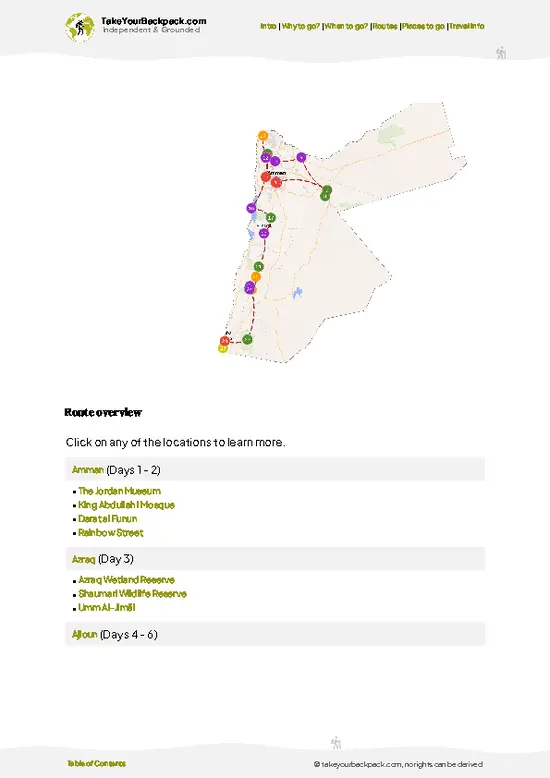
example page 0 from our offline Travel Guide for Jordan
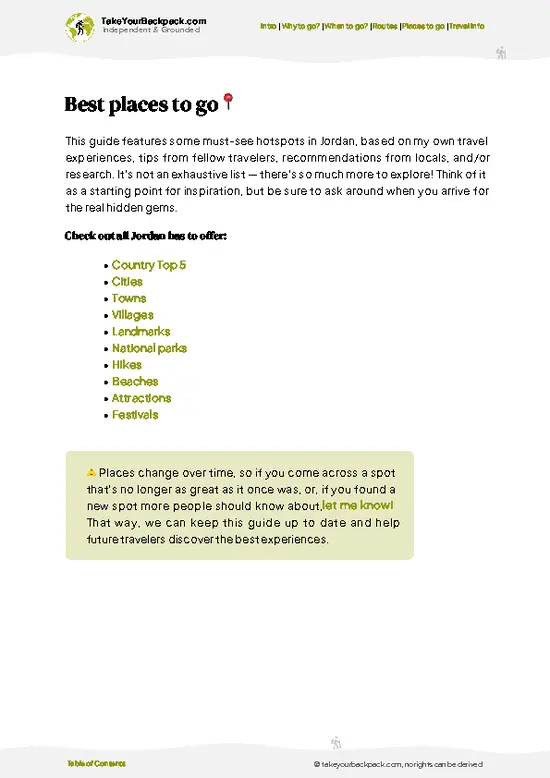
example page 1 from our offline Travel Guide for Jordan
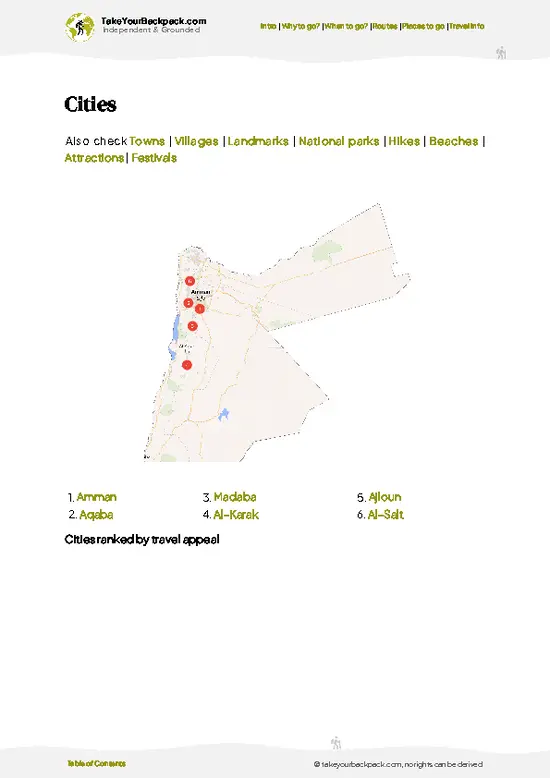
example page 2 from our offline Travel Guide for Jordan
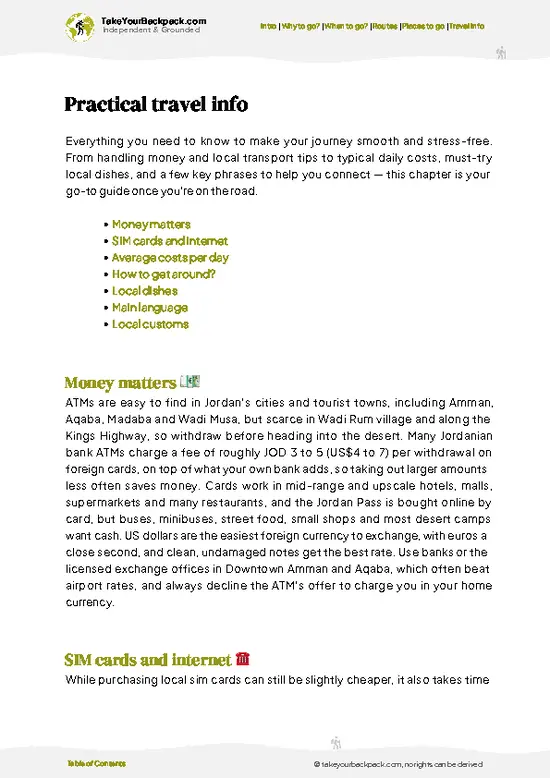
example page 3 from our offline Travel Guide for Jordan
example page 4 from our offline Travel Guide for Jordan
example page 5 from our offline Travel Guide for Jordan
example page 6 from our offline Travel Guide for Jordan
example page 7 from our offline Travel Guide for Jordan
The digital guide (230 pages) contains:
✅ 57 highlights, ranked by travel appeal
✅ Optimized 5, 10 & 15-day travel routes
✅ Cities, national parks, landmarks, beaches
✅ How to get around
✅ Offline-friendly for travel without Wi-Fi
👉 Click to see all 30+ guide features

📅 Plan smarter in minutes, not weeks
✅ Month by month travel advice
✅ Festivals & national holidays
✅ Budget expectations

🗺️ Go to the right places, skip the overrated ones
✅ Honest pros & cons of destinations
✅ Top hikes, parks & viewpoints
✅ Lesser-known places most travelers miss
✅ Clear “worth it vs skip it” guidance

🛏️ Travel smoothly without rookie mistakes
✅ Best areas to stay
✅ Transport systems explained simply
✅ Common scams & safety advice
✅ SIM cards, money & practical tips

🌍 Understand the country, not just visit it
✅ Culture & traditions
✅ 52 Essential phrases & customs
✅ Festivals worth planning around
✅ Traveler-friendly historical context
✅ Insights that make places more meaningful

📱 Built for real travel conditions
✅ Fully downloadable PDF
✅ Works completely offline
✅ Optimized for phone use
✅ Useful in remote areas & buses
✅ Everything in one place
Stop searching, start planning
Get instant access to your full guide. 30‑day money-back guarantee.
+ Add another guide for just

By proceeding you agree to our terms.
Sent to your inbox immediately after payment • 100% Secure Checkout
Best Backpacking Travel Advisor 2025 tourism awardBest Backpacking
Travel Advisor
2025
What others say about Take Your Backpack Guides:
⭐⭐⭐⭐⭐
Fantastic, amazing amount of information!
⭐⭐⭐⭐⭐
My goodness this is amazing, it's what I've been looking for hats off too you!
⭐⭐⭐⭐⭐
I think this is absolutely BRILLIANT
⭐⭐⭐⭐
Very complete and informative. It's still missing places, but I gotta to commend you
⭐⭐⭐⭐⭐
This is truly amazing, thank you, can't wait to explore it with my kids!
⭐⭐⭐⭐⭐
Awesome resource, thank you!
⭐⭐⭐⭐⭐
This is amazing! Can't wait to explore the ones I haven't seen
⭐⭐⭐⭐
I love this! Well done, great idea.
⭐⭐⭐⭐⭐
Thanks for taking the time to make this gem!
⭐⭐⭐⭐⭐
This might be the best website I've ever seen.
⭐⭐⭐⭐⭐
Congratulations, and thank you so much for your work; it's incredibly valuable.
⭐⭐⭐⭐
In all seriousness I think you did a great job pointing out the important spots
⭐⭐⭐⭐⭐
10/10 very good
⭐⭐⭐⭐⭐
As someone who's only just starting to visit regularly this is awesome, thank you.
⭐⭐⭐⭐
Thank you very much! I'm going to visit my dad, it's going to be very useful!
⭐⭐⭐⭐⭐
This is really cool! We'll be travelling for the first time and this definitely come in handy.
⭐⭐⭐⭐⭐
You are now our minister of culture, congratulations 👨‍💼
⭐⭐⭐⭐⭐
Just wanted to tell you that this is a pearl! Going to follow your recommendations.
⭐⭐⭐⭐⭐
This is so cool. I'll definitely be using the resource for my travels soon.
⭐⭐⭐⭐⭐
This is very impressive! Good work.
⭐⭐⭐⭐⭐
This is an amazing and informative site. Very well done!

🛏️ Where to stay?Top Areas to Stay

Jordan has plenty of hostels and budget guesthouses, with dorm beds typically running JD 8 to 15 (US$11 to 21) and simple private rooms from about JD 20 to 35 (US$28 to 50). In Amman, Downtown (Al-Balad) packs in the most cheap options within walking distance of the Citadel and Roman Theater, though it’s noisy with traffic and the call to prayer, while neighboring Jabal Amman around Rainbow Street costs a bit more but gives you leafy, safe streets plus the city’s best cafés and bars. Beyond the capital, Wadi Musa has the budget beds closest to Petra’s gate (quiet after dark), Wadi Rum swaps hostels for Bedouin desert camps, and Aqaba suits divers but has thinner, pricier budget choices.

If you … read more 👉
Jordan has plenty of hostels and budget guesthouses, with dorm beds typically running JD 8 to 15 (US$11 to 21) and simple private rooms from about JD 20 to 35 (US$28 to 50). In Amman, Downtown (Al-Balad) packs in the most cheap options within walking distance of the Citadel and Roman Theater, though it’s noisy with traffic and the call to prayer, while neighboring Jabal Amman around Rainbow Street costs a bit more but gives you leafy, safe streets plus the city’s best cafés and bars. Beyond the capital, Wadi Musa has the budget beds closest to Petra’s gate (quiet after dark), Wadi Rum swaps hostels for Bedouin desert camps, and Aqaba suits divers but has thinner, pricier budget choices.

If you enjoy meeting fellow travelers, consider choosing hostels with high ratings for atmosphere. On the other hand, if you prefer having your own space, a hotel might be a better option.

JordanDiscover the Country

👋 Meet the founderWho’s Behind Take Your Backpack?

Johan, backpacker and founder of TakeYourBackpackHi, I’m Johan (Netherlands 🇳🇱), the creator of TakeYourBackpack. Over the past 3 decades, I’ve backpacked through 90+ countries across six continents, gaining extensive experience with independent travel, long-term trips, and overland routes.

This site is built on a combination of firsthand travel experience and carefully curated insights from other backpackers. Many guides are based on places I’ve personally visited, while others bring together tips, observations, and practical advice shared by trusted travelers I’ve met along the way.

The goal is to provide realistic, experience-driven guidance — not generic itineraries — so you can explore destinations with better context, clearer expectations, and more confidence.