
×

Marshall Islands🇲🇭 | regionsMili AtollWartime airstrip, coastal guns, copra villages, turquoise reef flats | things to do and best time to go

Explore Ailuk AtollExplore Kwajalein Atoll

Backpacking in Mili Atoll
👀 For curious travelersregion ranked #4
By Johan Kruseman 🇳🇱 | Updated October 22, 2026

The decision here is whether to commit to the logistics, because reaching Mili means a flight from Majuro on a small aircraft with infrequent schedules, and that single fact tips it for or against. If you go, you get an atoll with almost no other visitors. Mili lies in the southeast of the Marshall Islands, roughly southeast of Majuro. On the ground it is coral sand lanes under coconut palms, the hum of generators, and the smell of copra drying in the sun. Rusted Japanese bunkers, guns and airstrip remains sit in the undergrowth, so every short walk ends at a wartime relic you can touch. Reef flats glow turquoise at low tide, and wading them gets you close to fish and clams. Heat and humidity are constant, there are no marked trails, and facilities are minimal. Arrange a local host before you land.

Discover everything you want to know in the 📖 Marshall Islands Travel Guide.


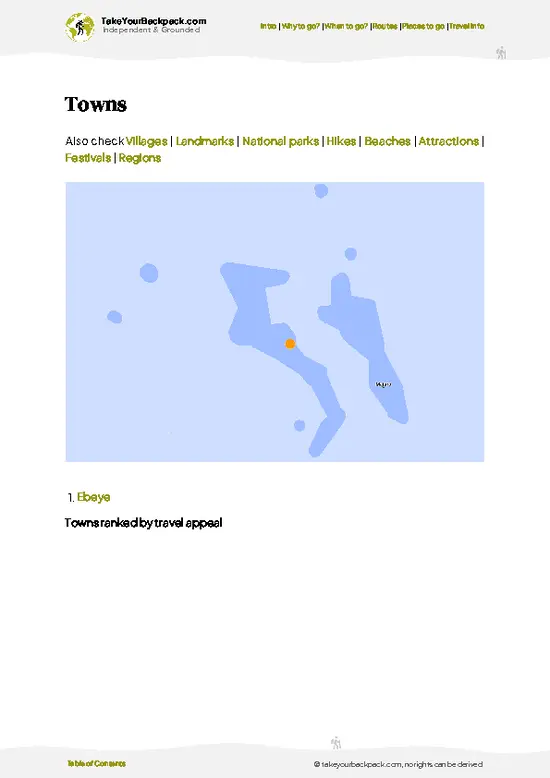
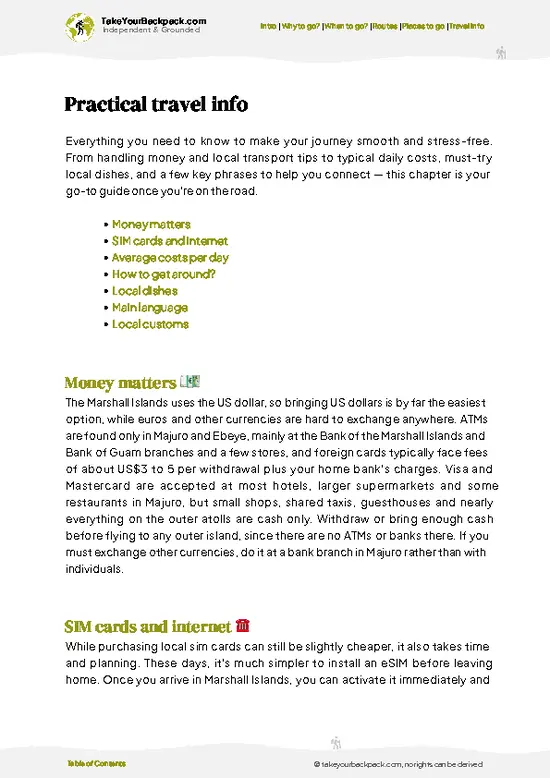
example page 0 from our offline Travel Guide for Marshall Islands
example page 1 from our offline Travel Guide for Marshall Islands
example page 2 from our offline Travel Guide for Marshall Islands
example page 3 from our offline Travel Guide for Marshall Islands
example page 4 from our offline Travel Guide for Marshall Islands
example page 5 from our offline Travel Guide for Marshall Islands
example page 6 from our offline Travel Guide for Marshall Islands
example page 7 from our offline Travel Guide for Marshall Islands
Loading the map 🌍
CLICK TO FILTER
towns
villages
landmarks
national parks
hikes
beaches
attractions
festivals
regions
SHOW COUNTRY’S BESTSHOW ALL

✨ Why go?
Ranked #4 region in Marshall Islands
What makes this region worth visiting

Backpackers choose Mili because it is one of the few places in Micronesia where you can walk among Japanese World War II ruins without a ticket booth, a guide script or another tourist in sight. The atoll was a Japanese garrison, and bunkers, gun emplacements, a communications structure and wrecked aircraft parts still lie scattered along the islets. You explore at your own pace, usually with a local family or island council member pointing the way, and that suits self-guided travelers far better than any tour could.

The second draw is the sheer remoteness of Mili’s lagoon, one of the larger lagoons in the country. Snorkeling the reef edges, watching locals fish and sharing meals of breadfruit and fresh catch gives you a real picture of outer-island life. Nothing here is packaged, so you … read more 👉
Backpackers choose Mili because it is one of the few places in Micronesia where you can walk among Japanese World War II ruins without a ticket booth, a guide script or another tourist in sight. The atoll was a Japanese garrison, and bunkers, gun emplacements, a communications structure and wrecked aircraft parts still lie scattered along the islets. You explore at your own pace, usually with a local family or island council member pointing the way, and that suits self-guided travelers far better than any tour could.

The second draw is the sheer remoteness of Mili’s lagoon, one of the larger lagoons in the country. Snorkeling the reef edges, watching locals fish and sharing meals of breadfruit and fresh catch gives you a real picture of outer-island life. Nothing here is packaged, so you adapt to island time, carry your own supplies and take whatever the day offers. For travelers who want history and quiet more than comfort, that is the whole appeal.

💡 HighlightsWhat this place is best known for

  1. Japanese Wartime Bunkers: Concrete and coral-rock fortifications left from the Japanese garrison, now wrapped in vines and pandanus. Crawling around the gun ports gives a clear sense of how isolated the soldiers were.
  2. Coastal Defense Guns: Heavy artillery pieces still point toward the sea on some islets, rusted brown and fused with the vegetation.
  3. Old Airstrip Remains: Wartime runway stretches near Mili’s northern islets, where coral surface shows through grass and palms. It is a flat, easy walk with a strong sense of history.
  4. Aircraft and Vehicle Wreckage: Corroded fragments of planes and machinery lie in the brush and on the reef, some reachable at low tide.
  5. Lagoon Snorkeling: Calm, clear water over coral heads, with reef fish, giant clams and the occasional ray. Visibility is best on still,
… read more 👉
  1. Japanese Wartime Bunkers: Concrete and coral-rock fortifications left from the Japanese garrison, now wrapped in vines and pandanus. Crawling around the gun ports gives a clear sense of how isolated the soldiers were.
  2. Coastal Defense Guns: Heavy artillery pieces still point toward the sea on some islets, rusted brown and fused with the vegetation.
  3. Old Airstrip Remains: Wartime runway stretches near Mili’s northern islets, where coral surface shows through grass and palms. It is a flat, easy walk with a strong sense of history.
  4. Aircraft and Vehicle Wreckage: Corroded fragments of planes and machinery lie in the brush and on the reef, some reachable at low tide.
  5. Lagoon Snorkeling: Calm, clear water over coral heads, with reef fish, giant clams and the occasional ray. Visibility is best on still, sunny days.
  6. Village Life on Mili Islet: Thatch and tin-roofed homes, church services, outrigger canoes pulled up on the sand and kids who will be curious about you.
  7. Sunset on the Ocean Side: The outer reef beaches face open Pacific swells, and the sky turns orange over breaking surf with almost no one else in view.
The item most visitors miss is the quiet overgrown corners of the smaller islets, where lesser-known bunkers and cisterns sit untouched because few boats ever land there.
Spotted a mistake or missing something? Contact us.

⌛️ 5 daysWhat you can realistically do in a week

Day 1: Mili Island: This is an arrival-and-orient day, built around a short flight and a slow walk. Flights from Majuro run on a thin schedule, so the plane dictates everything that follows. Land at the airstrip, settle in with a host family, and walk the nearby road past overgrown bunkers and rusting Japanese gun emplacements left from WWII. Keep the afternoon loose, because the tide and your host’s boat decide what is possible tomorrow.
Day 2: Mili Island Relics: Stay put and go deeper. Mili has thousands of war relics scattered through coconut groves, and a day on foot or by borrowed bicycle covers a surprising amount: concrete bunkers, wrecked aircraft parts, and old pillboxes along the reef side. Ask your host for a local guide, since the bush swallows the paths. Moving only once keeps … read more 👉
Day 1: Mili Island: This is an arrival-and-orient day, built around a short flight and a slow walk. Flights from Majuro run on a thin schedule, so the plane dictates everything that follows. Land at the airstrip, settle in with a host family, and walk the nearby road past overgrown bunkers and rusting Japanese gun emplacements left from WWII. Keep the afternoon loose, because the tide and your host’s boat decide what is possible tomorrow.
Day 2: Mili Island Relics: Stay put and go deeper. Mili has thousands of war relics scattered through coconut groves, and a day on foot or by borrowed bicycle covers a surprising amount: concrete bunkers, wrecked aircraft parts, and old pillboxes along the reef side. Ask your host for a local guide, since the bush swallows the paths. Moving only once keeps you out of the boat-dependent logistics for a day.
Day 3: Enejet: Now the lagoon takes over. Enejet, the other island with an airstrip, is reached by a local boat, and the ride across open water is the real transport lesson here: sailing depends on weather, fuel, and whoever is going that way. Go early, bring water, and plan to stay the night rather than rush back. The reward is a quieter island with its own wartime remains and almost no visitors.
Day 4: Detour to an Outer Islet: Ask your host to run you out to one of the smaller islets among the 92 in the ring. It adds sandy shallows, clear water for snorkeling, and a picnic on a beach with no footprints but yours. It costs only a few hours and fits inside the boat trip back toward your departure point, so nothing is added to the schedule.
Day 5: Back to the Airstrip: Keep the last day empty. Weather can delay a flight, and an unhurried morning with your hosts is better than a sprint. If you only get one day of the five, make it Day 2: the relic walk shows exactly why this atoll is worth the effort of reaching.

🌤️ When to go?When to go for the best experience

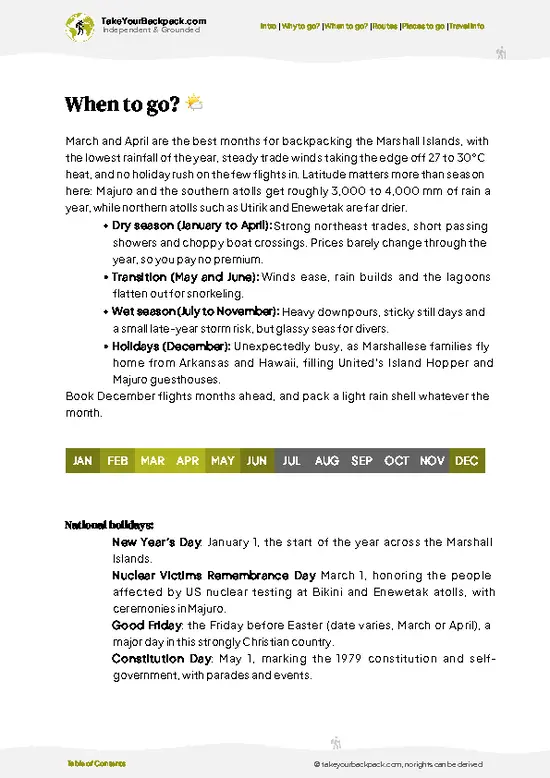
  • Dry Season (December to April): Trade winds keep the air at roughly 27 to 31°C (81 to 88°F), seas are calmer for the lagoon boat hops, and flights from Majuro run most reliably. This is the time to go.
  • Wet Season (May to November): Squalls roll through often, humidity sits high, and rain is possible any day. Highs stay around 28 to 31°C (82 to 88°F), and rough crossings can delay boats.
  • Daylight: Near the equator, sunrise comes between about 6:20 and 6:50 and sunset between about 6:15 and 6:50 all year, so plan walks and boat transfers for the cooler morning hours.
  • Crowds and Prices: Mili sees only a handful of visitors in any month. Prices for local transport and homestays do not change with the season, though flight seats tighten around the Christmas holidays.
Book the flight first, then build … read more 👉
  • Dry Season (December to April): Trade winds keep the air at roughly 27 to 31°C (81 to 88°F), seas are calmer for the lagoon boat hops, and flights from Majuro run most reliably. This is the time to go.
  • Wet Season (May to November): Squalls roll through often, humidity sits high, and rain is possible any day. Highs stay around 28 to 31°C (82 to 88°F), and rough crossings can delay boats.
  • Daylight: Near the equator, sunrise comes between about 6:20 and 6:50 and sunset between about 6:15 and 6:50 all year, so plan walks and boat transfers for the cooler morning hours.
  • Crowds and Prices: Mili sees only a handful of visitors in any month. Prices for local transport and homestays do not change with the season, though flight seats tighten around the Christmas holidays.
Book the flight first, then build the trip around it, because schedules from Majuro are thin and can shift with little notice.


source: climatestotravel.comJANJanuary: excellent for travelingFEBFebruary: excellent for travelingMARMarch: excellent for travelingAPRApril: excellent for travelingMAYMay: fair for travelingJUNJune: fair for travelingJULJuly: fair for travelingAUGAugust: fair for travelingSEPSeptember: fair for travelingOCTOctober: fair for travelingNOVNovember: fair for travelingDECDecember: excellent for traveling
when-to-go

✈️ The backpacker research shortcutMarshall Islands Travel Guide

An offline-friendly backpacking guide with optimized travel routes, ranked highlights, transport advice, and the best areas to stay.
example page 0 from our offline Travel Guide for Marshall Islands
example page 1 from our offline Travel Guide for Marshall Islands
example page 2 from our offline Travel Guide for Marshall Islands
example page 3 from our offline Travel Guide for Marshall Islands
example page 4 from our offline Travel Guide for Marshall Islands
example page 5 from our offline Travel Guide for Marshall Islands
example page 6 from our offline Travel Guide for Marshall Islands
example page 7 from our offline Travel Guide for Marshall Islands
The digital guide (125 pages) contains:
✅ 27 highlights, ranked by travel appeal
✅ Optimized 2, 3 & 5-day travel routes
✅ Cities, national parks, landmarks, beaches
✅ How to get around
✅ Offline-friendly for travel without Wi-Fi
👉 Click to see all 30+ guide features

📅 Plan smarter in minutes, not weeks
✅ Month by month travel advice
✅ Festivals & national holidays
✅ Budget expectations

🗺️ Go to the right places, skip the overrated ones
✅ Honest pros & cons of destinations
✅ Top hikes, parks & viewpoints
✅ Lesser-known places most travelers miss
✅ Clear “worth it vs skip it” guidance

🛏️ Travel smoothly without rookie mistakes
✅ Best areas to stay
✅ Transport systems explained simply
✅ Common scams & safety advice
✅ SIM cards, money & practical tips

🌍 Understand the country, not just visit it
✅ Culture & traditions
✅ 52 Essential phrases & customs
✅ Festivals worth planning around
✅ Traveler-friendly historical context
✅ Insights that make places more meaningful

📱 Built for real travel conditions
✅ Fully downloadable PDF
✅ Works completely offline
✅ Optimized for phone use
✅ Useful in remote areas & buses
✅ Everything in one place
Stop searching, start planning
Get instant access to your full guide. 30‑day money-back guarantee.
+ Add another guide for just

By proceeding you agree to our terms.
Sent to your inbox immediately after payment • 100% Secure Checkout
Best Backpacking Travel Advisor 2025 tourism awardBest Backpacking
Travel Advisor
2025
What others say about Take Your Backpack Guides:
⭐⭐⭐⭐⭐
Fantastic, amazing amount of information!
⭐⭐⭐⭐⭐
My goodness this is amazing, it's what I've been looking for hats off too you!
⭐⭐⭐⭐⭐
I think this is absolutely BRILLIANT
⭐⭐⭐⭐
Very complete and informative. It's still missing places, but I gotta to commend you
⭐⭐⭐⭐⭐
This is truly amazing, thank you, can't wait to explore it with my kids!
⭐⭐⭐⭐⭐
Awesome resource, thank you!
⭐⭐⭐⭐⭐
This is amazing! Can't wait to explore the ones I haven't seen
⭐⭐⭐⭐
I love this! Well done, great idea.
⭐⭐⭐⭐⭐
Thanks for taking the time to make this gem!
⭐⭐⭐⭐⭐
This might be the best website I've ever seen.
⭐⭐⭐⭐⭐
Congratulations, and thank you so much for your work; it's incredibly valuable.
⭐⭐⭐⭐
In all seriousness I think you did a great job pointing out the important spots
⭐⭐⭐⭐⭐
10/10 very good
⭐⭐⭐⭐⭐
As someone who's only just starting to visit regularly this is awesome, thank you.
⭐⭐⭐⭐
Thank you very much! I'm going to visit my dad, it's going to be very useful!
⭐⭐⭐⭐⭐
This is really cool! We'll be travelling for the first time and this definitely come in handy.
⭐⭐⭐⭐⭐
You are now our minister of culture, congratulations 👨‍💼
⭐⭐⭐⭐⭐
Just wanted to tell you that this is a pearl! Going to follow your recommendations.
⭐⭐⭐⭐⭐
This is so cool. I'll definitely be using the resource for my travels soon.
⭐⭐⭐⭐⭐
This is very impressive! Good work.
⭐⭐⭐⭐⭐
This is an amazing and informative site. Very well done!

🛏️ Where to stay?Best areas to stay in Marshall Islands

The best option is a homestay with a local family on Mili Island or one of the other inhabited islets, because there are no hotels or hostels in the atoll. Nothing inside the historical park itself is set up for overnight guests, so you sleep in the village and walk or boat out to the sites. Expect a mat or simple bed, a shared bathroom, rainwater for washing, and meals of rice, breadfruit, fish and coconut. Electricity is limited, so bring a power bank. Arrangements usually go through contacts in Majuro, the Mili atoll local government or your family host, and it is polite to bring food supplies … read more 👉
The best option is a homestay with a local family on Mili Island or one of the other inhabited islets, because there are no hotels or hostels in the atoll. Nothing inside the historical park itself is set up for overnight guests, so you sleep in the village and walk or boat out to the sites. Expect a mat or simple bed, a shared bathroom, rainwater for washing, and meals of rice, breadfruit, fish and coconut. Electricity is limited, so bring a power bank. Arrangements usually go through contacts in Majuro, the Mili atoll local government or your family host, and it is polite to bring food supplies or a gift to share.

Majuro is the gateway and the place to sort your gear. The Marshall Islands Resort, Hotel Robert Reimers and a few guesthouses near Delap and Uliga work for a night before or after the flight. Stock up on water, snacks, cash in US dollars and insect repellent there, since Mili has very limited shopping. Camping is possible only with the landowner’s permission, and the family will usually prefer you stay with them.

🚌 Getting aroundHow to get from A to B

Walking works on the islet where you sleep, and it stops making sense the moment the coral road ends. Mili Atoll is a ring of 92 islets around a big lagoon, so most of what you want to see sits across water. Everything runs on fuel, favors, and tides, so schedules are loose and plans bend. Expect salt spray, diesel fumes, and hot, bright reef flats.
  • Flights from Majuro: Air Marshall Islands links Majuro with the airstrip on Enejet, and seats are few and fill with locals. Fares run roughly US$100 to 200 each way, and the flight is short, well under an hour. Service is irregular because the airline is small and aircraft are shared across many outer islands, so an experienced traveler books early and leaves a buffer of several days at both ends.
  • Field-trip ship: Government cargo ships serve the
… read more 👉
Walking works on the islet where you sleep, and it stops making sense the moment the coral road ends. Mili Atoll is a ring of 92 islets around a big lagoon, so most of what you want to see sits across water. Everything runs on fuel, favors, and tides, so schedules are loose and plans bend. Expect salt spray, diesel fumes, and hot, bright reef flats.
  • Flights from Majuro: Air Marshall Islands links Majuro with the airstrip on Enejet, and seats are few and fill with locals. Fares run roughly US$100 to 200 each way, and the flight is short, well under an hour. Service is irregular because the airline is small and aircraft are shared across many outer islands, so an experienced traveler books early and leaves a buffer of several days at both ends.
  • Field-trip ship: Government cargo ships serve the outer atolls on long, uncertain loops, with deck space for a few dollars a day. They run this way because they carry copra, fuel, and supplies first, passengers second. Veterans bring a mat, food, water, and a flexible calendar, and treat it as an overnight adventure, not transport.
  • Local skiffs: Aluminum boats with outboards are the real transit system between islets, about US$10 to 40 per trip depending on distance and fuel. The lagoon is shallow and can be glassy in the morning and choppy by afternoon, so locals travel early. Agree the price and the return time before you step in, and wear sandals that can get soaked.
  • Walking and bicycles: Short sandy and coral tracks link houses, the airstrip, and WWII sites on the same islet. Sun is fierce by mid-morning, with little shade except under pandanus and breadfruit. Go at first light, carry a liter or two of water, and borrow a bike from your host if one is spare.
Ask your host to arrange boat rides, since families own the boats and know which channels are safe at which tide.

👛 Costs (as of 22 October 2026)Travel costs and budget guide for Mili Atoll

Expect to spend about US$70 to 130 a day on Mili, with flights from Majuro the biggest expense and everything else modest. The Marshall Islands uses the US dollar.
CategoryBudget RangeLocal Reality
Entrance FeesUS$0 to 10No formal park gate. Families sometimes ask for a small contribution to visit WWII sites on their land.
AccommodationUS$25 to 50Homestay with the host family, usually including a simple bed and shared bathroom. Majuro guesthouses cost more.
Local TransportUS$15 to 40Boat hire for lagoon trips and to visit other islets, priced by fuel and distance. The Majuro flight is a separate cost, often US$150 to 300 each way.
Food and SuppliesUS$15 to 25Meals are usually provided by the host for a fee. Bring snacks and bottled water from Majuro.
ExtrasUS$5Small gifts for the family, repellent
… read more 👉
Expect to spend about US$70 to 130 a day on Mili, with flights from Majuro the biggest expense and everything else modest. The Marshall Islands uses the US dollar.
CategoryBudget RangeLocal Reality
Entrance FeesUS$0 to 10No formal park gate. Families sometimes ask for a small contribution to visit WWII sites on their land.
AccommodationUS$25 to 50Homestay with the host family, usually including a simple bed and shared bathroom. Majuro guesthouses cost more.
Local TransportUS$15 to 40Boat hire for lagoon trips and to visit other islets, priced by fuel and distance. The Majuro flight is a separate cost, often US$150 to 300 each way.
Food and SuppliesUS$15 to 25Meals are usually provided by the host for a fee. Bring snacks and bottled water from Majuro.
ExtrasUS$5Small gifts for the family, repellent and sunscreen.
Total Daily BudgetUS$70 to 130Excludes flights to and from Majuro.
⚠️ Prices can change and everyone travels differently, so take this as a rough guide. Hope it helps you plan your adventure!

🍲 FoodWhat to Eat & Drink

Food here is built from the reef and the coconut. Expect fresh tuna and reef fish grilled over coals or served raw with lime, plus breadfruit roasted until smoky and dense, and pandanus fruit with a sticky, sweet chew. Coconut crab and lagoon lobster appear when hosts want to impress. Rice, canned meat, and instant noodles fill the gaps, because supplies arrive by plane and ship. Drinks are simple: green coconut water, strong instant coffee, and sweet tea.

There are no restaurants or markets in the usual sense. You eat with your host family, usually on a mat or at a plain table, and meals cost about US$10 to 20 a day if arranged in advance. Bring snacks and drinking water from Majuro, as shops are tiny and stock runs out.

Food is shared. Wait to be served, accept a little of everything, … read more 👉
Food here is built from the reef and the coconut. Expect fresh tuna and reef fish grilled over coals or served raw with lime, plus breadfruit roasted until smoky and dense, and pandanus fruit with a sticky, sweet chew. Coconut crab and lagoon lobster appear when hosts want to impress. Rice, canned meat, and instant noodles fill the gaps, because supplies arrive by plane and ship. Drinks are simple: green coconut water, strong instant coffee, and sweet tea.

There are no restaurants or markets in the usual sense. You eat with your host family, usually on a mat or at a plain table, and meals cost about US$10 to 20 a day if arranged in advance. Bring snacks and drinking water from Majuro, as shops are tiny and stock runs out.

Food is shared. Wait to be served, accept a little of everything, and offer to contribute fish or rice. Compliment the cook, and do not waste food. Alcohol is limited and best left to the host’s lead.

🛡️ SafetyStaying Safe: What Travelers Should Know

Mili is low-risk, and the hazards that matter are sun, water and isolation. At roughly 6°N the sun is intense all day, so wear a hat and long sleeves and drink plenty of water, since rainwater and bottled supplies are limited. Lagoon crossings in small boats can get choppy in squalls, so ask your host about conditions and wear a life jacket if one is offered. Currents run strongly through the channels between islets, so swim only where locals say it is safe. Walking is flat on sand and coral rubble, and reef shoes protect against sharp coral and stonefish. Wartime relics such as bunkers and rusted guns can have unstable footing and sharp metal, and unexploded ordnance may remain, so never touch or move anything. There are no dangerous land animals, though mosquitoes carry dengue, so use repellent. … read more 👉
Mili is low-risk, and the hazards that matter are sun, water and isolation. At roughly 6°N the sun is intense all day, so wear a hat and long sleeves and drink plenty of water, since rainwater and bottled supplies are limited. Lagoon crossings in small boats can get choppy in squalls, so ask your host about conditions and wear a life jacket if one is offered. Currents run strongly through the channels between islets, so swim only where locals say it is safe. Walking is flat on sand and coral rubble, and reef shoes protect against sharp coral and stonefish. Wartime relics such as bunkers and rusted guns can have unstable footing and sharp metal, and unexploded ordnance may remain, so never touch or move anything. There are no dangerous land animals, though mosquitoes carry dengue, so use repellent. Medical care is minimal, so bring a full first-aid kit and any medication.

FAQTraveler FAQ

Plan on 3 to 4 days, which fits the limited flight schedule from Majuro and gives you time on the main islet plus a boat trip or two. One full day covers the Japanese bunkers, guns and wreckage near the villages. Add extra days for reef walks and buffer for weather delays, since flights can be postponed.
No car is needed, and there are almost no roads of note on the atoll. You fly from Majuro to Mili’s airstrip, then walk the islet or hire a local boat for trips across the lagoon, typically US$15 to 40 a day. Everything near the village is within an hour on foot.
There is no formal entrance fee or permit gate, but you should ask permission from the landowner or local government before visiting WWII sites. A small contribution of about US$5 to 10 is appreciated. Arrange the visit through your homestay host or contacts in Majuro before you fly.
⚠️ Things can change over time, so always validate details locally before you go.

Other Marshallese regions near Mili Atoll

Explore more nearby:

  • Arno Atoll—Ine porches, pandanus mats, lagoon skiffs, sandy single lane| 108 km away
  • Majuro—Capital road, Alele Museum, Laura Beach, reef drop-offs| 115 km away
  • Maloelap Atoll—Taroa airbase ruins, Zero wreck, lagoon wrecks, reef passes| 302 km away

💡 Not sure where to go next?
Create a personalized itinerary for Marshall Islands including Mili Atoll and the places that fit your trip.

Generate my itinerary

👉 Discover all regions

Or checkout all Marshall Islands has to offer (think cities, towns, villages, national parks, hikes, beaches, festivals)
Country photo of Marshall Islands

We 💚 feedbackIs it worth it?

Mili suits history-minded travelers who are happy with no schedule, no menu and no signal. Come with patience, bring more food and water than seems sensible, and tell your host early what you want to see. I would pack headlamp batteries and sturdy reef shoes before anything else.

✍️ Help improve this page!
The information on this page is based on in-depth research, insights shared by experienced travelers, and feedback from the local travel community in Marshall Islands. While every effort is made to keep the information accurate and current, conditions can change — so if you spot anything incorrect or outdated, please get in touch.


🙋‍♂️ Give feedback

👋 Meet the founderWho’s Behind Take Your Backpack?

Johan, backpacker and founder of TakeYourBackpackHi, I’m Johan (Netherlands 🇳🇱), the creator of TakeYourBackpack. Over the past 3 decades, I’ve backpacked through 90+ countries across six continents, gaining extensive experience with independent travel, long-term trips, and overland routes.

This site is built on a combination of firsthand travel experience and carefully curated insights from other backpackers. Many guides are based on places I’ve personally visited, while others bring together tips, observations, and practical advice shared by trusted travelers I’ve met along the way.

The goal is to provide realistic, experience-driven guidance — not generic itineraries — so you can explore destinations with better context, clearer expectations, and more confidence.