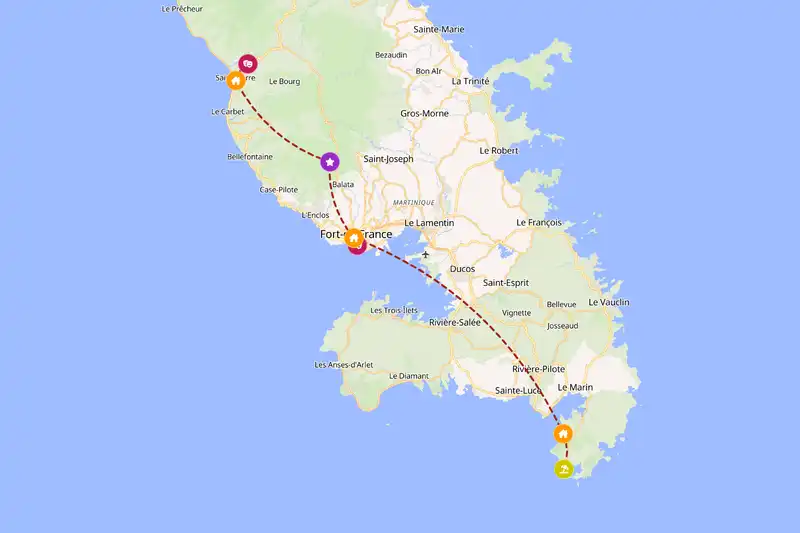
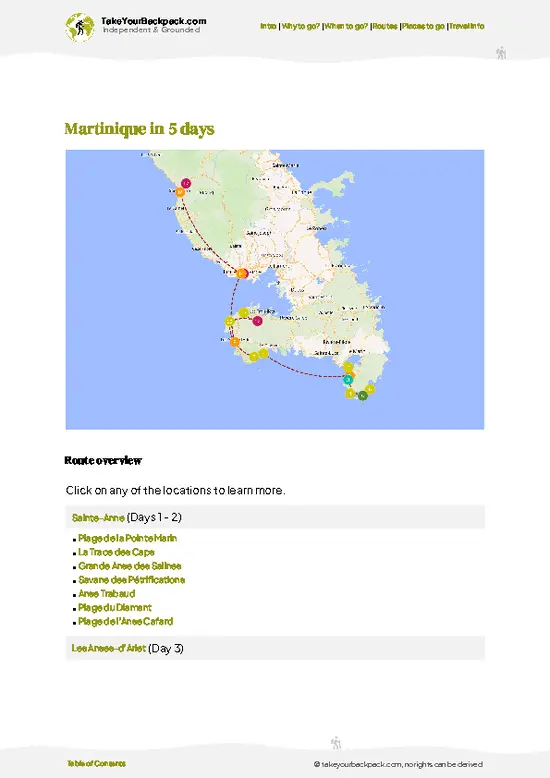
This five-day loop suits travelers who want a full picture of Martinique on a backpacker’s footing: two nights by the southern beaches, one in a fishing village, and two in the capital with a day in the volcanic north. The pace is steady but never frantic, with one long walking day and one fiddly transfer day. You will use taxis collectifs (the island’s shared minibuses), the vedettes (passenger ferries) across the bay to Fort-de-France, and a taxi or one-day rental car for the south coast leg, where shared minibus connections thin out.
Days 1-2: Sainte-Anne and La Trace des Caps
Start at the bottom of the island, because that is where Martinique looks most like the postcard.
Sainte-Anne is a low-rise village with a pastel church, a waterfront of snack bars and a morning market selling spices and local punch. Spend the first afternoon on
Plage de la Pointe Marin, a short walk from the center, where the shallow water stays calm enough to float for an hour.
Day 2 is the big one. Pick up
La …
read more 👉This five-day loop suits travelers who want a full picture of Martinique on a backpacker’s footing: two nights by the southern beaches, one in a fishing village, and two in the capital with a day in the volcanic north. The pace is steady but never frantic, with one long walking day and one fiddly transfer day. You will use taxis collectifs (the island’s shared minibuses), the vedettes (passenger ferries) across the bay to Fort-de-France, and a taxi or one-day rental car for the south coast leg, where shared minibus connections thin out.
Days 1-2: Sainte-Anne and La Trace des Caps
Start at the bottom of the island, because that is where Martinique looks most like the postcard. Sainte-Anne is a low-rise village with a pastel church, a waterfront of snack bars and a morning market selling spices and local punch. Spend the first afternoon on Plage de la Pointe Marin, a short walk from the center, where the shallow water stays calm enough to float for an hour.
Day 2 is the big one. Pick up La Trace des Caps, the coastal trail that wraps around the island’s southern tip, and follow it to Grande Anse des Salines, roughly 1 km of pale sand under leaning coconut palms, with the outline of Saint Lucia on clear days. Keep going past the salt pond to La Savane des Pétrifications, a dry, wind-scoured headland of red rock and scrub that feels like a different country, then on to Anse Trabaud, a wild Atlantic-side beach with no buildings at all. Start by 7 am, carry at least 2 liters of water per person, and expect 5 to 7 hours on your feet for the round trip. There is almost no shade past Salines.Day 3: Plage du Diamant to Les Anses d’Arlet
Moving west along the south coast is the one day where a car or taxi saves real time; the shared minibuses need changes and can stretch the trip to 2 to 3 hours. Stop at Plage du Diamant, a long, rough-water beach facing the Rocher du Diamant, a sheer rock island about 175 meters high. A few minutes away, Plage de l’Anse Caffard holds the Cap 110 memorial: twenty white stone figures, heads bowed, facing the sea in memory of a slave ship wrecked off this point in 1830.
Sleep in Les Anses d’Arlet, where a white church stands at the end of the pier and fishing boats sit on the sand. In the late afternoon, walk or ride over the hill to Anse Dufour to snorkel with green turtles grazing the seagrass, then take the steps down to Anse Noire, a small black-sand cove with a wooden jetty and coral close to shore.Day 4: The Slave Savannah and the Ferry to Fort-de-France
Head north to the Trois-Îlets area for The Slave Savannah, an open-air reconstruction of thatched huts, gardens and a 19th-century village built by a local historian to explain plantation life and its aftermath. Allow 2 hours. From there it is a short hop to Plage de l’Anse à l’Âne, a quiet family beach with its own ferry pontoon, and the vedette crosses the bay to Fort-de-France in about 20 to 30 minutes. Arriving by water gives you the best first look at the city: the fort walls, the Schoelcher Library’s iron dome and the green hills behind.
Spend the rest of the day on foot. The Musée d’Histoire et d’Ethnographie de Fort-de-France occupies a restored Creole villa with period furniture, jewelry and madras costumes, and it gives a far better sense of 19th-century island life than any souvenir stall on the Savane park.Day 5: Saint-Pierre and Distillerie Depaz
Finish with the north. A taxi collectif from the Pointe Simon terminal follows the Caribbean coast to Saint-Pierre in under an hour, past the fishing beaches of Case-Pilote and Le Carbet. The town was the island’s capital until Mont Pelée erupted on 8 May 1902 and killed around 28,000 people in minutes; you can still walk through the shell of the old theater and peer into the cell where prisoner Ludger Sylbaris (also known as Cyparis) survived. Then walk about 1 km uphill to Distillerie Depaz, a working rum estate at the foot of the volcano with free tastings and an old manor house. Catch a minibus back before 5 pm, when service dries up.
For one last detour, ask about the tombolo at Sainte-Marie, a sandbar that surfaces in the dry season and lets you wade across to a small islet on the Atlantic side.
 Best Backpacking