×

Montenegro🇲🇪 | best townsEssential 11 towns to Explore in Montenegro

Towns in Montenegro pack a lot into a small country, and the character changes every hour or so by bus. On the Adriatic coast, stone lanes smell of grilled fish and diesel, church bells carry over terracotta roofs, and summer prices and crowds climb fast. Inland, mountain towns sit under limestone walls with cool air, woodsmoke and far fewer visitors, though buses thin out. The Bay of Kotor sits between the two, steep and dramatic. For backpacking or independent travel, the coast offers ease and the interior offers space and lower costs.

By Johan Kruseman 🇳🇱 | Updated October 18, 2026
Explore the best villages in Montenegro

Why go?Understanding Their Importance

Montenegro is about 13,800 square kilometers, yet the Adriatic coast, a deep fjord-like bay, lakes and 2,000-meter limestone massifs all sit within a couple of hours of one another. That compression is why the towns feel so different. A walled Venetian-era port, an Ottoman-influenced market quarter with minarets and a clock tower, and a Slavic Orthodox monastery town can share one bus route. Centuries of Venetian, Ottoman and Austro-Hungarian rule left churches, bazaars and fortifications in layers, and you hear it in the call to prayer and the church bells.

The mountains shape everything. Roads twist through canyons and tunnels, distances are short but journeys are slow, and a 90 kilometer trip can take two hours. There is no rail network worth planning around, so buses and shared minivans … read more 👉
Montenegro is about 13,800 square kilometers, yet the Adriatic coast, a deep fjord-like bay, lakes and 2,000-meter limestone massifs all sit within a couple of hours of one another. That compression is why the towns feel so different. A walled Venetian-era port, an Ottoman-influenced market quarter with minarets and a clock tower, and a Slavic Orthodox monastery town can share one bus route. Centuries of Venetian, Ottoman and Austro-Hungarian rule left churches, bazaars and fortifications in layers, and you hear it in the call to prayer and the church bells.

The mountains shape everything. Roads twist through canyons and tunnels, distances are short but journeys are slow, and a 90 kilometer trip can take two hours. There is no rail network worth planning around, so buses and shared minivans carry most travelers, and timetables are fluid, especially outside summer. Coastal towns fill with cruise passengers and package visitors, while inland towns stay quiet, with plain cafés serving strong coffee and burek in the morning.

Know before you choose: the country uses the euro, cash is still common in smaller places, and summer on the coast means heat on stone, packed lanes and high prices. Mountain and lake towns suit those who want space, and they reward anyone willing to ride a slow bus.
How the List Was Created
The list of best towns in Montenegro is created based on charm, local culture, atmosphere, hidden gems, and visitor appeal. If you feel a town is missing in this list, please let us know.

When to go?Best Time to Visit Montenegro for towns

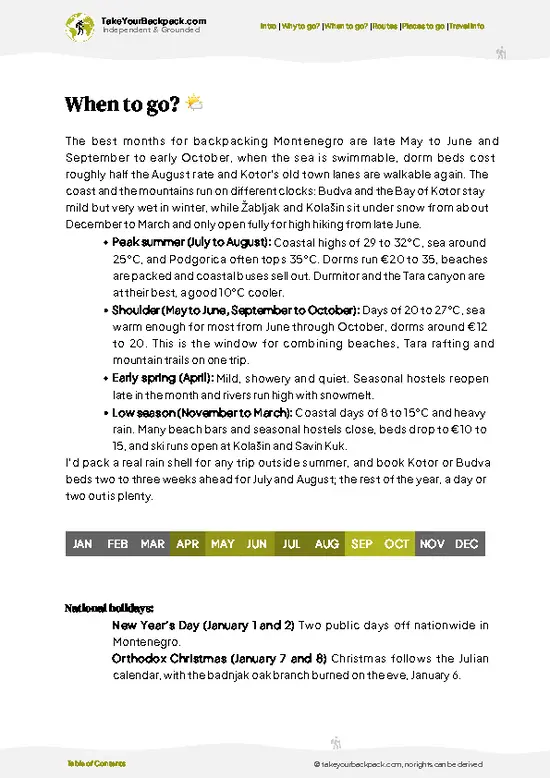
Best months: May, June and September: Late May, June and September are the best months for towns in Montenegro, because the coast sits at roughly 22 to 28°C, the sea is swimmable by late May or June, and the lanes are not yet jammed. Light in these months is soft and golden by early evening, and stone streets lose the midday heat quickly.

Summer peak: July and August: Coastal towns hit 30 to 35°C in July and August, with hot, still air in narrow streets and bay towns that trap heat. Accommodation prices on the coast can run 50 to 100 percent above shoulder-season rates, and beds in old towns sell out. Inland and mountain towns are a relief, with daytime temperatures often 20 to 28°C and cool nights, so summer works well if you head north and up.

Winter and early spring: From November to … read more 👉
Best months: May, June and September: Late May, June and September are the best months for towns in Montenegro, because the coast sits at roughly 22 to 28°C, the sea is swimmable by late May or June, and the lanes are not yet jammed. Light in these months is soft and golden by early evening, and stone streets lose the midday heat quickly.

Summer peak: July and August: Coastal towns hit 30 to 35°C in July and August, with hot, still air in narrow streets and bay towns that trap heat. Accommodation prices on the coast can run 50 to 100 percent above shoulder-season rates, and beds in old towns sell out. Inland and mountain towns are a relief, with daytime temperatures often 20 to 28°C and cool nights, so summer works well if you head north and up.

Winter and early spring: From November to March the coast is mild, around 8 to 14°C, but wet. Rain is heavy, with the Bay of Kotor region among the wettest areas in Europe, and many seasonal cafés, guesthouses and boat operators close. Mountain towns in the north see snow, often from December, and temperatures can fall well below freezing, with roads and bus services affected. April can be fresh and green but unsettled, with rain and cool evenings.

town hoppingTips for Visiting Multiple Destinations

Plan 7 to 12 days for several towns: A trip linking several towns in Montenegro works best over 7 to 12 days, because the country is small but the roads are slow and mountainous. Most travelers do well flowing north from the coast or the reverse, starting at a coastal hub such as Podgorica or Tivat airport, then working along the Adriatic and finishing inland.

The coast and the Bay of Kotor group naturally, with hops of 30 to 90 minutes by bus. The interior, around the capital and the mountains, is a separate cluster. Crossing from coast to mountains typically takes 1.5 to 3 hours, and Podgorica is the main transport hub for onward buses.

Give coastal stops 1 to 3 nights, since old streets are best seen early or late. Mountain towns deserve 2 to 3 nights, because journeys eat most of a day. … read more 👉
Plan 7 to 12 days for several towns: A trip linking several towns in Montenegro works best over 7 to 12 days, because the country is small but the roads are slow and mountainous. Most travelers do well flowing north from the coast or the reverse, starting at a coastal hub such as Podgorica or Tivat airport, then working along the Adriatic and finishing inland.

The coast and the Bay of Kotor group naturally, with hops of 30 to 90 minutes by bus. The interior, around the capital and the mountains, is a separate cluster. Crossing from coast to mountains typically takes 1.5 to 3 hours, and Podgorica is the main transport hub for onward buses.

Give coastal stops 1 to 3 nights, since old streets are best seen early or late. Mountain towns deserve 2 to 3 nights, because journeys eat most of a day.

The usual planning mistakes are packing in too many stops, trusting map distances rather than road time, and arriving at bus stations late in the day, when departures thin out. Another is moving on summer weekends, when coast roads clog and buses fill. Instead, book accommodation early for July and August, travel in the morning, and treat every transfer as a half day. Fewer bases with day trips usually works better than one-night stands.

The ListTop towns of Montenegro

1 Kotor

fortified old town, fjord-like bay, stone alleys

Ascend ancient ramparts, navigate narrow lanes, and absorb the atmosphere of a town shaped by centuries of maritime trade.

montenegro-city-kotor
© Google | Fitor Haziri

2 Budva

beachfront nightlife, medieval walls, Adriatic views

Swim at busy beaches, wander stone alleys after dark, and watch the coastline shift from day to night in this coastal hub.

montenegro-city-budva
© Google | Mike Halikias

3 Herceg Novi

fortresses, botanical gardens, bay entrance

Climb steep lanes lined with subtropical plants, pass layered fortifications, and watch boats enter the Bay of Kotor from the promenade.

montenegro-city-herceg-novi
© Google | Joe 97

4 Tivat

marina, modern developments, coastal promenade

Stroll along the waterfront, observe luxury yachts, and see how new architecture meets the Adriatic in this evolving port town.

montenegro-city-tivat
© Google |

5 Cetinje

royal palaces, museums, mountain plateau

Visit former royal residences, explore national collections, and sense the legacy of Montenegro’s old capital in a compact setting.

montenegro-city-cetinje
© Google |

6 Risan

Roman mosaics, citrus groves, sheltered bay

Wander among ancient floor mosaics, breathe in the scent of citrus, and watch fishermen mend nets along the calm shoreline.

montenegro-city-risan
© Google | Sandra Vidic

7 Nikšić

industrial heritage, brewery, mountain backdrop

Experience a working city where local beer, rugged landscapes, and a practical pace offer a different side of Montenegro.

montenegro-city-niksic
© Google |

8 Plav

glacial lake, alpine villages, borderland

Hike through remote valleys, stay in mountain guesthouses, and discover a region shaped by its proximity to Albania and Kosovo.

montenegro-city-plav
© Google |

9 Gusinje

Mountain valley, Ottoman mosques, borderland markets

Trace the contours of the valley, visit mosques with distinct minarets, and experience a crossroads where cultures and languages meet.

montenegro-city-gusinje
© Google |

10 Plužine

Piva Lake, canyon views, pine forests

Paddle across turquoise water, hike above deep gorges, and find quiet corners where the forest meets the lakeshore.

11 Rožaje

pine forests, mosque skyline, eastern gateway

Travelers find a distinct cultural blend, forested hills, and a quieter rhythm in this northeastern town near the Serbian border.

montenegro-city-rozaje
© Google |
Loading the map 🌍

Expert viewInsights from Locals and Experts

How many towns to visit: Three to five towns is the number I would advise for a backpacker, because transfers on winding mountain roads eat half a day each, and one town per two nights lets you see morning light and evening quiet. Below three you miss the contrast between coast and mountains, and above five you spend more time in bus stations than in the streets.

Which kind to prioritize: For a first trip, mix one walled coastal town, one bay town and one inland or mountain town. Coastal towns cost the most in money and comfort, since lanes are crowded and hot in summer, but they give you the easiest transport and the best food and swimming. Inland towns cost less and feel calmer, though buses are slower and rooms can be harder to book spontaneously. For the most value, I would put the inland … read more 👉
How many towns to visit: Three to five towns is the number I would advise for a backpacker, because transfers on winding mountain roads eat half a day each, and one town per two nights lets you see morning light and evening quiet. Below three you miss the contrast between coast and mountains, and above five you spend more time in bus stations than in the streets.

Which kind to prioritize: For a first trip, mix one walled coastal town, one bay town and one inland or mountain town. Coastal towns cost the most in money and comfort, since lanes are crowded and hot in summer, but they give you the easiest transport and the best food and swimming. Inland towns cost less and feel calmer, though buses are slower and rooms can be harder to book spontaneously. For the most value, I would put the inland towns first if you like hiking and quiet, and the coast first only if you want sea and nightlife.

What it costs: Budget US$35 to 60 a day in shoulder season, using hostels or simple rooms at roughly €15 to 30 a night, plus bakery meals and local buses. In July and August expect US$60 to 100 a day on the coast, as dorm beds and private rooms rise sharply. Local buses between towns usually run €2 to 10 per leg, and a taxi over the same distance can cost several times more. Entering town fortifications or old-town museums is often €2 to 15 each, and city wall climbs are the priciest sights, so choose one or two rather than all. Guides are rarely needed, but a half-day walking tour typically runs €15 to 30.

Safety and cultural notes: Towns are generally safe, with petty theft the main concern in crowded summer lanes, so keep phones and bags close. Steep marble steps get slick after rain, and summer heat on stone is real, so carry water and wear shoes with grip. Taxi drivers at ports and bus stations may quote inflated fares, so agree a price first or use a ride app. Dress modestly for monasteries and churches, with covered shoulders and knees, and remove hats inside. Mosques in older quarters expect similar respect. Smoking indoors is still common in cafés, and tipping about 10 percent or rounding up is normal. Cash helps in small places, and drivers on narrow roads can be fast, so take care crossing.

✈️ The backpacker research shortcutMontenegro Travel Guide

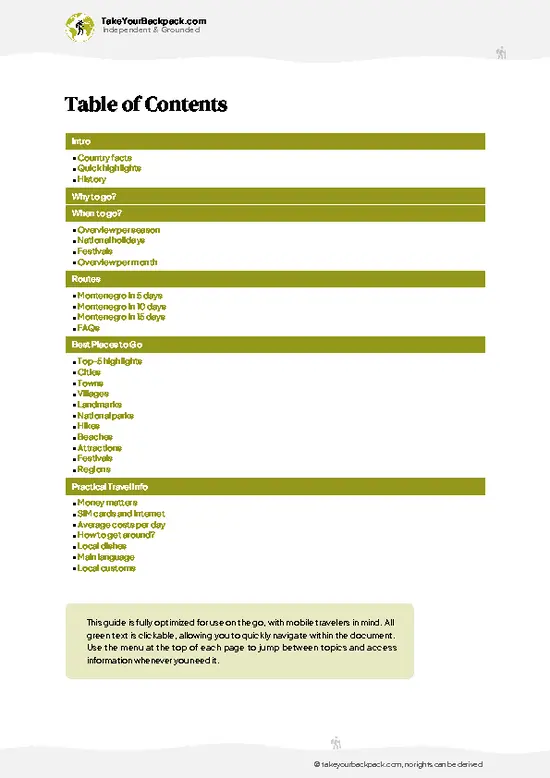
An offline-friendly backpacking guide with optimized travel routes, ranked highlights, transport advice, and the best areas to stay.
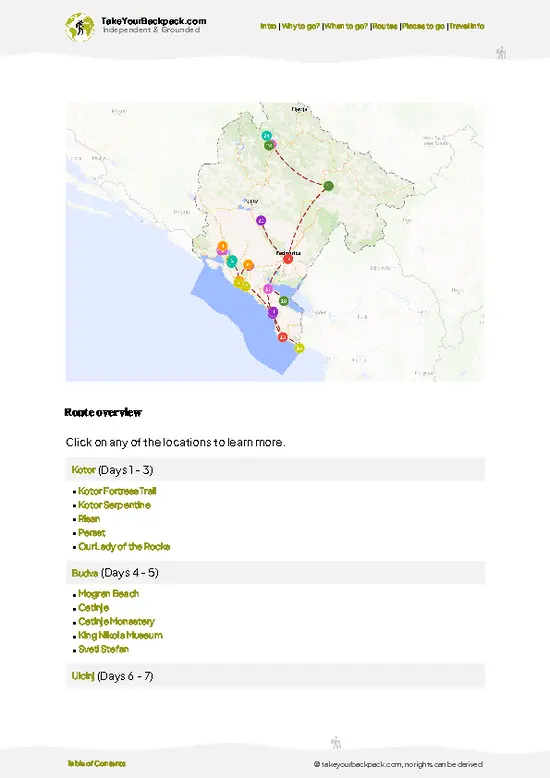
example page 0 from our offline Travel Guide for Montenegro
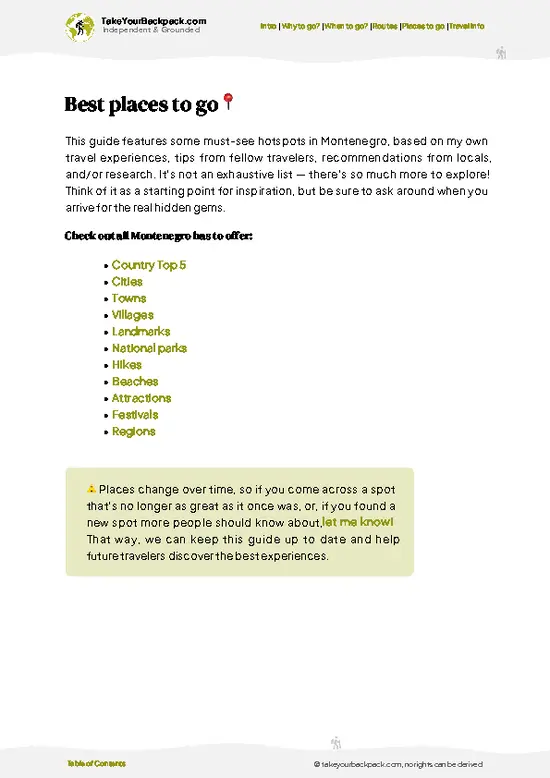
example page 1 from our offline Travel Guide for Montenegro
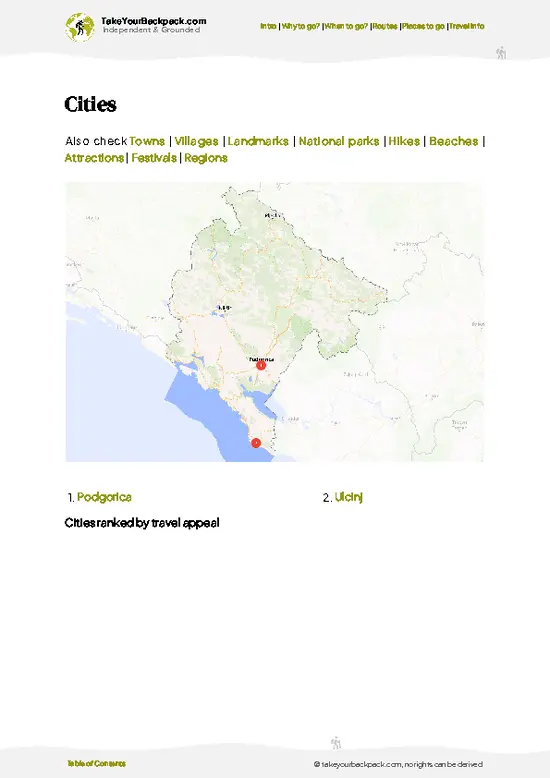
example page 2 from our offline Travel Guide for Montenegro
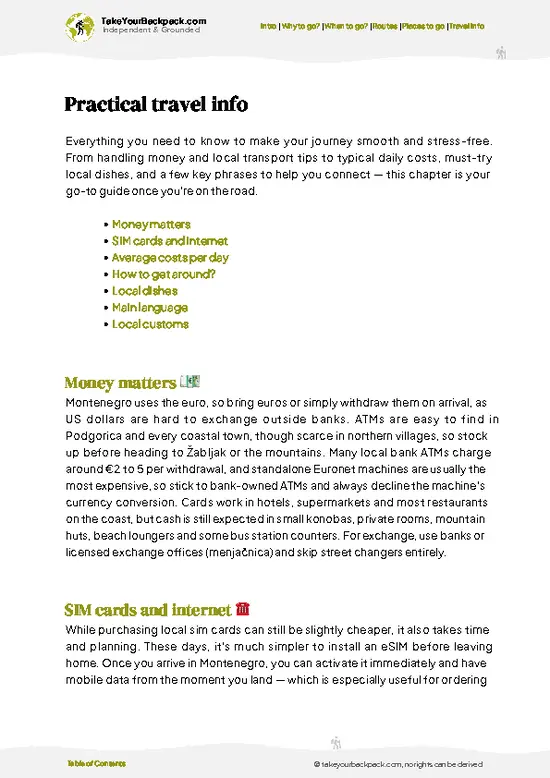
example page 3 from our offline Travel Guide for Montenegro
example page 4 from our offline Travel Guide for Montenegro
example page 5 from our offline Travel Guide for Montenegro
example page 6 from our offline Travel Guide for Montenegro
example page 7 from our offline Travel Guide for Montenegro
The digital guide (241 pages) contains:
✅ 62 highlights, ranked by travel appeal
✅ Optimized 5, 10 & 15-day travel routes
✅ Cities, national parks, landmarks, beaches
✅ How to get around
✅ Offline-friendly for travel without Wi-Fi
👉 Click to see all 30+ guide features

📅 Plan smarter in minutes, not weeks
✅ Month by month travel advice
✅ Festivals & national holidays
✅ Budget expectations

🗺️ Go to the right places, skip the overrated ones
✅ Honest pros & cons of destinations
✅ Top hikes, parks & viewpoints
✅ Lesser-known places most travelers miss
✅ Clear “worth it vs skip it” guidance

🛏️ Travel smoothly without rookie mistakes
✅ Best areas to stay
✅ Transport systems explained simply
✅ Common scams & safety advice
✅ SIM cards, money & practical tips

🌍 Understand the country, not just visit it
✅ Culture & traditions
✅ 52 Essential phrases & customs
✅ Festivals worth planning around
✅ Traveler-friendly historical context
✅ Insights that make places more meaningful

📱 Built for real travel conditions
✅ Fully downloadable PDF
✅ Works completely offline
✅ Optimized for phone use
✅ Useful in remote areas & buses
✅ Everything in one place
Stop searching, start planning
Get instant access to your full guide. 30‑day money-back guarantee.
+ Add another guide for just

By proceeding you agree to our terms.
Sent to your inbox immediately after payment • 100% Secure Checkout
Best Backpacking Travel Advisor 2025 tourism awardBest Backpacking
Travel Advisor
2025
What others say about Take Your Backpack Guides:
⭐⭐⭐⭐⭐
Fantastic, amazing amount of information!
⭐⭐⭐⭐⭐
My goodness this is amazing, it's what I've been looking for hats off too you!
⭐⭐⭐⭐⭐
I think this is absolutely BRILLIANT
⭐⭐⭐⭐
Very complete and informative. It's still missing places, but I gotta to commend you
⭐⭐⭐⭐⭐
This is truly amazing, thank you, can't wait to explore it with my kids!
⭐⭐⭐⭐⭐
Awesome resource, thank you!
⭐⭐⭐⭐⭐
This is amazing! Can't wait to explore the ones I haven't seen
⭐⭐⭐⭐
I love this! Well done, great idea.
⭐⭐⭐⭐⭐
Thanks for taking the time to make this gem!
⭐⭐⭐⭐⭐
This might be the best website I've ever seen.
⭐⭐⭐⭐⭐
Congratulations, and thank you so much for your work; it's incredibly valuable.
⭐⭐⭐⭐
In all seriousness I think you did a great job pointing out the important spots
⭐⭐⭐⭐⭐
10/10 very good
⭐⭐⭐⭐⭐
As someone who's only just starting to visit regularly this is awesome, thank you.
⭐⭐⭐⭐
Thank you very much! I'm going to visit my dad, it's going to be very useful!
⭐⭐⭐⭐⭐
This is really cool! We'll be travelling for the first time and this definitely come in handy.
⭐⭐⭐⭐⭐
You are now our minister of culture, congratulations 👨‍💼
⭐⭐⭐⭐⭐
Just wanted to tell you that this is a pearl! Going to follow your recommendations.
⭐⭐⭐⭐⭐
This is so cool. I'll definitely be using the resource for my travels soon.
⭐⭐⭐⭐⭐
This is very impressive! Good work.
⭐⭐⭐⭐⭐
This is an amazing and informative site. Very well done!

🛏️ Where to stay?Where to Stay in Montenegro

Montenegro has plenty of hostels and guesthouses, with dorm beds typically running €12 to 25 a night in summer and private rooms in family-run apartments (“sobe”) from about €25 to 45. In Kotor, the Old Town puts you inside the walls next to the fortress climb but gets loud and packed on cruise-ship days, while Dobrota just north is quieter and cheaper; Budva around the Old Town and Slovenska Plaža has the most party hostels and late bars, which is great for nightlife and bad for sleep. For mountains and lower prices, Žabljak is the base for Durmitor, and central Podgorica near the bus and train stations has cheap, safe, if unexciting beds that work well for onward connections.

If you enjoy meeting … read more 👉
Montenegro has plenty of hostels and guesthouses, with dorm beds typically running €12 to 25 a night in summer and private rooms in family-run apartments (“sobe”) from about €25 to 45. In Kotor, the Old Town puts you inside the walls next to the fortress climb but gets loud and packed on cruise-ship days, while Dobrota just north is quieter and cheaper; Budva around the Old Town and Slovenska Plaža has the most party hostels and late bars, which is great for nightlife and bad for sleep. For mountains and lower prices, Žabljak is the base for Durmitor, and central Podgorica near the bus and train stations has cheap, safe, if unexciting beds that work well for onward connections.

If you enjoy meeting fellow travelers, consider choosing hostels with high ratings for atmosphere. On the other hand, if you prefer having your own space, a hotel might be a better option.

MontenegroMore of Montenegro

👋 Meet the founderWho’s Behind Take Your Backpack?

Johan, backpacker and founder of TakeYourBackpackHi, I’m Johan (Netherlands 🇳🇱), the creator of TakeYourBackpack. Over the past 3 decades, I’ve backpacked through 90+ countries across six continents, gaining extensive experience with independent travel, long-term trips, and overland routes.

This site is built on a combination of firsthand travel experience and carefully curated insights from other backpackers. Many guides are based on places I’ve personally visited, while others bring together tips, observations, and practical advice shared by trusted travelers I’ve met along the way.

The goal is to provide realistic, experience-driven guidance — not generic itineraries — so you can explore destinations with better context, clearer expectations, and more confidence.