×

Namibia🇳🇦 | regionsSkeleton CoastShipwrecks, Cape Cross seals, fog, Hoarusib canyon | things to do and best time to go

Explore Tsau ǁKhaeb National ParkExplore Caprivi Strip

Backpacking in Skeleton Coast
🏆 Top pickregion ranked #2
By Johan Kruseman 🇳🇱 | Updated October 22, 2026

Years ago, the Skeleton Coast was a name that sailors dreaded, a fogbound shore where ships ran aground and survivors rarely walked out. Today the wrecks are rust and ribs, and travelers come by 4x4 or small plane for the emptiness itself. It lies along the northwest coast of Namibia, a long band of dunes, gravel plains and cold Atlantic surf between the Ugab and Kunene rivers. The air tastes of salt and kelp, fog muffles every sound, and seal colonies announce themselves by smell long before you see them. The southern stretch is cheap and easy to self-drive, though the scenery is sparse and the road is a flat ribbon of salt. The far north costs a lot more, yet it holds the dune seas and desert-adapted elephants, so a backpacker gets the most from driving the south and booking one guided day in the north. Before you go, know that the national park needs permits at its gates and fuel is scarce, so fill up in Swakopmund.

Discover everything you want to know in the 📖 Namibia Travel Guide.


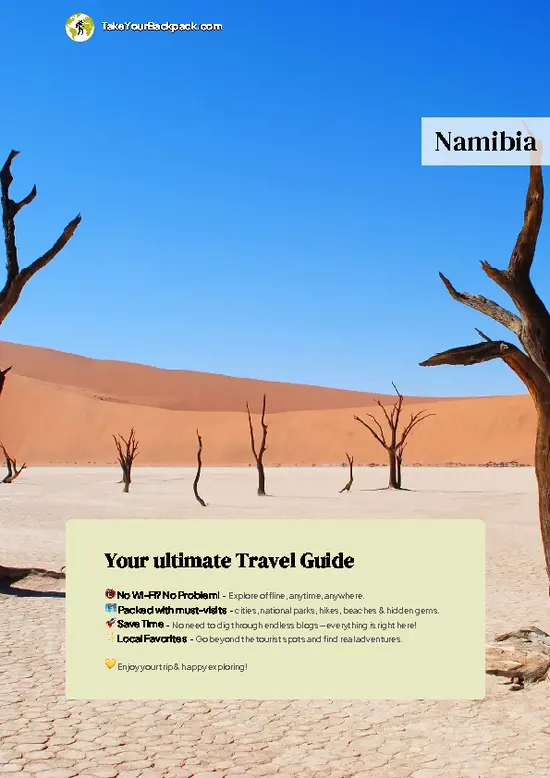
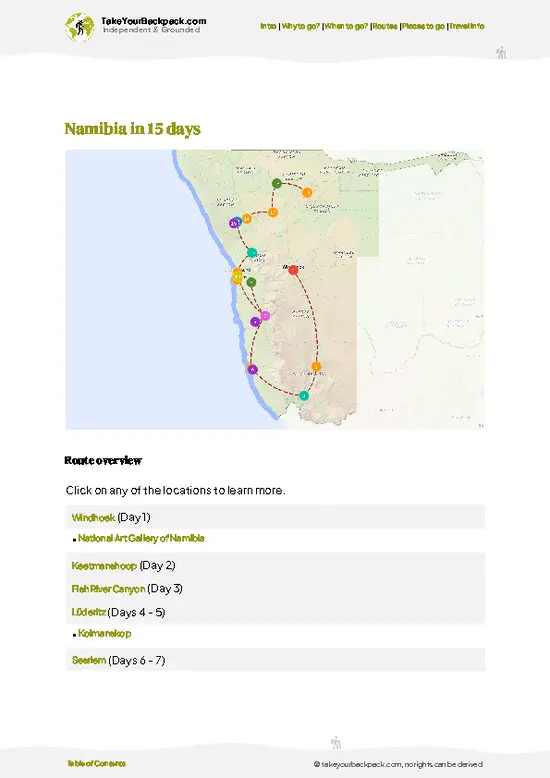
example page 0 from our offline Travel Guide for Namibia
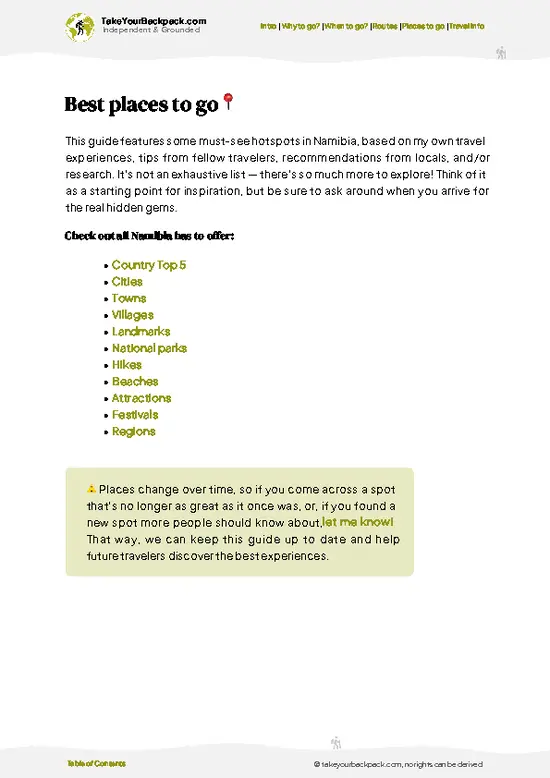
example page 1 from our offline Travel Guide for Namibia
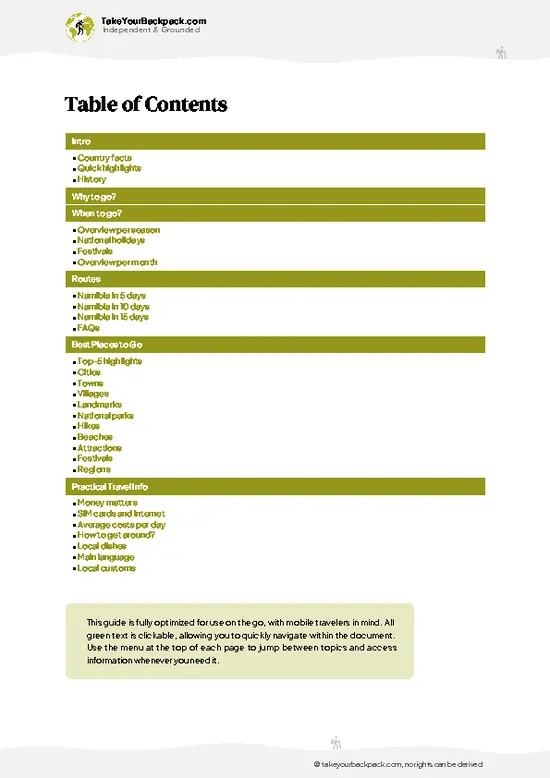
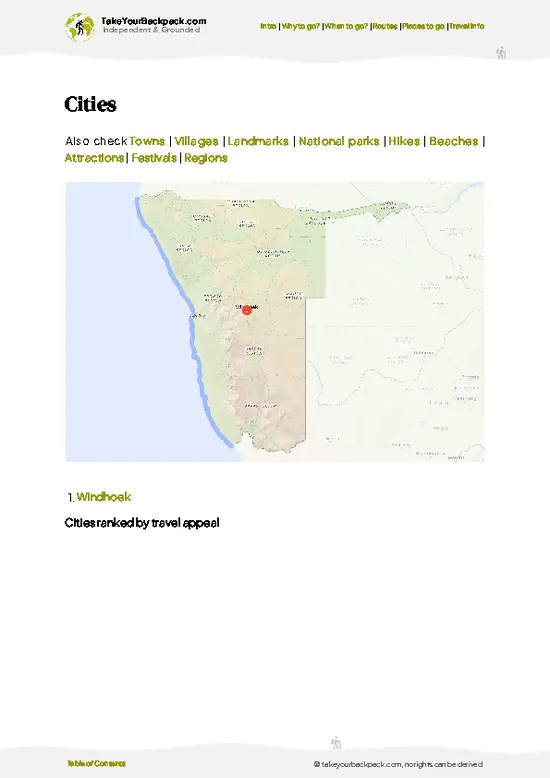
example page 2 from our offline Travel Guide for Namibia
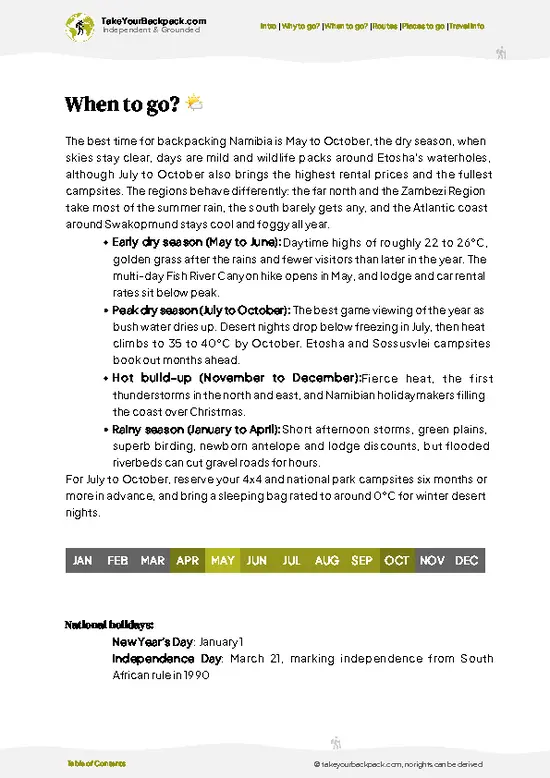
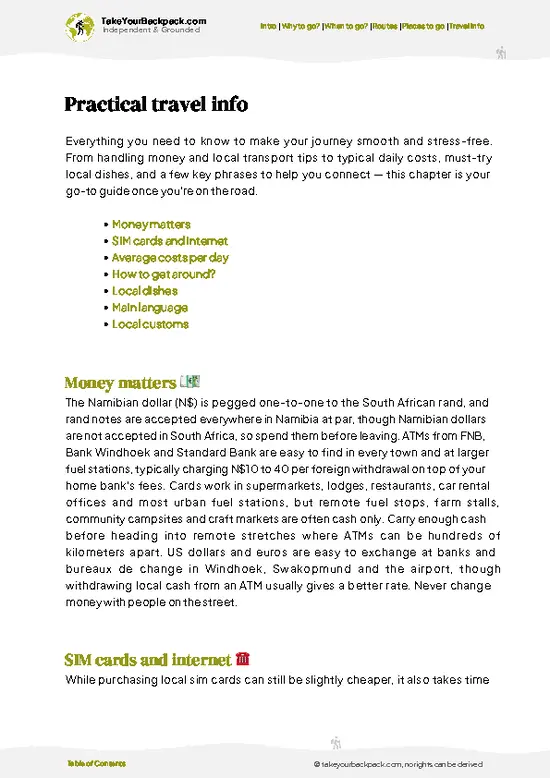
example page 3 from our offline Travel Guide for Namibia
example page 4 from our offline Travel Guide for Namibia
example page 5 from our offline Travel Guide for Namibia
example page 6 from our offline Travel Guide for Namibia
example page 7 from our offline Travel Guide for Namibia
Loading the map 🌍
CLICK TO FILTER
cities
towns
villages
landmarks
national parks
hikes
beaches
attractions
festivals
regions
SHOW COUNTRY’S BESTSHOW ALL

✨ Why go?
Ranked #2 region in Namibia
What makes it a must-see region

Skeleton Coast rewards backpackers who want a landscape that feels like another planet without a month of travel. The Atlantic fog bank meeting the Namib dunes creates a strip where cold sea, hot gravel and wind all show up within a single afternoon. You can watch Cape fur seals, walk beside ship skeletons and climb a dune ridge without repacking your bag.

The second reason is pace. The coast is slow country. One salt road runs north from the resort towns, gates and permits break the trip into clear stages, and nobody is in a hurry because there is nowhere else to be. That suits a traveler who likes to stop for a wreck, a lichen field or a jackal trotting along the surf line.

Third, the culture sits right inland. Himba settlements along the Hoarusib and Kunene rivers are reachable from the same … read more 👉
Skeleton Coast rewards backpackers who want a landscape that feels like another planet without a month of travel. The Atlantic fog bank meeting the Namib dunes creates a strip where cold sea, hot gravel and wind all show up within a single afternoon. You can watch Cape fur seals, walk beside ship skeletons and climb a dune ridge without repacking your bag.

The second reason is pace. The coast is slow country. One salt road runs north from the resort towns, gates and permits break the trip into clear stages, and nobody is in a hurry because there is nowhere else to be. That suits a traveler who likes to stop for a wreck, a lichen field or a jackal trotting along the surf line.

Third, the culture sits right inland. Himba settlements along the Hoarusib and Kunene rivers are reachable from the same corridor, so a coastal trip can include river valleys, clay formations and desert elephant tracking. Few places in Namibia combine ocean, desert and living culture in one loop with so little backtracking.

💡 HighlightsWhat this place is best known for

  1. Cape Cross Seal Reserve: One of the largest Cape fur seal colonies in Africa, with thousands of animals barking, squabbling and pupping on the rocks. The smell hits you in the parking lot. A replica of the Portuguese stone cross stands nearby. Entry is charged per person and per vehicle.
  2. Zeila Shipwreck: A rusting fishing trawler stranded on the shore, with the surf thumping against its hull. Go when the fog is thick and the whole scene turns gray and silent.
  3. Ugab River Gate: The southern entrance to the national park, marked by a pair of whale-bone skulls and a stern sign. Permits are checked here, and the gravel plain behind it feels like a threshold.
  4. Torra Bay: A simple camping area that opens only for a short season around the December and January holidays. Anglers dominate it, and the evenings
… read more 👉
  1. Cape Cross Seal Reserve: One of the largest Cape fur seal colonies in Africa, with thousands of animals barking, squabbling and pupping on the rocks. The smell hits you in the parking lot. A replica of the Portuguese stone cross stands nearby. Entry is charged per person and per vehicle.
  2. Zeila Shipwreck: A rusting fishing trawler stranded on the shore, with the surf thumping against its hull. Go when the fog is thick and the whole scene turns gray and silent.
  3. Ugab River Gate: The southern entrance to the national park, marked by a pair of whale-bone skulls and a stern sign. Permits are checked here, and the gravel plain behind it feels like a threshold.
  4. Torra Bay: A simple camping area that opens only for a short season around the December and January holidays. Anglers dominate it, and the evenings are cold and windy with a salty tang.
  5. Terrace Bay: A remote lodge outpost built for diamond and fishing crews, with a lonely beach and glimpses of old wreck timber. It is the practical end of the road for most self-drivers.
  6. Möwe Bay: A tiny former ranger station with a small museum of wreck relics and local history. Few visitors bother, so you often get the display and the wind to yourself.
  7. Rocky Point: A rugged headland where dark rock meets steady Atlantic swells, known for seabirds and seal activity. It rewards anyone willing to book a guided trip this far north.
  8. Hoarusib River Canyon: A dry riverbed that cuts inland through the desert, with scattered springs, fan palms and sometimes a rare sighting of desert-adapted elephants. Local Himba herders work this valley.
  9. Clay Castles: Eroded clay terraces in the Hoarusib valley, carved by wind and flash floods into towers and ramparts. Locals value it as a quiet side stop, and it is superb in low light.
  10. Cape Frio Seal Colony: The northern seal rookery, far quieter than Cape Cross and reached by guided or fly-in travel. You see the same chaos with almost no other people around.
For a first visit, Cape Cross Seal Reserve is the best pick because you can reach it without a permit-heavy expedition and the sights, sounds and smell make the whole coast real at once.
Spotted a mistake or missing something? Contact us.

Things to do around Skeleton Coast

Ratings based on Tripadvisor reviews. When you book through this link, you support our work at no extra cost to you.

⌛️ 5 daysWhat you can realistically do in a week

Day 1: Cape Cross
A salt-road morning, driven slowly with the fog still hanging over the sea. Transport sets the pace here: the coast has no public transit, so a rented 4x4 or a guided tour is the whole system, and fuel and permits determine how far you can go. Start at the seal reserve while the colony is loud, then stop at the Zeila wreck on the way north so you are camped near the park gate by evening.

Day 2: Ugab River Gate
Enter the park early with your permit and drive slowly along the gravel. This is a day of dull horizons that slowly become interesting, so stop often for bleached bones and lichen fields. Pushing on too far in one go tires you out, and the gate hours force a natural rhythm.

Day 3: Terrace Bay
Reach the last point most self-drivers can use, where the road ends and the lodge, … read more 👉
Day 1: Cape Cross
A salt-road morning, driven slowly with the fog still hanging over the sea. Transport sets the pace here: the coast has no public transit, so a rented 4x4 or a guided tour is the whole system, and fuel and permits determine how far you can go. Start at the seal reserve while the colony is loud, then stop at the Zeila wreck on the way north so you are camped near the park gate by evening.

Day 2: Ugab River Gate
Enter the park early with your permit and drive slowly along the gravel. This is a day of dull horizons that slowly become interesting, so stop often for bleached bones and lichen fields. Pushing on too far in one go tires you out, and the gate hours force a natural rhythm.

Day 3: Terrace Bay
Reach the last point most self-drivers can use, where the road ends and the lodge, the beach and the cold wind take over. Use the afternoon to walk the shore. Going farther north on your own is not allowed, so this is where logistics change.

Day 4: Hoarusib River
Join a guided trip or fly-in tour to enter the northern wilderness, where the river canyon cuts the desert. A detour to the Clay Castles adds sculpted formations and a quiet picnic spot without extra planning, because it sits on the same valley track. If one day justifies the whole trip, this is it, with elephants, Himba herders and the surf-fringed horizon in a single loop.

Day 5: Cape Frio
Finish at the northern seal colony and the long shoreline, then fly or drive out with the guide. Slow, quiet and uncrowded, it closes the trip with a calm beach walk.

🌤️ When to go?Choosing the right time of year

  • Cool Months (May to September): Afternoons reach 18 to 24°C (64 to 75°F) and nights drop to 8 to 12°C (46 to 54°F), with about 11 hours of daylight. Cold Atlantic fog sits on the shore most mornings, so photos of wrecks look moody and the wind has teeth. Rain is almost nonexistent, tour prices are steady and the gravel roads are quiet.
  • Warm Months (October to April): The coast stays near 18 to 26°C (64 to 79°F), while the desert a few kilometers inland pushes past 35°C (95°F). Daylight stretches to about 13 hours. Namibian families arrive in December and January for Torra Bay fishing camps, so permits and lodging prices rise sharply.
  • Seal Pup Season (November to December): Newborn Cape fur seals crowd the colony at Cape Cross, noisy and pungent. Dry riverbeds can run briefly after rare inland
… read more 👉
  • Cool Months (May to September): Afternoons reach 18 to 24°C (64 to 75°F) and nights drop to 8 to 12°C (46 to 54°F), with about 11 hours of daylight. Cold Atlantic fog sits on the shore most mornings, so photos of wrecks look moody and the wind has teeth. Rain is almost nonexistent, tour prices are steady and the gravel roads are quiet.
  • Warm Months (October to April): The coast stays near 18 to 26°C (64 to 79°F), while the desert a few kilometers inland pushes past 35°C (95°F). Daylight stretches to about 13 hours. Namibian families arrive in December and January for Torra Bay fishing camps, so permits and lodging prices rise sharply.
  • Seal Pup Season (November to December): Newborn Cape fur seals crowd the colony at Cape Cross, noisy and pungent. Dry riverbeds can run briefly after rare inland storms in February and March.
Book Terrace Bay or Torra Bay permits months ahead for December, and travel in June or July if you want empty roads.


source: climatestotravel.comJANJanuary: fair for travelingFEBFebruary: fair for travelingMARMarch: fair for travelingAPRApril: good for travelingMAYMay: good for travelingJUNJune: highly recommended for travelingJULJuly: highly recommended for travelingAUGAugust: excellent for travelingSEPSeptember: excellent for travelingOCTOctober: good for travelingNOVNovember: fair for travelingDECDecember: fair for traveling
when-to-go

✈️ The backpacker research shortcutNamibia Travel Guide

An offline-friendly backpacking guide with optimized travel routes, ranked highlights, transport advice, and the best areas to stay.
example page 0 from our offline Travel Guide for Namibia
example page 1 from our offline Travel Guide for Namibia
example page 2 from our offline Travel Guide for Namibia
example page 3 from our offline Travel Guide for Namibia
example page 4 from our offline Travel Guide for Namibia
example page 5 from our offline Travel Guide for Namibia
example page 6 from our offline Travel Guide for Namibia
example page 7 from our offline Travel Guide for Namibia
The digital guide (294 pages) contains:
✅ 71 highlights, ranked by travel appeal
✅ Optimized 5, 10 & 15-day travel routes
✅ Cities, national parks, landmarks, beaches
✅ How to get around
✅ Offline-friendly for travel without Wi-Fi
👉 Click to see all 30+ guide features

📅 Plan smarter in minutes, not weeks
✅ Month by month travel advice
✅ Festivals & national holidays
✅ Budget expectations

🗺️ Go to the right places, skip the overrated ones
✅ Honest pros & cons of destinations
✅ Top hikes, parks & viewpoints
✅ Lesser-known places most travelers miss
✅ Clear “worth it vs skip it” guidance

🛏️ Travel smoothly without rookie mistakes
✅ Best areas to stay
✅ Transport systems explained simply
✅ Common scams & safety advice
✅ SIM cards, money & practical tips

🌍 Understand the country, not just visit it
✅ Culture & traditions
✅ 52 Essential phrases & customs
✅ Festivals worth planning around
✅ Traveler-friendly historical context
✅ Insights that make places more meaningful

📱 Built for real travel conditions
✅ Fully downloadable PDF
✅ Works completely offline
✅ Optimized for phone use
✅ Useful in remote areas & buses
✅ Everything in one place
Stop searching, start planning
Get instant access to your full guide. 30‑day money-back guarantee.
+ Add another guide for just

By proceeding you agree to our terms.
Sent to your inbox immediately after payment • 100% Secure Checkout
Best Backpacking Travel Advisor 2025 tourism awardBest Backpacking
Travel Advisor
2025
What others say about Take Your Backpack Guides:
⭐⭐⭐⭐⭐
Fantastic, amazing amount of information!
⭐⭐⭐⭐⭐
My goodness this is amazing, it's what I've been looking for hats off too you!
⭐⭐⭐⭐⭐
I think this is absolutely BRILLIANT
⭐⭐⭐⭐
Very complete and informative. It's still missing places, but I gotta to commend you
⭐⭐⭐⭐⭐
This is truly amazing, thank you, can't wait to explore it with my kids!
⭐⭐⭐⭐⭐
Awesome resource, thank you!
⭐⭐⭐⭐⭐
This is amazing! Can't wait to explore the ones I haven't seen
⭐⭐⭐⭐
I love this! Well done, great idea.
⭐⭐⭐⭐⭐
Thanks for taking the time to make this gem!
⭐⭐⭐⭐⭐
This might be the best website I've ever seen.
⭐⭐⭐⭐⭐
Congratulations, and thank you so much for your work; it's incredibly valuable.
⭐⭐⭐⭐
In all seriousness I think you did a great job pointing out the important spots
⭐⭐⭐⭐⭐
10/10 very good
⭐⭐⭐⭐⭐
As someone who's only just starting to visit regularly this is awesome, thank you.
⭐⭐⭐⭐
Thank you very much! I'm going to visit my dad, it's going to be very useful!
⭐⭐⭐⭐⭐
This is really cool! We'll be travelling for the first time and this definitely come in handy.
⭐⭐⭐⭐⭐
You are now our minister of culture, congratulations 👨‍💼
⭐⭐⭐⭐⭐
Just wanted to tell you that this is a pearl! Going to follow your recommendations.
⭐⭐⭐⭐⭐
This is so cool. I'll definitely be using the resource for my travels soon.
⭐⭐⭐⭐⭐
This is very impressive! Good work.
⭐⭐⭐⭐⭐
This is an amazing and informative site. Very well done!

🛏️ Where to stay?Where staying makes the most sense

Swakopmund is the best base for the Skeleton Coast, with the most backpacker-friendly beds, an easy social scene and the only tour operators that run trips north. It sits about 70 km south of Henties Bay on a flat, walkable grid, and safety is solid in the center. Hostel dorms usually run US$15 to 25 a night. Evenings fill with travelers swapping notes on sandboarding, quad biking and shared car rentals, and it is easy to find people to split fuel costs for a drive up the coast. The cold sea air smells of salt and diesel.

Henties Bay is the quieter fallback, a small fishing town about 70 km north … read more 👉
Swakopmund is the best base for the Skeleton Coast, with the most backpacker-friendly beds, an easy social scene and the only tour operators that run trips north. It sits about 70 km south of Henties Bay on a flat, walkable grid, and safety is solid in the center. Hostel dorms usually run US$15 to 25 a night. Evenings fill with travelers swapping notes on sandboarding, quad biking and shared car rentals, and it is easy to find people to split fuel costs for a drive up the coast. The cold sea air smells of salt and diesel.

Henties Bay is the quieter fallback, a small fishing town about 70 km north where anglers and self-drivers stop for fuel and supplies. Guesthouses and self-catering rooms run about US$30 to 60, with few other backpackers around, so it suits those who want an early start at the Ugab Gate.

Inside the park, Terrace Bay and Torra Bay are the only public options. Torra Bay is a basic campsite, open only in December and January, with prices around US$10 to 15 per person. Terrace Bay is a bare-bones resort that must be booked in advance and costs well over backpacker rates. Wild camping is not permitted, so plan to sleep in Swakopmund and drive in for the day if you are on a tight budget.

🚌 Getting aroundHow to get around Skeleton Coast

Skeleton Coast has no bus station, train station or town center, so the real arrival point is the Ugab Gate on the C34 salt road, about 70 km of fast, crunchy pavement north of Henties Bay, which itself sits 70 km north of Swakopmund. Intercape coaches from Windhoek reach Swakopmund in about 4 to 5 hours for US$20 to 35, but nothing public runs beyond Swakopmund, and that gap shapes every plan. Roads here are pale salt and gravel, the wind carries a fishy, iodine tang, and a flat tire is a real possibility, so choose your transport with that in mind.

  • Rental 4x4: A high-clearance vehicle from Windhoek or Swakopmund costs roughly US$90 to 160 a day with a rooftop tent, plus fuel. It gives you the most for the money if you split it among three or four people, because you stop wherever a rusted
… read more 👉
Skeleton Coast has no bus station, train station or town center, so the real arrival point is the Ugab Gate on the C34 salt road, about 70 km of fast, crunchy pavement north of Henties Bay, which itself sits 70 km north of Swakopmund. Intercape coaches from Windhoek reach Swakopmund in about 4 to 5 hours for US$20 to 35, but nothing public runs beyond Swakopmund, and that gap shapes every plan. Roads here are pale salt and gravel, the wind carries a fishy, iodine tang, and a flat tire is a real possibility, so choose your transport with that in mind.

  • Rental 4x4: A high-clearance vehicle from Windhoek or Swakopmund costs roughly US$90 to 160 a day with a rooftop tent, plus fuel. It gives you the most for the money if you split it among three or four people, because you stop wherever a rusted hull or a lone jackal catches your eye. You carry your own spare tires, fuel and water, since pumps are scarce, and the glare off the salt pans is brutal without sunglasses.
  • Guided Day Tour from Swakopmund: Expect US$110 to 220 for a long day to Cape Cross and the southern shipwrecks. You pay more per kilometer than driving yourself, but you get a guide who reads the fog, finds the ghost-crab holes and handles the permit. It is the comfortable choice for solo travelers without a car.
  • Multi-Day Camping Safari: Small-group overland trips from Swakopmund or Windhoek cost around US$150 to 300 per person per day. You eat dinner by a driftwood fire with the surf booming in the dark, and the cost covers gear, permits and a driver who knows the soft patches.
  • Fly-In Safari: The remote northern concession is reached by light aircraft, for about US$1,000 to 1,800 per person per night with lodging included. The views of dunes meeting breakers are unmatched, but this is a splurge only a few backpackers can justify.
Entry to the public southern stretch costs about US$5 to 8 per person plus a small vehicle fee, and Terrace Bay requires an advance booking. Fill up in Henties Bay or Swakopmund and carry at least 5 liters of water per person per day.

🍲 FoodLocal Flavors for Backpackers

Food on the Skeleton Coast is dictated by the cold Benguela Current, so fresh fish and crayfish are the specialties. Kabeljou, a mild white fish, is often grilled or fried with lemon and served with chips. Oysters from Walvis Bay, a short drive south, arrive briny and cold, usually US$1 to 2 each. Biltong, air-dried game meat, is the staple road snack, and braai (barbecue) smoke drifts across most campsites at dusk.

Backpackers eat mostly in Swakopmund and Henties Bay, where bakeries sell hot meat pies and German-style rolls for US$2 to 4, a legacy of the colonial era. Cafés pour strong coffee and serve apple strudel with a thick cream. A fish-and-chips plate at a casual seafood spot runs US$8 to 15. Supermarkets in Swakopmund are the place to stock up, because inside the park there are almost … read more 👉
Food on the Skeleton Coast is dictated by the cold Benguela Current, so fresh fish and crayfish are the specialties. Kabeljou, a mild white fish, is often grilled or fried with lemon and served with chips. Oysters from Walvis Bay, a short drive south, arrive briny and cold, usually US$1 to 2 each. Biltong, air-dried game meat, is the staple road snack, and braai (barbecue) smoke drifts across most campsites at dusk.

Backpackers eat mostly in Swakopmund and Henties Bay, where bakeries sell hot meat pies and German-style rolls for US$2 to 4, a legacy of the colonial era. Cafés pour strong coffee and serve apple strudel with a thick cream. A fish-and-chips plate at a casual seafood spot runs US$8 to 15. Supermarkets in Swakopmund are the place to stock up, because inside the park there are almost no shops and a Terrace Bay meal is pricey.

Pair your plate with a cold Windhoek Lager, brewed under German purity rules. Beer comes in glass bottles, and servers will often bring bread and a sauce without being asked. Tipping about 10 percent is customary. In camp, share the braai, since offering a cut of meat is an easy way to start a conversation with South African anglers.

🛡️ SafetyScams, Hazards, and Annoyances

Skeleton Coast beach is a wild beauty, but it’s not exactly a sunbather’s paradise. Swimming? Well, let’s just say the ocean here has a personality. Strong currents and unpredictable waves can turn a casual dip into a wrestling match with Neptune. Locals know to stick to certain spots, often where the waves are tamer, so keep an eye on where they’re splashing around.

As for marine life, you might spot a ray or two, but don’t expect a shark to pop by for a friendly chat. The real danger is the sun. It’s relentless, especially midday. Slather on that sunscreen and consider a wide-brimmed hat your new best friend.

Keep your belongings close; the beach can attract opportunistic thieves. Enjoy the raw beauty, but stay aware. It’s all part of the adventure, right?

FAQTraveler FAQ

Plan two to three days for the Skeleton Coast if you are based in Swakopmund. A single long day covers Cape Cross, the Zeila wreck and the Ugab Gate, which is a drive of roughly 2 to 3 hours each way on salt road. Adding Terrace Bay or Torra Bay in season turns it into two nights, while the northern concession requires a fly-in stay of two to three nights at US$1,000 or more per person per night.
Getting around the Skeleton Coast without a car means joining a guided tour, since no public buses run north of Swakopmund. Day tours from Swakopmund cost about US$110 to 220, and multi-day camping safaris run around US$150 to 300 per person per day. You can also take an Intercape coach to Swakopmund for US$20 to 35 from Windhoek and then split a rental 4x4 with other travelers at about US$90 to 160 a day.
The Skeleton Coast is known for its shipwrecks, whale bones and fog-bound dunes that run straight into the cold Atlantic. Cape Cross holds a colony of up to roughly 100,000 Cape fur seals, and the wreck of the Zeila lies near Henties Bay. Desert-adapted elephants and lions roam the dry riverbeds in the north, though they are best seen on guided trips from lodges.
⚠️ Things can change over time, so always validate details locally before you go.

Other Namibian regions near Skeleton Coast

Explore more nearby:

  • Kunene Region—Epupa cascades, Himba settlements, Opuwo, Marienfluss track| 162 km away
  • Damaraland—Rock engravings, desert elephants, Brandberg massif, community campsites| 285 km away
  • Namib Sand Sea—Towering dunes, shifting sands, Sossusvlei pans, fossilized trees| 606 km away

💡 Not sure where to go next?
Create a personalized itinerary for Namibia including Skeleton Coast and the places that fit your trip.

Generate my itinerary

👉 Discover all regions

Or checkout all Namibia has to offer (think cities, towns, villages, national parks, hikes, beaches, festivals)
Country photo of Namibia

We 💚 feedbackParting advice and final tips

Skeleton Coast is most overlooked for its fog, which people treat as a nuisance and which is actually the show. The cold mist feeds the lichen fields and makes the wrecks look haunted, so I would pick a gray morning over a sunny one for photos. Bring a warm jacket and a spare fuel can, and keep your expectations for bright beach weather at home.

✍️ Help improve this page!
The information on this page is based on in-depth research, insights shared by experienced travelers, and feedback from the local travel community in Namibia. While every effort is made to keep the information accurate and current, conditions can change — so if you spot anything incorrect or outdated, please get in touch.


🙋‍♂️ Give feedback

👋 Meet the founderWho’s Behind Take Your Backpack?

Johan, backpacker and founder of TakeYourBackpackHi, I’m Johan (Netherlands 🇳🇱), the creator of TakeYourBackpack. Over the past 3 decades, I’ve backpacked through 90+ countries across six continents, gaining extensive experience with independent travel, long-term trips, and overland routes.

This site is built on a combination of firsthand travel experience and carefully curated insights from other backpackers. Many guides are based on places I’ve personally visited, while others bring together tips, observations, and practical advice shared by trusted travelers I’ve met along the way.

The goal is to provide realistic, experience-driven guidance — not generic itineraries — so you can explore destinations with better context, clearer expectations, and more confidence.