×

Nepal🇳🇵 | best villagesThe Must-See 2 villages in Nepal

Nepal packs its villages into three very different worlds, and picking the right one shapes your whole trip. In the Himalayan north, stone-and-timber settlements cling to trails at 2,500 to 4,000 meters, with Sherpa, Gurung and Tibetan-influenced communities, tea houses and prayer flags. The middle hills hold Newar brick towns and terraced Magar and Tamang farming hamlets, reached by local bus or jeep. The Terai lowlands add Tharu mud-walled homes and jungle edges. Backpackers and independent travelers can mix all three on a budget, but crowds, costs and effort swing hard. Trek-route villages are busiest, hill villages are calmest, so choose your mood and go.

By Johan Kruseman 🇳🇱 | Updated October 20, 2026
Explore the best landmarks in Nepal

Why go?What Makes Them Special

Nepal rewards village hunters because geography forced life into small, self-reliant pockets. Ridges, gorges and 8,000-meter walls kept communities apart for centuries, so ethnic groups such as Sherpa, Gurung, Tamang, Magar, Newar and Tharu each kept their own language, architecture, dress and festivals. Many places still link to the outside world by foot trails rather than roads, which means you move at walking pace through terraced fields, past mani walls and over suspension bridges.

The country also built a tea house network along its main trekking routes, so you can eat and sleep in mountain villages without carrying a tent. That is rare in the world and it keeps costs low. Farther from those routes, a homestay system lets families host guests and share dal bhat, the standard meal of … read more 👉
Nepal rewards village hunters because geography forced life into small, self-reliant pockets. Ridges, gorges and 8,000-meter walls kept communities apart for centuries, so ethnic groups such as Sherpa, Gurung, Tamang, Magar, Newar and Tharu each kept their own language, architecture, dress and festivals. Many places still link to the outside world by foot trails rather than roads, which means you move at walking pace through terraced fields, past mani walls and over suspension bridges.

The country also built a tea house network along its main trekking routes, so you can eat and sleep in mountain villages without carrying a tent. That is rare in the world and it keeps costs low. Farther from those routes, a homestay system lets families host guests and share dal bhat, the standard meal of rice, lentils and vegetables.

Know the limits before you commit. Roads in the hills are slow and often rough, landslides can close them in monsoon, and electricity or Wi-Fi can be patchy at altitude. Religion matters too: Hindu and Buddhist customs shape daily life, and village rhythms follow farming seasons and festivals. Come ready for steep climbs, simple rooms and early nights, and Nepal pays you back with an unusually intact village culture.
Why These Made the Cut
The list of best villages in Nepal is created based on authenticity, scenic beauty, community spirit, traditions, and overall character. If you feel a village is missing in this list, please let us know.

When to go?Seasonal Guide to Visiting

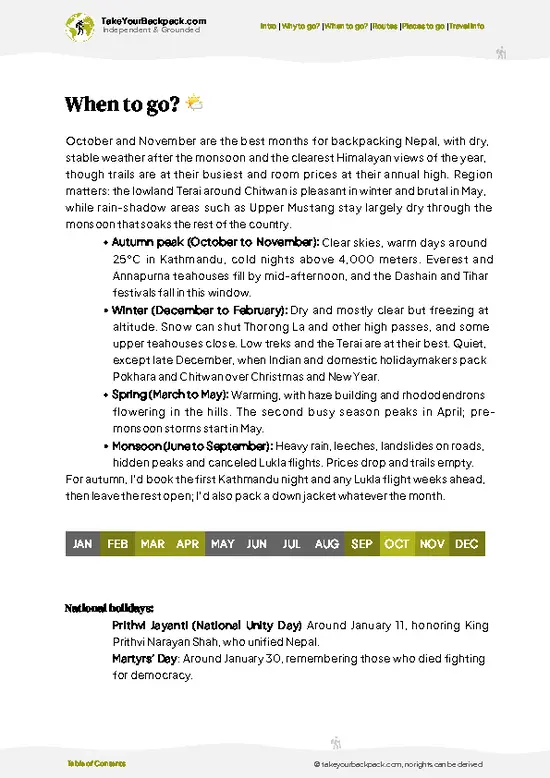
Best months for village travel: The best months are October to November and March to April, when skies are mostly clear, trails are dry and mountain views open up. October and November are the peak: expect daytime highs of 15 to 25°C in the hills, near freezing nights above 3,000 meters, and the busiest tea houses on the Annapurna and Everest routes. Rooms can fill up, and prices for food and beds creep up, so arrive early in the day. March and April bring warmer days and blooming rhododendron in the middle hills, with hazier long-distance views.
Shoulder and low seasons: December to February suits low and mid-altitude villages, with crisp mornings, cold nights and far fewer people. High villages above 3,500 meters can see snow, and some lodges close. Expect hill-town lows of 2 to 8°C and good … read more 👉
Best months for village travel: The best months are October to November and March to April, when skies are mostly clear, trails are dry and mountain views open up. October and November are the peak: expect daytime highs of 15 to 25°C in the hills, near freezing nights above 3,000 meters, and the busiest tea houses on the Annapurna and Everest routes. Rooms can fill up, and prices for food and beds creep up, so arrive early in the day. March and April bring warmer days and blooming rhododendron in the middle hills, with hazier long-distance views.
Shoulder and low seasons: December to February suits low and mid-altitude villages, with crisp mornings, cold nights and far fewer people. High villages above 3,500 meters can see snow, and some lodges close. Expect hill-town lows of 2 to 8°C and good bargains on rooms.

The monsoon runs roughly June to September. Central and eastern Nepal receive most of the year's rain, often 200 to 600 mm a month, so leeches, mud and landslide-blocked roads are common. Villages in the rain-shadow north, such as Mustang and Upper Dolpo, stay far drier, and the Terai turns hot and humid at 30 to 38°C. Monsoon is cheapest and quietest, with lush green terraces, but plan for delays.

village hoppingHow to Combine villages Into One Trip

How long to allow: A trip linking several villages in Nepal needs 10 to 21 days, and two weeks is the comfortable middle. Start in Kathmandu, then cluster stops by region: the Kathmandu Valley and nearby hills together, Pokhara and the Annapurna foothills together, and the Everest or Langtang trails as separate, longer commitments. Move west from Kathmandu to Pokhara (6 to 8 hours by tourist bus, 25 minutes by flight) and loop back, rather than zigzagging across the country. The Terai fits at the end, a 6 to 8 hour ride from Kathmandu or Pokhara toward Chitwan.
Pacing each stop: Give valley and hill villages 1 to 2 nights each, trek-route villages one night per walking day, and high-altitude stops an extra day to acclimatize. Local buses and shared jeeps cover 30 to 50 km in roughly 2 to 4 … read more 👉
How long to allow: A trip linking several villages in Nepal needs 10 to 21 days, and two weeks is the comfortable middle. Start in Kathmandu, then cluster stops by region: the Kathmandu Valley and nearby hills together, Pokhara and the Annapurna foothills together, and the Everest or Langtang trails as separate, longer commitments. Move west from Kathmandu to Pokhara (6 to 8 hours by tourist bus, 25 minutes by flight) and loop back, rather than zigzagging across the country. The Terai fits at the end, a 6 to 8 hour ride from Kathmandu or Pokhara toward Chitwan.
Pacing each stop: Give valley and hill villages 1 to 2 nights each, trek-route villages one night per walking day, and high-altitude stops an extra day to acclimatize. Local buses and shared jeeps cover 30 to 50 km in roughly 2 to 4 hours on hill roads, so budget generously.
Mistakes to avoid: Travelers often cram too many stops into too few days, then lose a day to a landslide or a delayed bus. Build in one spare day per week. Another common slip is flying to high airstrips such as Lukla without buffer days, since weather cancels flights regularly. Also avoid ignoring altitude: climb slowly, and sleep no more than 400 to 500 meters higher each night above 3,000 meters.

The ListThe Best villages of Nepal

1 Namche Bazaar

amphitheater layout, Sherpa market, altitude acclimatization

Spend time adjusting to thinner air while navigating terraced lanes, trading posts, and panoramic views of snow-capped peaks.

nepal-city-namche-bazaar
© Google |

2 Lukla

mountain airstrip, gateway to Everest, steep hillsides

Arrive in a high-altitude village defined by its short runway, constant movement of trekkers, and immediate immersion into rugged terrain.

Loading the map 🌍

Expert viewExpert Commentary on villages

How many villages to visit: Plan for four to six villages on a first trip. Fewer than that and you miss the contrast between mountain, hill and lowland life. More and you spend your days on buses, watching the same windows go by. Each place needs at least a night, ideally two, because the best moments come at dawn, when smoke curls from kitchen fires and the ridge turns pink, and at dusk, when a family lets you into the kitchen for a second plate of dal bhat.
Which kind suits your style: For hikers, choose trek-route villages: walking between tea houses on stone steps and swaying bridges earns you hot sweet tea, big mountain views and steady company. For culture seekers, pick middle-hill Newar, Tamang or Magar villages, where narrow brick lanes, temple courtyards and homestays put you at a … read more 👉
How many villages to visit: Plan for four to six villages on a first trip. Fewer than that and you miss the contrast between mountain, hill and lowland life. More and you spend your days on buses, watching the same windows go by. Each place needs at least a night, ideally two, because the best moments come at dawn, when smoke curls from kitchen fires and the ridge turns pink, and at dusk, when a family lets you into the kitchen for a second plate of dal bhat.
Which kind suits your style: For hikers, choose trek-route villages: walking between tea houses on stone steps and swaying bridges earns you hot sweet tea, big mountain views and steady company. For culture seekers, pick middle-hill Newar, Tamang or Magar villages, where narrow brick lanes, temple courtyards and homestays put you at a family table. For wildlife and slower days, a Tharu village in the Terai offers mud-walled houses, bike lanes through fields and evening dance. Short on time or fitness, go for villages reachable by road and skip the high passes.
What it costs: Expect US$20 to 35 a day on trek routes: a basic room often costs US$3 to 10, dal bhat US$5 to 8 and rises with altitude, and a charged phone or hot shower may add US$1 to 5. In hill villages and homestays, US$15 to 30 a day covers a bed, meals and local transport. Entry and permit costs matter: the Annapurna Conservation Area permit runs about NPR 3,000 (US$22), the TIMS card is often required, and Everest-region permits total roughly US$40 to 50. Guides cost US$25 to 35 a day and porters US$18 to 25. Local buses cost US$2 to 8 per ride, while jeeps and private cars cost far more.
Safety and cultural manners: Altitude sickness is the biggest risk: ascend slowly, drink plenty of water and descend if headaches or nausea worsen. Monsoon landslides can cut roads, and trails can turn slick, so check conditions before leaving. Dress modestly, with shoulders and knees covered, remove shoes before entering homes or temples, walk clockwise around Buddhist stupas and mani walls, and eat and pass food with your right hand. Ask before photographing people. Accept the offered tea with a smile and you will find doors open all along the trail.

✈️ The backpacker research shortcutNepal Travel Guide

An offline-friendly backpacking guide with optimized travel routes, ranked highlights, transport advice, and the best areas to stay.
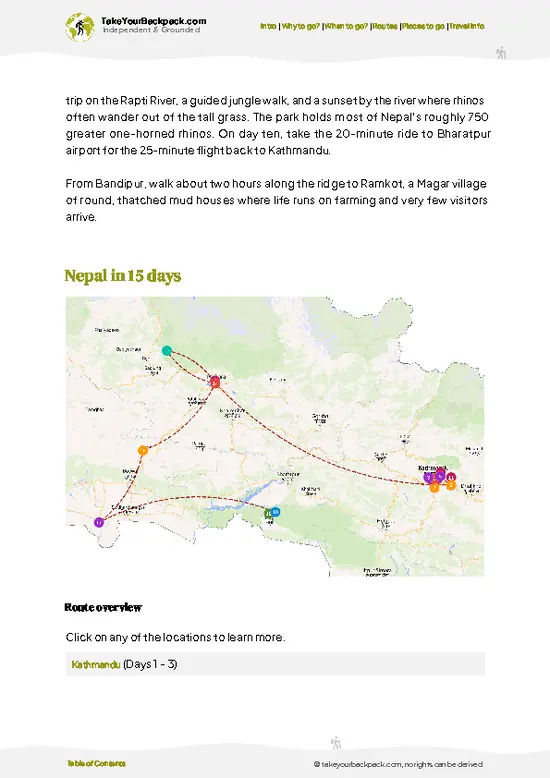
example page 0 from our offline Travel Guide for Nepal
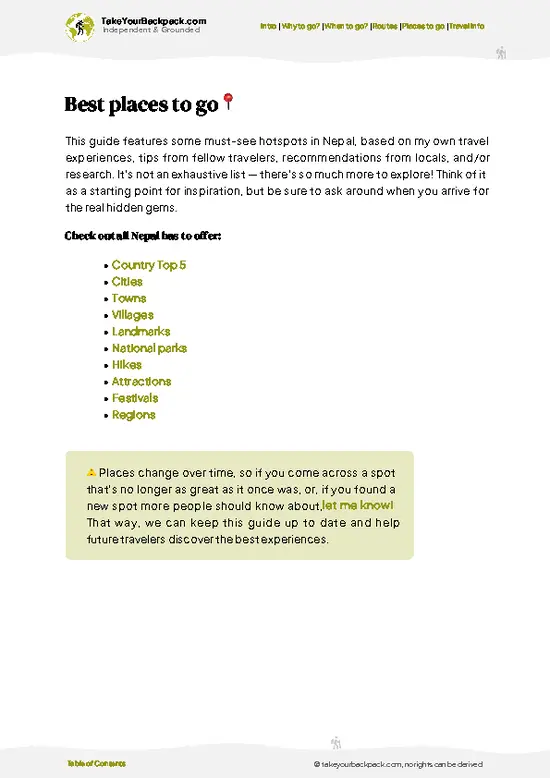
example page 1 from our offline Travel Guide for Nepal
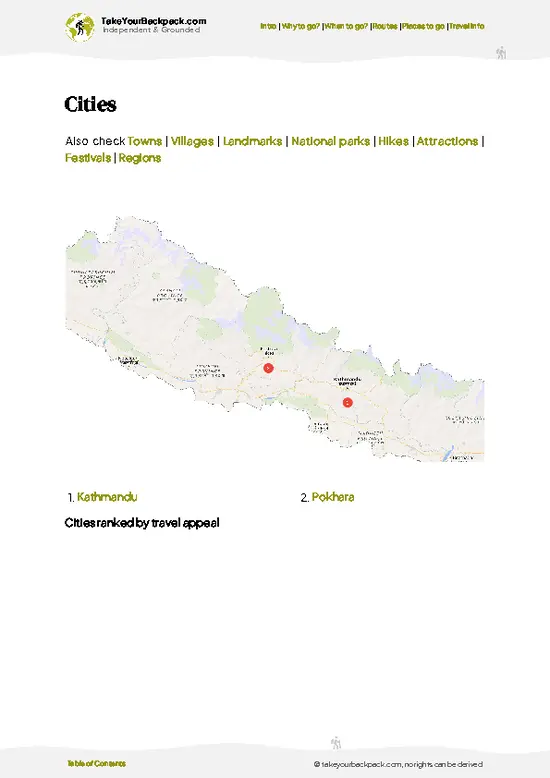
example page 2 from our offline Travel Guide for Nepal
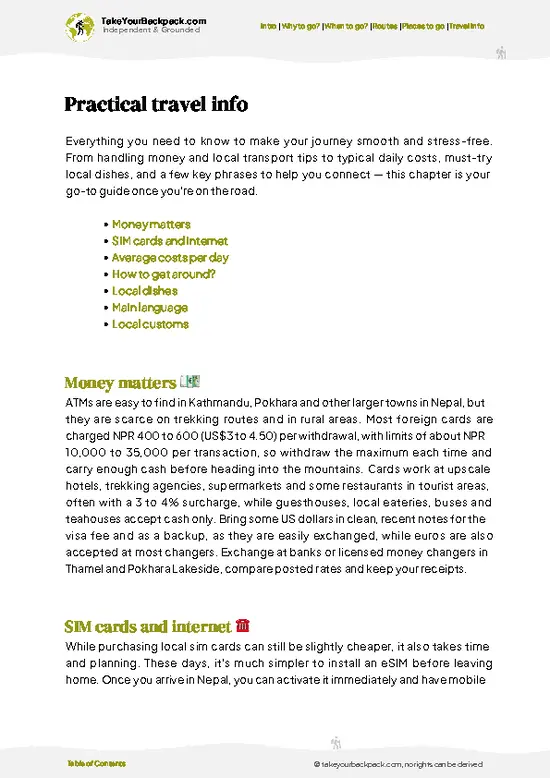
example page 3 from our offline Travel Guide for Nepal
example page 4 from our offline Travel Guide for Nepal
example page 5 from our offline Travel Guide for Nepal
example page 6 from our offline Travel Guide for Nepal
example page 7 from our offline Travel Guide for Nepal
The digital guide (337 pages) contains:
✅ 90 highlights, ranked by travel appeal
✅ Optimized 5, 10 & 15-day travel routes
✅ Cities, national parks, landmarks, beaches
✅ How to get around
✅ Offline-friendly for travel without Wi-Fi
👉 Click to see all 30+ guide features

📅 Plan smarter in minutes, not weeks
✅ Month by month travel advice
✅ Festivals & national holidays
✅ Budget expectations

🗺️ Go to the right places, skip the overrated ones
✅ Honest pros & cons of destinations
✅ Top hikes, parks & viewpoints
✅ Lesser-known places most travelers miss
✅ Clear “worth it vs skip it” guidance

🛏️ Travel smoothly without rookie mistakes
✅ Best areas to stay
✅ Transport systems explained simply
✅ Common scams & safety advice
✅ SIM cards, money & practical tips

🌍 Understand the country, not just visit it
✅ Culture & traditions
✅ 52 Essential phrases & customs
✅ Festivals worth planning around
✅ Traveler-friendly historical context
✅ Insights that make places more meaningful

📱 Built for real travel conditions
✅ Fully downloadable PDF
✅ Works completely offline
✅ Optimized for phone use
✅ Useful in remote areas & buses
✅ Everything in one place
Stop searching, start planning
Get instant access to your full guide. 30‑day money-back guarantee.
+ Add another guide for just

By proceeding you agree to our terms.
Sent to your inbox immediately after payment • 100% Secure Checkout
Best Backpacking Travel Advisor 2025 tourism awardBest Backpacking
Travel Advisor
2025
What others say about Take Your Backpack Guides:
⭐⭐⭐⭐⭐
Fantastic, amazing amount of information!
⭐⭐⭐⭐⭐
My goodness this is amazing, it's what I've been looking for hats off too you!
⭐⭐⭐⭐⭐
I think this is absolutely BRILLIANT
⭐⭐⭐⭐
Very complete and informative. It's still missing places, but I gotta to commend you
⭐⭐⭐⭐⭐
This is truly amazing, thank you, can't wait to explore it with my kids!
⭐⭐⭐⭐⭐
Awesome resource, thank you!
⭐⭐⭐⭐⭐
This is amazing! Can't wait to explore the ones I haven't seen
⭐⭐⭐⭐
I love this! Well done, great idea.
⭐⭐⭐⭐⭐
Thanks for taking the time to make this gem!
⭐⭐⭐⭐⭐
This might be the best website I've ever seen.
⭐⭐⭐⭐⭐
Congratulations, and thank you so much for your work; it's incredibly valuable.
⭐⭐⭐⭐
In all seriousness I think you did a great job pointing out the important spots
⭐⭐⭐⭐⭐
10/10 very good
⭐⭐⭐⭐⭐
As someone who's only just starting to visit regularly this is awesome, thank you.
⭐⭐⭐⭐
Thank you very much! I'm going to visit my dad, it's going to be very useful!
⭐⭐⭐⭐⭐
This is really cool! We'll be travelling for the first time and this definitely come in handy.
⭐⭐⭐⭐⭐
You are now our minister of culture, congratulations 👨‍💼
⭐⭐⭐⭐⭐
Just wanted to tell you that this is a pearl! Going to follow your recommendations.
⭐⭐⭐⭐⭐
This is so cool. I'll definitely be using the resource for my travels soon.
⭐⭐⭐⭐⭐
This is very impressive! Good work.
⭐⭐⭐⭐⭐
This is an amazing and informative site. Very well done!

🛏️ Where to stay?Best Stay Options in Nepal

Nepal has plenty of hostels and budget guesthouses, with dorm beds typically NPR 700 to 1,300 (about US$5 to 10) and basic private rooms from around NPR 1,300 to 2,700 (US$10 to 20). In Kathmandu, Thamel has by far the most choice, the bars and the trekking shops, but it is loud and traffic-choked until late, while Patan (around Jhamsikhel and the old Durbar Square lanes) and Boudha are calmer and safe but need a taxi to reach Thamel’s nightlife. In Pokhara, Lakeside packs in cheap rooms, cafés and live-music bars within walking distance of the water, and the quieter northern end around Khahare is better if you want sleep and lake views over late-night noise.

If you enjoy meeting fellow travelers, … read more 👉
Nepal has plenty of hostels and budget guesthouses, with dorm beds typically NPR 700 to 1,300 (about US$5 to 10) and basic private rooms from around NPR 1,300 to 2,700 (US$10 to 20). In Kathmandu, Thamel has by far the most choice, the bars and the trekking shops, but it is loud and traffic-choked until late, while Patan (around Jhamsikhel and the old Durbar Square lanes) and Boudha are calmer and safe but need a taxi to reach Thamel’s nightlife. In Pokhara, Lakeside packs in cheap rooms, cafés and live-music bars within walking distance of the water, and the quieter northern end around Khahare is better if you want sleep and lake views over late-night noise.

If you enjoy meeting fellow travelers, consider choosing hostels with high ratings for atmosphere. On the other hand, if you prefer having your own space, a hotel might be a better option.

NepalWhere to Go Next

👋 Meet the founderWho’s Behind Take Your Backpack?

Johan, backpacker and founder of TakeYourBackpackHi, I’m Johan (Netherlands 🇳🇱), the creator of TakeYourBackpack. Over the past 3 decades, I’ve backpacked through 90+ countries across six continents, gaining extensive experience with independent travel, long-term trips, and overland routes.

This site is built on a combination of firsthand travel experience and carefully curated insights from other backpackers. Many guides are based on places I’ve personally visited, while others bring together tips, observations, and practical advice shared by trusted travelers I’ve met along the way.

The goal is to provide realistic, experience-driven guidance — not generic itineraries — so you can explore destinations with better context, clearer expectations, and more confidence.