×

Nepal🇳🇵 | best landmarksThe Must-See 7 landmarks in Nepal

Landmarks in Nepal come in three flavors, and each one changes how you travel. The Kathmandu Valley packs medieval Newar squares, stupas and riverside cremation ghats into a few square miles, so you can cover several in a day on foot or by cheap local bus. Lumbini in the Terai lowlands spreads its sites across flat, quiet grounds, with fewer crowds and easy cycling. The Himalayan landmarks, from monasteries to sacred lakes and base camps, demand days of trekking, permits and lungs. Independent travelers can mix all three, but entry fees for foreigners, altitude and monsoon mud decide how far you go. Lace up and pick your kind.

By Johan Kruseman 🇳🇱 | Updated October 20, 2026
Explore the best national parks in Nepal

Why go?What Makes Them Special

Nepal stacks two living religions on top of the world's tallest mountains, and that combination has no match elsewhere. Hindu temples and Buddhist stupas share courtyards, priests still run daily rituals, and many sites are working places of worship rather than preserved ruins. Expect incense, bells, butter lamps and festival drums to be part of the visit.

Geography shapes everything. Steep ridges and river gorges kept valleys isolated, so each region developed its own architecture, from Newar brick and carved timber in the middle hills to Tibetan-style gompas in the high north. Earthquakes, especially the 2015 disaster, damaged many monuments; restoration is ongoing, so scaffolding is common at some sites.

Before choosing Nepal, know the practicalities. Foreigner entry fees apply at the … read more 👉
Nepal stacks two living religions on top of the world's tallest mountains, and that combination has no match elsewhere. Hindu temples and Buddhist stupas share courtyards, priests still run daily rituals, and many sites are working places of worship rather than preserved ruins. Expect incense, bells, butter lamps and festival drums to be part of the visit.

Geography shapes everything. Steep ridges and river gorges kept valleys isolated, so each region developed its own architecture, from Newar brick and carved timber in the middle hills to Tibetan-style gompas in the high north. Earthquakes, especially the 2015 disaster, damaged many monuments; restoration is ongoing, so scaffolding is common at some sites.

Before choosing Nepal, know the practicalities. Foreigner entry fees apply at the major heritage sites, often several times the price Nepalis and many South Asian visitors pay. Roads are slow, landslides cut routes in summer, and high-altitude landmarks need acclimatization and permits. Dress modestly, remove shoes and hats where asked, and walk clockwise around Buddhist shrines. Get those basics right and Nepal rewards you with landmarks that feel alive, not staged.
Why These Made the Cut
The list of best unique sites in Nepal is created based on history or culture, wow factor, atmosphere, quirks, and memorability. If you feel a unique site is missing in this list, please let us know.

When to go?Seasonal Guide to Visiting

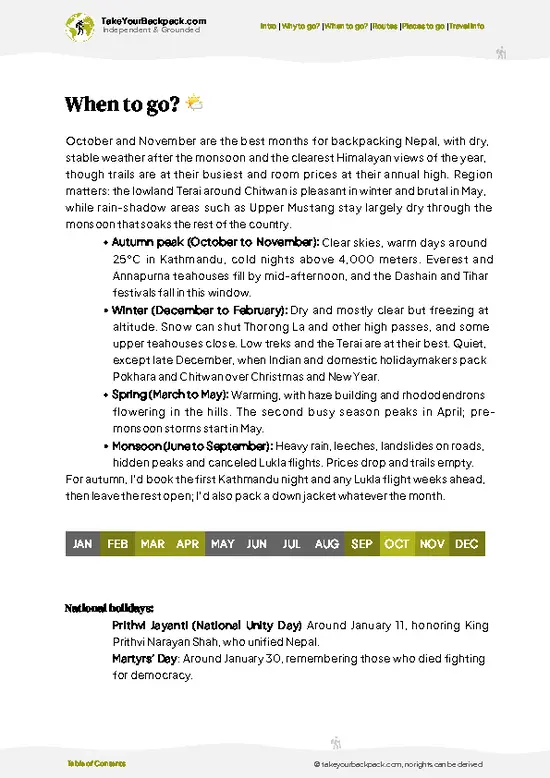
Best months: October to November and March to April: Pick October and November or March and April for landmarks in Nepal: skies are clearest, trails are dry and mountain views open up. Autumn is the peak, with daytime highs of about 20 to 25°C in Kathmandu and Pokhara, cool nights around 5 to 10°C, and the festival season of Dashain and Tihar packing temples with worshippers. Spring brings rhododendron blooms on the hill trails and slightly warmer, hazier days of 22 to 28°C.
Shoulder and low seasons: December to February is cold but sunny. Kathmandu nights drop to 2 to 5°C, high-altitude sites are snowbound or risky, and the lowland Terai can turn foggy in the morning. Rooms are cheaper, often 20 to 40 percent below peak rates, and crowds thin out.
June to September is monsoon, with the heaviest … read more 👉
Best months: October to November and March to April: Pick October and November or March and April for landmarks in Nepal: skies are clearest, trails are dry and mountain views open up. Autumn is the peak, with daytime highs of about 20 to 25°C in Kathmandu and Pokhara, cool nights around 5 to 10°C, and the festival season of Dashain and Tihar packing temples with worshippers. Spring brings rhododendron blooms on the hill trails and slightly warmer, hazier days of 22 to 28°C.
Shoulder and low seasons: December to February is cold but sunny. Kathmandu nights drop to 2 to 5°C, high-altitude sites are snowbound or risky, and the lowland Terai can turn foggy in the morning. Rooms are cheaper, often 20 to 40 percent below peak rates, and crowds thin out.
June to September is monsoon, with the heaviest rain in July and August, when the country gets roughly 80 percent of its annual rainfall. Landslides disrupt roads, leeches appear on lower trails and views vanish into cloud. The Terai turns hot and humid, often above 35°C. Valley sites stay open and uncrowded, and prices fall, but the high Himalaya is best saved for another season.

unique site hoppingHow to Combine landmarks Into One Trip

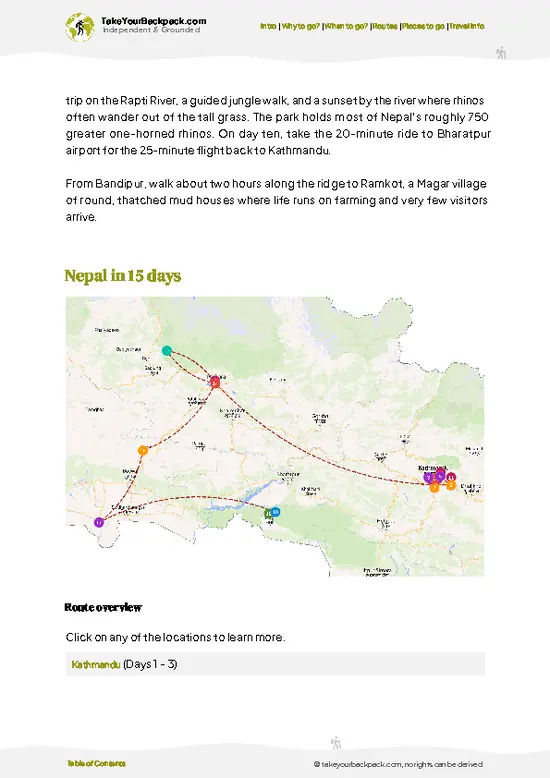
How many days to combine Nepal's landmarks: A trip linking several landmarks in Nepal works best with 10 to 16 days. That gives you room for the valley, the lowlands and one mountain excursion without sprinting.
Grouping regions and choosing a direction: Start in the Kathmandu Valley, where the cluster of heritage squares and shrines needs 3 to 5 days, since you can reach most by local bus, taxi or on foot. Move west toward Pokhara, a 6 to 8 hour tourist bus ride or a 25 minute flight, then continue south to Lumbini via Bhairahawa, roughly 6 to 8 hours by road from Pokhara. Lumbini deserves 1 to 2 days. Finish by flying or busing back to Kathmandu, or exit to India from the Sunauli border nearby. Add a high-altitude leg only if you have 5 to 12 spare days for acclimatization.
Planning mistakes … read more 👉
How many days to combine Nepal's landmarks: A trip linking several landmarks in Nepal works best with 10 to 16 days. That gives you room for the valley, the lowlands and one mountain excursion without sprinting.
Grouping regions and choosing a direction: Start in the Kathmandu Valley, where the cluster of heritage squares and shrines needs 3 to 5 days, since you can reach most by local bus, taxi or on foot. Move west toward Pokhara, a 6 to 8 hour tourist bus ride or a 25 minute flight, then continue south to Lumbini via Bhairahawa, roughly 6 to 8 hours by road from Pokhara. Lumbini deserves 1 to 2 days. Finish by flying or busing back to Kathmandu, or exit to India from the Sunauli border nearby. Add a high-altitude leg only if you have 5 to 12 spare days for acclimatization.
Planning mistakes to dodge: Travelers often underestimate road times: a 200 kilometer stretch can swallow a full day. Plan a buffer day before any international flight. Another error is squeezing too many valley sites into one day, which blurs the temples together. Cap it at two or three per day and start early, before the tour groups arrive. In monsoon, build in spare days for slides, and book flights rather than buses on key legs.

The ListThe Best landmarks of Nepal

1 Mount Everest

Sagarmatha summit, Khumbu glaciers, Sherpa villages

Follow winding trails through remote valleys, pass prayer flags and stone stupas, and witness the world’s highest peak from rugged vantage points.

Nepal - the Mount Everest

2 Lumbini

birthplace of Buddha, monastic zones, sacred garden

Wander among international monasteries and tranquil ponds, tracing the early life of Siddhartha Gautama in a landscape shaped by devotion.

nepal-unique-site-lumbini
© Google |

3 Boudhanath Stupa

massive mandala, Tibetan prayer wheels, rooftop viewpoints

Circle the stupa alongside pilgrims, watch monks in maroon robes, and absorb the steady hum of Buddhist ritual in Kathmandu’s northeast.

nepal-unique-site-boudhanath-stupa
© Google |

4 Swayambhunath Temple

hilltop stupa, resident monkeys, panoramic city views

Climb steep steps to a stupa ringed by prayer flags, where monkeys dart between shrines and Kathmandu sprawls below in the haze.

5 Gosaikunda

alpine lakes, high-altitude trails, sacred pilgrimage site

Trek through rugged terrain to reach glacial waters, where thin air and mountain silence create a rare sense of isolation and devotion.

6 Sundarijal

waterfalls, forest trails, Shivapuri foothills

Start a trek beside rushing streams, pass through dense forest, and watch locals collecting water at the edge of Kathmandu Valley.

nepal-unique-site-sundarijal
© Google |

7 Panchase

forest ridges, rhododendron blooms, panoramic lookout

Climb gentle slopes through dense woodland, spot rare birds, and reach a summit with broad views of Annapurna and Dhaulagiri ranges.

nepal-unique-site-panchase
© Google |
Loading the map 🌍

Expert viewExpert Commentary on landmarks

How many landmarks to plan for: Aim for 8 to 12 landmarks on a trip of two to three weeks, and let the number flex with altitude and weather. Nepal’s distances look short on a map but crawl on the ground. A 150 km bus ride on a two-lane highway can eat 7 to 9 hours, and landslide delays are routine in monsoon. Pack in more and you spend the trip staring through a bus window instead of standing at the sites. Fewer, with room to linger, gives you the temple courtyard at dawn, with butter lamps flickering and the bells starting up.
Choosing between kinds of landmarks: Nepal offers three broad kinds: sacred sites and old city squares in the Kathmandu Valley, lowland national parks and pilgrimage towns in the Terai, and mountain viewpoints and monasteries reached on foot. Culture seekers should … read more 👉
How many landmarks to plan for: Aim for 8 to 12 landmarks on a trip of two to three weeks, and let the number flex with altitude and weather. Nepal’s distances look short on a map but crawl on the ground. A 150 km bus ride on a two-lane highway can eat 7 to 9 hours, and landslide delays are routine in monsoon. Pack in more and you spend the trip staring through a bus window instead of standing at the sites. Fewer, with room to linger, gives you the temple courtyard at dawn, with butter lamps flickering and the bells starting up.
Choosing between kinds of landmarks: Nepal offers three broad kinds: sacred sites and old city squares in the Kathmandu Valley, lowland national parks and pilgrimage towns in the Terai, and mountain viewpoints and monasteries reached on foot. Culture seekers should weight the valley, where lanes of brick and carved wood are walkable and everything sits within a short taxi ride. Wildlife lovers should give the Terai a few days, where you get the jungle at eye level, sometimes a rhino in the grass. Trekkers can treat the mountain landmarks as the reason for the walk, since the trail is the ticket and the monastery or glacier view is the finish. Mixing all three works, but only if you accept that the mountains set the schedule.
What it costs: Budget US$25 to 45 a day for independent travel, covering a simple guesthouse room (US$5 to 15), dal bhat meals (US$2 to 4), and local transport. Entry fees are the real variable. Foreigners pay roughly NPR 1,000 to 2,000 (US$8 to 15) at the major valley heritage squares and about NPR 1,000 to 2,000 at big Buddhist and Hindu complexes, while many smaller shrines are free or ask a small donation. National park permits run around NPR 2,000 to 3,000 a day in the Terai, and trekking areas need permits of roughly US$20 to 30 plus a TIMS or local card where required. Licensed guides cost US$20 to 35 a day and pay off at sites where carvings and rituals make little sense without context. Tourist buses cost US$8 to 15 per leg, local buses far less, and taxis within the valley US$3 to 10 a ride.
Safety and etiquette on the ground: Walk clockwise around stupas and temples, spinning prayer wheels the same way, and you will fit in at once. Remove shoes before entering shrines, and note that leather items and cameras are barred inside some Hindu temples, where non-Hindus may be restricted from inner sanctums. Cover shoulders and knees, and ask before photographing people at cremation ghats, where the smoke and chanting are part of the day’s truth rather than a show. Keep your right hand for offerings and handing over money.
Altitude deserves respect at high sites: ascend slowly, drink 3 to 4 liters of water, and descend if headaches worsen. Monkeys at temple complexes snatch food and sunglasses, so keep snacks zipped away. Touts posing as free guides will lead you to a shop, so agree a price first or decline politely. Carry cash, since ATMs thin out fast outside Kathmandu and Pokhara, and in the rainy season leave buffer days so a blocked road does not cost you a flight.

✈️ The backpacker research shortcutNepal Travel Guide

An offline-friendly backpacking guide with optimized travel routes, ranked highlights, transport advice, and the best areas to stay.
example page 0 from our offline Travel Guide for Nepal
example page 1 from our offline Travel Guide for Nepal
example page 2 from our offline Travel Guide for Nepal
example page 3 from our offline Travel Guide for Nepal
example page 4 from our offline Travel Guide for Nepal
example page 5 from our offline Travel Guide for Nepal
example page 6 from our offline Travel Guide for Nepal
example page 7 from our offline Travel Guide for Nepal
The digital guide (337 pages) contains:
✅ 90 highlights, ranked by travel appeal
✅ Optimized 5, 10 & 15-day travel routes
✅ Cities, national parks, landmarks, beaches
✅ How to get around
✅ Offline-friendly for travel without Wi-Fi
👉 Click to see all 30+ guide features

📅 Plan smarter in minutes, not weeks
✅ Month by month travel advice
✅ Festivals & national holidays
✅ Budget expectations

🗺️ Go to the right places, skip the overrated ones
✅ Honest pros & cons of destinations
✅ Top hikes, parks & viewpoints
✅ Lesser-known places most travelers miss
✅ Clear “worth it vs skip it” guidance

🛏️ Travel smoothly without rookie mistakes
✅ Best areas to stay
✅ Transport systems explained simply
✅ Common scams & safety advice
✅ SIM cards, money & practical tips

🌍 Understand the country, not just visit it
✅ Culture & traditions
✅ 52 Essential phrases & customs
✅ Festivals worth planning around
✅ Traveler-friendly historical context
✅ Insights that make places more meaningful

📱 Built for real travel conditions
✅ Fully downloadable PDF
✅ Works completely offline
✅ Optimized for phone use
✅ Useful in remote areas & buses
✅ Everything in one place
Stop searching, start planning
Get instant access to your full guide. 30‑day money-back guarantee.
+ Add another guide for just

By proceeding you agree to our terms.
Sent to your inbox immediately after payment • 100% Secure Checkout
Best Backpacking Travel Advisor 2025 tourism awardBest Backpacking
Travel Advisor
2025
What others say about Take Your Backpack Guides:
⭐⭐⭐⭐⭐
Fantastic, amazing amount of information!
⭐⭐⭐⭐⭐
My goodness this is amazing, it's what I've been looking for hats off too you!
⭐⭐⭐⭐⭐
I think this is absolutely BRILLIANT
⭐⭐⭐⭐
Very complete and informative. It's still missing places, but I gotta to commend you
⭐⭐⭐⭐⭐
This is truly amazing, thank you, can't wait to explore it with my kids!
⭐⭐⭐⭐⭐
Awesome resource, thank you!
⭐⭐⭐⭐⭐
This is amazing! Can't wait to explore the ones I haven't seen
⭐⭐⭐⭐
I love this! Well done, great idea.
⭐⭐⭐⭐⭐
Thanks for taking the time to make this gem!
⭐⭐⭐⭐⭐
This might be the best website I've ever seen.
⭐⭐⭐⭐⭐
Congratulations, and thank you so much for your work; it's incredibly valuable.
⭐⭐⭐⭐
In all seriousness I think you did a great job pointing out the important spots
⭐⭐⭐⭐⭐
10/10 very good
⭐⭐⭐⭐⭐
As someone who's only just starting to visit regularly this is awesome, thank you.
⭐⭐⭐⭐
Thank you very much! I'm going to visit my dad, it's going to be very useful!
⭐⭐⭐⭐⭐
This is really cool! We'll be travelling for the first time and this definitely come in handy.
⭐⭐⭐⭐⭐
You are now our minister of culture, congratulations 👨‍💼
⭐⭐⭐⭐⭐
Just wanted to tell you that this is a pearl! Going to follow your recommendations.
⭐⭐⭐⭐⭐
This is so cool. I'll definitely be using the resource for my travels soon.
⭐⭐⭐⭐⭐
This is very impressive! Good work.
⭐⭐⭐⭐⭐
This is an amazing and informative site. Very well done!

🛏️ Where to stay?Where to Stay in Nepal

Nepal has plenty of hostels and budget guesthouses, with dorm beds typically NPR 700 to 1,300 (about US$5 to 10) and basic private rooms from around NPR 1,300 to 2,700 (US$10 to 20). In Kathmandu, Thamel has by far the most choice, the bars and the trekking shops, but it is loud and traffic-choked until late, while Patan (around Jhamsikhel and the old Durbar Square lanes) and Boudha are calmer and safe but need a taxi to reach Thamel’s nightlife. In Pokhara, Lakeside packs in cheap rooms, cafés and live-music bars within walking distance of the water, and the quieter northern end around Khahare is better if you want sleep and lake views over late-night noise.

If you enjoy meeting fellow travelers, … read more 👉
Nepal has plenty of hostels and budget guesthouses, with dorm beds typically NPR 700 to 1,300 (about US$5 to 10) and basic private rooms from around NPR 1,300 to 2,700 (US$10 to 20). In Kathmandu, Thamel has by far the most choice, the bars and the trekking shops, but it is loud and traffic-choked until late, while Patan (around Jhamsikhel and the old Durbar Square lanes) and Boudha are calmer and safe but need a taxi to reach Thamel’s nightlife. In Pokhara, Lakeside packs in cheap rooms, cafés and live-music bars within walking distance of the water, and the quieter northern end around Khahare is better if you want sleep and lake views over late-night noise.

If you enjoy meeting fellow travelers, consider choosing hostels with high ratings for atmosphere. On the other hand, if you prefer having your own space, a hotel might be a better option.

NepalMore of Nepal

👋 Meet the founderWho’s Behind Take Your Backpack?

Johan, backpacker and founder of TakeYourBackpackHi, I’m Johan (Netherlands 🇳🇱), the creator of TakeYourBackpack. Over the past 3 decades, I’ve backpacked through 90+ countries across six continents, gaining extensive experience with independent travel, long-term trips, and overland routes.

This site is built on a combination of firsthand travel experience and carefully curated insights from other backpackers. Many guides are based on places I’ve personally visited, while others bring together tips, observations, and practical advice shared by trusted travelers I’ve met along the way.

The goal is to provide realistic, experience-driven guidance — not generic itineraries — so you can explore destinations with better context, clearer expectations, and more confidence.