×

Nepal🇳🇵 | best citiesThe Must-See 2 cities in Nepal

Nepal packs its cities into a country where the land tilts from jungle plains to Himalayan ridgelines, and that tilt shapes everything. In the Kathmandu Valley, brick lanes and temple squares run on a loud, dusty, thrilling rhythm. Out in the hill towns, lakeside cafés and mountain views set a slower pace. Down in the Terai, the air turns hot and flat, crowds thin out, and prices drop. Independent travelers find that costs stay low everywhere, but access varies wildly, from short flights to long, bumpy bus rides. Pick your kind of city, then go explore.

By Johan Kruseman 🇳🇱 | Updated October 20, 2026
Explore the best towns in Nepal

Why go?What Makes Them Special

Nepal’s cities exist because of geography. Mountains confine people to valleys and river terraces, so urban life concentrates in tight pockets, and the Kathmandu Valley has held settlements for well over a thousand years. The Newar people built dense, walkable towns of carved wood, brick courtyards and shrines on nearly every corner, where Hindu and Buddhist traditions overlap in daily life. That makes Nepal a place where cities are living neighborhoods with working temples, not museum pieces.

The same terrain limits infrastructure. Roads twist through hills, landslides can close highways in monsoon, and domestic flights are often the fastest option. Expect power cuts, uneven sidewalks, heavy traffic and air pollution that peaks in the dry months, especially in the capital valley. The 2015 … read more 👉
Nepal’s cities exist because of geography. Mountains confine people to valleys and river terraces, so urban life concentrates in tight pockets, and the Kathmandu Valley has held settlements for well over a thousand years. The Newar people built dense, walkable towns of carved wood, brick courtyards and shrines on nearly every corner, where Hindu and Buddhist traditions overlap in daily life. That makes Nepal a place where cities are living neighborhoods with working temples, not museum pieces.

The same terrain limits infrastructure. Roads twist through hills, landslides can close highways in monsoon, and domestic flights are often the fastest option. Expect power cuts, uneven sidewalks, heavy traffic and air pollution that peaks in the dry months, especially in the capital valley. The 2015 earthquake damaged many historic monuments, and restoration continues, so some sites show scaffolding or rebuilt sections.

Before choosing Nepal for cities, understand that urban stops here are best treated as cultural bases and gateways to trekking, rafting and wildlife. You will not find sleek metros or fast trains. You will find intense street life, festivals scheduled by the lunar calendar, momo stalls on every block and prices that stretch a backpacker’s budget far.
Evaluating the Top Choices
The list of best cities in Nepal is created based on culture, vibe, attractions, transport ease, and local charm. If you feel a city is missing in this list, please let us know.

When to go?Seasonal Guide to Visiting

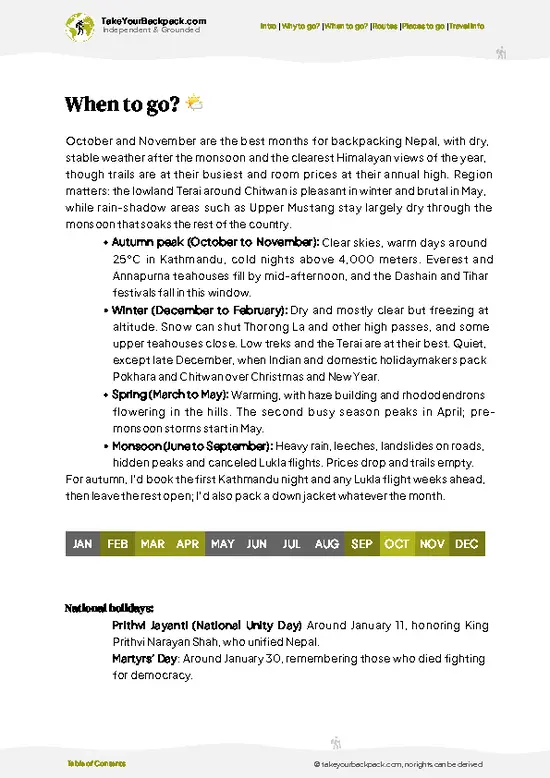
Best Months for City Travel: October to November and March to April are the best months for cities in Nepal, because skies are clear, rain is rare and temperatures sit in a comfortable range. Autumn is the peak: days reach roughly 20 to 27°C (68 to 81°F) in the hill valleys, nights drop to about 8 to 12°C (46 to 54°F), and festivals like Dashain and Tihar fill the calendar. Spring brings warmer days of 22 to 30°C (72 to 86°F) and blooming rhododendrons on the hills.
Shoulder Seasons and Monsoon: December to February is cold in the hills, with mornings near freezing at times, but the skies often stay sharp and blue and rooms cost 20 to 30 percent less than in autumn. Pack a down jacket, since many guesthouses have no heating. In the Terai, winter mornings bring thick fog, while days stay mild. … read more 👉
Best Months for City Travel: October to November and March to April are the best months for cities in Nepal, because skies are clear, rain is rare and temperatures sit in a comfortable range. Autumn is the peak: days reach roughly 20 to 27°C (68 to 81°F) in the hill valleys, nights drop to about 8 to 12°C (46 to 54°F), and festivals like Dashain and Tihar fill the calendar. Spring brings warmer days of 22 to 30°C (72 to 86°F) and blooming rhododendrons on the hills.
Shoulder Seasons and Monsoon: December to February is cold in the hills, with mornings near freezing at times, but the skies often stay sharp and blue and rooms cost 20 to 30 percent less than in autumn. Pack a down jacket, since many guesthouses have no heating. In the Terai, winter mornings bring thick fog, while days stay mild.

June to September is monsoon. The hill valleys get most of Nepal’s 1,400 to 2,000 mm of annual rain in these months, clouds hide the mountains, and landslides can delay buses for hours or days. Prices fall, crowds vanish and the green is dramatic, so flexible travelers can score bargains.
Heat in the Lowlands: The Terai swelters from April to June, regularly passing 35°C (95°F), so save the plains for the cooler months.

city hoppingHow to Combine cities Into One Trip

How Many Days to Plan: A trip combining several cities in Nepal needs 10 to 14 days, and 3 weeks gives you room for a slow pace and a weather buffer. The country splits into three clusters: the Kathmandu Valley in the center, the Pokhara hill region in the west-central hills, and the Terai lowlands along the southern border.
Direction and Timing: Start in the capital valley, where the international airport sits, then head west toward the hills, and finish in the lowlands or loop back by air. Give the valley cities 2 to 4 days in total, hill towns 2 to 3 days each, and Terai stops 1 to 2 days. The Kathmandu to Pokhara tourist bus takes roughly 6 to 8 hours, and a flight takes about 25 to 30 minutes. Kathmandu to the Terai border region runs 6 to 10 hours by road, depending on traffic and landslides. … read more 👉
How Many Days to Plan: A trip combining several cities in Nepal needs 10 to 14 days, and 3 weeks gives you room for a slow pace and a weather buffer. The country splits into three clusters: the Kathmandu Valley in the center, the Pokhara hill region in the west-central hills, and the Terai lowlands along the southern border.
Direction and Timing: Start in the capital valley, where the international airport sits, then head west toward the hills, and finish in the lowlands or loop back by air. Give the valley cities 2 to 4 days in total, hill towns 2 to 3 days each, and Terai stops 1 to 2 days. The Kathmandu to Pokhara tourist bus takes roughly 6 to 8 hours, and a flight takes about 25 to 30 minutes. Kathmandu to the Terai border region runs 6 to 10 hours by road, depending on traffic and landslides.
Planning Mistakes to Skip: The biggest error is trusting map distances. A 200 km stretch can eat a full day, so schedule one major transfer at most per day. Another is cramming too many stops into a short trip: choose two or three bases and use day trips instead. Travelers also forget that mountain flights cancel in bad weather, so keep a spare day before any international departure. Book fixed-date travel for festivals early, because buses and rooms fill up fast.

The ListThe Best cities of Nepal

1 Kathmandu

temple squares, urban sprawl, backpacker districts

Navigate a dense city of narrow lanes and ancient courtyards, where sacred sites and modern life coexist in constant motion.

2 Pokhara

lakeside promenade, Annapurna views, paragliding launch

Relax by the water’s edge or set out for the mountains, with outdoor activities and dramatic scenery always within reach.

nepal-city-pokhara
© Google | Sundar Baral
Loading the map 🌍

Expert viewExpert Commentary on cities

How Many Cities to Visit: Three is the number I advise for a typical 2 to 3 week trip, with four as a ceiling. Nepal’s roads are slow, and every extra stop costs you most of a day on a bus. Three bases leave time for the thing that makes cities here worth visiting: wandering at dawn, when courtyards fill with incense smoke, bells and women carrying flower offerings to shrines.
Choosing Your Kind of City: History and culture seekers should put the Newar towns first, where narrow brick alleys open onto squares with pagodas, and you can sip milk tea on a temple step while the neighborhood goes about its morning. Travelers who want rest, cafés and mountain views suit the lakeside hill towns, where you can paddle a boat at sunrise and watch peaks turn pink. Wildlife and quiet suit the Terai, where … read more 👉
How Many Cities to Visit: Three is the number I advise for a typical 2 to 3 week trip, with four as a ceiling. Nepal’s roads are slow, and every extra stop costs you most of a day on a bus. Three bases leave time for the thing that makes cities here worth visiting: wandering at dawn, when courtyards fill with incense smoke, bells and women carrying flower offerings to shrines.
Choosing Your Kind of City: History and culture seekers should put the Newar towns first, where narrow brick alleys open onto squares with pagodas, and you can sip milk tea on a temple step while the neighborhood goes about its morning. Travelers who want rest, cafés and mountain views suit the lakeside hill towns, where you can paddle a boat at sunrise and watch peaks turn pink. Wildlife and quiet suit the Terai, where bike rides through flat farmland end at jungle edges and far fewer tourists.
What It Costs: Budget travelers can live on US$20 to 35 a day: a dorm or simple room at US$4 to 12, dal bhat at US$2 to 4 (usually with free refills), and local buses at US$1 to 6 per trip. Comfortable mid-range travel runs US$40 to 70. Monument entry for foreigners in the major heritage squares is typically around NPR 1,000 to 2,000 (US$8 to 15). Licensed guides cost about US$20 to 30 a day, and they are worth it for temples, where carvings and rituals otherwise pass without explanation. Tourist buses run US$8 to 15 on the main routes, while domestic flights cost US$100 to 130.
Safety and Cultural Etiquette: Nepal is generally safe for solo and independent travelers, and petty theft is the main concern in crowded spots. Cross streets carefully. Traffic is chaotic, horns constantly sound, and sidewalks vanish. In dry months, wear a mask: dust and exhaust can sting your lungs and eyes. Drink only filtered or bottled water.

On culture, always walk clockwise around stupas and shrines, remove shoes before entering temples, and avoid touching anyone’s head. Leather items and cigarettes are not allowed inside some Hindu temples, and some sanctums admit only Hindus. Use your right hand for giving and eating. Dress modestly, with shoulders and knees covered. Ask before photographing people at rituals or funerals by the river. Bargain with a smile in markets, and you will often leave with a better price and a new friend.

✈️ The backpacker research shortcutNepal Travel Guide

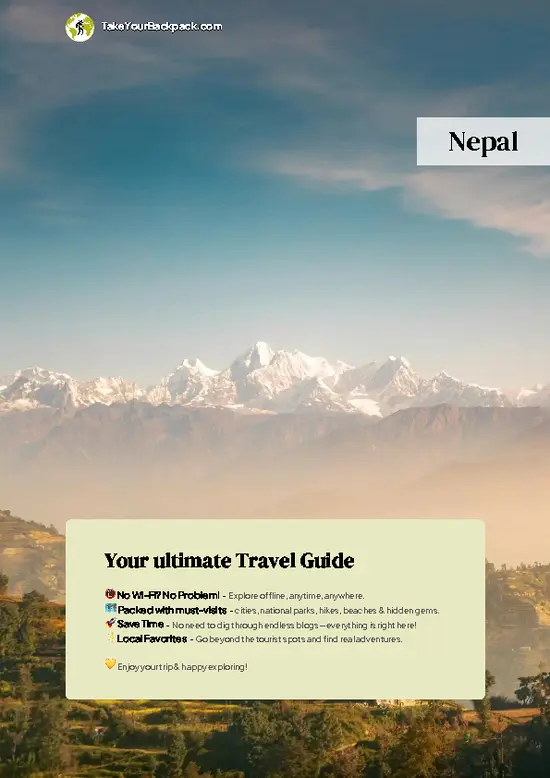
An offline-friendly backpacking guide with optimized travel routes, ranked highlights, transport advice, and the best areas to stay.
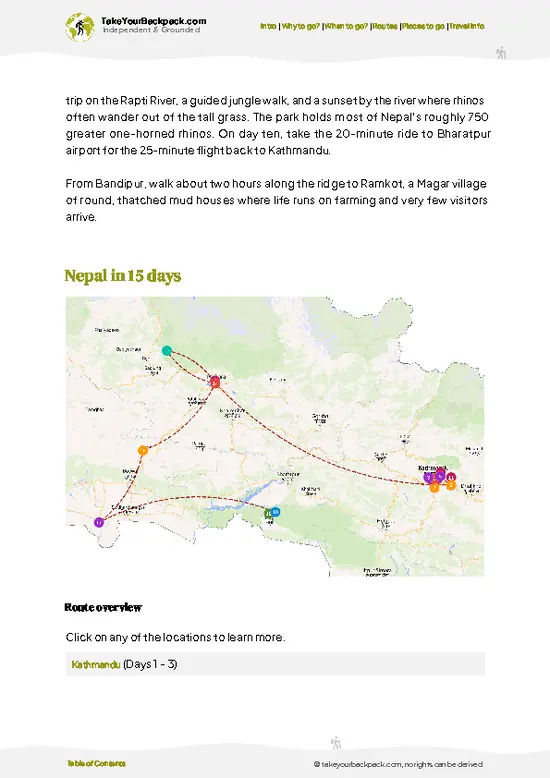
example page 0 from our offline Travel Guide for Nepal
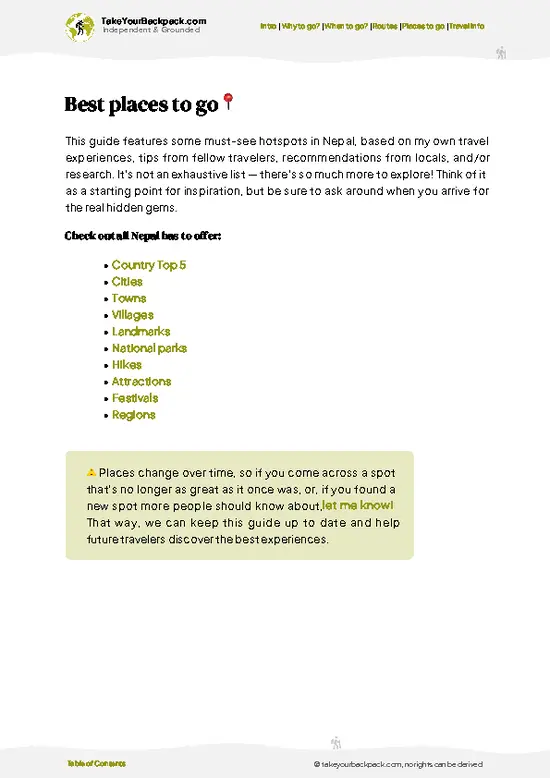
example page 1 from our offline Travel Guide for Nepal
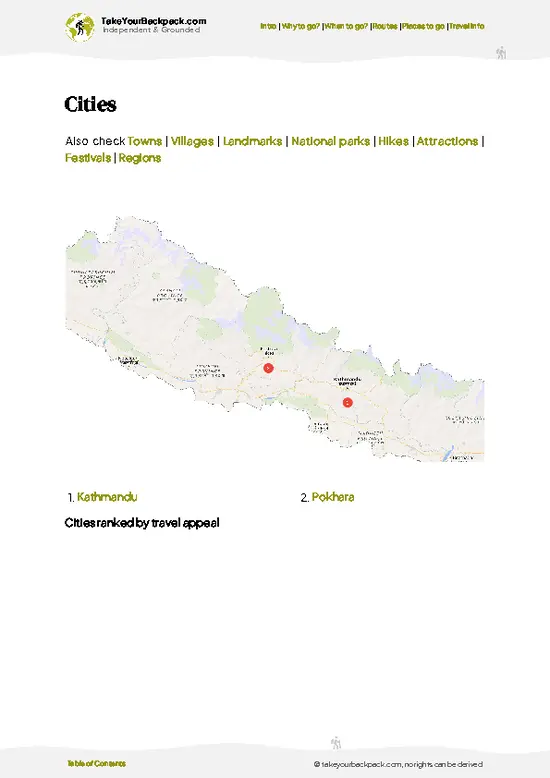
example page 2 from our offline Travel Guide for Nepal
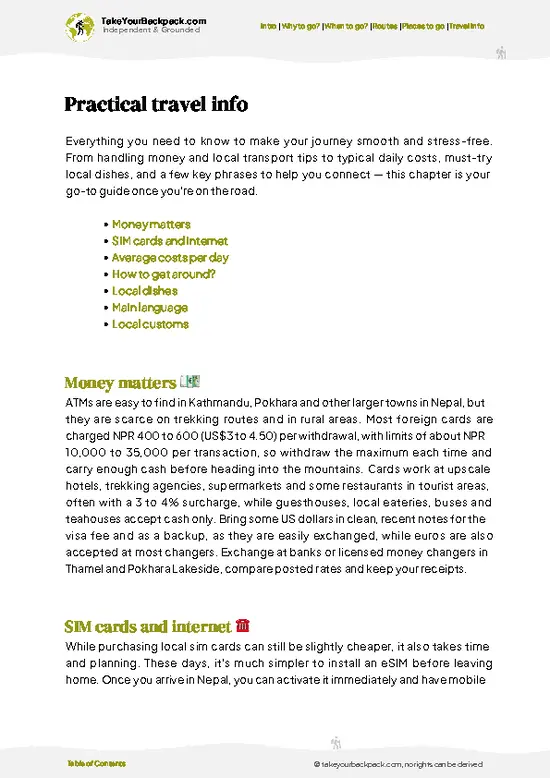
example page 3 from our offline Travel Guide for Nepal
example page 4 from our offline Travel Guide for Nepal
example page 5 from our offline Travel Guide for Nepal
example page 6 from our offline Travel Guide for Nepal
example page 7 from our offline Travel Guide for Nepal
The digital guide (337 pages) contains:
✅ 90 highlights, ranked by travel appeal
✅ Optimized 5, 10 & 15-day travel routes
✅ Cities, national parks, landmarks, beaches
✅ How to get around
✅ Offline-friendly for travel without Wi-Fi
👉 Click to see all 30+ guide features

📅 Plan smarter in minutes, not weeks
✅ Month by month travel advice
✅ Festivals & national holidays
✅ Budget expectations

🗺️ Go to the right places, skip the overrated ones
✅ Honest pros & cons of destinations
✅ Top hikes, parks & viewpoints
✅ Lesser-known places most travelers miss
✅ Clear “worth it vs skip it” guidance

🛏️ Travel smoothly without rookie mistakes
✅ Best areas to stay
✅ Transport systems explained simply
✅ Common scams & safety advice
✅ SIM cards, money & practical tips

🌍 Understand the country, not just visit it
✅ Culture & traditions
✅ 52 Essential phrases & customs
✅ Festivals worth planning around
✅ Traveler-friendly historical context
✅ Insights that make places more meaningful

📱 Built for real travel conditions
✅ Fully downloadable PDF
✅ Works completely offline
✅ Optimized for phone use
✅ Useful in remote areas & buses
✅ Everything in one place
Stop searching, start planning
Get instant access to your full guide. 30‑day money-back guarantee.
+ Add another guide for just

By proceeding you agree to our terms.
Sent to your inbox immediately after payment • 100% Secure Checkout
Best Backpacking Travel Advisor 2025 tourism awardBest Backpacking
Travel Advisor
2025
What others say about Take Your Backpack Guides:
⭐⭐⭐⭐⭐
Fantastic, amazing amount of information!
⭐⭐⭐⭐⭐
My goodness this is amazing, it's what I've been looking for hats off too you!
⭐⭐⭐⭐⭐
I think this is absolutely BRILLIANT
⭐⭐⭐⭐
Very complete and informative. It's still missing places, but I gotta to commend you
⭐⭐⭐⭐⭐
This is truly amazing, thank you, can't wait to explore it with my kids!
⭐⭐⭐⭐⭐
Awesome resource, thank you!
⭐⭐⭐⭐⭐
This is amazing! Can't wait to explore the ones I haven't seen
⭐⭐⭐⭐
I love this! Well done, great idea.
⭐⭐⭐⭐⭐
Thanks for taking the time to make this gem!
⭐⭐⭐⭐⭐
This might be the best website I've ever seen.
⭐⭐⭐⭐⭐
Congratulations, and thank you so much for your work; it's incredibly valuable.
⭐⭐⭐⭐
In all seriousness I think you did a great job pointing out the important spots
⭐⭐⭐⭐⭐
10/10 very good
⭐⭐⭐⭐⭐
As someone who's only just starting to visit regularly this is awesome, thank you.
⭐⭐⭐⭐
Thank you very much! I'm going to visit my dad, it's going to be very useful!
⭐⭐⭐⭐⭐
This is really cool! We'll be travelling for the first time and this definitely come in handy.
⭐⭐⭐⭐⭐
You are now our minister of culture, congratulations 👨‍💼
⭐⭐⭐⭐⭐
Just wanted to tell you that this is a pearl! Going to follow your recommendations.
⭐⭐⭐⭐⭐
This is so cool. I'll definitely be using the resource for my travels soon.
⭐⭐⭐⭐⭐
This is very impressive! Good work.
⭐⭐⭐⭐⭐
This is an amazing and informative site. Very well done!

🛏️ Where to stay?Best Stay Options in Nepal

Nepal has plenty of hostels and budget guesthouses, with dorm beds typically NPR 700 to 1,300 (about US$5 to 10) and basic private rooms from around NPR 1,300 to 2,700 (US$10 to 20). In Kathmandu, Thamel has by far the most choice, the bars and the trekking shops, but it is loud and traffic-choked until late, while Patan (around Jhamsikhel and the old Durbar Square lanes) and Boudha are calmer and safe but need a taxi to reach Thamel’s nightlife. In Pokhara, Lakeside packs in cheap rooms, cafés and live-music bars within walking distance of the water, and the quieter northern end around Khahare is better if you want sleep and lake views over late-night noise.

If you enjoy meeting fellow travelers, … read more 👉
Nepal has plenty of hostels and budget guesthouses, with dorm beds typically NPR 700 to 1,300 (about US$5 to 10) and basic private rooms from around NPR 1,300 to 2,700 (US$10 to 20). In Kathmandu, Thamel has by far the most choice, the bars and the trekking shops, but it is loud and traffic-choked until late, while Patan (around Jhamsikhel and the old Durbar Square lanes) and Boudha are calmer and safe but need a taxi to reach Thamel’s nightlife. In Pokhara, Lakeside packs in cheap rooms, cafés and live-music bars within walking distance of the water, and the quieter northern end around Khahare is better if you want sleep and lake views over late-night noise.

If you enjoy meeting fellow travelers, consider choosing hostels with high ratings for atmosphere. On the other hand, if you prefer having your own space, a hotel might be a better option.

NepalWhere to Go Next

👋 Meet the founderWho’s Behind Take Your Backpack?

Johan, backpacker and founder of TakeYourBackpackHi, I’m Johan (Netherlands 🇳🇱), the creator of TakeYourBackpack. Over the past 3 decades, I’ve backpacked through 90+ countries across six continents, gaining extensive experience with independent travel, long-term trips, and overland routes.

This site is built on a combination of firsthand travel experience and carefully curated insights from other backpackers. Many guides are based on places I’ve personally visited, while others bring together tips, observations, and practical advice shared by trusted travelers I’ve met along the way.

The goal is to provide realistic, experience-driven guidance — not generic itineraries — so you can explore destinations with better context, clearer expectations, and more confidence.