×

Nicaragua🇳🇮 | best landmarksDiscover the 4 Best landmarks Across Nicaragua

Nicaragua packs its landmarks into a narrow strip between two oceans, and the experience changes sharply from one region to the next. On the Pacific side, colonial plazas in Granada and León hold midday heat that smells of horse dung, frying plantain and old stone, with the most visitors and the highest prices. Around the volcanic lakes and cones, you hike through ash, sulfur fumes and cloud forest, usually with a guide. The north and the Caribbean coast see few travelers, take longer to reach, and cost more in time than money. Independent travelers can reach most major sites by chicken bus or shuttle, with entry fees that stay low.

By Johan Kruseman 🇳🇱 | Updated October 20, 2026
Explore the best national parks in Nicaragua

Why go?Understanding Their Importance

Nicaragua’s landmarks exist because of geology and colonial history layered over each other. The country sits on the Pacific Ring of Fire, so a chain of active and dormant volcanoes runs down its western side, bringing crater lakes, black-sand slopes and the occasional rumble of a vent. Next to them stand 16th-century Spanish cities, built on the shores of Lake Nicaragua and in the old capital of León, with thick-walled churches and yellow, ochre and blue facades that blister in the sun. Add pre-Columbian carvings and island sites, and the range is wide for such a small country.

What sets Nicaragua apart from Guatemala or Mexico is how few people share it. Ticket booths are modest, trails are often rough, and many places have no onsite interpretation beyond a local guide. Infrastructure is … read more 👉
Nicaragua’s landmarks exist because of geology and colonial history layered over each other. The country sits on the Pacific Ring of Fire, so a chain of active and dormant volcanoes runs down its western side, bringing crater lakes, black-sand slopes and the occasional rumble of a vent. Next to them stand 16th-century Spanish cities, built on the shores of Lake Nicaragua and in the old capital of León, with thick-walled churches and yellow, ochre and blue facades that blister in the sun. Add pre-Columbian carvings and island sites, and the range is wide for such a small country.

What sets Nicaragua apart from Guatemala or Mexico is how few people share it. Ticket booths are modest, trails are often rough, and many places have no onsite interpretation beyond a local guide. Infrastructure is basic outside the Pacific corridor: expect dust, potholed roads, sweaty minibuses and sometimes no signage. Volcano access can close with little notice when gas or activity rises, and rain turns tracks to mud. Plan for flexibility, carry cash in córdobas, and treat the unpolished edges as part of the appeal. Nicaragua suits travelers who prefer raw, lightly managed sites to polished heritage parks.
Evaluating the Top Choices
The list of best unique sites in Nicaragua is created based on history or culture, wow factor, atmosphere, quirks, and memorability. If you feel a unique site is missing in this list, please let us know.

When to go?Seasonal Guide to Visiting

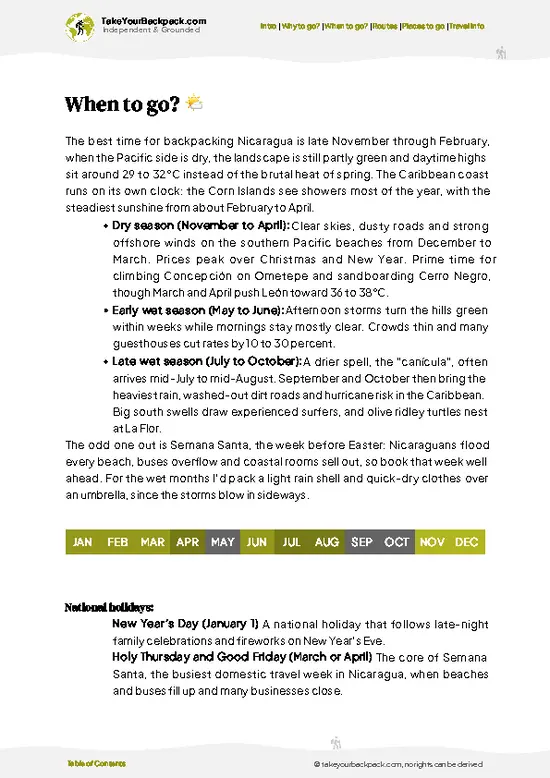
Best Months: The best months for landmarks in Nicaragua are December to April, when the Pacific side is dry, skies stay clear for volcano views and dirt roads are firm underfoot. Days run 30 to 35°C (86 to 95°F) in Granada and León, with hot, dusty afternoons and almost no rain. Mornings are the sensible time to climb or walk: the light is soft, the air is cooler by 5 to 8 degrees, and the heat settles in by 11 a.m.
Shoulder and Wet Season: May to November brings the rains, mostly as heavy afternoon downpours that arrive with thunder and drop 150 to 300 mm a month at the peak, with September and October the wettest. Mornings are often clear, so early starts still work. Trails turn slick, crater views can vanish into cloud, and unpaved roads to rural sites get churned up. In exchange the hills … read more 👉
Best Months: The best months for landmarks in Nicaragua are December to April, when the Pacific side is dry, skies stay clear for volcano views and dirt roads are firm underfoot. Days run 30 to 35°C (86 to 95°F) in Granada and León, with hot, dusty afternoons and almost no rain. Mornings are the sensible time to climb or walk: the light is soft, the air is cooler by 5 to 8 degrees, and the heat settles in by 11 a.m.
Shoulder and Wet Season: May to November brings the rains, mostly as heavy afternoon downpours that arrive with thunder and drop 150 to 300 mm a month at the peak, with September and October the wettest. Mornings are often clear, so early starts still work. Trails turn slick, crater views can vanish into cloud, and unpaved roads to rural sites get churned up. In exchange the hills turn deep green, crowds thin, and hostel and tour prices often drop 10 to 30 percent.
Peak Periods and Regions: Semana Santa (the week before Easter) and the Christmas to New Year stretch fill Pacific hostels and push up prices, so book ahead. The Caribbean coast is wetter nearly all year, with the heaviest rain from June to August and a drier spell from February to May. The northern highlands stay cooler, around 20 to 26°C (68 to 79°F).

unique site hoppingHow to Combine landmarks Into One Trip

How Many Days: A trip linking several landmarks in Nicaragua needs 7 to 14 days, and 10 is comfortable. The Pacific corridor holds most of the main stops, so it is easy to cluster. Granada, the volcano-and-lake area around Ometepe, and León work as a loop, with Managua only as an airport or bus transfer.
Direction and Transport: Most travelers enter through Managua or from Costa Rica near Rivas, then travel north: Rivas or Granada first, then Managua, then León. Going north-to-south works equally well if you arrive from Honduras. Granada to León takes 2.5 to 3.5 hours by shuttle or by chicken bus through Managua, and Granada to the Ometepe ferry port at San Jorge is about 1.5 hours. Ferries to the island take 1 to 1.5 hours and run on a set schedule that wind can disrupt. Allow 1 to 2 days … read more 👉
How Many Days: A trip linking several landmarks in Nicaragua needs 7 to 14 days, and 10 is comfortable. The Pacific corridor holds most of the main stops, so it is easy to cluster. Granada, the volcano-and-lake area around Ometepe, and León work as a loop, with Managua only as an airport or bus transfer.
Direction and Transport: Most travelers enter through Managua or from Costa Rica near Rivas, then travel north: Rivas or Granada first, then Managua, then León. Going north-to-south works equally well if you arrive from Honduras. Granada to León takes 2.5 to 3.5 hours by shuttle or by chicken bus through Managua, and Granada to the Ometepe ferry port at San Jorge is about 1.5 hours. Ferries to the island take 1 to 1.5 hours and run on a set schedule that wind can disrupt. Allow 1 to 2 days for a colonial city, 2 to 3 for the island, and 1 day for a volcano or crater hike.
Common Planning Mistakes: Travelers often cram too many stops into the dry months and lose hours to Managua’s heavy traffic and midday heat. Build in one slow day per three stops. Another error is leaving north or Caribbean legs without buffer: these routes can take 8 to 12 hours with several connections, so give them their own block or skip them.

The ListTop landmarks of Nicaragua

1 Laguna de Apoyo

Crater lake, warm calm water, kayaks and paddleboards, rim viewpoints

Swim, snorkel or paddle across still, warm water inside a flooded caldera, then climb to the rim for views toward Mombacho.

nicaragua-unique-site-laguna-de-apoyo
© Google | Gustavo Esquivel

2 Somoto Canyon

Basalt slot gorge, river float, cliff jumps, community guides

Drift or swim through narrow basalt corridors with local guides, then jump into deep pools or climb to rim viewpoints over the dry forest.

3 León Cathedral

Whitewashed rooftop, Rubén Darío tomb, crypt museum, Holy Week

Walk across the cathedral’s flat roof and domes for views of volcanoes and terracotta rooftops, then step below to the tombs and crypt.

nicaragua-unique-site-leon-cathedral
© Google | Balázs Pintér

4 León Viejo

Spanish street grid, church foundations, Momotombo backdrop, excavation trenches

Trace the original colonial street lines and church footings beneath Momotombo, with lake views and a small museum explaining why the town was abandoned.

nicaragua-unique-site-leon-viejo
© Google | Yader Sanchez
Loading the map 🌍

Expert viewInsights from Locals and Experts

How Many to Visit: I advise four to six landmarks on a one- to two-week trip. Nicaragua’s roads are slow, midday heat saps energy by noon, and a hike or colonial walk done at 7 a.m. leaves the afternoon for shade, a cold Toña and a plastic chair in a plaza. Past six, you spend more time in minibuses than at the sites.
Choosing by Travel Style: Backpackers on a tight schedule should choose one colonial city, one volcano and one island or lake site, since that mix covers the country’s range. Hikers should prioritize volcanoes and cloud forest, where you get crater views, sulfur smell and cool wind. History lovers should lean toward colonial churches and pre-Columbian sites, which are quiet, cheap and often have you alone with a local guide. Travelers with limited time should skip the remote north … read more 👉
How Many to Visit: I advise four to six landmarks on a one- to two-week trip. Nicaragua’s roads are slow, midday heat saps energy by noon, and a hike or colonial walk done at 7 a.m. leaves the afternoon for shade, a cold Toña and a plastic chair in a plaza. Past six, you spend more time in minibuses than at the sites.
Choosing by Travel Style: Backpackers on a tight schedule should choose one colonial city, one volcano and one island or lake site, since that mix covers the country’s range. Hikers should prioritize volcanoes and cloud forest, where you get crater views, sulfur smell and cool wind. History lovers should lean toward colonial churches and pre-Columbian sites, which are quiet, cheap and often have you alone with a local guide. Travelers with limited time should skip the remote north and Caribbean coast.
What It Costs: Plan on US$30 to 50 a day for hostel dorms, street food and local transport, rising to US$60 to 90 with private rooms and tours. Entry fees are modest: roughly US$2 to 10 for churches, towers and most reserves, with national parks and volcano areas around US$5 to 15. Guides, often required on volcano hikes, cost about US$10 to 40 per group depending on the trail. Chicken buses between towns run US$1 to 3, shuttles US$10 to 20. Carry córdobas for small entry booths, since card readers are rare and change is scarce.
Safety and Etiquette: Tourist areas are generally calmer than elsewhere in Central America, but petty theft happens in markets and on crowded buses, so keep your phone in a front pocket and avoid walking unlit streets at night. Volcano hikes carry real risk from gas and sudden closures: follow ranger instructions, wear sturdy shoes and carry a liter or two of water per person. Churches are active places of worship, so cover shoulders and knees, keep your voice low and ask before photographing people. Tip guides 10 to 15 percent and bring small bills, because that tip is a significant part of their income and a smiling hello in Spanish goes a long way.

✈️ The backpacker research shortcutNicaragua Travel Guide

An offline-friendly backpacking guide with optimized travel routes, ranked highlights, transport advice, and the best areas to stay.
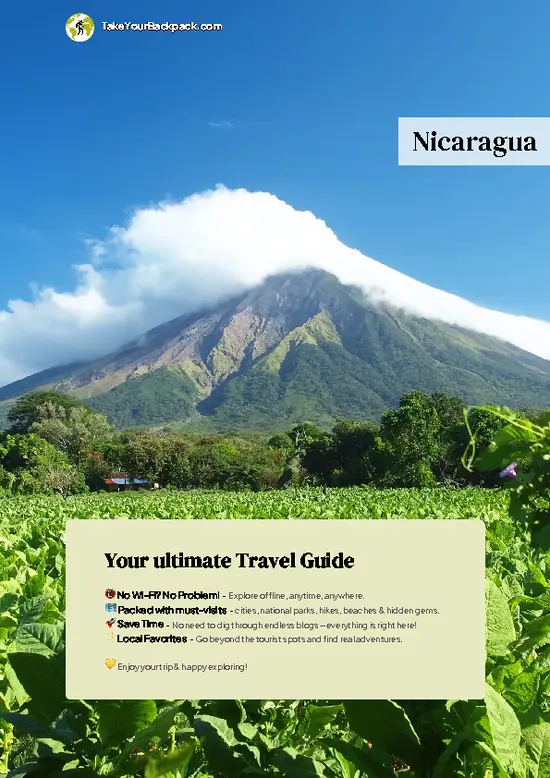
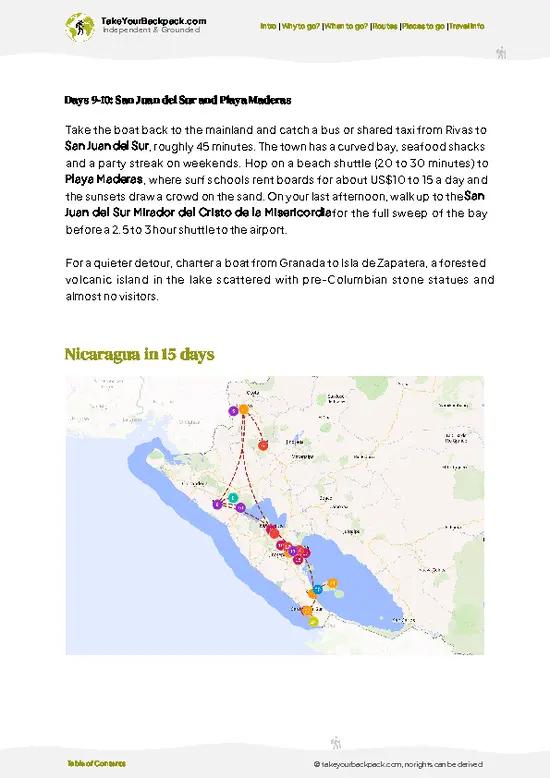
example page 0 from our offline Travel Guide for Nicaragua
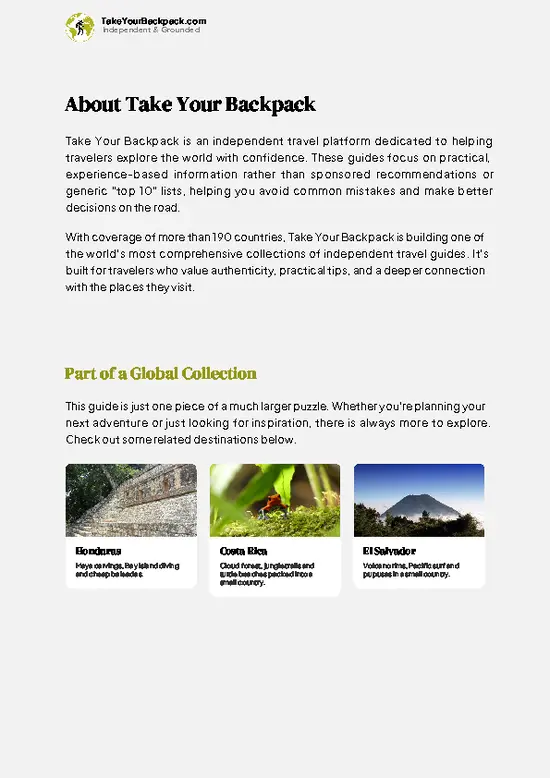
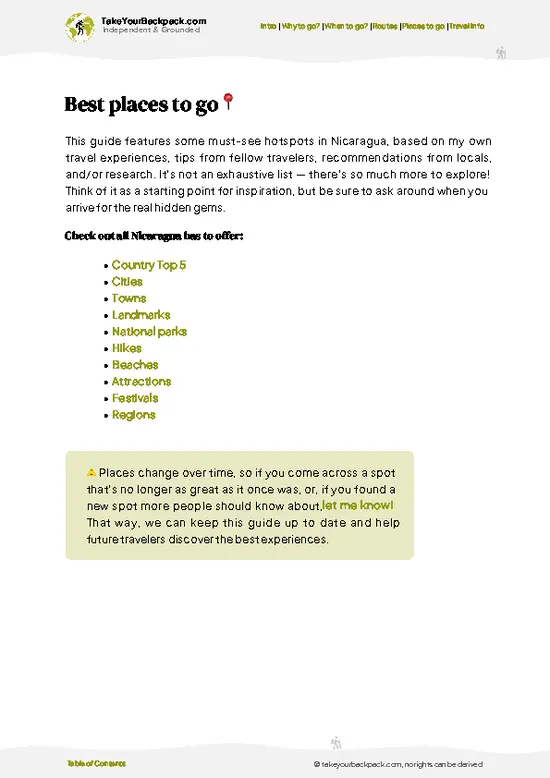
example page 1 from our offline Travel Guide for Nicaragua
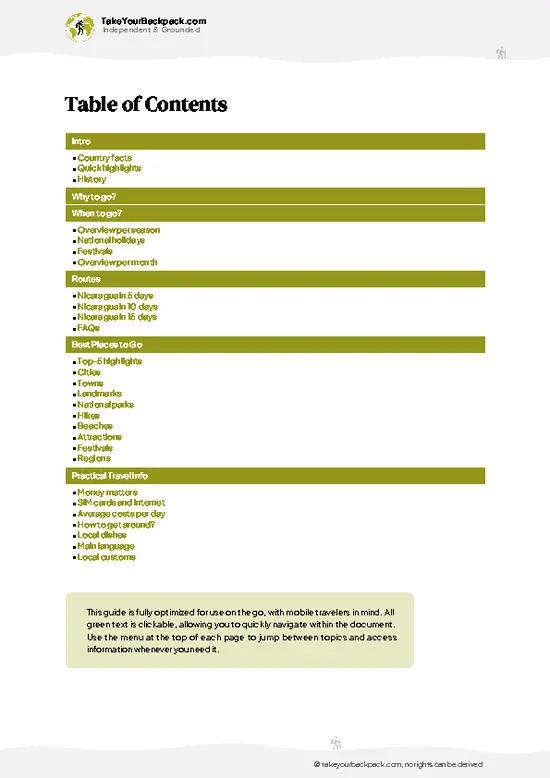
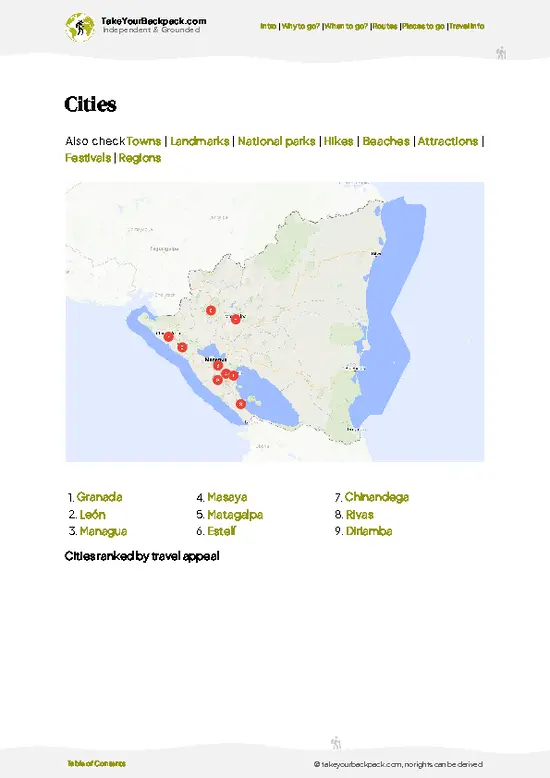
example page 2 from our offline Travel Guide for Nicaragua
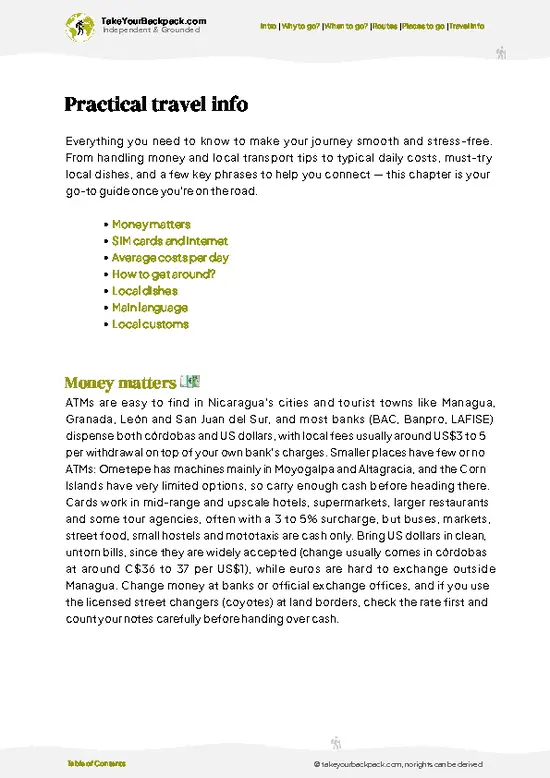
example page 3 from our offline Travel Guide for Nicaragua
example page 4 from our offline Travel Guide for Nicaragua
example page 5 from our offline Travel Guide for Nicaragua
example page 6 from our offline Travel Guide for Nicaragua
example page 7 from our offline Travel Guide for Nicaragua
The digital guide (256 pages) contains:
✅ 77 highlights, ranked by travel appeal
✅ Optimized 5, 10 & 15-day travel routes
✅ Cities, national parks, landmarks, beaches
✅ How to get around
✅ Offline-friendly for travel without Wi-Fi
👉 Click to see all 30+ guide features

📅 Plan smarter in minutes, not weeks
✅ Month by month travel advice
✅ Festivals & national holidays
✅ Budget expectations

🗺️ Go to the right places, skip the overrated ones
✅ Honest pros & cons of destinations
✅ Top hikes, parks & viewpoints
✅ Lesser-known places most travelers miss
✅ Clear “worth it vs skip it” guidance

🛏️ Travel smoothly without rookie mistakes
✅ Best areas to stay
✅ Transport systems explained simply
✅ Common scams & safety advice
✅ SIM cards, money & practical tips

🌍 Understand the country, not just visit it
✅ Culture & traditions
✅ 52 Essential phrases & customs
✅ Festivals worth planning around
✅ Traveler-friendly historical context
✅ Insights that make places more meaningful

📱 Built for real travel conditions
✅ Fully downloadable PDF
✅ Works completely offline
✅ Optimized for phone use
✅ Useful in remote areas & buses
✅ Everything in one place
Stop searching, start planning
Get instant access to your full guide. 30‑day money-back guarantee.
+ Add another guide for just

By proceeding you agree to our terms.
Sent to your inbox immediately after payment • 100% Secure Checkout
Best Backpacking Travel Advisor 2025 tourism awardBest Backpacking
Travel Advisor
2025
What others say about Take Your Backpack Guides:
⭐⭐⭐⭐⭐
Fantastic, amazing amount of information!
⭐⭐⭐⭐⭐
My goodness this is amazing, it's what I've been looking for hats off too you!
⭐⭐⭐⭐⭐
I think this is absolutely BRILLIANT
⭐⭐⭐⭐
Very complete and informative. It's still missing places, but I gotta to commend you
⭐⭐⭐⭐⭐
This is truly amazing, thank you, can't wait to explore it with my kids!
⭐⭐⭐⭐⭐
Awesome resource, thank you!
⭐⭐⭐⭐⭐
This is amazing! Can't wait to explore the ones I haven't seen
⭐⭐⭐⭐
I love this! Well done, great idea.
⭐⭐⭐⭐⭐
Thanks for taking the time to make this gem!
⭐⭐⭐⭐⭐
This might be the best website I've ever seen.
⭐⭐⭐⭐⭐
Congratulations, and thank you so much for your work; it's incredibly valuable.
⭐⭐⭐⭐
In all seriousness I think you did a great job pointing out the important spots
⭐⭐⭐⭐⭐
10/10 very good
⭐⭐⭐⭐⭐
As someone who's only just starting to visit regularly this is awesome, thank you.
⭐⭐⭐⭐
Thank you very much! I'm going to visit my dad, it's going to be very useful!
⭐⭐⭐⭐⭐
This is really cool! We'll be travelling for the first time and this definitely come in handy.
⭐⭐⭐⭐⭐
You are now our minister of culture, congratulations 👨‍💼
⭐⭐⭐⭐⭐
Just wanted to tell you that this is a pearl! Going to follow your recommendations.
⭐⭐⭐⭐⭐
This is so cool. I'll definitely be using the resource for my travels soon.
⭐⭐⭐⭐⭐
This is very impressive! Good work.
⭐⭐⭐⭐⭐
This is an amazing and informative site. Very well done!

🛏️ Where to stay?Best Places to Stay in Nicaragua

Nicaragua has a dense network of hostels and family-run guesthouses, with dorm beds typically running US$8 to 15 and simple private rooms US$20 to 35. In Granada, the blocks around Calle La Calzada put you steps from the colonial churches and the busiest bars (expect noise until late), while staying a few streets toward the lake buys quieter nights. In León, the grid around the cathedral is walkable and lively with students, and San Juan del Sur splits between the party-heavy town center and calmer beach stays near Playa Maderas; on Ometepe, Moyogalpa is handy for the ferry, while Santo Domingo and Balgüe trade convenience for beaches, farms and silence.

If you enjoy meeting fellow travelers, … read more 👉
Nicaragua has a dense network of hostels and family-run guesthouses, with dorm beds typically running US$8 to 15 and simple private rooms US$20 to 35. In Granada, the blocks around Calle La Calzada put you steps from the colonial churches and the busiest bars (expect noise until late), while staying a few streets toward the lake buys quieter nights. In León, the grid around the cathedral is walkable and lively with students, and San Juan del Sur splits between the party-heavy town center and calmer beach stays near Playa Maderas; on Ometepe, Moyogalpa is handy for the ferry, while Santo Domingo and Balgüe trade convenience for beaches, farms and silence.

If you enjoy meeting fellow travelers, consider choosing hostels with high ratings for atmosphere. On the other hand, if you prefer having your own space, a hotel might be a better option.

NicaraguaExplore Nicaragua

👋 Meet the founderWho’s Behind Take Your Backpack?

Johan, backpacker and founder of TakeYourBackpackHi, I’m Johan (Netherlands 🇳🇱), the creator of TakeYourBackpack. Over the past 3 decades, I’ve backpacked through 90+ countries across six continents, gaining extensive experience with independent travel, long-term trips, and overland routes.

This site is built on a combination of firsthand travel experience and carefully curated insights from other backpackers. Many guides are based on places I’ve personally visited, while others bring together tips, observations, and practical advice shared by trusted travelers I’ve met along the way.

The goal is to provide realistic, experience-driven guidance — not generic itineraries — so you can explore destinations with better context, clearer expectations, and more confidence.