×

Nicaragua🇳🇮 | best beachesDiscover the 6 Best beaches Across Nicaragua

Beaches in Nicaragua are mostly wide, dark-to-golden Pacific sweeps with warm surf, hot sand and the smell of salt, woodsmoke and grilled fish drifting from palm-roofed shacks. The Pacific coast is the surf and sunset side, with a hostel scene, shuttle vans and dollar-a-beer happy hours. The Caribbean coast and its islands are slower, pricier to reach and softer in color, with coconut bread, reggae and boat rides over green water. Independent travelers can cover the Pacific by chicken bus and shared shuttle, but the Caribbean takes flights or long river journeys. Expect heat, wind, and dust or mud depending on the season.

By Johan Kruseman 🇳🇱 | Updated October 20, 2026
Explore the best attractions in Nicaragua

Why go?Understanding Their Importance

Nicaragua suits beaches because of its two coastlines and a volcanic backbone. The Pacific side faces open ocean swell and takes steady offshore winds in the dry months, so the water is clear, the waves are consistent and the sand is often darker where volcanic rock has broken down. The Caribbean side is a different world: calm, humid, warm and green, shaped by Afro-Caribbean, Miskito and Creole communities, with English Creole spoken alongside Spanish.

The infrastructure gap matters. The Pacific has paved highways, a long-running surf and backpacker circuit and plenty of hostels. Much of the Caribbean has no road link to the Pacific side, so reaching it takes planning, time and some patience, though the reward is far fewer visitors. Prices on the Pacific are low by regional standards, but … read more 👉
Nicaragua suits beaches because of its two coastlines and a volcanic backbone. The Pacific side faces open ocean swell and takes steady offshore winds in the dry months, so the water is clear, the waves are consistent and the sand is often darker where volcanic rock has broken down. The Caribbean side is a different world: calm, humid, warm and green, shaped by Afro-Caribbean, Miskito and Creole communities, with English Creole spoken alongside Spanish.

The infrastructure gap matters. The Pacific has paved highways, a long-running surf and backpacker circuit and plenty of hostels. Much of the Caribbean has no road link to the Pacific side, so reaching it takes planning, time and some patience, though the reward is far fewer visitors. Prices on the Pacific are low by regional standards, but they rise near the resort developments, where gated projects and imported food push costs up.

Before choosing Nicaragua, know that the beaches are not manicured. Expect strong currents, sparse lifeguards, trash lines after storms and few facilities away from the main towns. Cash is still useful, as many small places do not take cards. In return you get big skies, warm water and a coastline that still feels lightly developed.
Evaluating the Top Choices
The list of best beaches in Nicaragua is created based on beauty, vibe, water quality, activities, and surrounding scenery. If you feel a beach is missing in this list, please let us know.

When to go?Seasonal Guide to Visiting

Best months for the Pacific coast: The best months for Nicaragua’s beaches are December to April, when the Pacific side is dry, skies are clear and daytime temperatures sit around 30 to 35°C. Rainfall is close to nil, the sand burns your feet by midday and the offshore wind keeps evenings comfortable. Peak demand falls over Christmas, New Year and especially Semana Santa (Holy Week), when Nicaraguan families fill the beaches, rooms sell out and prices can climb 30 to 100 percent.
Shoulder and green season: May and November are shoulder months, with hot mornings, afternoon thunderstorms and lower rates. From June to October the Pacific gets heavy afternoon downpours, with rainfall totals often well over 150 mm a month and September and October the wettest. Roads can turn to mud, but the hills … read more 👉
Best months for the Pacific coast: The best months for Nicaragua’s beaches are December to April, when the Pacific side is dry, skies are clear and daytime temperatures sit around 30 to 35°C. Rainfall is close to nil, the sand burns your feet by midday and the offshore wind keeps evenings comfortable. Peak demand falls over Christmas, New Year and especially Semana Santa (Holy Week), when Nicaraguan families fill the beaches, rooms sell out and prices can climb 30 to 100 percent.
Shoulder and green season: May and November are shoulder months, with hot mornings, afternoon thunderstorms and lower rates. From June to October the Pacific gets heavy afternoon downpours, with rainfall totals often well over 150 mm a month and September and October the wettest. Roads can turn to mud, but the hills are green and rooms are cheap, often 20 to 40 percent below high season. Surf is often at its biggest then, though winds can be less tidy.
Caribbean coast: The Caribbean follows a different pattern. It is wet for much of the year, with the heaviest rain from about June to December. February to May is the driest stretch, with calmer seas and clearer water. Humidity stays high throughout, so pack for sweat as much as sun.

beach hoppingHow to Combine beaches Into One Trip

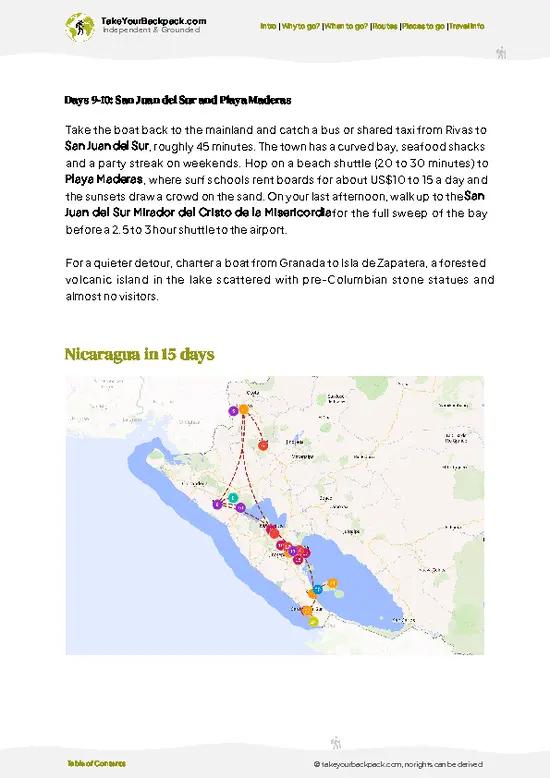
How long to allow: A trip combining several beaches in Nicaragua needs 7 to 14 days, depending on whether you stay on the Pacific side or add the Caribbean. The Pacific regions cluster well along one corridor, with the southern coast near San Juan del Sur, the central coast near Managua and León, and the northern coast near Chinandega. Travel runs most smoothly in a single direction, either north to south or the reverse, with Managua airport or Granada as the usual hubs. Most travelers fly into Managua and work outward, which avoids doubling back.
Time per stop and between regions: Allow 2 to 4 nights per stop. Less than that leaves you mostly in vans and on dusty roads. Transfers between Pacific regions usually take 1.5 to 4 hours by shared shuttle or chicken bus, with a change in Managua … read more 👉
How long to allow: A trip combining several beaches in Nicaragua needs 7 to 14 days, depending on whether you stay on the Pacific side or add the Caribbean. The Pacific regions cluster well along one corridor, with the southern coast near San Juan del Sur, the central coast near Managua and León, and the northern coast near Chinandega. Travel runs most smoothly in a single direction, either north to south or the reverse, with Managua airport or Granada as the usual hubs. Most travelers fly into Managua and work outward, which avoids doubling back.
Time per stop and between regions: Allow 2 to 4 nights per stop. Less than that leaves you mostly in vans and on dusty roads. Transfers between Pacific regions usually take 1.5 to 4 hours by shared shuttle or chicken bus, with a change in Managua or Rivas often needed. Reaching the Caribbean takes more: the Corn Islands are about 1.5 hours by plane from Managua plus a short boat or small-plane transfer, and the overland route through Bluefields takes most of a day or longer.
Common planning mistakes: Travelers often cram too many stops into a week and spend it in transit. Pick two or three bases and use day trips instead. Another mistake is underestimating the Caribbean, which needs at least 3 to 4 extra days. Book Semana Santa transport and rooms well ahead, and leave a buffer before any flight home, since rural roads and buses run late.

The ListTop beaches of Nicaragua

1 San Juan del Sur

Horseshoe bay, Cristo statue, fishing boats, waterfront bars

Climb to the Cristo viewpoint, watch boats unload at dawn, paddle the sheltered water, and join the weekend crowd along the shore.

nicaragua-beach-san-juan-del-sur
© Google | Laura Jamaica

2 Playa Maderas

Beach-break surf, hillside hostels, howler monkeys, Marsella trail

Take a lesson in the whitewater, walk over the headland to Marsella, and end the day at a low-key bonfire under open sky.

nicaragua-beach-playa-maderas
© Google |

3 Playa La Flor

Olive ridley arribadas, wildlife refuge, beach camping, sheltered bay

Pitch a tent behind the sand, swim the calm bay, and wait for ranger-led turtle nights during nesting season.

4 Playa El Coco

Turtle nights, gray-gold sand, morning surf, family kitchens

Join a guided night watch for nesting turtles, surf the main break in clean morning conditions, and finish with fried fish on the sand.

5 Playa Gigante

Landing pangas, calm crescent bay, beginner waves, tide pools

Watch fishermen drag their boats up the sand, swim the middle of the bay, then pick through low-tide pools on the rocky headlands.

6 Jiquilillo Beach

Padre Ramos estuary, dark-sand shoreline, mangrove birdlife, fishermen’s shacks

Paddle mangrove channels beneath the Cosigüina volcano, then walk an empty dark-sand shore and eat fried fish at a family comedor.

Loading the map 🌍

Expert viewInsights from Locals and Experts

How many beaches to visit: Visit three to five beach stops on a two-week trip. That is enough to compare coastlines without spending half your time on buses, and each stop gets time for sunrise, a long swim and an evening on the sand. More than that, and the dusty roads and midday heat will eat the trip. On the road, the best reward is a plate of fried fish and cold Toña on plastic chairs while the light drops.
Which kind to prioritize: Surfers and social travelers should lean toward the Pacific side, where hostels, surf schools and sunset bars make friends easy. Travelers after quiet should weigh the Caribbean, which means longer transport, higher costs and slower days, but with calm water, coconut-scented kitchens and little crowding. Mixing one lively Pacific stop with one remote stretch … read more 👉
How many beaches to visit: Visit three to five beach stops on a two-week trip. That is enough to compare coastlines without spending half your time on buses, and each stop gets time for sunrise, a long swim and an evening on the sand. More than that, and the dusty roads and midday heat will eat the trip. On the road, the best reward is a plate of fried fish and cold Toña on plastic chairs while the light drops.
Which kind to prioritize: Surfers and social travelers should lean toward the Pacific side, where hostels, surf schools and sunset bars make friends easy. Travelers after quiet should weigh the Caribbean, which means longer transport, higher costs and slower days, but with calm water, coconut-scented kitchens and little crowding. Mixing one lively Pacific stop with one remote stretch gives the best contrast.
What it costs: Budget about US$25 to 45 a day on the Pacific, covering a dorm bed (US$8 to 15), simple meals (US$3 to 8) and local transport. Shared shuttles between towns cost roughly US$10 to 25. Surf lessons run US$30 to 60, board rental US$10 to 20 a day, and boat trips to remote coves US$10 to 40 a head. Most public beaches are free, though some private beach clubs charge US$5 to 15 for day access, often redeemable against food and drinks. Expect the Caribbean to cost US$35 to 60 a day, mainly because flights and boats add US$100 to 200 return.
Safety and local etiquette: The biggest beach risk is rip currents. Few beaches have lifeguards, and surf can run hard even on sunny days, so ask locals where to swim and avoid water after drinking. Do not leave bags unattended on the sand, and keep valuables out of sight, because petty theft happens, especially on quiet stretches at dusk. Walk back to town before dark or take a taxi.
Local etiquette: Dress modestly away from the beach, as people in town usually wear shirts and shorts rather than swimwear. Greet shopkeepers and vendors with a quick “buenas” and ask before photographing people, particularly in Caribbean communities. Carry small bills in córdobas for snacks, tuk-tuks and tips, since change is often scarce. Pack reef-safe sunscreen, because the midday sun is intense, and take trash back out with you.

✈️ The backpacker research shortcutNicaragua Travel Guide

An offline-friendly backpacking guide with optimized travel routes, ranked highlights, transport advice, and the best areas to stay.
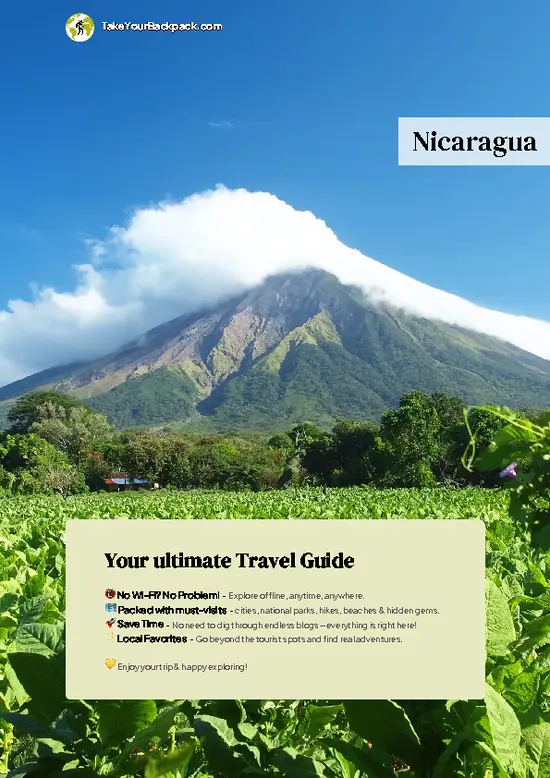
example page 0 from our offline Travel Guide for Nicaragua
example page 1 from our offline Travel Guide for Nicaragua
example page 2 from our offline Travel Guide for Nicaragua
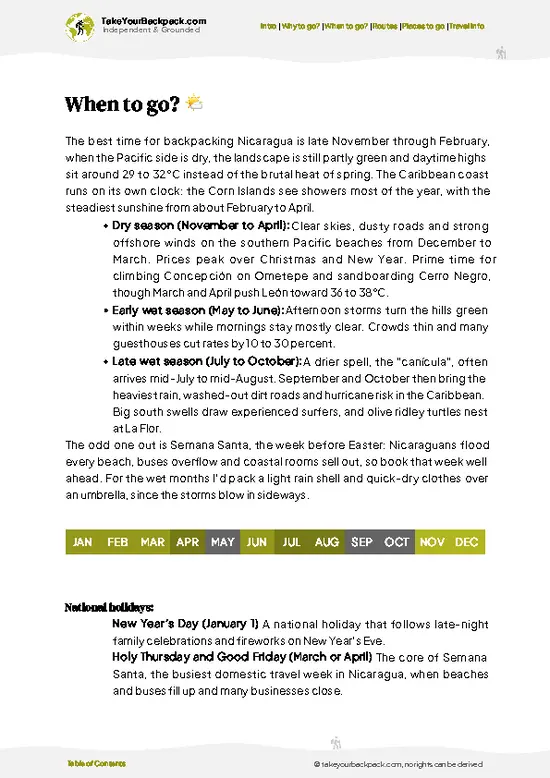
example page 3 from our offline Travel Guide for Nicaragua
example page 4 from our offline Travel Guide for Nicaragua
example page 5 from our offline Travel Guide for Nicaragua
example page 6 from our offline Travel Guide for Nicaragua
example page 7 from our offline Travel Guide for Nicaragua
The digital guide (256 pages) contains:
✅ 77 highlights, ranked by travel appeal
✅ Optimized 5, 10 & 15-day travel routes
✅ Cities, national parks, landmarks, beaches
✅ How to get around
✅ Offline-friendly for travel without Wi-Fi
👉 Click to see all 30+ guide features

📅 Plan smarter in minutes, not weeks
✅ Month by month travel advice
✅ Festivals & national holidays
✅ Budget expectations

🗺️ Go to the right places, skip the overrated ones
✅ Honest pros & cons of destinations
✅ Top hikes, parks & viewpoints
✅ Lesser-known places most travelers miss
✅ Clear “worth it vs skip it” guidance

🛏️ Travel smoothly without rookie mistakes
✅ Best areas to stay
✅ Transport systems explained simply
✅ Common scams & safety advice
✅ SIM cards, money & practical tips

🌍 Understand the country, not just visit it
✅ Culture & traditions
✅ 52 Essential phrases & customs
✅ Festivals worth planning around
✅ Traveler-friendly historical context
✅ Insights that make places more meaningful

📱 Built for real travel conditions
✅ Fully downloadable PDF
✅ Works completely offline
✅ Optimized for phone use
✅ Useful in remote areas & buses
✅ Everything in one place
Stop searching, start planning
Get instant access to your full guide. 30‑day money-back guarantee.
+ Add another guide for just

By proceeding you agree to our terms.
Sent to your inbox immediately after payment • 100% Secure Checkout
Best Backpacking Travel Advisor 2025 tourism awardBest Backpacking
Travel Advisor
2025
What others say about Take Your Backpack Guides:
⭐⭐⭐⭐⭐
Fantastic, amazing amount of information!
⭐⭐⭐⭐⭐
My goodness this is amazing, it's what I've been looking for hats off too you!
⭐⭐⭐⭐⭐
I think this is absolutely BRILLIANT
⭐⭐⭐⭐
Very complete and informative. It's still missing places, but I gotta to commend you
⭐⭐⭐⭐⭐
This is truly amazing, thank you, can't wait to explore it with my kids!
⭐⭐⭐⭐⭐
Awesome resource, thank you!
⭐⭐⭐⭐⭐
This is amazing! Can't wait to explore the ones I haven't seen
⭐⭐⭐⭐
I love this! Well done, great idea.
⭐⭐⭐⭐⭐
Thanks for taking the time to make this gem!
⭐⭐⭐⭐⭐
This might be the best website I've ever seen.
⭐⭐⭐⭐⭐
Congratulations, and thank you so much for your work; it's incredibly valuable.
⭐⭐⭐⭐
In all seriousness I think you did a great job pointing out the important spots
⭐⭐⭐⭐⭐
10/10 very good
⭐⭐⭐⭐⭐
As someone who's only just starting to visit regularly this is awesome, thank you.
⭐⭐⭐⭐
Thank you very much! I'm going to visit my dad, it's going to be very useful!
⭐⭐⭐⭐⭐
This is really cool! We'll be travelling for the first time and this definitely come in handy.
⭐⭐⭐⭐⭐
You are now our minister of culture, congratulations 👨‍💼
⭐⭐⭐⭐⭐
Just wanted to tell you that this is a pearl! Going to follow your recommendations.
⭐⭐⭐⭐⭐
This is so cool. I'll definitely be using the resource for my travels soon.
⭐⭐⭐⭐⭐
This is very impressive! Good work.
⭐⭐⭐⭐⭐
This is an amazing and informative site. Very well done!

🛏️ Where to stay?Top Places to Consider Staying

Nicaragua has a dense network of hostels and family-run guesthouses, with dorm beds typically running US$8 to 15 and simple private rooms US$20 to 35. In Granada, the blocks around Calle La Calzada put you steps from the colonial churches and the busiest bars (expect noise until late), while staying a few streets toward the lake buys quieter nights. In León, the grid around the cathedral is walkable and lively with students, and San Juan del Sur splits between the party-heavy town center and calmer beach stays near Playa Maderas; on Ometepe, Moyogalpa is handy for the ferry, while Santo Domingo and Balgüe trade convenience for beaches, farms and silence.

If you enjoy meeting fellow travelers, … read more 👉
Nicaragua has a dense network of hostels and family-run guesthouses, with dorm beds typically running US$8 to 15 and simple private rooms US$20 to 35. In Granada, the blocks around Calle La Calzada put you steps from the colonial churches and the busiest bars (expect noise until late), while staying a few streets toward the lake buys quieter nights. In León, the grid around the cathedral is walkable and lively with students, and San Juan del Sur splits between the party-heavy town center and calmer beach stays near Playa Maderas; on Ometepe, Moyogalpa is handy for the ferry, while Santo Domingo and Balgüe trade convenience for beaches, farms and silence.

If you enjoy meeting fellow travelers, consider choosing hostels with high ratings for atmosphere. On the other hand, if you prefer having your own space, a hotel might be a better option.

NicaraguaMore Places Across Nicaragua

👋 Meet the founderWho’s Behind Take Your Backpack?

Johan, backpacker and founder of TakeYourBackpackHi, I’m Johan (Netherlands 🇳🇱), the creator of TakeYourBackpack. Over the past 3 decades, I’ve backpacked through 90+ countries across six continents, gaining extensive experience with independent travel, long-term trips, and overland routes.

This site is built on a combination of firsthand travel experience and carefully curated insights from other backpackers. Many guides are based on places I’ve personally visited, while others bring together tips, observations, and practical advice shared by trusted travelers I’ve met along the way.

The goal is to provide realistic, experience-driven guidance — not generic itineraries — so you can explore destinations with better context, clearer expectations, and more confidence.