×

Nicaragua🇳🇮 | best attractionsDiscover the 12 Best attractions Across Nicaragua

Attractions in Nicaragua are mostly outdoors, and they ask you to sweat for them. Volcano slopes crunch with black cinder, colonial streets glow ochre and mustard at dusk, and lake air smells of wet stone and woodsmoke. The Pacific side is the busiest, with surf towns, hostels and shuttles that make independent travel easy. The colonial cities (Granada, León) are walkable and cheap. The north highlands and the Caribbean coast have thinner crowds, longer rides on rutted roads and fewer ATMs. Most entries cost US$2 to 10, so backpacking here is about picking the terrain you want to earn.

By Johan Kruseman 🇳🇱 | Updated October 20, 2026
Explore the best festivals in Nicaragua

Why go?Understanding Their Importance

Nicaragua packs an unusual amount of geology into a country the size of New York State. A chain of active volcanoes runs down the Pacific side, two huge freshwater lakes sit beside them, and cloud forest, Caribbean islands and dry colonial plains lie within a day of each other. That compression is the main reason it works so well for attractions: you can swap ash for surf for coffee farms without crossing a border.

History adds a second layer. Spanish colonial grids, revolution-era murals and Indigenous and Afro-Caribbean communities on the east coast give the cities a lived-in feel, with horse carts clattering past peeling pastel facades and church bells over the noon heat.

Before choosing it, know the limits. Infrastructure is basic outside the Pacific corridor. Roads to the Caribbean … read more 👉
Nicaragua packs an unusual amount of geology into a country the size of New York State. A chain of active volcanoes runs down the Pacific side, two huge freshwater lakes sit beside them, and cloud forest, Caribbean islands and dry colonial plains lie within a day of each other. That compression is the main reason it works so well for attractions: you can swap ash for surf for coffee farms without crossing a border.

History adds a second layer. Spanish colonial grids, revolution-era murals and Indigenous and Afro-Caribbean communities on the east coast give the cities a lived-in feel, with horse carts clattering past peeling pastel facades and church bells over the noon heat.

Before choosing it, know the limits. Infrastructure is basic outside the Pacific corridor. Roads to the Caribbean side and the north can be slow, and some sites lack signage, shade or card payment, so carry cash in córdobas or US dollars. Volcano and nature sites can close when gas levels or weather turn. Since 2018 political tension has affected how some areas are run, and rules for visitors can change, so check current government travel advisories and local news before booking. Tourism is smaller than in Costa Rica, which means fewer queues and lower prices, but also fewer safety nets.
Evaluating the Top Choices
The list of best attractions in Nicaragua is created based on cultural significance or entertainment value. If you feel a attraction is missing in this list, please let us know.

When to go?Seasonal Guide to Visiting

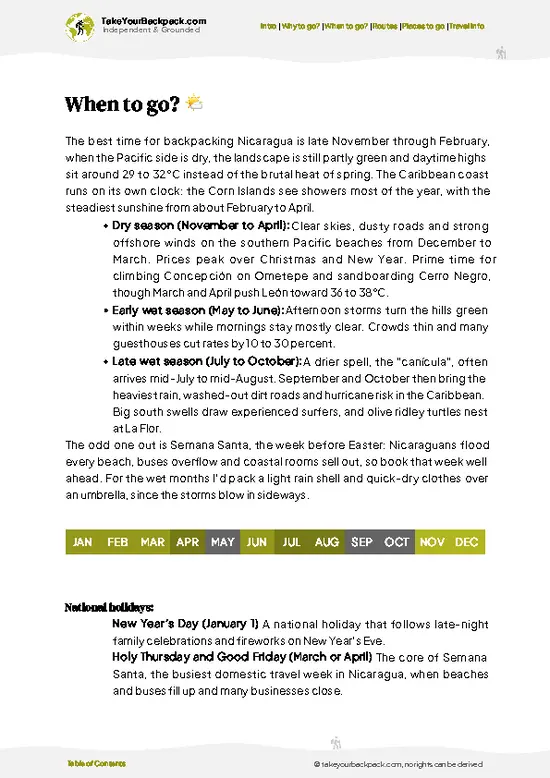
Best months and seasons: The best months for attractions in Nicaragua are December to April, the dry season, when skies are clear, volcano rims are visible and dirt roads stay firm. On the Pacific side, days run about 30 to 35°C (86 to 95°F), and by April the heat is heavy, with dusty air and brown hills. Start hikes before 7 a.m. to avoid the worst of it.

Shoulder and green season: May to November is the rainy season. Expect afternoon downpours, often 150 to 300 mm of rain a month at the peak in September and October, with mornings usually clear and hills turning bright green. Cloud can hide crater views and trails turn to red mud. Lodging in popular towns often costs 20 to 40 percent less than in peak months, and hostels are quieter. November and May are the best compromises, with lighter … read more 👉
Best months and seasons: The best months for attractions in Nicaragua are December to April, the dry season, when skies are clear, volcano rims are visible and dirt roads stay firm. On the Pacific side, days run about 30 to 35°C (86 to 95°F), and by April the heat is heavy, with dusty air and brown hills. Start hikes before 7 a.m. to avoid the worst of it.

Shoulder and green season: May to November is the rainy season. Expect afternoon downpours, often 150 to 300 mm of rain a month at the peak in September and October, with mornings usually clear and hills turning bright green. Cloud can hide crater views and trails turn to red mud. Lodging in popular towns often costs 20 to 40 percent less than in peak months, and hostels are quieter. November and May are the best compromises, with lighter rain and fewer people.

Regional differences: The Caribbean coast and Corn Islands are wetter, with rain possible in nearly any month and the heaviest from June to August, though March to May is typically driest. The northern highlands around Matagalpa and Jinotega stay cooler, around 20 to 26°C (68 to 79°F), and misty in the wet months. Holy Week (Semana Santa) and Christmas through New Year bring local crowds and higher beach prices, so book ahead.

attraction hoppingHow to Combine attractions Into One Trip

How many days to plan: A trip linking several attractions in Nicaragua needs 10 to 14 days, and 7 days works if you stay on the Pacific side. Distances look short on a map but shuttles stop often, so roads set the pace.

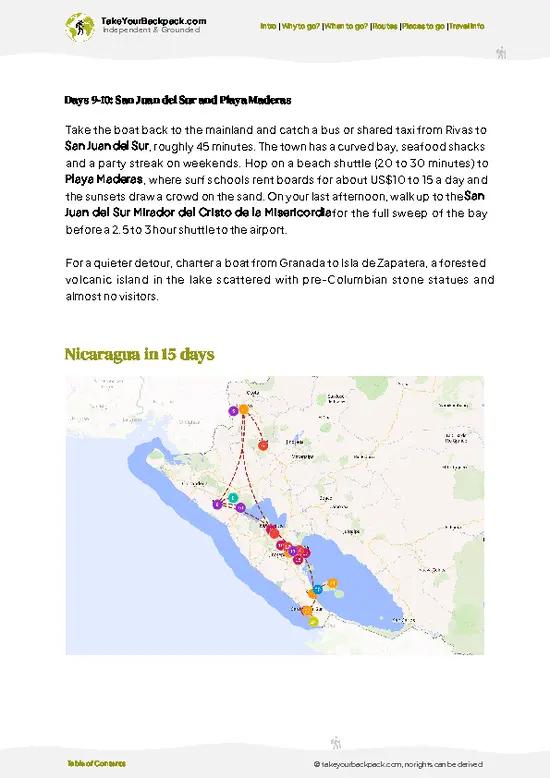
Grouping regions and direction: The Pacific corridor clusters well: Managua airport, Granada, Masaya, the island lake region around Ometepe, San Juan del Sur, and León with the northwest coast. Many travelers move from south to north, starting around San Juan del Sur and ending in León, or the reverse after a Costa Rica border crossing at Peñas Blancas. Granada works as a hub for day trips. Matagalpa and the northern highlands pair with León or Managua, while the Caribbean side needs its own block: flights from Managua to the Corn Islands take about 1.5 hours, and Bluefields … read more 👉
How many days to plan: A trip linking several attractions in Nicaragua needs 10 to 14 days, and 7 days works if you stay on the Pacific side. Distances look short on a map but shuttles stop often, so roads set the pace.

Grouping regions and direction: The Pacific corridor clusters well: Managua airport, Granada, Masaya, the island lake region around Ometepe, San Juan del Sur, and León with the northwest coast. Many travelers move from south to north, starting around San Juan del Sur and ending in León, or the reverse after a Costa Rica border crossing at Peñas Blancas. Granada works as a hub for day trips. Matagalpa and the northern highlands pair with León or Managua, while the Caribbean side needs its own block: flights from Managua to the Corn Islands take about 1.5 hours, and Bluefields is reached by bus plus boat over a long day.

Time per stop and transfers: Allow 2 to 3 nights per major base and 3 to 4 for Ometepe. Typical transfers: Managua to Granada 1 to 1.5 hours, Granada to San Juan del Sur 2 to 3 hours, Granada to León 2.5 to 3.5 hours, Managua to Matagalpa 2.5 to 3 hours. Chicken buses are slow, hot and loud, and shuttles are faster.

The usual error is cramming one site per day with midday transfers in 35°C heat. Group volcano or hiking mornings, leave afternoons for rides, and keep a spare day for weather closures.

The ListTop attractions of Nicaragua

1 Masaya Volcano Night Tour

Glowing lava lake, crater rim, bat lava tube, sulfur fumes

Stand at the crater rim after dark to watch molten rock pulse in the vent, then follow guides to roosting bats.

nicaragua-attraction-masaya-volcano-night-tour
© Google |

2 Las Isletas de Granada

Mangrove channels, lava-rock islets, spider monkeys, Spanish fort ruins

Glide by launch between small islands to spot herons, visit a monkey islet and see the stone walls of San Pablo.

3 Mombacho Volcano Canopy Tour

Zip lines, coffee canopy, howler monkeys, hanging bridges

Clip into a harness and glide over shade-grown coffee, with lake views, roaring monkeys and guides who name the birds.

nicaragua-attraction-mombacho-volcano-canopy-tour
© Google |

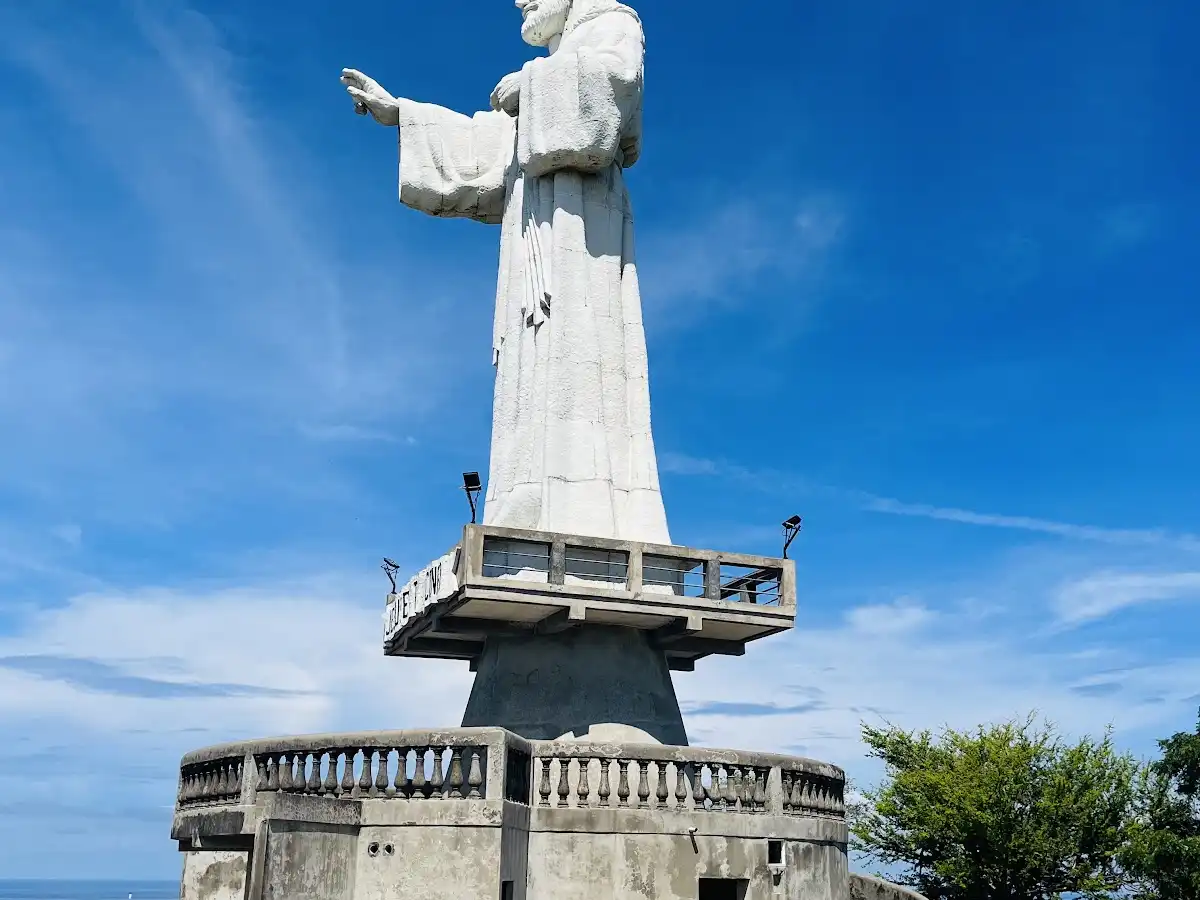
4 Cristo de la Misericordia

25-meter white Christ, headland climb, bay panorama, sunset overlook

Climb the paved road to an open-armed statue and look down over the horseshoe bay, its boats and rust-colored rooftops.

nicaragua-attraction-cristo-de-la-misericordia
© Google |

5 Flor de Caña Distillery

Oak barrel warehouses, rum tasting, column stills, cane fields

Walk among stacked aging barrels, watch molasses become spirit, then sample older and younger rums beneath the San Cristóbal cone.

6 Mirador de Catarina

Crater lake overlook, pottery stalls, plant nurseries, rim restaurants

Gaze down into a deep blue crater lagoon, browse painted ceramics and hammocks, and eat grilled fish at the railing.

nicaragua-attraction-mirador-de-catarina
© Google |

7 Museo de Arte Fundación Ortiz-Gurdián

Twin colonial houses, saints and altarpieces, Armando Morales, pre-Columbian pottery

Wander through two connected merchant houses where carved religious art, regional modern painting and shaded courtyards fill the rooms.

nicaragua-attraction-museo-de-arte-fundacion-ortiz-gurdian
© Google |

8 Museo Nacional de Nicaragua

Chorotega ceramics, basalt statues, ancient footprints, neoclassical palace

Study painted vessels and carved stone figures inside the old palace, then step out to the cathedral ruins on the plaza.

9 Teatro Nacional Rubén Darío

Tiered main hall, folk dance, symphony nights, Malecón plaza

Book a seat for marimba-backed dance or an orchestra program, then walk the waterfront outside before or after the show.

10 Museo de la Revolución

Ex-combatant guides, bullet-scarred walls, guerrilla portraits, rooftop plaza view

Hear firsthand battle accounts from former fighters inside a pocked palace, then look over the plaza from the roof.

11 Puerto Salvador Allende

Lake Xolotlán promenade, fried mojarra, dock boats, Sunday crowds

Stroll the paved waterfront at dusk, eat whole fried fish with your hands and catch weekend music along the strip.

12 ChocoMuseo Granada

Bean-to-bar workshop, hot cacao tasting, roasting demo, shaded courtyard

Roast, grind and temper cacao by hand, then mold a bar to carry off and sip a spiced Mesoamerican-style drink.

Loading the map 🌍

Expert viewInsights from Locals and Experts

How many to aim for: Plan on one main attraction every two days, roughly 5 to 7 in a two-week trip. That leaves time for the 4 a.m. starts, the slow bus rides and the afternoons when 34°C heat flattens everyone. Pack more in and the days blur into dust, sweat and transit. The reward for restraint is a summit sunrise you actually have energy for.

Choosing by travel style: If you like hiking and volcanoes, put those first, since guides are required at many sites and the early light on ash slopes is the point. Surf-minded travelers should head for the Pacific beaches, where offshore morning winds shape the waves. History and food people get more from the colonial cities, where market stalls sizzle with gallo pinto and fried plantains for US$2 to 4. Nature and cultural travelers with extra time … read more 👉
How many to aim for: Plan on one main attraction every two days, roughly 5 to 7 in a two-week trip. That leaves time for the 4 a.m. starts, the slow bus rides and the afternoons when 34°C heat flattens everyone. Pack more in and the days blur into dust, sweat and transit. The reward for restraint is a summit sunrise you actually have energy for.

Choosing by travel style: If you like hiking and volcanoes, put those first, since guides are required at many sites and the early light on ash slopes is the point. Surf-minded travelers should head for the Pacific beaches, where offshore morning winds shape the waves. History and food people get more from the colonial cities, where market stalls sizzle with gallo pinto and fried plantains for US$2 to 4. Nature and cultural travelers with extra time can add cloud forest, coffee farms or the Caribbean coast, accepting rougher logistics for far fewer visitors.

What it costs: A frugal backpacker spends US$30 to 50 a day including dorm bed (US$8 to 15), street meals and local buses. Entry fees run US$2 to 10 for most parks and reserves, volcano or national park fees often US$5 to 15, and guides US$10 to 40 a day or more for volcano or multi-day hikes depending on the group. Boat trips on the lakes cost around US$15 to 40 shared, and a shuttle costs US$10 to 20 per leg on popular routes. Carry small bills in córdobas, as change is scarce and card machines are rare outside cities.

Staying safe and respectful: Petty theft is the main risk, so keep phones out of sight in markets and on bus roofs. Use registered guides on volcano slopes and in remote areas, where trails can be steep, loose and exposed to gas. Take a hat, 3 liters of water and sturdy shoes, and check daily conditions with your hostel because sites can close for ash or weather. Avoid political demonstrations and do not photograph police or military. Ask before photographing people, dress modestly in churches, and bargain gently, since a US$1 saving matters less than goodwill with a family-run guide.

✈️ The backpacker research shortcutNicaragua Travel Guide

An offline-friendly backpacking guide with optimized travel routes, ranked highlights, transport advice, and the best areas to stay.
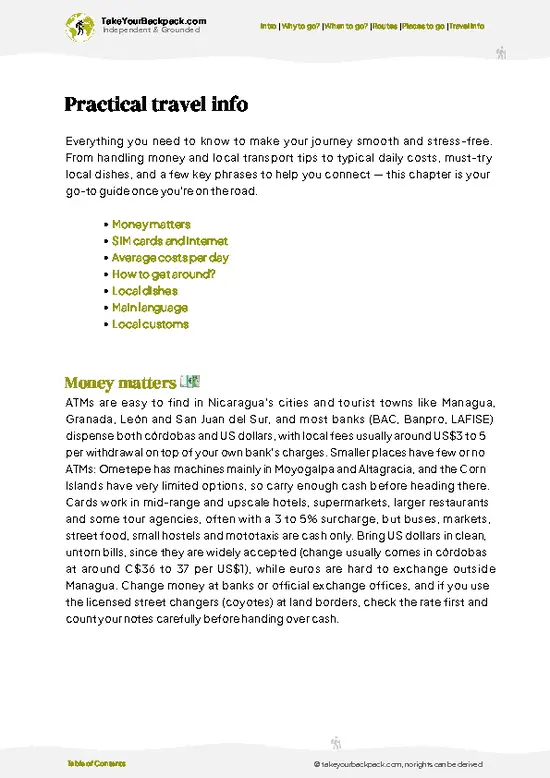
example page 0 from our offline Travel Guide for Nicaragua
example page 1 from our offline Travel Guide for Nicaragua
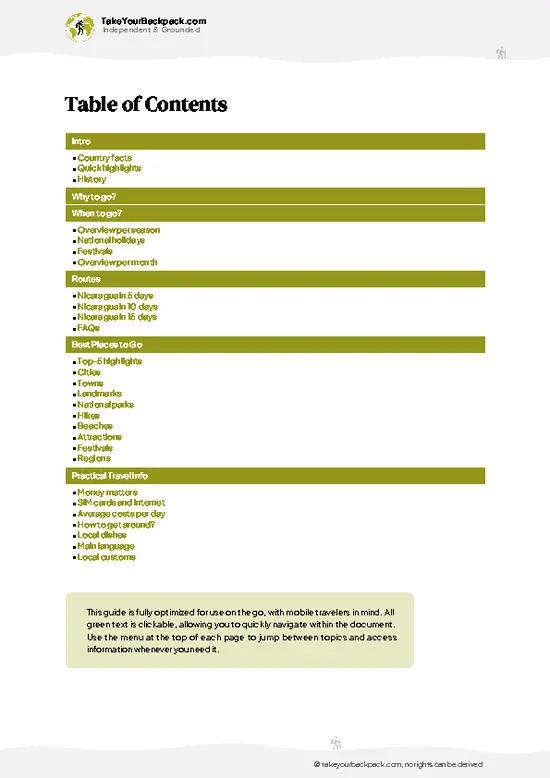
example page 2 from our offline Travel Guide for Nicaragua
example page 3 from our offline Travel Guide for Nicaragua
example page 4 from our offline Travel Guide for Nicaragua
example page 5 from our offline Travel Guide for Nicaragua
example page 6 from our offline Travel Guide for Nicaragua
example page 7 from our offline Travel Guide for Nicaragua
The digital guide (256 pages) contains:
✅ 77 highlights, ranked by travel appeal
✅ Optimized 5, 10 & 15-day travel routes
✅ Cities, national parks, landmarks, beaches
✅ How to get around
✅ Offline-friendly for travel without Wi-Fi
👉 Click to see all 30+ guide features

📅 Plan smarter in minutes, not weeks
✅ Month by month travel advice
✅ Festivals & national holidays
✅ Budget expectations

🗺️ Go to the right places, skip the overrated ones
✅ Honest pros & cons of destinations
✅ Top hikes, parks & viewpoints
✅ Lesser-known places most travelers miss
✅ Clear “worth it vs skip it” guidance

🛏️ Travel smoothly without rookie mistakes
✅ Best areas to stay
✅ Transport systems explained simply
✅ Common scams & safety advice
✅ SIM cards, money & practical tips

🌍 Understand the country, not just visit it
✅ Culture & traditions
✅ 52 Essential phrases & customs
✅ Festivals worth planning around
✅ Traveler-friendly historical context
✅ Insights that make places more meaningful

📱 Built for real travel conditions
✅ Fully downloadable PDF
✅ Works completely offline
✅ Optimized for phone use
✅ Useful in remote areas & buses
✅ Everything in one place
Stop searching, start planning
Get instant access to your full guide. 30‑day money-back guarantee.
+ Add another guide for just

By proceeding you agree to our terms.
Sent to your inbox immediately after payment • 100% Secure Checkout
Best Backpacking Travel Advisor 2025 tourism awardBest Backpacking
Travel Advisor
2025
What others say about Take Your Backpack Guides:
⭐⭐⭐⭐⭐
Fantastic, amazing amount of information!
⭐⭐⭐⭐⭐
My goodness this is amazing, it's what I've been looking for hats off too you!
⭐⭐⭐⭐⭐
I think this is absolutely BRILLIANT
⭐⭐⭐⭐
Very complete and informative. It's still missing places, but I gotta to commend you
⭐⭐⭐⭐⭐
This is truly amazing, thank you, can't wait to explore it with my kids!
⭐⭐⭐⭐⭐
Awesome resource, thank you!
⭐⭐⭐⭐⭐
This is amazing! Can't wait to explore the ones I haven't seen
⭐⭐⭐⭐
I love this! Well done, great idea.
⭐⭐⭐⭐⭐
Thanks for taking the time to make this gem!
⭐⭐⭐⭐⭐
This might be the best website I've ever seen.
⭐⭐⭐⭐⭐
Congratulations, and thank you so much for your work; it's incredibly valuable.
⭐⭐⭐⭐
In all seriousness I think you did a great job pointing out the important spots
⭐⭐⭐⭐⭐
10/10 very good
⭐⭐⭐⭐⭐
As someone who's only just starting to visit regularly this is awesome, thank you.
⭐⭐⭐⭐
Thank you very much! I'm going to visit my dad, it's going to be very useful!
⭐⭐⭐⭐⭐
This is really cool! We'll be travelling for the first time and this definitely come in handy.
⭐⭐⭐⭐⭐
You are now our minister of culture, congratulations 👨‍💼
⭐⭐⭐⭐⭐
Just wanted to tell you that this is a pearl! Going to follow your recommendations.
⭐⭐⭐⭐⭐
This is so cool. I'll definitely be using the resource for my travels soon.
⭐⭐⭐⭐⭐
This is very impressive! Good work.
⭐⭐⭐⭐⭐
This is an amazing and informative site. Very well done!

🛏️ Where to stay?Top Places to Consider Staying

Nicaragua has a dense network of hostels and family-run guesthouses, with dorm beds typically running US$8 to 15 and simple private rooms US$20 to 35. In Granada, the blocks around Calle La Calzada put you steps from the colonial churches and the busiest bars (expect noise until late), while staying a few streets toward the lake buys quieter nights. In León, the grid around the cathedral is walkable and lively with students, and San Juan del Sur splits between the party-heavy town center and calmer beach stays near Playa Maderas; on Ometepe, Moyogalpa is handy for the ferry, while Santo Domingo and Balgüe trade convenience for beaches, farms and silence.

If you enjoy meeting fellow travelers, … read more 👉
Nicaragua has a dense network of hostels and family-run guesthouses, with dorm beds typically running US$8 to 15 and simple private rooms US$20 to 35. In Granada, the blocks around Calle La Calzada put you steps from the colonial churches and the busiest bars (expect noise until late), while staying a few streets toward the lake buys quieter nights. In León, the grid around the cathedral is walkable and lively with students, and San Juan del Sur splits between the party-heavy town center and calmer beach stays near Playa Maderas; on Ometepe, Moyogalpa is handy for the ferry, while Santo Domingo and Balgüe trade convenience for beaches, farms and silence.

If you enjoy meeting fellow travelers, consider choosing hostels with high ratings for atmosphere. On the other hand, if you prefer having your own space, a hotel might be a better option.

NicaraguaMore Places Across Nicaragua

👋 Meet the founderWho’s Behind Take Your Backpack?

Johan, backpacker and founder of TakeYourBackpackHi, I’m Johan (Netherlands 🇳🇱), the creator of TakeYourBackpack. Over the past 3 decades, I’ve backpacked through 90+ countries across six continents, gaining extensive experience with independent travel, long-term trips, and overland routes.

This site is built on a combination of firsthand travel experience and carefully curated insights from other backpackers. Many guides are based on places I’ve personally visited, while others bring together tips, observations, and practical advice shared by trusted travelers I’ve met along the way.

The goal is to provide realistic, experience-driven guidance — not generic itineraries — so you can explore destinations with better context, clearer expectations, and more confidence.