×

Oman🇴🇲 | best hikesBest 4 hikes in Oman

Hiking in Oman means rock, heat and silence. The Hajar Mountains in the north throw up limestone ridges, terraced villages and cool air above 2,000 meters, with the smell of woodsmoke and rosewater on the breeze. Wadis near Muscat are easy to reach and busy on winter weekends, while the high Jebel Akhdar and Jebel Shams plateaus need a 4x4 or a rental car and feel emptier. In Dhofar in the south, the monsoon turns slopes green and misty in summer. Independent travelers get cheap, uncrowded trails, but shade is scarce, water runs out and distances are long.

By Johan Kruseman 🇳🇱 | Updated October 18, 2026
Explore the best beaches in Oman

Why go?Key Factors That Shape the Experience

Oman suits walking because geography packs extreme variety into a small, safe country. The Hajar range rises abruptly from the Gulf of Oman coast to nearly 3,000 meters, so a single drive moves you from date palms and hot, still air to juniper, pomegranate terraces and cold wind. Deep canyons, called wadis, cut through pale limestone and dark ophiolite, and the rock underfoot changes color and texture within an hour. The country has a long mountain village tradition, and the old falaj irrigation channels (UNESCO listed) still carry water along many paths, so you often walk beside the sound of running water in otherwise bone-dry country.

Before choosing Oman, know that it has almost no hiking infrastructure in the European sense. Trails are rarely signed, there are no mountain huts, and public … read more 👉
Oman suits walking because geography packs extreme variety into a small, safe country. The Hajar range rises abruptly from the Gulf of Oman coast to nearly 3,000 meters, so a single drive moves you from date palms and hot, still air to juniper, pomegranate terraces and cold wind. Deep canyons, called wadis, cut through pale limestone and dark ophiolite, and the rock underfoot changes color and texture within an hour. The country has a long mountain village tradition, and the old falaj irrigation channels (UNESCO listed) still carry water along many paths, so you often walk beside the sound of running water in otherwise bone-dry country.

Before choosing Oman, know that it has almost no hiking infrastructure in the European sense. Trails are rarely signed, there are no mountain huts, and public transport barely reaches trailheads, so a rental car is the practical choice. Flash floods in wadis are a real hazard after rain, even when the sky above you is clear. Heat dominates much of the year, and cultural norms matter: modest dress is expected near villages, and local people are generous hosts who appreciate respect and a greeting. Dhofar behaves like a different country, with monsoon mist and grazing camels.
How the List Was Created
The list of best hikes in Oman is created based on scenery, challenge, trail quality, landmarks, and overall enjoyment. If you feel a hike is missing in this list, please let us know.

When to go?Seasonal Guide to Visiting

Best months: The best months for hiking in Oman are November to March, when daytime highs in the northern lowlands sit around 22 to 30°C instead of the 40 to 48°C of summer. Mornings are crisp, the limestone is cool to touch, and the light is soft and amber until about 9 a.m.
Mountains and shoulder seasons: In the Hajar Mountains, above 2,000 meters, winter nights can drop to near freezing or below, so carry a warm layer and expect frost on rocks at dawn. October and April are workable shoulder months, with lowland afternoons of 33 to 38°C. Start before sunrise and finish by midday. Rain is scarce, roughly 100 mm a year in much of the north, but it comes in sudden downpours, usually December to April, and wadis can flood within minutes.
Summer and Dhofar: From June to September, northern trails … read more 👉
Best months: The best months for hiking in Oman are November to March, when daytime highs in the northern lowlands sit around 22 to 30°C instead of the 40 to 48°C of summer. Mornings are crisp, the limestone is cool to touch, and the light is soft and amber until about 9 a.m.
Mountains and shoulder seasons: In the Hajar Mountains, above 2,000 meters, winter nights can drop to near freezing or below, so carry a warm layer and expect frost on rocks at dawn. October and April are workable shoulder months, with lowland afternoons of 33 to 38°C. Start before sunrise and finish by midday. Rain is scarce, roughly 100 mm a year in much of the north, but it comes in sudden downpours, usually December to April, and wadis can flood within minutes.
Summer and Dhofar: From June to September, northern trails are punishing, with 45°C or more and hot rock that burns bare hands. The exception is Dhofar, where the khareef monsoon (roughly late June to early September) brings drizzle, fog, 20 to 28°C and green slopes, along with Gulf visitors and higher hotel rates. Winter is also the busiest season elsewhere, so book Muscat and mountain guesthouses ahead, and expect prices roughly 20 to 40 percent above summer lows.

hike hoppingHow to Combine hikes Into One Trip

How many days to allow: A trip combining several hikes in Oman needs 7 to 12 days, enough to cover the northern mountains and coast without rushing the driving.
Regions and direction: The sensible cluster is the north: Muscat with its nearby wadis, then the Hajar interior around Nizwa, Jebel Akhdar and Jebel Shams, and finally the eastern wadis toward Sur. Fly into Muscat, head inland first while your legs are fresh and the nights are cold, then drop to the warmer coast to finish. Muscat to Nizwa takes about 1.5 to 2 hours, Nizwa to the Jebel Shams area about 1.5 hours, and Muscat to Sur about 3 hours. Dhofar, around Salalah, sits roughly 1,000 km south (a 10 to 12 hour drive, or a 1.5 hour flight), so it only fits a longer trip, and only in monsoon season.
Pacing and common mistakes: Allow … read more 👉
How many days to allow: A trip combining several hikes in Oman needs 7 to 12 days, enough to cover the northern mountains and coast without rushing the driving.
Regions and direction: The sensible cluster is the north: Muscat with its nearby wadis, then the Hajar interior around Nizwa, Jebel Akhdar and Jebel Shams, and finally the eastern wadis toward Sur. Fly into Muscat, head inland first while your legs are fresh and the nights are cold, then drop to the warmer coast to finish. Muscat to Nizwa takes about 1.5 to 2 hours, Nizwa to the Jebel Shams area about 1.5 hours, and Muscat to Sur about 3 hours. Dhofar, around Salalah, sits roughly 1,000 km south (a 10 to 12 hour drive, or a 1.5 hour flight), so it only fits a longer trip, and only in monsoon season.
Pacing and common mistakes: Allow 1 to 2 nights per mountain base so you have time to hike early and drive in daylight. The common error is stacking a long drive and a hike in the same afternoon, when heat peaks and the light goes by about 6 p.m. Another is relying on buses, which rarely reach trailheads. Rent a car, and for steep mountain tracks pick a 4x4. Plan rest days after a high-altitude climb.

The ListMust-Visit hikes in Oman

1 Jebel Shams

summit ascent, rugged escarpment, canyon rim

Climb steadily toward Oman’s highest point, tracing the edge of a vast chasm and experiencing shifting weather and stark, open landscapes.

oman-hike-jebel-shams
© Google |

2 Balcony Walk

cliffside path, terraced villages, dramatic drop-offs

Follow a ledge carved into sheer rock, passing abandoned settlements and cultivated slopes while the valley floor drops away beneath your feet.

oman-hike-balcony-walk
© Google |

3 Snake Gorge

narrow canyons, deep pools, boulder scrambles

Navigate dramatic rock corridors and plunge into clear water as you traverse a route that demands agility, confidence, and careful planning.

4 Salma Plateau Trail

open highlands, ancient tombs, panoramic ridges

Walk across windswept plateaus dotted with Bronze Age relics, where distant mountain views and exposed terrain define the journey.

Loading the map 🌍

Expert viewPro Tips for Exploring the Best

How many hikes to do: Plan on three to five hikes over a 7 to 10 day trip. Oman’s distances are long and the heat limits you to roughly four hours of walking per day, so a handful of well-chosen routes beats a checklist. Each hike usually comes with 1 to 3 hours of driving on either side, and tired legs make for sloppy decisions on loose limestone.
Choosing a kind of hike: Match the terrain to your style. First-timers and families are best served by wadi walks, which are short, shaded in places and often end in a pool. Experienced trekkers should prioritize high plateau and canyon-rim routes, which involve altitude, exposure and cold. If you want culture, choose village and falaj paths, where terraced fields and stone houses give the walk a human scale. Summer travelers should skip the north … read more 👉
How many hikes to do: Plan on three to five hikes over a 7 to 10 day trip. Oman’s distances are long and the heat limits you to roughly four hours of walking per day, so a handful of well-chosen routes beats a checklist. Each hike usually comes with 1 to 3 hours of driving on either side, and tired legs make for sloppy decisions on loose limestone.
Choosing a kind of hike: Match the terrain to your style. First-timers and families are best served by wadi walks, which are short, shaded in places and often end in a pool. Experienced trekkers should prioritize high plateau and canyon-rim routes, which involve altitude, exposure and cold. If you want culture, choose village and falaj paths, where terraced fields and stone houses give the walk a human scale. Summer travelers should skip the north and look to Dhofar instead.
What it costs: Budget about US$45 to 80 a day (roughly 17 to 30 OMR) for an independent traveler. A rental car runs about OMR 12 to 25 a day (US$31 to 65) and is the biggest cost, though sharing it between two or three people brings the per-person figure down. A 4x4 costs more. Guesthouses and basic hotels run about OMR 15 to 35 a night. Most trails are free, though some wadis charge an entry fee of about OMR 1 to 5. A local guide for a canyon route runs roughly OMR 25 to 50 a day. Fuel is cheap, at around OMR 0.23 to 0.30 a liter. Over a week, expect about US$320 to 560 in total.
Safety and etiquette: Oman’s main hazard is flash flooding. Wadis can run with brown water after distant rain, so check the forecast and never camp in a dry riverbed. Carry 3 to 4 liters of water per person for a half-day walk, because springs are unreliable and the dry air hides how much you sweat. Start at first light, wear a hat and sturdy shoes, and expect spiky acacia and sharp, grippy rock that shreds soft soles. Mobile coverage fades in canyons, so tell your guesthouse your route and return time.
Cultural considerations: Dress modestly near villages: shoulders and knees covered, for both men and women. Ask before photographing people, particularly women. Drones need a permit. Greet people you pass, accept the offer of tea or dates, and don’t walk through private date gardens or irrigation channels without permission. Alcohol is only sold in licensed hotels, so don’t carry it on trails. Wild camping is generally tolerated in remote areas, but leave no trace, as goats and village children will find any rubbish.

✈️ The backpacker research shortcutOman Travel Guide

An offline-friendly backpacking guide with optimized travel routes, ranked highlights, transport advice, and the best areas to stay.
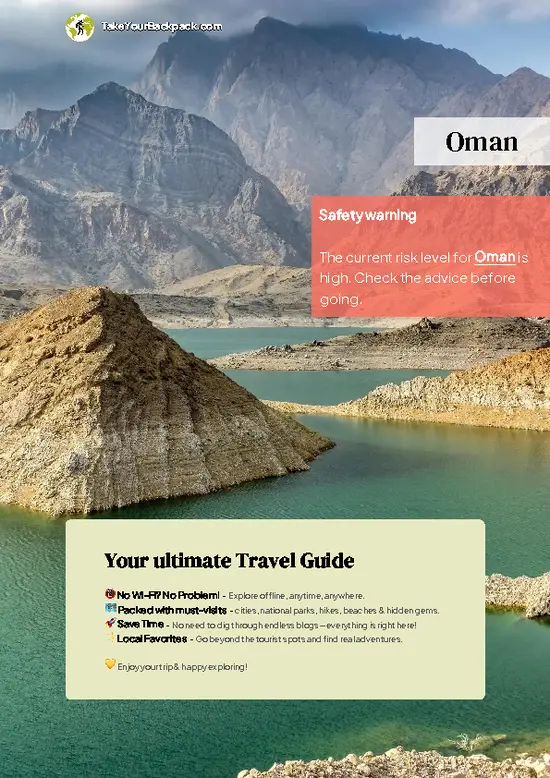
example page 0 from our offline Travel Guide for Oman
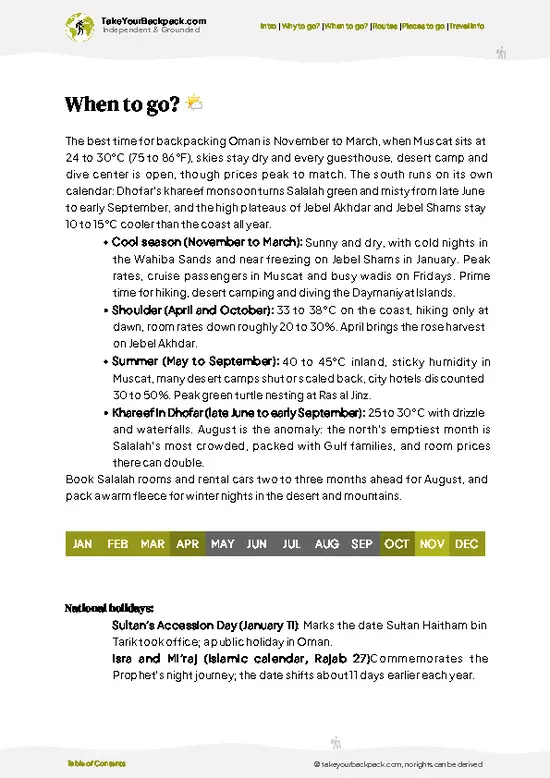
example page 1 from our offline Travel Guide for Oman
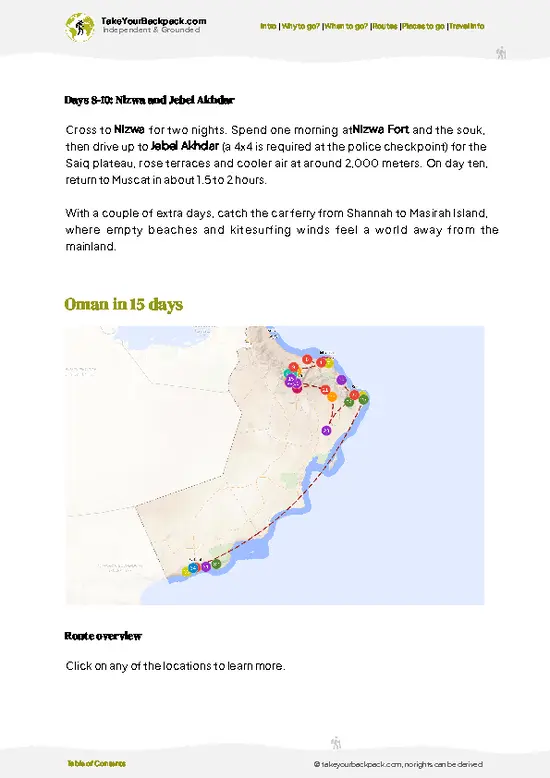
example page 2 from our offline Travel Guide for Oman
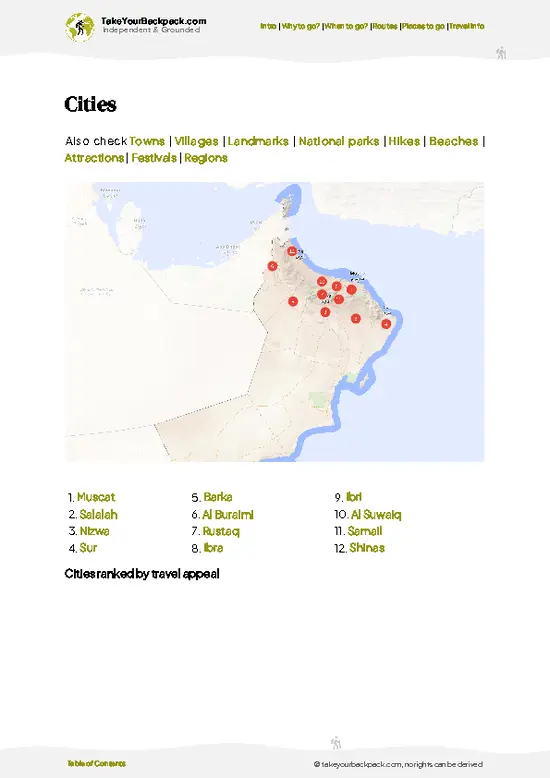
example page 3 from our offline Travel Guide for Oman
example page 4 from our offline Travel Guide for Oman
example page 5 from our offline Travel Guide for Oman
example page 6 from our offline Travel Guide for Oman
example page 7 from our offline Travel Guide for Oman
The digital guide (291 pages) contains:
✅ 73 highlights, ranked by travel appeal
✅ Optimized 5, 10 & 15-day travel routes
✅ Cities, national parks, landmarks, beaches
✅ How to get around
✅ Offline-friendly for travel without Wi-Fi
👉 Click to see all 30+ guide features

📅 Plan smarter in minutes, not weeks
✅ Month by month travel advice
✅ Festivals & national holidays
✅ Budget expectations

🗺️ Go to the right places, skip the overrated ones
✅ Honest pros & cons of destinations
✅ Top hikes, parks & viewpoints
✅ Lesser-known places most travelers miss
✅ Clear “worth it vs skip it” guidance

🛏️ Travel smoothly without rookie mistakes
✅ Best areas to stay
✅ Transport systems explained simply
✅ Common scams & safety advice
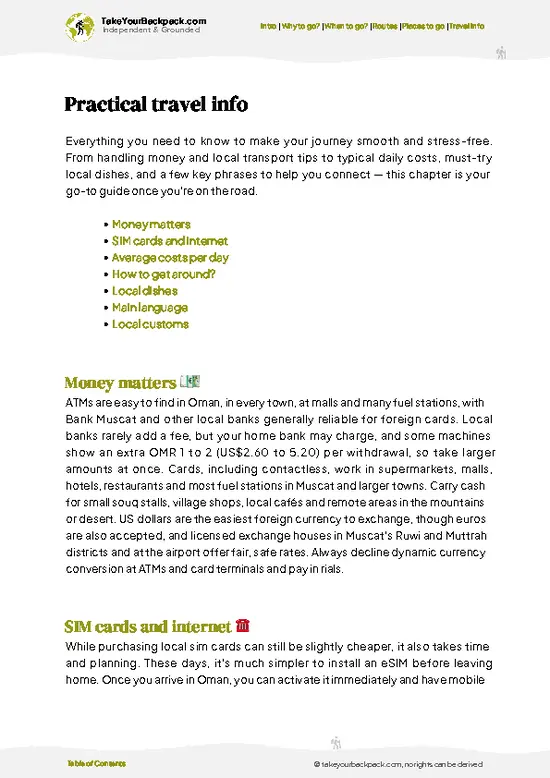
✅ SIM cards, money & practical tips

🌍 Understand the country, not just visit it
✅ Culture & traditions
✅ 52 Essential phrases & customs
✅ Festivals worth planning around
✅ Traveler-friendly historical context
✅ Insights that make places more meaningful

📱 Built for real travel conditions
✅ Fully downloadable PDF
✅ Works completely offline
✅ Optimized for phone use
✅ Useful in remote areas & buses
✅ Everything in one place
Stop searching, start planning
Get instant access to your full guide. 30‑day money-back guarantee.
+ Add another guide for just

By proceeding you agree to our terms.
Sent to your inbox immediately after payment • 100% Secure Checkout
Best Backpacking Travel Advisor 2025 tourism awardBest Backpacking
Travel Advisor
2025
What others say about Take Your Backpack Guides:
⭐⭐⭐⭐⭐
Fantastic, amazing amount of information!
⭐⭐⭐⭐⭐
My goodness this is amazing, it's what I've been looking for hats off too you!
⭐⭐⭐⭐⭐
I think this is absolutely BRILLIANT
⭐⭐⭐⭐
Very complete and informative. It's still missing places, but I gotta to commend you
⭐⭐⭐⭐⭐
This is truly amazing, thank you, can't wait to explore it with my kids!
⭐⭐⭐⭐⭐
Awesome resource, thank you!
⭐⭐⭐⭐⭐
This is amazing! Can't wait to explore the ones I haven't seen
⭐⭐⭐⭐
I love this! Well done, great idea.
⭐⭐⭐⭐⭐
Thanks for taking the time to make this gem!
⭐⭐⭐⭐⭐
This might be the best website I've ever seen.
⭐⭐⭐⭐⭐
Congratulations, and thank you so much for your work; it's incredibly valuable.
⭐⭐⭐⭐
In all seriousness I think you did a great job pointing out the important spots
⭐⭐⭐⭐⭐
10/10 very good
⭐⭐⭐⭐⭐
As someone who's only just starting to visit regularly this is awesome, thank you.
⭐⭐⭐⭐
Thank you very much! I'm going to visit my dad, it's going to be very useful!
⭐⭐⭐⭐⭐
This is really cool! We'll be travelling for the first time and this definitely come in handy.
⭐⭐⭐⭐⭐
You are now our minister of culture, congratulations 👨‍💼
⭐⭐⭐⭐⭐
Just wanted to tell you that this is a pearl! Going to follow your recommendations.
⭐⭐⭐⭐⭐
This is so cool. I'll definitely be using the resource for my travels soon.
⭐⭐⭐⭐⭐
This is very impressive! Good work.
⭐⭐⭐⭐⭐
This is an amazing and informative site. Very well done!

🛏️ Where to stay?Top Places to Consider Staying

Oman has only a handful of true hostels, so budget travel here usually means simple guesthouses, older hotels and heritage homestays at roughly OMR 15 to 25 (US$39 to 65) a night, with dorm beds in the few hostels starting around OMR 6 to 10 (US$16 to 26). In Muscat, Muttrah puts you on the corniche and next to the souq, with sea breezes and quiet evenings, while Ruwi is the cheapest district and the main bus hub but busy and short on charm, and Qurum and Al Khuwair cost more yet sit near the beach, malls and the licensed hotel bars where the city’s limited nightlife happens. Outside the capital, the old quarter of Nizwa has restored mud-brick guesthouses within walking distance of the fort … read more 👉
Oman has only a handful of true hostels, so budget travel here usually means simple guesthouses, older hotels and heritage homestays at roughly OMR 15 to 25 (US$39 to 65) a night, with dorm beds in the few hostels starting around OMR 6 to 10 (US$16 to 26). In Muscat, Muttrah puts you on the corniche and next to the souq, with sea breezes and quiet evenings, while Ruwi is the cheapest district and the main bus hub but busy and short on charm, and Qurum and Al Khuwair cost more yet sit near the beach, malls and the licensed hotel bars where the city’s limited nightlife happens. Outside the capital, the old quarter of Nizwa has restored mud-brick guesthouses within walking distance of the fort and souq, and all of these areas are very safe after dark.

If you enjoy meeting fellow travelers, consider choosing hostels with high ratings for atmosphere. On the other hand, if you prefer having your own space, a hotel might be a better option.

OmanMore Places Across Oman

👋 Meet the founderWho’s Behind Take Your Backpack?

Johan, backpacker and founder of TakeYourBackpackHi, I’m Johan (Netherlands 🇳🇱), the creator of TakeYourBackpack. Over the past 3 decades, I’ve backpacked through 90+ countries across six continents, gaining extensive experience with independent travel, long-term trips, and overland routes.

This site is built on a combination of firsthand travel experience and carefully curated insights from other backpackers. Many guides are based on places I’ve personally visited, while others bring together tips, observations, and practical advice shared by trusted travelers I’ve met along the way.

The goal is to provide realistic, experience-driven guidance — not generic itineraries — so you can explore destinations with better context, clearer expectations, and more confidence.