×

Oman🇴🇲 | best townsBest 10 towns in Oman

Towns in Oman are low, whitewashed, and quiet, built around date palms, forts and old souqs rather than high-rises. The light is hard and bright by noon, and the call to prayer carries over the rooftops at dawn. The north holds the mountain and oasis towns, easy to reach by road, with frankincense and rosewater in the air. The coastal fishing towns smell of salt, diesel and drying fish. The south around Salalah turns green and misty in summer. Distances are long and public buses are sparse, so independent travelers lean on shared taxis, hitching or a rental car. Costs run higher than in South Asia, but crowds stay thin.

By Johan Kruseman 🇳🇱 | Updated October 18, 2026
Explore the best villages in Oman

Why go?Key Factors That Shape the Experience

Oman suits town travel because geography decided where people settled. Water is scarce, so for centuries communities clustered around springs, wadis and the ancient falaj irrigation channels that still run cool and trickling through palm groves. Mud-brick walls, watchtowers and forts rose where trade routes crossed the mountains and the coast. Oman also kept its architecture and rhythm because it never rushed to rebuild. Much of the country is desert or rock, so towns sit far apart, and the stretch between them is part of the experience: gravel plains, scorched mountain walls and long straight highways with few services.

The climate shapes everything. Interior towns bake in summer, the coast turns humid, and the far south receives the khareef monsoon, which covers the hills in green fog. … read more 👉
Oman suits town travel because geography decided where people settled. Water is scarce, so for centuries communities clustered around springs, wadis and the ancient falaj irrigation channels that still run cool and trickling through palm groves. Mud-brick walls, watchtowers and forts rose where trade routes crossed the mountains and the coast. Oman also kept its architecture and rhythm because it never rushed to rebuild. Much of the country is desert or rock, so towns sit far apart, and the stretch between them is part of the experience: gravel plains, scorched mountain walls and long straight highways with few services.

The climate shapes everything. Interior towns bake in summer, the coast turns humid, and the far south receives the khareef monsoon, which covers the hills in green fog. Before choosing Oman for its towns, know that public transport is thin, so independent travel often means a rental car, shared taxis or long waits. Dress is conservative: shoulders and knees covered, especially outside the capital area. Friday is the quiet day, with many shops closed through midday and reopening in the late afternoon. Expect warm hospitality, with coffee and dates offered as a matter of course, and a pace that is slow, orderly and unhurried.
Evaluating the Top Choices
The list of best towns in Oman is created based on charm, local culture, atmosphere, hidden gems, and visitor appeal. If you feel a town is missing in this list, please let us know.

When to go?Seasonal Guide to Visiting

Best months for Oman’s towns: The best months are October to March, when daytime highs sit around 24 to 33°C and walking forts, souqs and palm groves is comfortable. Mornings are crisp in the mountains, with a clear, low sun that turns the stone gold. Nights in the high interior can drop to 5 to 10°C in December and January, so pack a fleece.
Shoulder and summer seasons: April and September to early October are workable shoulder months. Interior towns climb to 38 to 42°C by midday, so plan to be indoors from noon to mid-afternoon. From May to August the interior and the capital area can top 45°C, and the coast is sticky with humidity. Many travelers skip the north in these months.
Southern monsoon and peak periods: The south reverses the pattern. From roughly late June to early September, the … read more 👉
Best months for Oman’s towns: The best months are October to March, when daytime highs sit around 24 to 33°C and walking forts, souqs and palm groves is comfortable. Mornings are crisp in the mountains, with a clear, low sun that turns the stone gold. Nights in the high interior can drop to 5 to 10°C in December and January, so pack a fleece.
Shoulder and summer seasons: April and September to early October are workable shoulder months. Interior towns climb to 38 to 42°C by midday, so plan to be indoors from noon to mid-afternoon. From May to August the interior and the capital area can top 45°C, and the coast is sticky with humidity. Many travelers skip the north in these months.
Southern monsoon and peak periods: The south reverses the pattern. From roughly late June to early September, the khareef brings drizzle, fog and temperatures around 22 to 28°C, turning the hills green and the air damp. This is peak season for Gulf visitors, so hotel prices can double or more and weekends fill up. The rest of the year, the south is dry and quiet. In the north, rain is rare and falls mostly from December to March, in short, sharp downpours that can flood wadi roads. Ramadan shifts daytime opening hours, with cafés shut until sunset, and Eid brings family travel and busy roads.

town hoppingHow to Combine towns Into One Trip

How many days to combine towns: A trip linking several towns in Oman needs 8 to 14 days, because distances are large and the roads, while excellent, are long and empty. Under a week, stay in one region.
Grouping regions and direction: The northern mountains and interior oases cluster well around Muscat, the main transport hub, which has the international airport. The coast toward Sur and the Sharqiya side pairs naturally with the interior in a loop. The far south around Salalah sits roughly 1,000 km from the capital, a 12 to 14 hour drive across a flat, near-empty desert, so most travelers fly the leg (about 1.5 hours) rather than drive it. A sensible direction is to start in Muscat, move through the interior, then loop back via the coast, and fly south at the end if time allows.
Time per stop … read more 👉
How many days to combine towns: A trip linking several towns in Oman needs 8 to 14 days, because distances are large and the roads, while excellent, are long and empty. Under a week, stay in one region.
Grouping regions and direction: The northern mountains and interior oases cluster well around Muscat, the main transport hub, which has the international airport. The coast toward Sur and the Sharqiya side pairs naturally with the interior in a loop. The far south around Salalah sits roughly 1,000 km from the capital, a 12 to 14 hour drive across a flat, near-empty desert, so most travelers fly the leg (about 1.5 hours) rather than drive it. A sensible direction is to start in Muscat, move through the interior, then loop back via the coast, and fly south at the end if time allows.
Time per stop and transfers: Allow 1 to 2 nights per town, 3 for a base with side trips. Typical transfers between northern regions run 1.5 to 4 hours by road. Public buses connect main cities but run only a few times a day, and shared taxis serve smaller routes.
Planning mistakes: The common error is cramming too many stops into one day and driving after dark, when camels and goats wander the roads. Another is ignoring midday heat and the Friday slowdown, when sites open late. Build in slack, start early, and refuel whenever a station appears, since fuel stops can be 100 km apart.

The ListMust-Visit towns in Oman

1 Khasab

Musandam fjords, dhow cruises, mountain roads

Take a boat through dramatic sea inlets, drive steep mountain roads, and watch dolphins in the sheltered waters of the Musandam Peninsula.

2 Al Hamra

old mud houses, mountain base, living museum

Tour centuries-old homes with wooden ceilings, meet locals maintaining traditional lifestyles, and use the town as a base for mountain hikes.

oman-city-al-hamra
© Google |

3 Bahla

fortified walls, pottery workshops, date plantations

Wander through mud-brick lanes beneath ancient ramparts, watch traditional pottery being shaped, and pause in quiet groves of date palms.

4 Bidiyah

dune camps, camel treks, sand sports

Join a desert camp for stargazing, ride camels across shifting dunes, and try sandboarding or quad biking in the open expanse.

5 Dibba Al-Baya

fjord coastline, fishing coves, mountain backdrop

Travel along rugged inlets, watch fishermen at work in small coves, and enjoy views of steep cliffs rising from the sea.

6 Al Wasil

desert lodges, 4WD access, sand tracks

Stay at a desert lodge, use the village as a base for off-road adventures, and navigate sandy tracks into the Wahiba desert.

7 Al Awabi

wadi access, mountain villages, hiking trails

Start treks into the Western Hajar, visit small villages clinging to slopes, and follow wadis lined with wild fig and pomegranate trees.

8 Jalan Bani Bu Ali

watchtowers, mosque architecture, rural souqs

Climb old watchtowers, admire unique mosque minarets, and shop for essentials in small, practical markets serving the local community.

9 Jalan Bani Bu Hassan

date farms, old fort, pottery stalls

Walk through date plantations, visit a centuries-old fort, and browse handmade pottery sold by local artisans along the roadside.

10 Adam

desert edge, falaj system, ancient ruins

Explore the last town before the Empty Quarter, follow irrigation channels through date groves, and find remnants of early settlements.

11 Al Kamil Wal Wafi

wadi pools, mud villages, falaj irrigation

Swim in clear wadi pools, wander through quiet mud-brick settlements, and trace the ancient irrigation channels that sustain the area.

oman-city-al-kamil-wal-wafi
© Google |

12 Mahout

coastal lagoons, fishing villages, migratory birds

Spot flamingos and herons in tidal lagoons, visit quiet fishing hamlets, and observe the rhythms of coastal life far from main roads.

13 Al Jazer

remote beaches, cliffs, turtle nesting

Camp on isolated shores, watch sea turtles lay eggs at night, and explore dramatic cliffs along Oman’s southern coastline.

14 Yanqul

rocky hills, mud forts, date groves

Hike among rocky outcrops, explore a fortress built from earth, and rest under the shade of thick date palm plantations.

15 Al Mazyunah

border crossing, desert plateau, trade hub

Cross into Yemen or Oman, observe the flow of goods at the border, and experience the stark landscape of the southwestern plateau.

Think you know Oman?

Prove you’re a true local — uncover 5 lesser-known towns in Oman that locals tend to keep to themselves.
Loading the map 🌍

Expert viewPro Tips for Exploring the Best

How many towns to visit: Pick four to six towns on a trip of two weeks, and three or four if you have ten days or fewer. Oman’s distances are the reason. Highway stretches between regions run 3 to 6 hours across gravel plains and dry mountain, buses are infrequent, and every extra stop eats half a day of transit. Experienced travelers cut the list rather than rush it, because a town here is best at the hours when the heat breaks: the call to prayer drifting over a fort wall at dusk, the smell of frankincense and cardamom coffee, the clatter of a fish market before 8 a.m.
Which kind of town for which traveler: Oman’s towns fall into three broad types, and the useful move is to choose by how you like to travel. Mountain and oasis towns suit hikers and photographers: cooler air, terraced gardens, … read more 👉
How many towns to visit: Pick four to six towns on a trip of two weeks, and three or four if you have ten days or fewer. Oman’s distances are the reason. Highway stretches between regions run 3 to 6 hours across gravel plains and dry mountain, buses are infrequent, and every extra stop eats half a day of transit. Experienced travelers cut the list rather than rush it, because a town here is best at the hours when the heat breaks: the call to prayer drifting over a fort wall at dusk, the smell of frankincense and cardamom coffee, the clatter of a fish market before 8 a.m.
Which kind of town for which traveler: Oman’s towns fall into three broad types, and the useful move is to choose by how you like to travel. Mountain and oasis towns suit hikers and photographers: cooler air, terraced gardens, falaj irrigation channels running with cold water, and guesthouses in old mud-brick houses. Coastal fishing and port towns suit people who want street life, cheap grilled kingfish and a morning market. Desert-edge and fort towns suit those who want history and starry nights, but they ask for a car or a driver. If you are on a tight budget, lean toward the coastal and mountain types, since they have the cheapest food and the easiest shared transport. If you like quiet and heritage, lean toward the fort towns and book a night, not a drive-through.
What it costs: Plan on US$45 to 80 a day for a backpacker who mixes cheap hostels and guesthouses with some shared rides. Beds run roughly US$15 to 30 in a dorm or basic room, and a comfortable private room is US$50 to 90. Eating at Indian and Omani local cafes costs US$3 to 6 a meal, so it is the best way to keep the budget down. Oman is pricier than India or Egypt because most services are built for car owners and tour groups, not for walkers. Fort entry fees are usually US$2.50 to 5, and a few sites are free. A rental car is often the smartest spend at US$25 to 45 a day for a basic sedan, plus fuel at about US$0.50 a liter, and splitting it between two or three people beats waiting for buses. A 4x4, US$70 to 110 a day, is only needed for wadi tracks and mountain roads. Local guides for wadi walks or mountain villages commonly charge US$30 to 80 per half day. Taxis are not metered in many towns, so agree on the fare before you get in. Experienced travelers fix the price first and keep small rial notes, since drivers and market stalls rarely have change for large ones.
Safety and cultural considerations: Oman is among the safest countries I have traveled in, and petty crime in towns is rare. The real risks are physical. Midday summer heat can pass 45°C, wadis flash flood after distant rain even under a blue sky, and mountain hairpins have no guardrails in places. Carry at least 3 liters of water per person, avoid wadi floors when clouds gather, and never camp in a dry riverbed. Culture matters just as much. Oman is conservative and Ibadi Muslim, so dress with covered shoulders and knees for both men and women, loose fabric works best in the heat. Ask before photographing people, particularly women, and do not photograph military or government buildings. Remove shoes at mosque entrances and in homes. Non-Muslims may enter only Sultan Qaboos Grand Mosque in Muscat (at set morning hours), and not other mosques. During Ramadan, eating or drinking in public in daylight is not acceptable, and many cafes close until sunset. Alcohol is limited to licensed hotels and bars, and wild camping is allowed but should be done discreetly and far from villages.

✈️ The backpacker research shortcutOman Travel Guide

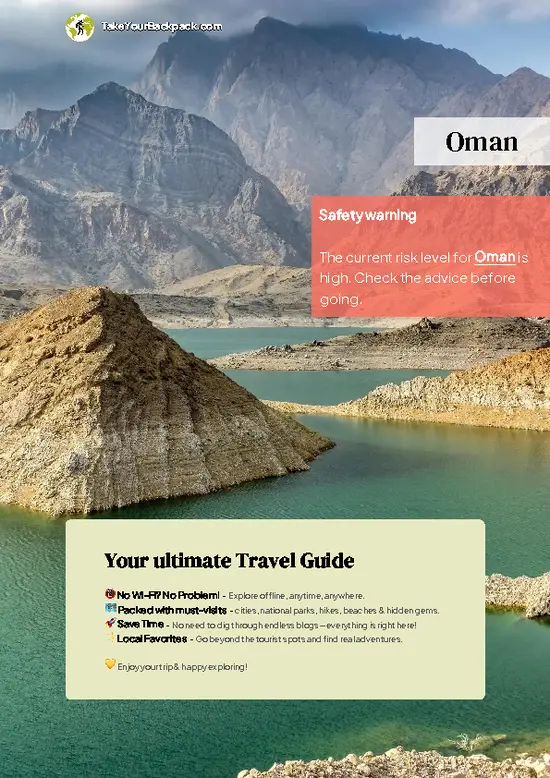
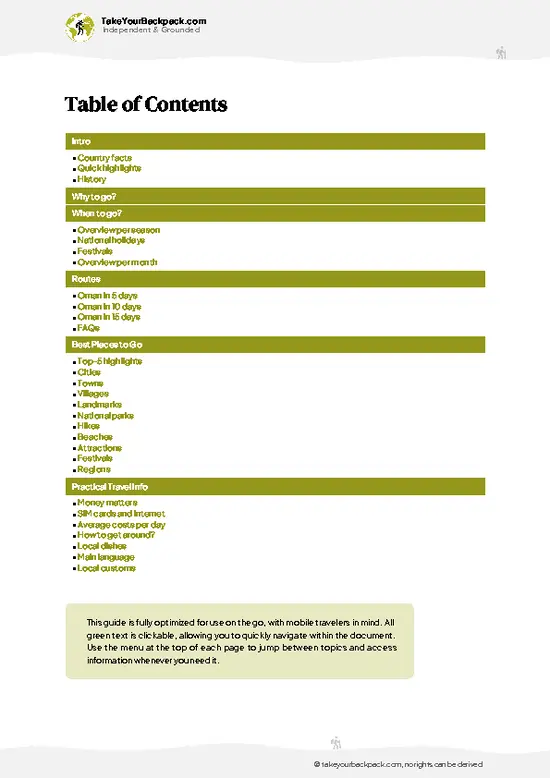
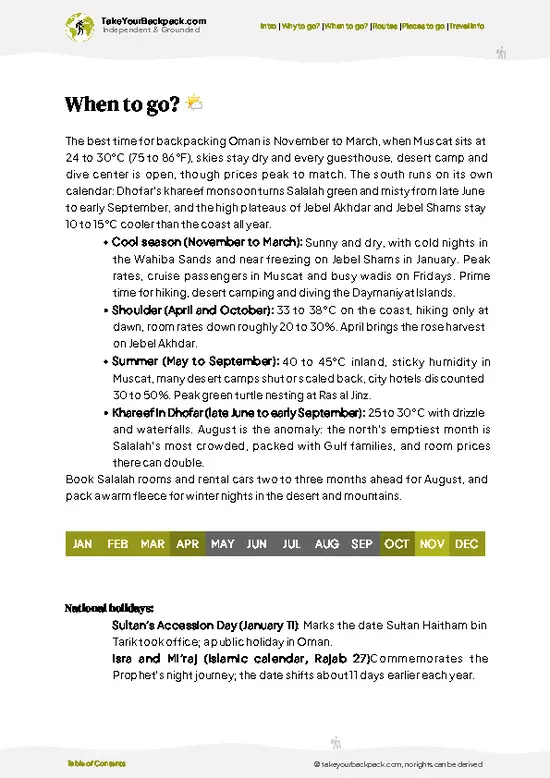
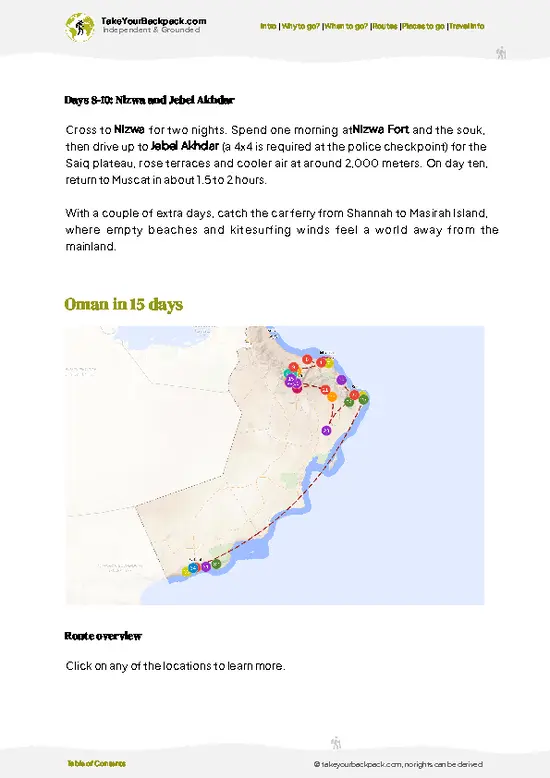
An offline-friendly backpacking guide with optimized travel routes, ranked highlights, transport advice, and the best areas to stay.
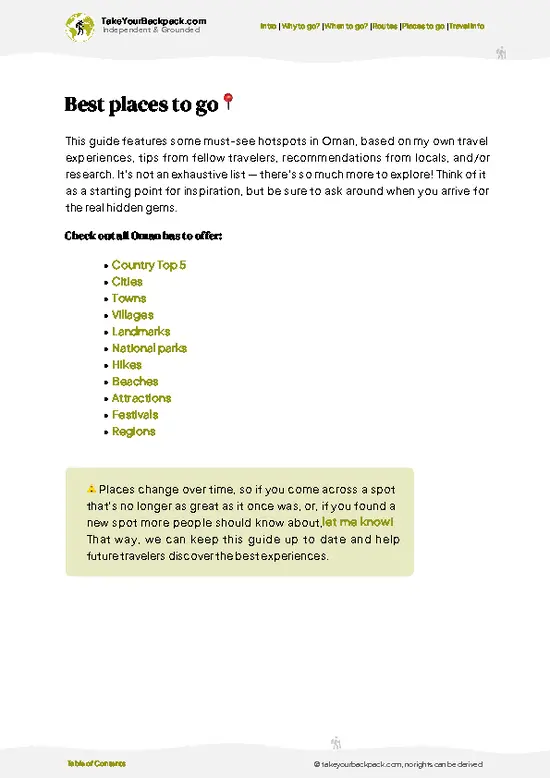
example page 0 from our offline Travel Guide for Oman
example page 1 from our offline Travel Guide for Oman
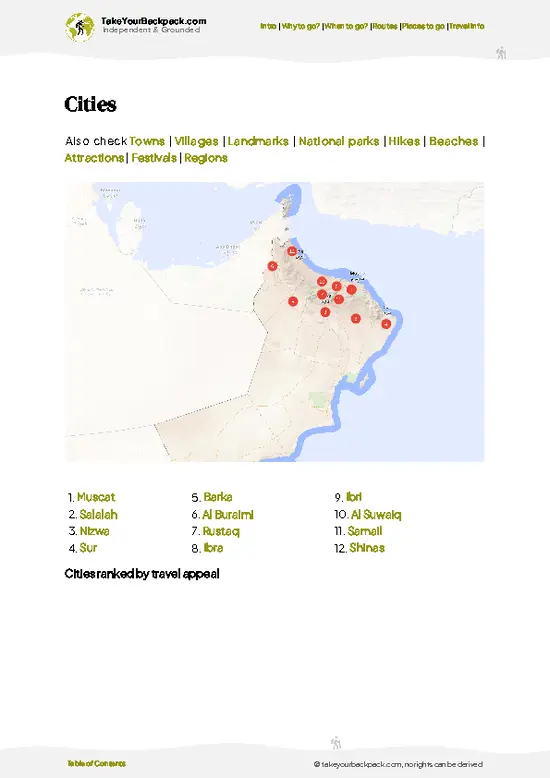
example page 2 from our offline Travel Guide for Oman
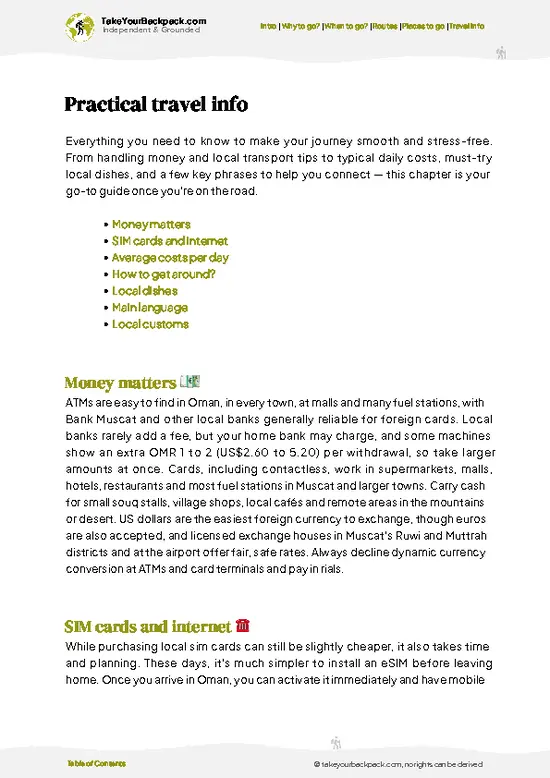
example page 3 from our offline Travel Guide for Oman
example page 4 from our offline Travel Guide for Oman
example page 5 from our offline Travel Guide for Oman
example page 6 from our offline Travel Guide for Oman
example page 7 from our offline Travel Guide for Oman
The digital guide (291 pages) contains:
✅ 73 highlights, ranked by travel appeal
✅ Optimized 5, 10 & 15-day travel routes
✅ Cities, national parks, landmarks, beaches
✅ How to get around
✅ Offline-friendly for travel without Wi-Fi
👉 Click to see all 30+ guide features

📅 Plan smarter in minutes, not weeks
✅ Month by month travel advice
✅ Festivals & national holidays
✅ Budget expectations

🗺️ Go to the right places, skip the overrated ones
✅ Honest pros & cons of destinations
✅ Top hikes, parks & viewpoints
✅ Lesser-known places most travelers miss
✅ Clear “worth it vs skip it” guidance

🛏️ Travel smoothly without rookie mistakes
✅ Best areas to stay
✅ Transport systems explained simply
✅ Common scams & safety advice
✅ SIM cards, money & practical tips

🌍 Understand the country, not just visit it
✅ Culture & traditions
✅ 52 Essential phrases & customs
✅ Festivals worth planning around
✅ Traveler-friendly historical context
✅ Insights that make places more meaningful

📱 Built for real travel conditions
✅ Fully downloadable PDF
✅ Works completely offline
✅ Optimized for phone use
✅ Useful in remote areas & buses
✅ Everything in one place
Stop searching, start planning
Get instant access to your full guide. 30‑day money-back guarantee.
+ Add another guide for just

By proceeding you agree to our terms.
Sent to your inbox immediately after payment • 100% Secure Checkout
Best Backpacking Travel Advisor 2025 tourism awardBest Backpacking
Travel Advisor
2025
What others say about Take Your Backpack Guides:
⭐⭐⭐⭐⭐
Fantastic, amazing amount of information!
⭐⭐⭐⭐⭐
My goodness this is amazing, it's what I've been looking for hats off too you!
⭐⭐⭐⭐⭐
I think this is absolutely BRILLIANT
⭐⭐⭐⭐
Very complete and informative. It's still missing places, but I gotta to commend you
⭐⭐⭐⭐⭐
This is truly amazing, thank you, can't wait to explore it with my kids!
⭐⭐⭐⭐⭐
Awesome resource, thank you!
⭐⭐⭐⭐⭐
This is amazing! Can't wait to explore the ones I haven't seen
⭐⭐⭐⭐
I love this! Well done, great idea.
⭐⭐⭐⭐⭐
Thanks for taking the time to make this gem!
⭐⭐⭐⭐⭐
This might be the best website I've ever seen.
⭐⭐⭐⭐⭐
Congratulations, and thank you so much for your work; it's incredibly valuable.
⭐⭐⭐⭐
In all seriousness I think you did a great job pointing out the important spots
⭐⭐⭐⭐⭐
10/10 very good
⭐⭐⭐⭐⭐
As someone who's only just starting to visit regularly this is awesome, thank you.
⭐⭐⭐⭐
Thank you very much! I'm going to visit my dad, it's going to be very useful!
⭐⭐⭐⭐⭐
This is really cool! We'll be travelling for the first time and this definitely come in handy.
⭐⭐⭐⭐⭐
You are now our minister of culture, congratulations 👨‍💼
⭐⭐⭐⭐⭐
Just wanted to tell you that this is a pearl! Going to follow your recommendations.
⭐⭐⭐⭐⭐
This is so cool. I'll definitely be using the resource for my travels soon.
⭐⭐⭐⭐⭐
This is very impressive! Good work.
⭐⭐⭐⭐⭐
This is an amazing and informative site. Very well done!

🛏️ Where to stay?Top Places to Consider Staying

Oman has only a handful of true hostels, so budget travel here usually means simple guesthouses, older hotels and heritage homestays at roughly OMR 15 to 25 (US$39 to 65) a night, with dorm beds in the few hostels starting around OMR 6 to 10 (US$16 to 26). In Muscat, Muttrah puts you on the corniche and next to the souq, with sea breezes and quiet evenings, while Ruwi is the cheapest district and the main bus hub but busy and short on charm, and Qurum and Al Khuwair cost more yet sit near the beach, malls and the licensed hotel bars where the city’s limited nightlife happens. Outside the capital, the old quarter of Nizwa has restored mud-brick guesthouses within walking distance of the fort … read more 👉
Oman has only a handful of true hostels, so budget travel here usually means simple guesthouses, older hotels and heritage homestays at roughly OMR 15 to 25 (US$39 to 65) a night, with dorm beds in the few hostels starting around OMR 6 to 10 (US$16 to 26). In Muscat, Muttrah puts you on the corniche and next to the souq, with sea breezes and quiet evenings, while Ruwi is the cheapest district and the main bus hub but busy and short on charm, and Qurum and Al Khuwair cost more yet sit near the beach, malls and the licensed hotel bars where the city’s limited nightlife happens. Outside the capital, the old quarter of Nizwa has restored mud-brick guesthouses within walking distance of the fort and souq, and all of these areas are very safe after dark.

If you enjoy meeting fellow travelers, consider choosing hostels with high ratings for atmosphere. On the other hand, if you prefer having your own space, a hotel might be a better option.

OmanMore Places Across Oman

👋 Meet the founderWho’s Behind Take Your Backpack?

Johan, backpacker and founder of TakeYourBackpackHi, I’m Johan (Netherlands 🇳🇱), the creator of TakeYourBackpack. Over the past 3 decades, I’ve backpacked through 90+ countries across six continents, gaining extensive experience with independent travel, long-term trips, and overland routes.

This site is built on a combination of firsthand travel experience and carefully curated insights from other backpackers. Many guides are based on places I’ve personally visited, while others bring together tips, observations, and practical advice shared by trusted travelers I’ve met along the way.

The goal is to provide realistic, experience-driven guidance — not generic itineraries — so you can explore destinations with better context, clearer expectations, and more confidence.