×

Portugal🇵🇹 | best festivalsExplore the 4 Best festivals in Portugal

Festivals in Portugal run on sardine smoke, brass bands and church bells, and the experience changes sharply with the map. In the north, around Porto and Braga, street parties pack narrow granite lanes with crowds and sticky-sweet drinks. Lisbon and the Alentejo lean toward music and arts events on warm evenings, with ticket prices that rise fast. The Algarve draws beach crowds and the priciest beds. Madeira and the Azores offer smaller, island-paced gatherings that need flights or ferries. For backpackers and independent travelers, cost, crowding and distance separate a cheap night on cobbles from a festival weekend where hostels sell out weeks ahead.

By Johan Kruseman 🇳🇱 | Updated October 18, 2026
Explore the best regions in Portugal

Why go?Why These festival Stand Out

Portugal suits festivals because religious calendars, village identity and warm weather overlap. Nearly every town keeps a patron saint, and the saint’s day means processions, flower-strewn streets, grilled sardines, fireworks and brass bands that carry across tiled rooftops. Summer evenings stay mild and dry, so most celebrations happen outdoors, often until the small hours, with smoke, sweat and sugar in the air. The country is also compact, and trains, buses and cheap local food make it easy to reach events without a car, at least between larger cities.

Some things to know before choosing Portugal for this. Big dates bring real crowds and tight, expensive accommodation, especially in Lisbon, Porto and the Algarve. Rural festivals can sit far from rail lines, so buses may be infrequent … read more 👉
Portugal suits festivals because religious calendars, village identity and warm weather overlap. Nearly every town keeps a patron saint, and the saint’s day means processions, flower-strewn streets, grilled sardines, fireworks and brass bands that carry across tiled rooftops. Summer evenings stay mild and dry, so most celebrations happen outdoors, often until the small hours, with smoke, sweat and sugar in the air. The country is also compact, and trains, buses and cheap local food make it easy to reach events without a car, at least between larger cities.

Some things to know before choosing Portugal for this. Big dates bring real crowds and tight, expensive accommodation, especially in Lisbon, Porto and the Algarve. Rural festivals can sit far from rail lines, so buses may be infrequent and the last one leaves early. Cobbled hills punish bad shoes, and street parties can feel loud and sticky at close range. Many events run on local rhythm: schedules slip, dinner happens late, and the best moments often begin after midnight. Portugal rewards flexible visitors who book early for headline dates and keep slack for the small-town surprises.
Behind the Scenes of Selection
The list of best festivals in Portugal is created based on energy, traditions, crowd experience, activities, and overall excitement. If you feel a festival is missing in this list, please let us know.

When to go?Seasonal Guide to Visiting

Best months: The best months for festivals in Portugal are June to September, because long dry evenings of roughly 22 to 30°C keep street parties, concerts and processions outdoors and comfortable. Rainfall in these months is minimal, often under 20 mm a month in the south, and daylight lasts past 9 p.m.
Shoulder seasons: April to May and late September to October bring 16 to 25°C, softer light and lower prices, with rooms often 20 to 40 percent cheaper than in midsummer. Showers are possible, especially in the north, where Porto and Minho can get 80 to 120 mm in a wet spring month. Easter and religious processions pull crowds in spring, particularly in Braga.
Peak periods: June is the one stretch that changes travel decisions: Lisbon and Porto fill up around the saints’ days, hostel dorms that … read more 👉
Best months: The best months for festivals in Portugal are June to September, because long dry evenings of roughly 22 to 30°C keep street parties, concerts and processions outdoors and comfortable. Rainfall in these months is minimal, often under 20 mm a month in the south, and daylight lasts past 9 p.m.
Shoulder seasons: April to May and late September to October bring 16 to 25°C, softer light and lower prices, with rooms often 20 to 40 percent cheaper than in midsummer. Showers are possible, especially in the north, where Porto and Minho can get 80 to 120 mm in a wet spring month. Easter and religious processions pull crowds in spring, particularly in Braga.
Peak periods: June is the one stretch that changes travel decisions: Lisbon and Porto fill up around the saints’ days, hostel dorms that cost €20 to 30 in spring can jump to €40 to 70, and beds sell out weeks ahead. July and August add Algarve heat of 30 to 35°C and the highest coastal rates. Inland Alentejo can pass 38°C, so shade and water matter.
Winter: November to March is cool, damp and quiet, with 8 to 15°C and frequent rain, and many seaside venues shut. Madeira stays milder, around 16 to 20°C.

festival hoppingTips for Visiting Multiple Destinations

How long to allow: A trip combining several festivals in Portugal needs 10 to 14 days, which gives time to travel, recover from late nights and keep a buffer for sold-out beds. Portugal is long and narrow, so grouping by region saves hours on the road.
Direction and clusters: Start in the north (Porto, Braga, Guimarães), then travel south through Coimbra toward Lisbon. Add the Alentejo or the Algarve last, since the coast is the most expensive and tiring. Porto to Lisbon takes about 3 hours by Alfa Pendular or Intercidades train, Lisbon to Faro about 3 hours by train or bus, and Lisbon to Évora about 1.5 hours by bus. The Azores and Madeira need flights of roughly 1.5 to 2.5 hours from Lisbon, so treat them as a separate trip or an end-of-route add-on.
Time per stop: Give a city or big festival … read more 👉
How long to allow: A trip combining several festivals in Portugal needs 10 to 14 days, which gives time to travel, recover from late nights and keep a buffer for sold-out beds. Portugal is long and narrow, so grouping by region saves hours on the road.
Direction and clusters: Start in the north (Porto, Braga, Guimarães), then travel south through Coimbra toward Lisbon. Add the Alentejo or the Algarve last, since the coast is the most expensive and tiring. Porto to Lisbon takes about 3 hours by Alfa Pendular or Intercidades train, Lisbon to Faro about 3 hours by train or bus, and Lisbon to Évora about 1.5 hours by bus. The Azores and Madeira need flights of roughly 1.5 to 2.5 hours from Lisbon, so treat them as a separate trip or an end-of-route add-on.
Time per stop: Give a city or big festival town 2 to 3 nights, and small-town events 1 to 2 nights. Remote villages may need an extra half day for bus connections.
Common planning mistakes: Travelers often pack too many long transfers into consecutive days, then arrive at a party exhausted. Cap travel days at about 4 hours. Another error is booking the Algarve first, then facing a long overnight shuffle north. Reserve beds for headline dates early, and keep trains booked in advance for weekends, when seats vanish and station queues grow.

The ListTop festivals of Portugal

1 NOS Alive

Seaside venue, international bands, summer crowds

Catch major acts on multiple stages near the Atlantic, with easy access to Lisbon and a festival atmosphere that draws music fans from across Europe.

2 Rock in Rio Lisboa

Parque da Bela Vista, global headliners, themed stages

Immerse yourself in a large-scale music event featuring diverse genres, interactive zones, and a sprawling park setting designed for all-day entertainment.

3 Festa de São João

Porto riverfront, plastic hammers, midnight fireworks

Experience Porto’s playful spirit as crowds gather for quirky traditions, riverside parties, and a night sky lit by elaborate pyrotechnics.

4 Festa de Santo António

Lisbon neighborhoods, grilled sardines, street weddings

Join locals as they fill narrow lanes with music, open-air feasts, and spontaneous celebrations honoring the city’s beloved matchmaker saint.

Loading the map 🌍

Expert viewPro Tips for Exploring the Best

How many festivals to plan: Aim for three to four festivals on a trip of two weeks. That is enough to feel the country’s rhythm without turning every day into a recovery day. Portuguese celebrations run late, often past 2 a.m., and each one demands a day of slow mornings, strong coffee from a corner café and a pastel de nata for ballast. Add more and the experience blurs into sore feet and train timetables.
Choosing the kind that suits you: Travelers on a tight budget should favor saints’ day street parties and village events. Entry is usually free, food stalls sell grilled sardines, bifana sandwiches and cheap beer, and the crowd is mostly local. Music lovers should prioritize ticketed festivals, which cost more but come with organized camping and clear logistics. Those after quiet cultural … read more 👉
How many festivals to plan: Aim for three to four festivals on a trip of two weeks. That is enough to feel the country’s rhythm without turning every day into a recovery day. Portuguese celebrations run late, often past 2 a.m., and each one demands a day of slow mornings, strong coffee from a corner café and a pastel de nata for ballast. Add more and the experience blurs into sore feet and train timetables.
Choosing the kind that suits you: Travelers on a tight budget should favor saints’ day street parties and village events. Entry is usually free, food stalls sell grilled sardines, bifana sandwiches and cheap beer, and the crowd is mostly local. Music lovers should prioritize ticketed festivals, which cost more but come with organized camping and clear logistics. Those after quiet cultural experiences should pick religious processions and regional folk events, where respectful watching is the whole point. Social travelers will find the easiest company at hostel-run outings and city street parties, and solo travelers do well in Lisbon and Porto, where groups form quickly.
What it costs: Budget US$45 to 80 a day in cities and US$35 to 60 in smaller towns outside peak dates (roughly €40 to 70 and €30 to 55). That covers a dorm bed at €20 to 35 (up to €40 to 70 on big dates), meals, and local transport. Per festival, free street parties cost only food and drinks, around €15 to 30 for an evening. Ticketed music events run about €50 to 100 for a day pass and €150 to 300 for multi-day passes, with camping often extra at €15 to 40. Regional trains and buses between towns cost €5 to 25 a leg. Organized guided tours of religious or cultural events, where offered, run about €20 to 45.
Safety and etiquette: Portugal is among Europe’s safer countries, but crowded parties attract pickpockets, especially in Lisbon and Porto. Carry a zipped front bag, leave your passport in the hostel locker and keep a photo of it on your phone. Cobbled streets are slippery after midnight, so wear closed shoes with grip. Night buses thin out quickly, so know the last departure or budget for a €8 to 20 ride-hailing trip home.
For religious events, dress modestly near churches, keep your voice low during processions and ask before photographing people in costume or at prayer. Fireworks and firecrackers go off unannounced, so protect your ears and hold phones tightly. Drink water between rounds, since heat and ginjinha add up faster than expected. Book the dates that matter early. If the bed is gone, look half an hour out by train rather than paying double in the center.

✈️ The backpacker research shortcutPortugal Travel Guide

An offline-friendly backpacking guide with optimized travel routes, ranked highlights, transport advice, and the best areas to stay.
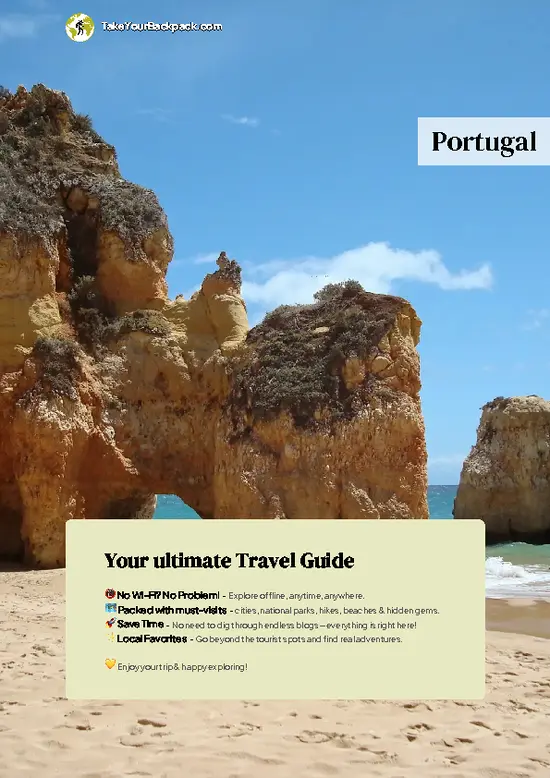
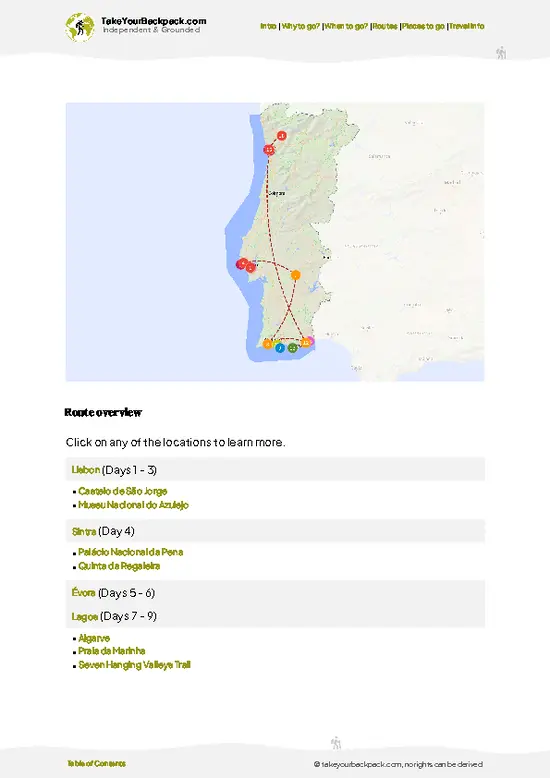
example page 0 from our offline Travel Guide for Portugal
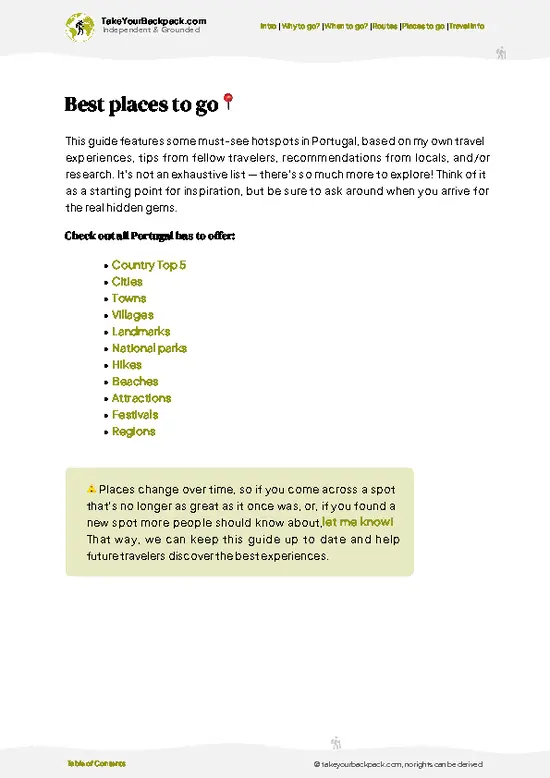
example page 1 from our offline Travel Guide for Portugal
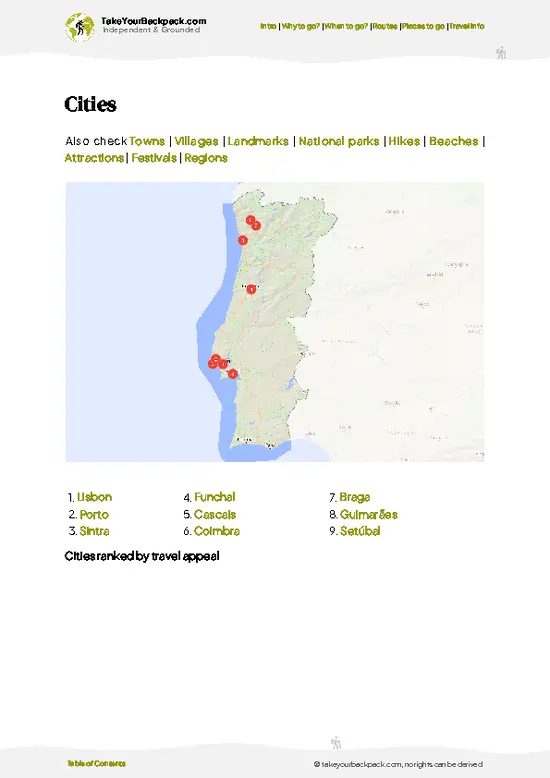
example page 2 from our offline Travel Guide for Portugal
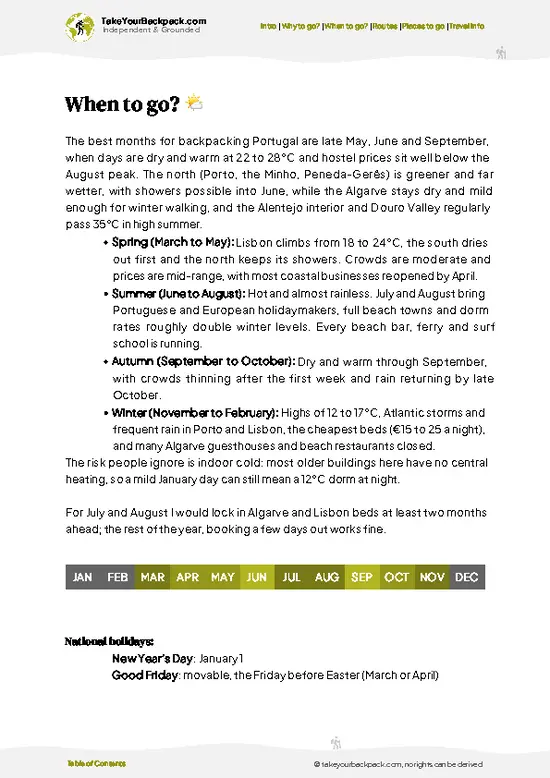
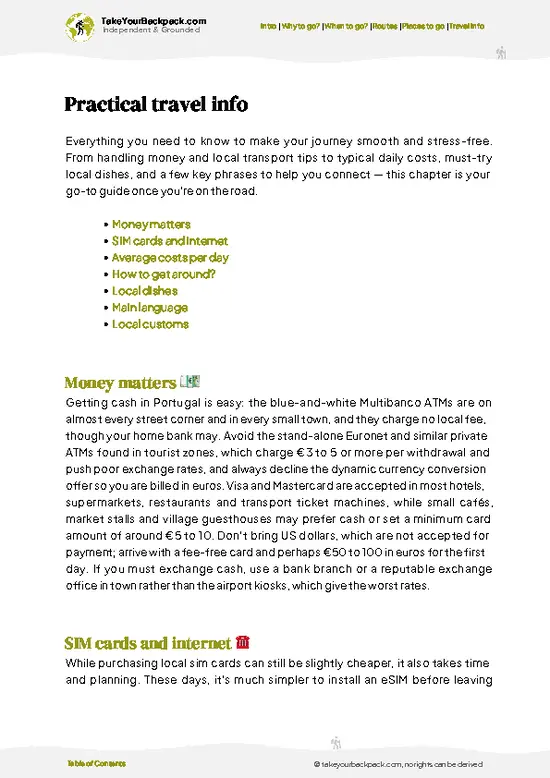
example page 3 from our offline Travel Guide for Portugal
example page 4 from our offline Travel Guide for Portugal
example page 5 from our offline Travel Guide for Portugal
example page 6 from our offline Travel Guide for Portugal
example page 7 from our offline Travel Guide for Portugal
The digital guide (361 pages) contains:
✅ 87 highlights, ranked by travel appeal
✅ Optimized 5, 10 & 15-day travel routes
✅ Cities, national parks, landmarks, beaches
✅ How to get around
✅ Offline-friendly for travel without Wi-Fi
👉 Click to see all 30+ guide features

📅 Plan smarter in minutes, not weeks
✅ Month by month travel advice
✅ Festivals & national holidays
✅ Budget expectations

🗺️ Go to the right places, skip the overrated ones
✅ Honest pros & cons of destinations
✅ Top hikes, parks & viewpoints
✅ Lesser-known places most travelers miss
✅ Clear “worth it vs skip it” guidance

🛏️ Travel smoothly without rookie mistakes
✅ Best areas to stay
✅ Transport systems explained simply
✅ Common scams & safety advice
✅ SIM cards, money & practical tips

🌍 Understand the country, not just visit it
✅ Culture & traditions
✅ 52 Essential phrases & customs
✅ Festivals worth planning around
✅ Traveler-friendly historical context
✅ Insights that make places more meaningful

📱 Built for real travel conditions
✅ Fully downloadable PDF
✅ Works completely offline
✅ Optimized for phone use
✅ Useful in remote areas & buses
✅ Everything in one place
Stop searching, start planning
Get instant access to your full guide. 30‑day money-back guarantee.
+ Add another guide for just

By proceeding you agree to our terms.
Sent to your inbox immediately after payment • 100% Secure Checkout
Best Backpacking Travel Advisor 2025 tourism awardBest Backpacking
Travel Advisor
2025
What others say about Take Your Backpack Guides:
⭐⭐⭐⭐⭐
Fantastic, amazing amount of information!
⭐⭐⭐⭐⭐
My goodness this is amazing, it's what I've been looking for hats off too you!
⭐⭐⭐⭐⭐
I think this is absolutely BRILLIANT
⭐⭐⭐⭐
Very complete and informative. It's still missing places, but I gotta to commend you
⭐⭐⭐⭐⭐
This is truly amazing, thank you, can't wait to explore it with my kids!
⭐⭐⭐⭐⭐
Awesome resource, thank you!
⭐⭐⭐⭐⭐
This is amazing! Can't wait to explore the ones I haven't seen
⭐⭐⭐⭐
I love this! Well done, great idea.
⭐⭐⭐⭐⭐
Thanks for taking the time to make this gem!
⭐⭐⭐⭐⭐
This might be the best website I've ever seen.
⭐⭐⭐⭐⭐
Congratulations, and thank you so much for your work; it's incredibly valuable.
⭐⭐⭐⭐
In all seriousness I think you did a great job pointing out the important spots
⭐⭐⭐⭐⭐
10/10 very good
⭐⭐⭐⭐⭐
As someone who's only just starting to visit regularly this is awesome, thank you.
⭐⭐⭐⭐
Thank you very much! I'm going to visit my dad, it's going to be very useful!
⭐⭐⭐⭐⭐
This is really cool! We'll be travelling for the first time and this definitely come in handy.
⭐⭐⭐⭐⭐
You are now our minister of culture, congratulations 👨‍💼
⭐⭐⭐⭐⭐
Just wanted to tell you that this is a pearl! Going to follow your recommendations.
⭐⭐⭐⭐⭐
This is so cool. I'll definitely be using the resource for my travels soon.
⭐⭐⭐⭐⭐
This is very impressive! Good work.
⭐⭐⭐⭐⭐
This is an amazing and informative site. Very well done!

🛏️ Where to stay?Best Stay Options in Portugal

Portugal has one of Europe’s densest and best-rated hostel scenes, with dorm beds from roughly €18 to €35 in summer and plenty of budget guesthouses outside the big cities. In Lisbon, Baixa and Chiado put you on flat ground near the metro and most sights, Bairro Alto and Cais do Sodré are the nightlife picks but stay loud until 3am, and Alfama is hilly and quieter, with fado bars instead of clubs. In Porto, Ribeira is right on the river but steep and touristy, while Baixa around the university area has more beds, cheaper food and an easy walk to the bars, and on the Algarve Lagos old town is the party hub, so pick a spot a few streets back if you want sleep.

If you enjoy meeting fellow travelers, … read more 👉
Portugal has one of Europe’s densest and best-rated hostel scenes, with dorm beds from roughly €18 to €35 in summer and plenty of budget guesthouses outside the big cities. In Lisbon, Baixa and Chiado put you on flat ground near the metro and most sights, Bairro Alto and Cais do Sodré are the nightlife picks but stay loud until 3am, and Alfama is hilly and quieter, with fado bars instead of clubs. In Porto, Ribeira is right on the river but steep and touristy, while Baixa around the university area has more beds, cheaper food and an easy walk to the bars, and on the Algarve Lagos old town is the party hub, so pick a spot a few streets back if you want sleep.

If you enjoy meeting fellow travelers, consider choosing hostels with high ratings for atmosphere. On the other hand, if you prefer having your own space, a hotel might be a better option.

PortugalWhere to Go Next

👋 Meet the founderWho’s Behind Take Your Backpack?

Johan, backpacker and founder of TakeYourBackpackHi, I’m Johan (Netherlands 🇳🇱), the creator of TakeYourBackpack. Over the past 3 decades, I’ve backpacked through 90+ countries across six continents, gaining extensive experience with independent travel, long-term trips, and overland routes.

This site is built on a combination of firsthand travel experience and carefully curated insights from other backpackers. Many guides are based on places I’ve personally visited, while others bring together tips, observations, and practical advice shared by trusted travelers I’ve met along the way.

The goal is to provide realistic, experience-driven guidance — not generic itineraries — so you can explore destinations with better context, clearer expectations, and more confidence.