×

Russia🇷🇺 | best beachesEssential 2 beaches to Explore in Russia

Beaches in Russia are summer places, shaped by a short season and by distance. The Black Sea coast around Sochi and Anapa carries most of the domestic demand. Sochi has pebble shores under the Caucasus foothills, while the stretch near Anapa has sand and shallow water. Both come with a loud, crowded, fairly affordable resort culture of promenades, cafés and guesthouses. The Sea of Azov is shallower and warmer still, with simpler towns and lower prices. In the northwest, the Baltic shore of Kaliningrad region and the Gulf of Finland near St Petersburg have pine-backed dunes, cooler water, thinner crowds and a bathing season of only a few weeks. In the Far East, Primorsky Krai near Vladivostok has sandy bays reached by suburban train, bus or ferry, and Lake Baikal has sand but surface water that rarely passes 17°C.
Costs run from about US$25 a day in an Azov guesthouse town to roughly double that in Sochi in August. For backpacking and other independent travel, access is the main variable. The south is well served by trains and flights, while the Far East needs a long haul. Most nationalities need a visa, and foreign bank cards do not work inside the country, so plan to carry cash.

By Johan Kruseman 🇳🇱 | Updated October 18, 2026
Explore the best attractions in Russia

Why go?What Makes Them Special

Russia is a country of cold seas with a handful of warm exceptions, and that single fact explains almost everything about its beaches. Most of the coastline faces the Arctic or the North Pacific, and ice covers much of it for months. The swimming coast is therefore concentrated in a few places: the Black and Azov seas in the south, the Baltic in the northwest, the Sea of Japan in the Far East, and a few large lakes. Expect a beach season of roughly three months in the south and as little as four to six weeks elsewhere.
The cultural logic follows from this. Since the Soviet period, the Black Sea has been the country’s national seaside. Sanatoriums, trade-union holiday housing and long concrete promenades were built there for workers on annual leave, and the habit of a two-week family trip to … read more 👉
Russia is a country of cold seas with a handful of warm exceptions, and that single fact explains almost everything about its beaches. Most of the coastline faces the Arctic or the North Pacific, and ice covers much of it for months. The swimming coast is therefore concentrated in a few places: the Black and Azov seas in the south, the Baltic in the northwest, the Sea of Japan in the Far East, and a few large lakes. Expect a beach season of roughly three months in the south and as little as four to six weeks elsewhere.
The cultural logic follows from this. Since the Soviet period, the Black Sea has been the country’s national seaside. Sanatoriums, trade-union holiday housing and long concrete promenades were built there for workers on annual leave, and the habit of a two-week family trip to the south has survived. Beaches are social spaces, with loudspeakers, paid loungers, food vendors, and people who bring picnics and stay all day. Visitors who expect empty coves will find them mainly on the Baltic, in Primorye outside peak weekends, and on the Baikal shore.
The infrastructure is uneven. Resort towns in Krasnodar Krai have dense transport, thousands of rooms and well-developed eating options, though in July and August they are crowded and prices rise sharply. Elsewhere, beach access can mean a regional train, a marshrutka minibus or a walk through forest, with few signs in English. Distance is the other defining factor. The Far East lies about eight hours by air from Moscow, and few visitors combine it with the south in one trip.
Before choosing Russia for beaches, a traveler should know several things. Water is cooler than in the Mediterranean outside peak summer, and the Baltic and Baikal are cold even in July. Entry usually requires a visa (an electronic one is available to citizens of many countries), and many governments publish travel advisories for parts of the country, so current guidance should be checked. Because international cards are not accepted, cash in rubles and some familiarity with local payment apps matter more here than in most places. Finally, the country is huge, and a beach holiday works best when confined to one region. Russia suits travelers who want a domestic holiday atmosphere, low to moderate prices and a very different cultural setting, more than those looking for tropical clear water.
Why These Made the Cut
The list of best beaches in Russia is created based on beauty, vibe, water quality, activities, and surrounding scenery. If you feel a beach is missing in this list, please let us know.

When to go?Timing Your Visit for the Best Experience

Best months: July and August are the best months for beaches in Russia because sea and air temperatures peak, with Black Sea water at 24 to 27°C and daytime air at 28 to 33°C in the south. These are also the most crowded and expensive weeks of the year.
The Black Sea coast (Sochi, Anapa, Gelendzhik) has the longest season. Swimming is comfortable from about mid-June to late September, with water above 20°C in those months. The Sea of Azov warms faster because it is shallow, reaching 24 to 28°C by July, and can be warm enough for swimming from late May. Rain is limited in July and August, though thunderstorms and strong winds occur, and the Sochi area gets more rainfall than the northern Krasnodar coast, particularly in autumn.
Shoulder seasons: The shoulder periods are late May to mid-June and … read more 👉
Best months: July and August are the best months for beaches in Russia because sea and air temperatures peak, with Black Sea water at 24 to 27°C and daytime air at 28 to 33°C in the south. These are also the most crowded and expensive weeks of the year.
The Black Sea coast (Sochi, Anapa, Gelendzhik) has the longest season. Swimming is comfortable from about mid-June to late September, with water above 20°C in those months. The Sea of Azov warms faster because it is shallow, reaching 24 to 28°C by July, and can be warm enough for swimming from late May. Rain is limited in July and August, though thunderstorms and strong winds occur, and the Sochi area gets more rainfall than the northern Krasnodar coast, particularly in autumn.
Shoulder seasons: The shoulder periods are late May to mid-June and September to early October on the southern coasts. In these weeks, air temperatures of 22 to 27°C suit walking and sunbathing, sea temperatures sit around 18 to 23°C, and accommodation can cost 30 to 50 percent less than in peak weeks. September in particular often has settled weather and falling crowds after school holidays end on September 1. From mid-October, many seasonal beachside cafés, rental stands and some guesthouses close.
Northwest, Far East and Baikal: The Baltic season in Kaliningrad region and the Gulf of Finland is short. Water reaches 17 to 21°C in July and early August, air temperatures are 20 to 26°C, and showers are common. St Petersburg’s white nights in June add long daylight, although the water is still cold then. In Primorsky Krai, the best swimming is late July to early September, with sea temperatures around 20 to 23°C. Early summer has frequent fog, and August and September carry some risk of typhoon-related storms and heavy rain. Lake Baikal is best in July and August, but surface water in open areas is often 10 to 15°C, with shallow bays warmer, up to about 18 to 20°C.
Prices and bookings: The peak period in the south runs from early July to late August, when booking a month or more ahead is sensible, and rooms can cost 1.5 to 2 times shoulder-season rates. The holiday weeks around May 1 and May 9 also bring crowds to Sochi and Anapa without reliable swimming weather. In winter the coasts are mostly quiet, with water temperatures of 8 to 10°C in the Black Sea and no beach services.

beach hoppingHow to Combine beaches Into One Trip

Trip length and structure: A trip combining several beaches in Russia needs 10 to 21 days, because distances are large and the swimming regions lie far apart. Most travelers do better to choose one or two regions than to cover the whole country.
The best-linked cluster is the south. Krasnodar is the main rail and bus hub, with services north to the Azov coast and west to Anapa, which takes roughly 2 to 3 hours by bus. Sochi and Adler are served by direct flights and long-distance trains. Sochi to Anapa takes about 6 to 7 hours by road, and Sochi to Gelendzhik around 4 to 5, and the Black Sea railway line is slow and often crowded in summer. A sensible south-coast trip moves in one direction, such as Azov to Anapa to Gelendzhik to Sochi, and finishes at the Sochi or Adler airport.
The northwest … read more 👉
Trip length and structure: A trip combining several beaches in Russia needs 10 to 21 days, because distances are large and the swimming regions lie far apart. Most travelers do better to choose one or two regions than to cover the whole country.
The best-linked cluster is the south. Krasnodar is the main rail and bus hub, with services north to the Azov coast and west to Anapa, which takes roughly 2 to 3 hours by bus. Sochi and Adler are served by direct flights and long-distance trains. Sochi to Anapa takes about 6 to 7 hours by road, and Sochi to Gelendzhik around 4 to 5, and the Black Sea railway line is slow and often crowded in summer. A sensible south-coast trip moves in one direction, such as Azov to Anapa to Gelendzhik to Sochi, and finishes at the Sochi or Adler airport.
The northwest pairs St Petersburg with Kaliningrad region. The two are connected by a flight of about 1 hour 40 minutes, and Moscow to Kaliningrad takes about 2 hours. Within each area, local trains and buses cover short hops of 30 to 90 minutes.
The Far East stands apart. Vladivostok is about 8 hours by air from Moscow and seven time zones away, and the Trans-Siberian train takes around six days. It works as a separate trip, or as the final leg after Lake Baikal, reached through Irkutsk, which is about 5 hours 30 minutes from Moscow by air and roughly 4 to 5 hours from Vladivostok by flight.
Time per stop: Plan 3 to 5 nights per coastal region, which leaves time for beach days, a rest day and weather changes. Allow 2 to 3 nights in the Far East or at Baikal, where getting to the shore can take half a day. Long-distance rail between southern towns often takes 1 night for each leg, so factor that in when counting days.
Planning mistakes: The commonest error is underestimating distance. Moscow to Sochi is about 1,600 km, and flying is far more practical than the 24 to 36 hours of train travel, so build the trip around flights and use trains for short links. A second error is using Moscow as the hub when a direct regional flight exists, which can cut a day. Southern airports have had closures and delays, so leave buffer days before any onward flight and keep a rail option in reserve. Booking tight connections in July and August fails when trains sell out, so buy rail tickets as soon as sales open, typically 60 to 90 days ahead. The final mistake is combining the Baltic and the Far East in one short trip, which spends more time in transit than on the shore. Choose one coast, then add a second only if the schedule allows 3 or more days of buffer.

The ListHighly Recommended beaches of Russia

1 Khalaktyrsky Beach

black volcanic sand, Pacific surf, wild coastline

Stand on dark sands facing open ocean, watch surfers ride strong waves, and experience the raw, untamed edge of Kamchatka.

russia-beach-khalaktyrsky-beach
© Google |

2 Vityazevo Beach

wide sand strip, shallow entry, Greek-inspired promenade

Stroll a spacious esplanade, wade far into warm shallows, and find plenty of space even in peak summer months.

russia-beach-vityazevo-beach
© Google |
Loading the map 🌍

Expert viewTips and Advice from Travelers

How many beaches to visit: Visit two to four beaches, and no more than one or two regions, because distance and weather make a longer list expensive in time and money. In summer, Russia’s coastal transport is crowded and slow, and each change of base costs half a day. Three beaches in one region usually give enough contrast between a developed resort shore and a quieter one. A trip with six or seven stops across several regions tends to produce more train and airport time than sand.
Prioritizing by travel style: Choose by what you want from the stop. Travelers who want social energy, cheap food and easy logistics should pick the southern Black Sea resorts. Those who want calm and shallow water should look at the Azov coast and the sandy stretches near Anapa, where the sea warms early. Anyone … read more 👉
How many beaches to visit: Visit two to four beaches, and no more than one or two regions, because distance and weather make a longer list expensive in time and money. In summer, Russia’s coastal transport is crowded and slow, and each change of base costs half a day. Three beaches in one region usually give enough contrast between a developed resort shore and a quieter one. A trip with six or seven stops across several regions tends to produce more train and airport time than sand.
Prioritizing by travel style: Choose by what you want from the stop. Travelers who want social energy, cheap food and easy logistics should pick the southern Black Sea resorts. Those who want calm and shallow water should look at the Azov coast and the sandy stretches near Anapa, where the sea warms early. Anyone wanting space and cooler air should pick the Baltic shore near Kaliningrad or the Gulf of Finland. Travelers who want wilder scenery can add Primorye or Baikal, but should treat them as a different kind of trip, with short swims and long journeys. Those with only a week should stay in the south and skip the rest.
Budget per day: A realistic backpacker budget is about US$30 to 45 a day (roughly 2,500 to 3,700 rubles) in Azov and Krasnodar Krai outside July and August, covering a hostel bed or guesthouse room, local food and buses. In peak weeks at Sochi, expect US$45 to 80 a day, since a dorm bed costs US$12 to 25 and a private room US$40 to 90 or more. The Baltic coast near St Petersburg and Kaliningrad is around US$35 to 60, and Vladivostok and Baikal US$40 to 70, with Baikal prices rising in July and August.
Per visit, most public beaches cost nothing to enter. Expect to pay 300 to 1,500 rubles (about US$3 to 15) for a sunbed and umbrella on organized shores, 100 to 400 rubles (US$1 to 4) for a private-operator changing room or shower, and 200 to 800 rubles for a local bus or minibus ride. Parking at popular spots can cost 200 to 600 rubles. Some private or protected coastlines, such as parts of national parks, charge an ecological fee, typically a few hundred rubles. Boat transfers and guided trips run from about 1,500 to 5,000 rubles per person depending on length.
Money pitfalls: International Visa and Mastercard cards are not accepted, so a traveler who arrives relying on them has no payment method. Bring enough cash in clean, undamaged US dollars or euros for the full stay, and exchange at banks in larger cities, which give better rates than airport counters or beach kiosks. Withdrawing from ATMs with a foreign card does not work. Avoid exchanging all money at once, because rates differ widely between offices. Sunbed prices in peak season are often negotiable or posted only after you sit down, so ask before settling in. A taxi from a station to a beach town costs far more if hailed on the street than if ordered through a local app such as Yandex Go, which needs a local phone number or SIM. Buy a Russian SIM at an official shop with a passport.
Delays and bookings: The costly delays are transport ones. Long-distance trains in July and August sell out, and southern airports have had restrictions that cancel or shift flights with little notice. Book flexible tickets where possible and keep a buffer of one night before any international departure. Book the first and last night of a beach stay, but leave the middle open, because weather can make a swim day unusable. Cheap guesthouses near beaches in the peak weeks fill by June, so reserve early. Wet weather in Sochi in autumn and in Primorye in late summer closes beaches and cancels ferries.
Safety on the water: Drowning is the main beach risk, and it is closely tied to alcohol and ignoring flag warnings. Swim only where lifeguards are present, follow the color flags (red means no swimming), and avoid swimming after drinking. Black Sea shores shelve quickly in places, and storms create strong currents. The Baltic and Baikal are cold enough to cause cold shock, so enter gradually. Jellyfish and sea nettles appear on some shores in late summer. Pebble beaches are hard on bare feet, so carry water shoes. Water quality can drop after heavy rain in towns with weak sewage systems, and some beaches post temporary swimming bans.
Cultural and legal points: Beaches are family places, and topless sunbathing is unusual on most public shores and may attract attention or a warning. Wear swimwear only on the sand, and cover up when walking in town. Alcohol is sold widely, but drinking in public places is restricted, and beach police can fine visitors. Photographing people, especially children, without asking can cause friction. Many shores are near military zones, ports or border areas, so do not photograph infrastructure or fly drones, which are tightly regulated. Carry your passport and migration card or registration slip, since checks happen, and register your stay if your accommodation does not do it for you. Leave no rubbish, because fines and complaints follow, and use the bins that are provided.
Health and gear: Pack strong sunscreen, a hat and sandals, because the southern sun is intense from June to August. Bring a dry bag if using ferries or small boats, and a light jacket for evenings on the Baltic and at Baikal. Travel insurance that covers the region is essential, and it should be checked for exclusions before buying, since policies differ on Russia. Carry any needed medication in original packaging. Tap water is often not recommended for drinking in resort towns, so buy bottled water. One practical observation: shaded seating on public shores disappears by 10 a.m. in July, so arrive early or bring your own umbrella.

✈️ The backpacker research shortcutRussia Travel Guide

An offline-friendly backpacking guide with optimized travel routes, ranked highlights, transport advice, and the best areas to stay.
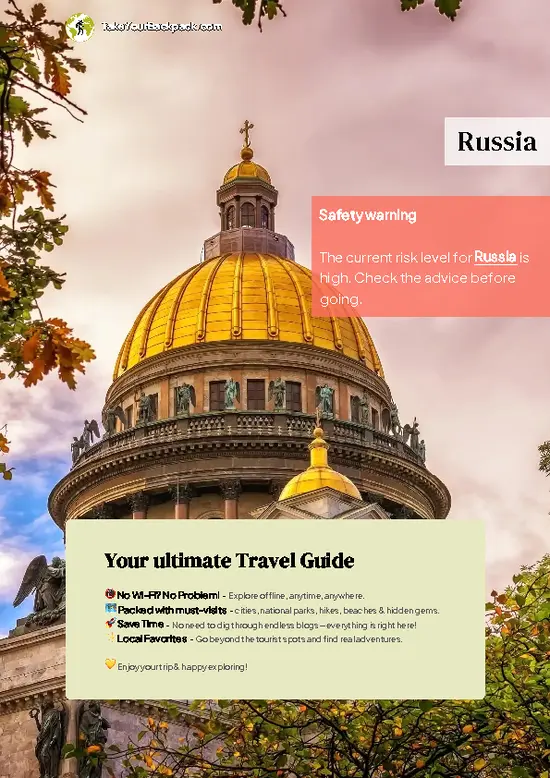
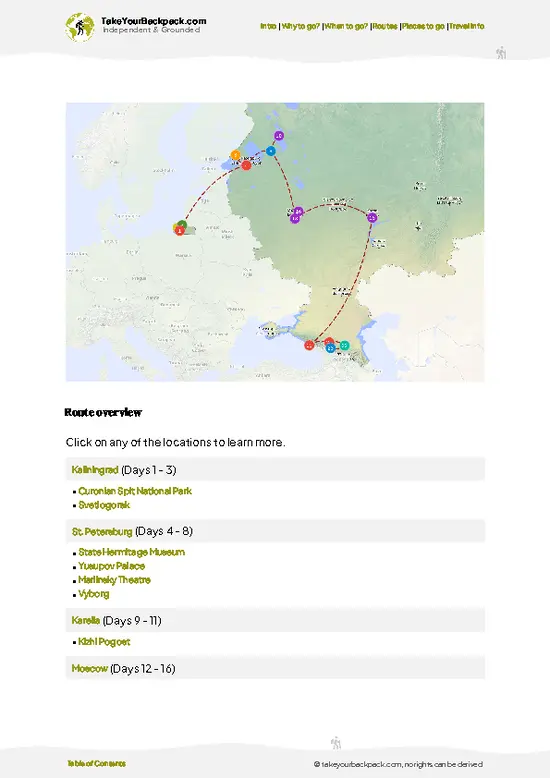
example page 0 from our offline Travel Guide for Russia
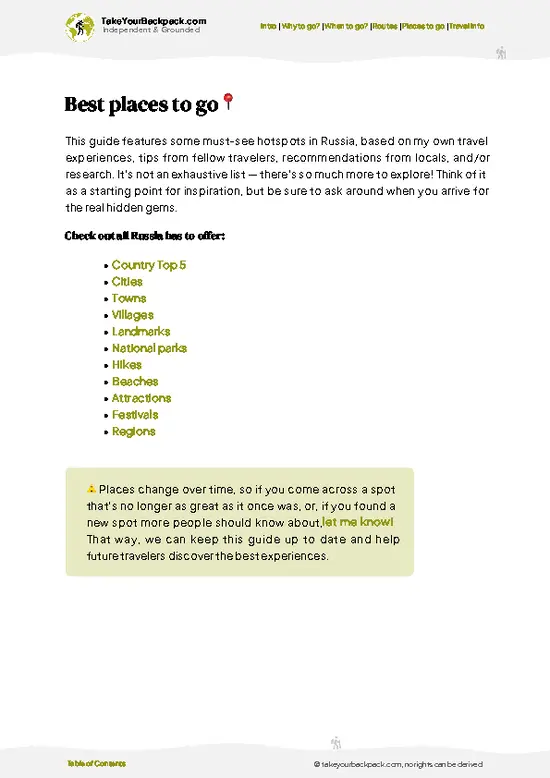
example page 1 from our offline Travel Guide for Russia
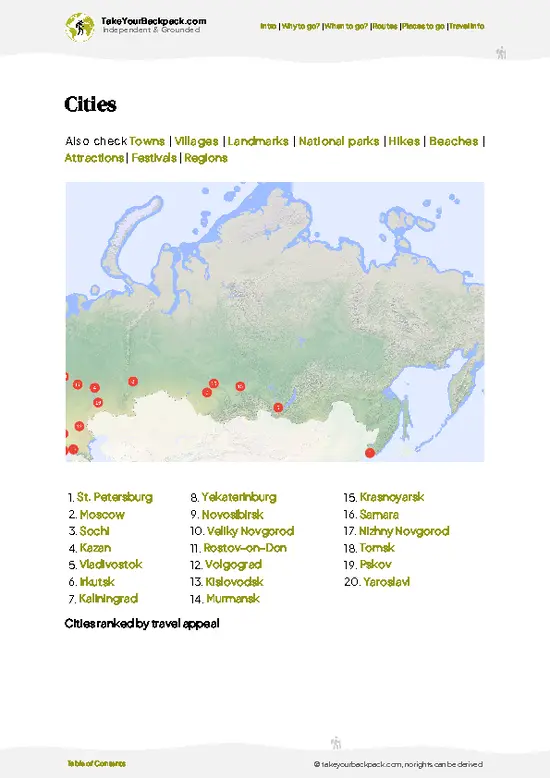
example page 2 from our offline Travel Guide for Russia
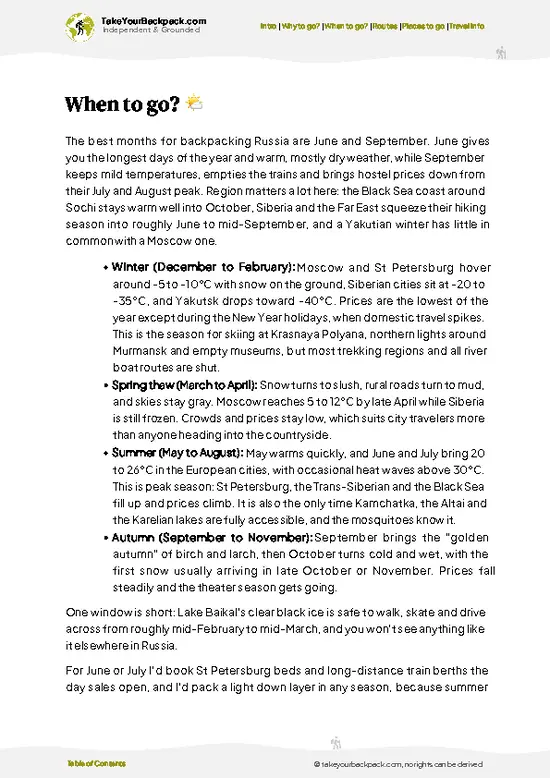
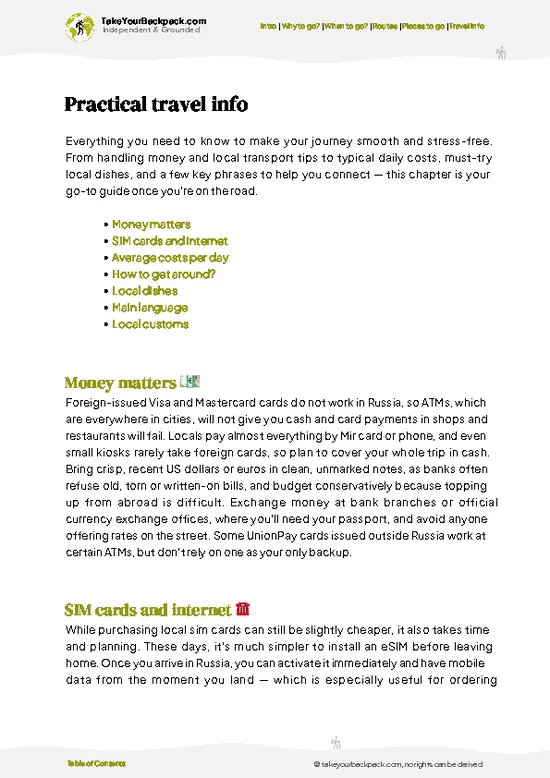
example page 3 from our offline Travel Guide for Russia
example page 4 from our offline Travel Guide for Russia
example page 5 from our offline Travel Guide for Russia
example page 6 from our offline Travel Guide for Russia
example page 7 from our offline Travel Guide for Russia
The digital guide (392 pages) contains:
✅ 104 highlights, ranked by travel appeal
✅ Optimized 14, 21 & 30-day travel routes
✅ Cities, national parks, landmarks, beaches
✅ How to get around
✅ Offline-friendly for travel without Wi-Fi
👉 Click to see all 30+ guide features

📅 Plan smarter in minutes, not weeks
✅ Month by month travel advice
✅ Festivals & national holidays
✅ Budget expectations

🗺️ Go to the right places, skip the overrated ones
✅ Honest pros & cons of destinations
✅ Top hikes, parks & viewpoints
✅ Lesser-known places most travelers miss
✅ Clear “worth it vs skip it” guidance

🛏️ Travel smoothly without rookie mistakes
✅ Best areas to stay
✅ Transport systems explained simply
✅ Common scams & safety advice
✅ SIM cards, money & practical tips

🌍 Understand the country, not just visit it
✅ Culture & traditions
✅ 52 Essential phrases & customs
✅ Festivals worth planning around
✅ Traveler-friendly historical context
✅ Insights that make places more meaningful

📱 Built for real travel conditions
✅ Fully downloadable PDF
✅ Works completely offline
✅ Optimized for phone use
✅ Useful in remote areas & buses
✅ Everything in one place
Stop searching, start planning
Get instant access to your full guide. 30‑day money-back guarantee.
+ Add another guide for just

By proceeding you agree to our terms.
Sent to your inbox immediately after payment • 100% Secure Checkout
Best Backpacking Travel Advisor 2025 tourism awardBest Backpacking
Travel Advisor
2025
What others say about Take Your Backpack Guides:
⭐⭐⭐⭐⭐
Fantastic, amazing amount of information!
⭐⭐⭐⭐⭐
My goodness this is amazing, it's what I've been looking for hats off too you!
⭐⭐⭐⭐⭐
I think this is absolutely BRILLIANT
⭐⭐⭐⭐
Very complete and informative. It's still missing places, but I gotta to commend you
⭐⭐⭐⭐⭐
This is truly amazing, thank you, can't wait to explore it with my kids!
⭐⭐⭐⭐⭐
Awesome resource, thank you!
⭐⭐⭐⭐⭐
This is amazing! Can't wait to explore the ones I haven't seen
⭐⭐⭐⭐
I love this! Well done, great idea.
⭐⭐⭐⭐⭐
Thanks for taking the time to make this gem!
⭐⭐⭐⭐⭐
This might be the best website I've ever seen.
⭐⭐⭐⭐⭐
Congratulations, and thank you so much for your work; it's incredibly valuable.
⭐⭐⭐⭐
In all seriousness I think you did a great job pointing out the important spots
⭐⭐⭐⭐⭐
10/10 very good
⭐⭐⭐⭐⭐
As someone who's only just starting to visit regularly this is awesome, thank you.
⭐⭐⭐⭐
Thank you very much! I'm going to visit my dad, it's going to be very useful!
⭐⭐⭐⭐⭐
This is really cool! We'll be travelling for the first time and this definitely come in handy.
⭐⭐⭐⭐⭐
You are now our minister of culture, congratulations 👨‍💼
⭐⭐⭐⭐⭐
Just wanted to tell you that this is a pearl! Going to follow your recommendations.
⭐⭐⭐⭐⭐
This is so cool. I'll definitely be using the resource for my travels soon.
⭐⭐⭐⭐⭐
This is very impressive! Good work.
⭐⭐⭐⭐⭐
This is an amazing and informative site. Very well done!

🛏️ Where to stay?Top Areas to Stay

Russia has plenty of hostels and budget guesthouses, with dorm beds typically running 800 to 2,000 rubles (US$9 to 22) a night, and most licensed hostels will handle the migration registration foreigners need. In Moscow, Kitay-gorod puts you a short walk from Red Square and among the densest cluster of bars, though the side streets get loud on weekends, while Arbat and Tverskoy are pricier but central and easy to walk at night. In St. Petersburg, the streets around Nevsky Prospekt give you the most beds, museums and late-night bars on your doorstep (with traffic noise as the price), and Vasilyevsky Island is calmer and cheaper but one metro hop from the center.

If you enjoy meeting fellow travelers, … read more 👉
Russia has plenty of hostels and budget guesthouses, with dorm beds typically running 800 to 2,000 rubles (US$9 to 22) a night, and most licensed hostels will handle the migration registration foreigners need. In Moscow, Kitay-gorod puts you a short walk from Red Square and among the densest cluster of bars, though the side streets get loud on weekends, while Arbat and Tverskoy are pricier but central and easy to walk at night. In St. Petersburg, the streets around Nevsky Prospekt give you the most beds, museums and late-night bars on your doorstep (with traffic noise as the price), and Vasilyevsky Island is calmer and cheaper but one metro hop from the center.

If you enjoy meeting fellow travelers, consider choosing hostels with high ratings for atmosphere. On the other hand, if you prefer having your own space, a hotel might be a better option.

RussiaDiscover the Country

👋 Meet the founderWho’s Behind Take Your Backpack?

Johan, backpacker and founder of TakeYourBackpackHi, I’m Johan (Netherlands 🇳🇱), the creator of TakeYourBackpack. Over the past 3 decades, I’ve backpacked through 90+ countries across six continents, gaining extensive experience with independent travel, long-term trips, and overland routes.

This site is built on a combination of firsthand travel experience and carefully curated insights from other backpackers. Many guides are based on places I’ve personally visited, while others bring together tips, observations, and practical advice shared by trusted travelers I’ve met along the way.

The goal is to provide realistic, experience-driven guidance — not generic itineraries — so you can explore destinations with better context, clearer expectations, and more confidence.