×

Samoa🇼🇸 | best regionsYour Guide to the 3 Best regions in Samoa

Samoa’s regions split along one sea passage. Upolu brings the airport, Apia’s diesel-and-frying-oil streets, and open-fale beach stays under coconut palms. Savai’i is bigger, quieter, and rougher, with black lava coasts, roosters at dawn, and long waits between buses. For independent travel or backpacking, the choice sets your costs, your pace, and how often you share a village road with anyone but locals.

By Johan Kruseman 🇳🇱 | Updated October 18, 2026
Explore the best towns in Samoa

Why go?Understanding Their Importance

Samoa suits regional travel because fa’a Samoa, the traditional way of life, still runs village life. Nearly all land is held under customary ownership, so beaches, pools and trails sit inside villages, and you pay small entry fees at the fale or the gate, often US$3 to 10 (about WST 8 to 28). Mornings smell of woodsmoke and umu ovens, and Sundays go quiet for church, with singing drifting across lawns. The country is small, volcanic and tropical, so humidity, sudden downpours and unpaved side roads are part of every outing. Public transport means colorful local buses with no fixed timetable, running mostly in the morning. Choose Samoa for slow, village-based travel rather than nightlife or big sights, and plan around Sunday closures and modest dress.
Behind the Scenes of Selection
The list of best regions in Samoa is created based on landscapes, local culture, attractions, vibes, and overall appeal. If you feel a region is missing in this list, please let us know.

When to go?When to Plan Your Trip

Best months and weather: The best months are May to October, the dry season, when days sit around 27 to 30°C, humidity eases, and roads dry out enough for lava coasts and waterfall tracks. Rain still comes in short, warm bursts. Shoulder and wet season: November to April is hot and sticky, 28 to 32°C, with heavy rain (monthly totals often over 300 mm) and a cyclone risk, mostly December to March. Wet-season tracks turn to red mud, and swimming holes can run brown. Savai’i’s dirt roads suffer most. Crowds and prices: July to August and the Christmas weeks are busiest, and beach fale fill up, so book ahead. Rates stay broadly similar across the year, with some resorts discounting in the wet season. September is a calm choice, with fewer visitors and settled weather.

region hoppingSuggested Travel Strategies

How many days to allow: A trip that combines several regions in Samoa needs 7 to 10 days. Start on Upolu, where the airport and Apia’s market and bus station give you a base for supplies and cash. Do the main island first, then cross to the neighboring island, so you finish with the slower, quieter stretch. Allow 3 to 4 nights per major stop, and 2 at minimum. The ferry from Mulifanua wharf to Salelologa takes about 60 to 90 minutes, and buses add 1 to 3 hours either side. Planning mistakes: Travelers pack in too many stops, forgetting that buses thin out by early afternoon and slow on Sundays. Cut stops, travel in the morning, and keep a buffer day. Ferry schedules shift with weather, so avoid tight flight connections right after a crossing. Carry cash, since village stays and bus fares rarely take cards.

The ListHighly Recommended regions of Samoa

1 Savai’i

Lava fields, blowholes, canopy walk, long distances, beach fales

Drive past black lava crust and spouting blowholes, swim in forest pools, and cross a banyan canopy bridge on the country’s largest, quietest island.

2 Upolu

Sea trenches, white-sand lagoons, Apia markets, waterfall pools

Climb down a ladder into a turquoise lava-tube pool, sleep in open beach fales by the lagoon, and spend mornings in Apia’s markets.

3 Apolima Strait

Crater island, car-free Manono, reef-gap landings, whale channel

Cross the channel by village boat to a crater hamlet behind a cliff gap, then walk Manono’s flat, vehicle-free circuit past churches and graves.

Loading the map 🌍

Expert viewWhat You Should Know

How many regions to visit: I advise two regions for a trip of 7 to 10 days. Roads are single-lane and winding, buses stop for every roadside chat, and a third base eats days in transit rather than in the water. Two gives you time to sit through an afternoon downpour on a fale mat and still hit the reef at low tide.Choosing between kinds of regions: If you want easy logistics, food variety and snorkeling day trips, pick the more developed, accessible area. If you want quiet, lava coasts, blowholes and village life with little traffic, pick the remote, bigger island. Mix both if you have a week or more. Either way, you get slow mornings, the smell of fresh coconut cream cooking, and evenings with no engine noise.What it costs: Budget US$40 to 70 a day on a backpacker budget, covering a beach … read more 👉
How many regions to visit: I advise two regions for a trip of 7 to 10 days. Roads are single-lane and winding, buses stop for every roadside chat, and a third base eats days in transit rather than in the water. Two gives you time to sit through an afternoon downpour on a fale mat and still hit the reef at low tide.Choosing between kinds of regions: If you want easy logistics, food variety and snorkeling day trips, pick the more developed, accessible area. If you want quiet, lava coasts, blowholes and village life with little traffic, pick the remote, bigger island. Mix both if you have a week or more. Either way, you get slow mornings, the smell of fresh coconut cream cooking, and evenings with no engine noise.What it costs: Budget US$40 to 70 a day on a backpacker budget, covering a beach fale with meals (often US$25 to 50 per person), buses at roughly US$0.50 to 3 per ride, and small village fees of US$3 to 10 per site. Guided hikes or snorkel trips run about US$20 to 60. Rental cars cost around US$60 to 100 a day, worth it only for sharing and for reaching remote coasts. Over a visit of 7 to 10 days, expect US$350 to 700 beyond flights.Safety and culture: Samoa is generally safe, but Sunday is for church and family, so keep noise low and expect shops and some stays to run on reduced service. Cover your shoulders and knees in villages, and wear a lavalava. Ask the village before swimming or camping, and never walk on a beach or a pool without permission. Dogs roam, and reefs have strong currents through channels, so check tides with a local before snorkeling. Rain can flood river crossings quickly. Respect gets you invited to a family meal and an easy welcome.

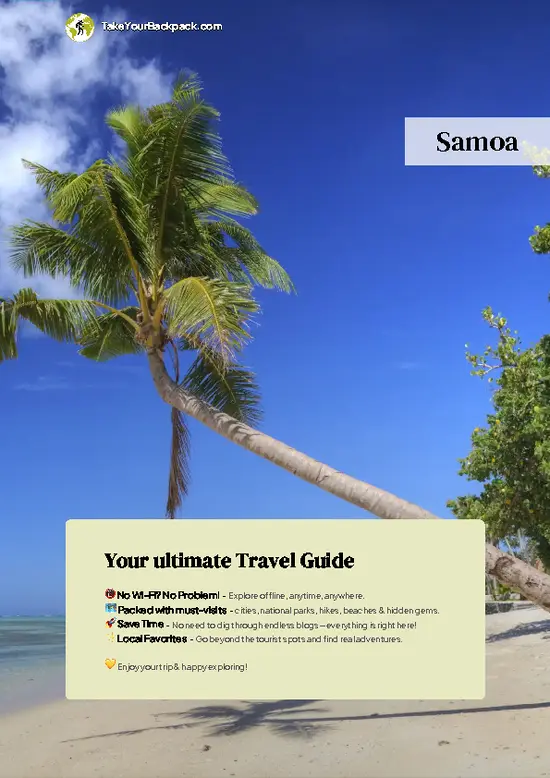
✈️ The backpacker research shortcutSamoa Travel Guide

An offline-friendly backpacking guide with optimized travel routes, ranked highlights, transport advice, and the best areas to stay.
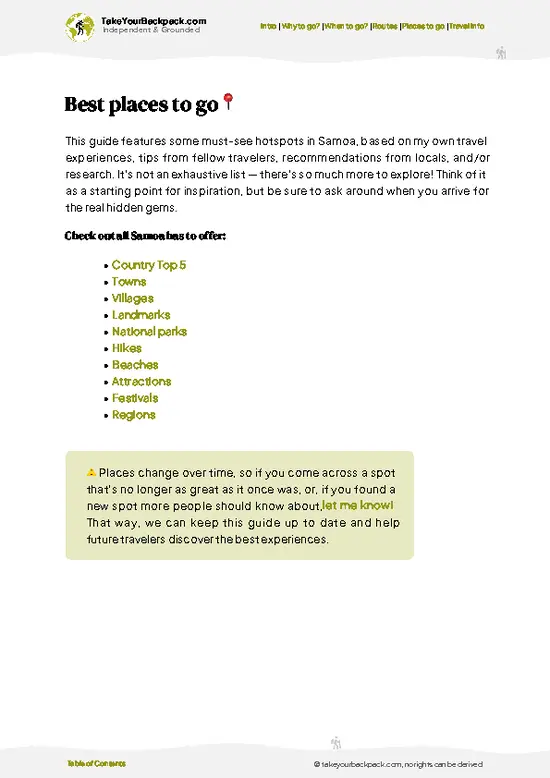
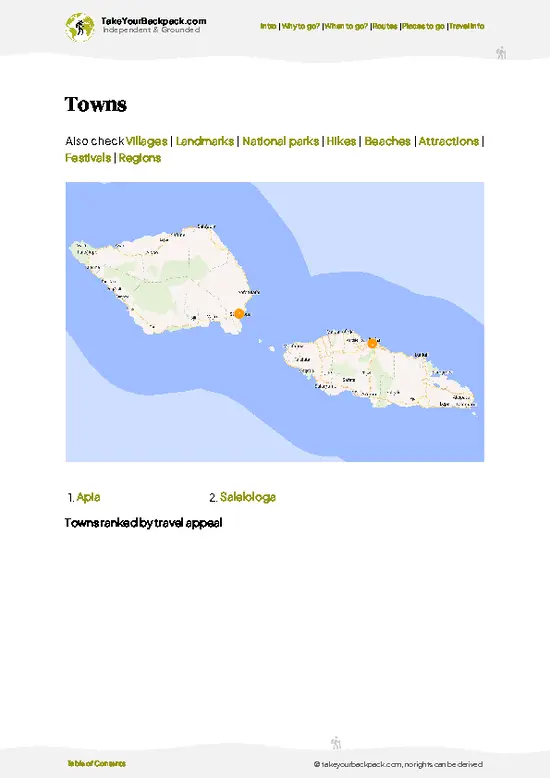
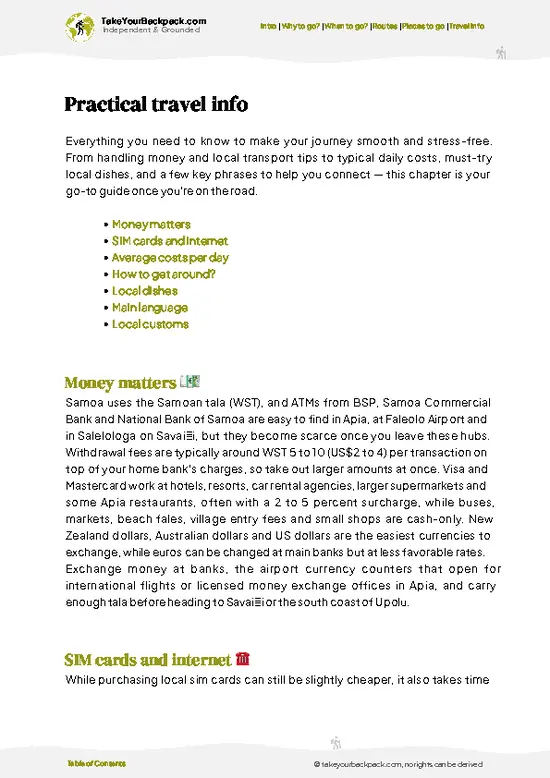
example page 0 from our offline Travel Guide for Samoa
example page 1 from our offline Travel Guide for Samoa
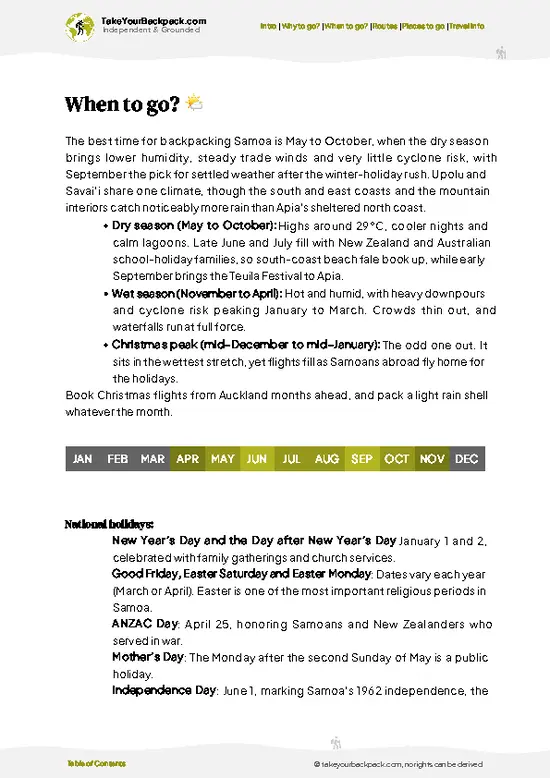
example page 2 from our offline Travel Guide for Samoa
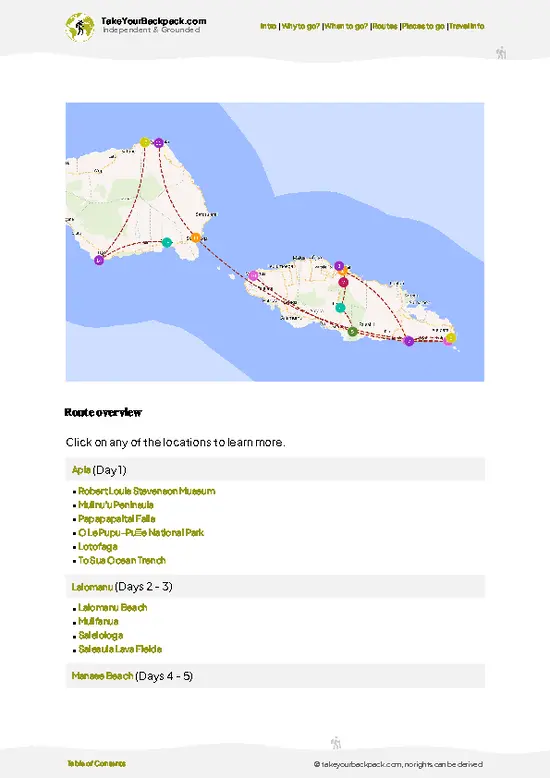
example page 3 from our offline Travel Guide for Samoa
example page 4 from our offline Travel Guide for Samoa
example page 5 from our offline Travel Guide for Samoa
example page 6 from our offline Travel Guide for Samoa
example page 7 from our offline Travel Guide for Samoa
The digital guide (138 pages) contains:
✅ 37 highlights, ranked by travel appeal
✅ Optimized 2, 3 & 5-day travel routes
✅ Cities, national parks, landmarks, beaches
✅ How to get around
✅ Offline-friendly for travel without Wi-Fi
👉 Click to see all 30+ guide features

📅 Plan smarter in minutes, not weeks
✅ Month by month travel advice
✅ Festivals & national holidays
✅ Budget expectations

🗺️ Go to the right places, skip the overrated ones
✅ Honest pros & cons of destinations
✅ Top hikes, parks & viewpoints
✅ Lesser-known places most travelers miss
✅ Clear “worth it vs skip it” guidance

🛏️ Travel smoothly without rookie mistakes
✅ Best areas to stay
✅ Transport systems explained simply
✅ Common scams & safety advice
✅ SIM cards, money & practical tips

🌍 Understand the country, not just visit it
✅ Culture & traditions
✅ 52 Essential phrases & customs
✅ Festivals worth planning around
✅ Traveler-friendly historical context
✅ Insights that make places more meaningful

📱 Built for real travel conditions
✅ Fully downloadable PDF
✅ Works completely offline
✅ Optimized for phone use
✅ Useful in remote areas & buses
✅ Everything in one place
Stop searching, start planning
Get instant access to your full guide. 30‑day money-back guarantee.
+ Add another guide for just

By proceeding you agree to our terms.
Sent to your inbox immediately after payment • 100% Secure Checkout
Best Backpacking Travel Advisor 2025 tourism awardBest Backpacking
Travel Advisor
2025
What others say about Take Your Backpack Guides:
⭐⭐⭐⭐⭐
Fantastic, amazing amount of information!
⭐⭐⭐⭐⭐
My goodness this is amazing, it's what I've been looking for hats off too you!
⭐⭐⭐⭐⭐
I think this is absolutely BRILLIANT
⭐⭐⭐⭐
Very complete and informative. It's still missing places, but I gotta to commend you
⭐⭐⭐⭐⭐
This is truly amazing, thank you, can't wait to explore it with my kids!
⭐⭐⭐⭐⭐
Awesome resource, thank you!
⭐⭐⭐⭐⭐
This is amazing! Can't wait to explore the ones I haven't seen
⭐⭐⭐⭐
I love this! Well done, great idea.
⭐⭐⭐⭐⭐
Thanks for taking the time to make this gem!
⭐⭐⭐⭐⭐
This might be the best website I've ever seen.
⭐⭐⭐⭐⭐
Congratulations, and thank you so much for your work; it's incredibly valuable.
⭐⭐⭐⭐
In all seriousness I think you did a great job pointing out the important spots
⭐⭐⭐⭐⭐
10/10 very good
⭐⭐⭐⭐⭐
As someone who's only just starting to visit regularly this is awesome, thank you.
⭐⭐⭐⭐
Thank you very much! I'm going to visit my dad, it's going to be very useful!
⭐⭐⭐⭐⭐
This is really cool! We'll be travelling for the first time and this definitely come in handy.
⭐⭐⭐⭐⭐
You are now our minister of culture, congratulations 👨‍💼
⭐⭐⭐⭐⭐
Just wanted to tell you that this is a pearl! Going to follow your recommendations.
⭐⭐⭐⭐⭐
This is so cool. I'll definitely be using the resource for my travels soon.
⭐⭐⭐⭐⭐
This is very impressive! Good work.
⭐⭐⭐⭐⭐
This is an amazing and informative site. Very well done!

🛏️ Where to stay?Where to Stay: Samoa Edition

Samoa has only a handful of true dorm hostels, but budget beds are easy to find: open-sided beach “fale” huts run by local families typically cost WST 80 to 150 (about US$30 to 55) per person a night, usually with breakfast and dinner included, alongside simple guesthouses from roughly WST 120 to 200 a room. Apia has the widest choice of guesthouses, plus the country’s only real nightlife, ATMs and bus terminal, though it is hot and traffic-noisy and has no swimmable beach of its own. For beach fales, Lalomanu on Upolu’s southeast coast and Manase on Savai’i’s north shore have the most options and are safe, quiet and right on the sand, but evenings end by about 10 pm, meals are limited to what … read more 👉
Samoa has only a handful of true dorm hostels, but budget beds are easy to find: open-sided beach “fale” huts run by local families typically cost WST 80 to 150 (about US$30 to 55) per person a night, usually with breakfast and dinner included, alongside simple guesthouses from roughly WST 120 to 200 a room. Apia has the widest choice of guesthouses, plus the country’s only real nightlife, ATMs and bus terminal, though it is hot and traffic-noisy and has no swimmable beach of its own. For beach fales, Lalomanu on Upolu’s southeast coast and Manase on Savai’i’s north shore have the most options and are safe, quiet and right on the sand, but evenings end by about 10 pm, meals are limited to what your host serves and getting anywhere means an infrequent bus or a hired car.

If you enjoy meeting fellow travelers, consider choosing hostels with high ratings for atmosphere. On the other hand, if you prefer having your own space, a hotel might be a better option.

SamoaExplore Beyond This Category

👋 Meet the founderWho’s Behind Take Your Backpack?

Johan, backpacker and founder of TakeYourBackpackHi, I’m Johan (Netherlands 🇳🇱), the creator of TakeYourBackpack. Over the past 3 decades, I’ve backpacked through 90+ countries across six continents, gaining extensive experience with independent travel, long-term trips, and overland routes.

This site is built on a combination of firsthand travel experience and carefully curated insights from other backpackers. Many guides are based on places I’ve personally visited, while others bring together tips, observations, and practical advice shared by trusted travelers I’ve met along the way.

The goal is to provide realistic, experience-driven guidance — not generic itineraries — so you can explore destinations with better context, clearer expectations, and more confidence.