×

Saudi Arabia🇸🇦 | best national parksThe Must-See 9 national parks in Saudi Arabia

National parks in Saudi Arabia are a young category. Most are protected areas and reserves declared or expanded since the late 2010s, and they are still being developed for visitors. The experience splits by region: the Asir highlands in the southwest are cool, green and reached by paved roads, while the northwest and the interior deserts are remote, dry and sparsely signed. Costs run higher than in neighboring countries, and access often depends on a rental car or an arranged tour. Independent travel is possible, but it takes planning, and crowds stay thin outside weekends and holidays.

By Johan Kruseman 🇳🇱 | Updated October 19, 2026
Explore the best hikes in Saudi Arabia

Why go?Why These national park Stand Out

Saudi Arabia covers most of the Arabian Peninsula, and that scale shapes its protected land. The country holds escarpments, lava fields, coral coasts, sand seas and a mountain range that catches monsoon-edge rain, so a single country offers habitats that elsewhere need several borders. Very low population density in the interior has kept large areas undeveloped, and the long human history of caravan routes and oasis settlement means many landscapes carry archaeological and cultural layers alongside the ecology.

The system is also new. Conservation was reorganized under national authorities in recent years, with reintroduction programs for species such as Arabian oryx and gazelles, and visitor facilities are still being built. Expect patchy infrastructure: well-managed entrances in some places, … read more 👉
Saudi Arabia covers most of the Arabian Peninsula, and that scale shapes its protected land. The country holds escarpments, lava fields, coral coasts, sand seas and a mountain range that catches monsoon-edge rain, so a single country offers habitats that elsewhere need several borders. Very low population density in the interior has kept large areas undeveloped, and the long human history of caravan routes and oasis settlement means many landscapes carry archaeological and cultural layers alongside the ecology.

The system is also new. Conservation was reorganized under national authorities in recent years, with reintroduction programs for species such as Arabian oryx and gazelles, and visitor facilities are still being built. Expect patchy infrastructure: well-managed entrances in some places, unmarked tracks in others, and limited public transport to almost any park.

Before choosing Saudi Arabia for this purpose, know that heat, distance and permits decide most trips. Summer temperatures in the lowlands make hiking dangerous. Some areas require advance booking or registration through official platforms, and a few need a licensed guide or a 4x4. Visitors need an e-visa, and dress and conduct follow local norms, which are more conservative in rural areas. Mobile coverage fades quickly off the main highways. Treat these parks as destinations that reward preparation rather than spontaneous drop-ins.
Behind the Scenes of Selection
The list of best national parks in Saudi Arabia is created based on landscapes, wildlife, adventure opportunities, facilities, and overall experience. If you feel a national park is missing in this list, please let us know.

When to go?Timing Your Visit for the Best Experience

Best months by region: The best months for national parks in Saudi Arabia are November to March, when daytime highs across most of the country fall to roughly 15 to 28°C and hiking is practical. In the interior and northwest, nights can drop to near freezing in December and January, and some desert areas see frost.

Shoulder seasons: October and April work for most regions, with daytime highs of 28 to 36°C in the lowlands and cooler air at elevation. The southwestern Asir highlands are different: they stay mild even in summer, with highs around 20 to 30°C, and receive their heaviest rain from July to September and again in spring. Afternoon storms can flood wadis and close tracks.

Summer and peak periods: From June to September, lowland and desert highs regularly pass 40°C and can reach 45 … read more 👉
Best months by region: The best months for national parks in Saudi Arabia are November to March, when daytime highs across most of the country fall to roughly 15 to 28°C and hiking is practical. In the interior and northwest, nights can drop to near freezing in December and January, and some desert areas see frost.

Shoulder seasons: October and April work for most regions, with daytime highs of 28 to 36°C in the lowlands and cooler air at elevation. The southwestern Asir highlands are different: they stay mild even in summer, with highs around 20 to 30°C, and receive their heaviest rain from July to September and again in spring. Afternoon storms can flood wadis and close tracks.

Summer and peak periods: From June to September, lowland and desert highs regularly pass 40°C and can reach 45 to 50°C along the Red Sea coast and in the interior. Long walks become a safety risk, and most visitors limit activity to early morning. Coastal humidity is high.

Crowds peak on Friday and Saturday weekends, in winter, and during national holidays, when Saudi families camp in the more accessible areas. Weekday visits are quieter. Accommodation and tour prices near popular parks can rise 20 to 50 percent in the winter high season, so book ahead for December to February. Rainfall elsewhere is low, generally under 100 mm a year in the desert.

national park hoppingHow to Combine national parks Into One Trip

How long a multi-park trip takes: A trip combining several national parks in Saudi Arabia needs 10 to 14 days, because distances are large and roads between regions are long. Trying to cover the country in under a week means spending most of it in a car.

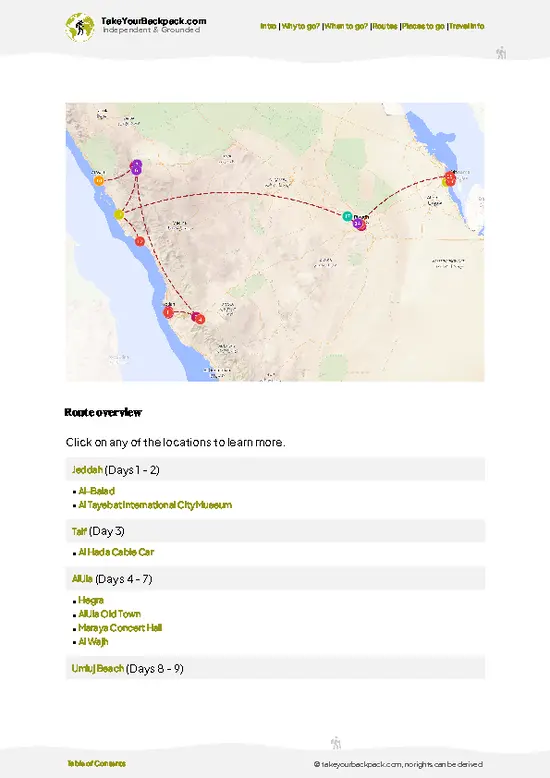
Which regions group together: Three clusters work. The northwest around AlUla and Tabuk, the southwest around Abha and the Asir mountains, and the Riyadh area with its central desert escarpments. Pairing the northwest with Riyadh, or the southwest with the Red Sea coast, is realistic. Linking all three is possible only with domestic flights. A common direction is to fly into Riyadh, work toward the northwest or southwest, and fly out from Jeddah or Madinah, which avoids backtracking.

Time per stop and between regions: Allow 2 to 3 days per … read more 👉
How long a multi-park trip takes: A trip combining several national parks in Saudi Arabia needs 10 to 14 days, because distances are large and roads between regions are long. Trying to cover the country in under a week means spending most of it in a car.

Which regions group together: Three clusters work. The northwest around AlUla and Tabuk, the southwest around Abha and the Asir mountains, and the Riyadh area with its central desert escarpments. Pairing the northwest with Riyadh, or the southwest with the Red Sea coast, is realistic. Linking all three is possible only with domestic flights. A common direction is to fly into Riyadh, work toward the northwest or southwest, and fly out from Jeddah or Madinah, which avoids backtracking.

Time per stop and between regions: Allow 2 to 3 days per park to cover access roads, a hike or drive inside the area and a rest period. Driving Riyadh to AlUla takes about 10 to 11 hours, and Abha to Jeddah around 8 to 9 hours. Domestic flights between hubs usually take 1.5 to 2 hours.

Common planning mistakes: Travelers often underestimate drive times and plan long transfers on arrival days. Build in buffer time and fly the longest legs. Another error is ignoring daylight, since tracks are unlit and fuel stops can be 100 km or more apart, so start early and refuel often. Finally, travelers book unlinked stops without checking permits, so confirm entry requirements before fixing dates.

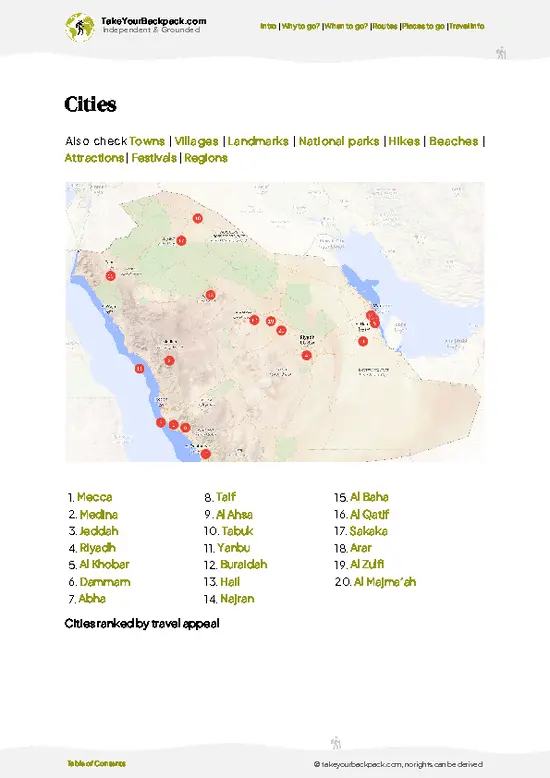
The ListTop national parks of Saudi Arabia

1 Asir National Park

terraced hillsides, rural villages, endemic flora

Hike through cultivated slopes and remote valleys, encountering rare plants and traditional settlements scattered across rugged terrain.

2 Farasan Islands

coral reefs, mangrove lagoons, migratory birds

Snorkel among vibrant reefs and paddle through mangroves while spotting seasonal birdlife in this Red Sea archipelago.

saudi-arabia-national-park-farasan-islands
© Google |

3 Wadi Al Disah

towering sandstone cliffs, palm groves, freshwater streams

Follow a lush canyon floor beneath sheer rock faces, where springs feed green oases and date palms line the water’s edge.

saudi-arabia-national-park-wadi-al-disah
© Google |

4 Al Soudah Park

misty juniper forests, mountain viewpoints, cool highlands

Ascend winding roads to experience crisp air, shaded trails, and panoramic overlooks unique to the highest peaks of Saudi Arabia.

saudi-arabia-national-park-al-soudah-park
© Google |

5 Raydah Escarpment Reserve

steep cliffs, cloud forest, rare bird species

Descend dramatic escarpments into cool, misty woodlands where elusive wildlife and endemic birds thrive in sheltered habitats.

6 Al Kharrarah National Park

red sand dunes, seasonal lake, picnic areas

Visit after rare rains to see a temporary lake form among rolling dunes, drawing families and wildlife to this accessible desert park.

7 Mahazat as-Sayd Protected Area

fenced reserve, Arabian oryx, desert plains

Observe reintroduced wildlife roaming open sands and acacia groves in a strictly managed sanctuary closed to casual entry.

8 Al Khunfah Wildlife Sanctuary

open steppe, gazelle herds, arid plateau

Travel across wide, grassy plains and rocky outcrops, watching for native antelope and desert-adapted species in a protected setting.

9 Harrat Khaybar

lava fields, volcanic cones, ancient stone structures

Traverse stark black basalt flows and climb extinct volcanoes, discovering mysterious archaeological sites scattered across the landscape.

saudi-arabia-national-park-harrat-khaybar
© Google |
Loading the map 🌍

Expert viewInsights from Locals and Experts

How many parks to visit: Plan for three to four parks on a trip of up to two weeks. Each needs a half day of driving to reach and a full day on site, and access roads are slow. Add more and the trip turns into transit, because public transport to protected areas is minimal and every extra stop means long hours behind a wheel or a guide’s vehicle. Fewer than three wastes the flight and visa cost.

Choosing between kinds of parks: Pick by travel style. Hikers and people on a tight budget do best in the Asir highlands, where marked trails, cooler air and cheaper local food make independent days simple. Travelers who want desert, rock formations or heritage landscapes should look to the northwest and interior, where distances are greater and a 4x4 or guide is often the practical choice. Coastal … read more 👉
How many parks to visit: Plan for three to four parks on a trip of up to two weeks. Each needs a half day of driving to reach and a full day on site, and access roads are slow. Add more and the trip turns into transit, because public transport to protected areas is minimal and every extra stop means long hours behind a wheel or a guide’s vehicle. Fewer than three wastes the flight and visa cost.

Choosing between kinds of parks: Pick by travel style. Hikers and people on a tight budget do best in the Asir highlands, where marked trails, cooler air and cheaper local food make independent days simple. Travelers who want desert, rock formations or heritage landscapes should look to the northwest and interior, where distances are greater and a 4x4 or guide is often the practical choice. Coastal and marine areas suit divers and snorkelers, but usually need booked boats or operators. Public transport reaches only the edges of a few areas, which is why experienced travelers rent a car for the whole trip and split its cost.

What it costs: Expect US$70 to 130 a day (about SAR 260 to 490) for an independent traveler using budget hotels, a shared rental car and self-catered or local meals. Basic campsites and guesthouses cost less, roughly US$25 to 60 a night, but options thin out near remote parks. Entry fees, where charged, usually run about SAR 10 to 100 (US$3 to 27) per person. Licensed guides or 4x4 tours cost roughly US$130 to 400 per day for a vehicle, which is cheaper per head when split among four. Fuel is inexpensive by international standards, about SAR 2 to 3 per liter, so the car is rarely the main expense.

Safety and conduct: Heat and dehydration are the main risks. Carry at least 4 liters of water per person for a day outing, more in summer, and avoid hiking between 10 a.m. and 4 p.m. when it is hot. Flash floods in wadis can follow rain far upstream, so avoid camping in dry riverbeds. Tell someone your plan and carry an offline map, since signal fails off main roads. Camel and wildlife encounters on roads are common at night, so drive in daylight where possible.

Cultural norms matter in rural areas. Dress modestly with covered shoulders and knees, and women travelers are not required to wear an abaya but should dress conservatively. Ask before photographing people, take your waste out, and respect protected-area rules on fires, drones and off-road driving. Check official platforms for permits and current closures before each visit.

✈️ The backpacker research shortcutSaudi Arabia Travel Guide

An offline-friendly backpacking guide with optimized travel routes, ranked highlights, transport advice, and the best areas to stay.
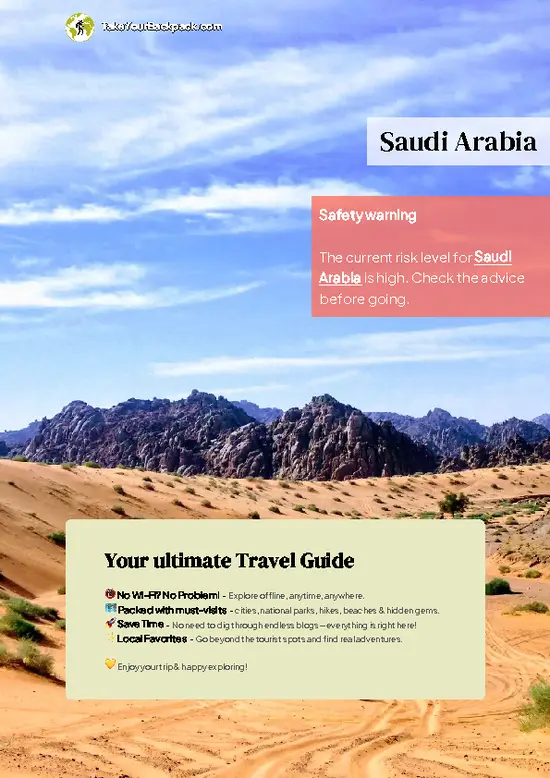
example page 0 from our offline Travel Guide for Saudi Arabia
example page 1 from our offline Travel Guide for Saudi Arabia
example page 2 from our offline Travel Guide for Saudi Arabia
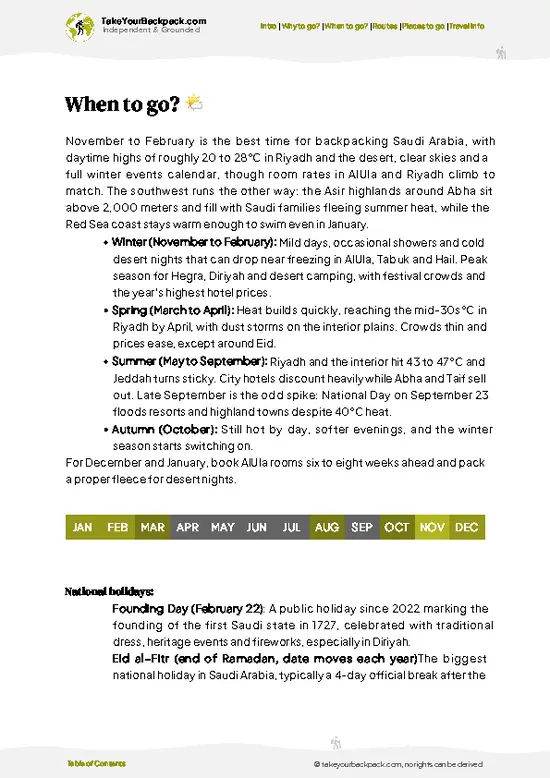
example page 3 from our offline Travel Guide for Saudi Arabia
example page 4 from our offline Travel Guide for Saudi Arabia
example page 5 from our offline Travel Guide for Saudi Arabia
example page 6 from our offline Travel Guide for Saudi Arabia
example page 7 from our offline Travel Guide for Saudi Arabia
The digital guide (322 pages) contains:
✅ 86 highlights, ranked by travel appeal
✅ Optimized 5, 10 & 15-day travel routes
✅ Cities, national parks, landmarks, beaches
✅ How to get around
✅ Offline-friendly for travel without Wi-Fi
👉 Click to see all 30+ guide features

📅 Plan smarter in minutes, not weeks
✅ Month by month travel advice
✅ Festivals & national holidays
✅ Budget expectations

🗺️ Go to the right places, skip the overrated ones
✅ Honest pros & cons of destinations
✅ Top hikes, parks & viewpoints
✅ Lesser-known places most travelers miss
✅ Clear “worth it vs skip it” guidance

🛏️ Travel smoothly without rookie mistakes
✅ Best areas to stay
✅ Transport systems explained simply
✅ Common scams & safety advice
✅ SIM cards, money & practical tips

🌍 Understand the country, not just visit it
✅ Culture & traditions
✅ 52 Essential phrases & customs
✅ Festivals worth planning around
✅ Traveler-friendly historical context
✅ Insights that make places more meaningful

📱 Built for real travel conditions
✅ Fully downloadable PDF
✅ Works completely offline
✅ Optimized for phone use
✅ Useful in remote areas & buses
✅ Everything in one place
Stop searching, start planning
Get instant access to your full guide. 30‑day money-back guarantee.
+ Add another guide for just

By proceeding you agree to our terms.
Sent to your inbox immediately after payment • 100% Secure Checkout
Best Backpacking Travel Advisor 2025 tourism awardBest Backpacking
Travel Advisor
2025
What others say about Take Your Backpack Guides:
⭐⭐⭐⭐⭐
Fantastic, amazing amount of information!
⭐⭐⭐⭐⭐
My goodness this is amazing, it's what I've been looking for hats off too you!
⭐⭐⭐⭐⭐
I think this is absolutely BRILLIANT
⭐⭐⭐⭐
Very complete and informative. It's still missing places, but I gotta to commend you
⭐⭐⭐⭐⭐
This is truly amazing, thank you, can't wait to explore it with my kids!
⭐⭐⭐⭐⭐
Awesome resource, thank you!
⭐⭐⭐⭐⭐
This is amazing! Can't wait to explore the ones I haven't seen
⭐⭐⭐⭐
I love this! Well done, great idea.
⭐⭐⭐⭐⭐
Thanks for taking the time to make this gem!
⭐⭐⭐⭐⭐
This might be the best website I've ever seen.
⭐⭐⭐⭐⭐
Congratulations, and thank you so much for your work; it's incredibly valuable.
⭐⭐⭐⭐
In all seriousness I think you did a great job pointing out the important spots
⭐⭐⭐⭐⭐
10/10 very good
⭐⭐⭐⭐⭐
As someone who's only just starting to visit regularly this is awesome, thank you.
⭐⭐⭐⭐
Thank you very much! I'm going to visit my dad, it's going to be very useful!
⭐⭐⭐⭐⭐
This is really cool! We'll be travelling for the first time and this definitely come in handy.
⭐⭐⭐⭐⭐
You are now our minister of culture, congratulations 👨‍💼
⭐⭐⭐⭐⭐
Just wanted to tell you that this is a pearl! Going to follow your recommendations.
⭐⭐⭐⭐⭐
This is so cool. I'll definitely be using the resource for my travels soon.
⭐⭐⭐⭐⭐
This is very impressive! Good work.
⭐⭐⭐⭐⭐
This is an amazing and informative site. Very well done!

🛏️ Where to stay?Top Areas to Stay

True dorm hostels are rare in Saudi Arabia, so budget travelers mostly book small hotels, furnished apartments or app-listed rooms, typically SAR 150 to 250 (about US$40 to 67) a night in big cities. In Riyadh, Al Batha has the cheapest beds and sits near Masmak Fort and the old souqs, though it is crowded, noisy and rough around the edges, while Al Olaya costs more but is clean, safe, on the Metro and closest to the city’s cafés and late-night dining. In Jeddah, Al Balad puts you inside the historic coral-stone quarter with few modern comforts, and Al Hamra near the Corniche is quieter and greener, with evening seafront walks but longer rides to the old town.

If you enjoy meeting fellow travelers, … read more 👉
True dorm hostels are rare in Saudi Arabia, so budget travelers mostly book small hotels, furnished apartments or app-listed rooms, typically SAR 150 to 250 (about US$40 to 67) a night in big cities. In Riyadh, Al Batha has the cheapest beds and sits near Masmak Fort and the old souqs, though it is crowded, noisy and rough around the edges, while Al Olaya costs more but is clean, safe, on the Metro and closest to the city’s cafés and late-night dining. In Jeddah, Al Balad puts you inside the historic coral-stone quarter with few modern comforts, and Al Hamra near the Corniche is quieter and greener, with evening seafront walks but longer rides to the old town.

If you enjoy meeting fellow travelers, consider choosing hostels with high ratings for atmosphere. On the other hand, if you prefer having your own space, a hotel might be a better option.

Saudi ArabiaDiscover the Country

👋 Meet the founderWho’s Behind Take Your Backpack?

Johan, backpacker and founder of TakeYourBackpackHi, I’m Johan (Netherlands 🇳🇱), the creator of TakeYourBackpack. Over the past 3 decades, I’ve backpacked through 90+ countries across six continents, gaining extensive experience with independent travel, long-term trips, and overland routes.

This site is built on a combination of firsthand travel experience and carefully curated insights from other backpackers. Many guides are based on places I’ve personally visited, while others bring together tips, observations, and practical advice shared by trusted travelers I’ve met along the way.

The goal is to provide realistic, experience-driven guidance — not generic itineraries — so you can explore destinations with better context, clearer expectations, and more confidence.