×

Saudi Arabia🇸🇦 | best landmarksThe Must-See 8 landmarks in Saudi Arabia

Landmarks in Saudi Arabia fall into a few distinct groups: desert rock formations and ancient tombs in the northwest, old mud-brick and coral-stone districts on the Red Sea and in the Najd, and modern towers and developments in Riyadh. Access differs sharply. Riyadh and Jeddah are simple to reach by train, domestic flight or rental car, while the northwest and the southwest highlands need a vehicle or a tour. Entry fees are modest compared with much of the Gulf, though remote sites cost more in transport. Independent travel and backpacking are now workable with the e-visa, and crowds remain thin outside Riyadh and Jeddah.

By Johan Kruseman 🇳🇱 | Updated October 19, 2026
Explore the best national parks in Saudi Arabia

Why go?Why These unique site Stand Out

Saudi Arabia is large, sparsely populated and largely desert, which explains why its landmarks are spread over great distances rather than clustered in a few tourist towns. The country sits on old caravan and incense routes and holds the two holiest cities of Islam, so its heritage reaches from Nabataean and earlier desert civilizations to Ottoman-era and Hejazi architecture. Dry air has preserved rock carvings and stone structures well, and low rainfall means open-air sites remain intact.

Tourism is recent. The tourist e-visa has been available since 2019, and the sector is still developing, so infrastructure is uneven. Major sites have visitor centers, ticketing and paved access, but public transport between regions is limited, and distances of several hundred kilometers between stops are … read more 👉
Saudi Arabia is large, sparsely populated and largely desert, which explains why its landmarks are spread over great distances rather than clustered in a few tourist towns. The country sits on old caravan and incense routes and holds the two holiest cities of Islam, so its heritage reaches from Nabataean and earlier desert civilizations to Ottoman-era and Hejazi architecture. Dry air has preserved rock carvings and stone structures well, and low rainfall means open-air sites remain intact.

Tourism is recent. The tourist e-visa has been available since 2019, and the sector is still developing, so infrastructure is uneven. Major sites have visitor centers, ticketing and paved access, but public transport between regions is limited, and distances of several hundred kilometers between stops are normal. Public transport in cities is improving, yet a rental car or a hired driver still opens up most of the country.

Travelers should also know that Mecca and the central area of Medina are closed to non-Muslims. Dress codes are modest for both men and women, with shoulders and knees covered, and prayer times can close shops and some sites for short periods. Alcohol is banned. For those who accept these terms, the reward is heritage that has seen far fewer visitors than comparable places in Jordan, Egypt or Oman.
Evaluating the Top Choices
The list of best unique sites in Saudi Arabia is created based on history or culture, wow factor, atmosphere, quirks, and memorability. If you feel a unique site is missing in this list, please let us know.

When to go?Timing Your Visit for the Best Experience

Best months and temperatures: The best months for landmarks in Saudi Arabia are November to March, when daytime highs in most regions sit between 15 and 28°C and open-air sites are comfortable to explore. From June to August, temperatures in Riyadh and the Eastern Province regularly pass 42°C, and outdoor visits are realistically limited to early morning.

Regional differences: The northwest, including the high desert around AlUla and Tabuk, is cool in winter, and nights between December and February can drop to around 0 to 8°C, so a warm layer is needed. The Red Sea coast around Jeddah stays humid, with highs of 28 to 32°C even in winter and above 38°C in summer. The southwest highlands near Abha are the exception: altitude keeps summer highs at roughly 25 to 30°C, and the region receives … read more 👉
Best months and temperatures: The best months for landmarks in Saudi Arabia are November to March, when daytime highs in most regions sit between 15 and 28°C and open-air sites are comfortable to explore. From June to August, temperatures in Riyadh and the Eastern Province regularly pass 42°C, and outdoor visits are realistically limited to early morning.

Regional differences: The northwest, including the high desert around AlUla and Tabuk, is cool in winter, and nights between December and February can drop to around 0 to 8°C, so a warm layer is needed. The Red Sea coast around Jeddah stays humid, with highs of 28 to 32°C even in winter and above 38°C in summer. The southwest highlands near Abha are the exception: altitude keeps summer highs at roughly 25 to 30°C, and the region receives its main rain from July to September.

Shoulder seasons, crowds and prices: October and April are shoulder months, warm but workable if you start early. Rain is rare nationwide, with most areas receiving under 100 mm a year, though sudden winter downpours can flood wadis. Peak demand falls in winter, particularly around December and January events in the northwest, when accommodation prices rise and rooms sell out in AlUla. Summer rates drop noticeably. During Ramadan, opening hours shift and many sites open in the evening.

unique site hoppingHow to Combine landmarks Into One Trip

Trip length and regional clusters: A trip combining several landmarks in Saudi Arabia needs 10 to 14 days, because the main areas are separated by long distances and domestic flights. The country divides into four workable clusters: the Najd around Riyadh, the Hejaz with Jeddah and Medina, the northwest around AlUla and Tabuk, and the southwest around Abha. Riyadh and the Najd pair with Jeddah by high-speed rail via Medina or by a flight of about 1.5 hours.

Direction and time per stop: A west-to-north or south-to-north loop works best, flying into Jeddah or Riyadh and leaving from the other. Allow 2 to 3 days for the northwest, 2 to 3 for Riyadh and surroundings, 2 for Jeddah and 2 to 3 for the southwest highlands. The Haramain train links Jeddah and Medina in about 2 hours, but AlUla is … read more 👉
Trip length and regional clusters: A trip combining several landmarks in Saudi Arabia needs 10 to 14 days, because the main areas are separated by long distances and domestic flights. The country divides into four workable clusters: the Najd around Riyadh, the Hejaz with Jeddah and Medina, the northwest around AlUla and Tabuk, and the southwest around Abha. Riyadh and the Najd pair with Jeddah by high-speed rail via Medina or by a flight of about 1.5 hours.

Direction and time per stop: A west-to-north or south-to-north loop works best, flying into Jeddah or Riyadh and leaving from the other. Allow 2 to 3 days for the northwest, 2 to 3 for Riyadh and surroundings, 2 for Jeddah and 2 to 3 for the southwest highlands. The Haramain train links Jeddah and Medina in about 2 hours, but AlUla is roughly 3.5 to 4 hours by road from Medina. Riyadh to Jeddah is about 950 km by road, or 9 to 10 hours.

Planning mistakes: The most common error is underestimating distances and trying to drive between regions in a single day. Fly the long legs and rent a car locally. Another is skipping advance booking: some sites require tickets or timed entry, and fully independent access is not always possible. Scheduling stops at midday in summer also wastes time. Begin before 8 am and keep the afternoon for indoor rest.

The ListTop landmarks of Saudi Arabia

1 Great Mosque of Mecca

sacred sanctuary, Kaaba, vast prayer halls

Join millions of pilgrims in a spiritual center defined by ritual, monumental architecture, and centuries of religious tradition.

Saudi Arabia - the Great Mosque of Mecca

2 AlUla

sandstone canyons, rock art, old town ruins

Experience dramatic desert landscapes dotted with ancient inscriptions and the remains of centuries-old settlements.

saudi-arabia-unique-site-alula
© Google |

3 Hegra

rock-cut tombs, desert necropolis, Nabatean facades

Survey monumental burial sites carved into sandstone cliffs, revealing the artistry and funerary practices of an ancient civilization.

4 Al-Ahsa Oasis

endless date palms, natural springs, mudbrick villages

Wander through a vast green expanse where traditional settlements and water sources sustain one of the world’s largest oases.

5 At-Turaif

mudbrick palaces, defensive walls, UNESCO site

Step into the birthplace of the Saudi state, exploring restored royal complexes and fortified lanes that shaped regional history.

saudi-arabia-unique-site-at-turaif
© Google |

6 Al-Qarah Mountain

sandstone caves, panoramic summit, cool corridors

Navigate a labyrinth of narrow rock passages and climb to viewpoints overlooking the oasis and desert beyond.

7 Ain al-Sukkar

ancient spring, stone channels, palm groves

Trace the flow of water through hand-carved irrigation, surrounded by date palms and remnants of early agricultural ingenuity.

8 Khaybar Oasis

fortified settlements, basalt walls, abandoned dwellings

Examine the remains of once-thriving communities, with defensive architecture and traces of daily life amid volcanic landscapes.

Loading the map 🌍

Expert viewInsights from Locals and Experts

How many landmarks to plan: Plan 6 to 8 landmark stops across a two-week trip. Distances are long, and a visit to a major site usually takes half a day to a full day once transport, ticketing and heat are counted. Fewer, longer stops are better than a checklist, since a drive of three to five hours between sites is routine and tiring.

Prioritizing by travel style: Travelers interested in ancient history and landscape should put the northwest desert sites first, as they are the strongest draw and the most developed for visitors. Those more interested in living culture do better in the old districts of Jeddah and the Najd towns, where entry is often free or low-cost and street life continues around the monuments. Modern architecture in Riyadh suits short stopovers. Skip anything that duplicates … read more 👉
How many landmarks to plan: Plan 6 to 8 landmark stops across a two-week trip. Distances are long, and a visit to a major site usually takes half a day to a full day once transport, ticketing and heat are counted. Fewer, longer stops are better than a checklist, since a drive of three to five hours between sites is routine and tiring.

Prioritizing by travel style: Travelers interested in ancient history and landscape should put the northwest desert sites first, as they are the strongest draw and the most developed for visitors. Those more interested in living culture do better in the old districts of Jeddah and the Najd towns, where entry is often free or low-cost and street life continues around the monuments. Modern architecture in Riyadh suits short stopovers. Skip anything that duplicates a type you have already seen.

Budget: A backpacker should expect US$60 to 110 a day (about SAR 225 to 410), higher in the northwest where lodging is limited. Entry fees at heritage sites typically run SAR 20 to 100 (US$5 to 27) per visit, and guided desert tours and four-wheel-drive excursions cost SAR 200 to 600 (US$55 to 160) per person. A rental car costs about SAR 100 to 200 (US$27 to 55) a day, with fuel cheap compared with Europe. Domestic flights between regions often cost SAR 200 to 500 (US$55 to 135) if booked ahead. Hostels are few, so budget guesthouses and mid-range hotels set the baseline price.

Why advance booking matters: Many of the best-known sites are run by a development authority that sells timed tickets online, and guides are mandatory at some. Walk-up entry may not be possible. Book a week or more ahead in winter, and keep printed or offline confirmations, as mobile coverage drops in remote areas.

Safety and conduct: Saudi Arabia has low rates of street crime, and the main risks are heat, driving and desert conditions. Carry at least 3 liters of water per person on any remote drive, tell your hotel your route, and avoid wadis when rain is forecast. Roads are fast and drivers aggressive, so night driving outside cities is best avoided.

Dress modestly: loose clothing covering shoulders and knees, and women are not legally required to wear an abaya but many travelers carry a light one. Photography of people, particularly women, requires permission, and photographing government or military buildings is prohibited. Drones need a permit. Mosques may close to visitors at prayer times, and non-Muslims cannot enter those in the holy cities. Same-sex couples and unmarried partners should expect hotels to apply local rules with varying strictness.

✈️ The backpacker research shortcutSaudi Arabia Travel Guide

An offline-friendly backpacking guide with optimized travel routes, ranked highlights, transport advice, and the best areas to stay.
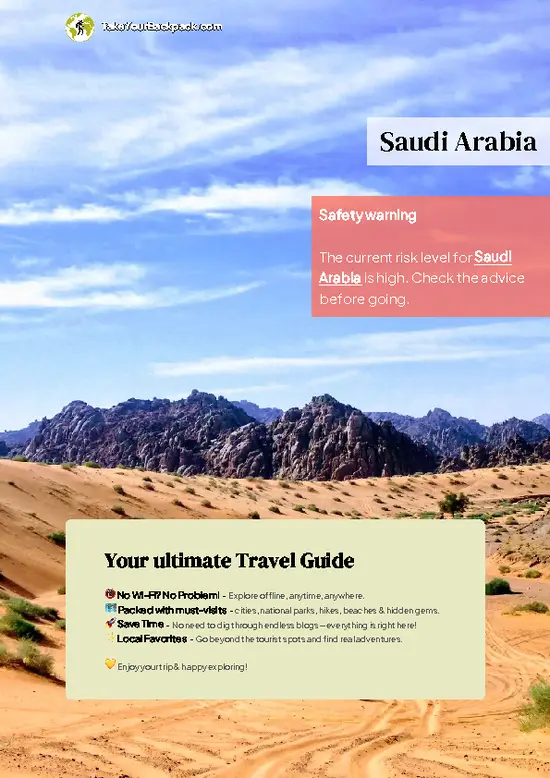
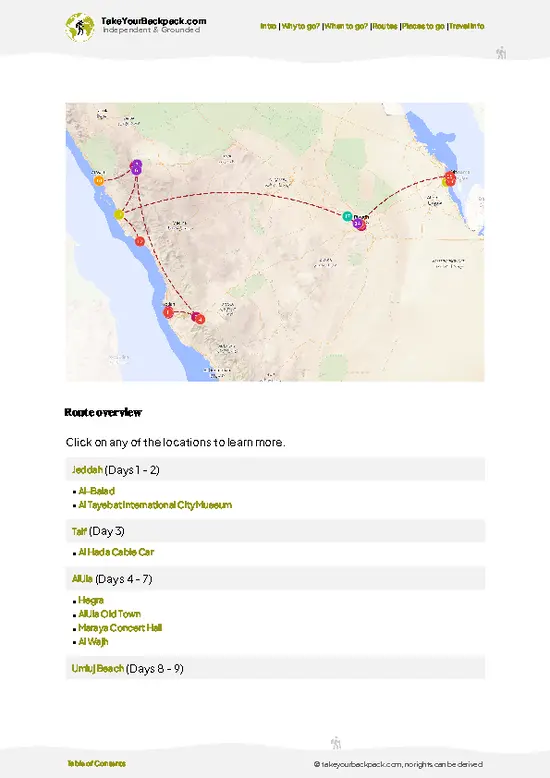
example page 0 from our offline Travel Guide for Saudi Arabia
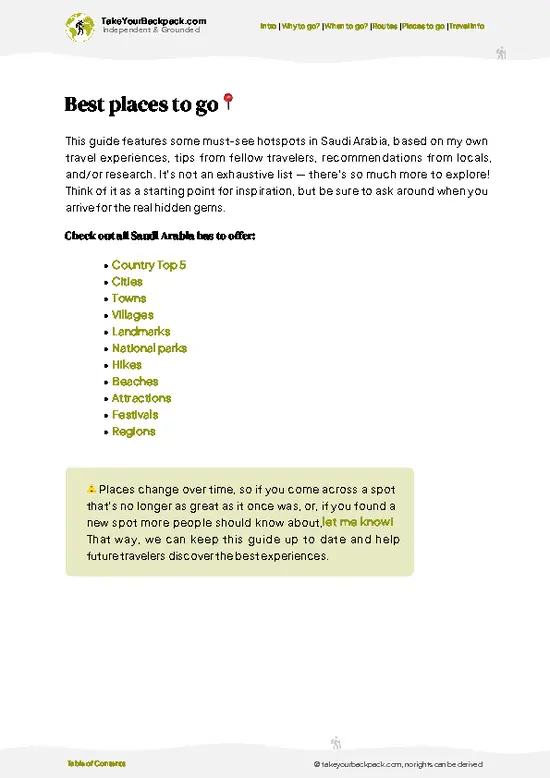
example page 1 from our offline Travel Guide for Saudi Arabia
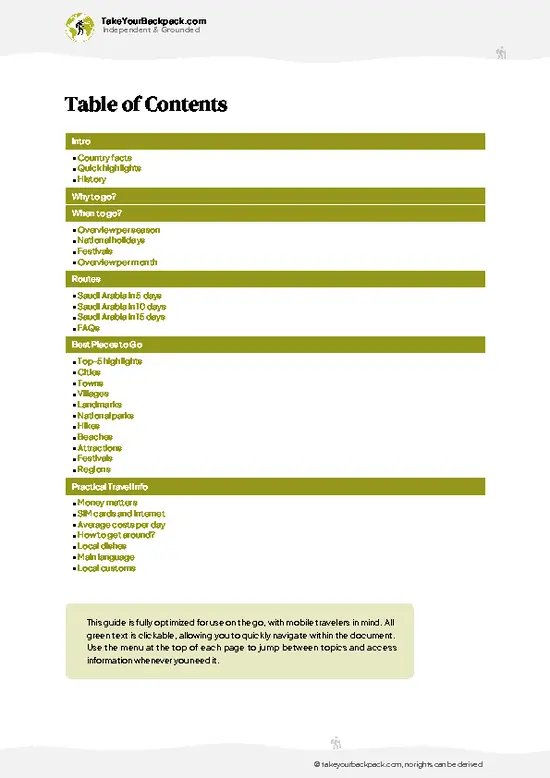
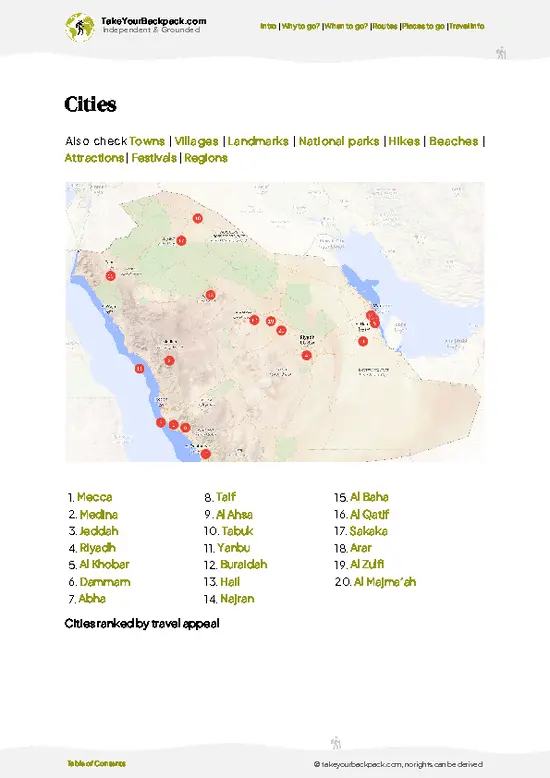
example page 2 from our offline Travel Guide for Saudi Arabia
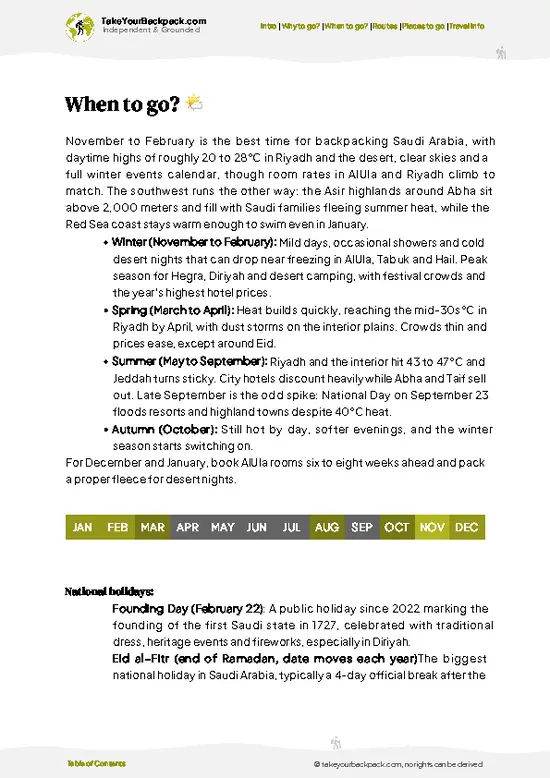
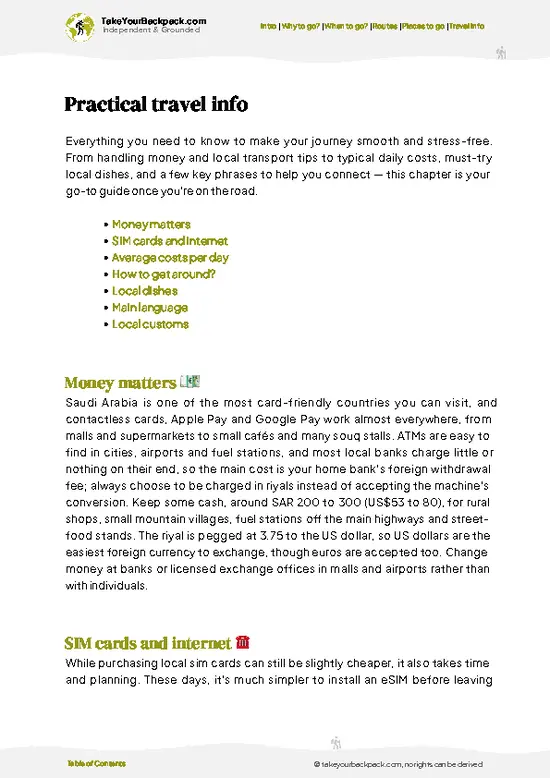
example page 3 from our offline Travel Guide for Saudi Arabia
example page 4 from our offline Travel Guide for Saudi Arabia
example page 5 from our offline Travel Guide for Saudi Arabia
example page 6 from our offline Travel Guide for Saudi Arabia
example page 7 from our offline Travel Guide for Saudi Arabia
The digital guide (322 pages) contains:
✅ 86 highlights, ranked by travel appeal
✅ Optimized 5, 10 & 15-day travel routes
✅ Cities, national parks, landmarks, beaches
✅ How to get around
✅ Offline-friendly for travel without Wi-Fi
👉 Click to see all 30+ guide features

📅 Plan smarter in minutes, not weeks
✅ Month by month travel advice
✅ Festivals & national holidays
✅ Budget expectations

🗺️ Go to the right places, skip the overrated ones
✅ Honest pros & cons of destinations
✅ Top hikes, parks & viewpoints
✅ Lesser-known places most travelers miss
✅ Clear “worth it vs skip it” guidance

🛏️ Travel smoothly without rookie mistakes
✅ Best areas to stay
✅ Transport systems explained simply
✅ Common scams & safety advice
✅ SIM cards, money & practical tips

🌍 Understand the country, not just visit it
✅ Culture & traditions
✅ 52 Essential phrases & customs
✅ Festivals worth planning around
✅ Traveler-friendly historical context
✅ Insights that make places more meaningful

📱 Built for real travel conditions
✅ Fully downloadable PDF
✅ Works completely offline
✅ Optimized for phone use
✅ Useful in remote areas & buses
✅ Everything in one place
Stop searching, start planning
Get instant access to your full guide. 30‑day money-back guarantee.
+ Add another guide for just

By proceeding you agree to our terms.
Sent to your inbox immediately after payment • 100% Secure Checkout
Best Backpacking Travel Advisor 2025 tourism awardBest Backpacking
Travel Advisor
2025
What others say about Take Your Backpack Guides:
⭐⭐⭐⭐⭐
Fantastic, amazing amount of information!
⭐⭐⭐⭐⭐
My goodness this is amazing, it's what I've been looking for hats off too you!
⭐⭐⭐⭐⭐
I think this is absolutely BRILLIANT
⭐⭐⭐⭐
Very complete and informative. It's still missing places, but I gotta to commend you
⭐⭐⭐⭐⭐
This is truly amazing, thank you, can't wait to explore it with my kids!
⭐⭐⭐⭐⭐
Awesome resource, thank you!
⭐⭐⭐⭐⭐
This is amazing! Can't wait to explore the ones I haven't seen
⭐⭐⭐⭐
I love this! Well done, great idea.
⭐⭐⭐⭐⭐
Thanks for taking the time to make this gem!
⭐⭐⭐⭐⭐
This might be the best website I've ever seen.
⭐⭐⭐⭐⭐
Congratulations, and thank you so much for your work; it's incredibly valuable.
⭐⭐⭐⭐
In all seriousness I think you did a great job pointing out the important spots
⭐⭐⭐⭐⭐
10/10 very good
⭐⭐⭐⭐⭐
As someone who's only just starting to visit regularly this is awesome, thank you.
⭐⭐⭐⭐
Thank you very much! I'm going to visit my dad, it's going to be very useful!
⭐⭐⭐⭐⭐
This is really cool! We'll be travelling for the first time and this definitely come in handy.
⭐⭐⭐⭐⭐
You are now our minister of culture, congratulations 👨‍💼
⭐⭐⭐⭐⭐
Just wanted to tell you that this is a pearl! Going to follow your recommendations.
⭐⭐⭐⭐⭐
This is so cool. I'll definitely be using the resource for my travels soon.
⭐⭐⭐⭐⭐
This is very impressive! Good work.
⭐⭐⭐⭐⭐
This is an amazing and informative site. Very well done!

🛏️ Where to stay?Where to Base Yourself

True dorm hostels are rare in Saudi Arabia, so budget travelers mostly book small hotels, furnished apartments or app-listed rooms, typically SAR 150 to 250 (about US$40 to 67) a night in big cities. In Riyadh, Al Batha has the cheapest beds and sits near Masmak Fort and the old souqs, though it is crowded, noisy and rough around the edges, while Al Olaya costs more but is clean, safe, on the Metro and closest to the city’s cafés and late-night dining. In Jeddah, Al Balad puts you inside the historic coral-stone quarter with few modern comforts, and Al Hamra near the Corniche is quieter and greener, with evening seafront walks but longer rides to the old town.

If you enjoy meeting fellow travelers, … read more 👉
True dorm hostels are rare in Saudi Arabia, so budget travelers mostly book small hotels, furnished apartments or app-listed rooms, typically SAR 150 to 250 (about US$40 to 67) a night in big cities. In Riyadh, Al Batha has the cheapest beds and sits near Masmak Fort and the old souqs, though it is crowded, noisy and rough around the edges, while Al Olaya costs more but is clean, safe, on the Metro and closest to the city’s cafés and late-night dining. In Jeddah, Al Balad puts you inside the historic coral-stone quarter with few modern comforts, and Al Hamra near the Corniche is quieter and greener, with evening seafront walks but longer rides to the old town.

If you enjoy meeting fellow travelers, consider choosing hostels with high ratings for atmosphere. On the other hand, if you prefer having your own space, a hotel might be a better option.

Saudi ArabiaExpand Your Journey

👋 Meet the founderWho’s Behind Take Your Backpack?

Johan, backpacker and founder of TakeYourBackpackHi, I’m Johan (Netherlands 🇳🇱), the creator of TakeYourBackpack. Over the past 3 decades, I’ve backpacked through 90+ countries across six continents, gaining extensive experience with independent travel, long-term trips, and overland routes.

This site is built on a combination of firsthand travel experience and carefully curated insights from other backpackers. Many guides are based on places I’ve personally visited, while others bring together tips, observations, and practical advice shared by trusted travelers I’ve met along the way.

The goal is to provide realistic, experience-driven guidance — not generic itineraries — so you can explore destinations with better context, clearer expectations, and more confidence.