×

Saudi Arabia🇸🇦 | best citiesThe Must-See 10 cities in Saudi Arabia

Cities in Saudi Arabia are built around oil-era planning, heat and the car. Expect wide boulevards, malls, and old quarters that survive in pockets rather than as whole districts. The differences between regions matter more than the similarities. The Hejaz in the west has coastal humidity, older merchant architecture and the easiest atmosphere for visitors. The Najd interior is drier, more conservative and spread out. The Eastern Province is industrial and orderly, with fewer visitors. Costs are moderate to high by regional standards, and distances are long. For backpacking or independent travel, the e-visa and domestic flights and trains make a self-guided trip workable, with crowds thin outside pilgrimage zones.

By Johan Kruseman 🇳🇱 | Updated October 19, 2026
Explore the best towns in Saudi Arabia

Why go?Why These city Stand Out

Saudi Arabia is a country of oases, ports and caravan stops separated by desert, so its cities developed as isolated centers rather than as a continuous urban network. Heat shaped older building styles, with thick walls, shaded lanes and wind towers. Oil wealth from the mid-twentieth century then reshaped nearly every city around highways and air conditioning. The result is a country where historic cores are small and modern districts large, which suits travelers interested in contrast and in how a fast-changing society looks in daily life.

The country is less suited to unplanned wandering on foot. Distances are long, summer heat limits daytime walking, and public transport within cities is still developing, so ride-hailing apps and taxis fill the gap. Cities come alive after sunset, and … read more 👉
Saudi Arabia is a country of oases, ports and caravan stops separated by desert, so its cities developed as isolated centers rather than as a continuous urban network. Heat shaped older building styles, with thick walls, shaded lanes and wind towers. Oil wealth from the mid-twentieth century then reshaped nearly every city around highways and air conditioning. The result is a country where historic cores are small and modern districts large, which suits travelers interested in contrast and in how a fast-changing society looks in daily life.

The country is less suited to unplanned wandering on foot. Distances are long, summer heat limits daytime walking, and public transport within cities is still developing, so ride-hailing apps and taxis fill the gap. Cities come alive after sunset, and shops and restaurants may close briefly around the five daily prayer times.

Before choosing Saudi Arabia for its cities, know that tourism infrastructure has grown quickly since the tourist e-visa opened to many nationalities, but it remains uneven. Mecca and the central area of Medina are restricted to Muslims. Dress and conduct rules are more relaxed than they once were, yet modest clothing remains the sensible default. Alcohol is not sold, and cash is rarely needed because cards and phone payments dominate.
Our Approach to Ranking
The list of best cities in Saudi Arabia is created based on culture, vibe, attractions, transport ease, and local charm. If you feel a city is missing in this list, please let us know.

When to go?Timing Your Visit for the Best Experience

Best months: The best months for Saudi cities are November to March, when daytime highs fall to roughly 18 to 30°C across most of the country and walking outdoors is comfortable. Rain is minimal, with most regions receiving under 100 mm a year, though brief winter downpours and flash floods can occur in the west and south.

Regional differences: The Najd interior turns cold at night in December and January, with lows near 5°C or lower, so a warm layer is needed. The Red Sea coast stays milder but humid, with highs of 28 to 32°C even in winter. The Eastern Province is pleasant in winter, yet humidity rises sharply from April.

Shoulder and low seasons: October and April are workable shoulder months, with highs of 33 to 38°C. From May to September, daytime temperatures commonly pass 40°C, and … read more 👉
Best months: The best months for Saudi cities are November to March, when daytime highs fall to roughly 18 to 30°C across most of the country and walking outdoors is comfortable. Rain is minimal, with most regions receiving under 100 mm a year, though brief winter downpours and flash floods can occur in the west and south.

Regional differences: The Najd interior turns cold at night in December and January, with lows near 5°C or lower, so a warm layer is needed. The Red Sea coast stays milder but humid, with highs of 28 to 32°C even in winter. The Eastern Province is pleasant in winter, yet humidity rises sharply from April.

Shoulder and low seasons: October and April are workable shoulder months, with highs of 33 to 38°C. From May to September, daytime temperatures commonly pass 40°C, and parts of the interior and Gulf coast approach 45 to 50°C. Outdoor sightseeing then shifts to early morning and after dark, and indoor attractions carry the day.

Peak periods and prices: Winter is also the high season, so hotel rates can run 20 to 50 percent above summer levels, and festivals and events cluster in this period. During Ramadan, daytime eating in public is restricted and opening hours shift toward the evening. Hajj season and the days around Eid bring heavy demand and higher prices, particularly in the west.

city hoppingHow to Combine cities Into One Trip

How long to allow: A trip combining several Saudi cities needs 10 to 16 days, because internal distances are large and each move takes most of a day once airport transfers are counted. Fewer than ten days forces a single region.

Grouping regions: Cities cluster into three practical zones: the west (Red Sea coast and the Hejaz), the center (around Riyadh), and the east (Gulf coast). The west and center pair well, since they are linked by frequent flights of about 1.5 to 2 hours. The Eastern Province connects to Riyadh by train in roughly 4 to 5 hours, which makes it an easy add-on. A west to center to east direction, or the reverse, avoids backtracking, and a loop that starts and ends at an international hub saves money on flights.

Time per stop: Allow 2 to 4 nights in a major city and 1 … read more 👉
How long to allow: A trip combining several Saudi cities needs 10 to 16 days, because internal distances are large and each move takes most of a day once airport transfers are counted. Fewer than ten days forces a single region.

Grouping regions: Cities cluster into three practical zones: the west (Red Sea coast and the Hejaz), the center (around Riyadh), and the east (Gulf coast). The west and center pair well, since they are linked by frequent flights of about 1.5 to 2 hours. The Eastern Province connects to Riyadh by train in roughly 4 to 5 hours, which makes it an easy add-on. A west to center to east direction, or the reverse, avoids backtracking, and a loop that starts and ends at an international hub saves money on flights.

Time per stop: Allow 2 to 4 nights in a major city and 1 to 2 in a smaller one. Large cities spread across tens of kilometers, so a single day covers only one or two districts. High-speed rail between Medina and Jeddah takes about 2 hours, while intercity buses are slower, often 8 to 12 hours on long routes.

Common planning mistakes: Travelers often underestimate distances and schedule a city per day. Others book summer trips with outdoor plans. Build in a buffer day, book trains and flights early in winter, and keep one rest day per week.

The ListTop cities of Saudi Arabia

1 Mecca

pilgrimage center, sacred mosque, global gathering

Observe the convergence of millions during Hajj, with infrastructure and rituals that define the city’s rhythm and restrict access for non-Muslims.

2 Medina

prophet’s mosque, religious study, tranquil courtyards

Experience a city shaped by spiritual traditions, with quiet neighborhoods and a pace influenced by centuries of scholarship and devotion.

3 Jeddah

Red Sea coast, coral houses, bustling souqs

Dive into a port city where historic districts meet contemporary art, and the sea breeze carries scents from diverse street food stalls.

4 Riyadh

skyscrapers, desert edge, business districts

Navigate sprawling highways, glass towers, and cultural institutions in a metropolis where tradition and rapid development intersect daily.

5 Al Khobar

corniche, modern malls, seaside dining

Stroll along landscaped waterfronts, enjoy international cuisine, and shop in a city known for its contemporary lifestyle.

6 Dammam

port city, business hub, coastal parks

Experience a gateway to the Eastern Province, with wide boulevards, seafood restaurants, and easy connections to neighboring Gulf states.

7 Abha

mountain air, misty valleys, summer escape

Experience cool highland weather, terraced hillsides, and a relaxed pace in a city known for its natural scenery and seasonal festivals.

8 Taif

rose farms, cool summers, mountain markets

Visit during the blooming season to see terraced gardens, taste local honey, and enjoy a respite from the heat of the plains.

9 Al Ahsa

date palm groves, desert springs, oasis towns

Wander through ancient irrigation channels, explore mudbrick villages, and sample fresh dates in the world’s largest oasis region.

10 Tabuk

desert plateaus, Ottoman railway, military presence

Explore a northern city marked by strategic history, arid landscapes, and access to ancient trade routes and archaeological sites.

11 Yanbu

industrial port, coral reefs, old harbor

Balance time between oil infrastructure and quiet beaches, with opportunities for diving and glimpses of the city’s maritime past.

12 Buraidah

camel market, date auctions, central plateau

Witness daily commerce at one of the world’s largest camel markets and explore a city at the heart of Saudi Arabia’s agricultural region.

13 Hail

rock art, wheat fields, desert festivals

Venture inland to see petroglyphs, seasonal gatherings, and a city shaped by caravan routes and agricultural traditions.

14 Najran

mud forts, palm groves, Yemeni influence

Travel to the southern border for adobe castles, date-filled oases, and architecture reflecting deep ties to cultures beyond the frontier.

15 Al Baha

green plateaus, forested slopes, mild climate

Discover quiet mountain villages, enjoy shaded hiking trails, and find respite from the heat in this cool, elevated city.

16 Al Qatif

Gulf coast, fishing heritage, island villages

Sample fresh seafood, visit traditional markets, and explore a city shaped by centuries of maritime trade and Shia culture.

17 Sakaka

archaeological sites, olive groves, basalt hills

Explore ancient tombs, sample local olives, and experience a city surrounded by volcanic terrain and prehistoric relics.

18 Arar

northern steppe, border crossing, sheep markets

Travelers find a practical stopover near Iraq, with open landscapes, livestock trading, and a climate shaped by harsh winters.

19 Al Zulfi

sand dunes, camel markets, rural landscapes

Drive through rolling desert, watch livestock auctions, and explore a city surrounded by traditional Bedouin culture.

20 Al Majma’ah

desert parks, heritage sites, seasonal festivals

Attend local events, explore restored mudbrick forts, and walk through palm-lined parks in a city with a strong community feel.

21 Unaizah

mud-brick houses, literary festivals, palm groves

Attend cultural events, wander shaded streets, and discover a town known for its hospitality and deep-rooted traditions.

22 Al Rass

central plateau, old mosques, weekly markets

Visit historic prayer sites, shop for local goods, and experience the rhythms of a small city on the Najd plain.

23 Al Qunfudhah

southern coast, coral reefs, local souks

Swim in warm waters, browse small-town markets, and enjoy a relaxed pace in a city with easy access to the Red Sea.

24 Duba

Red Sea port, seafood markets, coastal promenade

Experience a laid-back town where fishing boats dock daily, local markets bustle, and evenings bring sea breezes along the waterfront.

25 Al Qurayyat

border trade, desert highways, Levantine cuisine

Cross into Jordan, try regional dishes, and use this practical stopover as a gateway to northern Saudi Arabia and beyond.

26 Al Khafji

coastal border, oil industry, sandy shoreline

Stay in a practical hub for offshore workers, with access to quiet beaches and a strategic location near the Kuwait border.

27 Al Lith

Red Sea port, fishing boats, quiet beaches

Watch fishermen unload their catch, relax on uncrowded sands, and experience a low-key coastal town with a working harbor.

Think you know Saudi Arabia?

Prove you’re a true local — uncover 17 lesser-known cities in Saudi Arabia that locals tend to keep to themselves.
Loading the map 🌍

Expert viewInsights from Locals and Experts

How many cities to visit: Three to four cities is the sensible number for a trip of two weeks. Saudi cities are spread out, and each needs a full day just to reach and settle into, so adding a fifth stop usually means less time seeing anything. Slow travel also suits the country, where evenings, not mornings, are when much of public life happens.

Choosing between kinds of cities: Cities fall broadly into historic and cultural centers, modern capital-style metropolises, and coastal or resort-leaning places. Travelers who like architecture, markets and heritage should weight toward the first kind, since old quarters are small and best seen with time. Those interested in contemporary Saudi life, food and museums will get more from the large modern centers. Beach and diving travelers are better … read more 👉
How many cities to visit: Three to four cities is the sensible number for a trip of two weeks. Saudi cities are spread out, and each needs a full day just to reach and settle into, so adding a fifth stop usually means less time seeing anything. Slow travel also suits the country, where evenings, not mornings, are when much of public life happens.

Choosing between kinds of cities: Cities fall broadly into historic and cultural centers, modern capital-style metropolises, and coastal or resort-leaning places. Travelers who like architecture, markets and heritage should weight toward the first kind, since old quarters are small and best seen with time. Those interested in contemporary Saudi life, food and museums will get more from the large modern centers. Beach and diving travelers are better served on the Red Sea side. A mix of one of each keeps the trip varied and avoids repeating the same car-oriented urban experience.

What it costs: Saudi Arabia is not a budget destination. A frugal independent traveler can manage on US$60 to 90 a day (about SAR 225 to 340), using hostels or basic hotels at US$30 to 55, local meals at US$5 to 12 and ride-hailing. Mid-range travelers should plan US$110 to 180 a day. Museum and heritage site entry usually runs SAR 30 to 100 (US$8 to 27), and guided tours range from US$30 to 100 per person depending on length. Domestic flights often cost US$40 to 120 one way when booked early, and trains are in a similar range. Taxi apps cost far less than hiring a car, and a rental is rarely worth it inside cities, where parking and driving style add stress.

Safety and conduct: Violent crime against visitors is rare, and most problems are traffic-related, since driving is fast and lane discipline loose. An experienced traveler uses ride-hailing rather than walking along multi-lane roads at night. Pedestrian crossings are not always respected.

Dress is the main cultural adjustment. Shoulders and knees covered is a safe standard for everyone, and women are not required to wear an abaya but many choose looser, longer clothing. Public displays of affection draw disapproval. Photographing people, especially women, without permission is a problem, and photographing government buildings can lead to questions.

Prayer closures catch visitors out. Many shops pause for 15 to 30 minutes several times a day, so plan errands around them rather than waiting outside. Carry a passport copy, keep a card handy, and download an offline map, since signal can drop between districts.

✈️ The backpacker research shortcutSaudi Arabia Travel Guide

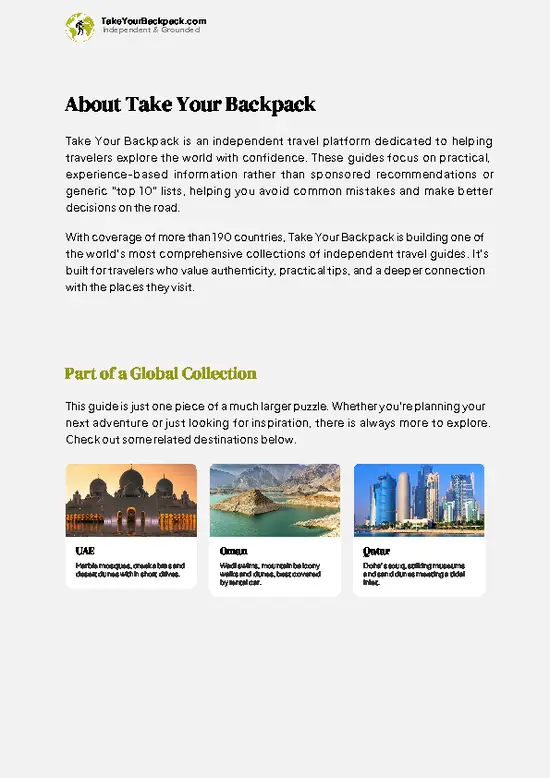
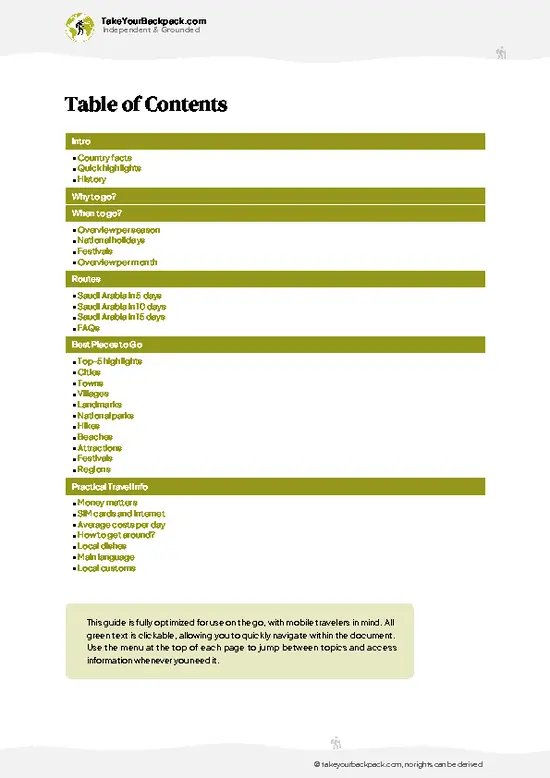
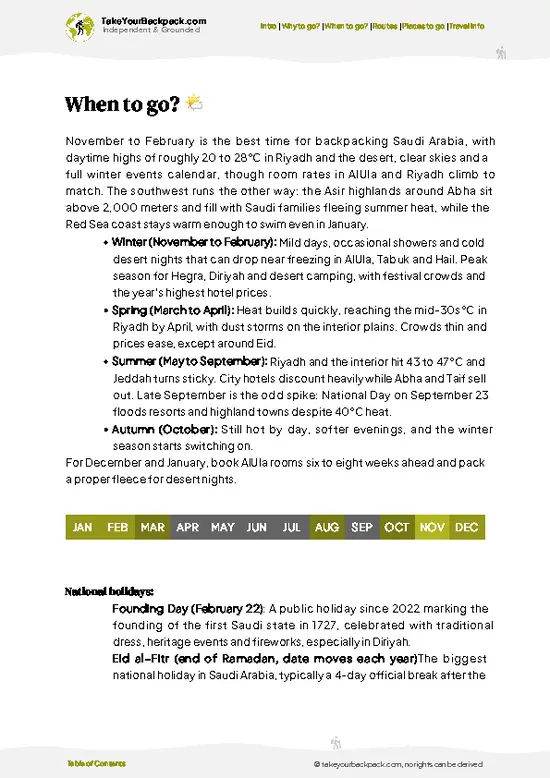
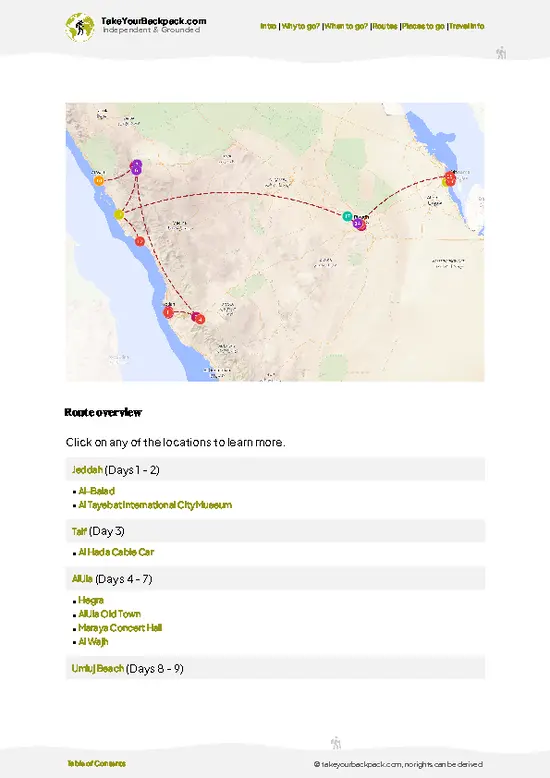
An offline-friendly backpacking guide with optimized travel routes, ranked highlights, transport advice, and the best areas to stay.
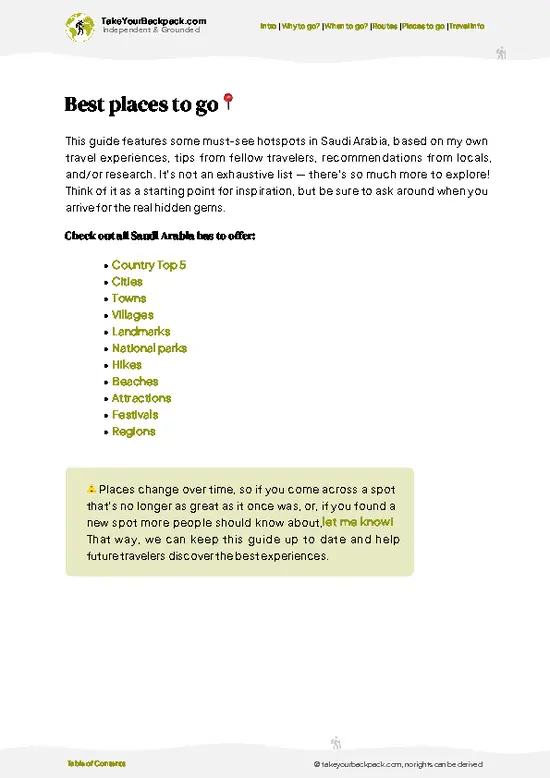
example page 0 from our offline Travel Guide for Saudi Arabia
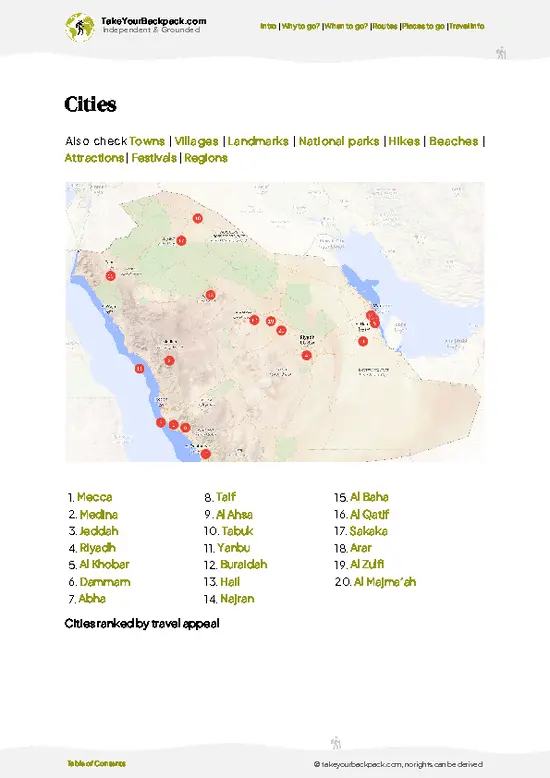
example page 1 from our offline Travel Guide for Saudi Arabia
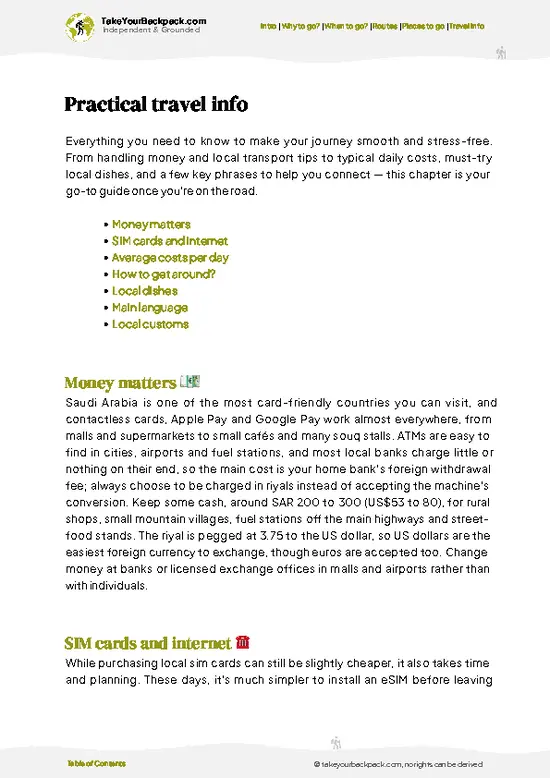
example page 2 from our offline Travel Guide for Saudi Arabia
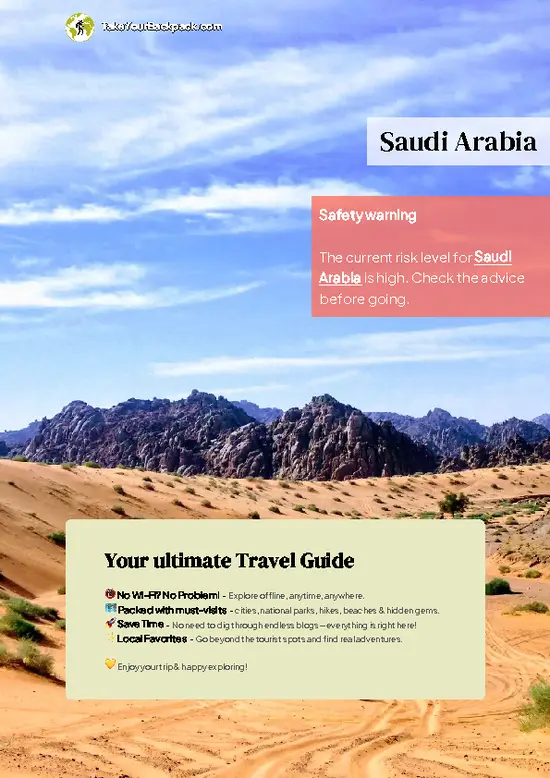
example page 3 from our offline Travel Guide for Saudi Arabia
example page 4 from our offline Travel Guide for Saudi Arabia
example page 5 from our offline Travel Guide for Saudi Arabia
example page 6 from our offline Travel Guide for Saudi Arabia
example page 7 from our offline Travel Guide for Saudi Arabia
The digital guide (322 pages) contains:
✅ 86 highlights, ranked by travel appeal
✅ Optimized 5, 10 & 15-day travel routes
✅ Cities, national parks, landmarks, beaches
✅ How to get around
✅ Offline-friendly for travel without Wi-Fi
👉 Click to see all 30+ guide features

📅 Plan smarter in minutes, not weeks
✅ Month by month travel advice
✅ Festivals & national holidays
✅ Budget expectations

🗺️ Go to the right places, skip the overrated ones
✅ Honest pros & cons of destinations
✅ Top hikes, parks & viewpoints
✅ Lesser-known places most travelers miss
✅ Clear “worth it vs skip it” guidance

🛏️ Travel smoothly without rookie mistakes
✅ Best areas to stay
✅ Transport systems explained simply
✅ Common scams & safety advice
✅ SIM cards, money & practical tips

🌍 Understand the country, not just visit it
✅ Culture & traditions
✅ 52 Essential phrases & customs
✅ Festivals worth planning around
✅ Traveler-friendly historical context
✅ Insights that make places more meaningful

📱 Built for real travel conditions
✅ Fully downloadable PDF
✅ Works completely offline
✅ Optimized for phone use
✅ Useful in remote areas & buses
✅ Everything in one place
Stop searching, start planning
Get instant access to your full guide. 30‑day money-back guarantee.
+ Add another guide for just

By proceeding you agree to our terms.
Sent to your inbox immediately after payment • 100% Secure Checkout
Best Backpacking Travel Advisor 2025 tourism awardBest Backpacking
Travel Advisor
2025
What others say about Take Your Backpack Guides:
⭐⭐⭐⭐⭐
Fantastic, amazing amount of information!
⭐⭐⭐⭐⭐
My goodness this is amazing, it's what I've been looking for hats off too you!
⭐⭐⭐⭐⭐
I think this is absolutely BRILLIANT
⭐⭐⭐⭐
Very complete and informative. It's still missing places, but I gotta to commend you
⭐⭐⭐⭐⭐
This is truly amazing, thank you, can't wait to explore it with my kids!
⭐⭐⭐⭐⭐
Awesome resource, thank you!
⭐⭐⭐⭐⭐
This is amazing! Can't wait to explore the ones I haven't seen
⭐⭐⭐⭐
I love this! Well done, great idea.
⭐⭐⭐⭐⭐
Thanks for taking the time to make this gem!
⭐⭐⭐⭐⭐
This might be the best website I've ever seen.
⭐⭐⭐⭐⭐
Congratulations, and thank you so much for your work; it's incredibly valuable.
⭐⭐⭐⭐
In all seriousness I think you did a great job pointing out the important spots
⭐⭐⭐⭐⭐
10/10 very good
⭐⭐⭐⭐⭐
As someone who's only just starting to visit regularly this is awesome, thank you.
⭐⭐⭐⭐
Thank you very much! I'm going to visit my dad, it's going to be very useful!
⭐⭐⭐⭐⭐
This is really cool! We'll be travelling for the first time and this definitely come in handy.
⭐⭐⭐⭐⭐
You are now our minister of culture, congratulations 👨‍💼
⭐⭐⭐⭐⭐
Just wanted to tell you that this is a pearl! Going to follow your recommendations.
⭐⭐⭐⭐⭐
This is so cool. I'll definitely be using the resource for my travels soon.
⭐⭐⭐⭐⭐
This is very impressive! Good work.
⭐⭐⭐⭐⭐
This is an amazing and informative site. Very well done!

🛏️ Where to stay?Where to Base Yourself

True dorm hostels are rare in Saudi Arabia, so budget travelers mostly book small hotels, furnished apartments or app-listed rooms, typically SAR 150 to 250 (about US$40 to 67) a night in big cities. In Riyadh, Al Batha has the cheapest beds and sits near Masmak Fort and the old souqs, though it is crowded, noisy and rough around the edges, while Al Olaya costs more but is clean, safe, on the Metro and closest to the city’s cafés and late-night dining. In Jeddah, Al Balad puts you inside the historic coral-stone quarter with few modern comforts, and Al Hamra near the Corniche is quieter and greener, with evening seafront walks but longer rides to the old town.

If you enjoy meeting fellow travelers, … read more 👉
True dorm hostels are rare in Saudi Arabia, so budget travelers mostly book small hotels, furnished apartments or app-listed rooms, typically SAR 150 to 250 (about US$40 to 67) a night in big cities. In Riyadh, Al Batha has the cheapest beds and sits near Masmak Fort and the old souqs, though it is crowded, noisy and rough around the edges, while Al Olaya costs more but is clean, safe, on the Metro and closest to the city’s cafés and late-night dining. In Jeddah, Al Balad puts you inside the historic coral-stone quarter with few modern comforts, and Al Hamra near the Corniche is quieter and greener, with evening seafront walks but longer rides to the old town.

If you enjoy meeting fellow travelers, consider choosing hostels with high ratings for atmosphere. On the other hand, if you prefer having your own space, a hotel might be a better option.

Saudi ArabiaExpand Your Journey

👋 Meet the founderWho’s Behind Take Your Backpack?

Johan, backpacker and founder of TakeYourBackpackHi, I’m Johan (Netherlands 🇳🇱), the creator of TakeYourBackpack. Over the past 3 decades, I’ve backpacked through 90+ countries across six continents, gaining extensive experience with independent travel, long-term trips, and overland routes.

This site is built on a combination of firsthand travel experience and carefully curated insights from other backpackers. Many guides are based on places I’ve personally visited, while others bring together tips, observations, and practical advice shared by trusted travelers I’ve met along the way.

The goal is to provide realistic, experience-driven guidance — not generic itineraries — so you can explore destinations with better context, clearer expectations, and more confidence.