×

Singapore🇸🇬 | best national parksExplore the 10 Best national parks in Singapore

Singapore’s protected green spaces are small, managed and almost free to enter, which changes how a backpacker approaches them. Nothing here is a remote wilderness. Instead you get remnant rainforest, mangrove, island kampung and landscaped gardens, all run by one agency (NParks) and linked by MRT and bus. Cost is low, access is easy and crowds depend on the kind: ticketed garden attractions near the city center fill up, while forest and mangrove areas stay quiet on weekdays. For independent travel, the real choice is between walk-in-and-go sites and ones needing a ferry or a ticket.

By Johan Kruseman 🇳🇱 | Updated October 19, 2026
Explore the best hikes in Singapore

Why go?Why These national park Stand Out

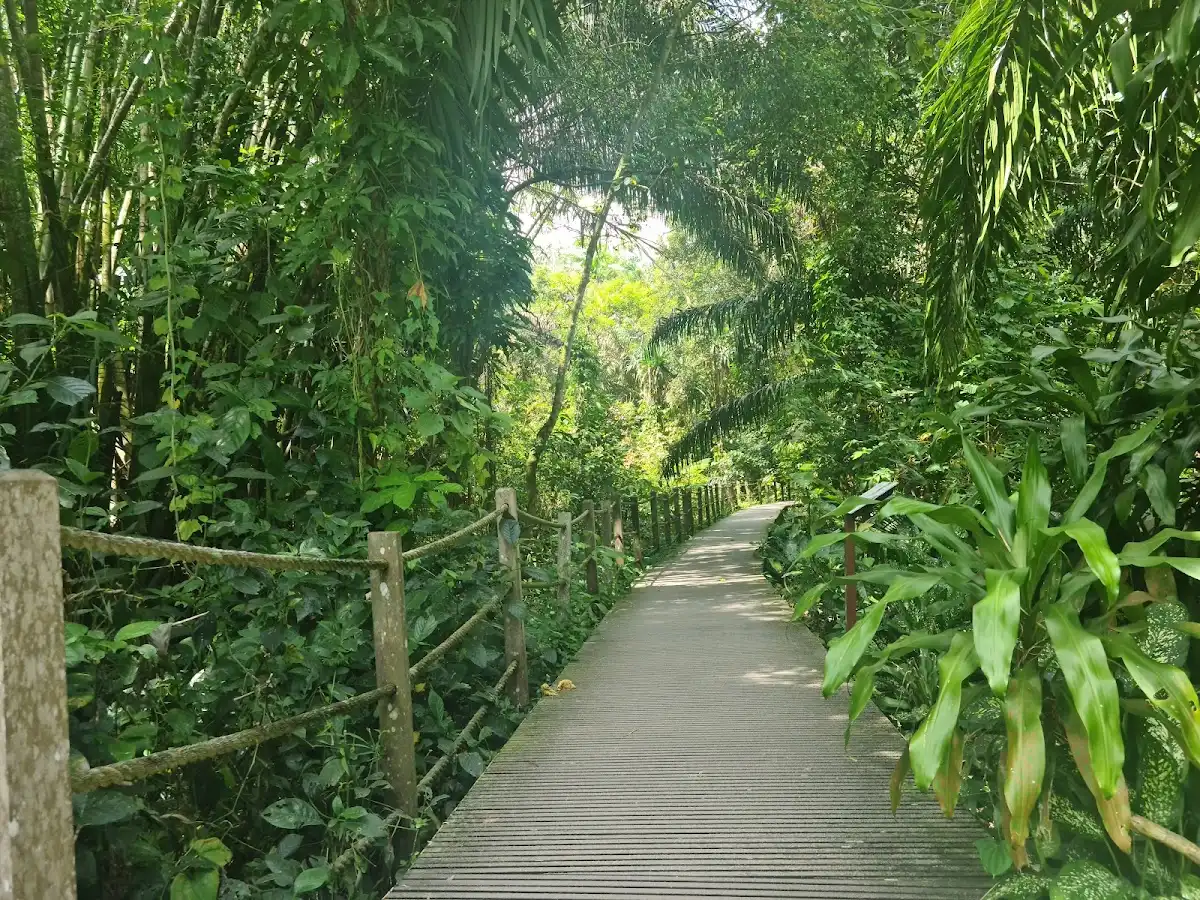
Singapore is an unusual place to go looking for nature. A tiny island of about 735 square kilometers with roughly six million people has kept only small fragments of its original forest, so the experience is shaped by deliberate conservation and planning rather than by size. Government policy since the 1960s has pushed a “city in a garden” approach, which is why even central areas have tree-lined connectors, boardwalks and well-marked trails. The result is dependable infrastructure: paths are maintained, signage is clear, toilets and shelters appear at regular intervals, and public transport reaches almost every trailhead.
The equatorial climate is the other defining factor. Heat, humidity above 80 percent and sudden downpours produce dense, fast-growing greenery, but they also make exertion … read more 👉
Singapore is an unusual place to go looking for nature. A tiny island of about 735 square kilometers with roughly six million people has kept only small fragments of its original forest, so the experience is shaped by deliberate conservation and planning rather than by size. Government policy since the 1960s has pushed a “city in a garden” approach, which is why even central areas have tree-lined connectors, boardwalks and well-marked trails. The result is dependable infrastructure: paths are maintained, signage is clear, toilets and shelters appear at regular intervals, and public transport reaches almost every trailhead.
The equatorial climate is the other defining factor. Heat, humidity above 80 percent and sudden downpours produce dense, fast-growing greenery, but they also make exertion feel harder than the distances suggest. Travelers expecting multi-day treks, camping in the backcountry or large mammals will be disappointed. What works is short, rewarding outings, often combined with food stops at hawker centers.
Before choosing Singapore for nature, understand the rules. Feeding wildlife, littering, smoking in parks and picking plants carry fines, and some sites have set hours or ticketed zones. Plan for half-day visits, not expeditions, and Singapore delivers well.
How the List Was Created
The list of best national parks in Singapore is created based on landscapes, wildlife, adventure opportunities, facilities, and overall experience. If you feel a national park is missing in this list, please let us know.

When to go?When to Plan Your Trip

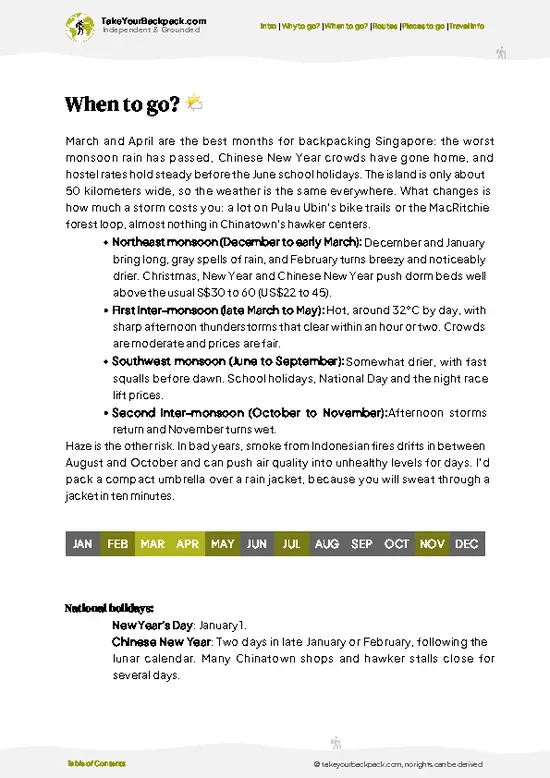
Best months and the weather behind them: February to April are the best months for Singapore’s parks, because the northeast monsoon has faded, rainfall drops and skies are at their clearest. Temperatures barely change all year, sitting around 25 to 32°C with humidity usually above 80 percent, so the real variable is rain. The island receives roughly 2,000 to 2,400 mm annually.
Shoulder seasons and the wet months: June to August is a good second window. It is a little drier, though occasional haze from regional fires can appear between August and October and make outdoor effort unpleasant. The inter-monsoon periods of April to May and October to November bring intense afternoon thunderstorms. Plan trails for the morning, ideally starting by 7:30 or 8:00, and keep a light rain jacket handy.
November … read more 👉
Best months and the weather behind them: February to April are the best months for Singapore’s parks, because the northeast monsoon has faded, rainfall drops and skies are at their clearest. Temperatures barely change all year, sitting around 25 to 32°C with humidity usually above 80 percent, so the real variable is rain. The island receives roughly 2,000 to 2,400 mm annually.
Shoulder seasons and the wet months: June to August is a good second window. It is a little drier, though occasional haze from regional fires can appear between August and October and make outdoor effort unpleasant. The inter-monsoon periods of April to May and October to November bring intense afternoon thunderstorms. Plan trails for the morning, ideally starting by 7:30 or 8:00, and keep a light rain jacket handy.
November to January is the wettest stretch, with December often the peak. Rain is frequent, but it usually arrives in long showers rather than all-day gloom, and forest and mangrove areas look their greenest.
Crowds and prices: Parks are free or inexpensive year-round, so seasonality shows up mainly in accommodation. Hotel and hostel rates rise around December, the June school holidays and the September Grand Prix weekend. Weekends fill popular green spaces with local families, so weekdays are quieter.

national park hoppingTips for Visiting Multiple Destinations

How many days to allow: A trip combining several of Singapore’s parks and reserves needs 2 to 4 days, because each stop takes a half day and the heat limits how much fits into one morning or afternoon. Singapore is small, but the sites sit in different corners, so geography matters more than distance.
Which regions group well: The central belt (around the Botanic Gardens, Bukit Timah and the Central Catchment) clusters well and connects by MRT and bus, with 20 to 40 minutes between points. The city-center waterfront sits close by and works as an easy add-on. The northwest (Kranji and Sungei Buloh) and the northeast and Changi side (the Pulau Ubin ferry) are separate trips, usually 60 to 90 minutes from each other by transit. Work from the center outward, doing the central sites first, then … read more 👉
How many days to allow: A trip combining several of Singapore’s parks and reserves needs 2 to 4 days, because each stop takes a half day and the heat limits how much fits into one morning or afternoon. Singapore is small, but the sites sit in different corners, so geography matters more than distance.
Which regions group well: The central belt (around the Botanic Gardens, Bukit Timah and the Central Catchment) clusters well and connects by MRT and bus, with 20 to 40 minutes between points. The city-center waterfront sits close by and works as an easy add-on. The northwest (Kranji and Sungei Buloh) and the northeast and Changi side (the Pulau Ubin ferry) are separate trips, usually 60 to 90 minutes from each other by transit. Work from the center outward, doing the central sites first, then one outer region per day. Base yourself near an MRT interchange such as Dhoby Ghaut or Little India to keep every transfer short.
Pacing mistakes to avoid: Many travelers stack three or four sites into one day and spend half of it in transit. Allow 3 to 5 hours per stop and no more than two per day. Another common error is starting walks at midday, when heat and storms peak. Begin early, rest at midday indoors, and schedule ticketed or covered attractions for afternoon. Island ferries run on set schedules and take cash, so check the last return before committing.

The ListHighly Recommended national parks of Singapore

1 Bukit Timah Nature Reserve

primary rainforest, summit trail, native wildlife

Ascend dense forest slopes to Singapore’s highest point, passing rare plants and long-tailed macaques in a pocket of original rainforest.

2 MacRitchie Reservoir Park

canopy walk, forest boardwalks, reservoir views

Traverse shaded trails and a suspension bridge above water, with glimpses of monitor lizards and the city’s oldest reservoir.

3 Sungei Buloh Wetland Reserve

mangrove boardwalks, migratory birds, mudflats

Spot crocodiles and shorebirds in tidal wetlands, where raised trails wind through mangroves and open up to wide mudflats.

singapore-national-park-sungei-buloh-wetland-reserve
© Google |

4 Coney Island Park

casuarina woods, rustic trails, sandy beach

Cycle or walk along unpaved paths through wild groves, with open stretches leading to a quiet, undeveloped shoreline.

5 Labrador Nature Reserve

coastal cliffs, WWII relics, rocky shore

Walk coastal trails lined with war history and native plants, then scan the intertidal zone for crabs and migratory birds at low tide.

singapore-national-park-labrador-nature-reserve
© Google |

6 Windsor Nature Park

stream crossings, freshwater springs, forest edge

Cross wooden bridges over clear streams and explore the transition zone between urban fringe and mature forest.

singapore-national-park-windsor-nature-park
© Google |

7 Thomson Nature Park

ruined village, fig groves, wildlife corridors

Walk quiet trails past remnants of an abandoned settlement, with a chance to spot pangolins and native fruit trees.

8 Kranji Marshes

bird hides, freshwater marsh, observation tower

Watch herons and kingfishers from quiet boardwalks, surrounded by open wetlands and reed beds rarely found elsewhere in the city.

singapore-national-park-kranji-marshes
© Google |

9 Lower Peirce Reservoir Park

tranquil waters, mature forest, fishing spots

Sit by calm reservoir edges shaded by old trees, or follow a short boardwalk into peaceful secondary forest.

singapore-national-park-lower-peirce-reservoir-park
© Google |

10 Bishan-Ang Mo Kio Park

meandering river, open lawns, community spaces

Enjoy riverside walks and grassy fields, where a restored waterway winds through landscaped parkland frequented by locals.

11 Mount Faber Park

hilltop lookout, cable car station, city panorama

Reach the summit for broad views over the harbour, or connect to Sentosa by cable car from lush, tree-lined paths.

12 Pasir Ris Park

mangrove forest, playgrounds, seaside cycling

Relax by the water or explore a boardwalk through mangroves, with family-friendly facilities and wide open lawns for picnics.

13 Fort Canning Park

archaeological sites, spice garden, colonial landmarks

Trace centuries of history on wooded slopes, where ancient ruins, heritage trees, and old fortifications shape the landscape.

Think you know Singapore?

Prove you’re a true local — uncover 3 lesser-known national parks in Singapore that locals tend to keep to themselves.
Loading the map 🌍

Expert viewInsights from Locals and Experts

How many to visit: Three to four sites is the right number for most backpackers. Each needs a half day, the humidity drains energy faster than the mileage suggests, and after the fourth the landscapes start to blur because the island is small. Spend a week and you can stretch to five or six, but returns diminish quickly.
Prioritizing by travel style: Choose one site from each category rather than three of the same. Hikers and wildlife watchers should put forest and mangrove reserves first, since they offer real trails, birds, monitor lizards and macaques. Travelers wanting culture and a slower pace should pick the island kampung area, where cycling replaces walking. Those short on time or traveling with non-hikers get the most from landscaped gardens and city-edge green space, which are easy … read more 👉
How many to visit: Three to four sites is the right number for most backpackers. Each needs a half day, the humidity drains energy faster than the mileage suggests, and after the fourth the landscapes start to blur because the island is small. Spend a week and you can stretch to five or six, but returns diminish quickly.
Prioritizing by travel style: Choose one site from each category rather than three of the same. Hikers and wildlife watchers should put forest and mangrove reserves first, since they offer real trails, birds, monitor lizards and macaques. Travelers wanting culture and a slower pace should pick the island kampung area, where cycling replaces walking. Those short on time or traveling with non-hikers get the most from landscaped gardens and city-edge green space, which are easy and shaded in places. Photographers should favor mornings at open-air sites and keep the ticketed conservatories for rain.
What it costs: Entry to nearly all reserves and most gardens is free. Exceptions are the paid attractions: the orchid garden costs around S$15 for foreign adults, and the cooled conservatories near the waterfront run roughly S$20 to 60 depending on what you combine (about US$15 to 45). Transport is cheap, with MRT and bus rides costing S$1 to 2.50 each. The island ferry costs about S$4 each way in cash, and bike rental on the island runs around S$10 to 20 a day.
A realistic day budget for a park-focused day is S$25 to 45 (US$19 to 34), covering transport, two hawker-center meals at S$4 to 7 each, and water. A single visit typically costs S$3 to 10 (US$2 to 8) in fares unless you add a ticketed attraction. Guided walks and night tours, where offered, often cost S$20 to 60 and are optional because trails are signed. Dorm beds in the city typically run S$30 to 60 a night, which dominates the real budget more than any park fee.
Safety and local rules: Heat is the main hazard. Carry at least 1.5 liters of water per person, wear breathable clothes and shoes with grip, and stop at shelters when a storm rolls in, since lightning is frequent. Use insect repellent, as dengue is present on the island.
Never feed monkeys or other wildlife. Fines can reach S$5,000, and macaques will grab plastic bags and snacks, so keep food zipped inside your pack. Wild boar and snakes occur in forest areas, and the safest response is distance and quiet. Stay on marked trails, which also protects fragile habitat.
Cultural expectations are straightforward. Littering, smoking in parks and picking plants are fined. Drones usually need a permit. Sound carries on boardwalks, so keep voices low near bird hides. Parks are very safe for solo travelers, including after dark in well-lit areas, but carry a phone with a local data plan for maps and emergencies. One practical observation: the offline map on a phone often misses smaller connector paths, so screenshot trail signs at the entrance.

✈️ The backpacker research shortcutSingapore Travel Guide

An offline-friendly backpacking guide with optimized travel routes, ranked highlights, transport advice, and the best areas to stay.
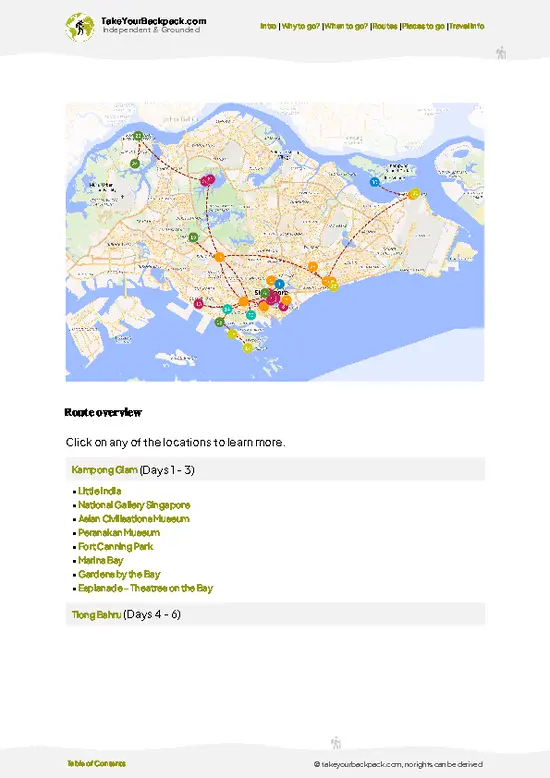
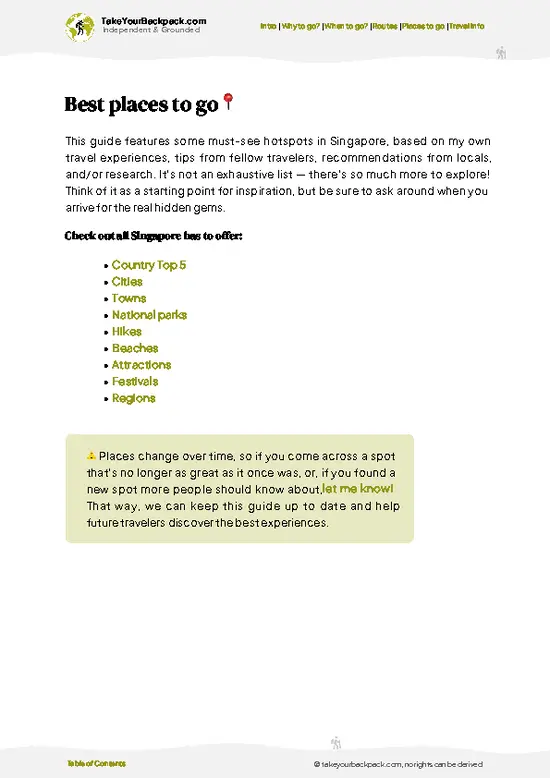
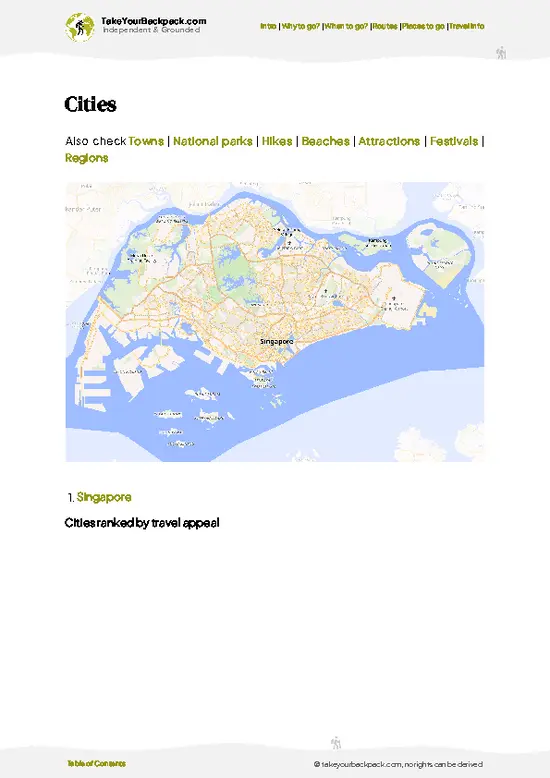
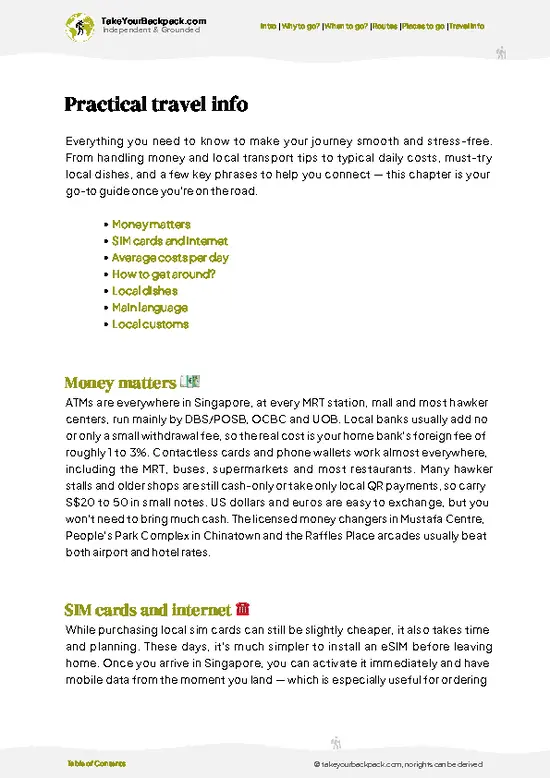
example page 0 from our offline Travel Guide for Singapore
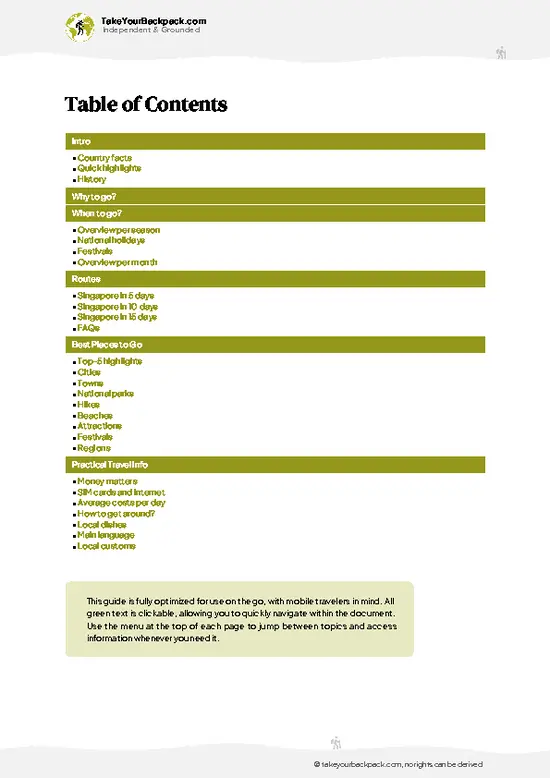
example page 1 from our offline Travel Guide for Singapore
example page 2 from our offline Travel Guide for Singapore
example page 3 from our offline Travel Guide for Singapore
example page 4 from our offline Travel Guide for Singapore
example page 5 from our offline Travel Guide for Singapore
example page 6 from our offline Travel Guide for Singapore
example page 7 from our offline Travel Guide for Singapore
The digital guide (246 pages) contains:
✅ 63 highlights, ranked by travel appeal
✅ Optimized 5, 10 & 15-day travel routes
✅ Cities, national parks, landmarks, beaches
✅ How to get around
✅ Offline-friendly for travel without Wi-Fi
👉 Click to see all 30+ guide features

📅 Plan smarter in minutes, not weeks
✅ Month by month travel advice
✅ Festivals & national holidays
✅ Budget expectations

🗺️ Go to the right places, skip the overrated ones
✅ Honest pros & cons of destinations
✅ Top hikes, parks & viewpoints
✅ Lesser-known places most travelers miss
✅ Clear “worth it vs skip it” guidance

🛏️ Travel smoothly without rookie mistakes
✅ Best areas to stay
✅ Transport systems explained simply
✅ Common scams & safety advice
✅ SIM cards, money & practical tips

🌍 Understand the country, not just visit it
✅ Culture & traditions
✅ Local customs
✅ Festivals worth planning around
✅ Traveler-friendly historical context
✅ Insights that make places more meaningful

📱 Built for real travel conditions
✅ Fully downloadable PDF
✅ Works completely offline
✅ Optimized for phone use
✅ Useful in remote areas & buses
✅ Everything in one place
Stop searching, start planning
Get instant access to your full guide. 30‑day money-back guarantee.
+ Add another guide for just

By proceeding you agree to our terms.
Sent to your inbox immediately after payment • 100% Secure Checkout
Best Backpacking Travel Advisor 2025 tourism awardBest Backpacking
Travel Advisor
2025
What others say about Take Your Backpack Guides:
⭐⭐⭐⭐⭐
Fantastic, amazing amount of information!
⭐⭐⭐⭐⭐
My goodness this is amazing, it's what I've been looking for hats off too you!
⭐⭐⭐⭐⭐
I think this is absolutely BRILLIANT
⭐⭐⭐⭐
Very complete and informative. It's still missing places, but I gotta to commend you
⭐⭐⭐⭐⭐
This is truly amazing, thank you, can't wait to explore it with my kids!
⭐⭐⭐⭐⭐
Awesome resource, thank you!
⭐⭐⭐⭐⭐
This is amazing! Can't wait to explore the ones I haven't seen
⭐⭐⭐⭐
I love this! Well done, great idea.
⭐⭐⭐⭐⭐
Thanks for taking the time to make this gem!
⭐⭐⭐⭐⭐
This might be the best website I've ever seen.
⭐⭐⭐⭐⭐
Congratulations, and thank you so much for your work; it's incredibly valuable.
⭐⭐⭐⭐
In all seriousness I think you did a great job pointing out the important spots
⭐⭐⭐⭐⭐
10/10 very good
⭐⭐⭐⭐⭐
As someone who's only just starting to visit regularly this is awesome, thank you.
⭐⭐⭐⭐
Thank you very much! I'm going to visit my dad, it's going to be very useful!
⭐⭐⭐⭐⭐
This is really cool! We'll be travelling for the first time and this definitely come in handy.
⭐⭐⭐⭐⭐
You are now our minister of culture, congratulations 👨‍💼
⭐⭐⭐⭐⭐
Just wanted to tell you that this is a pearl! Going to follow your recommendations.
⭐⭐⭐⭐⭐
This is so cool. I'll definitely be using the resource for my travels soon.
⭐⭐⭐⭐⭐
This is very impressive! Good work.
⭐⭐⭐⭐⭐
This is an amazing and informative site. Very well done!

🛏️ Where to stay?Where to Stay in Singapore

Singapore has plenty of hostels and capsule-style dorms, with beds typically running S$30 to 60 (about US$22 to 45) a night, and almost all of them sit in a few central districts. Chinatown puts you closest to hawker centers and a short walk or MRT ride from Marina Bay, Little India is the cheapest and noisiest, with crowded streets on weekend nights, and Kampong Glam (around Bugis) has the best bar scene on Haji Lane and Arab Street. If you want quiet, look a few blocks away from Clarke Quay, whose riverside clubs run late. Safety is excellent in every one of these areas.

If you enjoy meeting fellow travelers, consider choosing hostels with high ratings for atmosphere. On the other hand, if … read more 👉
Singapore has plenty of hostels and capsule-style dorms, with beds typically running S$30 to 60 (about US$22 to 45) a night, and almost all of them sit in a few central districts. Chinatown puts you closest to hawker centers and a short walk or MRT ride from Marina Bay, Little India is the cheapest and noisiest, with crowded streets on weekend nights, and Kampong Glam (around Bugis) has the best bar scene on Haji Lane and Arab Street. If you want quiet, look a few blocks away from Clarke Quay, whose riverside clubs run late. Safety is excellent in every one of these areas.

If you enjoy meeting fellow travelers, consider choosing hostels with high ratings for atmosphere. On the other hand, if you prefer having your own space, a hotel might be a better option.

SingaporeMore of Singapore

👋 Meet the founderWho’s Behind Take Your Backpack?

Johan, backpacker and founder of TakeYourBackpackHi, I’m Johan (Netherlands 🇳🇱), the creator of TakeYourBackpack. Over the past 3 decades, I’ve backpacked through 90+ countries across six continents, gaining extensive experience with independent travel, long-term trips, and overland routes.

This site is built on a combination of firsthand travel experience and carefully curated insights from other backpackers. Many guides are based on places I’ve personally visited, while others bring together tips, observations, and practical advice shared by trusted travelers I’ve met along the way.

The goal is to provide realistic, experience-driven guidance — not generic itineraries — so you can explore destinations with better context, clearer expectations, and more confidence.