×

Singapore🇸🇬 | best citiesExplore the Best cities in Singapore

Singapore packs all of its urban centers into one island city-state, so choosing between them means choosing a character, not a destination across long distances. The central core holds the heritage districts, most hostels and the heaviest crowds, with dorm beds at S$35 to 60 (US$26 to 45). The regional centers in the east, west and north are planned towns with fewer visitors and hawker meals at S$4 to 7 (US$3 to 5). Because the island is only about 50 km wide, access is rarely a problem, and independent travel works on a single contactless card. What changes is atmosphere and price.

By Johan Kruseman 🇳🇱 | Updated October 19, 2026
Explore the best towns in Singapore

Why go?Why These city Stand Out

Singapore’s urban appeal comes from planning. A small island of roughly 735 square kilometers with no rural hinterland, it has been designed for density since independence in 1965, and government housing estates, parks and transit were laid out together. The result is a country where every urban area is connected and legible, with the MRT reaching nearly every district and signage in English.
The population is about 5.9 million, and its Chinese, Malay and Indian communities plus a large foreign workforce shape the food, festivals and religious architecture you see across the island. Colonial-era trading history left the oldest districts, while later land reclamation created newer waterfront areas.
Before choosing Singapore for its urban side, know three things. It is hot and humid year-round, … read more 👉
Singapore’s urban appeal comes from planning. A small island of roughly 735 square kilometers with no rural hinterland, it has been designed for density since independence in 1965, and government housing estates, parks and transit were laid out together. The result is a country where every urban area is connected and legible, with the MRT reaching nearly every district and signage in English.
The population is about 5.9 million, and its Chinese, Malay and Indian communities plus a large foreign workforce shape the food, festivals and religious architecture you see across the island. Colonial-era trading history left the oldest districts, while later land reclamation created newer waterfront areas.
Before choosing Singapore for its urban side, know three things. It is hot and humid year-round, around 25 to 32°C with humidity often above 80 percent, so outdoor walking is limited by heat more than distance. It is not a low-cost country, although hawker food keeps daily spending manageable. And it is strictly regulated: fines apply for littering, eating on trains and vaping, and drug laws carry severe penalties. Visitors who accept the rules and the heat find one of Asia’s easiest places to explore independently.
Evaluating the Top Choices
The list of best cities in Singapore is created based on culture, vibe, attractions, transport ease, and local charm. If you feel a city is missing in this list, please let us know.

When to go?When to Plan Your Trip

Best months and why: February to April are the best months, because the wet northeast monsoon has ended, rainfall drops and skies are clearer, with highs of 31 to 33°C. Singapore has no true dry season, and annual rainfall is about 2,000 to 2,400 mm, so showers can arrive in any month. They are usually short afternoon downpours of 30 to 60 minutes, and they cool the air briefly.
Wet and shoulder seasons: November to January is the wettest stretch, with December often receiving 250 to 300 mm and rain lasting longer on some days. Temperatures dip only slightly to around 24 to 30°C. June to August is drier on average and acts as a shoulder season, although it overlaps with school holidays. From August to October, smoke from fires in neighboring Indonesia can cause haze in some years, which affects … read more 👉
Best months and why: February to April are the best months, because the wet northeast monsoon has ended, rainfall drops and skies are clearer, with highs of 31 to 33°C. Singapore has no true dry season, and annual rainfall is about 2,000 to 2,400 mm, so showers can arrive in any month. They are usually short afternoon downpours of 30 to 60 minutes, and they cool the air briefly.
Wet and shoulder seasons: November to January is the wettest stretch, with December often receiving 250 to 300 mm and rain lasting longer on some days. Temperatures dip only slightly to around 24 to 30°C. June to August is drier on average and acts as a shoulder season, although it overlaps with school holidays. From August to October, smoke from fires in neighboring Indonesia can cause haze in some years, which affects air quality and outdoor plans.
Peak periods and prices: Hotel rates rise most during the Formula 1 Singapore Grand Prix weekend, usually in September or October, when rooms can cost 50 to 100 percent more. Chinese New Year in late January or February brings festive decorations and crowds, and some family-run food stalls close for 2 to 5 days. December and June school holidays lift prices for hostels and hotels by roughly 10 to 30 percent. Shopping sales peak around the Great Singapore Sale in summer.

city hoppingTips for Visiting Multiple Destinations

How long a multi-area trip takes: A trip combining several urban areas in Singapore needs 3 to 5 days, because each stop takes half a day to a full day and heat limits how much you can fit in. The island is compact, so the real constraint is energy, not distance.
Grouping and direction: The central core clusters closely, with most areas within 10 to 20 minutes of each other by MRT. The east, west and north are each 25 to 45 minutes from the center, and moving directly between east and west can take 50 to 70 minutes. The sensible pattern is to start near Changi Airport in the east, which is about 30 to 40 minutes from the core, then spend the middle of the trip in the center, and finish in the west or north on a single outward leg. Interchanges such as City Hall, Dhoby Ghaut and Outram Park … read more 👉
How long a multi-area trip takes: A trip combining several urban areas in Singapore needs 3 to 5 days, because each stop takes half a day to a full day and heat limits how much you can fit in. The island is compact, so the real constraint is energy, not distance.
Grouping and direction: The central core clusters closely, with most areas within 10 to 20 minutes of each other by MRT. The east, west and north are each 25 to 45 minutes from the center, and moving directly between east and west can take 50 to 70 minutes. The sensible pattern is to start near Changi Airport in the east, which is about 30 to 40 minutes from the core, then spend the middle of the trip in the center, and finish in the west or north on a single outward leg. Interchanges such as City Hall, Dhoby Ghaut and Outram Park make transfers easy.
Planning mistakes: The most common error is zigzagging across the island, which wastes hours. Group stops by MRT line instead. Another is traveling during the weekday rush, roughly 7:30 to 9:30 am and 5:30 to 7:30 pm, when trains are packed. Plan outdoor stops for morning or after 4 pm, and keep air-conditioned museums or malls for the midday heat between 12 and 3 pm.

The ListHighly Recommended cities of Singapore

1 Singapore

hawker centers, Marina Bay skyline, multicultural quarters, urban gardens

Navigate a city where diverse neighborhoods, efficient transport, and green spaces intersect, offering distinct local flavors and city views at every turn.

Singapore - Singapore
Loading the map 🌍

Expert viewInsights from Locals and Experts

How many to visit: Three to four distinct urban areas over a 4 to 5 day stay is the right number. Each deserves half a day to a full day, and humidity of 80 percent or more drains energy faster than most visitors expect. Packing in six or seven leaves you tired and seeing little beyond train platforms.
Which kind for which style: Match the type of area to how you travel. Heritage and food districts suit budget travelers, because hawker centers serve meals for S$4 to 8 (US$3 to 6) and many streets are free to walk. Modern waterfront and garden areas suit first-timers who want landmark views, but ticketed attractions add up fast. Residential regional centers suit repeat visitors and anyone who wants everyday life, with cheaper food and almost no tour groups. A balanced mix is one from each type. … read more 👉
How many to visit: Three to four distinct urban areas over a 4 to 5 day stay is the right number. Each deserves half a day to a full day, and humidity of 80 percent or more drains energy faster than most visitors expect. Packing in six or seven leaves you tired and seeing little beyond train platforms.
Which kind for which style: Match the type of area to how you travel. Heritage and food districts suit budget travelers, because hawker centers serve meals for S$4 to 8 (US$3 to 6) and many streets are free to walk. Modern waterfront and garden areas suit first-timers who want landmark views, but ticketed attractions add up fast. Residential regional centers suit repeat visitors and anyone who wants everyday life, with cheaper food and almost no tour groups. A balanced mix is one from each type. If you have only 2 to 3 days, skip the regional centers and stay in the core.
Budget figures: A backpacker spending carefully can manage S$90 to 140 a day (US$68 to 105). A typical breakdown: dorm bed S$35 to 60 (US$26 to 45), hawker meals S$15 to 25 (US$11 to 19) for the day, and MRT or bus fares of S$6 to 12 (US$4.50 to 9). Entry fees vary widely. Many districts, parks and temples are free, museums run S$10 to 25 (US$7.50 to 19), and headline attractions can be S$25 to 50 (US$19 to 38). Guided walking tours cost S$30 to 60 (US$22 to 45), with free tip-based options in the core. Restaurant and bar bills often carry a 10 percent service charge plus 9 percent GST, shown as “++” on menus. Tipping is not expected. Alcohol is heavily taxed, with a beer at a bar costing S$12 to 18 (US$9 to 13.50), so buying from shops or skipping it saves a lot.
Safety and cultural considerations: Violent crime and petty theft are rare, and solo travelers, including women at night, generally find it very safe. The real risks are legal and environmental. Fines of up to S$500 apply for eating or drinking on MRT trains, and smoking is banned in most public areas. Vaping is illegal, and bringing in e-cigarettes can bring heavy penalties. Drug offenses can carry the death penalty. Public drinking is restricted between 10:30 pm and 7 am. Jaywalking near crossings is fined.
On the health side, heatstroke and dehydration are far more likely problems than crime, so carry water and use shade. Dengue occurs year-round, so repellent is worthwhile.
Cultural etiquette matters in the mixed religious areas. Remove shoes before entering temples, mosques and many homes, cover shoulders and knees at places of worship, and avoid pointing with a finger at people or sacred objects. Queue politely and give up MRT priority seats to those who need them.

✈️ The backpacker research shortcutSingapore Travel Guide

An offline-friendly backpacking guide with optimized travel routes, ranked highlights, transport advice, and the best areas to stay.
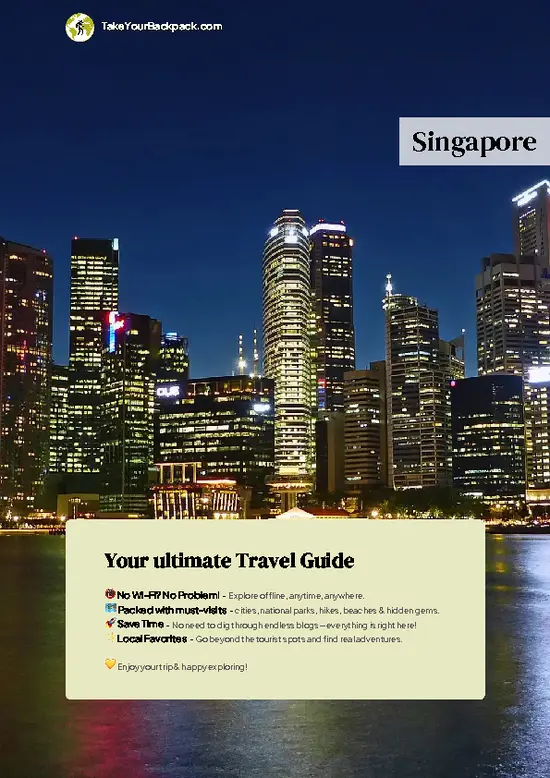
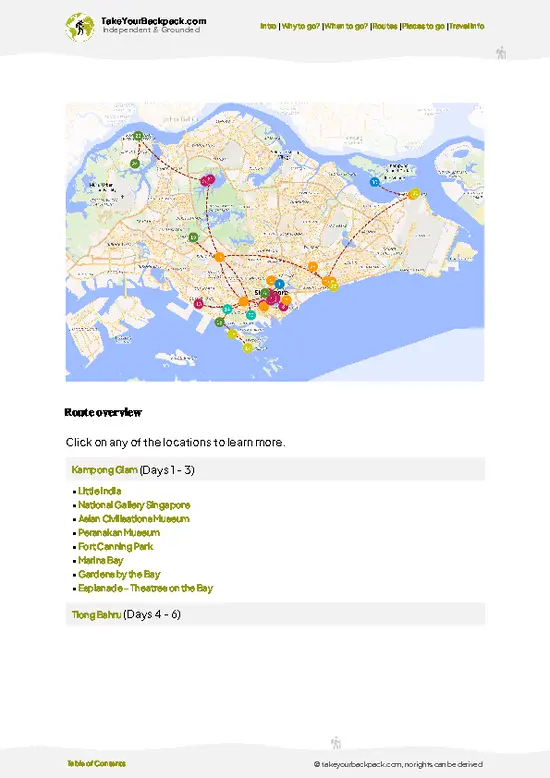
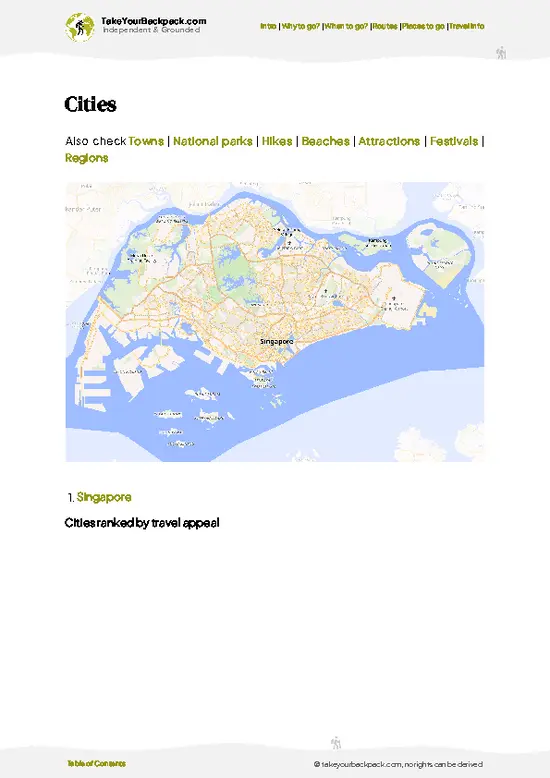
example page 0 from our offline Travel Guide for Singapore
example page 1 from our offline Travel Guide for Singapore
example page 2 from our offline Travel Guide for Singapore
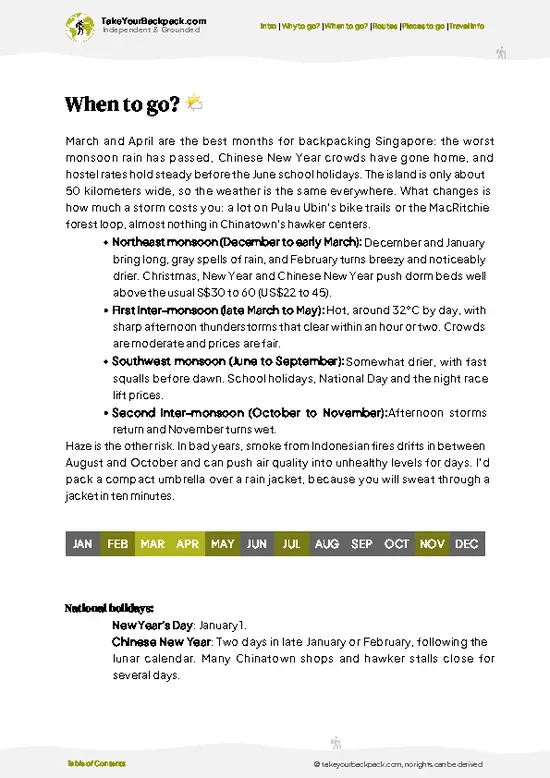
example page 3 from our offline Travel Guide for Singapore
example page 4 from our offline Travel Guide for Singapore
example page 5 from our offline Travel Guide for Singapore
example page 6 from our offline Travel Guide for Singapore
example page 7 from our offline Travel Guide for Singapore
The digital guide (246 pages) contains:
✅ 63 highlights, ranked by travel appeal
✅ Optimized 5, 10 & 15-day travel routes
✅ Cities, national parks, landmarks, beaches
✅ How to get around
✅ Offline-friendly for travel without Wi-Fi
👉 Click to see all 30+ guide features

📅 Plan smarter in minutes, not weeks
✅ Month by month travel advice
✅ Festivals & national holidays
✅ Budget expectations

🗺️ Go to the right places, skip the overrated ones
✅ Honest pros & cons of destinations
✅ Top hikes, parks & viewpoints
✅ Lesser-known places most travelers miss
✅ Clear “worth it vs skip it” guidance

🛏️ Travel smoothly without rookie mistakes
✅ Best areas to stay
✅ Transport systems explained simply
✅ Common scams & safety advice
✅ SIM cards, money & practical tips

🌍 Understand the country, not just visit it
✅ Culture & traditions
✅ Local customs
✅ Festivals worth planning around
✅ Traveler-friendly historical context
✅ Insights that make places more meaningful

📱 Built for real travel conditions
✅ Fully downloadable PDF
✅ Works completely offline
✅ Optimized for phone use
✅ Useful in remote areas & buses
✅ Everything in one place
Stop searching, start planning
Get instant access to your full guide. 30‑day money-back guarantee.
+ Add another guide for just

By proceeding you agree to our terms.
Sent to your inbox immediately after payment • 100% Secure Checkout
Best Backpacking Travel Advisor 2025 tourism awardBest Backpacking
Travel Advisor
2025
What others say about Take Your Backpack Guides:
⭐⭐⭐⭐⭐
Fantastic, amazing amount of information!
⭐⭐⭐⭐⭐
My goodness this is amazing, it's what I've been looking for hats off too you!
⭐⭐⭐⭐⭐
I think this is absolutely BRILLIANT
⭐⭐⭐⭐
Very complete and informative. It's still missing places, but I gotta to commend you
⭐⭐⭐⭐⭐
This is truly amazing, thank you, can't wait to explore it with my kids!
⭐⭐⭐⭐⭐
Awesome resource, thank you!
⭐⭐⭐⭐⭐
This is amazing! Can't wait to explore the ones I haven't seen
⭐⭐⭐⭐
I love this! Well done, great idea.
⭐⭐⭐⭐⭐
Thanks for taking the time to make this gem!
⭐⭐⭐⭐⭐
This might be the best website I've ever seen.
⭐⭐⭐⭐⭐
Congratulations, and thank you so much for your work; it's incredibly valuable.
⭐⭐⭐⭐
In all seriousness I think you did a great job pointing out the important spots
⭐⭐⭐⭐⭐
10/10 very good
⭐⭐⭐⭐⭐
As someone who's only just starting to visit regularly this is awesome, thank you.
⭐⭐⭐⭐
Thank you very much! I'm going to visit my dad, it's going to be very useful!
⭐⭐⭐⭐⭐
This is really cool! We'll be travelling for the first time and this definitely come in handy.
⭐⭐⭐⭐⭐
You are now our minister of culture, congratulations 👨‍💼
⭐⭐⭐⭐⭐
Just wanted to tell you that this is a pearl! Going to follow your recommendations.
⭐⭐⭐⭐⭐
This is so cool. I'll definitely be using the resource for my travels soon.
⭐⭐⭐⭐⭐
This is very impressive! Good work.
⭐⭐⭐⭐⭐
This is an amazing and informative site. Very well done!

🛏️ Where to stay?Where to Stay: Singapore Edition

Singapore has plenty of hostels and capsule-style dorms, with beds typically running S$30 to 60 (about US$22 to 45) a night, and almost all of them sit in a few central districts. Chinatown puts you closest to hawker centers and a short walk or MRT ride from Marina Bay, Little India is the cheapest and noisiest, with crowded streets on weekend nights, and Kampong Glam (around Bugis) has the best bar scene on Haji Lane and Arab Street. If you want quiet, look a few blocks away from Clarke Quay, whose riverside clubs run late. Safety is excellent in every one of these areas.

If you enjoy meeting fellow travelers, consider choosing hostels with high ratings for atmosphere. On the other hand, if … read more 👉
Singapore has plenty of hostels and capsule-style dorms, with beds typically running S$30 to 60 (about US$22 to 45) a night, and almost all of them sit in a few central districts. Chinatown puts you closest to hawker centers and a short walk or MRT ride from Marina Bay, Little India is the cheapest and noisiest, with crowded streets on weekend nights, and Kampong Glam (around Bugis) has the best bar scene on Haji Lane and Arab Street. If you want quiet, look a few blocks away from Clarke Quay, whose riverside clubs run late. Safety is excellent in every one of these areas.

If you enjoy meeting fellow travelers, consider choosing hostels with high ratings for atmosphere. On the other hand, if you prefer having your own space, a hotel might be a better option.

SingaporeExplore Beyond This Category

👋 Meet the founderWho’s Behind Take Your Backpack?

Johan, backpacker and founder of TakeYourBackpackHi, I’m Johan (Netherlands 🇳🇱), the creator of TakeYourBackpack. Over the past 3 decades, I’ve backpacked through 90+ countries across six continents, gaining extensive experience with independent travel, long-term trips, and overland routes.

This site is built on a combination of firsthand travel experience and carefully curated insights from other backpackers. Many guides are based on places I’ve personally visited, while others bring together tips, observations, and practical advice shared by trusted travelers I’ve met along the way.

The goal is to provide realistic, experience-driven guidance — not generic itineraries — so you can explore destinations with better context, clearer expectations, and more confidence.