×

Solomon Islands🇸🇧 | best beachesTop-Rated 4 beaches in Solomon Islands

Beaches in Solomon Islands are rarely a resort product. Expect coral sand that squeaks underfoot, palm shade, woodsmoke drifting from kitchen huts and canoes hauled up above the tideline. Around Honiara on Guadalcanal, black volcanic sand and WWII wreck-strewn shallows sit a short taxi ride from town. In Western Province and Malaita, the best stretches sit on lagoon islands reached by boat, with basic village stays and no crowds. Costs rise with every transfer. Independent travel works if you accept irregular boats, cash-only payments and local customs, and the reward is a whole beach to yourself.

By Johan Kruseman 🇳🇱 | Updated October 23, 2026
Explore the best attractions in Solomon Islands

Why go?Why Travelers Love These Spots

Solomon Islands has around 900 islands scattered across the western Pacific, and that geography is the whole story. Long barrier reefs and sheltered lagoons mean calm, clear water close to shore, with coral gardens starting a few strokes from the sand. Tourism infrastructure is thin, so beaches stay quiet, but it also means no lifeguards, no beach bars and few signs. Most shoreline belongs to customary landowners, not the state. Access is negotiated with the village, usually through a small fee, and a visit is a courtesy exchange as much as a swim. History adds another layer, because the Guadalcanal campaign of 1942 to 43 left rusting wrecks, landing craft and relics in shallow water, which is rare for a beach country. Climate is hot and humid year-round, with water around 28 to 30°C, but … read more 👉
Solomon Islands has around 900 islands scattered across the western Pacific, and that geography is the whole story. Long barrier reefs and sheltered lagoons mean calm, clear water close to shore, with coral gardens starting a few strokes from the sand. Tourism infrastructure is thin, so beaches stay quiet, but it also means no lifeguards, no beach bars and few signs. Most shoreline belongs to customary landowners, not the state. Access is negotiated with the village, usually through a small fee, and a visit is a courtesy exchange as much as a swim. History adds another layer, because the Guadalcanal campaign of 1942 to 43 left rusting wrecks, landing craft and relics in shallow water, which is rare for a beach country. Climate is hot and humid year-round, with water around 28 to 30°C, but cyclones, sudden squalls and heavy rain can cancel boats. Before choosing it, accept that flights are domestic and pricey, that malaria is present so prophylaxis matters, and that saltwater crocodiles live in some estuaries and lagoons, so ask locals where swimming is safe. Cash is the currency of everything, and ATMs vanish outside Honiara and a few provincial centers.
Our Approach to Ranking
The list of best beaches in Solomon Islands is created based on beauty, vibe, water quality, activities, and surrounding scenery. If you feel a beach is missing in this list, please let us know.

When to go?Best Time to Visit Solomon Islands for beaches

Best months for beach time: The best months are May to October, when the southeast trade winds bring lower humidity, less rain and calmer skies than the wet season. Daytime highs sit around 29 to 31°C, nights drop to about 23 to 25°C, and sea temperature stays roughly 28°C. Mornings are often glassy and clear, which is when snorkeling visibility peaks.Wet season and shoulder months: From November to April the air turns thick and sticky, with afternoon downpours and a cyclone risk, peaking from about January to March. Annual rainfall around Honiara is roughly 2,000 mm, but far more falls on the weather side of islands, and the south coasts of Guadalcanal and Malaita can be wet and rough in the trade-wind months. Western Province lagoons usually stay more sheltered. April and November are workable … read more 👉
Best months for beach time: The best months are May to October, when the southeast trade winds bring lower humidity, less rain and calmer skies than the wet season. Daytime highs sit around 29 to 31°C, nights drop to about 23 to 25°C, and sea temperature stays roughly 28°C. Mornings are often glassy and clear, which is when snorkeling visibility peaks.Wet season and shoulder months: From November to April the air turns thick and sticky, with afternoon downpours and a cyclone risk, peaking from about January to March. Annual rainfall around Honiara is roughly 2,000 mm, but far more falls on the weather side of islands, and the south coasts of Guadalcanal and Malaita can be wet and rough in the trade-wind months. Western Province lagoons usually stay more sheltered. April and November are workable shoulder months, with fewer visitors and some showers. Boat cancellations and muddy tracks increase in the wet season.Crowds and prices: Solomon Islands never gets truly crowded. Dive operators and guesthouses are busiest from June to September, and then a bed in the provinces can be hard to find at short notice. Rates barely change by season, so the real cost of the wet months is lost time to delays, not cheaper stays. Church holidays and Independence Day on July 7 can affect transport schedules.

beach hoppingHow to Combine beaches Into One Trip

How long a multi-beach trip takes: A trip linking several beaches needs 10 to 16 days, because boats and flights set the pace, not distance. Honiara is the only practical hub, and everything radiates from it. Western Province is reached by Solomon Airlines flights from Honiara to Munda or Gizo, around 1 to 1.5 hours. Malaita is a fast-boat or short-flight hop, and the Florida Islands sit across the sound from Honiara.Grouping regions and direction: Cluster by water. Guadalcanal, Malaita and the Floridas combine easily with short boat rides of about 1 to 3 hours. Western Province needs its own block, with Munda and Gizo linked by boats of 1.5 to 3 hours. A sensible direction is to start near Honiara to adjust to heat and cash logistics, then fly west and finish in the lagoons, so your long … read more 👉
How long a multi-beach trip takes: A trip linking several beaches needs 10 to 16 days, because boats and flights set the pace, not distance. Honiara is the only practical hub, and everything radiates from it. Western Province is reached by Solomon Airlines flights from Honiara to Munda or Gizo, around 1 to 1.5 hours. Malaita is a fast-boat or short-flight hop, and the Florida Islands sit across the sound from Honiara.Grouping regions and direction: Cluster by water. Guadalcanal, Malaita and the Floridas combine easily with short boat rides of about 1 to 3 hours. Western Province needs its own block, with Munda and Gizo linked by boats of 1.5 to 3 hours. A sensible direction is to start near Honiara to adjust to heat and cash logistics, then fly west and finish in the lagoons, so your long flight home leaves from a regional hub with a buffer.Pacing and planning mistakes: Allow 3 to 5 nights per region and at least two nights at each remote village stay, since arrival days vanish into waiting for boats. The common mistake is packing in tight connections. Flights are cancelled or rescheduled, and small boats leave when full, so leave a spare day before any international departure. Another is arriving without enough cash. Withdraw in Honiara, carry small notes, and confirm pickups by phone a day ahead. Pack dry bags, because spray and sudden squalls soak everything.

The ListHighly Recommended beaches of Solomon Islands

1 Uepi Island

Reef wall, Marovo Lagoon, night snorkel, woodcarving villages

Swim a few strokes past shallow coral to a sheer drop-off, dive the lagoon walls, and visit carvers in nearby villages.

2 Nusa Tupe

Western Province, house reef, starry nights, near Gizo

Wade into sheltered shallows to snorkel giant clams, kayak the flat lagoon, and use the island as a quiet base for Gizo wreck dives.

3 Marau Sound

Sheltered lagoon, island hopping by boat, dugout canoes, copper dusk

Paddle a dugout between sandbars and mangrove edges, snorkel the coral shallows, then eat fish and sweet potato in a village kitchen.

4 Mbabanga Island

House reef, calm lagoon, Sanbis Resort, kayaking, night sky

Slip into clear lagoon shallows where coral starts a short swim from the sand, then paddle the island’s mangrove edge toward Gizo’s hills.

solomon-islands-beach-mbabanga-island
© Google |
Loading the map 🌍

Expert viewExpert Commentary on beaches

How many beaches to visit: Plan on three to five beach stays in total, not a long checklist. Each remote stay costs a day in transit, and the pleasure comes from staying put: dawn light on a flat lagoon, the click of hermit crabs, a fish grilled over coals at dusk. Two nights minimum lets the place sink in. Anything beyond five turns the trip into waiting rooms and wharves.Which kind suits which traveler: Divers and snorkelers should prioritize lagoon islands in Western Province, where coral and wrecks sit just offshore. History-minded travelers get more from the Guadalcanal coast, with war relics in the shallows and easy day trips. Anyone on a tight budget or with limited time should lean on beaches within reach of Honiara, because transfers are the biggest cost. Culture seekers will enjoy … read more 👉
How many beaches to visit: Plan on three to five beach stays in total, not a long checklist. Each remote stay costs a day in transit, and the pleasure comes from staying put: dawn light on a flat lagoon, the click of hermit crabs, a fish grilled over coals at dusk. Two nights minimum lets the place sink in. Anything beyond five turns the trip into waiting rooms and wharves.Which kind suits which traveler: Divers and snorkelers should prioritize lagoon islands in Western Province, where coral and wrecks sit just offshore. History-minded travelers get more from the Guadalcanal coast, with war relics in the shallows and easy day trips. Anyone on a tight budget or with limited time should lean on beaches within reach of Honiara, because transfers are the biggest cost. Culture seekers will enjoy Malaita, where beach stays come with village life, shell-money traditions and slow canoe rides.What it costs: Budget about US$45 to 90 a day (roughly SBD 380 to 750) on a basic plan, using guesthouses, village stays and shared boats. Village homestays run about US$15 to 35 a night with meals often included. Landowner or access fees are usually US$2 to 10 per visit. Local guides for snorkeling or reef walks cost US$10 to 30. Boat transfers range from about US$15 to 100 depending on distance, and a charter is far more. Domestic flights often cost US$100 to 250 a sector. Bring more cash than seems sensible, since card use is rare.Safety and customs: Ask the village before swimming, setting up a hammock or taking photos, as the shore is customary land. Pay fees in person, to the right person, and expect a short chat first. Dress modestly away from town: shorts and a T-shirt over swimwear when walking through villages, and no topless sunbathing. Never swim in river mouths, murky lagoons or at dusk, because saltwater crocodiles are present in parts of the country. Strong currents run through reef passes, and there are no lifeguards. Take malaria prophylaxis, repellent and reef-safe sun protection, plus a basic first-aid kit, since clinics are far apart. One practical note: sandflies bite at dawn and dusk, so long sleeves on the sand save your trip.

✈️ The backpacker research shortcutSolomon Islands Travel Guide

An offline-friendly backpacking guide with optimized travel routes, ranked highlights, transport advice, and the best areas to stay.
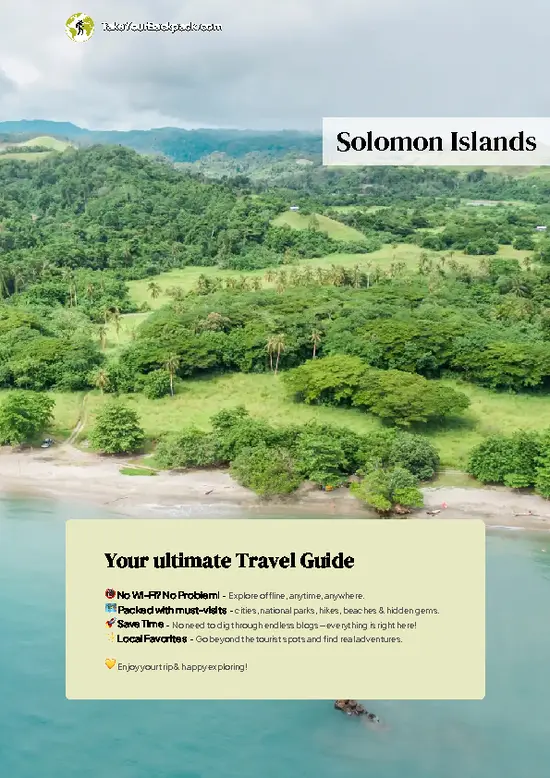
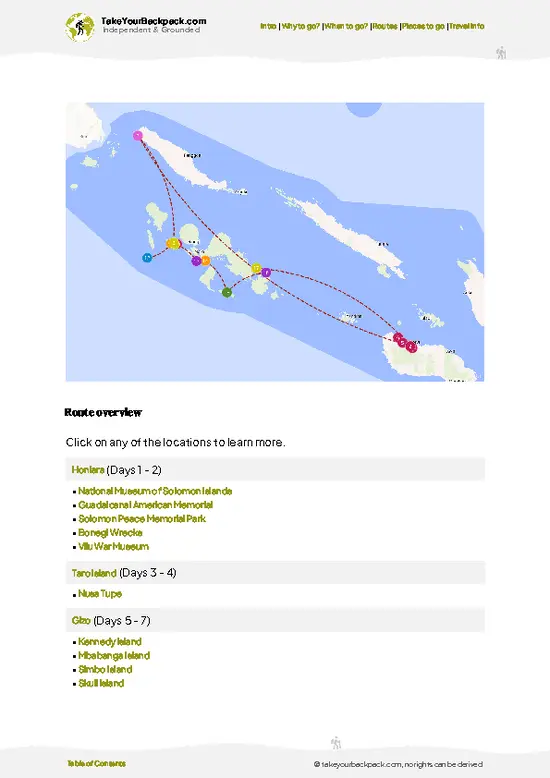
example page 0 from our offline Travel Guide for Solomon Islands
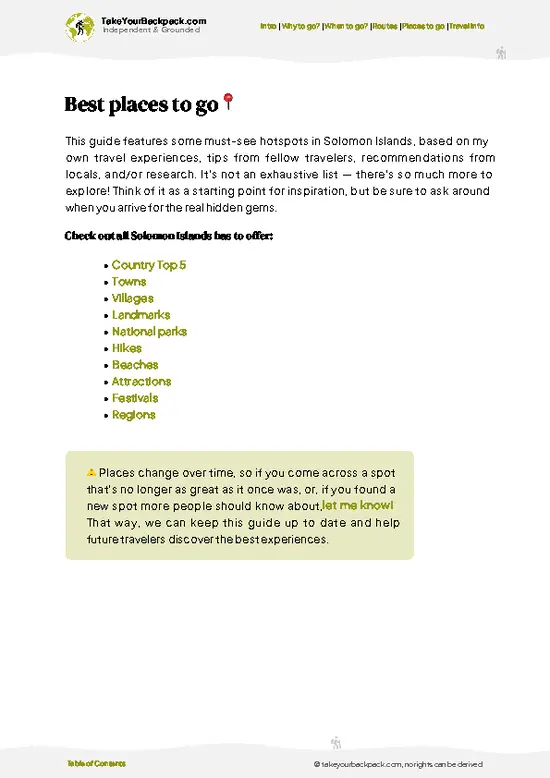
example page 1 from our offline Travel Guide for Solomon Islands
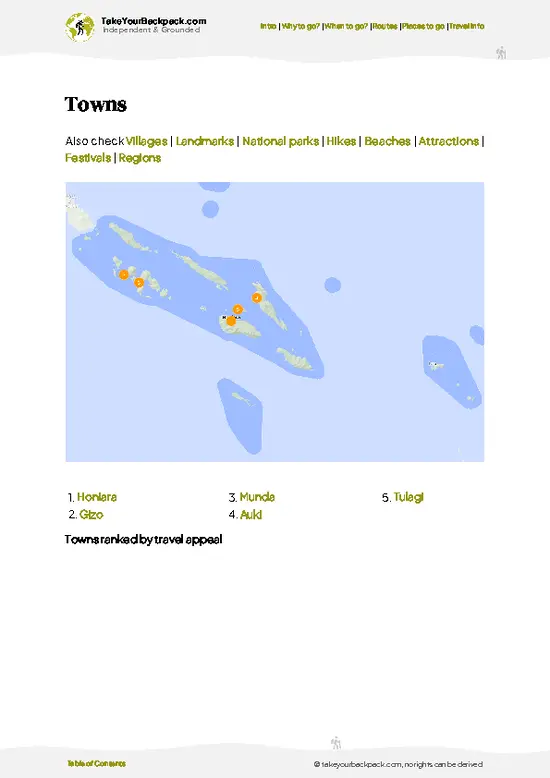
example page 2 from our offline Travel Guide for Solomon Islands
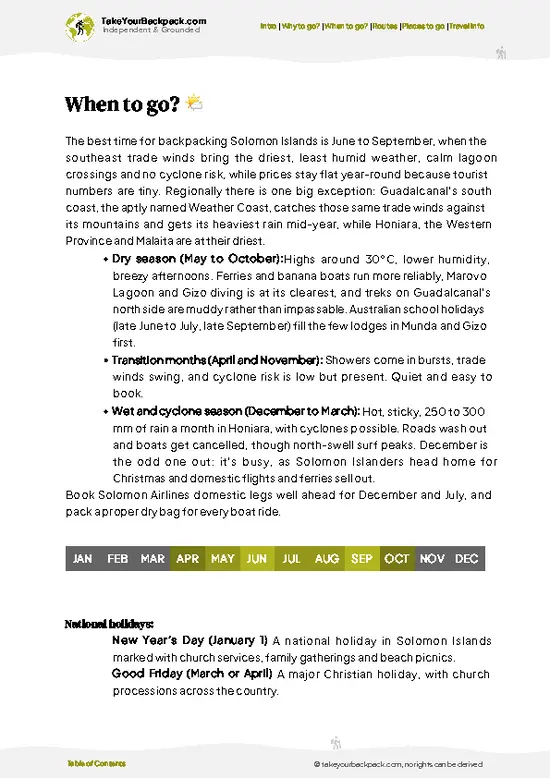
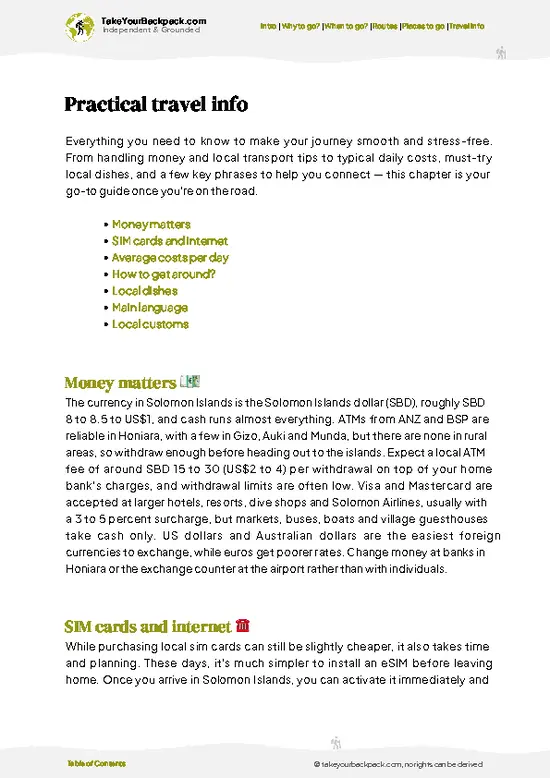
example page 3 from our offline Travel Guide for Solomon Islands
example page 4 from our offline Travel Guide for Solomon Islands
example page 5 from our offline Travel Guide for Solomon Islands
example page 6 from our offline Travel Guide for Solomon Islands
example page 7 from our offline Travel Guide for Solomon Islands
The digital guide (145 pages) contains:
✅ 33 highlights, ranked by travel appeal
✅ Optimized 5, 10 & 15-day travel routes
✅ Cities, national parks, landmarks, beaches
✅ How to get around
✅ Offline-friendly for travel without Wi-Fi
👉 Click to see all 30+ guide features

📅 Plan smarter in minutes, not weeks
✅ Month by month travel advice
✅ Festivals & national holidays
✅ Budget expectations

🗺️ Go to the right places, skip the overrated ones
✅ Honest pros & cons of destinations
✅ Top hikes, parks & viewpoints
✅ Lesser-known places most travelers miss
✅ Clear “worth it vs skip it” guidance

🛏️ Travel smoothly without rookie mistakes
✅ Best areas to stay
✅ Transport systems explained simply
✅ Common scams & safety advice
✅ SIM cards, money & practical tips

🌍 Understand the country, not just visit it
✅ Culture & traditions
✅ 52 Essential phrases & customs
✅ Festivals worth planning around
✅ Traveler-friendly historical context
✅ Insights that make places more meaningful

📱 Built for real travel conditions
✅ Fully downloadable PDF
✅ Works completely offline
✅ Optimized for phone use
✅ Useful in remote areas & buses
✅ Everything in one place
Stop searching, start planning
Get instant access to your full guide. 30‑day money-back guarantee.
+ Add another guide for just

By proceeding you agree to our terms.
Sent to your inbox immediately after payment • 100% Secure Checkout
Best Backpacking Travel Advisor 2025 tourism awardBest Backpacking
Travel Advisor
2025
What others say about Take Your Backpack Guides:
⭐⭐⭐⭐⭐
Fantastic, amazing amount of information!
⭐⭐⭐⭐⭐
My goodness this is amazing, it's what I've been looking for hats off too you!
⭐⭐⭐⭐⭐
I think this is absolutely BRILLIANT
⭐⭐⭐⭐
Very complete and informative. It's still missing places, but I gotta to commend you
⭐⭐⭐⭐⭐
This is truly amazing, thank you, can't wait to explore it with my kids!
⭐⭐⭐⭐⭐
Awesome resource, thank you!
⭐⭐⭐⭐⭐
This is amazing! Can't wait to explore the ones I haven't seen
⭐⭐⭐⭐
I love this! Well done, great idea.
⭐⭐⭐⭐⭐
Thanks for taking the time to make this gem!
⭐⭐⭐⭐⭐
This might be the best website I've ever seen.
⭐⭐⭐⭐⭐
Congratulations, and thank you so much for your work; it's incredibly valuable.
⭐⭐⭐⭐
In all seriousness I think you did a great job pointing out the important spots
⭐⭐⭐⭐⭐
10/10 very good
⭐⭐⭐⭐⭐
As someone who's only just starting to visit regularly this is awesome, thank you.
⭐⭐⭐⭐
Thank you very much! I'm going to visit my dad, it's going to be very useful!
⭐⭐⭐⭐⭐
This is really cool! We'll be travelling for the first time and this definitely come in handy.
⭐⭐⭐⭐⭐
You are now our minister of culture, congratulations 👨‍💼
⭐⭐⭐⭐⭐
Just wanted to tell you that this is a pearl! Going to follow your recommendations.
⭐⭐⭐⭐⭐
This is so cool. I'll definitely be using the resource for my travels soon.
⭐⭐⭐⭐⭐
This is very impressive! Good work.
⭐⭐⭐⭐⭐
This is an amazing and informative site. Very well done!

🛏️ Where to stay?Best Stay Options in Solomon Islands

True dorm-style hostels are rare in the Solomon Islands, so budget travel here usually means simple family guesthouses and church-run lodges at roughly SI$300 to 600 (US$35 to 70) a night for a room, with traditional leaf-hut ecolodges taking over in the provinces. In Honiara, Point Cruz puts you closest to the Central Market, the museum and the few bars that stay open late, but it gets congested by day and is best avoided on foot after dark, while the hillside streets of Lengakiki and Vura are quieter and cooler at the cost of a bus or taxi ride into town. Outside the capital, Gizo has the widest spread of budget guesthouses near the dive shops and waterfront, and Munda offers lagoon-side lodges … read more 👉
True dorm-style hostels are rare in the Solomon Islands, so budget travel here usually means simple family guesthouses and church-run lodges at roughly SI$300 to 600 (US$35 to 70) a night for a room, with traditional leaf-hut ecolodges taking over in the provinces. In Honiara, Point Cruz puts you closest to the Central Market, the museum and the few bars that stay open late, but it gets congested by day and is best avoided on foot after dark, while the hillside streets of Lengakiki and Vura are quieter and cooler at the cost of a bus or taxi ride into town. Outside the capital, Gizo has the widest spread of budget guesthouses near the dive shops and waterfront, and Munda offers lagoon-side lodges that are very quiet with almost no nightlife.

If you enjoy meeting fellow travelers, consider choosing hostels with high ratings for atmosphere. On the other hand, if you prefer having your own space, a hotel might be a better option.

Solomon IslandsWhere to Go Next

👋 Meet the founderWho’s Behind Take Your Backpack?

Johan, backpacker and founder of TakeYourBackpackHi, I’m Johan (Netherlands 🇳🇱), the creator of TakeYourBackpack. Over the past 3 decades, I’ve backpacked through 90+ countries across six continents, gaining extensive experience with independent travel, long-term trips, and overland routes.

This site is built on a combination of firsthand travel experience and carefully curated insights from other backpackers. Many guides are based on places I’ve personally visited, while others bring together tips, observations, and practical advice shared by trusted travelers I’ve met along the way.

The goal is to provide realistic, experience-driven guidance — not generic itineraries — so you can explore destinations with better context, clearer expectations, and more confidence.