×

Solomon Islands🇸🇧 | best villagesTop-Rated villages in Solomon Islands

Villages in Solomon Islands are not tourist stops. They are where most of the 700,000 or so people live, in leaf-roofed houses of sago palm thatch and woven walls, on coral shores where pigs root under coconut trees and smoke from cooking fires drifts over the lagoon. Atmosphere changes by province: Western Province has dive-and-lodge villages with simple guesthouses, Malaita has proud, traditional communities, and Makira and Temotu are remote and quiet. Costs stay low but transport is slow and irregular, so independent travel and backpacking here mean boats, patience and cash. Crowds barely exist.

By Johan Kruseman 🇳🇱 | Updated October 23, 2026
Explore the best landmarks in Solomon Islands

Why go?Why Travelers Love These Spots

Solomon Islands suits village travel because village life is still the main way of living, not a staged display. About 80 percent of people live rurally, and most land is held under customary ownership by clans, so nothing is built or visited without a community's agreement. That shapes everything: you arrive by canoe or small boat, ask permission, and are fed taro, cassava, fish and coconut cooked over fire. Over 70 languages are spoken across hundreds of islands, so customs, dress and carving change from one lagoon to the next. Geography does the rest. Rainforest ridges, reef passages and volcanic cones keep communities apart, which protects local traditions but makes movement hard. The infrastructure is thin. Roads outside Honiara and Auki are rough, ferries and small flights run on loose … read more 👉
Solomon Islands suits village travel because village life is still the main way of living, not a staged display. About 80 percent of people live rurally, and most land is held under customary ownership by clans, so nothing is built or visited without a community's agreement. That shapes everything: you arrive by canoe or small boat, ask permission, and are fed taro, cassava, fish and coconut cooked over fire. Over 70 languages are spoken across hundreds of islands, so customs, dress and carving change from one lagoon to the next. Geography does the rest. Rainforest ridges, reef passages and volcanic cones keep communities apart, which protects local traditions but makes movement hard. The infrastructure is thin. Roads outside Honiara and Auki are rough, ferries and small flights run on loose schedules, and mobile coverage drops out fast. Expect humid heat, mosquitoes, and nights lit only by stars and kerosene lamps. Before choosing this country, know that accommodation is usually basic village stays or small lodges, often with rainwater showers and shared toilets, and that you pay fees directly to the community. Bring small notes in Solomon dollars, because there are no ATMs beyond the main towns. Respect for kastom, the local customary law, matters more than any schedule.
Behind the Scenes of Selection
The list of best villages in Solomon Islands is created based on authenticity, scenic beauty, community spirit, traditions, and overall character. If you feel a village is missing in this list, please let us know.

When to go?Best Time to Visit Solomon Islands for villages

Best months for village visits: The best months are May to October, when the drier southeast trade winds cut humidity and rain, and boat crossings are more reliable. Days sit around 28 to 31°C, nights drop to 23 to 25°C, and the air feels less sticky than the wet months. The southeast trades can make open water choppy, particularly on exposed routes along the south coasts, so small boats sometimes wait for calmer mornings.
Wet season and cyclone risk: From November to April the northwest monsoon brings heavy downpours, with annual rainfall of roughly 3,000 to 5,000 mm in many areas. Trails turn to red mud, rivers rise, and the afternoon smell of wet leaves and woodsmoke hangs thick. Cyclones can occur, mostly between January and March, and can cancel boats and flights for days. Mosquitoes peak … read more 👉
Best months for village visits: The best months are May to October, when the drier southeast trade winds cut humidity and rain, and boat crossings are more reliable. Days sit around 28 to 31°C, nights drop to 23 to 25°C, and the air feels less sticky than the wet months. The southeast trades can make open water choppy, particularly on exposed routes along the south coasts, so small boats sometimes wait for calmer mornings.
Wet season and cyclone risk: From November to April the northwest monsoon brings heavy downpours, with annual rainfall of roughly 3,000 to 5,000 mm in many areas. Trails turn to red mud, rivers rise, and the afternoon smell of wet leaves and woodsmoke hangs thick. Cyclones can occur, mostly between January and March, and can cancel boats and flights for days. Mosquitoes peak in this period too.
Shoulder periods and crowds: April and November are workable shoulder months, with showers but also fewer visitors. Crowds are never an issue, though village stays can be fully booked during festivals and church events, and December to January sees many islanders traveling home, so boats and flights fill. Prices stay broadly steady year-round because most villages charge fixed fees, but transport costs rise when fuel is scarce.

village hoppingHow to Combine villages Into One Trip

How long a combined trip takes: A trip combining several villages needs 10 to 21 days, because transport, not distance, eats the time. Honiara, on Guadalcanal, is the hub for flights and ferries. The most sensible clusters are Western Province around Gizo and Munda, Malaita via Auki, and Guadalcanal and Makira to the east of Honiara. Travel one region at a time and work in one direction, for example flying west first, then returning toward Honiara, because small-plane and boat schedules often point to the capital.
Time per stop and between regions: Allow 2 to 3 nights per village so you can arrive, share a meal, meet the elders and still have a day on the water or forest trail. Honiara to Gizo is roughly 1 to 1.5 hours by plane, Honiara to Auki takes about 2 to 3 hours by fast boat or about … read more 👉
How long a combined trip takes: A trip combining several villages needs 10 to 21 days, because transport, not distance, eats the time. Honiara, on Guadalcanal, is the hub for flights and ferries. The most sensible clusters are Western Province around Gizo and Munda, Malaita via Auki, and Guadalcanal and Makira to the east of Honiara. Travel one region at a time and work in one direction, for example flying west first, then returning toward Honiara, because small-plane and boat schedules often point to the capital.
Time per stop and between regions: Allow 2 to 3 nights per village so you can arrive, share a meal, meet the elders and still have a day on the water or forest trail. Honiara to Gizo is roughly 1 to 1.5 hours by plane, Honiara to Auki takes about 2 to 3 hours by fast boat or about 30 minutes by flight, and local boat hops between villages can run 30 minutes to 4 hours across open sea with the smell of petrol and salt spray.
Common planning mistakes: The most frequent errors are packing in too many stops, trusting timetables, and having no buffer. Flights and boats are canceled or late, so add one spare day before any international departure. Do not book tight onward connections. Message hosts ahead, confirm boat pickups, and carry cash and food for delays.

The ListHighly Recommended villages of Solomon Islands

1 Taro Island

Provincial capital islet, produce market, airstrip, shore reef

Walk the coral-sand shoreline at low tide, browse the morning market for taro and fish, then snorkel clear shallows off a quiet islet.

Loading the map 🌍

Expert viewExpert Commentary on villages

How many villages to visit: I advise three to five villages on a trip of two to three weeks. Each stay needs time to settle in: arriving by dugout canoe or banana boat, being welcomed, eating and listening to the evening hymns drift across the water. Fewer, longer stays give you conversation, fishing, and walks through gardens. More than that and you spend the trip in wet boat seats rather than in villages.
Choosing the kind of village: Match village type to your style. Lodge-style coastal villages in Western Province suit first-timers and divers, with private huts and easier boat access. Kastom villages on Malaita suit culture seekers who want carving, shell-money traditions and long talks, but expect fewer comforts. Remote outer islands such as Makira or Temotu suit experienced backpackers … read more 👉
How many villages to visit: I advise three to five villages on a trip of two to three weeks. Each stay needs time to settle in: arriving by dugout canoe or banana boat, being welcomed, eating and listening to the evening hymns drift across the water. Fewer, longer stays give you conversation, fishing, and walks through gardens. More than that and you spend the trip in wet boat seats rather than in villages.
Choosing the kind of village: Match village type to your style. Lodge-style coastal villages in Western Province suit first-timers and divers, with private huts and easier boat access. Kastom villages on Malaita suit culture seekers who want carving, shell-money traditions and long talks, but expect fewer comforts. Remote outer islands such as Makira or Temotu suit experienced backpackers who can live with rain, bucket washing and uncertain transport. The reward is quiet, with reef sounds, birdsong and no engines at night.
What it costs: Budget US$35 to 70 a day (about SBD 300 to 600) including a village stay and food. Simple village accommodation typically costs SBD 100 to 250 per person per night, with meals adding SBD 50 to 150 a day. Community entry or visitor fees run about SBD 50 to 200 per person, local guides SBD 150 to 400 a day, and boat charters SBD 500 to 2,000 or more, depending on fuel and distance. Share boat costs when you can. Carry small notes, since villages rarely have change.
Safety and cultural considerations: Always ask permission before arriving, ideally through the host or a local contact, and never wander onto land, reefs or sacred sites uninvited. Many sites are tabu, and a guide or elder will tell you where not to go. Dress modestly: women wear a knee-length skirt or lavalava, and men keep shirts on in the village. Ask before taking photos. Swim and snorkel only where hosts say it is safe, as saltwater crocodiles live in some areas and currents run hard through reef passes. Malaria is present, so bring prophylaxis, repellent and a net. Bring water treatment, a headlamp and dry bags. Keep alcohol out of the picture, as many villages ban it. Tipping is unnecessary, but gifts such as rice, tea or school supplies are appreciated and make a village stay feel balanced.

✈️ The backpacker research shortcutSolomon Islands Travel Guide

An offline-friendly backpacking guide with optimized travel routes, ranked highlights, transport advice, and the best areas to stay.
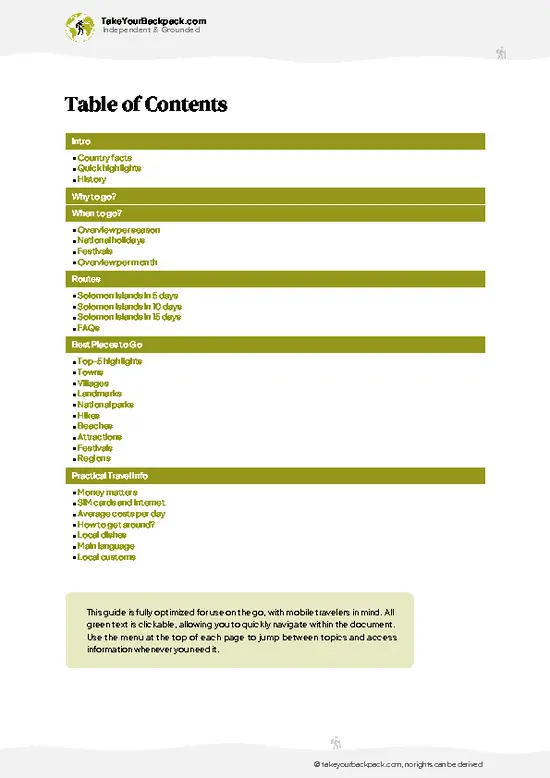
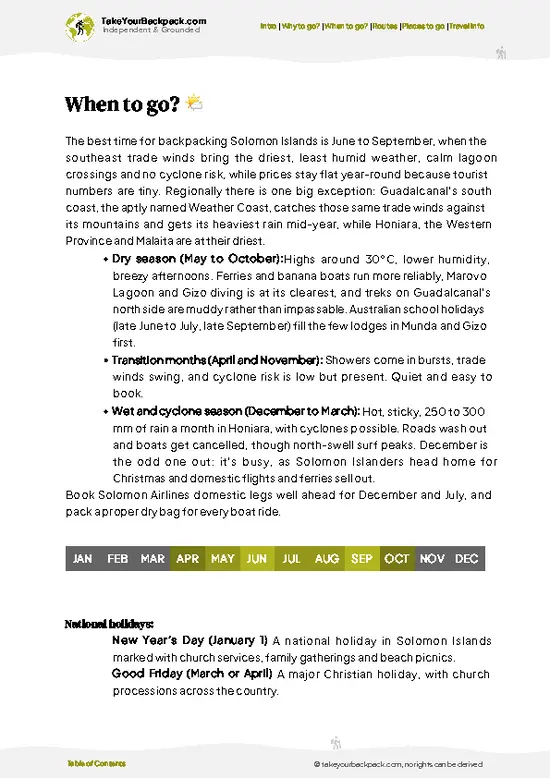
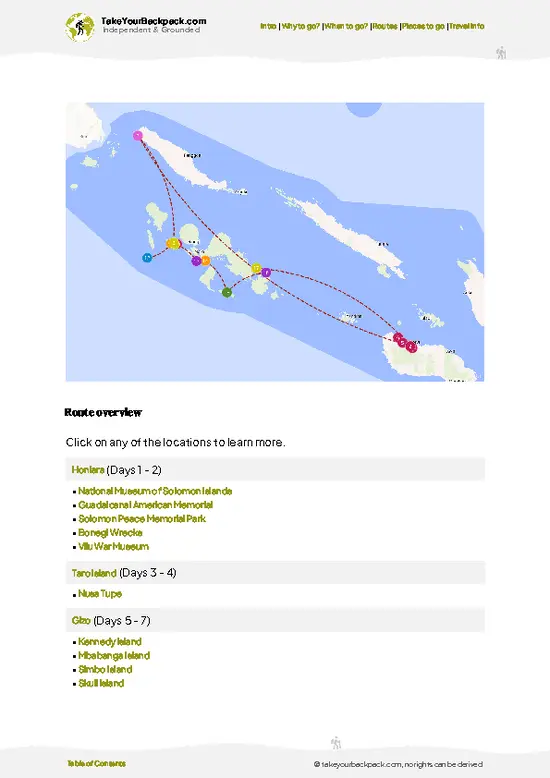
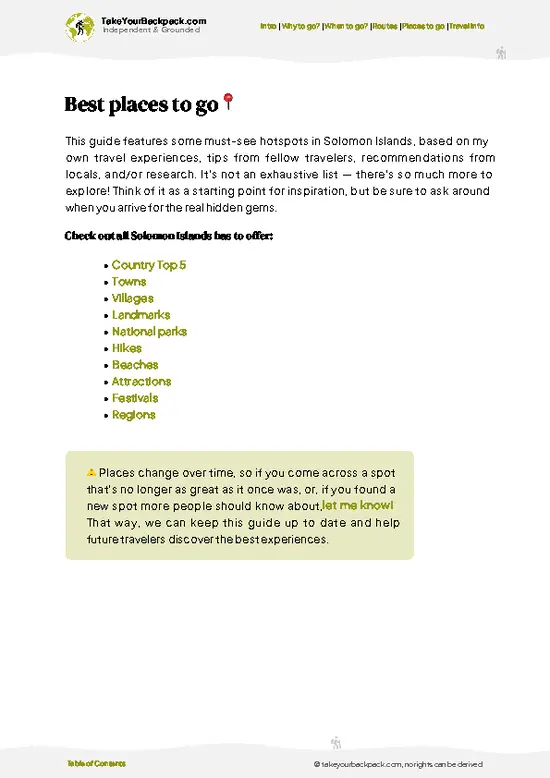
example page 0 from our offline Travel Guide for Solomon Islands
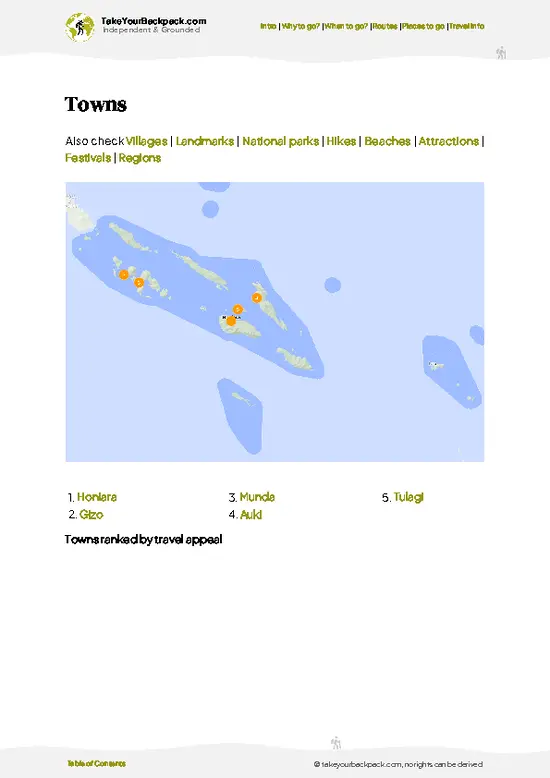
example page 1 from our offline Travel Guide for Solomon Islands
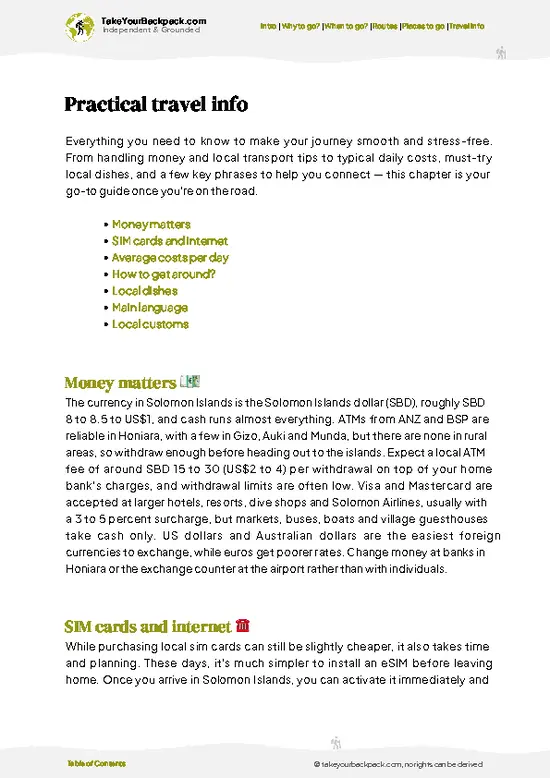
example page 2 from our offline Travel Guide for Solomon Islands
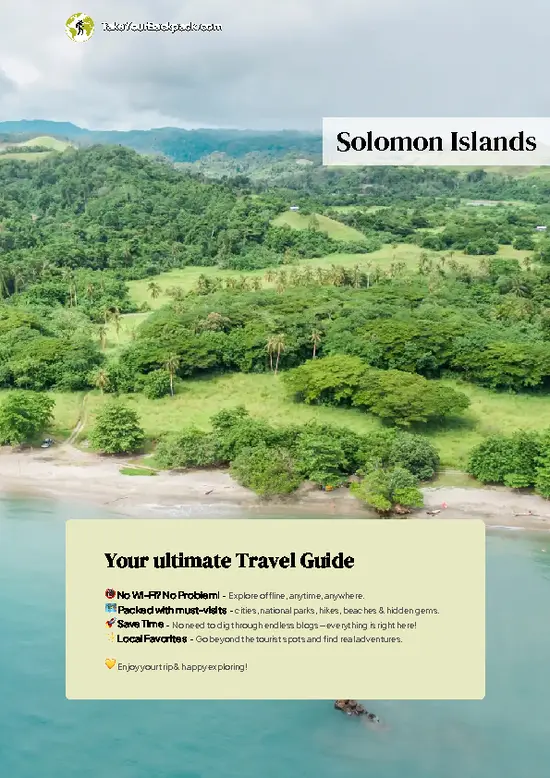
example page 3 from our offline Travel Guide for Solomon Islands
example page 4 from our offline Travel Guide for Solomon Islands
example page 5 from our offline Travel Guide for Solomon Islands
example page 6 from our offline Travel Guide for Solomon Islands
example page 7 from our offline Travel Guide for Solomon Islands
The digital guide (145 pages) contains:
✅ 33 highlights, ranked by travel appeal
✅ Optimized 5, 10 & 15-day travel routes
✅ Cities, national parks, landmarks, beaches
✅ How to get around
✅ Offline-friendly for travel without Wi-Fi
👉 Click to see all 30+ guide features

📅 Plan smarter in minutes, not weeks
✅ Month by month travel advice
✅ Festivals & national holidays
✅ Budget expectations

🗺️ Go to the right places, skip the overrated ones
✅ Honest pros & cons of destinations
✅ Top hikes, parks & viewpoints
✅ Lesser-known places most travelers miss
✅ Clear “worth it vs skip it” guidance

🛏️ Travel smoothly without rookie mistakes
✅ Best areas to stay
✅ Transport systems explained simply
✅ Common scams & safety advice
✅ SIM cards, money & practical tips

🌍 Understand the country, not just visit it
✅ Culture & traditions
✅ 52 Essential phrases & customs
✅ Festivals worth planning around
✅ Traveler-friendly historical context
✅ Insights that make places more meaningful

📱 Built for real travel conditions
✅ Fully downloadable PDF
✅ Works completely offline
✅ Optimized for phone use
✅ Useful in remote areas & buses
✅ Everything in one place
Stop searching, start planning
Get instant access to your full guide. 30‑day money-back guarantee.
+ Add another guide for just

By proceeding you agree to our terms.
Sent to your inbox immediately after payment • 100% Secure Checkout
Best Backpacking Travel Advisor 2025 tourism awardBest Backpacking
Travel Advisor
2025
What others say about Take Your Backpack Guides:
⭐⭐⭐⭐⭐
Fantastic, amazing amount of information!
⭐⭐⭐⭐⭐
My goodness this is amazing, it's what I've been looking for hats off too you!
⭐⭐⭐⭐⭐
I think this is absolutely BRILLIANT
⭐⭐⭐⭐
Very complete and informative. It's still missing places, but I gotta to commend you
⭐⭐⭐⭐⭐
This is truly amazing, thank you, can't wait to explore it with my kids!
⭐⭐⭐⭐⭐
Awesome resource, thank you!
⭐⭐⭐⭐⭐
This is amazing! Can't wait to explore the ones I haven't seen
⭐⭐⭐⭐
I love this! Well done, great idea.
⭐⭐⭐⭐⭐
Thanks for taking the time to make this gem!
⭐⭐⭐⭐⭐
This might be the best website I've ever seen.
⭐⭐⭐⭐⭐
Congratulations, and thank you so much for your work; it's incredibly valuable.
⭐⭐⭐⭐
In all seriousness I think you did a great job pointing out the important spots
⭐⭐⭐⭐⭐
10/10 very good
⭐⭐⭐⭐⭐
As someone who's only just starting to visit regularly this is awesome, thank you.
⭐⭐⭐⭐
Thank you very much! I'm going to visit my dad, it's going to be very useful!
⭐⭐⭐⭐⭐
This is really cool! We'll be travelling for the first time and this definitely come in handy.
⭐⭐⭐⭐⭐
You are now our minister of culture, congratulations 👨‍💼
⭐⭐⭐⭐⭐
Just wanted to tell you that this is a pearl! Going to follow your recommendations.
⭐⭐⭐⭐⭐
This is so cool. I'll definitely be using the resource for my travels soon.
⭐⭐⭐⭐⭐
This is very impressive! Good work.
⭐⭐⭐⭐⭐
This is an amazing and informative site. Very well done!

🛏️ Where to stay?Where to Stay in Solomon Islands

True dorm-style hostels are rare in the Solomon Islands, so budget travel here usually means simple family guesthouses and church-run lodges at roughly SI$300 to 600 (US$35 to 70) a night for a room, with traditional leaf-hut ecolodges taking over in the provinces. In Honiara, Point Cruz puts you closest to the Central Market, the museum and the few bars that stay open late, but it gets congested by day and is best avoided on foot after dark, while the hillside streets of Lengakiki and Vura are quieter and cooler at the cost of a bus or taxi ride into town. Outside the capital, Gizo has the widest spread of budget guesthouses near the dive shops and waterfront, and Munda offers lagoon-side lodges … read more 👉
True dorm-style hostels are rare in the Solomon Islands, so budget travel here usually means simple family guesthouses and church-run lodges at roughly SI$300 to 600 (US$35 to 70) a night for a room, with traditional leaf-hut ecolodges taking over in the provinces. In Honiara, Point Cruz puts you closest to the Central Market, the museum and the few bars that stay open late, but it gets congested by day and is best avoided on foot after dark, while the hillside streets of Lengakiki and Vura are quieter and cooler at the cost of a bus or taxi ride into town. Outside the capital, Gizo has the widest spread of budget guesthouses near the dive shops and waterfront, and Munda offers lagoon-side lodges that are very quiet with almost no nightlife.

If you enjoy meeting fellow travelers, consider choosing hostels with high ratings for atmosphere. On the other hand, if you prefer having your own space, a hotel might be a better option.

Solomon IslandsMore of Solomon Islands

👋 Meet the founderWho’s Behind Take Your Backpack?

Johan, backpacker and founder of TakeYourBackpackHi, I’m Johan (Netherlands 🇳🇱), the creator of TakeYourBackpack. Over the past 3 decades, I’ve backpacked through 90+ countries across six continents, gaining extensive experience with independent travel, long-term trips, and overland routes.

This site is built on a combination of firsthand travel experience and carefully curated insights from other backpackers. Many guides are based on places I’ve personally visited, while others bring together tips, observations, and practical advice shared by trusted travelers I’ve met along the way.

The goal is to provide realistic, experience-driven guidance — not generic itineraries — so you can explore destinations with better context, clearer expectations, and more confidence.